A Comparative Analysis of Edge Detection Methods in Magnetic Data
Taehwan Jeon1, Hyoungrea Rim2,3,*, and Yeong-Sue Park3
1Department of Earth Science Education, Seoul National University, Seoul 08826, Korea
2Department of Exploration Geophysics, University of Science and Technology, Daejeon 34132, Korea
3Korea Institute of Geoscience and Mineral Resources, Daejeon 34132, Korea
Abstract: Many edge detection methods, based on horizontal and vertical derivatives, have been introduced to provide us with intuitive information about the horizontal distribution of a subsurface anomalous body. Understanding the characteristics of each edge detection method is important for selecting an optimized method. In order to compare the characteristics of the individual methods, this study applied each method to synthetic magnetic data created using homogeneous prisms with different sizes, the numbers of bodies, and spacings between them. Seven edge detection methods were comprehensively and quantitatively analyzed: the total horizontal derivative (HD), the vertical derivative (VD), the 3D analytic signal (AS), the title derivative (TD), the theta map (TM), the horizontal derivative of tilt angle (HTD), and the normalized total horizontal derivative (NHD). HD and VD showed average good performance for a single-body model, but failed to detect multiple bodies. AS traced the edge for a single-body model comparatively well, but it was unable to detect an angulated corner and multiple bodies at the same time. TD and TM performed well in delineating the edges of shallower and larger bodies, but they showed relatively poor performance for deeper and smaller bodies. In contrast, they had a significant advantage in detecting the edges of multiple bodies. HTD showed poor performance in tracing close bodies since it was sensitive to an interference effect. NHD showed great performance under an appropriate window.
Keywords: edge detection, magnetic.
Introduction
Edge detection methods for potential data have been used to enhance the horizontal boundaries of anomalous bodies by differentiating the potential field. Various methods for edge detection have been introduced and are widely used. The total horizontal derivative (HD) showed the maxima on the edges (Cordell, 1979), and the zero of the vertical derivative (VD) has been used to detect fault lines (Evjen, 1936). Furthermore, it was suggested that the maxima of a 3D analytic signal (AS) can delineate the edges (Nabighian, 1972; Roest et al., 1992). Miller and Singh (1994) proposed the tilt
derivative (TD), which is the ratio of the total horizontal derivative to the vertical derivative; it provides a zero value on an edge. Verduzco et al. (2004) expanded the tilt derivative to higher-order derivatives and introduced the total horizontal derivative of the tilt angle (HTD), the maxima of which successfully outlined the edges of bodies. Theta map (TM), the ratio of the total horizontal derivative to the analytic signal, has also been used to trace the edges by their maxima (Wijns et al., 2005). Ma and Li (2012) proposed the normalized total horizontal derivative (NHD) which applies a window-filtering technique to the total horizontal derivative, and they used the maxima to delineate the edges.
Several authors partially conducted comparative studies proposing a new method. Miller and Singh (1994) compared TD with VD, HD, and AS in order to highlight the advantage of TD for detecting two prisms at different depths at the same time. Verduzco et al. (2004) compared their new method, HTD, to conventional methods and showed that HTD provides
*Corresponding author: [email protected]
*Tel: +82-42-868-3133
*Fax: +82-42-868-3174
This is an Open-Access article distributed under the terms of the Creative Commons Attribution Non-Commercial License (http://
creativecommons.org/licenses/by-nc/3.0) which permits unrestricted non-commercial use, distribution, and reproduction in any medium, provided the original work is properly cited.
a constant detection result regardless of the inclination of the magnetic sources. Wijns et al. (2005) compared TM to existing methods in various models. Ma and Li (2012) compared NHD with HD, TD, and HTD to emphasize the improvements of NHD. However, these comparisons have been commonly performed in only limited cases to emphasize the advantages of a new method. Since each method certainly has characteristic features depending on the dimensions of anomalous bodies, the need for a comparison study is as significant as the development of a new method. The information attained by these comparison studies would not only be applied to the actual interpretation of real data, but would provide improved information for use in choosing a more optimized method. Furthermore, a quantitative comparison of edge detection methods is required so they can be applied to the automatic interpretation of large airborne magnetic data. So far, previous comparisons were performed qualitatively by showing the visual location of solutions.
In order to compare the performance of these methods, we designed synthetic prism models with different physical parameters such as size, the number of prisms, and the spacing between prisms. We applied each edge detection method to synthetic magnetic data after RTP (reduction-to-the-pole) using the computation of Li and Chouteau (1998). Each method automatically found solutions of the boundaries based on its own edge indicator. We then comprehensively assessed the horizontal accuracy and the stability of the individual edge detection methods to compare the performance.
Edge Detection Methods
In this study, we compared seven edge detection methods. The First method is the total horizontal derivative (HD), which is one of the basic methods for edge enhancement and uses the scalar amplitude of the horizontal component of gradient. That is,
, (1)
where f represent a potential field (Cordell, 1979). The
maxima of HD occur on the edges.
A second basic method, the first vertical derivative (VD), is simply expressed as
. (2)
Evjen (1936) showed that the zero value of VD indicates the location of an infinite fault line.
Moreover, VD is theoretically and easily calculated by Laplace’s equation and the Fourier transform (Evjen, 1936; Gunn, 1975).
The 3D analytic signal (AS) is given by
, (3)
which is the square sum of HD and VD (Nabighian, 1972; Roest et al., 1992). The maxima of AS provide an indication of the edges (Roest et al., 1992).
The tilt angle or tilt derivative, TD, is defined as the ratio of VD and HD, similar to a tilt angle in geometry (Miller and Singh, 1994). The zero values of TD represent the locations of the edges. The expression for TD is given by
. (4)
Verduzco et al. (2004) suggested that the total horizontal derivative of the tilt derivative (HTD), by means of the horizontal derivative of TD, is expressed as
. (5)
The maxima of HTD indicate the locations of edges.
Wijns et al. (2005) proposed the theta map (TM), which is obtained by a proportion of AS to HD, and they showed that the edges can be indicated by the maxima of TM. The expression for TM is given by
. (6)
The value of TM can be regarded as cosè corresponding to the ratio of HD to AS.
HD df
dx---
⎝ ⎠⎛ ⎞2 df dy---
⎝ ⎠⎛ ⎞2 +
=
VD df
dz---
=
AS= HD2+VD2
TD tan–1 VD HD---
⎝ ⎠
⎛ ⎞
=
HTD d
dx---TD
⎝ ⎠
⎛ ⎞2 d
dy---TD
⎝ ⎠
⎛ ⎞2
+
=
TM HD
---AS
=
The normalized total horizontal derivative (NHD), which used a window-filtering technique to normalize HD by its own local maxima, can be expressed as
, (7)
where m and n represent the horizontal lengths of the sampling window (Ma and Li, 2012). The maximum value of NHD can be used as a reference to trace the edges.
The proposed indicators for these edge detection methods are summarized in Table 1. The indicator, termed universal indicator in this study, was used as a standard for searching the location of edge of sources.
Evaluation Criteria
As discussed in the previous section, all edge detection methods have characteristic edge indicators.
They are used to determine the reference value for finding the edges of sources on the derivative data.
Although the ideal edge indicators for these methods have been demonstrated in the literatures, they are not always accurate for every possible model. Thus, it is necessary to use criteria that can evaluate the stabilities
and accuracies of the universal edge indicators.
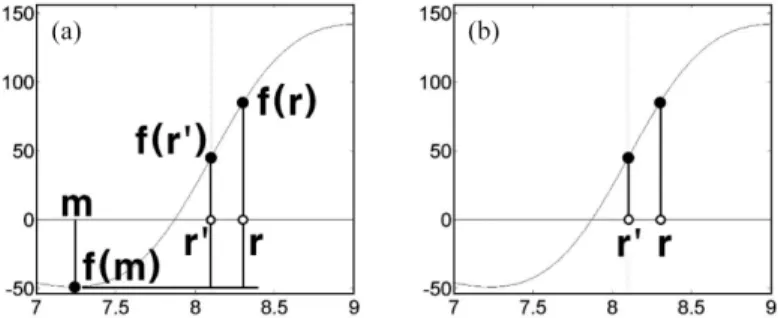
An example of a profile of derivative data caused by an anomalous body is shown in Fig. 1. This figure shows a magnified view around an edge and is enlarged for convenience. Since the curve is a function with respect to the space and the corresponding universal indicator is given by a specific value of the function, some positions can be filtered out easily. If a universal indicator filtered out f(r), the position r could be the possible solution of edge detection. In this case, let us assume that the real position of edge in synthetic model was r’. The real value just above an edge, f(r’), has a little difference from the filtered value, f(r), and the solution naturally includes some error as much as the difference between r and r’. Since the values of f(r) and f(r’) change depending on the conditions of the model, their magnitudes are normalized with respect to the local minimum f(m), considering the total amplitude of the curve.
Replacing f(r’)−f(m) with VE and f(r)−f(m) with VI
simply, we took VE/VI as the vertical analysis factor (Fig. 1a). This ratio, expressed in percentage terms, used to verify the stability of the edge indicator. For example, if the VE/VI ratio of a method is 100% in some synthetic models, it is possible to say that the
NHD HD i j( ),
max HD i m( ( – :i m+ j n, – :j n+ )) ---
=
Fig. 1. A schematic plot of the criteria for the edge detection methods. The value of f(r) is determined by a universal indica- tor, then the position r can be the solution of the edge location. Point r’ represents the real location of the edge, and the value of derivative data just above r’ is given by f(r’). The local minimum f(m) in the derivative data is used to normalize the ampli- tude of f(r) and f(r’). (a) The ratio of f(r’)-f(m) and f(r)-f(m) is used to assess the stability of an indicator. (b) The horizontal accuracy is simply evaluated by the difference between rand r’.
Table 1. Edge indicators for seven methods and their normalization
Methods HD VD AS TD TM HTD NHD
universal indicator max 0 max 0 1 max 1
Normalization × × × ○ ○ × ○
edge indicator traces a consistent location of an edge and the method functions stably. At the same time, the horizontal error can be considered as shown in Fig.
1b. The spatial error between position r and r’ can be used to evaluate the accuracy of methods. A smaller difference naturally means good accuracy of the indicator.
Plus, we set that every edge indicator has some range, so it filters adjacent values near f(r), as well as exact value of f(r), and the solution of edge location is also given by a set of adjacent points around the position r. Calculating the difference between r and the closest r’ at every solution, we evaluated the accuracy of a method with a single factor by adopting the mean of r−r’. The ranges of edge indicators are uniformly set at 10 % of the total amplitude of each profile to assess them under same condition.
According to the criteria, all models have two evaluation factors and are categorized by the width/
depth (W/D) ratio of a single prism or the spacing/
depth (S/D) ratio of two prisms.
Edge Detection of a Single Body
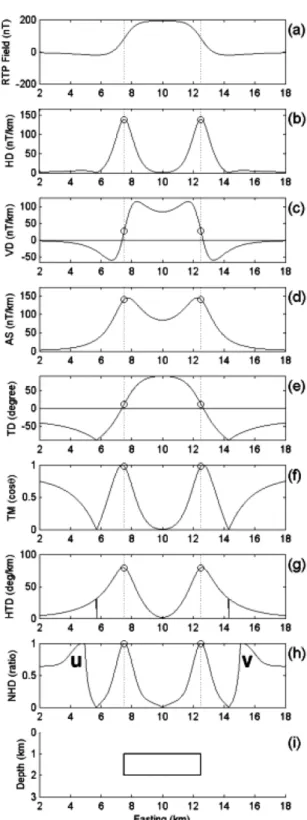
The RTP magnetic response due to a single prism is computed on surface (0 m) for a 20 km×20 km area with 20 m grid spacing in both horizontal directions, which is similarly determined by the conditions of airborne survey. Since most of them focus on discovering shallower structures with various horizontal scales, the depth of the prism is fixed at 1 km, and its width varies 1 km to 10 km; thus, the W/D ratio varies from 1 to 10. The susceptibility contrast of the prism is also fixed for all models in this group. An example of the profiles of a model is provided in Fig. 2. If the W/D ratio of the prism is sufficiently large, the curves of the methods become ideal and it is easy to detect the edge of the prism. However, as the W/D ratio of an anomalous prism becomes smaller, the accuracy decreases.
In Fig. 2h, it is remarkable to note that the curve for NHD shows additional fake edges (u and v) outside of the prism, since the window size is too
Fig. 2. (a) RTP magnetic anomaly due to a single prism.
(b) HD. (c) VD. (d) AS. (e) TD. (f) TM. (g) HTD. (h) NHD with small window filtering. NHD produces fake edges on u and v. (i) A synthetic prism.
small relative to the size of the whole area or target.
This means that selecting a proper size of window is critical for NHD in order to avoid ambiguity in the interpretation.
The results of a stability analysis for each indicator are displayed in Fig. 3. The x-axis represents the W/
D ratio of an anomalous body, and the y-axis means the stability of the indicator. All edge indicators generally shows good stabilities for sources with large W/D ratio, which means that the indicators agree very closely with the real value on the edge. However, some methods deviate from the 100% base line as the W/D ratio becomes smaller. This means that the universal edge indicators may include errors in the detection of some structures with a small W/D ratio.
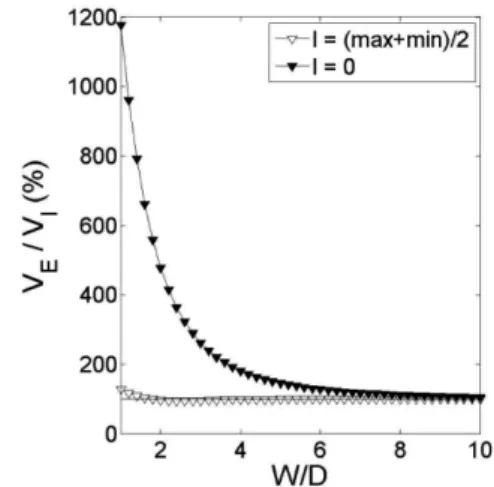
HD, NHD, VD, and HTD show relatively stable indicators. Meanwhile, VD is given by an adjusted edge indicator, a mean value for the maximum and minimum. Fig. 4 compares the conventional indicator, zero value, and the new indicator of VD, by means of the stability analysis mentioned above. As shown in Fig. 4, the conventional indicator (solid triangles) actually gives accurate solutions for detecting a prominent structure such as an infinite fault line, etc.
(Evjen, 1936). However, it shows a large error for smaller or deeper bodies, which implies that it is possibly inappropriate to be a universal indicator of VD. Evjen (1936) note that the VD profile analysis over an infinite fault line of a semi-infinite source shows that the maximum and minimum have the same magnitudes with different signs and the positions of them are symmetrically located from the fault.
Although the mean value of them for a semi-infinite source is ideally zero at the position of a boundary, it is not for a finite source. Therefore, we applied the mean value of the maximum and minimum as the new indicator. The adjusted indicator (open triangles) is maintained at 100% for most cases. This indicates that the mean value of the maximum and minimum plays an effective role as a universal edge indicator for VD. Furthermore, AS, TD, and TM regard the VD component as constantly zero, which implies that they naturally include more error when detecting some sources in which the W/D ratio is relatively small.
The results of Fig. 3 also signify these features.
The actual detection of the methods reflects the results of Fig. 3. Fig. 5 shows the mean distance (horizontal difference) of the methods with respect to the W/D ratio of the prism. The methods which have stable indicators showed few differences and high Fig. 4. The adjusted indicator of VD, the mean value of the maximum and minimum (open triangles), shows signifi- cantly improved stability as a universal indicator than the conventional indicator of VD, the zero value (solid triangles).
Fig. 3. The VE/VI ratio of HD and NHD (black dots), VD (open triangles), AS (open diamonds), TD (solid squares), TM (open squares), and HTD (solid triangles). The VD curve was computed by the adjusted indicator in Fig. 4. TD and TM show the larger deviations from a base line as the prism has a smaller W/D ratio. Meanwhile, HD, NHD, and VD show relatively stable indicators with respect to the W/D ratio of the prism.
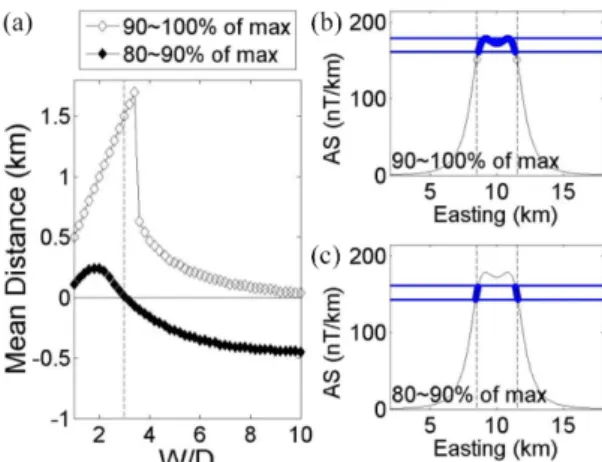
accuracy, while TD and TM show a larger dislocation for the structures with small W/D ratio. Both methods give solutions on the outside of the boundaries when the W/D ratio of the prism is relatively small. AS, in particular, shows an unnatural solution inside the boundary with a large error in the middle part of the W/D ratio; this is because the AS curve appears like a table mountain in these cases (Fig. 6b). Since the edge indicator of AS is the maximum of the curve, it detects all coordinates around the table mountain as shown in Fig. 6b. If there is a larger error when tracing the exact location of the edges, then it can be properly treated by an adjusted edge indicator. For instance, the value lower than the maxima shows improved accuracy in detecting the edges of small structures (Fig. 6c). As shown in Fig. 6a, the adjusted indicator for AS functions better for a prism with a smaller W/D ratio, while the original indicator is more accurate in tracing other sources in which the W/D ratios are relatively large. This fact implies that AS needs adjusted indicators to achieve a better analysis with respect to the condition of the target.
Edge Detection of Multiple Bodies
The RTP magnetic response due to a double prism is computed at the same height (0 m) of a 20 km×20 km area with 20 m grid spacing in both horizontal
directions. To investigate the resolution of the methods with respect to the spacing, it varies from 0.5 km to about 5 km. The depths to the top of both prisms are 1 km and their sizes are set to 5 km×5 km×1 km so that the W/D ratio of the bodies is given by a constant value of 5. This size of each prism was selected by the result of previous section, which enables the seven methods to have maximized performance. Since the sizes of the prisms are constant, the spacing/depth (S/
D) ratio is newly used to categorize the models in this group.
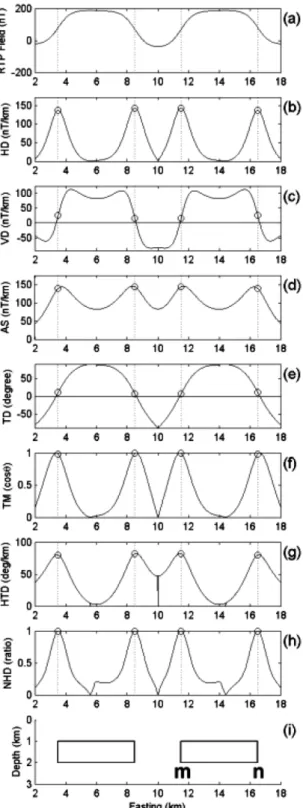
An example of the edge detection methods for two identical prisms and the derivatives of the seven methods are shown in Fig. 7. Both bodies have the same depths, sizes, and susceptibility contrasts. The stabilities and accuracies are investigated on the edge m or n as shown in Fig. 7i, and these are expected to show the largest distortions as the spacing changes.
If the two prisms have sufficient spacing between them, all of the methods would be able to naturally trace the individual edges as they would for two independent prisms with an W/D ratio of 5; however, as this spacing decreases, the derivatives of the field Fig. 5. The mean distance of the seven methods. AS shows
larger deviations in the middle part of the W/D ratio.
Fig. 6. (a) A comparison of the existing indicator (90~100%
of maximum, open diamonds) and the adjusted indicator (80~90% of maximum, solid diamonds) in the case of AS.
(b) and (c) show AS curves corresponding to the existing indicator and the adjusted indicator respectively, where W/
D=3. The indicator of AS is proposed as 80~90% of the maximum, because the existing indicator (90~100% of maxi- mum given by Roest et al., 1992) resulted in large devia- tions in the middle part of the W/D ratio.
would be distorted and it becomes more difficult to distinguish the prisms. Reflecting this expectation, Fig.
8 shows dislocations in the VE/VI ratio on the edge m or n for the case of close bodies. Most of the indicators of the methods decay visibly at a particular spacing between the prisms.
Despite this deformation, some of the methods (VD, TD, TM, and NHD) successfully detect edges with somewhat of a horizontal difference (Fig. 9). Although they show more errors tracing a rectangular edge, they Fig. 7. (a) RTP magnetic anomaly due to two identical
prisms. (b) HD. (c) VD. (d) AS. (e) TD. (f) TM. (g) HTD.
(h) NHD. (i) Two synthetic prisms. The stability and accu- racy of each indicator were investigated on the edge m or n.
Fig. 8. Stability analysis result for two identical prisms on the edge m or n. The VE/VI ratio of the seven methods decays visibly as the spacing between the two prisms decreases.
Fig. 9. The mean of the horizontal difference of the seven methods from the edge m or n with respect to the S/D ratio of two identical prisms. HD, AS, and HTD failed to detect some parts of the boundaries at less than a certain spacing.
could distinguish the edges of two adjacent prisms as long as they are relatively close. In contrast, HTD, HD, and AS fail to trace complete edges at less than a certain spacing (Fig. 10), since their derivative fields become distorted when the two bodies are located too close to each other. Because the values of some edges stray from the range of the indicators, the methods fail to detect these edges by their own universal edge indicators. These two-dimensional results may be sufficient to delineate the complete edges of prisms by rule of thumb; however, additional procedures, such as adjusting the range of the universal edge indicator, applying a windowing technique, etc., are necessary to detect the edges automatically.
In brief, VD, TD, TM and NHD perform relatively well tracing the complete edges of two identical bodies at the same depth, regardless their spacing.
However, AS, HD, and HTD are affected by critical values of the spacing, and beneath the values they miss some parts of the boundaries. Additionally, different susceptibility contrasts and depths of the prisms make the distortions in the derivative field of HD, AS, and HTD more severe, so that they fail to
detect an inconspicuous body even though the spacing is sufficient (Fig. 11).
Conclusion
Seven different edge detection methods were comparatively analyzed using synthetic magnetic data for prism models, with variations in the sizes, numbers, and spacing between the prisms. The results of the comparison are summarized in Table 2. The performances are evaluated by the spatial error between solutions and the closest edge location, assuming that we have few information about the subsurface structure. Most of actual analysis, we should interpret the derivative data alone, so that the absolute error of the solution would be the proper evaluation factor as a result. Further, the standard we introduced here was arbitrarily selected to give prominence to the relative performance level of each method.
HD, which is a popular method, showed good horizontal accuracy in detecting a single prominent prism regardless of its W/D ratio, but it was inadequate for tracing plural prisms with close spacing. VD Fig. 10. (a) The mean of the horizontal difference of HD, AS from the edge m or n of two identical prisms. (b) A profile of HD and the 2D detection. The universal edge indicator of HD failed to detect the edge m. (c) A profile of AS and the 2D detection. The indicator of AS missed the edge m. (d) A profile of HTD and the 2D detection. By the interference effect, the universal indicator of HTD could not detect most of the boundaries including the edge n. Examples of the three methods were investigated on the S/D ratio marked with a broken line in Fig. 10a.
produced sharp edges if the edge indicator was adjusted by the mean value of the maximum and minimum value of the derivative data. The adjusted indicator had the advantage of tracing the smaller and deeper prisms universally over the existing indicator
(zero value). It showed great accuracy in displaying the edges of two identical prisms as well. AS showed good performance in delineating a single prism, and it could generate improved edges if the indicator was adjusted using both the W/D ratio prism and the Fig. 11. (a) RTP magnetic anomaly due to two identical prisms. (b) HD. (c) VD. (d) AS. (e) TD. (f) TM. (g) HTD. (h) NHD.
(i) Two synthetic prisms. Profiles in column A were derived by two prisms with different susceptibility contrasts, and those in column B were computed by two prisms with different depths. The highlighted methods (HD, AS, and HTD) failed to detect the edges of an inconspicuous body.
characteristic curve. Moreover, it had difficulty in detecting the edges of multiple adjacent prisms. TD and the TM appeared very similar to each other, and they had a significant advantage in displaying a large and shallow prism. In addition, both methods converted weak responses into a normalized scale, so they could successfully detect multiple prisms individually. HTD showed good performance for a single prism as well, but it was extremely sensitive to the spacing between anomalous bodies. NHD complemented the original method, HD, and it also covered a weak point of the method and successfully detected multiple prisms.
However, the selecting windows for applying NHD are critical.
Acknowledgments
This study was supported by Korea Institute of Geoscience and Mineral Resources (KIGAM) funded by the Ministry of Science, ICT and Future Planning of Korea.
References
Cordell, L., 1979, Gravimetric expression of Graben
faulting in Santa Fe Country and the Espanola basin, New Mexico: New Mexico Geological Society Guidebook, 30th Field Conference, 59-64.
Evjen, H.M., 1936, The place of the vertical gradient in gravitational interpretations: Geophysics, 1, 127-136.
Gunn, P.J., 1975, Linear transformations of gravity and magnetic fields: Geophysical Prospecting, 23, 300-312.
Li, X. and Chouteau, M., 1998, Three-dimensional gravity modeling in all space: Surveys in Geophysics, 19, 339- 368.
Ma, G. and Li, L., 2012, Edge detection in potential fields with the normalized total horizontal derivative: Computers and Geosciences, 41, 83-87.
Miller, H.G. and Singh, V., 1994, Potential field tilt-a new concept for location of potential field sources: Journal of Applied Geophysics, 32, 213-217.
Nabighian, M.N., 1972, The analytic signal of two dimensional magnetic bodies with polygonal cross section: its properties and use for automated anomaly interpretation: Geophysics, 37, 507-517.
Roest, W.R., Verhoef, J., and Pilkington, M., 1992, Magnetic interpretation using the 3-D analytic signal:
Geophysics, 57, 116-125.
Verduzco, B., Fairhead, J.D., and Green, C.M., 2004, New insights into magnetic derivatives for structural mapping:
The Leading Edge, 23, 116-119.
Wijns, C., Perez, C., and Kowalczyk, P., 2005, Theta map:
edge detection in magnetic data: Geophysics, 70, 39-43.
Manuscript received: June 30, 2015 Revised manuscript received: July 31, 2015 Manuscript accepted: September 3, 2015 Table 2. The characteristics and performances of the seven methods. The performance is evaluated by the spatial error between solutions and closest edge location, assuming that there is no information about the scale of subsurface structure. A double cir- cle represents a good accuracy, a circle indicates moderate performance, and a triangle denotes poor performance for models on the left side. A hyphen indicates that a method has failed to detect some part of the edges. Some methods that show condi- tional performance are marked with an asterisk
Methods HD VD AS TD TM HTD NHD
Applied indicator max max 0 1 max 1
A single prism W/D<5 ⊙ ⊙ ⊙* △ △ ○ ⊙*
W/D 5 ⊙
Two identical prisms S/D<2 - ○ - ⊙ ⊙ - ○*
S/D 2 ⊙
Two different prisms – △ – ○ ○ – ○*
⊙: Complete edge error 200 m; ○: Complete edge error 500 m; △: Complete edge error >500 m; -: Target lost max min+
---2