Introduction
Microbial amendments have received considerable interest in sustainable agriculture for enhancing crop productivity, improving soil quality, and reducing inputs of chemical fertilizers and pesticides (Hussain et al., 1999). Microbial amendments are also known as biofertilizers, biodynamic fertilizers or microbial inoculants, which are comprised of living microorganisms that can function as chemical fertilizer adjuvants, biocontrol agents, and plant growth factors (Li and Zhang, 2000). One popular microbial amendment is Effective Microorganisms, developed by Teruo Higa, a professor at the University of the Ryukyus, Okinawa
(Yamada and Xu, 2000). Effective Microorganisms has been usedas an inoculant to change soil microbial diversity and the microbial interaction between soils and plants, thus Effective Microorganisms has been widely reported to improve soil quality and productivity of crops over a wide range of agroecological conditions. Effective Microorganisms are comprised of a large number of microbial species, predominantly lactic acid bacteria (Lactobacillus plantarum, Streptococcus lactis, and Streptococcus faecalis), numerous typesof photosynthetic bacteria (Rhodoseudomonas spaeroides), actinomycetes (Streptomyces albus), and yeasts (Saccharomyces cerevisiae and Candida utilis)
Because most microorganisms in Effective Microorganisms are heterotrophic, they require organic sources of carbon and nitrogen. Thus, Effective
Received : 23 January 2007 Accepted : 20 April 2007*Corresponding author: Phone : +15738845070, E-mail : [email protected]
Effects of a Biological Amendment on Chemical and Biological Properties and Microbial Diversity in Soils Receiving Different Organic Amendments
Kee-Choon Park, and Robert J. Kremer
1,*Gyeongbuk Agricultural Research and Extension services, Daegu 702-708, Korea
1
Agricultural Research Service, United States Department of Agriculture (USDA-ARS), Columbia, MO 65211, USA
Biological amendments consisting of suspensions of selected microorganisms are often used in conjunction with various organic materials for amending soils to improve soil quality and plant growth. The effects of the biological amendment on chemical and biological properties of soil were investigated for a biological amendmentalone and when combined with different organic materials includingmunicipal compost (MC), poultry litter (PL), and cover crops (red clover (RC) and spring oats). A liquid preparation of a biological amendment called Effective Microorganisms was sprayed on the tested plots three times over a two-year period. Effective Microorganisms alone did not influence pH, K, or organic matter content in soil. However, increases in P in PL-treated soils in fall of both years andCa in MC-treated soil in fall 2001, and decreases in Ca, Mg, and cation exchange capacity (CEC) in RC-planted soil were associated with EM. Increased dehydrogenase(DH) activitiesassociated with Effective Microorganismswere only detected in July (P=0.0222) and October (P=0.0834) for RC-planted soils in the first year. Fluorescein diacetate (FDA) hydrolysisappeared to be enhanced by Effective Microorganisms in soils untreated or treated with MC and oatsbut only sporadically during the sampling period. FDA hydrolysis in both PL- and RC-treated soils as well as DH activity in PL-treated soils decreased with Effective Microorganisms treatment. Effective Microorganisms did not influence substrate utilization patterns expressed by the BIOLOG assay. We conclude that Effective Microorganisms effects on soil chemical and biological properties varied depending on the added organic materials. Effective Microorganisms periodically increased soil DH activity and FDA hydrolysis with RC and with MC plus oats, respectively.
Key words: Biological amendment, dehydrogenase activity, FDA hydrolysis, Community-level physiological
profiling (CLPP), and BIOLOG
Microorganisms has been most effective when applied in combination with organic amendments (Yamada and Xu, 2000). Effective Microorganisms increased biological soil activities and improved physical and chemical soil properties through rapid humification of fresh organic matter when Effective Microorganisms was mixed with animal manure or green manure (Valarini et al., 2003).
The effects of other biodynamic preparations on soil microbial activity and composition have been questionable because effects of such preparations were negligible compared to composts, which significantly affected all soil microbial properties including microbial biomass, respiration, DH activity, soil C mineralization, and soil microbial community FAME profiles (Carpenter-Boggs et al., 2000).
If biological amendments affect nutrient cycling, the effect may be due to stimulation of soil microorganisms that mediate many nutrient transformations. Numerous reports have described the effects of Effective Microorganisms on plant growth, and crop yield and quality (Xu et al., 2000), however, there isvery little evidence for the effects of actualEffective Microorganisms on soil properties. This research examined the effects of Effective Microorganisms applied as liquid suspensions following amendment of soil with several organic materials including cover crops.
The objectives of this study were to determine if Effective Microorganisms affected soil chemical and microbiological properties as influenced by organic amendment and time during the growing season. We hypothesized that Effective Microorganisms mightalter soil fertility and biological characteristics, and that the effects might differ depending on organic sources and sampling time.
Materials and methods
Study site, experimental design, and sampling procedures This study was conducted at the University of Missouri Bradford Research Center (38。53' N, 92。
12' W)in North Central Missouri during 2001 and 2002.
The soil at the research site was a Mexico silt loam (fine, smectitic, mesic Aeric Vertic Epiaqualfs). A strip-plot (split-block) design was used with three replicate blocks, and individual plots were approximately 36 m
2(4 X 9 m) for this research. Each block consisted of five plots randomly arranged to receive different organic materials, and each block was split so that half of the plots was
treated with Effective Microorganisms (EM) and the other half did not receive EM (Park, 2004). The organic amendments included poultry litter (PL); municipal compost (MC; red clover (Trifolium pratense) (RC) and oats (Avena sativa) cover crops. MC and PL with average moisture contents of 82.6% and 40.5% and C:N ratio of 30.4 and 10.3, respectively, were manually applied at 15 and 20 tons ha
-1, respectively, in early May and incorporated into soil by mid-June each year before soybean planting. A control plot without any organic amendment was also plowed as in MC and PL plots.
Soybeans were sowed at a row width of 76 cm and plant density of 44,800 plants ha
-1after application of MC and PL in early summer. In oats- and RC-treated plots, oats and RC were planted as cover crops with seeding rates of 134 and 13.4 kg ha
-1, respectively, in early spring each year, maintained until the end of the experiment without additional fertilizers and sowing of soybeans, and mowed in late spring to allow the above growth to remain on the soil surface. EM was obtained from Sustainable Community Development, LLC (Kansas City, MO) as a microbial suspension in a molasses carrier. The EM suspensionwas diluted 10 X in water and was applied to the soil surface using a backpack sprayer on May 9
thand December 4
th, 2001 and May 4
th, 2002 at a rate of 200 L ha
-1. Soil was sampled from the upper 10 cm of the profile following procedures and collected at sampling dates (Fig. 1) reported previously (Park, 2004).
Analysis of soil chemical and biological properties Soil chemical properties (soil organic matter (SOM), pH, CEC, P, K, Ca, and Mg) and soil biological characteristics of DH activity, FDA hydrolysis, and community-level physiological profiling (CLPP) using BIOLOG were analyzed by the methods described in the research performed by Park (2004).
Statistical analysis Data were analyzed using a 2 x 5
strip-plot design based on two EM treatments (whole
plot), and five organic amendments (sub plot). The
datafor soil chemical properties and soil enzymes were
analyzed with the linear mixed model of repeated
measures of three (chemical properties) or nine
(biological properties) sampling dates and slice option
with SAS statistical software package (SAS Institute,
1999).Principal component analysis (PCA) was
performed on BIOLOG data to characterize microbial
communities for different sampling dates and organic
amendments. Multivariate approaches developed by Läuter (1996) and Glimm et al. (1997) and multivariate analysis of variance (MANOVA) tests were applied for principal components after principal component analysis to test significant differences between EM treatments within organic sources for each sampling date.
Results and Discussion
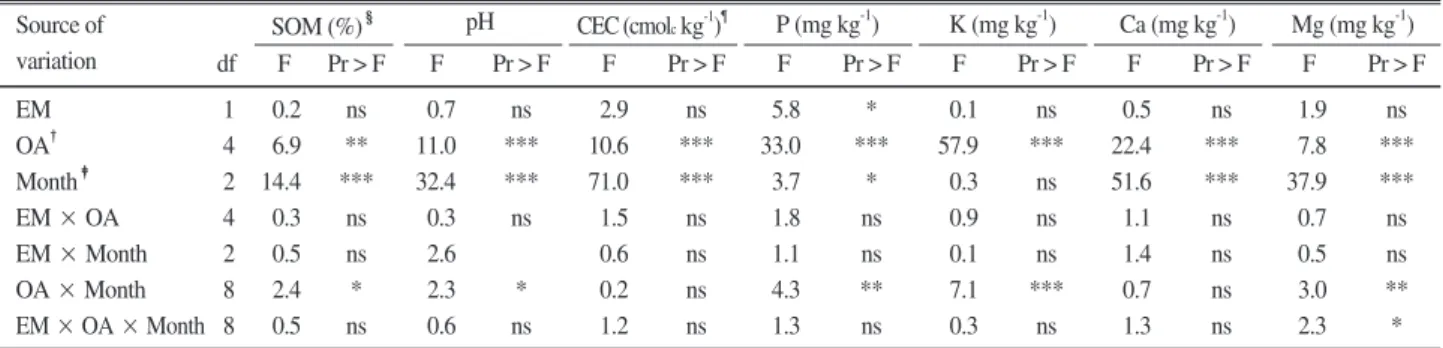
SOM, pH, CEC, P, K, Ca, and Mg were measured in fall 2001, and spring and fall 2002. EM, organic amendments, and sampling dates significantly affected soil chemical properties, with a few cases of significant interactions between EM, organic amendments, and sampling dates. Soil chemical properties were not affected by EM compared with organic amendments and sampling dates although a significant effect on P was detected (Table 1). Analysis of variance (ANOVA) showed significant effects only with P content due to EM application (Table 1) but pairwise comparison showed a few cases of significant effects on CEC, Ca, and Mg with EM treatment. When compared to the same organic amendment applied alone, EM combined with PL was associated with increased P in October 2001 and 2002;
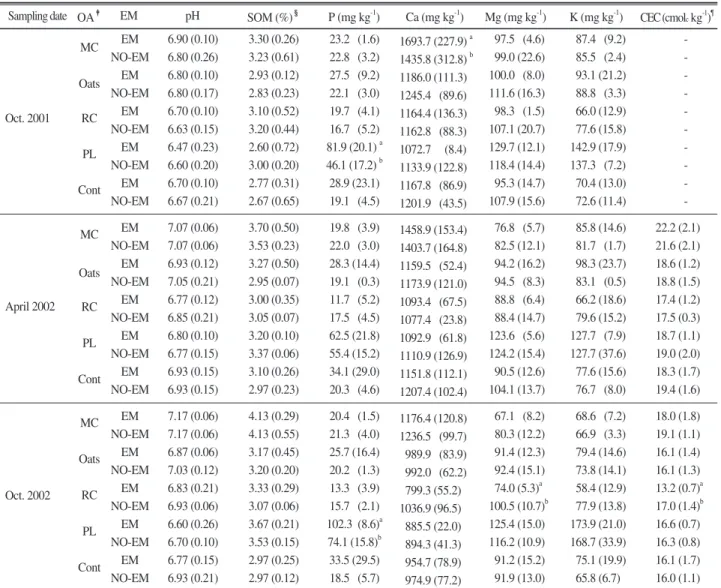
EM combined with MC was associated with increased Ca in October 2001; and EM combined with RC was associated with decreased Ca, Mg, and CEC in October 2002 (Table 2). High P and Ca contents of treated soils were likely a reflection of the inherent high initial concentrations of these nutrients in the PL and MC amendments (Park, 2004). The decreased Ca and Mg levels and lower CEC associated with EM + RC treatments might affect microbial decomposition of red clover residues, however, further study addressing the
specific relationshipsbetween these soil properties and decomposition is required.
The decreased CEC in RC plots is somewhat similar to the report of Valarini et al. (2003) in which EM combined with PL slightly affected CEC but the effect did not persist. These effects of EM on nutrient levels in RC plots agreed with reports that biological amendments could stimulate both decomposition and mineralization of soil organic materials, perhaps by selectively inhibiting or stimulating specificcomponents of the native microbial community, leading to enhanced soil nutrient availability (Chen et al., 2002). EM may also influence the soil C/N ratio when used with green manure residues like RC but not when used with animal manure, which had a lower C/N ratio than crop residues (Valarini et al., 2003). Our results showing no affect of EM on soil pH agree with the results of previous laboratory studies with EM (Valarini et al., 2003). SOM was not affected by EM, which suggests that EM did not influence in situ decomposition of SOM or that the microbial density in liquid EM was too low to supplement microbial activity in soil. EM did not affect soil DH or FDA hydrolytic activity while organic amendments significantly influenced FDA hydrolysis (Table 3). Similarly, Chen et al. (2003) reported in a laboratory study that two commercial biostimulants did not affect soil DH activity and substrate-induced respirationregardless of the kind of organic materials, when they were applied with alfalfa leaves and wheat straw.The interaction between EM and organic amendments was not significant, which suggests that EM did not contribute to effects of organic amendments on microbial activity (Table 3). EM significantly influenced DH activity and FDA hydrolysis of organic amendments in only a few cases, based on
Source of variation EM OA"
Month‡ EM × OA EM × Month OA × Month EM × OA × Month
"
OA: organic amendments including municipal compost, poultry litter, oats, red clover, and non-amended control;
‡Month: October 2001, and April and October 2002;
SOM: soil organic matter content;
¶CEC; cation exchange capacity ***: P < 0.001; **: P < 0.01; *: P < 0.05 ns: no significant 1
4 2 4 2 8 8
0.2 6.9 14.4 0.3 0.5 2.4 0.5
ns
**
***
ns ns
* ns
0.7 11.0 32.4 0.3 2.6 2.3 0.6
ns
***
***
ns
* ns
2.9 10.6 71.0 1.5 0.6 0.2 1.2
ns
***
***
ns ns ns ns
5.8 33.0 3.7 1.8 1.1 4.3 1.3
*
***
* ns ns
**
ns 0.1 57.9 0.3 0.9 0.1 7.1 0.3
ns
***
ns ns ns
***
ns 0.5 22.4 51.6 1.1 1.4 0.7 1.3
ns
***
***
ns ns ns ns
1.9 7.8 37.9 0.7 0.5 3.0 2.3
ns
***
***
ns ns
**
* Pr > F F
Pr > F F
Pr > F F
Pr > F F
Pr > F F
Pr > F F
Pr > F F
Mg (mg kg-1) Ca (mg kg-1)
K (mg kg-1) P (mg kg-1)
CEC (cmolckg-1)¶ SOM (%) pH
df
Table 1. Analysis of variance for chemical parameters in soils applied with a biological amendment after being treated with five different organic amendments in 2001 and 2002.
pairwise comparisons (Fig. 1, 2).
The EM effects on DH activity and FDA hydrolysis were variable among organic amendments and sampling
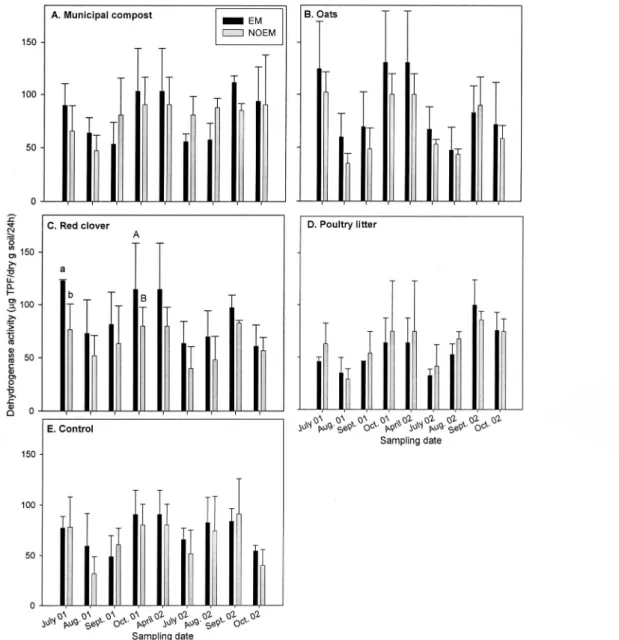
dates. EM increased DH activity only in RC plots in July (P=0.0222) and October 2001 (P=0.0834) (Fig. 1).
Effects due to biological amendments might be caused by
CEC (cmolckg-1)¶ K (mg kg-1)
Mg (mg kg-1) Ca (mg kg-1)
P (mg kg-1) SOM (%)
OA‡ EM pH EM NO-EM
EM NO-EM
EM NO-EM
EM NO-EM
EM NO-EM
EM NO-EM
EM NO-EM
EM NO-EM
EM NO-EM
EM NO-EM
EM NO-EM
EM NO-EM
EM NO-EM
EM NO-EM
EM NO-EM
6.90 (0.10) 6.80 (0.26) 6.80 (0.10) 6.80 (0.17) 6.70 (0.10) 6.63 (0.15) 6.47 (0.23) 6.60 (0.20) 6.70 (0.10) 6.67 (0.21) 7.07 (0.06) 7.07 (0.06) 6.93 (0.12) 7.05 (0.21) 6.77 (0.12) 6.85 (0.21) 6.80 (0.10) 6.77 (0.15) 6.93 (0.15) 6.93 (0.15) 7.17 (0.06) 7.17 (0.06) 6.87 (0.06) 7.03 (0.12) 6.83 (0.21) 6.93 (0.06) 6.60 (0.26) 6.70 (0.10) 6.77 (0.15) 6.93 (0.21)
3.30 (0.26) 3.23 (0.61) 2.93 (0.12) 2.83 (0.23) 3.10 (0.52) 3.20 (0.44) 2.60 (0.72) 3.00 (0.20) 2.77 (0.31) 2.67 (0.65) 3.70 (0.50) 3.53 (0.23) 3.27 (0.50) 2.95 (0.07) 3.00 (0.35) 3.05 (0.07) 3.20 (0.10) 3.37 (0.06) 3.10 (0.26) 2.97 (0.23) 4.13 (0.29) 4.13 (0.55) 3.17 (0.45) 3.20 (0.20) 3.33 (0.29) 3.07 (0.06) 3.67 (0.21) 3.53 (0.15) 2.97 (0.25) 2.97 (0.12)
23.2 (1.6) 22.8 (3.2) 27.5 (9.2) 22.1 (3.0) 19.7 (4.1) 16.7 (5.2) 81.9 (20.1) a 46.1 (17.2) b 28.9 (23.1) 19.1 (4.5) 19.8 (3.9) 22.0 (3.0) 28.3 (14.4) 19.1 (0.3) 11.7 (5.2) 17.5 (4.5) 62.5 (21.8) 55.4 (15.2) 34.1 (29.0) 20.3 (4.6) 20.4 (1.5) 21.3 (4.0) 25.7 (16.4) 20.2 (1.3) 13.3 (3.9) 15.7 (2.1) 102.3 (8.6)a 74.1 (15.8)b 33.5 (29.5) 18.5 (5.7)
1693.7 (227.9) a 1435.8 (312.8) b 1186.0 (111.3) 1245.4 (89.6) 1164.4 (136.3) 1162.8 (88.3) 1072.7 (8.4) 1133.9 (122.8) 1167.8 (86.9) 1201.9 (43.5) 1458.9 (153.4) 1403.7 (164.8) 1159.5 (52.4) 1173.9 (121.0) 1093.4 (67.5) 1077.4 (23.8) 1092.9 (61.8) 1110.9 (126.9) 1151.8 (112.1) 1207.4 (102.4) 1176.4 (120.8) 1236.5 (99.7) 1989.9 (83.9) 1992.0 (62.2) 1799.3 (55.2) 1036.9 (96.5) 1885.5 (22.0) 1894.3 (41.3) 1954.7 (78.9) 1974.9 (77.2)
197.5 (4.6) 199.0 (22.6) 100.0 (8.0) 111.6 (16.3) 198.3 (1.5) 107.1 (20.7) 129.7 (12.1) 118.4 (14.4) 195.3 (14.7) 107.9 (15.6) 176.8 (5.7) 182.5 (12.1) 194.2 (16.2) 194.5 (8.3) 188.8 (6.4) 188.4 (14.7) 123.6 (5.6) 124.2 (15.4) 190.5 (12.6) 104.1 (13.7) 167.1 (8.2) 180.3 (12.2) 191.4 (12.3) 192.4 (15.1) 174.0 (5.3)a 100.5 (10.7)b 125.4 (15.0) 116.2 (10.9) 191.2 (15.2) 191.9 (13.0)
187.4 (9.2) 185.5 (2.4) 193.1 (21.2) 188.8 (3.3) 166.0 (12.9) 177.6 (15.8) 142.9 (17.9) 137.3 (7.2) 170.4 (13.0) 172.6 (11.4)
185.8 (14.6) 181.7 (1.7) 198.3 (23.7) 183.1 (0.5) 166.2 (18.6) 179.6 (15.2) 127.7 (7.9) 127.7 (37.6) 177.6 (15.6) 176.7 (8.0)
168.6 (7.2) 166.9 (3.3) 179.4 (14.6) 173.8 (14.1) 158.4 (12.9) 177.9 (13.8) 173.9 (21.0) 168.7 (33.9) 175.1 (19.9) 165.8 (6.7)
- - - - - - - - - - 22.2 (2.1) 21.6 (2.1) 18.6 (1.2) 18.8 (1.5) 17.4 (1.2) 17.5 (0.3) 18.7 (1.1) 19.0 (2.0) 18.3 (1.7) 19.4 (1.6) 18.0 (1.8) 19.1 (1.1) 16.1 (1.4) 16.1 (1.3) 13.2 (0.7)a 17.0 (1.4)b 16.6 (0.7) 16.3 (0.8) 16.1 (1.7) 16.0 (1.1) MC
Oats
RC Oct. 2001
April 2002
Oct. 2002
"
( ): Standard deviation; ‡OA: organic amendments of municipal compost (MC), oats, red clover (RC), poultry litter (PL), non-amended control (Cont);
SOM: soil organic matter content; ¶CEC; cation exchange capacity aand b: Significant differences between EM and NO-EM within same organic amendments with p < 0.05.
PL
Cont
MC
Oats
RC
PL
Cont
MC
Oats
RC
PL
Cont Sampling date
Table 2. Pairwise comparisons of a biological amendment effects on soil chemical parameters within each five organic amendments for two years.""
Source of variation
EM OA"
Sampling date‡ EM × OA EM × Sampling date OA × Sampling date EM × OA × Sampling date
"
OA: organic amendments, municipal compost, poultry litter, oats, red clover, and non-amended control; ‡sampling date: July, August, September, October in 2001, and April, July, August, September, October in 2002 ***: P < 0.001; **: P < 0.01; *: P < 0.05; ns: no significant
1 4 8 4 8 32 32
2.2 1.3 21.0 0.7 1.2 2.6 0.8
ns ns
***
ns ns
***
ns
1.2 7.4 168.7 1.4 1.0 1.5 1.2
ns
**
***
ns ns ns ns Pr > F F
Pr > F F
DH activity FDA hydrolysis
df
Table 3. Analysis of variance for dehydrogenase (DH) activity and fluorescein diacetate (FDA) hydrolysisin soils applied with a biological amendment after being treated with different organic amendments in 2001 and 2002.
selectively inhibiting or stimulating particular components of the microbial community (Chen et al., 2002, 2003). EM affected DH activity at two sampling dates only in RC plotsand had no effect in other plots at any other sampling date (Fig. 1). EM effects may depend on organic source because DH activity was generally lower in PL plots. Furthermore, PL may not favor proliferation ofmicroorganisms in EM. The increase of DH activity in RC plots in 2001 due to EM treatment also suggests that organic substances originating from the RC roots may be more readily metabolized by microorganisms in EM. Similarly, previous studies have illustrated the variable effects of biological amendments.
Biostimulantsdid not significantly influence soil
biological parameters including DH activity and microbial biomass when biodynamic field sprays were combined with biodynamically prepared compost and non-biodynamic compost (Carpenter-Boggs et al., 2000) but increased DH activitywhen combined with dairy manure and woodshaving bedding (Carpenter-Boggs, 1999).
FDA hydrolysis (Fig. 2) increased when EM was combined with MC in August 2001 (P=0.0375) and April 2002 (P=0.0256);oats in September 2002 (P=0.0755) or when applied alone (control) in April 2002 (P=0.0245). FDA hydrolysis decreased with EM plus RC in July 2002 (P=0.0003). The FDA hydrolysis in PL soils was not influenced by EM application (Fig. 2). Similar to
Fig. 1. Dehydrogenase activity in soils treated with a biological fertilizer (EM) combined with or without various organic amendments in 2001 through 2002. a and b, and A and B show significant differences among EM treatments within organic amendment and sampling date with P values of <0.05 and <0.10, respectively. Vertical bars indicate the standard deviation.
DH activity, overall FDA hydrolysis was inconsistent across all organic amendments. The greater number of increases in activity associated with EM treatment indicates that EM was slightly more effective in stimulating organic matter decomposition, which is a reflection of FDA hydrolysis (Schnürer et al., 1985 Speir, 1977). Also, EM may suppress plant root diseases when applied with suitable organic matter sources during a critical plant growth stage, and increasing FDA hydrolysis which is related to antagonism of soilborne plant pathogenic fungi (Ghini et al., 1998; Inbar et al., 1991).
MANOVA t tests for principal components of PCA with BIOLOG data did not separate EM treatments from
non-EM treatment within each organic source. The ANOVA t test for each principal component separated EM treatments from non-EM treatments for PC3 and PC4 in soils treated with PL, RC, MC, and the control in September or October in 2001 and 2002 (Table 4). We previously demonstrated that organic amendmentand sampling date significantly impacted soil microbial functional diversity (Park, 2004). These negligible effects on microbial substrate utilization patterns suggest that EM did not change soil microbial functional diversity in thefield or could not stimulate indigenous soil microorganisms in the field after three applications nor persisted long enough to be detected as changes in the CLPP, under conditions of the present study.
Fig. 2. Fluorescein diacetate hydrolytic activity in soils treated with a biological fertilizer (EM) combined with or without various organic amendments in 2001 through 2002. a, b and A, B show significant differences among EM treatments within organic amendment and sampling date with P values of <0.05 and <0.10, respectively. Vertical bars indicate the standard deviation.
Conclusion
EM influenced soil chemical and biological properties, however, effects were limited, especially when compared to influences of organic sources alone across all sampling dates. EM shows potential for increasing DH activity when combined with RC, decreasing FDA hydrolysis when combined with RC, increasingFDA hydrolysis when combined with oats and MC, and decreasing both DH activity and FDA hydrolysis when combined with PL. EM was not effective in changing microbial substrate utilization patterns in this field study. Changes caused by EM in this study should not be compared with results of other experiments involvingdifferent soils, weather, or bio-fertilizer preparations because microbial survival and effects of EM likely vary with environmental factors. In future research with EM, other microbial parameters should be measured, and possible shorter sampling intervals,alternative application methods, and long-term or repeated applications of EM that comprise more robust preparations should be examined because of the apparent difficulty of the microorganisms in EM to sustain their activities in soil.
Acknowledgments
We thank Tim Reinbott for assistance with field operations and Jenan Nichols, Megan Hayes, Sarah Lafrenz, and Heidi Lewis for technical assistance.
References
Carpenter-Boggs, L., Reganold, J. P., Kennedy, A. C. 1999. Effects of biodynamic preparations on compost development. Biol Agric Hortic. 17:313-328.
Carpenter-Boggs, L., Reganold, J. P., Kennedy, A. C. 2000.
Biodynamic preparations: Short-term effects on crops, soils, and weed populations. Am. J. Alt. Agric. 15:110-118.
Chen, S. K., Edwards, C. A., Subler, S. 2003. The influence of two agricultural biostimulants on nitrogen transformations, microbial activity, and plant growth in soil microcosms. Soil Biol. Biochem.
35:9-19.
Chen, S. K., Subler, S., Edwards, C. A. 2002. Effects of argicultural biostimulants on soil microbial activity and nitrogen dynamics.
Appl. Soil Ecol. 19:249-259.
Ghini, R., Mendes, M. D. L., Bettiol, W. 1998. Rate of hydrolysis of fluorescein diacetate (FDA) as indicator of microbial activity and soil suppressiveness to Rhizoctonia solani. Summa Phytopathol.
24:239-242.
Glimm, E., Heuer, H., Engelen, B., Smalla, K., Backhaus, H. 1997.
Statistical comparisons of community catabolic profiles. J.
Microbiol. Methods. 30:71-80.
Hussain, T., Javaid, T., Parr, J. F., Jilani, G., Haq, M. A. 1999. Rice and wheat production in Pakistan with effective microorganisms.
Am. J. Alt. Agric. 14:30-36.
Huysman, F., Verstraete, W., Brookes, P. C. 1994. Effect of manuring practices and increased copper concentrations on soil microbial populations. Soil Biol. Biochem. 26:103-110.
Inbar Y., Boehm, M. J., Hoitink, H. A. J. 1991. Hydrolysis of fluorescein diacetate in spagnum peat cotainer media for predicting suppressiveness to damping-off caused by Pythium ultimum. Soil Biol. Biochem. 23:479-83.
Läuter, J. 1996. Exact t and F tests for analyzing studies with multiple endpoints. Biometrics. 52:964-970.
Li, Z., Zhang, H. 2000. Application of microbial fertilizers in sustainable agriculture. J. Crop Prod. 3:337-347.
Park, K. 2004. Enzymatic activity, microbial diversity, and weed seed banks in soils receiving different organic amendments and the biological fertilizer EMTM. Ph.D. dissertation. University of Missouri, Columbia, Missouri, USA.
SAS Statistical Analysis Systems. 1999. SAS User's Guide. Version 8. Cary, NC: Statistical Analysis Systems Institute.
Schnürer, J., Clarholm, M., Rosswall, T. 1985. Microbial biomass and activity in an agricultural soil with different organic matter contents. Soil Biol. Biochem. 17:611-618.
Speir, T. W. 1977. Studies on a climosequence of soils in tussock grasslands. 11. Urease, phosphatase, and sulphatase activities of topsoils and their relationships with other properties including plant available sulphur. N. Z. J. Sci. 20:159-166.
Sampling dates"
Oct. 2001 Oct. 2001 Sept. 2002 Oct. 2002 Oct. 2002
Poultry litter Control Red clover
Compost Poultry litter
PC4 PC3 PC4 PC3 PC3
"
total sampling dates: July, August, September, October in 2001, and April, July, August, September, October in 2002; ‡Organic amendments: municipal compost, poultry litter, oats, red clover, and non-amended control; Principal components which can make significant differences between EM treatments within same organic matter sources after principal component analysis with BIOLOG data.
Principal components Organic amendments‡
Table 4. Principal components which significantly differentiated a biological amendment treatment within the same organic amendments when BIOLOG data were analyzed with principal component analysis followed by ANOVA t test performed with the principal components.
Valarini, P. J., Díaz Alvarez, M. C., Gascó, J. M., Guerrero, F., Tokeshi, H. 2003. Assessment of soil properties by organic matter and EM-microorganism incorporation. R. Bras. Ci. Solo. 27:519-525.
Xu, H, Parr, J. F., Umemura, H. 2000, Nature farming and microbial
applications. Food Products Press.
Yamada, K., Xu, H. 2000. Properties and applications of an organic fertilizer inoculated with effective microorganisms. J. Crop Prod.
3:255-268.
여러가지의 선발된 미생물로 구성된 미생물비료는 토양 개량과 식물 생장 촉진을 위해서 여러 유기물과 결합 하여 이용되기도 한다. 미생물 비료를 미생물 비료 단독으로 그리고 도시 가로수 부산물 퇴비, 가금류 분뇨 부 산물, 레드클로버와 귀리의 피복작물 등의 유기물과 같이 토양에 처리하여 토양의 화학적 또는 생물학적 특성 에 미치는 효과를 측정하였다. 액체상의 미생물 비료를 2년동안 3회 처리하였다. 미생물 비료 단독으로는 pH, K, 유기물 함량에 영향을 미치지 않았지만, 미생물비료의 처리는 2년 가을 모두 가금류 분뇨 부산물을 처리한 토양의 인산 함량을 증가시켰고, 첫해 가을에 퇴비를 처리한 토양의 칼슘함량을 증가시켰으며, 레드클로버를 처리한 토양의 Ca, Mg, 그리고 양이온교환용량을 감소시켰다. 미생물 비료는 레드클로버가 처리된 토양에서 첫 해 7월에 탈수소효소 활성을 증가시켰다. 미생물 비료는 유기물이 처리되지 않은 토양이나 퇴비가 처리된 토양 에서 FDA의 가수분해도를 가끔 증가시켰다. 가금류 분뇨 부산물과 레드 클로버가 처리된 토양의 FDA 가수분 해도와 가금류 분뇨 부산물이 처리된 토양의 탈수소효소활성은 미생물 비료의 처리로 감소하였다. 한편, 미생 물 비료의 처리는 BIOLOG에 의한 토양 미생물 군락의 생리생태적 다양성에는 영향을 미치지 못했다. 따라서 토양의 미생물학적 특성에 미치는 미생물비료의 효과는 같이 투여되는 유기물의 종류에 따라 다양하다고 할 수 있으며, 탈수소효소의 활성은 레드클로버가 처리된 토양에서, 그리고 FDA 가수분해도는 퇴비와 귀리가 처 리된 토양에서 가끔 증가했다.
각기 다른 유기물이 투여된 토양에서 토양의 화학적, 미생물학적 특성과 미생물의 다양성에 미치는 생물비료의 효과
박기춘·로버트 크레이머1,*
경북농업기술원, 1작부체계와 수질 연구부 미국 농무성 농업연구센타