• 검색 결과가 없습니다.

A Study on Bi-metal 3D printing Technology Development based on Laser Technology

N/A
N/A
Protected

Academic year: 2021

Share "A Study on Bi-metal 3D printing Technology Development based on Laser Technology"

Copied!
7
0
0

로드 중.... (전체 텍스트 보기)

전체 글

(1)

A Study on Bi-metal 3D printing Technology Development based on Laser Technology

Chiyen Kim

1*

<Abstract>

Additive manufacturing(AM) can create complex shapes directly in 3D CAD models with internal geometry compared to conventional subtraction manufacturing. AM technology has the advantage of adopting various materials as well as the reduction of material. However, the high cost of AM is still a significant barrier preventing the wider adoption of AM in industries. This paper analyzes the technical application cases for solving these entry barriers and proposes a bi-metal 3D printing technology as an anticipated application to overcome the difficulty. The paper investigates the complications for current 3D metal printing technology to conduct bi-metal 3D printing and addresses ongoing solution research based on laser technology.

Keywords : Metal 3D printing, Additive Manufacturing, Laser

1* Correspond author, Department of Mechatronics, Korea Polytechnics, Cheongju 28590, Republic of Korea, Professor

E-mail: [email protected]

(2)

1. Introduce

3D printing technology, so-called rapid prototyping, has been emerging for the fast-manufacturing of mock-up product from the early 1980s[1]. In the 2000s, 3D printing technology was spotlighted on various media with infinite possibilities for applications in cutting-edge technologies such as aerospace and medical technology, with features that could easily print a variety of materials and complex designs, and additive manufacturing technology gained ground as an area of manufacturing technology [2][3]. Also, the possibility and market demand for this flexible manufacturing method has formed a demand market in many printing manufacturing companies and has continued to grow at an average rate of 16.5% per year since the formation of the $ 7 billion market in 2017 [4].

The expansion of these markets and industries has led to new applications and application technologies. As the 3D printing technology became active in the 2000s, technologies that fuse similar 3D printing and electronic circuit manufacturing in the manufacturing process were developed around SANDIA Lab and UTEP in the United States of America [5]. This is a method of manufacturing that intersects printing and circuit making layer by layer, allowing the built-in electronic circuitry to operate at the same time as the printing output. Through this convergence technology, the technology

of printing electronic circuits and components by additive manufacturing is called 3D printed electronics, and recently a commercial product called Voxel8 has appeared on the market. Technological advances have emerged not only with the application of 3D printing own technology but also with the design and manufacturing-linked technology forms for additive manufacturing. In 2015, GE Aviation produced the Fuel Nozzle tip, which used to manufacture and assemble 20 split parts, as a single component through 3D design and 3D printing, to reduce the weight and cost, and by 2018, it sold 30,000 units in mass production [6].[7]

While the application of these additive manufacturing technologies is evolving into a variety of areas, several difficulties arise now due to internal problems in the printing process itself. While the application of these additive manufacturing technologies is evolving into a variety of areas, several difficulties arise now due to internal problems in the printing process itself. Typical, there are various problems with various methods of construction, such as an incomplete process itself, manufacturing error, power deformation due to thermal deformation and contraction by post-processing, such as sintering. Various studies are currently being conducted in academia and industry to solve the occurrence of problem these by various additive manufacturing methods [8][9].

Many of these research and development

activities are often focused on the

(3)

establishment of manufacturing industries in additive manufacturing technology when it comes to large trends. However, the cost of printing processing is still higher than that of traditional cutting processing, and it is still difficult to expand to the manufacturing industry on its own as long as it is not an environment in which manufacturing processes are reduced and high value in use areas such as GE Aviation.

This study seeks to find manufacturing unit price problems in applications, which are barriers to entry of metal 3D printing technology into the manufacturing industry, and to present methods for investigating and solving technology needs in the printing process, thereby increasing the use of additive manufacturing technology in manufacturing industries. To increase the manufacturing value of printed output, the focus was on composite printing technology using dissimilar materials to have functionality as well as the shape of printed output. Also, previous metal printing technologies analyze problems in the application of different materials and seek solutions through optical methods.

2. Multi functional Metal printing

2.1 Metal 3D printing Trand (Cost Re-evaluation)

According to the trends of metal 3D printing technology, time and cost problems such as unit price increase due to metal powder manufacturing, limitation of printing speed, and acquisition rate due to thermal deformation are impediments to the expansion of the product market. To solve these cost problems, the metal printer industry market is largely formed in two directions.

The first is where the output itself generates high value-added, and the demand itself, such as the production of high- complexity feature parts that need to be treated with medical implants or discharge processing, its high unit cost, which can offset the cost of printing.

Another direction is to directly reduce the

volume and weight and eliminate the

assembly process of parts, thereby reducing

the manufacturing cost by directly

manufacturing the product that was

previously manufactured by unit assembly

with one output. When multiple parts are

converted into a single module, it is called

modulation.

(4)

2.2 New application : Bi-metal 3D printing

The current analysis and distribution of the metal 3D printing technology in the manufacturing industry focuses on the target and method of application without changing the printing process technology. In this study, we explored ways to expand into manufacturing technology through changes in additive manufacturing processes. The method proposed in the study focus on technology derivatives that transform the printing process, such as 3D printed electronics, so that metal printing outputs have additional functionality as well as the functionality of feature structures, thereby selecting bi-metal 3D printing. In general, the bond between bi-metal is commonly referred to as alloy, and many studies have been conducted on material design through inter material alloys in metal 3D printing today. Rather, the precision manufacturing characteristics of additive manufacturing technology allow the composite use of the metal properties of each material through structural placement while retaining the inherent properties of metal materials instead of alloys. Rather, the precision manufacturing characteristics of additive manufacturing technology allow the composite use of the metal properties of each material through structural placement while retaining the inherent properties of metal materials instead of alloys. The method of producing composite functions through

geometrical coupling while maintaining these metal-specific properties is called bi-metal additive manufacturing technology. In the case of 3D printing is a method of stacking materials in dots or cotton units, it is possible to physically layer different materials by location if only material supply is separable. bi-material additive manufacturing is a method similar to the method of modularizing the parts produced by assembling the parts produced from the existing parts at a time and assembling the parts previously assembled for other materials for heat resistance, heat transfer channels, electromagnetic shielding, etc. It can be regarded as one batch production.

Currently, in the case of metal materials, several output cases are reported only for sheet lamination and DED due to ease of material supply. The bi-material bonding technology in the technology development stage or research stage has recently been re-spotlighted in the lightweight technology sector and has been actively invested in commercialization and development of the technology. 3D manufacturing technology company in Boston, U.S.A, NVBOT announced that it will launch a new venture company NVLAB and start developing large multi- metallic printer systems for industrial use.

According to the report, it is aimed at 10

times the printer speed of the current SLS

(Selective laser setting) technology and the

printed performance to stack dissimilar

materials, including stainless steel, titanium,

(5)

nickel, copper and other nonferrous metals, And the application will increase the lightening rate as much as possible by applying lightweight materials in addition to the existing Honeycomb structure.

3. Problem Analysis for bi metal 3D printing

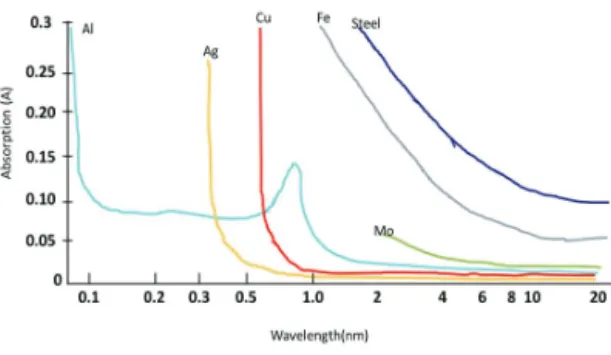
Fig. 1 Absorption of various metallic material by wavelength

It is difficult to physically use the conventional 3D metal printer for bi-metal material additive manufacturing. To date, laser sources used in metal 3D printing systems, which have been marketed and released, are limited to CO2 laser and fiber laser. Although TRUMP, a German machine company, has recently released a new TruPrint 5000 with green lasers applied to Laser Metal Fusion 3D Printers, most PDF and DED printers are still using the conventional laser source of infrared wavelengths. As shown in Figure 1, the wavelength range absorbed varies depending on the type of metal. In the case

of metal 3D printers are used only with specific infrared wavelengths, precious metal and copper materials with a relatively low absorption rate for infrared wavelengths have poor printing process efficiency, or the material’s phase-change itself is difficult to stack. Even if some nonlinear absorption occurs, there are many incidental problems, such as gaseous eruptions, that occur when the size of the underlying melting pool changes and the application is reached because high power is required when energy transfer efficiency is low. This is, in fact, one of the typical limitations of current laser-based 3D metal printers. Even if the phase change of metal powder occurs due to laser input, only a very limited number of materials are printed out because of another manufacturing problem for 3D shape-making.

The limitations of these 3D metal printers’

laser sources are the biggest stumbling block to the manufacture of dissimilar material stacking. As shown in Fig. 1, wavelengths absorbed vary depending on the type of metal. This requires the selection of suitable wavelength laser light sources, but conventional printers utilize only infrared (1060 nm) wavelength light sources, which, even if they use metal that can be print with conventional 3D printers, create a problem where metals with low absorption rates of infrared wavelengths, such as copper, are not produced in the printing layer of that metal.

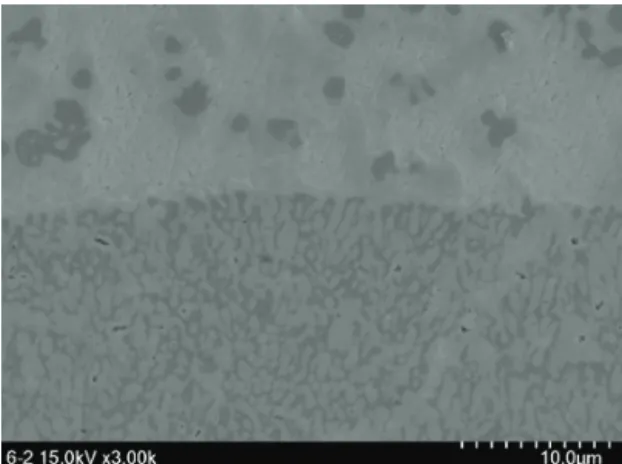
In Fig. 2, 3D printed samples of bi-metals

performed in this lab were observed using

(6)

SEM equipment. Currently, metal that is difficult to sinter with laser is approached in other alternative ways such as electro beam mapping (EBM) or binder jet method instead of laser metal printer. They cause other problems such as vacuum chambers and post-sintering processes.

Another realistic problem arises when using various wavelengths of laser sources within a 3D printer. Normally, the power used in metal printing varies somewhat depending on the speed of the printing and driving conditions, but high power is required at least 150W on a CW basis, causing supply and demand problems for wavelengths below the visible or visible areas as the laser source manufacture itself is expensive or not developed.

4. Conclusion

In this study, examples of how to overcome barriers to entry of metal 3D printing technology into the manufacturing industry among additive manufacturing technologies were investigated, and as a new method, multi-function product printing through bi-metal additive manufacturing was proposed. Currently, metal 3D printing technology has a threshold in which it cannot overcome the difference in absorption rates for material-specific wavelengths to use light sources limited to laser modules in infrared wavelengths. To overcome these laser optical limitations, we are currently researching impulse laser and composite laser methods. In the future, basic experiments and improvements will be produced to present the results of improved cross-material bonding techniques.

Acknowledgments

This research was supported by Basic Science Research Program through the National Research Foundation of Korea(NRF) funded by the Ministry of Education (NRF-2019R1I1A3A01063433)

Fig. 2 SEM image of a sample 3d printed with

bi-metal

(7)

References

[1] Kodama, Hideo. “Automatic method for fabricating a three‐dimensional plastic model with photo‐hardening polymer.” Review of scientific instruments vol. 52, no. 11, pp. 1770- 1773, (1981).

[2] Huang, Runze, et al. “Energy and emissions saving potential of additive manufacturing: the case of lightweight aircraft components.” Journal of Cleaner Production 135, pp. 1559-1570, (2016).

[3] Horn, Timothy J., and Ola LA Harrysson.

“Overview of current additive manufacturing technologies and selected applications.” Science progress vol.95, no. 3, pp. 255-282, (2012).

[4] Wohlers Associates, “Wohler’s Report” 2018.

[5] MacDonald, Eric, and Ryan Wicker. “Multiprocess 3D printing for increasing component functionality.”

Science vol 353, no. 6307, pp. aaf2093, (2016).

[6] GE Additive, New manufacturing milestone:

30,000 additive fuel nozzles, GE Addtive Stories, October 04, 2018, [Online], Available.

https://www.ge.com/additive/stories/new-manufactu ring-milestone-30000-additive-fuel-nozzles [7] Esra, K. O. Ç., and Cihan GÖKÇÖL.

“ADDITIVE MANUFACTURING (3D PRINTING) APPLICATIONS IN AUTOMOTIVE SECTOR.”

Ejovoc (Electronic Journal of Vocational Colleges) vol.8, no. 2, pp.155-157.

[8] Sames, William J., et al. “The metallurgy and processing science of metal additive manufacturing.”

International Materials Reviews vol. 61, no. 5, pp. 315-360, (2016).

[9] Zeltmann, Steven Eric, et al. “Manufacturing and security challenges in 3D printing.” Jom vol. 68, no. 7, pp. 1872-1881, (2016).

(Manuscript received March 3, 2020;

revised March 28, 2020; accepted March 31, 2020)

수치

Fig.  1  Absorption  of  various  metallic  material  by  wavelength
Fig.  2  SEM  image  of  a  sample  3d  printed  with  bi-metal

참조

관련 문서

그림(1)처럼 볼록렌즈와 오목렌즈를 겹쳐서 사물을 보면 어떻게 보이는지 관찰하여보자1. 그림(2)처럼 볼록렌즈와 볼록렌즈를 겹쳐서

ƒ Casting is a manufacturing process by which a molten material such as metal or plastic is introduced into a mold made of sand or metal, allowed to solidify within the mold,

A Study on the Development of Ship’s Ballast Water A Study on the Development of Ship’s Ballast Water A Study on the Development of Ship’s Ballast Water A Study on the

As the manufacturing technology of a laser welding equipment supplying directly a high density heat energy in the joining part, which is different from

• Select one of the elemental technologies of Smart City and describe the current level of this technology, the direction of future technology development, and the urban space to

Objective : This study is to identify factors related to performance of hand washing in daily life for emergency Medical Technology students.. Methods : The study subjects

As the basis of the study, concept behind information communication technology was formed, and based on theoretical fundamentals of current internet use, ICT

 Casting is a manufacturing process by which a molten material such as metal or plastic is introduced into a mold made of sand or metal, allowed to solidify within the mold,