• 검색 결과가 없습니다.

Key Factors Affecting Students' Satisfaction and Intention to Use e-Learning in Rwanda's Higher Education

N/A
N/A
Protected

Academic year: 2021

Share "Key Factors Affecting Students' Satisfaction and Intention to Use e-Learning in Rwanda's Higher Education"

Copied!
10
0
0

로드 중.... (전체 텍스트 보기)

전체 글

(1)

Key Factors Affecting Students’ Satisfaction and Intention to Use e-Learning in Rwanda’s Higher Education

Akimana Violaine 1 , Gee-Hyun Hwang 2*

1

Teamleader, Rwanda Utility Regulatory Authority (RURA), Rwanda,

2

Professor, Office of International Affairs/Graduate School of Information Science, Soongsil University

르완다 고등교육기관 학생들의 e-러닝 만족도 및 사용의도에 영향을 미치는 핵심요인 연구

Akimana Violaine 1 , 황기현 2*

1

르완다 유틸리티규제위원회 팀장 

2

숭실대학교 국제처/정보과학대학원 교수

Abstract This study aims to explore key factors which influence user’s decision-making on the adoption of e-learning. We integrated UTAUT and Information Success Models to test that four independent factors affect student satisfaction to use e-learning in Rwanda‘s higher education. Data was collected by surveying students of University of Rwanda and Protestant Institute of Social Sciences (n=206). The analysis results showed that performance expectancy, facilitating conditions and effort expectancy except for social influence have a significant effect on students’ satisfaction. This can help university administrators understand the factors that influence students’ adoption of e-learning and incorporate these results into Rwanda's e-learning design and implementation. In final, Rwanda’s government can contribute to establishing the e-learning policy and allocating its relevant resources centered on student needs.

Key Words : e-learning, Higher Education, UTAUT, Satisfaction, Intention to Use, Rwanda

요 약 본 연구는 e-러닝 시스템의 채택과 사용에 대한 사용자들의 의사결정 과정에 영향을 미치는 핵심 요인들을 탐색하는 것을 목적으로 한다. 이를 위해 르완다의 고등 교육 기관에서 네 가지 독립 요인이 학생들의 e-러닝 시스템  만족도와 사용 의도에 영향을 미치는지를 검증하기 위해 UTAUT와 IS 성공 모델을 통합한 새로운 연구모형을 제안했다. 연구모델에 입각하여 설문지를 작성하고 르완다 대학교와 개신교 사회과학원 학생들의 설문조사를 통해 최종적으로 206개의 실증적 데이터가 수집되었다. 분석 결과에 따르면 사회적 영향을 제외한 성과기대, 노력기대, 촉진 조건 등 3개 요인은  e-러닝 시스템에 대한 학생들의 만족도 및 사용 의향에 유의한 영향을 미쳤다. 본 연구는 대학 관리자가 학생들의 e-러닝 채택 및 사용에 영향을 미치는 핵심요인들을 이해하고, 이들 연구결과를 르완다 고등교육기관의 e-러 닝 프로젝트 설계 및 추진 계획 수립에 반영할 수 있다. 궁극적으로는 르완다 정부가 학생 니즈 중심으로 올바른 e-러닝 교육정책 을 수립하고 적절한 자원 배분을 계획하는 데 기여할 수 있다

주제어 : e-러닝, 고등교육, UTAUT, 만족도, 사용의도, 르완다

*This paper was prepared based on the first author’s master thesis in Soongsil University.

*Corresponding Author : Gee-Hyun, Hwang([email protected])

Received April 1, 2019 Revised April 30, 2019

Accepted May 20, 2019 Published May 28, 2019

(2)

1. Introduction

The digital age revolution and the proliferation of information and communication technology(ICT) have enabled faster and easier information sharing, communication and collaboration among students, teachers and school administrators. The use of ICT in education is generally called e-learning which is a useful tool for improving the quality of learning and teaching. It is an “innovative approach to education delivery via electronic forms of information that enhance the learner’s knowledge, skills, or other performance” [1]. E-learning is seen as a solution to provide educational services to many people with less physical supervision.

The internet promoted the development of education, and is now a tool to drive knowledge.

However, e-learning is still in its early stage in developing countries. Most developing countries have showed an interest in implementing e-learning but faced obstacles in infrastructure, resources, information access, personal characteristics, support from institution, technology and connectivity, instructors’ design and technology confidence, as well as culture and policy[2,3]. Technology convergence within education in developing countries lagged behind due to cultural, political, and economic concerns. Despite these challenges, there are still opportunities to improve the effectiveness and efficiency of e-learning in developing countries[4].

Among developing countries, Rwanda’s government is committed to achieving a middle income nation by 2020 based on the socio-economic knowledge and information utilization. The government recognize that the use of ICT in education is a key approach to accomplish the Vision 2020 objectives as well as the best approach to eliminate illiteracy and put human resources for its socio-economic development.

However, there are some challenges in Rwanda’s higher education unlike developed

countries such as Korea. These difficulties are lack of lecturers or professors, insufficient number of computers, insufficient power supply, lack of ICT infrastructures, insufficient awareness of ICT and so on. Therefore, most Rwanda‘s universities are in the early stages of conducting e-learning. To overcome these difficulties, the government of Rwanda will have to initiate and update the ICT policies and plan for improving the ICT services in all education sectors.

Considering Rwanda’s specific circumstances, this study aims to discover the underlying factors that influence student acceptance of e-learning by using e-learning acceptance model in Rwanda’s higher education.  

2. Research Background

2.1 E-learning

According to webopedia, e-learning is basically network-assisted transfer of skills and knowledge.

E-learning means using electronic applications and processes for learning and teaching. E-learning applications and processes include digital collaboration, web-based and computer-based learning, and virtual classrooms. Its contents are delivered via internet, intranet, TV, audio, CD-ROM, and satellite. It is known that the term e-learning originated during the 1980s.

E-learning can contain teaching and learning atmosphere, which is part of a blended learning with a mix of offline and digital elements[5, 6].

The blended instruction combines both classroom and online learning in which teachers can achieve their pedagogical goals by combining benefits of two instructional modalities. Main components of the blended instruction are provided online with face-to-face instruction.

From the information system perspective, e-learning is one of the major technical innovations for stakeholder organizations[1,7].

It is free from temporal and spatial constraints,

(3)

which assists participants to create .value and allows people to learn anytime, anywhere[2]. No one is excluded from education by geographic, physical or social circumstance. Moving clients to digital channels is a critical issue for educational organizations. because e-learning allows them to increase access to information, flexibility of learning environments, personalized instruction, and learner control..

However, e-learning needs software and hardware platform in order to provide successful services for customers. There are some disadvantages of e-learning from the participant’s point of view. It requires participants to overcome basic computer literacy, ICT infrastructure constraints, feeling of isolation and lack of self-discipline and self-motivation[7, 8]. E-learning requires more student maturity and self-discipline than traditional classroom education. This explains that e-learning programs have a higher dropout rate than existing programs[3]. So, stakeholder should choose a specific plans to overcome these challenges.


2.2 Rwanda‘s higher education e-learning

Rwanda is a small country in Eastern Africa.

She suffered from the effects of a civil war involving genocide in the 1990s, but has holistically made attempts to recover. Real GDP grew an average of 8% per year over the past decade, the greatest growth in East Africa. Due to strong economic growth, per capita income increased to $ 780 in 2018 from $ 225 in 2000.

One example of Rwanda's recovery is in improving education for the people. President Paul Kagame has allocated about 20% of the national budget to education. This, combined with the country’s desire to modernize and improve other areas, has resulted in a synergistic adoption of Rwanda’s education technology such as online courses, even MOOCs(Massive Open Online Courses). In particular, the Rwandan

government purses to improve Rwanda's education system by using ICT. The Rwandan government believes that using ICT in education is the best method to reduce illiteracy and foster human resources for socio-economic development.

Rwanda‘s government has introduced several ICT initiatives as well as many ongoing e-learning projects. This plan, together with the desire to increase accessibility of education, has resulted in a surge in the use of e-learning in Rwanda.

Higher education is delivered by public and private institutions where there are 38 universities with 5,670 staff and 84,448 students.

The government of Rwanda is promoting e-learning to accelerate the development of higher educations. E-learning has today become the main stream among Rwanda’s universities[1].

Courses in different fields are offered online, students can enroll for a course through internet, lecturers and students are able to share online course materials which include notes, assignments and other multimedia contents. In universities, higher learning institutes as well, large or small, online teaching and learning system is a key component of their education systems. For a number of the higher education institutions, a well-established online teaching  and learning system is their lifeline for keeping their classes running.

Each university operates their e-learning portal not only to integrate open and distance e-learning programs from all colleges but also assist in developing online materials and resources using educational technology. In general, e–learning systems commonly used by universities include interactive learning software, interactive whiteboard, video conferenceing tool, learning management systems (LMS), and digital signage[9].

The University of Rwanda has in fact

integrated an e-learning module into its supply,

signalling that as time goes on, e-learning and

m-learning will become a significant part of

university education in Rwanda as well.

(4)

Currently, the largest roadblock to education in Rwanda is a lack of educator training. Educators, lecturers or professors are not exceptionally common in universities. Computers available in universities are not enough to affect student learning, but certain application of ICT can positively impact students' knowledge, skills and attitudes[9].

E-learning also has some barriers like insufficient power supply (only 60% of the population can access to electricity), lack of ICT infrastructures, insufficient awareness of ICT, and so on. To cope with such difficulties, the government of Rwanda will have to initiate and update the ICT policies and plan for improving the ICTs services in all education sectors.  

2.3 Technology adoption models

New information system acceptance has turned out to be a prerequisite for successful implementation of the system. Therefore, the determinants of user acceptance can contribute to the improvement of system design and use[10].

Researchers are actively studying how users' perceptions of IT systems affect acceptance and how individuals adopt these new systems.

Technology adoption models illustrate how individuals perceive technology and make a decision to adopt or reject the new technology [11]. Therefore, we introduce two related technology adoption models that study key factors affecting user’s satisfaction and adoption to use a specific information system(IS).

First, the UTAUT(Unified Theory of Acceptance and Use of Technology) model is widely known to be the most comprehensive and theoretical research model in the IS field[10]. The original UTAUT consists of four key independent factors along with the behavioral intention to use and the system use(see Fig. 1).

Fig. 1. Original UTAUT Model[12]

Among the four main factors, performance expectancy refers to the degree to which an individual recognizes that using the system will have him or her to gain the benefit of job performance. Effort expectancy represents the degree of ease associated with system use, while social influence refers to the level to which a person believes that important people think he or she should adopt a new technology system.

Facilitating conditions refer to the level to which a person is aware that the use of the system is supported by the organizational and technical environment.

Meanwhile, DeLone and McLean[13] proposed a conceptual information system(IS) success model  in 1992. The IS success model incorporates six dimensions like “System Quality, Information Quality, Service Quality, User Satisfaction, Intention to Use and Net Benefits”. Each factor plays an important role for IS satisfaction and success, whereas all the factors are inter-correlated with one another(see Fig. 2).

Fig. 2. Revised Model of DeLone & McLean[13]

(5)

3. Research Model and Hypothesis

3.1 Research Model

This research aims to investigate the behavioral aspects that have an influence on students’ satisfaction and intention to use e-learning systems in Rwanda. Rwanda's e-learning systems have been recently introduced by several universities. Rwanda's e-learning market is expected to grow rapidly at an early stage as both home PC and mobile penetration increase. Basically, e-learning system is a technological product which can be secured from converging ICT and education for online learning and teaching.

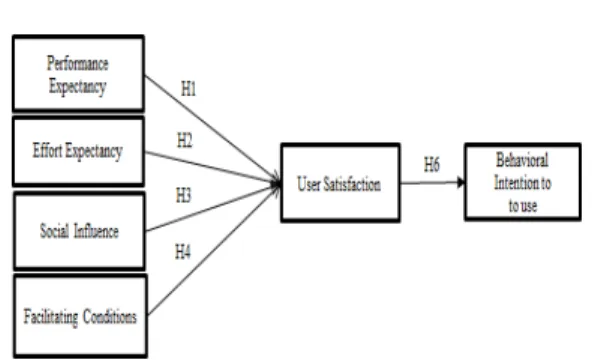
This study proposed an integrated research model of IS success model and UTAUT(see Fig.

3) because Rwanda's e-learning market is in its early stage, not fully implemented nationwide.

The former IS success model is used to study the correlation between three quality factors, user satisfaction, intention to use and net benefits[1 2,14]. The latter UTAUT was used to determine users’ technology acceptance and use behavior[11].

With respect to technology adoption, this study also needed to ensure key factors affecting Rwanda's higher education institute students’

satisfaction and intention to use e-learning systems which can be implemented by converging ICT and education. Another reason is that the satisfaction issues determine the degree of meeting the needs of Rwanda's users. The e-learning systems can also be classified as information system and technology, while UTAUT and IS success models were respectively proved in the existing literature. Therefore, the integrated research model as seen in Fig. 3 was developed for identifying the satisfaction and behavioral aspect of users who are adopting the e-learning systems in Rwanda.

Fig. 3. Integrated Research Model

Our research model in Fig. 3 comprises four independent factors and two dependent factors such as user satisfaction with e-learning service and intention to use it. Performance expectancy, effort expectancy, social influence, facilitating condition were selected from UTAUT model, while user satisfaction with e-learning service and intention to use came from IS success model.

Four independent factors play a role of direct determinants of user satisfaction with e-learning.

3.2 Research Hypothesis

3.2.1 Independent Variables and Satisfaction This research has examined e-learning system services based on UTAUT and IS. We assumed that users will only adopt an information technology when it satisfies their learning needs or requirements at hand and contributes to improving their learning performance. The e-learning system is built on software and hardware platform. One of the most important advantages of e-learning is that no one is excluded from education by geographic, physical or social circumstance[15, 16].

Performance expectancy represents user perception of performance improvement achieved by using e-learning services to learn anytime and anywhere. Effort expectancy means users’

perception of how difficult they utilize e-learning

services. When users recognize that e-learning

services are easy to use and spend less effort,

they tend to have more satisfaction and

(6)

expectation toward accomplishing the expected performance. Social influence refers to the effect of important people such as a user’s relatives, friends, and superiors on user behavior. Their opinions will have an influence on users’ satisfaction and usage of e-learning services. Facilitating conditions represent that an institution and infrastructure exists to support the use of a system[16, 17].

E-learning as a new service requires specific skills for users to configure and operate personal computer, laptop and pad and connect to the internet network. However, they will be more satisfied if the personal or group performance is improved after the information system is supported by an institution and infrastructure[1 8,19]. So, this study investigates the influence of four aforementioned independent factors on user satisfaction with e-learning service as follows.

H1: Performance expectancy affects user satisfaction with e-learning service.

H2: Effort expectancy affects user satisfaction with e-learning service.

H3: Social influence affects user satisfaction with e-learning service.

H4: Facilitating conditions affect user satisfaction with e-learning service.

3.2.2 Satisfaction and Intention to Use The satisfaction is defined as users‘ affect with prior use of e-learning service[13]. The behavioral intention to use means a degree of the possibility that an individual will adopt e-learning service[12]. The IS success model proved that the satisfaction with information system has significant effect on behavioral intention to use it[13]. User satisfaction is associated with both intention to use information system[18]. In final, the higher behavioral intention to use e-learning service will result in its actual use[12]. Therefore, we hypothesize:

H5: User satisfaction with e-learning system affects behavioral intention to use it.

4. Data Collection and Analysis

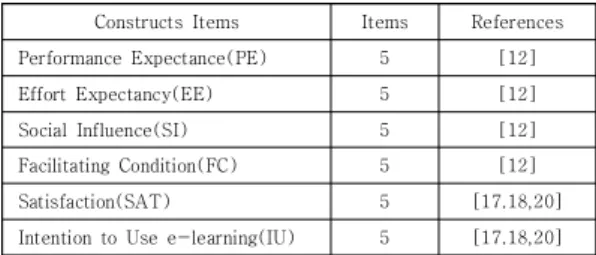
Our study model includes six constructs, each of which was tested in multiple items(see Table 1). The survey questionnaires written in English were based on a proposed research framework consisting of seven Likert scale scales, anchored at 1 = entirely disagree , 4 = neither agree nor disagree , 7 = entirely agree. Most items were derived from different literature and modified for the context of e-learning system in order to maintain content validity. This study analyzed the collected data using statistical software such as SPSS 18.0 and AMOS 18.0.

Constructs Items Items References

Performance Expectance(PE) 5 [12]

Effort Expectancy(EE) 5 [12]

Social Influence(SI) 5 [12]

Facilitating Condition(FC) 5 [12]

Satisfaction(SAT) 5 [17.18,20]

Intention to Use e-learning(IU) 5 [17.18,20]

Table 1. Measurements Construct and Items

4.1 Data Collection

The total number of questionnaires distributed in this study was 245, with 212 response data collected and 206 remaining after data cleaning.

In this survey, confidentiality of the respondents was assured. From the analysis, we can see that there are more women than men in the sample (women 57%, men 43%). The age distribution is less than 18 years (1%), 18~22 years (29%), 22~26 years (54%), 26~30 (13%), and 30 years or older(3%).

For internet experience, the distribution

represents less than 1 year(6%), 1~3 years (27%),

3~6 years (31%), more than 6 years(32%), and no

experience(4%). Computer usage experience

statistics show that 64% of students have

experience with laptops and 27% have experience

with desktops, while only 1% have experience

using PDAs and 8% do not use computers.

(7)

4.2 Reliability and validity test

Exploratory factor analysis is a tool for identifying covariance and correlation between variables, which aims to find the common factors that well fit the data and to decrease the number of variables. Maximum likelihood method was selected to do exploratory factor analysis using Varimax rotation method. Factor Loadings were a minimum of 0.723 and a maximum of 0.881, thus proving its effectiveness. The Cronbach's alpha(  ) test was performed to measure the internal consistency. Each factor showed internal consistency, showing 0.728 or more as seen in Table 2.

VAR  CR AVE 1 2 3 4 5 6

EE .791 .737 .615 0.784 SAT .890 .861 .675 0.331 0.821 SI .846 .806 .509 0.299 0.251 0.713 FC .841 .763 .522 0.034 -0.108 0.557 0.722 IU .729 .760 .515 0.148 0.618 0.464 0.287 0.718 PE .728 .712 .553 0.095 0.451 0.177 0.185 0.563 0.743

Note) The diagonal value means Square Root of AVE.

Table 2. Reliability and Discriminant Validity test

Confirmatory factor analysis was used to assess both validity and reliability of the latent variables. During the reliability assessment process, two items in Performance Expectance(PE) factor and one in Intention to Use(IU) factor were excluded as they were below the recommended threshold. These items were consequently deleted to enhance the reliability measure of the remaining items.

As a result, CR(construct reliability) was larger than 0.712, whereas AVE(Average Variance Extracted) was greater than 0.509. Therefore. convergent validity was proved. Discriminant validity was tested to assess the difference between different latent variables. Discriminant validity is satisfied when the diagonal elements are greater than the off-diagonal values in the corresponding rows and columns, thus proving Table 2 shows the discrimination validity.

4.3 Structural model fit test

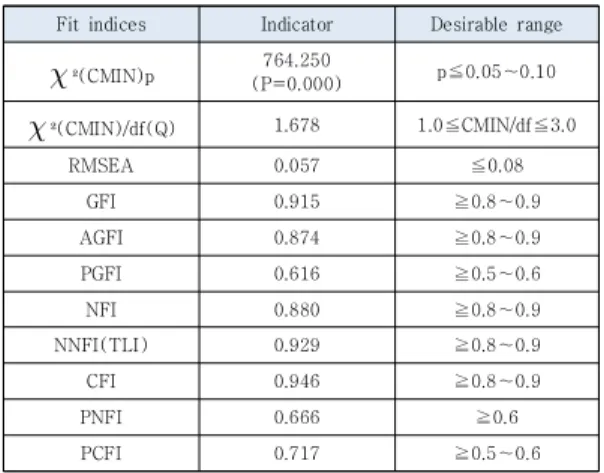
The conformity of the structural equation mode was evaluated before hypothesis testing. This research used three fit indices such as incremental fit, absolute fit and parsimony fit as seen in Table 3.

Fit indices Indicator Desirable range

²(CMIN)p (P=0.000) 764.250 p≦0.05~0.10

 ²(CMIN)/df(Q) 1.678 1.0≦CMIN/df≦3.0

RMSEA 0.057 ≦0.08

GFI 0.915 ≧0.8~0.9

AGFI 0.874 ≧0.8~0.9

PGFI 0.616 ≧0.5~0.6

NFI 0.880 ≧0.8~0.9

NNFI(TLI) 0.929 ≧0.8~0.9

CFI 0.946 ≧0.8~0.9

PNFI 0.666 ≧0.6

PCFI 0.717 ≧0.5~0.6

Table 3. Structural Model fit test

In absolute fit index, the calculations of x²(CMIN)p,  ²(CMIN)/ df(Q) , RMSEA (Root Mean Square Error of Approximation),  GFI (Goodness of Fit Index), AGFI (Adjusted Goodness of Fit Index), and PGFI are 764.250(P=0.000), 1.678,0.057,0.915, 0.874, and 0.616 respectively. In incremental fit index, NFI (Normed Fix Index), NNFI and CFI (Comparative Fit Index) were calculated as 0.880, 0.929, and 0.946 respectively. PNFI and PCFI are rated as 0.666 and 0.717 respectively for parsimony fit index, The analysis results reveal that the model fit index is appropriate for all acceptance criteria in Table 3.

4.4 Hypothesis test

In this study, the structural equation modeling

(SEM) using Amos 18.0 was employed to test the

research model. Testing the hypotheses determines

which predictors(independent variables) provide a

meaningful input to the explanation of the

dependent variables[21]. Path analysis was used

(8)

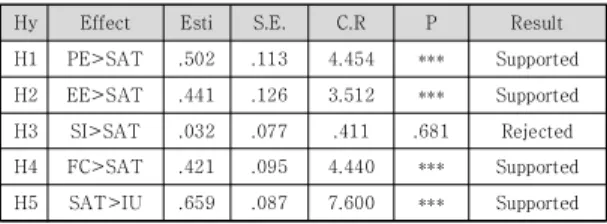
in order to test the hypothesis in structural equation model. Table 4 indicates the results of testing the hypothesis of this research. In hypotheses, H1 to H4 were respectively used to study the affect of 4 independent variables on satisfaction to use e-learning systems(SAT). Hypothesis H5 was also used to test the relationship between satisfaction to use e-learning systems(SAT) and User Adoption of e-learning(IU). The result shows that hypotheses H3 is rejected, while the remainder hypotheses H1, H2, H4, and H5 are supported as shown in Table 4.

The hypothesis testing results indicate that Performance Expectancy(PE), Effort Expectancy(EE) and Facilitating Condition (FC) affect satisfaction to use e-learning systems(SAT), whereas Social Influence(SI) doesn't influence satisfaction to use e-learning systems(SAT). Finally, satisfaction to use e-learning systems(SAT) has an influence on User Adoption of e-learning(IU).

Hy Effect Esti S.E. C.R P Result

H1 PE>SAT .502 .113 4.454 *** Supported H2 EE>SAT .441 .126 3.512 *** Supported H3 SI>SAT .032 .077 .411 .681 Rejected H4 FC>SAT .421 .095 4.440 *** Supported H5 SAT>IU .659 .087 7.600 *** Supported Note) ***P<0.001 2-tailed

Table 4. The Summary of hypothesis testing

5. Conclusion and Discussions

This research was designed to investigate key factors that affect students’ satisfaction to use e-learning system in higher education in Rwanda. This study used a research model integrating UTAUT and IS success model. Our test results showed that three constructs except SI had significant positive effect on students’ satisfaction and behavioral intention to use e-learning.

The hypothesis testing result shows that H1 was accepted. There were a significant positive

relationship between performance expectancy (PE) and satisfaction of e-learning system. PE revealed the strongest predictor in e-learning satisfaction, which is similar to findings by some publications[12, 22]. This result indicated that students believe that they can be motivated to increase their learning performance while using e-learning system. Students are more satisfied with e-learning when they improve their learning performance using e-learning services. PE is therefore very important for higher learning institutions in developing countries such as Rwanda where availability of high quality e-learning system may motivate students to increase their productivity while learning.

For effort expectancy (H2), it is found that there is a positive relationship between effort expectancy and users’ satisfaction to use e-learning system. If users can easily and conveniently use the e-learning services, they will be able to continuously use e-learning services. Therefore, Rwanda’s students will perceive more satisfaction with e-learning and finally have an intention to use e-learning services. This implicates that students believe that a lot of instruction will not be needed to use e-learning as they think e-learning should be clear, understandable, and easy to use[12]. If the devices and contents are made easy and convenient to use, students will be likely to adopt and use more e-learning service. This finding support some earlier studies[2, 3], but contradicts with the findings of Venkatesh et al.[15].

In terms of Social Influence(H3), this study

showed that there is not a positive relationship

between social influence and user satisfaction,

which supports some findings[11] but is

opposite to the other finding[3, 23]. This means

that users were not influenced by peer groups

and interpersonal word-of-mouth. Students will

not intend to use e-learning services as people

who are familiar with or important to them

request to use e-learning services. This can be

(9)

explained by the unique culture of students in Rwanda. They tend to gain more confidence while independently learning a new system or acquiring a new knowledge.

Another key finding was that students think they have sufficient resources and knowledge to use e-learning. This was proved by the fact that facilitating conditions had positive affect on students’ satisfaction to use e-learning. This is a little strange as we believe that sufficient resources are not provided in Rwanda and therefore facilitating conditions will have an effect on user’s satisfaction and adoption[24].

However, it was found that more than 90% of students revealed that they could access to e-learning system via mobile devices. This supports some study results performed elsewhere in Africa[25].

In final, the student satisfaction shows a significant relationship with the intention to use the system(IU), which confirms the theory stated by other studies[17, 26]. User satisfaction has an influence on intention to use e-learning system, which becomes significantly stronger if the personal, group or organizational performance is improved after the system is used. Additionally, student satisfaction will be related to both intention to use and usage[18, 20]. This clearly suggests that e-learning system in Rwanda’s Higher Education should be enjoyable and easy to be used by students. This will result in continuous usage and satisfaction of e-learning system in their future learning.

In conclusion, universities need to consider these research findings as the basis for IT decision-making and strategic planning in the academic area. Universities will be able to use the model components to identify elements that need more attention, especially when new e-learning initiatives are in the early stages of planning and design. In particular, Rwanda’s educators should first focus both on improving the quality of learning resources included in e-learning systems and developing tools that will

promote student learning. Second, e-learning system design and development must be not complex for the easy use by students, which will lead to more motivation and satisfaction while using the system. Last, higher education institutions should focus on strengthening access to e-learning system using mobile devices. These study results can give guidelines for proper planning and distribution of resources, which means efficient and optimal allocation of fiscal and human resources.

On the other hand, this study is only a start for studying critical factors affecting user satisfaction to use e-learning. In particular, as the convergence of ICT and education is rapidly evolving with the adoption of mobile devices, more research is needed on adopting e-learning. Firstly, this study investigated the factors affecting the satisfaction of e-learning among students in Rwanda’s Higher Education only. Therefore, the research findings may not be applied to other developing countries.

We suggest that future study validate the research model in other countries.

In addition, the sample is limited to students of University of Rwanda and another three private universities in the southern province, which is lack of generalizing the picture of all university students of Rwanda. This research was also limited to students although instructors and managers are also major stakeholder. So, future research should include more universities for survey or other stakeholders for advanced research results.

REFERENCES

[1] S.  Siritongthaworn, D.  Krairit, N.  J.  Dimmitt  & H. 

Paul.(2006). The study of e-Learning technology implementation: a preliminary investigation of universities in Thailand. Education and Information Technologies, 11(2), 137–160. 

[2] Å,  Grönlund & Y. M.  Islam.(2010). A mobile

e-Learning environment for developing countries: the

Bangladesh virtual interactive classroom. Information

Technology for Development, 16(4) , 244–259.  

(10)

[3] K. Shraim, & Z. Khlaif.(2010). An e-Learning approach to secondary education in Palestine:

opportunities and challenges. Information Technology for Development, 16(3), 159–173.  

[ 4] R. Santhanam, S. Sasidharan & J. Webster. (2008).

Using self-regulatory learning to enhance e-Learning-based information technology training.

Information Systems Research, 19(1) , 26–47. 

[5] J.Kim, J.Jung, J. Jo & H.Lim. (2019). A Study on the Effectiveness of e-learning video class using the online learning judgement system : Focused on the social studies classes in Elementary school. Journal of the Korea Convergence Society, 10(2), 141-148 [6] Y. M. Son &  B. S. Jung.. (2015). Convergence

Development of Video and E-learning System for Education Disabled Students. Journal of the Korea Convergence Society , 6(4), 113-119.

[7] H.D.Lee & M.W.Nam. (2018). The Analysis of Academic Achievement based on Spatio-Temporal Data Relate to e-Learning Patterns of University e-Learning Learners. Journal of Convergence for Information Technology, 8(4), 247-253.

[8] T. I. Han. (2015).  A Study on the Technical Evaluation of the Quality Certification for e-Learning Contents. Journal of Digital Convergence, 13(1),  49-66.

[9] Ministry of Youth and ICT (2012). Rwanda ICT Sector Profile : Measuring ICT sector  performance and Tracking ICT for Development (ICT4D) towards Rwanda Socio-Economic Transformation. Kigali.

[10] R.  Agarwal & J.  Prasad.(1998). The antecedents and consequences of user perceptions in information technology adoption. Decision Support Systems, 22, 15-29.

[11] S.  Taylor  & P. A.  Todd.(1995). Understanding Information Technology Usage: A Test of Competing  Models. Information Systems Research,6(4), 144-176.

[12] V. Venkatesh, M. G. Morris, G. B. Davis & F. D. Davi s.(2003). User acceptance of information technology:

Toward a unified view. MIS Quarterly, 27(3) , 425-478.

[13] W. H. DeLone & E. R. McLean.(2003). The DeLone and McLean Model of Information Systems Success: A Ten-Year Update. Journal of Management Information Systems, 19(4), 9-30.

[14] C. H. Jung & S. H. Namn.(2014). Cloud Computing Acceptance at Individual Level Based on Extended UTAUT. Journal of Digital Convergence, 12(1), 287-294.

[15] M. R. Eom, W. J. Choi & Y. H. Song. (2018). Exploring the Educational Needs of Learning Supporting Program on the Students` Perception of Current Competencies and Important Competencies. Journal of Convergence for Information Technology, 8(3), 175-181.

[16] X. Zhao, A. S. Mattila & L. S. E. Tao.(2008). The role of post-training self-efficacy in customers' use of self-service technologies. International Journal of Service Industry Management, 19(4), 492-505.

[17] W. H. Delone & E. R. Mclean.(2003). The DeLone and McLean model of information systems success:

Aten-year update. Journal of Management Information Systems, 19(4), 9-30.

[18] A. Bhattacherjee.(2001). An empirical analysis of the antecedents of electronic commerce service continuance.  Decision Support Systems, 32(2), 201-214.

[19] H. C.Song. (2018). A Study of Factors Affecting on m-learning Satisfaction based on UTAUT. Journal of Digital Convergence, 16(7), 123-129.

[20] U. Konradta, T. Christophersena & U. Schaeffer-Kuelz b.(2006). Predicting user satisfaction, strain and system usage of employee self-services. International Journal of Human-Computer Studies, 64(11) , 1141-1153.

[21] J. F. Jr. Hair, R. E. Anderson, R. L. Tatham & W. C. 

Black.(1998). Multivariate Data Analysis. (5th Edition). Upper Saddle River, NJ: Prentice Hall.

[22] H. S. Suh & S. H. Park. (2011). Study on the Innovation Acceptance Characteristics for Digital Convergence Products. Journal of Digital Convergence, 9(4), 51-67.

[23] K. K. Seo. (2016). Analysis of use intention of mobile cloud service using a convergence technology acceptance model. Journal of Digital Convergence, 14(12), 105-110.

[24] T. D. Thomas, L. Singh & K. Gaffar. (2013). The utility of the UTAUT model in explaining mobile learning adoption in higher education in Guyana. JEDICT, 9(3), 71–85.

[25] J. M. Kihoro, P. A. Oyier, B. M. Kiula, J. M. Wafula 

& R. W. Ibukah.(2013). E-Learning Eco-system for Mobility and Effective Learning: A Case of JKUAT IT Students. In IST-Africa 2013 Conference, 1–9.

Akimana Violaine [정회원]

․ 2016년 2월 : 숭실대학교 정보과학대 학원 글로벌ICT융합학과 졸업(공학석 사)

․ 2016년 2월 ~ 현재 : 르완다 유틸리티 규제위원회 팀장

․ 관심분야 : 빅데이터, 전자정부 등

․ E-Mail : [email protected]

황 기 현(Hwang, Gee-Hyun) [정회원]

․ 1987년 2월 : 한국과학기술원 산업공 학과 졸업(공학석사)

․ 1997년 12월 : 영국 버밍험대에서 공 학박사 취득(TQM and SCM)

․ 2010년 9월 ~ 현재 : 숭실대 국제처/

정보과학대학원 교수 재직 중

․ 관심분야 : 국제개발협력, TQM, SCM, ICT융합 등

․ E-Mail : [email protected]

수치

Fig.  1.  Original  UTAUT  Model[12]
Fig.  3.  Integrated  Research  Model
Table  1.  Measurements  Construct  and  Items
Table  2.  Reliability  and  Discriminant  Validity  test
+2

참조

관련 문서

북동류형 호우 시스템에서 순전(Veering)은 지상에서 대류권계면까지 나타난다.. 따라서 온대저기압의 발달과 경로를

구름이 만들어지고 강수과정이 나타나는 지구 대류권에서 기화열은 융해열보다 중요하게 다루어진다... 지표부근 대기에서는 등온선과

불안정한 대기에서는 단열 냉각이 상승 운동에 미치는 효과 또는 단열 승 온이 하강 운동에 미치는 효과가 감소되기 때문에, 불안정은 오메가(상승 과 하강

따라서, 고도가 높은 단일층 구름에서 대류권 냉각이 가장 적게 일어나는 반면, 고도가 낮은 단일층 구름에서 대류권 냉각이 가장 크게 일어난다.... 나머지 4%는

여름철 집중호우를 야기하는 대표적인 형태는 중규모 대류계(Mesoscale Convective Systems, MCSs)이다... 하층제트는

빙정의 균질 핵생성은 빙정핵 또는 응결핵을 포함하지 않은 순수한 과냉각 수적의 동결이나 온도가 0°C 이하인 수증기 가 과포화 상태에서 빙정핵이 없이 수증기 분자들 간의

Johnson, 1979: The coupling of upper and lower tropospheric jet streaks and implications for the development of severe convective storms...

최근 국민 생활수준 향상으로 국민 삶의 질 향상을 위하여 다소 보수적인 예보보다는 나타날 가능성이 가장 높은 예보를 요구하고 있으며, 동네예보 가 이러한