Efficacy of Intravitreal Triamcinolone Acetonide for Eyes with Postvitrectomy Diabetic Vitreous Hemorrhage
Sun Young Lee, MD, Hee Gyung Lee, MD, Hyewon Chung, MD, Young Hee Yoon, MD, June-Gone Kim, MD
Department of Ophthalmology, Asan Medical Center, University of Ulsan, College of Medicine, Seoul, Korea
Purpose: To evaluate the efficacy of intravitreal triamcinolone acetonide (IVT) for the management of postvitrectomy diabetic vitreous hemorrhage.
Methods: The authors conducted a retrospective study of patients with postvitrectomy diabetic vitreous hemorrhage who were administered 4 mg (0.1 cc) of triamcinolone acetonide ophthalmic suspension. Ocular history, adverse events, BCVA, intraocular pressure, external eye examination, slit-lamp biomicroscopy, fundus examination, B-scan ultrasonography, and fundus photography were assessed on day 1, weeks 1, 2, and 4 and months 2 and 3.
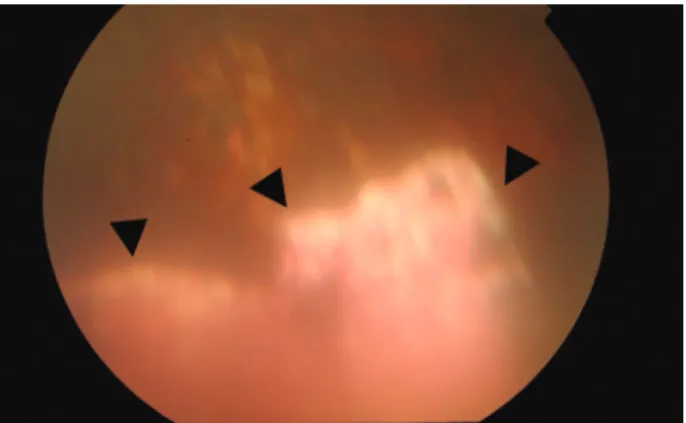
Results: There were 19 eyes of 18 consecutive patients with mean follow-up after IVT injection of 28 weeks. Of the 19 eyes, 17 eyes (89%) experienced clearing of vitreous hemorrhage within 1 to 5 weeks (mean, 1.7 weeks) with visible triamcinolone precipitates along with blood clot in the inferior aspect of fundus. Of these 17 eyes, 12 eyes (63%) maintained vitreous hemorrhage-free condition at last follow-up with a mean visual acuity of 20/63 (range, 20/320 20/25), whereas 5 (29%) developed recurrent vitreous hemorrhage after clearing of vitreous hemorrhage. Vitreous hemorrhage was not cleared in 2 eyes, which required surgical procedures.
Conclusions: IVT injection may be beneficial for clearing recurrent postvitrectomy Diabetic Vitreous Hemorrhage.
Korean Journal of Ophthalmology 21(4):208-212, 2007
Key Words: Diabetic vitreous hemorrhage, Intravitreal triamcinolone injection, Postvitrectomy, Recurrent vitreous hemorrhage.
Received: June 11, 2007 Accepted: October 30, 2007
Reprint requests to June-Gone Kim, MD, Department of Ophthal- mology, University of Ulsan, Asan Medical Center, 388-1 Poongnap-dong, Songpa-gu, Seoul 138-040, Korea Fax: 82-02-470-6440, Tel: 82-2- 2224-3673, E-mail: [email protected]
* Presented at the 2006 annual meeting of the Association for Research in Vision and Ophthalmology.
The incidence of recurrent vitreous hemorrhage of proliferative diabetic retinopathy following posterior vitrectomy ranges from 12 % to 63 %.
1-3Recurrent vitreous hemorrhage may be caused by the dissolution of blood clots trapped in the remaining anteroperipheral vitreous gel, remnants of fibrovascular tissue, reactivation of retinal sites that bled intraoperatively, anterior hyaloidal fibrovascular proliferation, or neovascularization originating from the sclerotomy sites.
4-5This condition is usually managed by fluid-gas exchange or vitreous cavity washout.
6-7Intravitreal triamcinolone acetonide (IVT) has been shown to be a useful adjunct therapy for intraocular edematous and neovascular disease.
8-12Corticosteroids are used in the treatment of various retinal diseases primarily for their
anti-inflammatory and anti-angiogenic effects. Corticosteroids inhibit prostaglandins and inflammatory adhesion molecules, thus contribute to the stabilization of the blood-retinal barrier.
13-15Corticosteroids also inhibit expression of the vascular endothelial growth factor (VEGF), as well as the induction of VEGF by platelet-derived growth factor (PEGF) and platelet activating factor (PAF).
16We have found that IVT, when used along with vitrectomy for the treatment of proliferative diabetic retinopathy, facilitates the absorption of macular edema. Follow up examinations have shown the triamcinolone precipitates downward of vitreous cavity along with retained blood. We have therefore assessed the efficacy of IVT for the management of postvitrectomy diabetic vitreous hemorrhage.
Materials and Methods
Among the patients at Asan Medical Center from April 1
through November 30, 2005, we conducted a retrospective
study of 19 eyes of 18 patients who received IVT injection
for postvitrectomy diabetic vitreous hemorrhage. The 19 eyes
in this study included those who previously had three-port
Patient
No. Age/Sex/
Laterality Post-op Dx
*Ocular history Interval from PPV to IVT (wk)
†VH scale
(Grade) Lens status Duration of followup (wk)
1 44/M/OS DMVH PPV 14 3 IOL 26
2 47/M/OD DMTRD/VH PPV,SR 14 1 Phakic 36
3 41/F/OS DMTRD/VH PPV 50 1 IOL 34
4 77/F/OS DMVH PPV 68 1 IOL 37
5 77/F/OD DMVH PPV 83 3 IOL 37
6 63/M/OD DMVH PPV 42 1 IOL 35
7 58/F/OS DMTRD/VH PPV 17 3 IOL 26
8 67/F/OS DMTRD/VH PPV 14 3 IOL 30
9 57/F/OS DMTRD/VH PPV 4 2 Phakic 32
10 68/F/OS DMVH PPV 9 3 IOL 29
11 66/F/OD DMTRD/VH PPV 1 1 IOL 26
12 50/M/OS DMVH PPV 7 3 IOL 17
13 38/M/OS DMTRD/VH PPV 42 1 IOL 20
14 45/M/OS DMVH PPV 14 3 IOL 32
15 48/M/OD DMTRD/VH PPV 14 1 IOL 36
16 59/F/OD DMVH PPV 7 3 IOL 14
17 63/M/OS DMVH PPV 14 2 IOL 14
18 52/F/OD DMVH PPV 4 3 IOL 26
19 51/F/OS DMVH PPV 11 2 IOL 28
*
postoperative diagnosis of prior vitrectomy
†Interval between last procedure (pars plana vitrectomy, silicone oil removal) and intravitreal triamcinolone acetonide injection (weeks).
DMTRD, diabetic tractional retinal detachment; DMVH, diabetic vitreous hemorrhage; PPV, pars plana vitrectomy; IVT, intravitreal triamcinolone acetonide injection; SR, silicone oil removal; IOL, intraocular lens.
Table 2. Patient and Recurrent Vitreous Hemorrhage Characteristics
Description Grade No vitreous hemorrhage 0
Mild vitreous hemorrhage with visible fundus details 1
Moderate vitreous hemorrhage with no visible fundus details but with an orange fundus reflex 2 Severe vitreous hemorrhage with no retinal details and no orange fundus reflex 3 Table 1. Intravitreal Hemorrhage Scaling according to the Diabetic Retinopathy Vitrectomy Study pars plana vitrectomy, with or without cataract operation for
nonclearing vitreous hemorrhage (11 eyes), and vitreous hemorrhage with traction retinal detachment (8 eyes). The risks and benefits of the procedure were discussed with each patient before injection, and all patients provided written informed consent. This study had Institutional Research Board approval.
The degree of intravitreal hemorrhage was scaled according to the diabetic retinopathy vitrectomy study grading system (Table 1).
17Baseline parameters were documented, including visual acuity, intraocular pressure (IOP), lenticular status and retinal attachment through the B-scan. The eye was cleansed with 10% Betadine (Becetin
Ⓡ, Hyundai Pharm, Seoul, Korea) solution. A sterile lid speculum was placed in the eye, and sterile topical lidocaine was used to anesthetize the inferotemporal quadrant.
Triamcinolone acetonide (4 mg/0.1 ml; TRIAM
Ⓡ; Shinpoong, Seoul, Korea) was injected inferotemporally through the pars plana using a 30 gauge needle on a tuberculin syringe.
Response to treatment was monitored on day 1, weeks 1, 2, and 4, and months 2 and 3 by Snellen visual acuity and biomicroscopic examination. IOP was recorded at every visit, along with potential corticosteroid-induced and injection- related complications. Other assessments included ocular history, adverse events, external eye examination, fundus examination, B-scan ultrasonography, and fundus photography.
Results
A total of 19 eyes from 18 patients were reviewed.
Patient's age, gender, ocular laterality, diagnosis of prior vitrectomy, and interval between vitrectomy and IVT injection are described in Table 2.
The visual acuity of 15 eyes at the time of IVT injection
ranged from LP to CF, and in 4 eyes the visual acuity was
slightly better than CF. Nine eyes had grade 3 VH (severe
vitreous hemorrhage with no retinal details and no orange
fundus reflex), 2 eyes had grade 2 VH (moderate vitreous
Patient No. Change in VH scale Change in VA
Comment
#Early Best Final Early
‡Best (week)
§Final
Π1 3 0 0 CF 20/100(3) 20/50
2 1 0 0 20/250 20/125(1) CF Recurred VH/AFX, VW
3 1 0 0 CF CF(1) 20/250
4 1 0 0 CF 20/80(1) 20/40
5 3 0 0 HM 20/200(5) 20/100
6 1 0 0 20/200 20/63(2) 20/80
7 3 3 0 HM CF(1) 20/50 Nonclearing VH, AFx
8 3 0 0 CF 20/250(3) 20/250 Recurred VH/VW, SO
9 2 0 1 HM 6/200(1) 20/320 Recurred VH/VW
10 3 0 0 HM CF(1) 20/250
11 1 0 0 CF 20/100(3) 20/200
12 3 0 0 LP 20/125(2) 20/50
13 1 0 0 6/200 20/100(1) 20/40
14 3 0 0 CF 20/100(3) 20/25
15 1 0 0 20/320 20/125(1) 20/200 Recurred VH/AFx, VW
16 3 3 0 CF CF(1) 20/320 Nonclearing VH/AFx
17 1 0 0 HM 6/200(1) 20/320
18 3 0 0 CF 20/63(2) 20/50
19 2 0 0 HM 6/240(1) 20/200 Recurred VH/AFx
‡