• 검색 결과가 없습니다.

Treatment of oral hemangioma with decompression using CO2 laser: Case report

N/A
N/A
Protected

Academic year: 2021

Share "Treatment of oral hemangioma with decompression using CO2 laser: Case report"

Copied!
3
0
0

로드 중.... (전체 텍스트 보기)

전체 글

(1)

131 Vascular anomalies can be classified diversely according to its

anatomic form and pathogenesis. Among others, hemangioma and vascular malformation occur relatively common and it is known that more than 50% of hemangioma cases occur at head and neck area [1]. In case of oral hemangioma, patients often complain esthetic problem and discomfort at mastication and speaking, moreover repeatable bleeding tendency can lead to severe problem potentially. Hemangioma usually has soft, fluctuant texture and bluish color without pulsation as characteristics. Mostly it exist as independent lesion while it often appears as a part of systemic syndrome (Rendu-Osler- Weber, Blue rubber bleb nevus, Maffucci’s syndrome) [2].

Although the pathogenesis, development at molecular level of hemangioma and the origin of vascular malformation has not been identified yet, these both lesions rapidly grow up in common.

Lately as molecular and genetic approach develops, concepts about pathogenesis and treatment for vascular anomalies have been changed and above all the most important things are assessment from various field and long-term follow-up.

As treatment for hemangioma, various methods have been reported in literature such as classic surgical treatment, embo- lization and systemic and local steroid administration. And treatment using interferon or chemotherapy also have been reported in some severe cases [3]. Although total excision is definite method for vascular anomalies, especially if it occur in oral cavity, total surgical excision would affect to esthetic and functional roles of oral structures. Thus it is needed to make treatment plan carefully.

This case report describes hemangioma on left mouth corner which resulted in esthetically and functionally satisfactory result by decompression treatment using CO

2

laser followed by surgical excision of decreased lesion.

Case Report

A 22-year-old female patient visited to department of oral and maxillofacial surgery with chief complaint for swelling on ORAL BIOLOGY RESEARCH 2013; 37(2): 131-133

Treatment of oral hemangioma with decompression using CO 2 laser: Case report

Yu-Ri Choi, Seong-Yong Moon*

Department of Oral and Maxillofacial Surgery, Chosun University Dental Hospital, School of Dentistry, Chosun University, Gwangju, Korea

ABSTRACT

Hemangioma is a benign neoplasm that mostly occurs in the head and neck area. It rarely occurs in the oral cavity, but in such cases will often result in discomfort in aesthetic and functional aspects such as speaking and mastication. Several methods have been used as treatments for hemangioma. In the case of aggressive surgical excision, patients sometimes complain of unacceptable functional and aesthetic results. In this case report, we described a 22-year-old female patient who had a hemangioma on the left mouth corner. The lesion was treated two times with decompression using a CO

2

laser and final excision.

A satisfactory functional and aesthetic was obtained using this method.

Key Words: H emangioma, Decompression, Laser coagulation Case Report

Received Jun 10, 2013; Revised version received Sep 12, 2013 Accepted Sep 12, 2013

Corresponding author: Seong-Yong Moon

Department of Oral and Maxillofacial Surgery, Chosun University Dental Hospital, 303 Pilmun-daero, Dong-gu, Gwangju 501-825, Korea

Tel: 82-62-220-3810, Fax: 82-62-224-9172 E-mail: [email protected]

This is an open-access article distributed under the terms of the Creative Commons Attribution Non-Commercial License (http://creativecommons.org/licenses/by-nc/3.0)

which permits unrestricted non-commercial use, distribution, and reproduction in any medium, provided the original work is properly cited.

(2)

132

Treatment of oral hemangioma with decompression using CO

2

laser

her left mouth corner which had been formed from 4 to 5 years ago. With clinical examination, botryose like bluish colored and fluctuant swelling was observed at left mouth corner (Fig.

1). She complained of discomfort caused by repeated rupture and swelling. Considering esthetic and functional aspect, decompression was tried using CO

2

laser (Spectradenta;

Lutronic INC, Ilsan, Korea) for decreasing the size.

As procedure, local anesthesia was done with 2% lidocaine including 1 : 100,000 epinephrine (Yuhan Coporation, Seoul, Korea) around the lesion. Then two holes were made at upper and lower area of lesion using CO

2

laser and connected to each other and Surgicel (Ethicon, Somerville, NJ, USA) was packed into holes for hemostasis (Fig. 2). At three months follow-up, decreased size of lesion was observed comparing with that of first visit. The same procedure was performed again at four months follow-up and one month later definitely decreased size of lesion was observed (Fig. 3). Thus final surgical excision was

done using CO

2

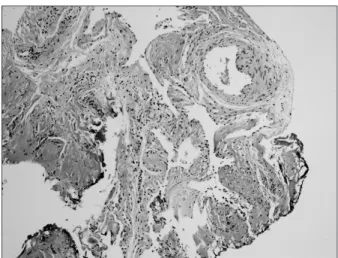
laser under local anesthesia. Four months after final excision, satisfactory result was observed in esthetic and functional aspect and recurrent tendency has not been observed yet (Fig. 4). The histopathologic finding revealed squamous epithelium with subepithelial dilated lymphatics (Fig. 5).

Discussion

Although hemangioma and vascular malformation can be classified separately according to pathologic categories, these usually considered as same disease for diagnostic concern and treatment methods. Before treatment histological diagnosis is not made in common, because hemangioma and vascular malformation both have characteristics as benign neoplasm and unnecessary bleeding can be caused during biopsy procedures.

Hemangioma is benign neoplasm caused by proliferation of

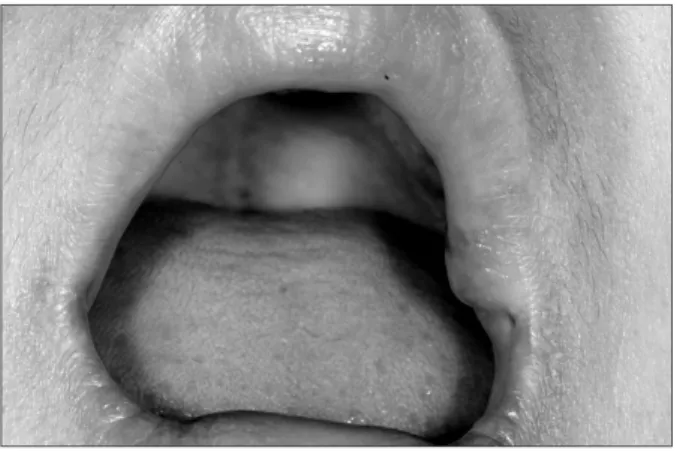
Fig. 4. Satisfactory result was observed without recurrence at four months after final excision.

Fig. 3. The size of lesion was definitely decreased after 2 times of de- compression.

Fig. 2. Decompression was done using CO

2

laser.

Fig. 1. Bluish colored non-pedunculated mass on left upper mouth

corner at first visit.

(3)

Yu-Ri Choi, Seong-Yong Moon

133 endothelial cells, and occurs in head and neck area while it is

observed rarely in oral cavity [4]. It tends to occur in young ages and female in common, while sometimes it is found at birth.

Although intrinsic and extrinsic factors have been suggested as the etiologic factors for hemangioma, the definite etiology has not been established yet and it is still under investigation.

In case of large lesion over than 3 cm size, the lesion needs to undergo differential diagnosis whether it is high flow type which has main feeding artery such as arteriovenous vascular malformation or not. If it prove as high flow type, pulsation or vibration would be commonly detectable and preoperative examination should be performed essentially such as angiography or doppler examination. In case of high flow type lesion, embolization of main feeding artery has to be preceded for prevention of life-threatening massive hemorrhage. But most of head and neck vascular lesions have small size under 3 cm and it makes the lesion to be treated under local anesthesia in outpatient clinics [5].

In intraoral area, the most common occurrence site is lip and many hemangioma lesions disappeared spontaneously without treatment. But if complication occur such as ulceration, infection, hemorrhage or airway obstruction, treatment becomes essential [6].

These days several treatment have been used for hemangioma such as systemic steroid administration, intra-lesional steroid injection for decreasing the lesion size, embolization, intra- lesional sclerotic agent injection, laser treatment and surgical excision [7]. Among them sometimes inappropriate and excessively aggressive treatment results in some problems.

Surgical excision at a time has an advantage as decreased treatment period, but it has also possibility to make patients not to accept unaesthetic result and functional problems such as mastication, speaking and swallowing [2]. However it is also necessary to consider that too much conservative excision can also lead to reoccurrence of lesion. For surgical excision, CO

2

laser makes procedure simple but it can also result in discomfort due to tissue defect thus it is often impossible to remove lesion at once in case of extensive lesion [8,9]. Except for some specific cases, the aim of treatment is to control the symptoms and preserve oral tissue and it is very important to preserve normal shape of oral structure and recover its own functions [2].

In this case report, considering esthetic and functional role of lip, hemangioma was treated with 2 times of decompression for decreasing size of lesion and 5 months after decompression, final surgical excision was done. With this treatment satisfac- tory result was presented and recurrent tendency has not been shown yet. Thus it is considered that this decompression and surgical excision method could be applied for treatment for oral hemangioma.

References

1. Watson WL, McCarthy WD: Blood and lymph vessel tumors, a report of 1,056 cases. Surg Gynec and Obst 71:569-588, 1940.

2. Dixon JA, Davis RK, Gilbertson JJ: Laser photocoagulation of vascular malformations of the tongue. Laryngoscope 96:537- 541, 1986.

3. Hurvitz CH, Alkalay AL, Sloninsky L, Kallus M, Pomerance JJ:

Cyclophosphamide therapy in life-threatening vascular tumors.

J Pediatr 109:360-363, 1986.

4. Ezekowitz RA, Mulliken JB, Folkman J: Interferon alfa-2a therapy for life-threatening hemangiomas of infancy. N Engl J Med 326:1456-1463, 1992.

5. Burkey BB, Garrett G: Use of the laser in the oral cavity.

Otolaryngol Clin North Am 29:949-961, 1996.

6. McHeik JN, Renauld V, Duport G, Vergnes P, Levard G:

Surgical treatment of haemangioma in infants. Br J Plast Surg 58:1067-1072, 2005.

7. Van Doorne L, De Maeseneer M, Stricker C, Vanrensbergen R, Stricker M: Diagnosis and treatment of vascular lesions of the lip. Br J Oral Maxillofac Surg 40:497-503, 2002.

8. Ohshiro T: The CO2 laser in the treatment of cavernous haemangioma of the lower lip: a case report. Lasers Surg Med 1:337-345, 1981.

9. Aronoff BL: The use of lasers in hemangiomas. Lasers Surg Med 1:323-335, 1981.

Fig. 5. Dilated lymphatic channels at subepithelial area (H&E, ×100).

수치

Fig. 4. Satisfactory result was observed without recurrence at four  months after final excision.
Fig. 5. Dilated lymphatic channels at subepithelial area (H&E, ×100).

참조

관련 문서