Impact of Premarital Coaching (PMC) Intervention using the Psycho-educational Approach on Parenting Self-efficacy of Newly-married Underage Couples: A Narrative Literature Review of
Evidence and Feasibility in Indonesia
Ade, Sutrimo
Graduate Student, College of Nursing, Seoul National University, Seoul, Korea
Purpose: The purpose of this study was to identify the latest evidence for interventions involving adolescent newly- weds, and the feasibility of premarital coaching (PMC). Methods: A narrative literature review design carried out through related studies was used for the present literature review. A diverse search from several databases was performed to create a critical appraisal and to develop a more integrated model for the PMC program. Studies that empirical, written in English, peer-reviewed, and published during 2008~2017 were included. Results: Six articles were selected for the review. The principal findings identified three major themes including underage peri- od as a high-risk for marriage, development tasks of the newly married spouse, parenting self-efficacy and the psycho-educational approach of PMC to enhance parenting knowledge, skills, and readiness. Conclusion: It was found that content of PMC as the preparation of underage married couples were formulated based on coaching technic, various spouse and parenting educations, and adjusted based on couples’s preferences. Rigorous stud- ies with measurement of long-term retentions are needed.
Key Words: Marriage, Parenting, Self-efficacy, Review
Corresponding author: Ade, Sutrimo
College of Nursing, Seoul National University, 103 Daehak-ro, Jongro-gu, Seoul 03080, Korea.
Tel: +82-2-740-8477, Fax: +82-2-765-4103, E-mail: [email protected] 투고일 2018년 3월 12일 / 심사완료일 2018년 4월 3일 / 게재확정일 2018년 4월 9일
INTRODUCTION 1. Background
Child marriage has become a major global concern due to the increasing number of child marriages trend. Cur- rently, it is included as one of the Sustainable Develop- ment Goals (SDGs) targets. From the The United Nations Children's Fund (UNICEF) data report, the number of un- derage marriages is estimated to be about 14.2 million annually. More than 700 million of these involved child brides, and tragically one out three were married before they turn 15 years old. Unfortunately, Indonesia has one of the highest numbers of child marriages and was ranked seventh globally for child marriage as well. The United Nations Development Economic and Social Affairs (UN DESA) revealed that, after Cambodia, Indonesia occupied
the second highest position among The Association of Southeast Asian Nations (ASEAN) countries.
1)The number of girls who were aged under 18 years at the time of marriage was 1,348,886 in 2012 (3,695 girls married per day. Moreover, 292,663 were married aged under 16 years, and 110,198 were married off before they could attain 15 years. In 2015, West Sulawesi (34.2%) and South Kalimantan (33.7%) had the highest provincial in- cidencts, while the lowest numbers were from Riau is- lands (11.7%) and Aceh (12.4%). In the district and sub- district scope analysis, information gathered from 15~19- year-olds adolescents from 106 districts showed that teen- age marriages made up 20% of underage marriages in 2010.
2)Another report showed that the top three districts in
terms of teenage marriage rates were Central Java, South
Kalimantan, and East Java; however, provincial rates could
be different because the numbers there are much higher than the national scope. In Central Java, the provincial pre- valence rate was persistently low (13.5% in 2012), but at the district level, Wonosobo had the highest prevalence rate (63% in 2010) among national districts. Moreover, there were 36 out of 1000 birth incidents for 15~19-year- old teenage couples (an average of 0.46 for live births of babies.
3)The transitional period of adolescence is highly influen- tial for a teenage couple, especially in terms of this devel- opmental phase’s impact on partnership and parenting.
While adolescenets generally do not have enough emo- tional and intellectual maturity to fulfill the requirements of married life and parenting, which are life-long, com- plex learning processes, they should be more prepared for issues they could face in their near future. The more pre- pared they are, the better quality of parenting they are able to achieve. Their readiness for future married life and parenting can be understood through the parenting self- efficacy framework. This understanding of framework covers not only knowledge and attitude but also skills and commitment to providing adequate parenting and partici- pating in the spousal relationship.
4)Parenting Self-Efficacy (PSE) can be described as pa- rents’ confidence in their ability to managing and perform parenting tasks. Potter and Hui-Chin found that the high- er the PSE score, the better their capability; they were more responsible, more responsive, and had better com- munication skills. The level of parenting readiness in cog- nitive and attitude aspects influenced the form of PSE.
Once the teenagers got married, they faced many issues, such as accepting the attributes and several roles and con- sequences of being a spouse, dealing with family in the broader context, and mostly parental issues. Preparation and readiness to face their new identity should be a con- cern for better future married life.
5)As a default program of the Indonesian government, the Ministry of Health formally created a guideline for a preparation program or educational intervention which was focused on reproduction and sexual education it was created before the Minister of Health Regulation number 97 in 2014. However, the coverage of this program is un- able to keep up with the rising demand from underage married couples. While several direct applications, tech- niques, and other aspects can cause improvement, general care can be improved based on the couple’s preferences, the interactions between the two partners, and a compre- hensive approach toward assessment, education and fu- ture plans, among specific population.
3)Bloomfield and Kendall
6)suggested the educational
method for improving PSE based on previously proven interventions. Moreover, knowledge and attitude were found to increase as well. The outcomes of education were adequate knowledge, attitude, and skills. In the psycho- education framework, education is not only understand- ing or mastering ability but also consistency and commit- ment after the program. This approach can also accom- odate adjustments based on the needs of the teenage bride or groom in their initial years and throughout their long married life after they have passed through the adoles- cence stage. This article will focus on how to identify the influences of premarital coaching (PMC) and relevant knowledge and attitude on the teenage future parent or parent-to-be in terms of PSE understanding.
2. Purpose
The purpose of this study was to identify the updated evidence regarding interventions for adolescentnewly- weds, and the feasibility of PMC in improving the PSE scores of newly married teenage couples.
METHODS
This literature review adopted a narrative synthesis ap- proach which is a textual approach method reviewing and synthesizing empirical data. It focuses on summariz- ing, integrating, and interpreting existing evidence. Nar- rative synthesis is the analysis examination of a text-based phenomenon to provide an extensive description of the predominant issues identified from a body of literature.
The narrative method approach offers a structured way of extracting and synthesizing findings of the available stud- ies to enable a more specific approach to data synthesis.
7)RESULTS
Fig. 1 showing a systematic search of the literature pub- lished between 2008 and 2017. The search was conducted to identify published studies from four electronic data- bases, namely PubMed, CINAHL, ProQuest and EBSCHO using the following terms identified from the title, ab- stract, keywords or medical subject headings: “first pa- renting educational program.”, “underage marriage.”,
“ parenting self-efficacy.”, and “psycho-education for cou-
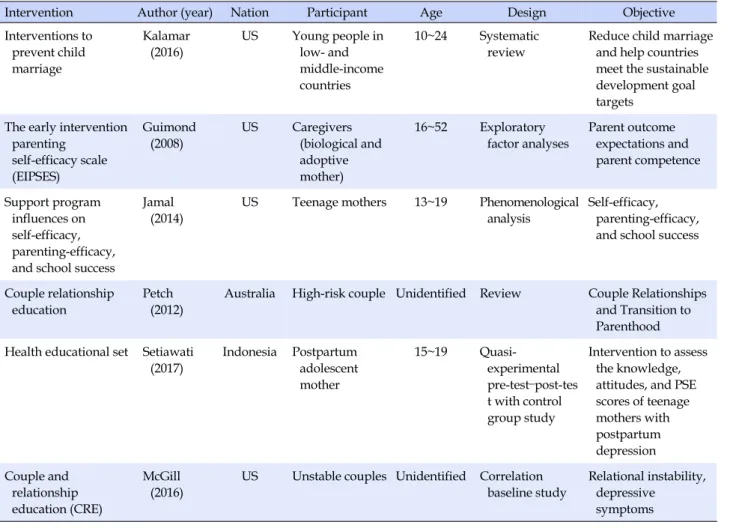
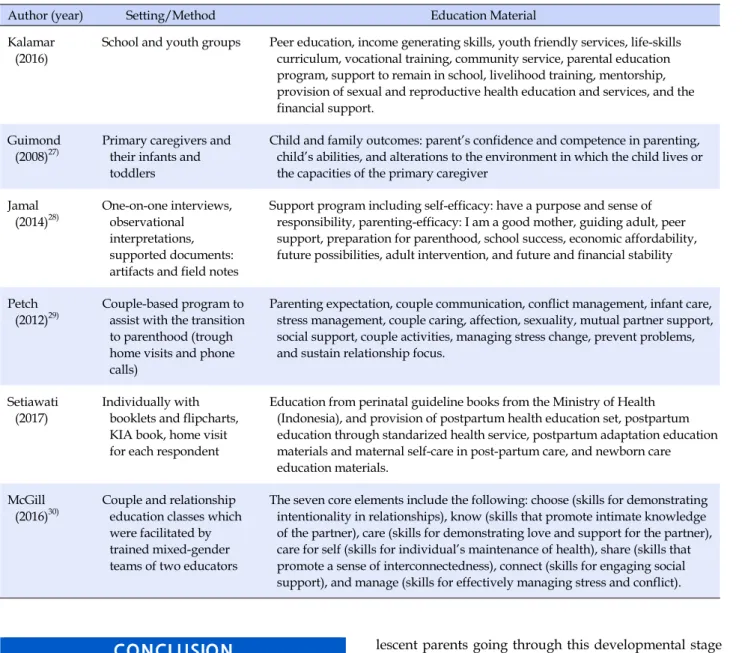
ple.” These results are shown in Table 1, which reflects the
fact that previous literature required educational content
for marital education. These materials are then discussed
in Table 2.
Pubmed proQuest CINAHL SAGE
Search term:
“first parenting educational program,”
“underage marriage,”
“parenting self-efficacy,” and
“psycho-education for couple” Excluded:
- Duplicates
- Editorials, commentary, discussion papers, and conference abstracts N=821
Articles excluded:
Descriptive, correlational studies and multi analysis
Articles screened for eligibility (n=25)
Studies Included (n=6)
Fig. 1. Flow chart of the literature review.
DISCUSSION
This study’s literature section, will focus on underage marriage among high-risk married couple, development tasks of the newly married spouses, parenting self-effi- cacy, and the psycho-educational approach of PMC for enhancing parenting knowledge, skills and readiness.
1. Adolescent Spouses as High-risk Couples and the Consequences of Adolescent Marriage The developmental stage of adolescence is an integrat- ed transition from childhood to adulthood, which is ac- companied by several marks of unsynchronized changes in biological, cognitive-emotional, and social aspects, as well as the functioning of identity relations. Although those changes positively contribute to the individual’s matura- tion, other aspects can give rise to psychological issues.
8)Biological maturation is one of the effects of adolescence;
specifically, the brain’s gray and white matter, neural den- sity changes in the prefrontal cortex, and synaptic prun- ing support the development of the cognitive functions, such that the capacity for working memory, meta-cogni- tion, and hypothetical thought also advanced. Some ad- verse effects of these developmental changes have been
linked to maladaptive thinking patterns.
9)The other aspect is cognitive-emotional; adolescents are ego-oriented and this makes it difficult them for them to have empathy.
10)This aspect could affect the unprepared couple, who are taking on the role of partner or parent- to-be. Based on Halford et al,
11)other high-risks to newly married adolescent couples are worsened by customs or religious married plans, financial issues (due to low aver- age income), a family conflict such as parental divorce, step family status, aggression or domestic violence expe- riences, and mental health-related problems.
The government of Indonesia is poised to seriously tac-
kle the child marriage issue. The latest reports in 2016
spurred an urgent concern and collaborative commitment
to intervene in underage marriage by utilizing effective
and efficient programs and legislation to take action. It
strongly possessed that underage girls should be actively
included in each response stages. These comprehensive
steps are crucial for empowerment themselves and also
creating interventions and outcome improvements be-
cause adolescent marriage negatively affects both the ado-
lescents themselves and their family units, and it will be
held as being representative of the country itself Indone-
sia should prepare to make future investments to provide
a better quality of life for this concerned population.
12)Table 1. Journal Analysis of Premarital Programs for Underage Couples
Intervention Author (year) Nation Participant Age Design Objective
Interventions to prevent child marriage
Kalamar (2016)
US Young people in low- and middle-income countries
10~24 Systematic review
Reduce child marriage and help countries meet the sustainable development goal targets
The early intervention parenting
self-efficacy scale (EIPSES)
Guimond (2008)
US Caregivers (biological and adoptive mother)
16~52 Exploratory factor analyses
Parent outcome expectations and parent competence
Support program influences on self-efficacy, parenting-efficacy, and school success
Jamal (2014)
US Teenage mothers 13~19 Phenomenological analysis
Self-efficacy, parenting-efficacy, and school success
Couple relationship education
Petch (2012)
Australia High-risk couple Unidentified Review Couple Relationships and Transition to Parenthood Health educational set Setiawati
(2017)
Indonesia Postpartum adolescent mother
15~19 Quasi- experimental pre-test–post-tes t with control group study
Intervention to assess the knowledge, attitudes, and PSE scores of teenage mothers with postpartum depression Couple and
relationship education (CRE)
McGill (2016)
US Unstable couples Unidentified Correlation baseline study
Relational instability, depressive symptoms
Officially, the 1974 Indonesian Marriage Law stipulated that parental consent was required for every marriage of a couple aged below 21 years. Under this consent law, teen- age girls can legally marry at 16 years, while males can marry at 19 years. The parents are able to request the peti- tion to the court for an exemption for an earlier marriage for their child; this dispensation has no minimum age limit. The dispensation rates are highest in three cities;
Bogor, Tuban, and Mamuju. In these cities, the approval rates were estimated to be 95% on average. International human rights treaty bodies, including the Convention on the Rights of the Child, suggested that the marital age should 18 years.
13)Moreover, adolescents who marry early also has face greater risks in terms of their personal health and well- being. Globally, one of the highest causes of deaths among 15-to-19-year-old girls is pregnancy-related mortality.
Teenage married couples tend to experience more domes- tic violence and other foms of abuse. Generally, the educa- tional and economic level of married adolescents is under
average. This drives their lower financial and social status which also inhibits their ability to eradicate their poverty cycle. This has future consequences that could directly af- fect to their children. The worst scenario occurred in 2014 when there was a loss of at least 1.7 percent in the Indone- sian GDP due to child marriage.
14)2. Newly Married Parenting Development Task and Parenting Self-efficacy
Most underage newly married couples are at nuclear
dyad stage of new marriage or stage of a new marriage
when pregnancy and child bearing are expected of them
as part of the traditional family life cycle. Their responsi-
bilities, which correspond with development tasks are estab-
lishing a strong relationship with their partner, blending
personal needs, enhancing conflict-and-resolution approaches,
developing patterns of communication and intimacy. For
dyads, who in the next steps should plan to make adjust-
ments for pregnancy, birth, and infant care, it is important
to adapt at to their new roles as couples and parents-to-be and maintain on the couple bond and intimacy.
15)Lavenda and Kestler-Peleg
16)explained the holistic un- derstanding of parenting self-efficacy which is not only described as a personal resource, but also promotes in- dividual performance and well-being. Furthermore, it can be identified as the extent of a person’s ability to perform and succeed in responsibility-orieted such as tasks or duties. For parenting, it is described as a person’s con- fidence in their capability to achieve in parenting respon- sibility. Furthermore, parental self-efficacy is also asso- ciated with spousal support.
Cohen et al
17)revealed that the emotional support from a significant other had a positive impact on parenting self- efficacy. Additionally, the data from previous research proved a negative correlation between parental stress and self-efficacy from Ebstrup et al
18)study that it can be as- sumed that parental self-efficacy was associated with a negative between stress and spousal support.
3. Pscycho-educational Approach of PMC for Im- proving Adolescent Parenting
As new parents-to-be, newly married couples generally do not have adequate preparation for their future par- enting. They must learn to face lack of knowledge, adap- tation to a new life phase and anxiety issues. Their future role as main parental units should be a major concern.
This is necessary for the betterment of their children and themselves. There are so many cases of abandoned chil- dren, domestic abuse, divorce, and other factors chil- dren’s high mortality rates, which can be attributed to un- prepared parents. Bandura
19)stated that increase in know- ledge increases would lead to escalation in their self-effi- cacy. Self-efficacy building can contribute toward the gen- eral ability and cognitive, social and attitude skills should be arranged in an integrated action for achieving the de- velopmental target. Congruent to that statement, this stu- dy’s results confirmed that a knowledge increase was fol- lowed by attitude changes and increased PSE score.
20)Information about self-efficacy is crucial for teenage couples in their new roles -as parents. The understanding of the teenage couple is exactly inadequate because the teenager did not have any child rearing experience. There- fore, most of them generally do not have any appropriate knowledge for looking after their baby and themselves. If teenage couples are unable to fulfill their new responsi- bilities as a new couple, it creates incompetence and feel- ings of hopelessness that could affect their care for their baby. Psychological problems are not only caused due to
of deficit in knowledge but also due to negative attitudes.
According to Holub et al,
21)stress comes from the neg- ative feelings of the teenage couple toward their own sta- tus as parents-to-be; they are less likely to pay attention to their task and unable to accomplish their new roles. This situation could lead to postpartum depression.
22)Postpar- tum teenage couples need substantial education as one of the basic forms of social support for achieving their role as a couple and to improve their parenting self-efficacy.
4)These results in accordance with the results of the article review by Oliveira and Néné
23)on learning needs.
Weiss and Lokken
24)stated that knowledge, attitude, and the ability of the couple would affect the couple’s readiness, confidence, and ability to assume their parental roles. According to Buchko and Gutshall
25)it is important for nurses to provide efficient and effective educational materials to new teenage parents. Focusing on and select- ing lesson materials based on the patient’s condition al- lows the nurse to efficiently deliver health education to the newly married couple.
This method can make it easier for nurses to support and communicate with new couples about their learning needs. In addition, support from responsible health pro- viders can improve parenting self-efficacy and help the postpartum couple achieve various stages in their couple role. It was also found that the health education set was effective in improving knowledge, attitudes and post- partum parenting self-efficacy.
26)The content of PMC is focused on meeting direct pa- renting needs by exploring or reflecting on methods for improving their state of preparedness in the initial ses- sion. It also includes assessment of the couple’s points of view, sorting out their issues, analysis of the actual con- dition of their family, and setting therapy goal. The main sessions involve educational materials and sessions re- lated various issues, including three sessions -depending on the client’s preference- which focus on communication skills, conflict resolution, parenting roles, family plan- ning, perinatal health strategies, children’s growth and development, parenting skills, and long-life learning me- thod to continue education. The educational contents are based on the Ministry of Health’s guidelines, other cur- rent guidelines, related books, and relevant research.
Lastly, the final session is focused on the topic of how to
prepare for married life, parenting and next family envi-
ronment which can be an output of the marriage action
plan. There are total of five sessions of 30~60 minutes each,
which are held during each meeting, trained educator or
registered nurse which who is considered qualified only
after taking a training preparation course.
Table 2. Educational Content Summary of the Selected Interventions and Evaluations
Author (year) Setting/Method Education Material
Kalamar (2016)
School and youth groups Peer education, income generating skills, youth friendly services, life-skills curriculum, vocational training, community service, parental education program, support to remain in school, livelihood training, mentorship, provision of sexual and reproductive health education and services, and the financial support.
Guimond (2008)27)
Primary caregivers and their infants and toddlers
Child and family outcomes: parent’s confidence and competence in parenting, child’s abilities, and alterations to the environment in which the child lives or the capacities of the primary caregiver
Jamal (2014)28)
One-on-one interviews, observational interpretations, supported documents:
artifacts and field notes
Support program including self-efficacy: have a purpose and sense of responsibility, parenting-efficacy: I am a good mother, guiding adult, peer support, preparation for parenthood, school success, economic affordability, future possibilities, adult intervention, and future and financial stability
Petch (2012)29)
Couple-based program to assist with the transition to parenthood (trough home visits and phone calls)
Parenting expectation, couple communication, conflict management, infant care, stress management, couple caring, affection, sexuality, mutual partner support, social support, couple activities, managing stress change, prevent problems, and sustain relationship focus.
Setiawati (2017)
Individually with booklets and flipcharts, KIA book, home visit for each respondent
Education from perinatal guideline books from the Ministry of Health (Indonesia), and provision of postpartum health education set, postpartum education through standarized health service, postpartum adaptation education materials and maternal self-care in post-partum care, and newborn care education materials.
McGill (2016)30)
Couple and relationship education classes which were facilitated by trained mixed-gender teams of two educators
The seven core elements include the following: choose (skills for demonstrating intentionality in relationships), know (skills that promote intimate knowledge of the partner), care (skills for demonstrating love and support for the partner), care for self (skills for individual’s maintenance of health), share (skills that promote a sense of interconnectedness), connect (skills for engaging social support), and manage (skills for effectively managing stress and conflict).
CONCLUSION
The huge prevalence of underage marriage is becoming a worldwide concern for the target population and the health sector. High-risk teenage populations are still strug- gling through the maturation phase of development ado- lescence, which affects almost every aspect of their lives. It could worsen their married life as a spouse and future parent. The adolescence stage of development could wor- sen many aspects of their future life. Parenting self-effi- cacy is a comprehensive concept for covering the personal and social aspects and parenting ability. Previous empiri- cal interventions were most likely to be performed to en- hance PSE. The proven education program, which is the first line of the effectiveness of the psycho-educational ap- proach for first-time parenting, can be the solution for ado-
lescent parents going through this developmental stage assorted on the sort-term and longer stages provided by the training preparation course.
There are several concerning limitations in this review.
First, there needs to be an improvement of the methodo-
logical review. The age restriction employed in of previ-
ous evaluated articles varies across studies. In fact, nearly
all the interventions that did not clearly show entirely posi-
tive outcomes. The inclusion of a particular intervention
with the same outcome is another issue. For example, if a
group reported on short-term and longer-term follow-ups
of a pregnancy, we use the most recent report on the inter-
vention and its impact. This limitation would bias the in-
tervention results toward the impact. Despite these limi-
tations, this review contributes to the improvement of
well-designed intervention.
REFERENCES
1. Ministry of Health Republic (ID). 2015 Profil kesehatan In- donesia [2015 Health profile Indonesia] [Internet]. Jakarta:
Ministry of Health (ID); 2016 [cited 2018 Jan 25]. 403 p. Avail- able from:
http://www.depkes.go.id/resources/download/pusdatin/p rofil-kesehatan-indonesia/profil-kesehatan-Indonesia-2015.
pdf Indonesian
2. Sammon EM, Martinez M, Jagmag M, Wahyudi R. Overview of promising practices in adolescent programming in Indo- nesia by UNICEF (and other partners) [Internet]. [place un- known]: Oxford Policy Management; 2017 Jul 14 [cited 2018 Jan 25]. 62 p. Available from:
https://www.unicef.org/indonesia/Overview_of_Promising _Practices_in_Adolescent_Programming_in_Indonesia.pdf 3. Statistics Indonesia; National Population and Family Planning
Board (ID); Ministry of Health (ID); ICF International. Indone- sia demographic and health survey 2012 [Internet]. Jakarta (ID): Statistics Indonesia; 2013 [cited 2018 Jan 25]. 544 p. Avail- able from:
https://www.dhsprogram.com/pubs/pdf/FR275/FR275.pdf 4. DeVito J. How adolescent mothers feel about becoming a par-
ent. J Perinat Educ. 2010 Spring;19(2):25-34.
https://doi.org/10.1624/105812410X495523
5. Meliala A. Succesful Parenting. Bogor: Bypass; 2012. 124 p.
6. Bloomfield L, Kendall S. Testing a parenting programme eval- uation tool as a pre-and post-course measure of parenting self- efficacy. J Adv Nurs. 2007 Dec;60(5):487-93.
https://doi.org/10.1111/j.1365-2648.2007.04420.x
7. Kalamar AM, Lee-Rife S, Hindin MJ. Interventions to prevent child marriage among young people in low-and middle-in- come countries: a systematic review of the published and gray literature. J Adolesc Health. 2016 Sep;59(3 Suppl):S16-21.
https://doi.org/10.1016/j.jadohealth.2016.06.015
8. Lohmann RC. Teen anxiety: a CBT and ACT activity resource book for helping anxious adolescents. London (UK): Jessica Kingsley Publishers; 2014. 240 p.
9. Casey BJ, Ruberry EJ, Libby V, Glatt CE, Hare T, Soliman F, et al. Transitional and translational studies of risk for anxiety.
Depress Anxiety. 2011 Jan;28(1):18-28.
https://doi.org/10.1002%2Fda.20783
10. Partridge BC. Adolescent psychological development, parent- ing styles, and pediatric decision making. J Med Philos. 2010 Oct;35(5):518-25. https://doi.org/10.1093/jmp/jhq044 11. Halford WK, O'donnell C, Lizzio A, Wilson KL. Do couples at
high risk of relationship problems attend premarriage educa- tion?. J Fam Psychol. 2006 Mar;20(1):160-3.
https://doi.org/10.1037/0893-3200.20.1.160
12. Ministry of Health (ID); The United Nations Children's Fund.
Child marriage in Indonesia: progress on pause [Internet].
Jakarta (ID): Ministry of Health (ID); 2016 [cited 2018 Jan 25]. 7 p. Available from:
https://www.unicef.org/indonesia/UNICEF_Indonesia_Chi ld_Marriage_Reserach_Brief_.pdf
13. United Nations Children's Fund. Legal protection from violen- ce: analysis of domestic laws related to violence against child- ren in ASEAN member States [Internet]. Bangkok: UNICEF EAPRO; 2015 [cited 2018 Jan 25]. 276 p. Available from:
https://www.unicef.org/eapro/ASEAN_VAC(1).pdf 14. Rabi A, Rumble L, Irdiana N, Helscher P, Suharti. The cost of
inaction: child and adolescent marriage in Indonesia [Internet].
Paper presented at: 10th ISPCAN Asia Pacific Regional Confer- ence on Child Abuse and Neglect; 2015 Oct 25-27; Kuala Lum- pur, Malaysia. Available from:
https://www.researchgate.net/profile/Lauren_Rumble/pub lication/283084606_The_cost_of_inaction_Child_marriage_in _Indonesia/links/5629d50608ae22b17030eaef/The-cost-of-in action-Child-marriage-in-Indonesia
15. Kaakinen JR, Coehlo DP, Steele R, Tabacco A, Hanson SMH.
Family health care nursing: theory, practice, and research. 5th ed. Philadelphia(PA): F.A. Davis; 2014. 649 p.
16. Lavenda O, Kestler-Peleg M. Parental self-efficacy mitigates the association between low spousal support and stress. Psychiatry Res. 2017 Oct;256:228-30.
https://doi.org/10.1016/j.psychres.2017.06.060
17. Cohen SR, Holloway SD, Domínguez-Pareto I, Kuppermann M. Support and self-efficacy among Latino and White parents of children with ID. Am J Intellect Dev Disabil. 2015 Jan;120 (1):16-31. https://doi.org/10.1352/1944-7558-120.1.16 18. Ebstrup JF, Eplov LF, Pisinger C, Jorgensen T. Association be-
tween the Five Factor personality traits and perceived stress: is the effect mediated by general self-efficacy?. Anxiety Stress Coping. 2011 Jul;24(4):407-19.
https://doi.org/10.1080/10615806.2010.540012
19. Bandura A. Self-efficacy: toward a unifying theory of behav- ioral change. Psychol Rev. 1977 Mar;84(2):191-215.
https://doi.org/10.1037/0033-295X.84.2.191
20. Raynor PA. An exploration of the factors influencing parental self-efficacy for parents recovering from substance use dis- orders using the social ecological framework. J Addict Nurs.
2013 Apr-Jun;24(2):91-9.
https://doi.org/10.1097/JAN.0b013e3182922069
21. Holub CK, Kershaw TS, Ethier KA, Lewis JB, Milan S, Ickovics JR. Prenatal and parenting stress on adolescent maternal adjustment: identifying a high-risk subgroup. Matern Child Health J. 2007 Mar;11(2):153-9.
https://doi.org/10.1007/s10995-006-0159-y
22. Leahy-Warren P, McCarthy G. Maternal parental self-efficacy in the postpartum period. Midwifery. 2011 Dec;27(6):802-10.
https://doi.org/10.1016/j.midw.2010.07.008
23. de Oliveira PS, Nene M. Nursing care needs in the postpartum period of adolescent mothers: systematic review. J Nurs UFPE.
2014 Nov;8(11):3953-61.
https://doi.org/10.5205/reuol.6679-58323-1-ED.0811201419 24. Weiss ME, Lokken L. Predictors and outcomes of postpartum
mothers' perceptions of readiness for discharge after birth. J Obstet Gynecol Neonatal Nurs. 2009 Jul-Aug;38(4):406-17.
https://doi.org/10.1111/j.1552-6909.2009.01040.x
25. Buchko BL, Gutshall CH, Jordan ET. Improving quality and efficiency of postpartum hospital education. J Perinat Educ.
2012 Fall;21(4):238-47.
https://doi.org/10.1891/1058-1243.21.4.238
26. Setiawati N, Setyowati, Budiati T. SETIA Health education set enhances knowledge, attitude, and parenting self-efficacy score in postpartum adolescent mothers. Compr Child Adolesc Nurs.
2017;40(sup1):114-27.
https://doi.org/10.1080/24694193.2017.1386979
27. Guimond AB, Wilcox MJ, Lamorey SG. The Early Intervention Parenting Self-Efficacy Scale (EIPSES): scale construction and initial psychometric evidence. J Early Interv. 2008 Sep;30(4):
295-320. https://doi.org/10.1177/1053815108320814 28. Jamal L. Teen mother perceptions of support program influen-
ces on self-efficacy, parenting-efficacy, and school success [dis- sertation]. Omaha, NE: College of Saint Mary; 2014. 184 p.
29. Petch J, Halford WK, Creedy DK, Gamble J. Couple relation- ship education at the transition to parenthood: A window of opportunity to reach high-risk couples. Fam Process. 2012 Dec;
51(4):498-511.
https://doi.org/10.1111/j.1545-5300.2012.01420.x
30. McGill J, Adler-Baeder F, Bradford AB, Kerpelman J, Ketring SA, Sollie D. The role of relational instability on individual and partner outcomes following couple relationship education participation. Fam Relat. 2016 Jul;65(3):407-23.
https://doi.org/10.1111/fare.12201