• 검색 결과가 없습니다.

1-D Shear Wave Velocity Structure of Northwestern Part of Korean Peninsula

N/A
N/A
Protected

Academic year: 2021

Share "1-D Shear Wave Velocity Structure of Northwestern Part of Korean Peninsula"

Copied!
6
0
0

로드 중.... (전체 텍스트 보기)

전체 글

(1)

http://dx.doi.org/10.9719/EEG.2019.52.6.555

555

This is an Open Access article distributed under the terms of the Creative Commons Attribution Non-Commercial License (http://creativecommons.org/licenses/by-nc/3.0) which permits unrestricted non-commercial use, distribution, and reproduction in any medium, provided original work is properly cited.

*Corresponding author: [email protected]

1-D Shear Wave Velocity Structure of Northwestern Part of Korean Peninsula

Tae Sung Kim*

Earthquake Research Center, Korea Institute of Geoscience and Mineral Resources (KIGAM), Daejeon 34132, Republic of Korea

한반도 북서부의 1차원 전단파 속도구조

김태성*

한국지질자원연구원 지진연구센터, 대전광역시 유성구 과학로 124 (Received: 18 December 2019 / Accepted: 23 December 2019)

중국 지역 4개 지진에서 발생한 2~30초 범위의 레일리파를 이용하여 북한 지역의 1차원 전단파 속도구조를 구하였다.

레일리파는 남북한의 국경선 인근에 위치한 5개의 광대역 관측소(BRD, SNU, CHNB, YKB, KSA)에 양호하게 기록되 었다. 다중필터분석를 이용하여 레일리파 기본모드 군속도가 계산되었고 이는 다시 위상부합필터를 적용하여 개선되었 다. 2.9~3.2 km/s의 범위에 이르는 평균 분산곡선을 역산하여 전단파 속도를 구하였다. 지진원으로부터 BRD 관측소의 경로에서 추출된 4~6초 주기의 상대적으로 느린 군속도는 서해 서한만분지의 퇴적층군과 연관되었을 가능성이 있다.

14~20km 의 상대적으로 깊은 지역 전단파 저속도층은 평남분지와 관련된 것으로 생각되며 낭림육괴와 평남분지에 분포

하는 변성암 및 화강암체는 표면부터 14km 깊이의 빠른 전단파 속도와 일치한다.

주요어 : 전단파 속도구조, 레일리파 군속도 분산곡선, 서한만분지, 평남분지, 낭림육괴

One-dimensional shear wave velocity structure of North Korea is constrained using short (2-sec) to long period (30- sec) Rayleigh waves generated from four seismic events in China. Rayleigh waves are well recorded at the five broadband seismic stations (BRD, SNU, CHNB, YKB, KSA) which are located near to the border between North and South Korea.

Group velocities of fundamental-mode Rayleigh waves are estimated with the Multiple Filter Analysis and refined by using the Phase Matched Filter. Average group velocity dispersion curve ranging from 2.9 to 3.2 km/s, is inverted to con- strain the shear wave velocity structures. Relatively low group velocity dispersion curves along the path between the events to BRD at period from 4 to 6 seconds may correspond to the sedimentary sequence of the West Korea Bay Basin (WKBB) in the Yellow Sea. The low velocity zone in deep layers (14-20 km) may be related to the deep sedimentary structure in Pyongnam basin. The fast shear wave velocity structure from the surface to the depth of 14 km is consistent with the existence of metamorphic rocks and igneous bodies in Nangrim massif and Pyongnam basin.

Key words : shear wave velocity structure, Rayleigh wave group velocity dispersion curve, West Korea Bay Basin, Pyongnam basin, Nangrim massif

1. Introduction

It is necessary to have a well-constrained

regional seismic velocity model to understand the

crustal structure of North Korea and to decode the

source parameters of the natural and man-made

(2)

events occurring in North Korea. Particularly the attention on the analysis using regional seismic signals has been intensively increased since North Korea’s first nuclear test on October 9, 2006.

However, the essential part, the velocity structure of North Korea is not well constructed until now.

The estimates on the crustal structure of southern part of Korean Peninsula have been carried out by utilization of travel times (Kim and Kim, 1983;

Kim and Jung, 1985; Kim, 1995; Song and Lee 2001; Cho et al., 2006), joint inversion using shear wave phase velocity dispersion and receiver function (Chang et al., 2004; Chang and Baag, 2005), joint inversion using surface wave dispersion curves from ambient noise and receiver function for constraining a 3-D shear wave velocity structure of southern part of Korean Peninsula (Yoo et al., 2007) and shear wave group velocity variation derived from noise correlation function (Kang and Shin, 2006). The crustal studies on the northern part of Korean Peninsula, however, were limited in number of studies. For hydrocarbon and petroleum resources exploration, several studies reported basin structures of Northern Yellow Sea (Massoud et al., 1991; Wu et al., 2008). These studies didn’t include the mainland of North Korea and shear wave velocity model. A simplified two-layer P wave velocity model of North Korea was reported (Paek et al., 1996). The report, however, didn’t describe shear wave velocity structure of North Korea.

In this paper, one-dimensional shear wave velocity structure of northwestern part of Korean Peninsula is presented based on surface wave dispersion analysis. The seismic signals generated from four earthquakes in China mainly propagated through the crust and upper mantle of North Korea and the Yellow Sea. The surface waves from the events gave an opportunity to constrain one-dimensional

shear wave velocity structure in the northwestern part of Korean Peninsula.

2. Data and Method

The Haicheng area in China, which belongs to southern Liaoning Province, is a seismically active area because of natural earthquakes from active faults (Deng et al. 2003) and man-made events from large mining activities. Historically there was a M 7.3 event in 1975, which was caused by the left-lateral slip of a northwest-trending fault (Wang et al., 2006).

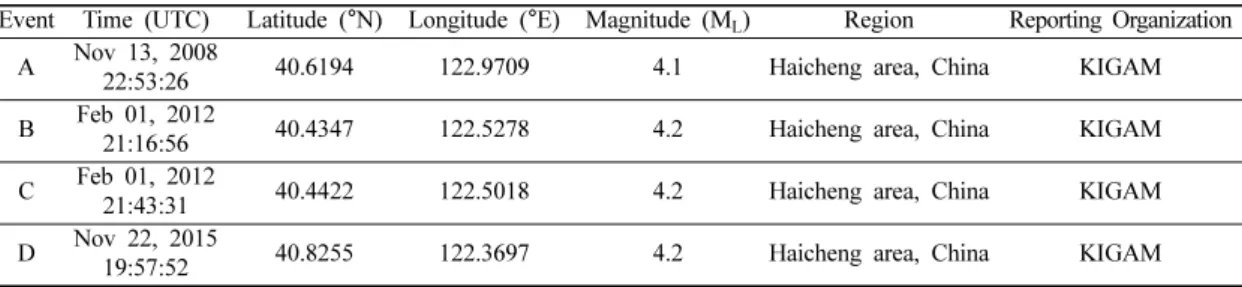
Four earthquake greater than M

L

4.0 have occurred in the Haicheng area of China since November 13, 2008 (Table 1). Seismic Signals from these earthquakes were recorded at the seismic stations in South Korea. Between these stations, five broadband seismic stations (BRD, SNU, CHNB, YKB, KSA) in South Korea were chosen for the analysis (Fig. 1). The stations are located near to the border between North and South Korea. The stations are equipped with STS- 2 seismometers except for YKB in which a CMG3TB is installed. The data stream of 20 Hz sampling rate is selected for the analysis.

Clear surface waves are observed as well as body wave phases P

n

, P

g

, L

g

in the raw data (Fig. 2).

Two data streams recorded at BRD from the two 2012 events are not included for the analysis due to the poor data quality (Fig. 2b). The period of surface wave ranges from short (~2 seconds) to long period (~30 seconds). In this study, we focus on short to long period Rayleigh waves to constrain the shear wave velocity structure in study area.

Fundamental-mode group velocity dispersion curves of Rayleigh wave are extracted by using the Multiple Filter Analysis (MFA; Dziewonski et al.,

Table 1. Event Information

Event Time (UTC) Latitude ( °N) Longitude (°E) Magnitude (M

L

) Region Reporting Organization A Nov 13, 2008

22:53:26 40.6194 122.9709 4.1 Haicheng area, China KIGAM

B Feb 01, 2012

21:16:56 40.4347 122.5278 4.2 Haicheng area, China KIGAM

C Feb 01, 2012

21:43:31 40.4422 122.5018 4.2 Haicheng area, China KIGAM

D Nov 22, 2015

19:57:52 40.8255 122.3697 4.2 Haicheng area, China KIGAM

(3)

1969). MFA is a moving-window technique applied in the frequency domain. Signal’s amplitudes in the frequency (period) and group velocity domain are estimated through the MFA. After applying MFA to Rayleigh waves, Phase Matched Filter (PMF; Herrin and Goforth, 1977) is adopted to remove multi-pathing or higher mode surface waves that may bias group velocity estimation.

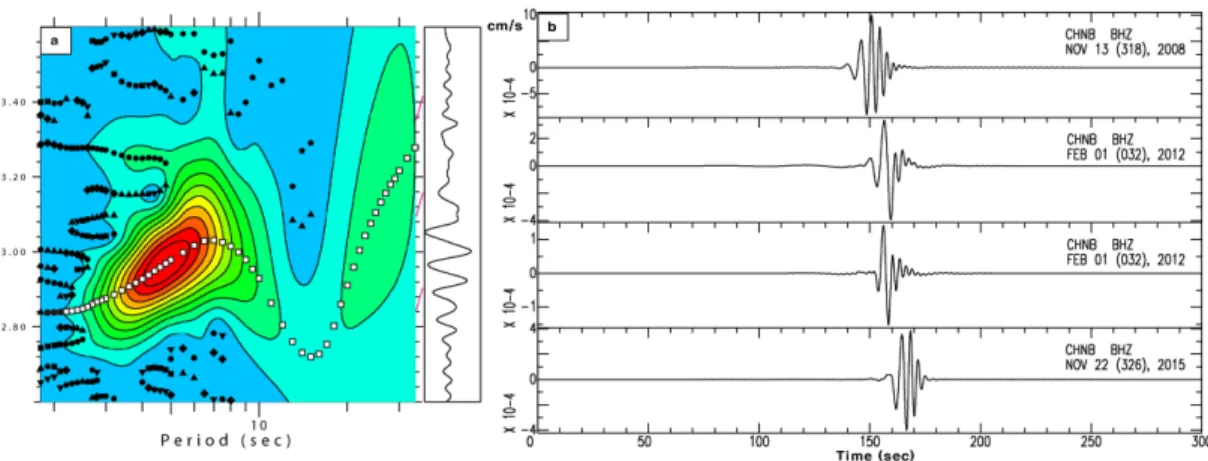
Fig. 3 illustrates an example of fundamental- mode Rayleigh dispersion curve and waveforms after applying the MFA and PMF to the vertical component seismograms recorded at CHNB. All the group velocity dispersion curves in study area are used to calculate average dispersion curve with standard deviation at each period (Fig. 4a). The average group velocity dispersion curves range from 2.9 to 3.2 km/s.

Rayleigh dispersion curve is primarily affected by the P-wave velocity, shear-wave velocity, layer thickness, density and quality factor Q. The shear- wave velocity, however, has the strong influence on the Rayleigh wave dispersion curve (Mooney and Bolt, 1966; Busher and Smith, 1971; Bache et al., 1978) and will be the main parameter determined from the inversion procedure with fixed layer thickness. The inversion method is an iterative, stochastic least squares method for estimating shear wave velocity at each layer. The inversion method for this study used the inversion scheme Fig. 1. Map of study area is illustrated. The red circles

represent four earthquakes occurred in Haicheng area while five blue triangles represent broad band seismic stations in South Korea. A yellow triangle is MUS station at which the velocity profile of the initial model 2 was estimated (Yoo et al., 2007). Tectonic boundaries (white) within Korean Peninsula (Lee, 1988) and part of West Korea Bay Basin boundaries (WKBB, red) in the Yellow Sea (Wu et al., 2008) are shown. The numbered regions are the names of the main geological blocks; 1. Tumangang Basin, 2. Paektusan Volcanic Plateau, 3. Kwanmobong Uplift, 4. Kilju-Myoungchoen Basin, 5. Hyesan-Iwon Basin, 6. Nangrim Massif, 7. Pyongnam Basin, 8. Anju Basin, 9. Imjingang Foldbelt, 10. Kyonggi Massif, 11. East Sag of WKBB, 12. West Sag, 13. West Swell, 14.

North Sag, 15. North Swell, 16. South Sag, 17. South Swell.

Fig. 2. Seismic signals from the four events recorded at five stations are displayed with total length of 300 seconds. The

event information is summarized in Table 1. (a) Top trace is the vertical component seismic signal recorded at CHNB from

the event A. Second trace is the signal from the event B. Third trace is the signal from the event C. Bottom trace is the signal

from the event D. (b) Seismograms at BRD. The same relationship as demonstrated in Fig. 2a. The second and third traces

show poor data quality. These data are not included in the analysis. (c) Seismograms at SNU. The same relationship as

demonstrated in Fig. 2a. (d) Seismograms at KSA. The same relationship as demonstrated in Fig. 2a. (e) Seismograms at

YKB. The same relationship as demonstrated in Fig. 2a.

(4)

written by Herrmann (2006).

Before starting inversion process, a careful consideration for choosing initial model was taken into account because a proper initial model will lead to the optimum velocity model which is near to the real velocity structure in study area. First, a two-layer shear wave velocity model is considered as a candidate for the initial model. This model was attained based on the P wave velocity model of northeastern part of Korean Peninsula (Paek et al., 1996). The first layer is the granitic crust from

surface down to 15 km while the second layer is the basaltic crust from 15 km to the crust-mantle boundary at 32 km. The P wave velocities for the first and second layer are 5.96 km/s and 6.7 km/s, respectively. The shear wave velocity is assumed using Poisson’s ratio of 0.25 (Fig. 4b). Second, a five-layer shear wave velocity model from a joint inversion study (Yoo et al., 2007) is considered as the other candidate for the initial model. According to Yoo et al. (2007), profiles of the 3D shear wave velocity structure in the southern part of Korean Fig. 3. Examples of multiple filter analysis (MFA) and phase matched filter (PMF) at CHNB are illustrated. (a) A dispersion curve of the fundamental-mode Rayleigh wave at CHNB from the event A is extracted through MFA. (b) Fundamental-mode Rayleigh waves after applying PMF for the four events recorded at CHNB are shown. The signals arranged in the order of ascending from event A to D are shown.

Fig. 4. Summary of Rayleigh wave dispersion curves, initial models and inverted model. (a) Dispersion curves along the path of

inland (gray), yellow sea (green) and the average dispersion curve (red) are compared to each other. The blue bars represent

standard deviations. (b) Two initial shear wave velocity models (broken lines) are compared with the inverted shear wave

velocity model (red). The initial model 1 was from Paek et al., 1996 while the initial model 2 was from Yoo et al., 2007.

(5)

Peninsula is calculated at 81 stations by combining the benefits of surface wave dispersion curves and receiver function. This model is robust compared to the first candidate of initial model in minimizing tradeoff between shear wave velocity and crustal thickness with joint inversion method. Therefore, we choose second candidate’s shear wave velocity profile at MUS station as the initial model. MUS station is near to our study area (Fig. 1).

3. Results and Discussion

Inversion process is performed iteratively until the fit between observed and calculated dispersion curve reaches more than 99.5 %. Fig. 4a shows that observed average group velocity dispersion curve and calculated fit for the path of northwestern part of Korean Peninsula. The shear wave velocity in the inverted one-dimensional model increases generally from 3.23 km/s to 3.93 km/s with depth increase from the surface to the crust-mantle boundary at 32 km except a low velocity zone (LVZ) for the depth from 14 to 20 km (Fig. 4b).

The geological setting in study area can be divided into two environments; geology in North Korea’s mainland and the Yellow Sea. The Nangrim massif and Pyongnam basin composes most part of North Korea’s mainland (Fig. 1). Nangrim massif consists of Precambrian crystalline schist and gneiss with the intrusion of Triassic to Jurassic granitoid while the Pyongnam Paleozoic basin is overlying the massif with the lower marine and the upper terrestrial sedimentary sequences (Lee, 1988). On the other hand, the geological feature of the Yellow Sea is quite different from that of the mainland. Wu et al., 2008, reviewed the research results on the Yellow Sea from 1950s when the study on the Yellow Sea was motivated due to the need for exploring hydrocarbon. They grouped sedimentary basins into three groups; the North Yellow Sea Basin (NYSB) or the West Korea Bay Basin (WKBB), the northern basin of the South Yellow Sea (SYSNB) and the southern basin of the South Yellow Sea (SYSSB). The WKBB is located in the northern area of the Yellow Sea, which is western offshore of North Korea. As it is illustrated in Fig. 1, the propagation path from the events to BRD crosses the eastern depression of WKBB. The WKBB is the one of significant

tectonic unit developed in the Nangrim massif, and mainly consists of Late Mesozoic and Early Cenozoic sequences with Quaternary unfolded sedimentary top layers. The WKBB between Haiyang Island Rise and Liugong Island Rise shows the series of graben, host, fault structure, and extends to the Anju onshore of the North Korea. Based on the interpreted seismic sequences, the thickness of strata is reported as 5.3 to 6.6 km (Wu et al., 2008;

Massoud et al., 1991). Deep sags exist along active faults and sediments deposit during rifting since Late Cretaceous.

The group velocity dispersion curve for the path to BRD from 4 to 6 seconds may be closely related to the sedimentary basin structure of WKBB even though an inverted velocity model is not calculated (Fig. 1, Fig. 4). The LVZ calculated in the inverted 1-D model, estimated for the path from the four events to five stations, is located from 14 to 20 km.

This LVZ may be correlated with the Pyongnam Paleozoic basin composing of marine sedimentary sequences at lower crust. The relationship between LVZ and tectonic structure needs further investigation in the future. The relatively fast shear wave velocity from surface to the depth of 14 km, which varies from 3.23 to 3.37 km/s, can be related to the existence of igneous and metamorphic rocks such as mafic intrusions and quartzite in study area.

These rock types have relatively higher shear modulus (Kim and Bae, 2006), which explains fast shear wave velocity along the path in study area.

4. Conculsion

Short (2-sec) to long (30-sec) period Rayleigh waves generated from the four earthquakes from Haicheng area were well recorded at the five broadband stations in South Korea. The fundamental- mode group velocity dispersion curves from Rayleigh waves were estimated using MFA and PMF. The average group velocity dispersion curves were inverted to constrain one-dimensional shear wave velocity structure in northwestern part of Korean Peninsula by using an iterative, stochastic linear inversion method.

Relatively low group velocity dispersion curve

along the path to BRD at period from 4 to 6

seconds may correspond to the Late Mesozoic and

Early Cenozoic sedimentary sequences in the

(6)

WKBB. The LVZ, estimated at the depth from 14 to 20 km for the propagation path in northwestern part of Korean Peninsula, may be correlated with the marine sedimentary sequence of the Pyongnam basin, which needs more study to verify the relationship between the two. The igneous body and metamorphic rocks in study area, which have relatively higher shear modulus, may affect the increase of group velocity along the path and result in relatively faster shear wave velocity structure.

In this paper, a study on the one-dimensional shear wave velocity structure of North Korea was calculated using a simple and classical surface wave analyzing methodology. The attained one dimensional shear wave velocity structures could be further used as the initial model for updating the shear wave velocity structure of North Korea from additional studies on the velocity structure in the future.

Acknowledgement

This work was supported by the Basic Research Project of the Korea Institute of Geoscience and Mineral Resources (KIGAM) funded by the Ministry of Science and ICT of Korea.

References

Bache, T.C., Rodi, W.L. and Harkrider, D.G. (1978) Crustal structures inferred from Rayleigh-wave signatures of NTS explosions. Bulletin of the Seismological Society of America, v.68, p.1399-1413.

Busher, R.L. and Smith, R.B. (1971) Crustal structure of the Eastern Basin and Range Province and the Northern Colorado Plateau from phase velocities of Rayleigh waves . Geophysical Monograph Series Vol. 14: The Structure and Physical Properties of the Earth’s Crust.

American Geophysical Union, p.59-70.

Chang, S., Baag, C. and Langston, C.A. (2004) Joint anal- ysis of teleseismic receiver functions and surface wave dispersion using the genetic algorithm. Bulletin of the Seismological Society of America, v.94, p.691-704.

Chang, S. and Baag, C. (2005) Crustal structure in Southern Korea from joint analysis of teleseismic receiver func- tions and surface-wave dispersion. Bulletin of the Seis- mological Society of America, v.95, p.1516-1534.

Cho, K.H., Herrmann, R.B., Ammon, C.J. and Lee, K.

(2006) Imaging the Upper Crust of the Korean Pen- insula by Surface-Wave Tomography. Bulletin of the Seismological Society of America, v.97, p.198-207.

Deng, Q., Zhang, P., Ran, Y., Yang, X., Min, W. and Chu,

Q. (2003) Basic characteristics of active tectonics of China. Science China Earth Sciences, v.46, p.356-372.

Dziewonski, A., Bloch, S. and Landisman, M. (1969) A Technique for the Analysis of Transient Seismic Sig- nals. Bulletin of the Seismological Society of America, v.59, p.427-444.

Herrin, E.S. and Goforth, T. (1977) Phase-matched filters:

application to the study of Rayleigh waves. Bulletin of the Seismological Society of America, v.67, p.1250- 1275.

Herrmann, R. (2006) Surface wave inversion program, Computer Programs in Seismology. Saint Louis Uni- versity.

Kang, T.S. and Shin, J.S. (2006) Surface-wave tomography from ambient seismic noise of accelerograph networks in southern Korea. Geophysical Research Letters, v.33, L17303.

Kim, S.J. and Kim, S.G. (1983) A study on the crustal struc- ture of South Korea by using Seismic Waves. Journal of the Korean Institute of Mineral and Mining Engineers, v.16, p.51-61.

Kim, S.K. (1995) A study on the crustal structure of the Korean Peninsula. Journal of the Geological Society of Korea, v.31, p.393-403.

Kim, S.K. and Jung, B.H. (1985) Crustal Structure of the Southern Part of Korea. Journal of the Korean Institute of Mineral and Mining Engineers, v.18, p.151-157.

Kim, S.K. and Bae, H.-S. (2006) Investigation of Post-seis- mic Sites Using Local Seismic Tomography in the Korean Peninsula. Economic and Environmental Geol- ogy, v.39, p.111-128.

Lee, D.S. (1988) Geology of Korea. Kyohak-Sa, Seoul, 514 p.

Massoud, M.S., Killops, S.D., Scott, A.C. and Mattery, D.

(1991) Oil Source Rock Potential of the Lacustrine Jurassic Sim Uuju Formation, West Korea Bay Basin.

Journal of Petroleum Geology, v.14, p.365-386.

Mooney, H. and Bolt, B. (1966) Dispersive characteristics of the first three Rayleigh modes for a single surface layer. Bulletin of the Seismological Society of America, v.56, p.46-67.

Paek, R.J., Kan, H.G., Jon, G.P., Kim, Y.M. and Kim, Y.H.

(1996) Geology of Korea. Geological Institute Academy of Sciences DPR of Korea, p.451-471.

Song, S.G. and Lee, K. (2001) Crustal structure of the Korean Peninsula by travel time inversion of local earthquakes. Journal of the Geological Society of Korea, p.21-33.

Wang, K., Chen, Q.-F., Sun, S. and Wang, A. (2006) Pre- dicting the 1975 Haicheng Earthquake. Bulletin of the Seismological Society of America, v.96, p.757-795.

Wu, S., Ni, X. and Cai, F. (2008) Petroleum geological framework and hydrocarbon potential in the Yellow Sea. Chinese Journal of Oceanography and Limnology, v.26, p.23-34.

Yoo, H. J., Herrmann, R.B., Cho, K.H. and Lee, K. (2007)

Imaging the three-dimensional crust of the Korean pen-

insula by joint inversion of surface-wave dispersion and

teleseismic receiver functions. Bulletin of the Seismo-

logical Society of America, v.97, p.1002-1011.

수치

Table 1. Event Information
Fig. 2. Seismic signals from the four events recorded at five stations are displayed with total length of 300 seconds
Fig. 4. Summary of Rayleigh wave dispersion curves, initial models and inverted model

참조

관련 문서