Immunotherapy in Pediatric Hematologic Malignant Neoplasms
Kyung Taek Hong
Department of Pediatrics, Seoul National University College of Medicine, Seoul National University Cancer Research Institute, Seoul, Korea
Childhood acute leukemia has achieved tremendous treatment outcome improvement over the past several decades. Given that pediatric leukemia remains the most com- mon type of childhood malignant tumors, there are still unmet needs in relapsed/
refractory diseases. Moreover, reducing the toxic adverse effects of chemotherapy is another big challenge. Over the past decades, immunotherapy in pediatric leukemia has achieved significant improvement. This review will focus on the recent develop- ment and achievement of bi-specific T-cell engagers, antibody-drug conjugates, and chimeric antigen receptor T cell therapies in pediatric leukemia. Moreover, several prevalent obstacles in administering these treatments will also be discussed. Based on the characteristics of each treatment, a variety of clinical trials are currently underway. As a new treatment modality, immunotherapy should be optimally applied based on disease conditions.
pISSN 2233-5250 / eISSN 2233-4580 https://doi.org/10.15264/cpho.2020.27.1.14 Clin Pediatr Hematol Oncol 2020;27:14∼21
Received on March 31, 2020 Revised on April 14, 2020 Accepted on April 16, 2020
Corresponding Author: Kyung Taek Hong Department of Pediatrics, Seoul National University College of Medicine, Seoul National University Cancer Research Institute, 101 Daehak-ro, Jongno-gu, Seoul 03080, Korea Tel: +82-2-2072-3631
Fax: +82-2-743-3455 E-mail: [email protected] ORCID ID: orcid.org/0000-0002-8822-1988 Key Words: Childhood leukemia, Immunotherapy, Bi-specific T-cell engagers,
Antibody-drug conjugates, Chimeric antigen receptor T cell
Copyright ⓒ 2020 Korean Society of Pediatric Hematology-Oncology
This is an Open Access article distributed under the terms of the Creative Commons Attribution Non-Commercial License (http://creativecommons.org/licenses/
Introduction
Childhood acute leukemia achieved tremendous treat- ment outcome improvement over the past several deca- des, especially in patients with acute lymphoblastic leu- kemia (ALL). Risk-directed treatment for childhood ALL has achieved a 5-year survival rate of more than 90%, while reducing the relapse incidence to less than 10%
[1-3]. However, childhood acute myeloid leukemia (AML) continues to have relatively lower survival rates of around 60% despite intensive chemotherapy and sub- sequent consolidative hematopoietic stem cell trans- plantation (HSCT) [4].
Given that pediatric leukemia remains the most com- mon type of childhood malignant tumors, reducing the
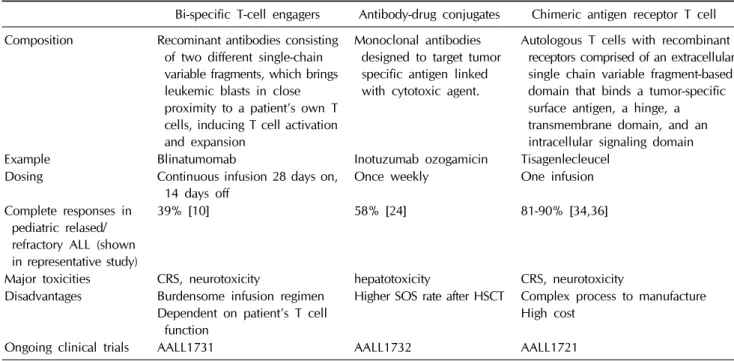
toxic adverse effects of chemotherapy is another great challenge. Moreover, unmet needs still exist for sub- sequent treatment in relapsed or refractory ALL. As an immunotherapy for leukemia, HSCT is one of the well- known immunotherapy and relapse risk can be reduced through graft-versus-leukemia effect [5,6]. In recent years, advanced concept of immunotherapy has been widely in- corporated into the treatment options for pediatric leu- kemia. These include bi-specific T-cell engagers (BiTEs), antibody-drug conjugates (ADCs), and chimeric antigen receptor T cell (CAR-T) therapies (Table 1, Fig. 1). This review focuses on the recent development and achieve- ment of these immunotherapies in pediatric leukemia, especially based on papers published within 10 years, and also highlights emerging applications of immuno- therapy as upfront treatment.
Table 1. Summary of immunotherapy in pediatric hematologic malignancy
Bi-specific T-cell engagers Antibody-drug conjugates Chimeric antigen receptor T cell Composition Recominant antibodies consisting
of two different single-chain variable fragments, which brings leukemic blasts in close proximity to a patient’s own T cells, inducing T cell activation and expansion
Monoclonal antibodies designed to target tumor specific antigen linked with cytotoxic agent.
Autologous T cells with recombinant receptors comprised of an extracellular single chain variable fragment-based domain that binds a tumor-specific surface antigen, a hinge, a transmembrane domain, and an intracellular signaling domain
Example Blinatumomab Inotuzumab ozogamicin Tisagenlecleucel
Dosing Continuous infusion 28 days on,
14 days off Once weekly One infusion
Complete responses in pediatric relased/
refractory ALL (shown in representative study)
39% [10] 58% [24] 81-90% [34,36]
Major toxicities CRS, neurotoxicity hepatotoxicity CRS, neurotoxicity Disadvantages Burdensome infusion regimen
Dependent on patient’s T cell function
Higher SOS rate after HSCT Complex process to manufacture High cost
Ongoing clinical trials AALL1731 AALL1732 AALL1721
ALL, acute lymphoblastic leukemia; CRS, cytokine release syndrome; SOS, sinusoidal obstructive syndrome; HSCT, hematopoietic stem cell transplantation.
Fig. 1. Schema of immunother- apeutic modalities for hematologic malignancy. Antibody-based and cell-based immunotherapies includ- ing blinatumomab, inotuzumab, and chimeric antigen receptor (CAR) T cell, have been clinically trans- lated (Adopted from Schultz L et al. Hematology Am Soc Hematol Educ Program. 2019;2019:226-32.).
Bi-Specific T-cell Engagers (BiTE)
Advances in protein engineering have resulted in the accelerated development of new recombinant antibodies
that are capable of binding to tumor-specific antigens, and simultaneously activating effector T cells. BiTEs con- sist of two different single-chain variable fragments (scFv) joined by a short flexible glycine–serine linker [7].
Blinatumomab is one of the BiTEs which has two specific
binding site, CD19 and CD3. It brings CD19+ leukemic blasts in close proximity to a patient’s own CD3+ T cells, inducing T cell activation and expansion, which ulti- mately leading to leukemic cell death [8,9].
Base on the promising results of blinatumomab in adult, a phase I/phase II dose-escalation/dose-expansion trial of blinatumomab in pediatric patients with re- lapsed/refractory B cell precursor (BCP) ALL had been conducted [10]. In this study, the recommended blinatu- momab dosage for pediatric patients was 5 μg/m2/day for the first seven days, followed by 15 μg/m2/day there- after for subsequent 21 days. Complete remission within the first two cycles was achieved in 27 of 70 patients (39%) who were treated at the recommended dose, with 14 of these responders (52%) having negative minimal re- sidual disease (MRD). Median relapse-free survival (RFS) was 4.4 months, median overall survival (OS) was 7.5 months, and 6-month RFS was 42%. Adverse effects ob- served in this study included cytopenia, transient liver enzyme elevation, neurologic events such as tremor, diz- ziness in 24% of patients, and cytokine release syndrome (CRS) in 6%. Neurotoxicity and CRS also occurs after CAR-T therapy which is discussed in detail below. Long- term follow-up of previous study has reported that 14 (20%) of the 70 patients who received blinatumomab at the recommend dose were alive at two years, and addi- tional eight patients were still alive at study closure [11].
Moreover, a multicenter expanded access study of 40 pa- tients achieved 63% of complete remission rate after two cycles of blinatumomab therapy [12].
Blinatumomab also showed efficacy and safety in pe- diatric BCP ALL patients with MRD positive, which fur- ther eliminates MRD and serves as a bridging therapy be- fore HSCT [13]. In adult patients where more research has been conducted, blinatumomab yields obvious bene- fit compared to conventional standard chemotherapy in relapsed or refractory BCP ALL, with manageable tox- icities [14]. Additionally, a clinical trial has demonstrated that blinatumomab therapy is effective in adult patients with MRD positive BCP ALL. The 5-year event-free sur- vival (EFS) of these patients was 50%, which is more su- perior in comparison with generally accepted outcomes
of <25% for adult patients with MRD positive BCP ALL [15]. Moreover, blinatumomab resulted in 36% of com- plete remission rate in relapsed/refractory Philadelphia- positive (Ph+) adult ALL patients who were refractory to tyrokine kinase inhibitors [16,17].
Based on these results, the US Food and Drug Admini- stration (FDA) granted approval of blinatumomab in Ph− pediatric patients with relapsed/refractory BCP ALL in September 2016, and Ph+ patients included in July 2017.
Furthermore, in March 2018, blinatumomab received ac- celerated FDA approval for use in both adults and chil- dren of first or second remission but with detectable MRD at or above 0.1%. In Korea, blinatumomab received approval in pediatric patients only for Ph− relapsed/re- fractory BCP ALL in February 2017 and subsequently, Ph+ in January 2019.
Blinatumomab is now under evaluation as treatment option for newly diagnosed pediatric BCP ALL. The Children’s Oncology Group (COG) is conducting rando- mized clinical studies of blinatumomab for standard-risk ALL (AALL1731, NCT03914625), and patients were ran- domly assigned into two groups of blinatumomab versus conventional chemotherapy. This trial aims to find out whether the addition of two cycles of blinatumomab to the standard therapy can improve disease-free survival in standard-risk ALL patients. Another trial, the St. Jude Total 17 protocol (NCT03117751), investigated the effec- tiveness of blinatumomab in patients with MRD of 0.01 to 1% at the end of treatment induction. Based on these trials, blinatumomab is believed to gradually becoming the standard upfront treatment for pediatric BCP ALL.
Although there are no approved BiTE therapies for pe- diatric AML, these are actively being investigated, includ- ing a few clinical trials targeting CD33 (NCT02520427), CD123 (NCT02152956), and CD371 (NCT03038230) in adult patients. Moreover, the COG Pediatric Early Phase Clinical Trial Network initiated a comprehensive study to evaluate the safety and preliminary antileukemia activity of the CD123-CD3 dual affinity-retargeting antibody flo- tetuzumab, specifically in children and adolescents with relapsed/refractory AML (NCT04158739).
Antibody-Drug Conjugates (ADC)
Antibody-drug conjugate (ADC) is a monoclonal anti- body designed to target tumor specific antigen linked with cytotoxic agent. Unlike BiTEs, this therapy does not require T cells to kill the target cell. Inotuzumab ozoga- micin is a humanized CD22 monoclonal antibody con- jugated to calicheamicin [18]. CD22 is expressed on more than 90% of BCP ALL cells and mature B lymphocytes, but not on hematopoietic stem cells, or non-hema- topoietic lineage cells [19]. After inotuzumab ozogamicin binds to CD22, this molecule can be rapidly internalized and exhibits cytotoxicity via calicheamicin.
Compared with conventional intensive chemotherapy, inotuzumab ozogamicin showed significantly higher com- plete remission rate (80.7% versus 29.4%), and higher MRD negative rate among patients with remission (78.4%
versus 28.1%), compared to conventional intensive che- motherapy in relapsed adult BCP ALL (INOVATE study) [20]. This randomized phase III study in adults with BCP ALL showed significantly longer EFS and OS in inotu- zumab treatment arm. Moreover, inotuzumab in combi- nation with low-intensity chemotherapy for older pa- tients BCP ALL with Ph- showed promising results, of which 2-year RFS was 59% [21].
A retrospective analysis of pediatric compassionate use program of inotuzumab provided important in- formation [22]. Among 51 pediatric patients with re- lapsed/refractory BCP ALL, 67% of patients showed com- plete morphologic responses, with negative MRD in 71%
of these responders. Sinusoidal obstructive syndrome is a well-known adverse event of inotuzumab, which oc- curred in 22% of total patients and 52% of HSCT re- cipients. In this study, CD22 downregulation was sug- gested as a mechanism of resistance, which has also been reported in other pediatric cases [23]. Furthermore, a phase II COG trial of inotuzumab in children and young adults with relapsed/refractory CD22 positive BCP ALL (AALL1621) recently reported the results of 48 patients.
Complete remission rate was 58% of all patients, of whom 65% achieved MRD negative; and sinusoidal ob-
structive syndrome occurred in 8% of all patients and in 31% of HSCT recipients [24]. This agent is now being in- vestigated as upfront treatment for high risk BCP ALL to evaluate efficacy and safety of adding two blocks of in- otuzumab to chemotherapy backbone (AALL1732). Based on this trial, inotuzumab could be used an effective sal- vage therapy in refractory/relapsed CD22+ BCP ALL, as well as an upfront chemotherapy in the near future.
In pediatric AML, a CD33-targeting ADC called gemtu- zumab ozogamicin, has shown promising results. The COG first evaluated gemtuzumab in pediatric relapsed AML to find out the maximum tolerated dose and safety (AAML03P1) [25]. A subsequent COG randomized trial (AAML0531) compared the outcome of children with de novo AML who received either standard chemotherapy or standard chemotherapy with gemtuzumab during the in- duction I and intensification II phases of therapy, which resulted in a significant improvement of EFS in the gem- tuzumab arm [26]. Response to gemtuzumab was related to the elevated CD33 expression [27] and a CD33 splicing polymorphism in the coding region of exon 2, which is the antibody-binding site for gemtuzumab [28]. Based on these data, gemtuzumab ozogamicin will be incorporated into the frontline therapy for children, adolescents and young adults with CD33+ AML in the phase III AAML1831 trial.
Chimeric Antigen Receptor T cell (CAR-T)
Chimeric antigen receptors (CARs) are recombinant receptors comprised of an extracellular single chain var- iable fragment (scFv)-based domain that binds a tu- mor-specific surface antigen, a hinge, a transmembrane domain, and an intracellular signaling domain CD3 z chain; and, in the case of second-generation CAR-T, it includes one or more additional costimulatory domain.
These recombinant products are usually manufactured from autologous T cells obtained from patients via apheresis. These T cells are modified ex vivo by in- troducing a gene that codes for CARs. CAR-T interaction with target cells occurs in a human leukocyte antigen–in- dependent fashion which is effective in patients with
cancers that express the target antigens [29].
The second-generation CAR-T that incorporated a second intracellular T-cell signaling domain (e.g., CD28, 4-1BB [CD137]) had resulted in greater proliferative ca- pacity and better antitumor efficacy with persistence [30-32]. This therapy targeting CD19 and/or CD22 has shown tremendous efficacy in pediatric relapsed/re- fractory BCP ALL patients. The first success in using CAR-T cells to treat two BCP ALL patients was reported in 2013 [33]. Thereafter, University of Pennsylvania re- search group reported cases of 30 children and adults with BCP ALL treated with 19-BBz CAR-T cells [34].
Complete remission was achieved in 27 patients who were able to receive CAR-T cells successfully (90%), in- cluding 2 patients with blinatumomab-refractory con- dition, and 15 who had undergone allogeneic HSCT.
Six-month EFS and OS rates were 67% and 78%, re- spectively. This was a remarkable outcome for these pa- tients who were previously thought to be incurable.
Another initial trials using 19-28z CAR-T cells have shown similar complete remission rates which were ob- served in 67% of 21 pediatric and young adult patients [35]. However, more patients treated with 19-28z CAR-T cells required a subsequent HSCT for long-term survival compared to those treated with 19-BBz CAR-T cells.
A phase II global collaborative study (ELIANA) of tisa- genlecleucel (19-BBz CAR-T) of 75 pediatric and young adult patients confirmed previous reported efficacy [36].
At three months, the complete remission rate was 81%, with all patients being MRD negative as detected by flow cytometry. Twelve-month EFS and OS were 50% and 76%, respectively. Remarkably, persistence of CAR-T cells was observed for up to 20 months, which led to long-term survival without subsequent HSCT. To decrease T cell differentiation and maximize CAR expression, pre- defined T cell product with 1:1 ratio of CD8+:CD4+ T cells was used at Seattle Children’s Hospital, which yielded a 93% complete remission rate, a 1-year EFS of 50%, and OS of 66% [37]. Furthermore, to enhance CAR-T cell ex- pansion and prolonged persistence, the use of a low-af- finity CD19 scFv CAR-T cells was reported [38]. More re- sults of pediatric and young adults CAR-T studies are
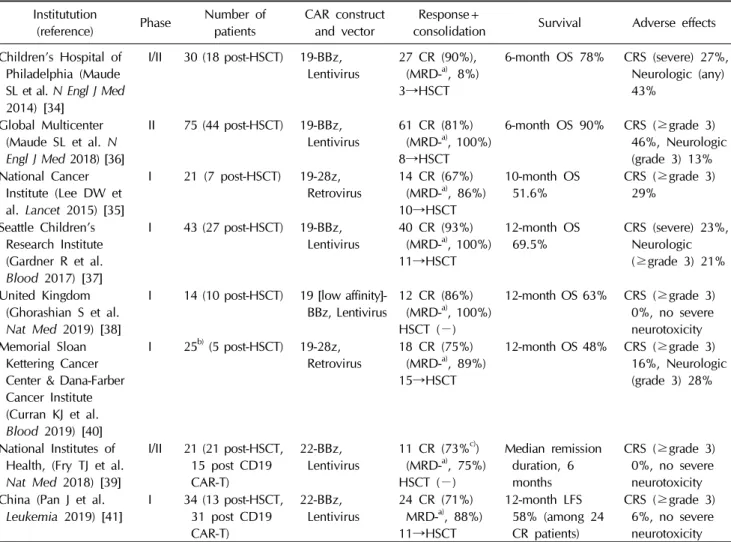
shown in Table 2 [39-41].
Although CAR-T cell therapy marks a new era of im- munotherapy for hematologic malignant neoplasms, sev- eral severe complications should be considered. First, CRS occurs when activated T cells produce abundant in- flammatory cytokines including interleukin-6 (IL-6) or interferon-γ, has to be closely monitored after CAR-T in- fusion [42]. To ameliorate this severe immune hyper- activation, an anti–IL-6 receptor antagonist, tocilizumab, has been approved by the FDA for treating CAR-T cell– induced CRS. A recent study demonstrated that early in- tervention for CRS with tocilizumab and/or corticoste- roids not only reduced the incidence of transition from mild to severe CRS, but also had no detrimental effect on the MRD negative complete remission rates or func- tional CAR-T cell persistence [43]. Neurotoxicity includ- ing encephalopathy, tremor, delirium, and seizures have been reported, which are related to high disease burden, CRS, high CAR-T expansion, and pre-existing neurologic problems [44]. An updated guideline of CRS and neuro- toxicity induced by CAR-T cell therapy have been re- cently published by the American Society for Transplan- tation and Cellular Therapy [45].
Several obstacles of CAR-T cell therapy have been reported. One mechanism of resistance to CAR-T cell treatment is the loss of CAR-T cell persistence. Early ex- haustion of robust CAR-T cells can limit their persistent anti-leukemia activity. Costimulation using 4-1BB has been shown to ameliorate T cell exhaustion more effec- tively, compared to CD28 which appears to augment the exhaustion induced by persistent CAR signaling [46]. This could be the reason for longer median duration of 19- BBz CAR-T cells (168 days) than that of 19-28z CAR-T cells (30 days), and why 19-BBz CAR-T cells were asso- ciated with longer remission without HSCT [35,36].
Moreover, recent finding of prolonged persistence of low-affinity CD19 scFv CAR-T cells could help overcome this obstacle [38]. In addition, target antigen loss is an- other resistance mechanism. The loss of CD19 antigen can result from mutations, alternate splice variants, and lineage switch [47]. To overcome CD19 antigen loss, CD22 can be a better target, which is expressed on most
Table 2. Pediatric and young adults chimeric antigen recetor T cell studies Institutution
(reference) Phase Number of
patients CAR construct
and vector Response+
consolidation Survival Adverse effects Children’s Hospital of
Philadelphia (Maude SL et al. N Engl J Med 2014) [34]
I/II 30 (18 post-HSCT) 19-BBz,
Lentivirus 27 CR (90%), (MRD-a), 8%) 3→HSCT
6-month OS 78% CRS (severe) 27%, Neurologic (any) 43%
Global Multicenter (Maude SL et al. N Engl J Med 2018) [36]
II 75 (44 post-HSCT) 19-BBz,
Lentivirus 61 CR (81%) (MRD-a), 100%) 8→HSCT
6-month OS 90% CRS (≥grade 3) 46%, Neurologic (grade 3) 13%
National Cancer Institute (Lee DW et al. Lancet 2015) [35]
I 21 (7 post-HSCT) 19-28z,
Retrovirus 14 CR (67%) (MRD-a), 86%) 10→HSCT
10-month OS
51.6% CRS (≥grade 3) 29%
Seattle Children’s Research Institute (Gardner R et al.
Blood 2017) [37]
I 43 (27 post-HSCT) 19-BBz,
Lentivirus 40 CR (93%) (MRD-a), 100%) 11→HSCT
12-month OS
69.5% CRS (severe) 23%, Neurologic (≥grade 3) 21%
United Kingdom (Ghorashian S et al.
Nat Med 2019) [38]
I 14 (10 post-HSCT) 19 [low affinity]-
BBz, Lentivirus 12 CR (86%) (MRD-a), 100%) HSCT (−)
12-month OS 63% CRS (≥grade 3) 0%, no severe neurotoxicity Memorial Sloan
Kettering Cancer Center & Dana-Farber Cancer Institute (Curran KJ et al.
Blood 2019) [40]
I 25b) (5 post-HSCT) 19-28z,
Retrovirus 18 CR (75%) (MRD-a), 89%) 15→HSCT
12-month OS 48% CRS (≥grade 3) 16%, Neurologic (grade 3) 28%
National Institutes of Health, (Fry TJ et al.
Nat Med 2018) [39]
I/II 21 (21 post-HSCT, 15 post CD19 CAR-T)
22-BBz,
Lentivirus 11 CR (73%c)) (MRD-a), 75%) HSCT (−)
Median remission duration, 6 months
CRS (≥grade 3) 0%, no severe neurotoxicity China (Pan J et al.
Leukemia 2019) [41] I 34 (13 post-HSCT, 31 post CD19 CAR-T)
22-BBz,
Lentivirus 24 CR (71%) MRD-a), 88%) 11→HSCT
12-month LFS 58% (among 24 CR patients)
CRS (≥grade 3) 6%, no severe neurotoxicity
a)Percentage of MRD negative patients among those with CR. b)As a conditioning regimen, 17 patients received high-dose cyclo- phosphamide (3 g/m2) and 8 received low-dose cyclophosphamide (≤1.5 g/m2). c)Of 21 patients, 15 patients received ≥1x10⁶/kg CD22-CAR T cells. CR rate was calculated from these 15 patients.
CAR, chimeric antigen receptor; HSCT, hematopoietic stem cell transplantation; CR, complete remission; MRD, minimal residual disease; OS, overall survival; CRS, cytokine release syndrome.
B ALL cells. A phase I study of an anti-CD22 CAR-T cell was conducted in 21 children and adults with refractory/
relapse BCP ALL, of which a complete remission was re- ported for 17 (73%) of whom had received CD19-targeted immunotherapy [39], including five patients in whose ALL cells CD19 expression had been completely lost or reduced. Manufacturing of CAR-T cells is another issue.
In ELIANA trial, seven out of 92 enrolled patients had product-related issues [36]. It was observed that heavily pretreated patients could not have enough T cells, there- fore manufacturing failure should be considered for CAR-T cell therapy. In such cases, ‘universal’ CAR-T cells
using HLA-mismatched cells from a healthy donor could be a viable option in the future, which was first reported in a United Kingdom study group [48]. Furthermore, the CAR gene can be inserted into B-ALL cells during CAR-T manufacture, which bind in cis to CD19+ ALL cells, to mask the target molecule and inhibit recognition by CAR-T cells [49].
Given this outstanding result of CAR-T cell therapy, many CAR-T trials are ongoing globally using various vi- ral vectors to target a variety of antigens. The COG has entered a phase II open-label study (AALL1721) for pa- tients ages 1 to 25 years with initial diagnosis of CD19+
expressing B-ALL, have de novo National Cancer Insti- tute high-risk features, and with MRD ≥0.01% at the end of consolidation chemotherapy. Furthermore, many dual antigen-targeting CAR-T cells are being developed and used in clinical trials. However, development of CAR-T cells for patients with AML has been challenging due to the lack of universal myeloid antigens for therapeutic targeting and the considerable risk of “on-target/off-tu- mor” hematologic, and nonhematologic toxicity. Several phase I clinical trials of CD33 or CD123 CAR-T are un- derway in adults with AML (NCT03126864, NCT03904069, NCT02159495, NCT03766126).
Conclusion
The immunotherapy of childhood leukemia has en- tered a new treatment paradigm. New immunother- apeutic agents are being rapidly developed and numer- ous clinical trials are under way, globally. However, ther- apeutic challenges remain to maximize treatment effi- cacy with minimized toxicities, which include CRS, neu- rotoxicity, and on-target/off-tumor effect. Future im- munotherapy trials should aim to optimize treatment with or without conventional chemotherapy, and to in- dividualize treatment plan more specifically.
Conflict of Interest Statement
The author has no conflict of interest to declare.
References
1. Hunger SP, Mullighan CG. Acute lymphoblastic leukemia in children. N Engl J Med 2015;373:1541-52.
2. Pui CH, Yang JJ, Hunger SP, et al. Childhood acute lympho- blastic leukemia: progress through collaboration. J Clin Oncol 2015;33:2938-48.
3. Pui CH, Nichols KE, Yang JJ. Somatic and germline genomics in paediatric acute lymphoblastic leukaemia. Nat Rev Clin Oncol 2019;16:227-40.
4. Zwaan CM, Kolb EA, Reinhardt D, et al. Collaborative efforts driving progress in pediatric acute myeloid leukemia. J Clin Oncol 2015;33:2949-62.
5. Gustafsson Jernberg A, Remberger M, Ringdén O, Winiarski J. Graft-versus-leukaemia effect in children: chronic GVHD
has a significant impact on relapse and survival. Bone Marrow Transplant 2003;31:175-81.
6. Horowitz MM, Gale RP, Sondel PM, et al. Graft-versus-leuke- mia reactions after bone marrow transplantation. Blood 1990;
75:555-62.
7. Velasquez MP, Bonifant CL, Gottschalk S. Redirecting T cells to hematological malignancies with bispecific antibodies. Blood 2018;131:30-8.
8. Winters A, Gore L. Moving immunotherapy into the front line in ALL. Hematology Am Soc Hematol Educ Program 2019;
2019:209-17.
9. Löffler A, Kufer P, Lutterbüse R, et al. A recombinant bispe- cific single-chain antibody, CD19 x CD3, induces rapid and high lymphoma-directed cytotoxicity by unstimulated T lym- phocytes. Blood 2000;95:2098-103.
10. von Stackelberg A, Locatelli F, Zugmaier G, et al. Phase I/phase II study of blinatumomab in pediatric patients with relapsed/refractory acute lymphoblastic leukemia. J Clin Oncol 2016;34:4381-9.
11. Gore L, Locatelli F, Zugmaier G, et al. Survival after blinatu- momab treatment in pediatric patients with relapsed/re- fractory B-cell precursor acute lymphoblastic leukemia. Blood Cancer J 2018;8:80.
12. Locatelli F, Zugmaier G, Vora A, et al. Blinatumomab use in pediatric patients (pts) with relapsed/refractory B-precursor acute lymphoblastic leukemia (r/r ALL) from an open-label, multicenter, expanded access study. J Clin Oncol 2017;35(15 Suppl):10530.
13. Keating AK, Gossai N, Phillips CL, et al. Reducing minimal residual disease with blinatumomab prior to HCT for pedia- tric patients with acute lymphoblastic leukemia. Blood Adv 2019;3:1926-9.
14. Kantarjian H, Stein A, Gökbuget N, et al. Blinatumomab ver- sus chemotherapy for advanced acute lymphoblastic leukemia.
N Engl J Med 2017;376:836-47.
15. Gökbuget N, Dombret H, Bonifacio M, et al. Blinatumomab for minimal residual disease in adults with B-cell precursor acute lymphoblastic leukemia. Blood 2018;131:1522-31.
16. Martinelli G, Boissel N, Chevallier P, et al. Complete hemato- logic and molecular response in adult patients with re- lapsed/refractory Philadelphia chromosome–positive b-pre- cursor acute lymphoblastic leukemia following treatment with blinatumomab: results from a phase II, single-arm, mul- ticenter study. J Clin Oncol 2017;35:1795-802.
17. Rambaldi A, Ribera JM, Kantarjian HM, et al. Blinatumomab compared with standard of care for the treatment of adult patients with relapsed/refractory Philadelphia chromosome- positive B-precursor acute lymphoblastic leukemia. Cancer 2020;126:304-10.
18. DiJoseph JF, Armellino DC, Boghaert ER, et al. Antibody-tar- geted chemotherapy with CMC-544: a CD22-targeted im- munoconjugate of calicheamicin for the treatment of B-lym- phoid malignancies. Blood 2004;103:1807-14.
19. Piccaluga PP, Arpinati M, Candoni A, et al. Surface antigens analysis reveals significant expression of candidate targets for immunotherapy in adult acute lymphoid leukemia. Leuk Lymphoma 2011;52:325-7.
20. Kantarjian HM, DeAngelo DJ, Stelljes M, et al. Inotuzumab ozogamicin versus standard therapy for acute lymphoblastic leukemia. N Engl J Med 2016;375:740-53.
21. Kantarjian H, Ravandi F, Short NJ, et al. Inotuzumab ozoga- micin in combination with low-intensity chemotherapy for older patients with Philadelphia chromosome-negative acute lymphoblastic leukaemia: a single-arm, phase 2 study. Lancet Oncol 2018;19:240-8.
22. Bhojwani D, Sposto R, Shah NN, et al. Inotuzumab ozogami- cin in pediatric patients with relapsed/refractory acute lym- phoblastic leukemia. Leukemia 2019;33:884-92.
23. Paul MR, Wong V, Aristizabal P, Kuo DJ. Treatment of re- current refractory pediatric pre-B acute lymphoblastic leuke- mia using inotuzumab ozogamicin monotherapy resulting in CD22 antigen expression loss as a mechanism of therapy resistance. J Pediatr Hematol Oncol 2019;41:e546-e9.
24. O’Brien MM, Ji L, Shah NN, et al. A phase 2 trial of in- otuzumab ozogamicin (InO) in children and young adults with relapsed or refractory (R/R) CD22+ B-acute lympho- blastic leukemia (B-ALL): results from Children’s Oncology Group Protocol AALL1621. Blood 2019;134(Suppl 1):741.
25. Aplenc R, Alonzo TA, Gerbing RB, et al. Safety and efficacy of gemtuzumab ozogamicin in combination with chemo- therapy for pediatric acute myeloid leukemia: a report from the Children’s Oncology Group. J Clin Oncol 2008;26:2390- 3295.
26. Gamis AS, Alonzo TA, Meshinchi S, et al. Gemtuzumab ozo- gamicin in children and adolescents with de novo acute mye- loid leukemia improves event-free survival by reducing re- lapse risk: results from the randomized phase III Children’s Oncology Group trial AAML0531. J Clin Oncol 2014;32:3021-32.
27. Pollard JA, Loken M, Gerbing RB, et al. CD33 expression and its association with gemtuzumab ozogamicin response: re- sults from the Randomized Phase III Children’s Oncology Group trial AAML0531. J Clin Oncol 2016;34:747-55.
28. Lamba JK, Chauhan L, Shin M, et al. CD33 Splicing poly- morphism determines gemtuzumab ozogamicin response in de novo acute myeloid leukemia: report from Randomized Phase III Children’s Oncology Group trial AAML0531. J Clin Oncol 2017;35:2674-82.
29. Imai C, Mihara K, Andreansky M, et al. Chimeric receptors with 4-1BB signaling capacity provoke potent cytotoxicity against acute lymphoblastic leukemia. Leukemia 2004;18:
676-84.
30. Savoldo B, Ramos CA, Liu E, et al. CD28 costimulation im- proves expansion and persistence of chimeric antigen re- ceptor-modified T cells in lymphoma patients. J Clin Invest 2011;121:1822-6.
31. Milone MC, Fish JD, Carpenito C, et al. Chimeric receptors containing CD137 signal transduction domains mediate en- hanced survival of T cells and increased antileukemic effi- cacy in vivo. Mol Ther 2009;17:1453-64.
32. Maher J, Brentjens RJ, Gunset G, Rivière I, Sadelain M. Human T-lymphocyte cytotoxicity and proliferation directed by a single chimeric TCRzeta /CD28 receptor. Nat Biotechnol 2002;
20:70-5.
33. Grupp SA, Kalos M, Barrett D, et al. Chimeric antigen re-
ceptor-modified T cells for acute lymphoid leukemia. N Engl J Med 2013;368:1509-18.
34. Maude SL, Frey N, Shaw PA, et al. Chimeric antigen receptor T cells for sustained remissions in leukemia. N Engl J Med 2014;371:1507-17.
35. Lee DW, Kochenderfer JN, Stetler-Stevenson M, et al. T cells expressing CD19 chimeric antigen receptors for acute lym- phoblastic leukaemia in children and young adults: a phase 1 dose-escalation trial. Lancet 2015;385:517-28.
36. Maude SL, Laetsch TW, Buechner J, et al. Tisagenlecleucel in children and young adults with B-cell lymphoblastic leuke- mia. N Engl J Med 2018;378:439-48.
37. Gardner RA, Finney O, Annesley C, et al. Intent-to-treat leu- kemia remission by CD19 CAR T cells of defined formulation and dose in children and young adults. Blood 2017;129:3322- 31.
38. Ghorashian S, Kramer AM, Onuoha S, et al. Enhanced CAR T cell expansion and prolonged persistence in pediatric pa- tients with ALL treated with a low-affinity CD19 CAR. Nat Med 2019;25:1408-14.
39. Fry TJ, Shah NN, Orentas RJ, et al. CD22-targeted CAR T cells induce remission in B-ALL that is naive or resistant to CD19- targeted CAR immunotherapy. Nat Med 2018;24:20-8.
40. Curran KJ, Margossian SP, Kernan NA, et al. Toxicity and re- sponse after CD19-specific CAR T-cell therapy in pedia- tric/young adult relapsed/refractory B-ALL. Blood 2019;134:
2361-8.
41. Pan J, Niu Q, Deng B, et al. CD22 CAR T-cell therapy in re- fractory or relapsed B acute lymphoblastic leukemia. Leuke- mia 2019;33:2854-66.
42. Lee DW, Gardner R, Porter DL, et al. Current concepts in the diagnosis and management of cytokine release syndrome.
Blood 2014;124:188-95.
43. Gardner RA, Ceppi F, Rivers J, et al. Preemptive mitigation of CD19 CAR T-cell cytokine release syndrome without at- tenuation of antileukemic efficacy. Blood 2019;134:2149-58.
44. Santomasso BD, Park JH, Salloum D, et al. Clinical and bio- logical correlates of neurotoxicity associated with CAR T-cell therapy in patients with B-cell acute lymphoblastic leukemia.
Cancer Discov 2018;8:958-71.
45. Lee DW, Santomasso BD, Locke FL, et al. ASTCT consensus grading for cytokine release syndrome and neurologic tox- icity associated with immune effector cells. Biol Blood Marrow Transplant 2019;25:625-38.
46. Long AH, Haso WM, Shern JF, et al. 4-1BB costimulation ameliorates T cell exhaustion induced by tonic signaling of chimeric antigen receptors. Nat Med 2015;21:581-90.
47. Gardner R, Wu D, Cherian S, et al. Acquisition of a CD19- negative myeloid phenotype allows immune escape of MLL- rearranged B-ALL from CD19 CAR-T-cell therapy. Blood 2016;127:2406-10.
48. Qasim W, Zhan H, Samarasinghe S, et al. Molecular remission of infant B-ALL after infusion of universal TALEN gene-edit- ed CAR T cells. Sci Transl Med 2017;9.
49. Ruella M, Xu J, Barrett DM, et al. Induction of resistance to chimeric antigen receptor T cell therapy by transduction of a single leukemic B cell. Nat Med 2018;24:1499-503.