Korean J. Microbiol. Biotechnol. Vol. 40, No. 1, 39–42 (2012) http://dx.doi.org/10.4014/kjmb.1110.10005
pISSN 1598-642X eISSN 2234-7305
벼의 생엽절편을 이용한 병원균 억제물질의 대량 스크리닝 방법 개발
박샛별
1,2
·이충환2
·김태종3
·강린우4
·이병무1
·김정구1 *
1농촌진흥청 국립농업과학원 유전자분석개발과, 2건국대학교 생명공학과
3국민대학교 임산생명공학과, 4건국대학교 신기술융합학과
Received : October 18, 2011 / Revised : December 18, 2011 / Accepted : January 3, 2012
Development of a Method for High throughput Screening of Antagonistic Substances against Rice Pathogens using Rice Leaf Explants. Park, Sait Byul1,2, Choong Hwan Lee2, Tae-Jong Kim3, Lin Woo Kang4, Byoung Moo Lee1, and Jeong-Gu Kim1*. 1Genomics Division, National Academy of Agricultural Sci- ence, Rural Development Administration, Suwon 441-707, Korea, 2Division of Bioscience and Biotechnology, Konkuk University, Seoul 143-701, Korea, 3Department of Forest Products and Biotechnology, Kookmin Univer- sity, Seoul 136-702, Korea, 4Department of Advanced Technology Fusion, Konkuk University, Seoul 143-701, Korea − A new method for the high throughput screening of antagonistic substances against rice pathogens using rice leaf explants was developed. This method can be used to confirm the activities of any compound or mixture suppressing rice bacterial blight (BB) before field tests. Xanthomonas oryzae pv. oryzae (Xoo) culture medium was distributed in 96 well plates with equally sized explants and the active compounds were added to the wells. The strength suppressing BB was converted into an area percent of the lesion on the rice explants.
The explants under BB suppressing activity remained uninfected maintaining their actual green color, while infected explants exhibited pale yellow-colored lesions. Based on the results, this method seems to be faster and easier, dose-dependent, and can be performed all-at-once with a small amount of unspecified compounds.
This method also has the potential to be applied to inspection activities for the suppression of other waterborne crop diseases.
Keywords: Xanthomonas oryzae pv. oryzae, suppressing activity, screening method
서 론
벼흰잎마름병은 잔토모나스 오라이자에 의한 식물병으로 [10] 도관을 통해 전이되는 특성상 발병의 속도가 빠르며 쌀 생산량의 피해에 직접적인 영향을 주기에 벼흰잎마름병의 방제는 쌀의 주 생산국가의 공통적 당면 과제이다. 흰잎마 름병에 저항성을 지니는 벼 품종을 개량하는[7, 11] 유전적 연구, 또는 균 자체의 생장을 억제하는 천연물 유래 물질을 개발하는[2, 6] 화학적 연구가 보고 된 바 있으나 실질적 방 제는 매우 어려운 실정이다.
실지 실험 이전에 흰잎마름병에 대한 저항성을 갖는 벼 품종을 평가하거나 병의 억제 물질이 지닌 효능을 확인하기 위해 가위 접종법이 주로 쓰이고 있다. 그러나 가위 접종 이 후로 결과를 확인하기 까지는 최소 2주 이상의 시간이 필요 하고 벼 잎에 나타난 병징을 측정하는 과정이 번거로울 수 있다[5, 9]. 또한 여러 물질의 효과를 한 눈에 확인 하기 어
렵고 재현성의 문제도 발생 할 수 있다. 이에 본 연구는 벼 잎 생엽절편을 이용한 벼흰잎마름병 억제 물질의 새로운 스 크리닝 법을 제시한다. 이 방법을 통해 1주일 안에 결과를 확인할 수 있고 소량의 물질로 간편한 실험 설계가 가능하 다. 또한 여러 물질의 활성을 동시에 측정 할 수 있으며 그 재현성 역시 뛰어난 장점이 있다.
재료 및 방법 시약 및 기구
벼 잎의 표면 살균을 위한 살균액은 0.05%의 Triton X- 100(Sigma)를 포함하는 1% 차아염소산나트륨용액(유한양 행)을 사용하였다. 억제물질의 양성대조구로서는 2,4-di- acetylphloroglucinol (DAPG; Toronto Research Chemicals (Canada)을 사용하였다. 96 well plate는 SPL Lifesciences (Korea)에서 구입하였고 실험에 사용된 핀셋, 가위, 알루미 늄포일 등은 고압 멸균 또는 화염살균하여 사용하였다.
병원균의 배양
실험에 사용한 병원균 균주는 벼흰잎마름병균 Xanthomonas
*Corresponding author
Tel: +82-31-299-1644, Fax: +82-31-299-1622
E-mail: [email protected]
40 PARK et al.
oryzae pv. oryzae KACC10331(이명 KXO85)이었다. 병원 균 균주의 배양온도는 28oC였고 관행적인 가위접종 방법에 사용하는 배양조건을 따랐다[4]. 즉, YGC (ATCC 459:
glucose 5.0%, yeast extract 0.5%, CaCO3 1.25%, and agar 1.5%) 평판배지에서 유지되는 소량의 균집락을 5 mL의 210 broth (sucrose 0.5%, casein enzymatic hydrolysate 0.8%, yeast extract 0.4%, K2HPO4 0.3%, and MgSO4·7H2O 0.03%)에서 24±4시간 동안 진탕배양한 다음 이 배양액을 PSA (peptone-sucrose-agar: Bacro-Peptone 1.0%, sucrose 1.0%, monosodium glutamate 0.1%, and agar 1.5%) 평판 배지에 도말하여 2일간 배양한 후 균집락을 멸균증류수에 분산시키고 600 nm에서의 흡광도가 0.5가 되도록 희석하여 사용하였다.
벼 잎 생엽절편의 표면살균
표면 살균액(0.05% Triton X-100 in 1% sodium hypo- chlorite)에 10~12 cm 길이의 벼 잎을 담그어 15분간 정치한 후 멸균 증류수로 3-4회 헹구었다. 표면 살균된 벼는 주맥을 제거하고 가로, 세로 3~4 mm의 크기로 잘라 사용하였다.
벼흰잎마름병 억제 활성 유무의 동시 확인과 재현성 확인 96 well plate의 각 well에 200 µL의 병원균 배양액을 가 하고, 벼흰잎마름병에 대한 억제 활성을 지니는지 확인하고 자 하는 특정 추출물의 10 mg 당 100 µL의 50% DMSO에 용해하여 10 µL씩 처리하였다. Plate는 7일간 30oC, 상대습 도 90~95%를 유지하며 암조건으로 정치하였다.
이 방법이 물질 농도에 의존적으로 유효함을 확인하기 위 하여 DAPG를 512 µg/mL에서 1 µg/mL까지 2배 연속 희석 을 사용하여 처리하였고, 모든 반복에서 양성대조구로 DAPG 를 사용하였다.
벼 생엽절편에 나타난 병변 면적의 수치화
벼 생옆절편의 병변 면적을 수치화하기 위하여 Adobe Photoshop을 이용하였다. PC상에서 실험 결과 사진의 벼 생 옆절편을 크기에 맞춰 사각형으로 오려 낸 후, threshold 값 의 변화를 주어 흑백으로 전환하였다. 이렇게 전환된 사진 을 gif 양식으로 저장하여 Image J analyzer 프로그램(http:/
/chemist.hosting.paran.com/imgarea/)에서 불러낸 후 실행하 였다. 프로그램에 의해 제시된 수치를 기준으로, 흑색 퍼센 트를 건전한 잎의 면적으로, 백색 퍼센트를 병변의 면적으 로 정량하였고, 3반복한 실험결과 사진을 바탕으로 각 생엽 절편의 병변 면적 퍼센트의 평균값을 계산하였다. 흑색 부 분이 95퍼센트 이상인 것은 흰잎마름병균에 의해 감염되지 않은 상태로 평가하였고, 20퍼센트 이하를 생엽절편 사멸의 기준으로 삼아 처리 물질이 흰잎마름병균 예방에 효과가 없 음으로 판단하였다. 병변 면적의 수치화 과정은 Fig. 4에 나 타내었다.
결과 및 고찰
특정 추출물이나 순수물질이 벼흰잎마름병에 억제 활성이 있는지 확인하기 전에 몇 가지 방법으로 병원균을 접종한다.
그러나 종자에 직접 균과 물질을 입히는 방법은 효능을 평 가하기까지 상당히 긴 시간을 요구한다. 가위 접종이나 핀 접종 역시 병징 발생의 유무를 확인 하는데 약 3주 정도의 시간이 필요하고 억제활성을 확인하고자 하는 물질이 벼에 흡수되어 제대로 작용 할 수 있도록 정교한 실험 설계가 있 어야 한다. 본 연구에서 개발한 스크리닝은 벼 생엽절편을 이용하는 방법으로 시간과 공간, 기술적 측면에서 제약이 적 은 효율성을 발휘한다. 파종 후 6주간 생장한 보통의 벼 잎 1개로 약 200개 물질을 스크리닝할 수 있다.
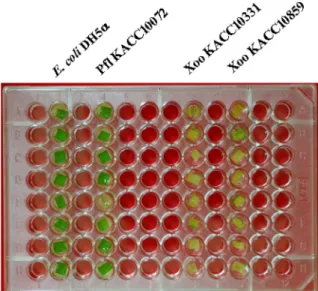
먼저 실지에서와 같이 플레이트 환경에서도 벼흰잎마름병 균이 벼에 병을 일으킬 수 있음을 입증하기 위해 96 well plate에 병원균이 접종된 벼 생엽절편을 배치하였다(Fig. 1).
그 결과, 벼흰잎마름병균만이 종 특이성을 보이며 벼의 생 엽절편에 병을 일으킴을 확인하였다.
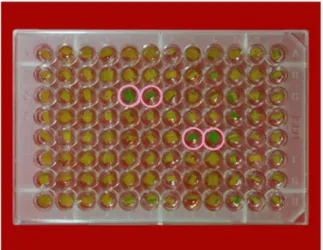
미지의 서로 다른 물질들을 벼 생엽절편에 처리하고 1주 일의 반응시간을 준 후, 잎 절편이 녹색으로 건전하게 유지 되는 경우는 병발생이 억제된 것으로, 황갈색으로 병징을 보 이는 경우는 처리한 물질에 억제 활성이 없는 것으로 평가 하였다. 이 방법을 통해 벼흰잎마름병에 대한 억제활성을 가 진 물질을 대량으로, 경제적으로 손쉽게 선별할 수 있었다 (Fig. 2).
Fig. 1. Pathogenicity of Xoo toward rice in 96 well plates. Xoo
infected rice explants which demonstrated Xoo could show patho-
genecity in 96 well plates like field environment. E. coli DH5a and
Pfl KACC10072 did not affect rice in that merely Xoo species-
specifically operated its virulency toward rice in the developed
condition. E. coli and P. fluorescens were negative controls that did
not cause any disease on rice. P. fluorescens even suppresses the
disease.
HIGHTHROUGHPUT SCREENINGOF SUPPRESSING SUBSTANCESUSING RICE LEAF EXPLANTS 41
또한 본 스크리닝 법을 통해 처리한 물질의 농도 의존적 으로 흰잎마름병의 감염 여부를 파악할 수 있었다. 억제물 질로 알려진 2,4-diacetylphloroglucinol (DAPG)를 1~512 µg/mL의 농도로 2배 희석하여 연속 처리하였을 때, 32 µg/
mL에서 최소저해농도가 확인 되었고, 16 µg/mL에서는 부 분적으로, 8 µg/mL 이하부터는 병징이 확실히 인정되었다.
즉, 본 스크리닝법을 통해 단순히 활성의 유무만을 파악할 수 있는 것이 아니라 처리 농도에 따른 활성의 강도 역시 평 가 할 수 있었다. 3반복의 실험에서 재현성 역시 뛰어나 본 스크리닝 법의 효율성에 대한 신뢰도를 높여주었다(Fig. 3).
식물의 병변 면적을 정량화 하는데 있어서 퍼센트 율을 적용하는 것이 1974년에 제안[1]된 이후 작물 손실에 관한 조사, 항균, 항곰팡이제의 억제능이나 식물 저항성 스크리닝 등에 응용되어 왔다. 최근에는 오이의 탄저병변을 디지털 이 미지화 하여 면적을 계산[6]하는 등, 식물 병변의 면적을 정 량하는데 있어 Photoshop 등 여러 프로그램이 적용되고 있 다. 따라서 본 연구에서도 벼 생엽절편의 병변 면적을 정량 하고 추후의 도식화가 용이하도록 면적 퍼센트를 산출하였 다. Adobe Photoshop과 Image J analyzer를 이용하여 벼 생엽절편 사진을 흑백으로 전환한 후 흑색 퍼센트를 건전한 상태의 잎 면적으로 계산하였다(Fig. 4). 병원균을 처리 하 지 않은 생엽절편의 흑색 면적이 평균 95%를 나타낸 것을 기준으로, 물질 처리에 의해 벼 흰잎바름병 감염이 억제 된 것으로 판단하였다. 또한 물질의 처리 없이 흰잎마름병균에 감염된 벼 생엽절편의 흑색 퍼센트가 평균 20%로 나타난 것 을 기준으로 하여, 이 시점부터 처리 물질에 병 억제능이 없
는 것으로 평가하였다. 처리 물질이 흰잎마름병균에 대한 억 제능을 지닌 경우, 벼 생엽절편의 흑색 퍼센트가 농도 의존 적으로 감소하는 것을 나타내었으므로 이와 같은 병변의 정 량화 방법이 타당하다고 판단하였다.
본 연구에서 개발한 스크리닝 법은 실험 설계가 간편하고,
Fig. 2. All-at-once comparison of the activity existence sup-
pressing rice bacterial blight. Randomly selected 96 extracts from the Streptomyces culture collection from ECUM (Extract Collection of Useful Microorganism; www.ecum.or.kr) were treated on Xanthomonas oryzae pv. oryzae medium with rice leaf explants if they exhibited inhibitory activity against rice bacterial blight. Green-colored leaf explants meant they were under sup- pressing activities of the extracts while pale yellow explants were infected from BB. Some of extracts suppressed the disease and the explants remained green. They are marked with pink circles.
Fig. 3. Reproducibility confirmation of the screening method.
To determine if the screening method represent reproducibility, 2,4-diacetylphloroglucinol (DAPG) was treated from 1 to 512 µg/
mL with the two-fold serial dilution. The plate was incubated at 37
oC for a week. Experiments were conducted in triplicate. B., blank (DAPG not treated).
Fig. 4. Quantification of lesions on rice leaf explants by lesion area percentage measurement. The lesions on rice leaf explants were measured by digital image analyzing programs. The color in rice explants’ picture was converted into mono-scale (black and white) by Adobe Photoshop, then the black and white area percent was calculated through Image J analyzer. Black area more than 95% was considered as a healthy state and the area less than 20%
was evaluated as an infected state with bacterial blight. The lesion
area on the compound/extract-treated rice leaf explants decreased
dose-dependently.
42 PARK et al.
1주일 내로 결과를 확인할 수 있으며, 동시에 여러 물질의 활성 평가가 가능하고, 높은 재현성을 보였다. 이 방법은 벼 잎 생엽절편을 이용한 흰잎마름병 억제활성의 평가뿐만 아 니라 다른 수인성 식물병에도 응용 가능성을 지닌 것으로 보 인다. 이 방법은 또한 시험 대상 물질이 벼에 대한 약해 (phytotoxicity)를 보이는 지를 사전에 가려낼 수 있는 이점 을 가지고 있다.
요 약
벼흰잎마름병을 억제하는 물질의 활성을 확인하기 위하여 벼 잎 생엽절편을 이용하는 새로운 스크리닝 방법을 개발하 였다. 96 well plate에 잔토모나스 오라이자의 배양액을 분 주하고 균등한 크기의 벼 잎 생엽절편을 배치한 후 효능을 확인하고자 하는 물질을 처리하였다. 흰잎마름병균을 억제 하는 물질의 활성도는 벼 잎 생엽절편 병징의 면적율로 환 산되었다. 물질에 의하여 병의 발생이 억제된 벼 잎 생엽절 편은 병원균 배양액 내에서 건전한 녹색을 유지하였고 병이 발생된 벼 잎 생엽절편은 황갈색 병징을 나타내었다. 이를 통하여 본 실험법이 빠르고 간편하며, 농도 의존적인 활성 확인이 가능하고, 소량으로 다수 물질의 활성 여부를 동시 에 평가할 수 있음을 확인하였다. 본 스크리닝 법은 벼흰잎 마름병 뿐만 아니라 여타의 수인성 작물질병억제 활성을 확 인하는 데 응용 가능성이 있을 것으로 생각된다.
Acknowledgements
This study was carried out with the support of “Netx Generation Biogreen21 Research Program (PJ008083)” of Rural Development Administration, Republic of Korea and Institutional Research Project 200802I01011065 of NAAS.
R EFERENCES
1. JAMES, W. C. 1974. Assessment of plant diseases and losses. Annu. Rev. Phytopathol. 12: 27-48.
2. Kang, Y. S., Y. Lee, S. K. Cho, K. H. Lee, B. J. Kim, M.
Kim, Y. Lim, and M. Cho. 2009. Antibacterial activity of a
disaccharide isolated from Streptomyces sp. strain JJ45 against Xanthomonas sp. FEMS Microbiol Lett. 294: 119- 125.
3. Kim, J. G., B. M. Lee, C. H. Lee, and T. J. Kim. 2009.
Methods for screening antagonistic substances against rice pathogens using rice leaf fragments. Korean Pat. Application No. 10-2009-0046323 (20090527).
4. Kim, S. Y, J. G. Kim, B. M. Lee, and J. Y. Cho. 2009.
Mutational analysis of the gum gene cluster required for xanthan biosynthesis in Xanthomonas oryzae pv. oryzae.
Biotechnol. Lett. 31: 265-270.
5. Koch, M. F. and J. E. Parlevlietz. 1990. Assessment of quan- titative resistance of rice cultivars to Xanthomonas campestris pv. oryzae: A comparison of assessment methods. Euphytica 51: 185-189.
6. Kwack, M. S., Kim, E. N., Lee, H., Kim, J. W., Chun, S. C., and Kim, K. D. 2005. Digital image analysis to measure lesion area of cucumber anthracnose by Colletotrichum orbiculare. J. Gen. Plant Pathol. 71: 418-421.
7. Lee, K. S., S. Rasabandith, E. R. Angeles, and G. S. Khush.
2003. Inheritance of resistance to BB in 21 cultivars of rice.
Phytopathology 93: 147-152.
8. Lim, C., J. Kim, J. N. Choi, K. Ponnusamy, Y. Jeon, S. U.
Kim, J. G. Kim, and C. Lee. 2010. Identification, fermentation, and bioactivity against Xanthomonas oryzae of antimicrobial metabolites isolated from Phomopsis longicolla S1B4. J.
Microbiol. Biotechnol. 20: 494-500.
9. Noor, A., Z. Chaudhry, H. Rashid, and B. Mirza. 2006.
Evaluation of resistance of rice varieties against bacterial blight caused by Xanthomonas oryzae pv. oryzae. Pak. J.
Bot. 38: 193-203.
10. Swings, J., V. Mooter, M. Vauterin, L. Hoste, B. Gillis, T.
Mew, and K. Kersterf. 1990. Reclassification of the casual agent of bacterial blight (X. compestris pv. oryzae) and bacterial leaf streak (X. compestris pv. oryzicola) of rice as pathovars of Xanthomonas oryza (ex-Ishimaya, 1922) sp..
Int. J. System Bacteriol. 40: 309-311.
11. Zhou, Y. L., M. R. Xu, M. F. Zhao, X. W. Xie, L. H. Zhu, B.
Y. Fu, and Z. K. Li. 2010. Genome-wide gene responses in a transgenic rice line carrying the maize resistance gene Rxo1 to the rice bacterial streak pathogen, Xanthomonas oryzae pv.
oryzicola. BMC Genomics 11: 78.