https://doi.org/10.4094/chnr.2019.25.3.245
CHNR
Factors Influencing the Happiness of Late School-aged Children: A Focus on Family Strength and Self-control
Bo Kyoung Jin
1, Hye Young Ahn
21Graduate Student, Graduate School, Department of Nursing, Eulji University, Daejeon; 2Professor, College of Nursing, Eulji University, Daejeon, Korea
Purpose: The purpose of this study was to obtain research-based evidence on the relationships among general characteristics, family strength, self-control, and happiness among late school-aged children using a correlational research design. Methods: The parti- cipants were 172 fifth- and sixth-grade students from two public elementary schools. Data were collected by employing structured questionnaires, including the Korean Family Strengths Scale for Strengthening Family II, a self-control scale, and a happiness scale.
Data analysis was conducted using SPSS version 23.0. Results: The level of happiness of late school-aged students showed significant correlations with family strength (r=.78, p<.001), and self-control (r=.59, p<.001). Family strength had a significant positive correlation with self-control (r=.55, p<.001). The factors with a significant impact on participants’ happiness were family strength
(β=.63, p<.001), self-control (β=.21, p<.001), exercise frequency, and self-perceived health. The total explanatory power of the model was 69%, and the explanatory power of family strength for the level of happiness was 61%, showing that the family strength was the most important factor that promoted happiness in late school-aged students. Conclusion: These findings imply that improving family strength is an important aspect of promoting happiness among late school-aged children. Interventions to strengthen late school-aged children’s self-control are also necessary.
Key words: Happiness; Children; Family; Self-control
INTRODUCTION
1. Need for StudyThe transition to modern society has caused numerous major problems relating to children's health, including some emerging problems with a negative effect on children's devel- opment such as poverty, dropping out of school, violence, and family breakdown [1]. As a reflection of common mental health problems in adolescence, suicide remains the top cause of death- among adolescents (aged 9~24) in South Korea (hereafter, Korea), although the number of adolescent suicides has slightly de- creased [2]. Even if serious psychological problems develop during childhood, the pursuit of a happy life is a common goal of human existence [3]. Happiness affects both lifespan and the quality of life. People who reported feeling very happy lived longer and had a lower risk of death than those who were less likely or unlikely to feel happy [4].
Comparative international research found that children and adolescents in Korea scored 90.4 (out of an average score of 100 for Organization for Economic Co-operation and Development countries) for subjective happiness; this score has increased in recent years, but remains lower than that of other countries [5].
Happiness is defined as a state in which people experience a lower of negative sentiment, a high level of positive emotion, Corresponding author Hye Young Ahn
https://orcid.org/0000-0002-5353-671X College of Nursing, Eulji University,
771-77 Beon-gil, Gyeryong-ro, Joong-gu, Daejeon 34824, Korea TEL +82-42-259-1715 FAX +82-42-259-1709
E-MAIL [email protected]
*This article was adapted from a thesis by Bo Kyoung Jin in partial fulfillment of the requirements for the master's degree at Eulji University.
Received Feb 4, 2019 Revised Apr 22, 2019 Accepted Jun 4, 2019
This is an Open Access article distributed under the terms of the Creative Commons Attribution Non- Commercial License (http://creativecommons.org/licenses/by-nc/4.0/) which permits unrestricted non- commercial use, distribution, and reproduction in any medium, provided the original work is properly cited.
and a high level of satisfaction with valuable work or activ- ities that contribute to the development of society and in- dividuals [6]. A 70-year longitudinal study on happiness, con- ducted by Harvard University, suggested that happy and healthy senescence depended on social human relations, not on high intellectual levels or social class [3]. The need for hu- man relation forms a fundamental and crucial motivation for human beings [7]. Experiencing happiness and satisfaction by meeting one’s needs for relationships is an important aspect of life [7]. In other words, good relationships may improve one’s awareness of social support, reduce depression and anxiety, and increase happiness [6]. Therefore, the emotional support received from other people in human relationships is a stron- ger determinant of happiness than household socioeconomic status, academic performance, or self-efficiency [8].
Kang suggested that four components of happiness-self-es- teem, optimism, peer relations, and the home environment- were relevant for elementary school children in Korea [6]. Of these four components, strong human relations (encompassing both peer relations and parent-child relations) and emotional support (e.g., a sense of stability) had a particularly strong im- pact on childrens’ perceptions of happiness [8]. School-aged children can perceive support and satisfaction as members of society when they experience better relationships through a healthy family [1].
In the same context, human relations that lead to happiness may involve family strength as a factor that provides a sense of stability and emotional support. Although research on the family, which is the most universal and important element of human relations that contributes to happiness among school- aged children, has generally focused on problems and pathol- ogy in family life, discussions since the 1960s have also ex- plored how to reinforce the positive aspects and strengths of families and investigated way of improving family relations [9]. Family strength can be defined as a framework that pro- motes the healthy development of individual members of the family, facilitates the ability of family members to share a val- ue system as a group due to harmonious familiar interaction, and contributes to smooth interactions with kinship and social systems [10,11].
Since the 1990s, research into healthy families has been con- ducted in Korea [12,13]. Children and adolescents spend a large amount of time with their family, and have many experi- ences at home. Family-centered care is also valued for pedia- trics inpatients, in terms of both daily life and diseases man- agement [14]. Human beings, who are independent, are af- fected by their family, which forms their primary environ- ment, as they establish their personal identity. Therefore, the more important human beings’ internal needs or establish- ment of a personal identity becomes, the more necessary and
important it becomes to have a healthy family [12].
In addition, self-control is the ability to refrain from im- pulsive desires and behaviors and to delay pleasure and sat- isfaction [15]. This refers to the ability to behave in a way that is suitable for given situation and the self-regulation to control and delay the pursuit of immediate and impulsive satisfaction in pursuit of better outcomes and satisfaction [16]. Self-control starts with interactive control between the mother and the newborn infant, and it is important to emphasize the role of nature and nurture in children’s development of self-control [17]. When parents treat their child’s impulsive reactions care- fully and consistently, the child develops better self-control [18]. It is therefore necessary to regard self-control, which fa- cilitates impulse control and leads to long-term satisfaction, as a major variable when analyzing happiness among school- aged children.
Philosophical thinking about happiness started in ancient times, and the psychological aspect of the role of nurses in- volved in children’s physical and mental health has become more important in our rapidly-changing society [1]. From the perspective of personal health and healing, explorations of happiness in the practical and theoretical development of nursing should reflect subjects’ values regarding the concept of health. It is therefore necessary to consider and encourage personal values, including human happiness, throughout nursing as a holistic discipline [19].
While the theme of happiness has long been investigated from various points of view, it is necessary to conduct basic nursing research on this topic, since little nursing research has investigated family strength and self-control. Preadolescence is the period that begins toward the end of childhood and ends at the 13th birthday. Children between 11 and 12 years old are generally considered to be preadolescents. This is a time when the developmental features of childhood and early adolescence overlap considerably [20]. This study aimed to in- vestigate the factors influencing happiness among fifth- and sixth-graders, an age of transition into adolescence.
2. Objectives
This study aimed to investigate family strength, self-con- trol, and happiness, as perceived by elementary school chil- dren, with the goal of identifying the factors affecting their happiness.
METHODS
1. Study DesignThis study involved descriptive correlational research to in-
vestigate family strength, self-control, and happiness among late school-aged children and to provide basic data that can be used to help develop nursing interventions regarding their psychological and emotional well-being.
2. Subjects and Research Duration
The data were collected from June to July 2016. Fifth-and sixth-graders who understood the purpose of this study par- ticipated, at two elementary schools in D Metropolitan City.
G*Power version 3.1.9.2 was used to estimate the sample size for linear multiple regression. A total minimum sample size of 171 persons was found, with an effect size (f2) of .10, a signifi- cance level (⍺) of .05, power (1-β) of .90, and five predictors [21]. We distributed 320 copies and collected 244 returned sur- veys, of which 72 were excluded as containing insincere an- swers and 172 were analyzed. Therefore, the response rate was 76%.
3. Instruments 1) Family strength
To measure children’s perceptions of family strength, the Korean Family Strength Scale for Strengthening Family II de- veloped by Yoo et al. [13] was used. This tool contains a total of 22 items to measure such sub-concepts of family resilience (7 questions), mutual respect and acceptance (5 questions), qualitative bonding (4 questions), economic stability and co- operation (3 questions), and family cultural and social parti- cipation (3 questions). Each item is measured on a 5-point Likert scale with scores ranging from 1 (“totally disagree”) to 5 (“totally agree”). Higher scores indicate greater family strength. For internal consistency reliability, Cronbach’s ⍺ was .94 at the time of its development [13] and .95 in this study.
2) Self-control
We obtained permission to use the tools developed by Nam and Ok [18], and Koo [22]. We confirmed the items and con- firmed their face validity through a pilot study. An adapted scale with a total of 20 items as used to measure children’s self-control. The items in this tool are related to the pursuit of long-term (10 questions) and immediate (10 questions) satisfaction. Each item is measured on a 5-point Likert scale with scores ranging from 1 (“totally disagree”) to 5 (“totally agree”). Higher scores indicate greater self-control. For in- ternal consistency reliability, Cronbach’s ⍺ was .78 in pre- vious research [18] and .87 in this study.
3) Happiness
To measure children’s perceptions of happiness, the scale
developed by Kang [6] with a total of 36 items was used. This tool contains the sub-factors of self-esteem (12 questions), op- timism (10 questions), peer relations (6 questions), and home environment (8 questions). Each item is measured on a 5-point Likert scale with scores ranging from 1 (“totally disagree”) to 5 (“totally agree”). Higher scores indicate more happiness.
For internal consistency reliability, Cronbach’s ⍺ was .95 at the time of its development [6] and .97 in this study.
4) General characteristics
The questionnaire included items on gender and grade [23], parents' education, religion [18], economic level [18,23], self- perceived health [12], being alone [20], time spent conversing with parents, time spent using the internet [24], and exercise frequency [25].
General characteristics were indicated by selecting a given category or by writing a response directly. Gender was in- dicated as male or female. Respondents indicated their own grade. Parents’ educational background was classified as middle school graduation or lower, high school graduation, college graduation, graduate school graduation. Perceived economic status was categorized as high, middle or low. Self- perceived health was classified as healthy, moderate or poor.
For time spent conversing with parents, the categories were
<30 min/day, 30~59 min/day, and ≥60 min/day. For time spent on the internet, the categories were <60 min/day, 60~
119 min/day, and≥120 min/day. Exercise frequency was categorized as <1, 1~2, 3~4, and ≥5 times per week.
4. Data Collection
The data were collected after obtaining approval from the Institutional Review Board (**16-25). Information about the re- searcher was given to the vice-principals and head teachers in charge of the fifth and sixth grades at two elementary schools in D Metropolitan City. The provided information included the purpose of the research and the data collection methods, confidentiality, possible advantages and disadvantages of par- ticipation, and a promise not to use the responses for any other purpose than that of the research. Participants were also in- formed that they could discontinue participation at any time by refusing to complete the questionnaire during the data col- lection process. Parents and students were asked to provide written consent before the study was conducted. At the re- quest of the school, the questionnaire was distributed to all students in the fifth and sixth grades at the elementary schools.
5. Data Analysis
The collected data were analyzed using SPSS version 23.0
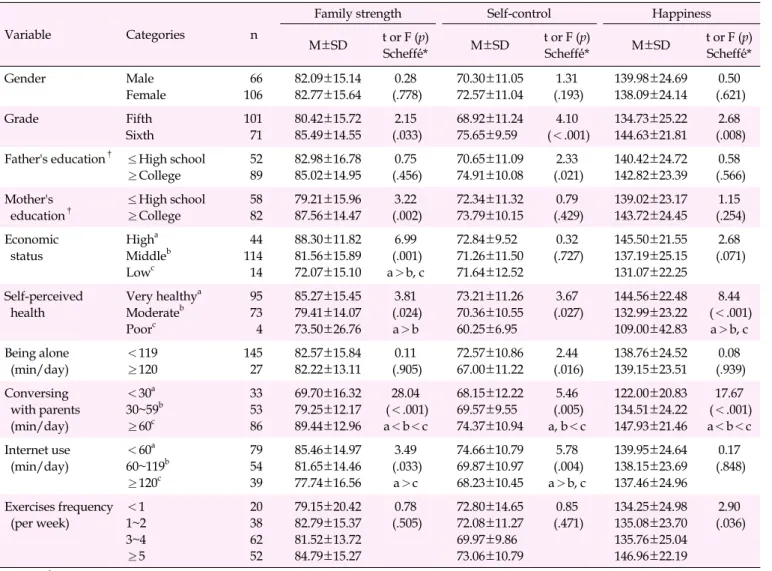
Table 1. Family Strength, Self-control, and Happiness according to General Characteristics (N=172)
Variable Categories n
Family strength Self-control Happiness
M±SD t or F (p)
Scheffé́* M±SD t or F (p)
Scheffé́* M±SD t or F (p) Scheffé́*
Gender Male
Female
66 106
82.09±15.14 82.77±15.64
0.28 (.778)
70.30±11.05 72.57±11.04
1.31 (.193)
139.98±24.69 138.09±24.14
0.50 (.621)
Grade Fifth
Sixth
101 71
80.42±15.72 85.49±14.55
2.15 (.033)
68.92±11.24 75.65±9.59
4.10 (<.001)
134.73±25.22 144.63±21.81
2.68 (.008) Father's education† ≤High school
≥College
52 89
82.98±16.78 85.02±14.95
0.75 (.456)
70.65±11.09 74.91±10.08
2.33 (.021)
140.42±24.72 142.82±23.39
0.58 (.566) Mother's
education†
≤High school
≥College
58 82
79.21±15.96 87.56±14.47
3.22 (.002)
72.34±11.32 73.79±10.15
0.79 (.429)
139.02±23.17 143.72±24.45
1.15 (.254) Economic
status
Higha Middleb Lowc
44 114 14
88.30±11.82 81.56±15.89 72.07±15.10
6.99 (.001) a>b, c
72.84±9.52 71.26±11.50 71.64±12.52
0.32 (.727)
145.50±21.55 137.19±25.15 131.07±22.25
2.68 (.071)
Self-perceived health
Very healthya Moderateb Poorc
95 73 4
85.27±15.45 79.41±14.07 73.50±26.76
3.81 (.024) a>b
73.21±11.26 70.36±10.55 60.25±6.95
3.67 (.027)
144.56±22.48 132.99±23.22 109.00±42.83
8.44 (<.001) a>b, c Being alone
(min/day)
<119
≥120
145 27
82.57±15.84 82.22±13.11
0.11 (.905)
72.57±10.86 67.00±11.22
2.44 (.016)
138.76±24.52 139.15±23.51
0.08 (.939) Conversing
with parents (min/day)
<30a 30~59b
≥60c
33 53 86
69.70±16.32 79.25±12.17 89.44±12.96
28.04 (<.001) a<b<c
68.15±12.22 69.57±9.55 74.37±10.94
5.46 (.005) a, b<c
122.00±20.83 134.51±24.22 147.93±21.46
17.67 (<.001) a<b<c Internet use
(min/day)
<60a 60~119b
≥120c
79 54 39
85.46±14.97 81.65±14.46 77.74±16.56
3.49 (.033) a>c
74.66±10.79 69.87±10.97 68.23±10.45
5.78 (.004) a>b, c
139.95±24.64 138.15±23.69 137.46±24.96
0.17 (.848)
Exercises frequency (per week)
<1 1~2 3~4
≥5
20 38 62 52
79.15±20.42 82.79±15.37 81.52±13.72 84.79±15.27
0.78 (.505)
72.80±14.65 72.08±11.27 69.97±9.86 73.06±10.79
0.85 (.471)
134.25±24.98 135.08±23.70 135.76±25.04 146.96±22.19
2.90 (.036) (IBM Corp., Armonk, NY, USA). Participants’ general charac-
teristics, family strength, happiness, and self-control were an- alyzed using descriptive statistics. The differences in family strength, happiness, and self-control according to the general characteristics of the late school-aged children were analyzed using the t-test and analysis of variance. Post hoc testing was done using the Scheffé test. The correlations among family strength, happiness, and self-control, as perceived by the late school-aged children, were analyzed using Pearson’ correla- tion coefficients. The effects of these factors on their happiness were analyzed using stepwise multiple regression.
RESULTS
1. Family Strength, Self-control, and Happiness by General Characteristics
The mean scores for family strength, self-control, and hap-
piness by general characteristics are presented in Table 1.
The following significant differences in mean family strength scores according to the general characteristics were found.
Sixth-graders scored significantly higher than fifth-graders (t=2.15, p=.033). Children whose mothers were college grad- uates or had a higher education level had significantly higher family strength scores than those whose mothers were high school graduates or lower (t=3.22, p=.002). Children with a high economic status scored highest for family strength, fol- lowed by those at the middle and low levels (F=6.99, p=.001).
Family strength differed significantly by self-perceived health (F=3.81, p=.024). The Scheffé test found that children who perceived themselves to be very healthy had higher family strength scores than those with moderate self-perceived health. Family strength differed significantly according to the amount of time spent conversing with parents (F=28.04, p<
.001), with the highest scores found for those who reported
≥60 min/day of conversation, followed by those who re-
ported 30~59 min/day and <30 min/day. Family strength also differed significantly by the amount of time spent using the internet (F=3.49, p=.033). The Scheffé test found that those who reported <60 min/day of internet use had significantly higher family strength scores than those who reported ≥120 min/day.
Several significant differences were found in mean self- control scores according to general characteristics. Sixth-grad- ers scored significantly higher for self-control than fifth-grad- ers (t=4.10, p<.001). Children whose fathers were college gra- duates or had a higher education level scored significantly higher for self-control than those whose fathers were high school graduates or lower (t=2.33, p=.021). Self-control showed statistically significant difference according to self-perceived health (F=3.67, p=.027), time spent alone (F=2.44, p=.016), and time spent conversing with parents (F=5.46, p=.005). The Scheffé test found that those who spent ≥60 min/day con- versing with parents had higher self-control scores than those who spent <30 min/day and 30~59 min/day conversing with their parents. Self-control significantly differed according to the amount of time spent using the internet (F=5.78, p=.004).
The Scheffé test found that those who reported <60 min/day of internet use had higher self-control scores than those who reported 60~119 min/day or ≥120 min/day.
The following differences were found in the mean happi- ness score by general characteristics. Sixth-graders scored sig- nificantly higher for happiness than fifth-graders (t=2.68, p=
.008). Happiness differed statistically significantly by self-per- ceived health (F=8.44, p<.001). The Scheffé test found that children who perceived themselves as very healthy had high- er happiness scores than those whose self-perceived health was moderate or poor. Happiness differed significantly by the amount of time spent conversing with parents (F=17.67, p<
.001). The Scheffé test found that happiness was highest for those spent ≥60 min/day conversing with their parents, fol- lowed by those who reported spending 30~59 minutes and
<30 min/day conversing with their parents. Happiness dif- fered significantly by the frequency of exercise per week (F=
2.90, p=.036).
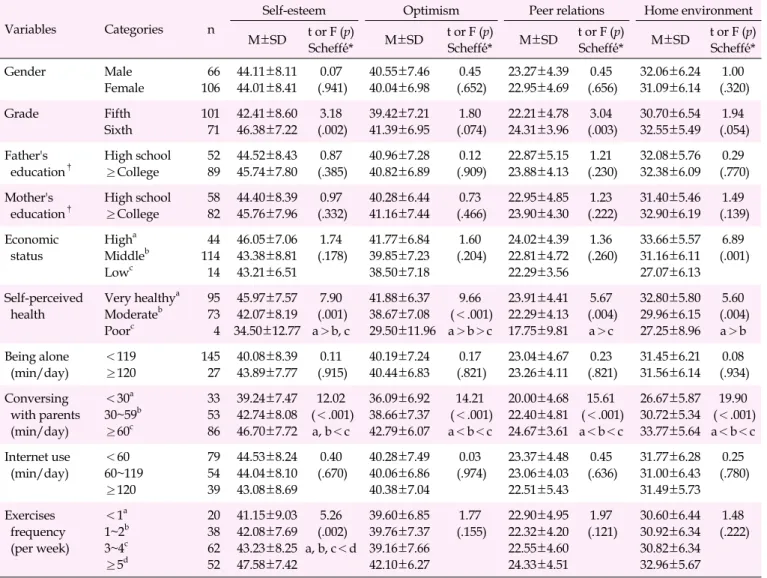
The differences in the mean scores of sub-domains of hap- piness (self-esteem, optimism, peer relations, and home envi- ronment) according to general characteristics are presented in Table 2. For self-esteem, sixth-graders scored significantly higher than fifth-graders (t=3.18, p=.002). Self-esteem differed significantly by self-perceived health (F=7.90, p=.001). The Scheffé test found that children who perceived themselves to be very healthy had higher self-esteem scores than those whose self-perceived health was moderate or poor. Self- esteem differed significantly by the time spent conversing with parents (F=12.02, p<.001). The Scheffé test found that
those who spent ≥60 min/day conversing with their parents had significantly higher self-esteem scores than those who spent <30 min/day and 30~59 min/day conversing with their parents. Self-esteem differed statistically significantly by ex- ercise frequency (F=5.26, p=.002). The Scheffé test found that participants who exercised ≥5 times a week showed higher self-esteem than those who exercised less than 1, 1~2, and 3~4 times a week.
The following differences in mean scores for optimism according to general characteristics were found. Optimism differed statistically significantly by self-perceived health (F=9.66, p<.001). The Scheffé test found that optimism was highest among those who perceived themselves to be very healthy, followed by those with moderate and poor self-per- ceived health. Optimism differed significantly by the time spent conversing with parents (F=14.21, p<.001). The Scheffé
test found that optimism was highest among those who spent
≥60 min/day conversing with their parents, followed by those who spent 30~59 min/day and <30 min/day convers- ing with their parents.
Multiple significant differences were found in the mean scores for peer relations according to general characteristics.
Sixth-graders scored significantly higher than fifth-graders (t=3.04, p=.003). Peer relations differed statistically signifi- cantly by self-perceived health (F=5.67, p=.004). The Scheffé
test found that children who perceived themselves as very healthy scored higher for peer relations than those whose self-perceived health was poor. Scores for peer relations dif- fered significantly by the time spent conversing with parents (F=15.61, p<.001). The Scheffé test found that scores for peer relations were highest among those who spent ≥60 min/day conversing with their parents, followed by those who spent 30~59 min/day and <30 min/day conversing with their parents.
The following differences were found in the mean scores for home environment according to general characteristics:
Home environment differed statistically significantly by house- hold economic status (t=6.89, p=.001) and by self-perceived health (F=5.60, p=.004). The Scheffé test found that children who perceived themselves as very healthy had higher home environment scores than those with moderate self-perceived health. Home environment differed significantly by the time spent conversing with parents (F=19.90, p<.001). The Scheffé
test found the highest score for home environment were found among those who spent ≥60 min/day conversing with their parents, followed by those who spent 30~59 min/day and <30 min/day conversing with their parents.
In particular, self-perceived health and time spent convers- ing with parents were associated with significant differences for all the areas (self-esteem, optimism, peer relations and home environment) (Table 2).
Table 2. The Sub-domains of Happiness according to General Characteristics (N=172)
Variables Categories n
Self-esteem Optimism Peer relations Home environment
M±SD t or F (p)
Scheffé́* M±SD t or F (p)
Scheffé́* M±SD t or F (p)
Scheffé́* M±SD t or F (p) Scheffé́*
Gender Male
Female
66 106
44.11±8.11 44.01±8.41
0.07 (.941)
40.55±7.46 40.04±6.98
0.45 (.652)
23.27±4.39 22.95±4.69
0.45 (.656)
32.06±6.24 31.09±6.14
1.00 (.320)
Grade Fifth
Sixth
101 71
42.41±8.60 46.38±7.22
3.18 (.002)
39.42±7.21 41.39±6.95
1.80 (.074)
22.21±4.78 24.31±3.96
3.04 (.003)
30.70±6.54 32.55±5.49
1.94 (.054) Father's
education†
High school
≥College
52 89
44.52±8.43 45.74±7.80
0.87 (.385)
40.96±7.28 40.82±6.89
0.12 (.909)
22.87±5.15 23.88±4.13
1.21 (.230)
32.08±5.76 32.38±6.09
0.29 (.770) Mother's
education†
High school
≥College
58 82
44.40±8.39 45.76±7.96
0.97 (.332)
40.28±6.44 41.16±7.44
0.73 (.466)
22.95±4.85 23.90±4.30
1.23 (.222)
31.40±5.46 32.90±6.19
1.49 (.139) Economic
status
Higha Middleb Lowc
44 114 14
46.05±7.06 43.38±8.81 43.21±6.51
1.74 (.178)
41.77±6.84 39.85±7.23 38.50±7.18
1.60 (.204)
24.02±4.39 22.81±4.72 22.29±3.56
1.36 (.260)
33.66±5.57 31.16±6.11 27.07±6.13
6.89 (.001)
Self-perceived health
Very healthya Moderateb Poorc
95 73 4
45.97±7.57 42.07±8.19 34.50±12.77
7.90 (.001) a>b, c
41.88±6.37 38.67±7.08 29.50±11.96
9.66 (<.001) a>b>c
23.91±4.41 22.29±4.13 17.75±9.81
5.67 (.004)
a>c
32.80±5.80 29.96±6.15 27.25±8.96
5.60 (.004) a>b Being alone
(min/day)
<119
≥120
145 27
40.08±8.39 43.89±7.77
0.11 (.915)
40.19±7.24 40.44±6.83
0.17 (.821)
23.04±4.67 23.26±4.11
0.23 (.821)
31.45±6.21 31.56±6.14
0.08 (.934) Conversing
with parents (min/day)
<30a 30~59b
≥60c
33 53 86
39.24±7.47 42.74±8.08 46.70±7.72
12.02 (<.001) a, b<c
36.09±6.92 38.66±7.37 42.79±6.07
14.21 (<.001) a<b<c
20.00±4.68 22.40±4.81 24.67±3.61
15.61 (<.001) a<b<c
26.67±5.87 30.72±5.34 33.77±5.64
19.90 (<.001) a<b<c Internet use
(min/day)
<60 60~119
≥120
79 54 39
44.53±8.24 44.04±8.10 43.08±8.69
0.40 (.670)
40.28±7.49 40.06±6.86 40.38±7.04
0.03 (.974)
23.37±4.48 23.06±4.03 22.51±5.43
0.45 (.636)
31.77±6.28 31.00±6.43 31.49±5.73
0.25 (.780)
Exercises frequency (per week)
<1a 1~2b 3~4c
≥5d
20 38 62 52
41.15±9.03 42.08±7.69 43.23±8.25 47.58±7.42
5.26 (.002) a, b, c<d
39.60±6.85 39.76±7.37 39.16±7.66 42.10±6.27
1.77 (.155)
22.90±4.95 22.32±4.20 22.55±4.60 24.33±4.51
1.97 (.121)
30.60±6.44 30.92±6.34 30.82±6.34 32.96±5.67
1.48 (.222)
*p<.050; †Included no response.
2. Correlations among Family Strength, Self-control, and Happiness of Participants
The correlations among family strength, self-control, and happiness are presented in Table 3. Happiness was signifi- cantly positively correlated with family strength (r=.78, p<
.001) and self-control (r=.59, p<.001), and family strength was significantly positively correlated with self-control (r=.55, p<
.001).
Family strength was significantly positively correlated with the pursuit of long-term (r=.59, p<.001) and immediate satis- faction (r=.32, p<.001) among the sub-domains of self-control.
Family strength was significantly positively correlated with self-esteem (r=.73, p<.001), optimism (r=.70, p<.001), peer relations (r=.69, p<.001), and a home environment (r=.79, p<
.001) among the sub-domains of happiness.
Self-control was significantly positively correlated with
family resilience (r=.53, p<.001), mutual respect and accept- ance (r=.54, p<.001), qualitative bonding (r=.49, p<.001), eco- nomic stability and cooperation (r=.36, p<.001), and family cultural and social participation (r=.39, p<.001) among the sub-domains of family strength. Self-control was significantly positively correlated with self-esteem (r=.62, p<.001), opti- mism (r=.50, p<.001), peer relations (r=.53, p<.001), and home environment (r=.53, p<.001) among the sub-domains of happiness.
Happiness was significantly positively correlated with fam- ily resilience (r=.77, p<.001), mutual respect and acceptance (r=.79, p<.001), qualitative bonding (r=.68, p<.001), economic stability and cooperation (r=.53, p<.001), and family cultural and social participation (r=.56, p<.001) among the sub-do- mains of family strength. Happiness was also significantly pos- itively correlated with the pursuit of long-term (r=.67, p<.001) and immediate satisfaction (r=.31, p<.001) among the sub-do-
Table 3. Correlations among Family Strength, Self-control, and Happiness (N=172)
Variables 1 1-1 1-2 1-3 1-4 1-5 2 2-1 2-2 3 3-1 3-2 3-3 3-4
r r r r r r r r r r r r r r
1. Family strengths 1-1. Family resilience
1-2. Mutual respect and acceptance 1-3. Qualitative bonding
1-4. Economic stability cooperation 1-5. Family cultural and social participation
1 .95**
.93**
.89**
.77**
.78**
1 .89**
.78**
.68**
.65**
1 .80**
.63**
.61**
1 .60**
.65**
1 .61** 1 2. Self-control
2-1. Long-term satisfaction 2-2. Immediate satisfaction
.55**
.59**
.32**
.53**
.57**
.32**
.54**
.57**
.33**
.49**
.52**
.30**
.36**
.43**
.18*
.39**
.45**
.20**
1 .87**
.83**
1 .44** 1 3. Happiness
3-1. Self-esteem 3-2. Optimism 3-3. Peer relations 3-4. Home environment
.78**
.73**
.70**
.69**
.79**
.77**
.72**
.67**
.68**
.77**
.79**
.72**
.73**
.70**
.79**
.68**
.63**
.59**
.59**
.71**
.53**
.51**
.46**
.46**
.52**
.56**
.54**
.49**
.48**
.55**
.59**
.62**
.50**
.53**
.53**
.67**
.70**
.60**
.58**
.60**
.31**
.33**
.24**
.31**
.28**
1 .95**
.94**
.91**
.91**
1 .82**
.85**
.81**
1 .84**
.81**
1 .74**
1
*p<.050; **p<.001.
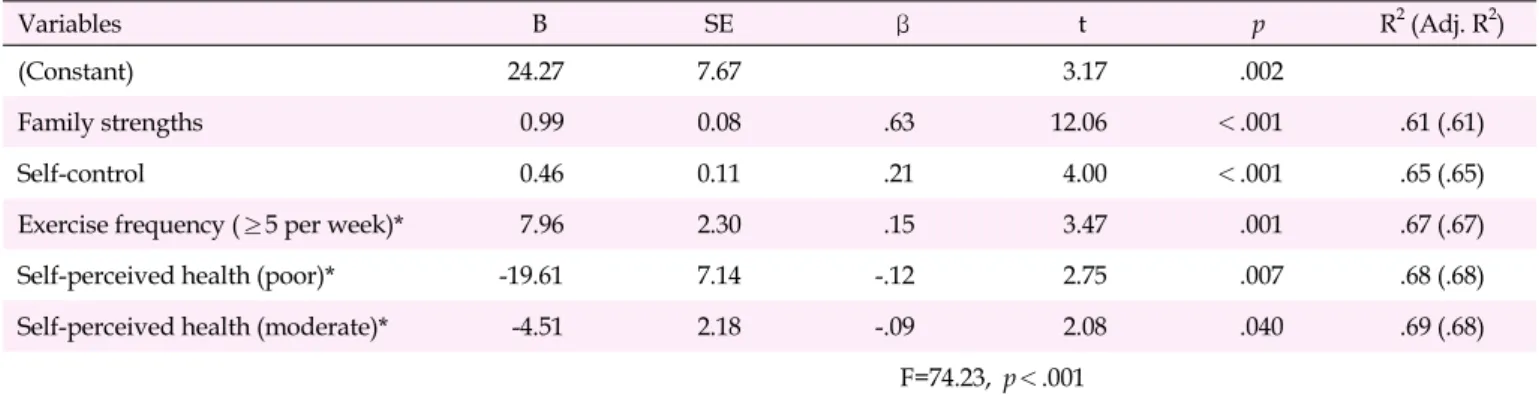
Table 4. Regression Analysis of Happiness (N=172)
Variables B SE β t p R2(Adj. R2)
(Constant) 24.27 7.67 3.17 .002
Family strengths 0.99 0.08 .63 12.06 <.001 .61 (.61)
Self-control 0.46 0.11 .21 4.00 <.001 .65 (.65)
Exercise frequency (≥5 per week)* 7.96 2.30 .15 3.47 .001 .67 (.67)
Self-perceived health (poor)* -19.61 7.14 -.12 2.75 .007 .68 (.68)
Self-perceived health (moderate)* -4.51 2.18 -.09 2.08 .040 .69 (.68)
F=74.23, p<.001
*Dummy variables.
mains of self-control. Higher levels of family strength and self- control were correlated with higher levels of happiness.
3. Factors Affecting Happiness of Participants
The variable inflation factor (VIF) and tolerance were esti- mated to determine multicollinearity among the independent variables used in the regression analysis. There was no multi- collinearity, with - VIF values of 1.02~1.46 and tolerance val- ues of .69~.98. There was no auto-correlation, as shown by a Durbin-Watson statistic of 1.72. Therefore, the assumptions for the regression analysis were met. The regression analysis of happiness was conducted using family strength, self-con- trol, weekly exercise frequency, and self-perceived health as independent variables (Table 4). The stepwise regression ana- lysis model for identifying the factors affecting the children’s happiness was statistically significant (F=74.23, p<.001).
The factors affecting happiness among late school-aged children were family strength (β=.63, p<.001), self-control (β= .21, p<.001), exercising ≥5 times a week (β=.15, p<.001), and poor or moderate self-perceived health (β=-.12, p=.007; β= -.09, p=.040, respectively). These factors accounted for 69% of the total variance. The children’s happiness was primarily explained by family strength (61%) as well as by self-control (4%). A smaller effect was observed for exercising ≥5 times a week (2%). Late school-aged children with higher levels of family strength and self-control felt happier. Happiness was higher in those exercising ≥5 times a week, and was lower in those with poor or moderate self-perceived health.
DISCUSSION
A healthy family is characterized by mutual respect and ac- ceptance, qualitative bonding, economic stability and cooper-
ation, family elasticity, and family cultural and social partic- ipation [13]. This study found that family strength was asso- ciated with high economic status and self-perceived health.
Family strength was also higher in respondents who reported spending a small amount of time using the internet and a large amount conversing with their parents. Economic stabil- ity is an important element of basic family life. It is therefore believed that higher economic status leads to greater family strength. Those regarding themselves as healthy had higher levels of family strength. The physical health of family mem- bers is one of the characteristics of a healthy family [10]. It is therefore necessary to expand education on positive health perceptions and physical activity programs in order to im- prove family strength. In this study, high family strength was inversely correlated with internet usage time and directly cor- related with time spent conversing with parents. School-aged students in Korea were found to use the internet for more than 30 minutes and less than 1 hour per day (41.7%) [24]. The re- sult in the present study indicates that time spent in convert- sation-as compared to personal online activity-promotes fam- ily strength. Therefore, it is necessary to ensure time for con- vertsation with parents as a means of improving family strength, and such an approach is expected to improve family strength through experiential learning programs for late school-aged children.
The children’s score for self-control was higher than in a previous study using the same tool [18]. Research on self-con- trol related to problem behaviors has been conducted at na- tional and international levels [22,26-28], and improvements in self-control have been found due to an increasing recog- nition of its importance. In this study, those who spent less time alone and on the internet, and more time conversing with their parents, had higher self-control. This reflects the process of self-control formation, in which self-control is internalized through repetition and reinforcement of external control [17].
That is, late school-aged children who have more chances to receive and internalize advice from influential people around them develop better self-control.
This observation is also consistent with the finding that problematic internet utilization was correlated with low self-control [24,27]. A literature review regarding internet ad- diction found that lower scores for self-control were corre- lated with internet addiction and longer internet usage time [24]. While it is necessary to conduct further research on this topic because studies have used different scales for internet usage time, improved self-control is expected to reduce inter- net addiction and internet usage time. Children with better self-control used the internet and smartphones with greater moderation, and it is likely that they have less exposure to problem behaviors and problematic internet and smartphone
utilization than those with poor self-control. High self-control was associated with spending more time conversing with parents. This result is similar to the finding that adolescents who engaged in less conversation with their parents were more likely to adhere to peer relations and had a higher like- lihood of experiencing problem behaviors [27]. Time spent conversing with parents also makes a difference in children’s self-control.
In this study, sixth-graders were happier than fifth graders, and high self-perceived health and more time spent convers- ing with parents were also associated with happiness among school-age children. Regarding the finding of this study that sixth-graders felt happier, regardless of gender, previous re- search comparing elementary and middle school students [29] found that higher-grade elementary school students felt happier. Happiness by school grade differed among the chil- dren; therefore, further research should be conducted on hap- piness by grade in school. The children who perceived them- selves as very healthy were happier than their counterparts.
This result is consistent with the previous finding that ele- mentary school children with better subjective health status felt happier, were more satisfied, and had fewer negative emotions [23]. As mentioned above, physically healthy chil- dren seemed to feel happier. Happiness has the same meaning as subjective well-being and satisfaction, and those regarding themselves as healthy are expected to feel more satisfied and happier. Happiness was higher among children who spent more time conversing with their parents. This result is con- sistent with the finding that better intra-family conversations and higher levels of family support, were associated with hap- piness [29]. Time spent conversing with parents made sig- nificant differences in late school-aged children’s happiness, as well as in family strength and self-control. Therefore, if late school-aged children can ensure that they spend more than 60 minutes per day conversing with their parents, they can in- crease their happiness by improving family strength and self-control.
Late school-aged children’s happiness did not differ by eco- nomic status, in contrast to the previous finding that social class and family income were factors affecting happiness [8].
Economic status made significant differences in family strength and home environment among the sub-areas of happiness, but did not affect self-esteem, optimism, or peer relations. It is therefore difficult to say that household economic status im- pacts happiness. Late school-aged children with greater fam- ily strength were happier. This is consistent with previous studies of family strength in preschoolers [29] and school- aged children [30]. It is believed that school-aged children can perceive support and satisfaction as members of society and feel happy when they experience healthy and good human
relationships through a healthy family [1]. Family strength accounted for 61% of children’s happiness. Self-control ac- counted for additional 4% of children’s happiness. Children with better self-control felt happier. This result shows that school-aged children’s happiness was correlated with their pursuit of long-term satisfaction. Pursuit of long-term satis- faction is expected to be an important engine that enables school-aged children experiencing long-term school life to be mentally healthy. Furthermore, exercising ≥5 times per week exerted a smaller, but still meaningful, effect on happiness, with an explanatory power of 2%.
Numerous studies have investigated ways to reduce de- pressive factors and to prevent addiction or problem behav- iors, with the objective of improving happiness among child- ren. Based on this study, more attempts should be made to make children happier by improving family strength, by re- inforcing self-control and positive health perceptions, and by improving physical activity. This study is distinct from those that have sought to explain children’s happiness in terms of school-related variables, such as performance and adjustment to school. To increase the happiness of school-aged children, it is necessary to expand the scope of nursing into commun- ity-based health education, including physical activity pro- grams at school and at home and interventions designed to foster positive health perceptions, instead of limiting inter- ventions to personal factors. This study is significant in that it provided evidence for the importance of family strength for school-aged children and furnished basic data suggesting in- terventions to make them happier by fostering positive men- tal habits.
CONCLUSION
In today’s society, the intense demands of academic work and high levels of stress are threatening children’s mental health. Suicide is the top cause of death among adolescents in Korea. This study aimed to investigate family strength, self- control, and happiness, as perceived by school-aged children, and on this basis, to obtain basic data for use in developing a programs to make them happier. Family strength and self- control jointly accounted for 65% of school-aged children’s happiness. Children exercising ≥5 times per week felt hap- pier, and exercise had an explanatory power of 2% for chil- dren’s happiness. Therefore, further studies should inves- tigate the role of exercise in greater depth. Furthermore, chil- dren who regarded their health as moderate or poor were less likely to feel happy. Therefore, efforts should be made to re- inforce family strength and self-control, to encourage more frequent exercise on a weekly basis, and to foster positive health perceptions in order to improve happiness among
school-aged children.
The results of this study were specific to the location where it was conducted, making it difficult to generalize our results.
Therefore, further research should be conducted with an ex- panded selection of participants. On the basis of these results, it is necessary to develop and apply programs that reinforce family strength and self-control for school-aged children. Fur- ther research should be conducted into other factors influenc- ing late school-aged children’s happiness.
Conflict of interest
No existing or potential conflict of interest relevant to this article was reported.
REFERENCES
1. Hockenberry MJ, Wilson D, Rodgers CC. Wong's nursing care of infants and children. 11th ed. St Louis, MO: Elsvier Inc.; 2018. p.
8-23.
2. Statistics Korea, Ministry of Gender Equality and Family. Youth statistics in 2016 [Internet]. Daejeon: Statistics Korea; 2015 [cited 2019 Feb 1]. Available from:
http://kostat.go.kr/portal/korea/kor_nw/1/6/1/index.board?
bmode=read&bSeq=&aSeq=353501&pageNo=4&rowNum=10&
navCount=10&currPg=&sTarget=title&sTxt=0.
3. Vaillant GE. Aging well: Surprising guideposts to a happier life from the landmark Harvard study of adult developmen. 1st ed.
Boston: Little, Brown and Company; 2008. p. 9-29.
4. Lawrence EM, Rogers RG, Wadsworth T. Happiness and longevity in the United States. Social Science and Medicine. 2015;145:115-119.
https://doi.org/10.1016/j.socscimed.2015.09.020
5. Yeom YS, Kim KM, Lee SW. 2016 8th International comparative study of child and adolescent happiness index. Research Results Report. Seoul: Korea Bang Jung Hwan Foundation; 2016 May.
6. Kang YH. Exploring the constructs of happiness of elementary students. The Journal of Elementary Education. 2008;21(2):159-177.
7. Baumgardner SR, Crothers MK. Positive psychology. 1st ed. United States of Amarica: Pearson; 2009. p. 26-59.
8. Park Y, Kim U. Factors influencing happiness among Korean ado- lescents: With specific focus on the influence of psychological, rela- tional and financial resources and academic achievement. Korean Journal of Psychological and Social Issues. 2009;15(3):399-429.
9. Otto HA. What is a strong family? Marriage and Family Living.
1962;24(1):77-80. https://doi.org/10.2307/348232
10. Yoo YJ. A discussion on the concept of sound home and healthy family. Journal of Korean Home Management Association. 1999;
17(3):93-102.
11. Yoo GS. A survey on the elements of strong families: Focusing on family systems and family strengths. Journal of Family Relations.
2004;9(2):25-42.
12. Yoo YJ. A study on the development of Korean family strengths scale for strengthening the family. Journal of Family Relations.
2004;9(2):119-151.
13. Yoo Y, Lee I, Kim S, Choi H. Development of Korea family strengths scale (KFSS-II). Journal of Korean Home Management Association. 2013;31(4):113-129.
https://doi.org/10.7466/JKHMA.2013.31.4.113
14. Ho K, Shaul RZ, Chapman LA, Ford-Jones EL. Standard of care in pediatrics: Integrating family-centred care and social determinants of health. Healthcare Quarterly. 2016;19(1):55-60.
https://doi.org/10.12927/hcq.2016.24608
15. Lee GN. A review study of self-control in children. Dong-A Edu- cational Review. 1995;21:103-124.
16. Kim WH, Lee DH. The relationships among perceived interpar- ental conflict and self-control, school mal-adjustment behaviors in middle school students. Korean Journal of Counseling. 2010;11(4):
1767-1782.
17. Burns CE, Dunn AM, Brady MA, Starr NB, Blosser CG. Pediatric primary care. 4th ed. St Louis, MO: Elsvier Inc.; 2009. p. 73-91.
18. Nam HM, Ok SW. The effects of psychological family environ- ment, self-control and friend characteristics of middle school stu- dents on their problem behaviors. Family and Environment Re- search. 2001;39(7):37-58.
19. Cottrell L. Joy and happiness: A simultaneous and evolutionary con- cept analysis. Journal of Advanced Nursing. 2016;72(7):1506-1517.
https://doi.org/10.1111/jan.12980
20. Hockenberry M, Wilson D. Wong's essentials of pediatric nursing.
9th ed. St Louis, MO: Elsvier Inc.; 2012.
21. Kang H. Effect size and sample size calculation using G*POWER.
Paju: Freedom Academy; 2019. p. 105-115.
22. Koo HY. Effects of a cell phone use education program on knowl- edge, attitude, self-efficacy, and self-control of cell phone use in
elementary school students. Journal of Korean Academy of Child Health Nursing. 2012;18(3):109-118.
https://doi.org/10.4094/jkachn.2012.18.3.109
23. Jung Y. Analysis on the variables affecting perceived happiness of elementary school students [dissertation]. Seoul: Ewha Womans University; 2015. p. 1-237.
24. Moon YI, Koo HY, Park HR. Scope of internet addiction and pre- dictors of addiction in Korean children in early elementary school.
Korean Journal of Child Health Nursing. 2005;11(3):263-272.
25. Kim IS. The influence of amount of physical activity and exercise participation factors of elementary school children on their happi- ness. The Korean Journal of Elementary Physical Education. 2011;
17(3):113-123.
26. Park YS, Park JH. The effects of school violence victimization on cyberbullying perpetration in middle school students and the moderating role of self-control. Korean Journal of Child Studies.
2016;37(3):39-51. https://doi.org/10.5723/kjcs.2016.37.3.39 27. Li D, Li X, Wang Y, Zhao L, Bao Z, Wen F. School connectedness
and problematic internet use in adolescents: A moderated media- tion model of deviant peer affiliation and self-control. Journal of Abnormal Child Psychology. 2013;41(8):1231-1242.
https://doi.org/10.1007/s10802-013-9761-9
28. Yeun YR, Han SJ. Effects of psychosocial interventions for school- aged children's internet addiction, self-control and self-esteem:
Meta-analysis. Healthcare Informatics Research. 2016;22(3):217-230.
https://doi.org/10.4258/hir.2016.22.3.217
29. Jo EJ. Impact factors of perceived happiness among primary school- child and middle school student from low-income families: Focused on individual factors, family factors, and school factors. Youth Facilities and Environment. 2014;12(1):53-64.
30. Kwon YH. The effects of temperament and family strengths on child's happiness. The Journal of Future Early Childhood Education.
2015;22(2):309-331.