• 검색 결과가 없습니다.

A comparison of coupled and uncoupled dynamic analysis for the flexible riser in shallow water

N/A
N/A
Protected

Academic year: 2021

Share "A comparison of coupled and uncoupled dynamic analysis for the flexible riser in shallow water"

Copied!
7
0
0

로드 중.... (전체 텍스트 보기)

전체 글

(1)

†Corresponding Author: Division of Naval achitecture & Offshore Engineering, INHA University, Inharo, Nam-gu, Incheon 402-751, Korea, E-mail: [email protected], Tel: 032-860-7342

1 Division of Naval achitecture & Offshore Engineering, INHA University, E-mail: [email protected], Tel: 032-860-7342 2 Division of Naval achitecture & Offshore Engineering, INHA University, E-mail: [email protected], Tel:

032-860-7342

3 Division of Naval achitecture & Offshore Engineering, INHA University, E-mail: [email protected], Tel: 032-860-7342

A comparison of coupled and uncoupled dynamic analysis for the flexible riser in shallow water

Chul-Hee Jo 1 ․ Do-Youb Kim 2 ․ Su-Jin Hwang 3 · Yu-Ho Rho

(Received November 4, 2013; Revised November 19, 2013;Accepted January 13, 2014)

Abstract: Flexible risers have been used extensively in recent years for floating and early production systems.

Such risers offer the advantage of having inherent heave compliance in their catenary thereby greatly reducing the complexity of the riser-to-rig and riser-to subsea interfaces. Another advantage with flexible risers is their greater reliability. Concerns about fatigue life, gas permeation and pigging of lines have been overcome by ex- tensive experience with these risers in production applications. In this paper, flexible riser analysis results were compared through coupled and uncoupled dynamic analyses methods. A time domain coupled analysis capability has been developed to model the dynamic responses of an integrated floating system incorporating the inter- actions between vessel, moorings and risers in a marine environment. For this study, SPM (Single Point Mooring) system for an FSU in shallow water was considered. This optimization model was integrated with a time-domain global motion analysis to assess both stability and design constraints of the flexible riser system Keywords: Dynamic analysis, Coupled analysis, Flexible analysis, Harmony search algorithm.

1. Introduction

Traditionally, the motions of a floating vessel and the load effects in mooring lines and risers have been analysed by a separated two step-procedure [1]:

1) Compute motions of the floater based on large body (diffraction/radiation) theory in which load effects from risers are modeled as a linear restoring force only. This is typically a linear frequency domain procedure, or a more sophisticated de-coupled time domain procedure can be used.

2) Apply the vessel motions computed in step 1

as a terminal excitation of the mooring line or riser system in order to computed dynamic load effects. This is typically carried out using a non-linear time domain procedure due to inherent non-linarites present in these systems.

The main shortcomings of this separated approach are:

 Mean loads on riser and mooring lines due to current is not accounted for.

 The important damping effect from the

mooring and riser system on the LF (Low

Frequency) motions can only be included in

a simplistic way.

(2)

 The dynamics of mooring lines will not influence the WF (Wave Frequency) motions of the floater.

The effect of these shortcomings will increase con- siderably when water depth increase. In deep water, the interaction between mooring lines/ risers and the floater will be pronounced, and a separate analysis approach may be too inaccurate. In a coupled ap- proach the total floater and slender structure response is solved for simultaneously at every time step in the simulation. In this way, the full interaction between floater and slender structure is accounted overcoming the limitations by a separated approach.

2. Coupled analysis methodology

All the system components are described in a finite element (FE) model. The applied FE procedure is a displacement formulation that allows for unlimited displacements and rotations in the three-dimensional space, while the strains are assumed to be moderate.

2.1 Coupled effects

Coupling effects refer to the influence on the float- er mean position and dynamic response from slender structure restoring, damping and inertia forces. These force contributions are elaborated as follows.

Restoring:

1) Static restoring force from the mooring and riser system as a function of floater offset 2) Current loading and its effects on the

restoring force of the mooring and riser system

3) Seafloor friction (if mooring lines and/ or risers have bottom contact)

Damping:

4) Damping from mooring and riser system due to dynamic, current, etc.

5) Friction force due to hull/ riser contact.

Inertia:

6) Additional inertia forces due to the mooring and riser system

In a traditional de-coupled analysis, 1) can be ac- curately accounted for. 2), 4) and 6) may be approximated. Generally, 3) and 5) cannot be ac- counted for. However, a coupled analysis as described previously can include consistent treatment of all these effects.

2.2 De-coupled analysis

In a de-coupled analysis the equations of the rigid body floater motions are solved in time domain, but the effects of the mooring and riser system are in- cluded quasi-statically using non-linear springs, i.e.

quasi-static restoring force characteristics. All other coupling effects, e.g. contributions from damping and current loading on the slender structures, need to be given as input to the analysis based on a separate assessment.

Figure 1: Illustration of traditional separated analysis

Figure 2: Illustration of coupled analysis

(3)

2.3 Coupled analysis

In a coupled analysis the complete system of equa- tions accounting for the rigid body model of the floater as well as the slender body model for the ris- ers and mooring lines are solved simultaneously using a non-linear time domain approach for dynamic analysis. Dynamic equilibrium is obtained at each time step ensuring consistent treatment of the floater/

slender structure coupling effects. The coupling ef- fects are automatically included in the analysis scheme.

2.4 Coupled equations of motions

The governing dynamic equilibrium equation of the spatially discretized system is expressed by

            (1) where R I , R D and R S represent inertia, damping and internal reaction force vectors respectively. R E is the external force vector.  ,  and  are the structure displacement, velocity and acceleration vectors [2].

The inertia force vector is expressed as

    (2) where M is the system mass matrix that includes structural mass, mass accounting for internal fluid flow in pipes, and hydrodynamic mass. The damping force vector is expressed as

    (3) where C is the system damping matrix that includes contributions from internal structural damping as well as hydrodynamic damping.

The internal reaction force vector   is cal- culated based on the instantaneous state of stress in the elements. The external load vector accounts for weight and buoyancy, forced displacements, environ- mental forces and specific forces. Equation (2) ex- presses a nonlinear system of differential equations.

Nonlinearities may be due to the displacement de- pendencies in the inertia and damping forces and due to the coupling between the external load vector and structural displacements and velocity.

Introducing the tangential mass, damping and stiff- ness matrices at start of the time increment, and im- plementation of the residual force vector from the previous time step, the linearized incremental equa- tion of motion is given by

                   (4) where  ,  and  are the incremental nodal ac- celerations, velocities and displacements respectively.

All force vectors and system matrices are established by assembly of element contributions and nodal com- ponent contributions in a common global reference frame.

In a coupled analysis the floating vessel is treated as a nodal component assuming the vessel acts as a rigid body. The forces on the vessel, represented by large volume body, are computed separately at each time step end included in the external load vector RE. The exception is the vessel inertia forces repre- senting the vessel mass and the frequency-in- dependent part of the added mass which are included in the mass matrix of the system.

3. Harmony search algorithm

This paper identifies the factors affecting the flexi-

ble riser configuration design. Existing 15” flexible

riser was designed as a way to optimize by HS

(harmony Search). This paper was written on the pa-

per, based on the price of the mooring line opti-

mization achieved in the design of shallow water in

the clean-up, and a combination of variables that af-

fect the optimization of the mooring line and the var-

iables that affect the design of a flexible riser impact

of were identified [3].

(4)

Compared to other simulation-based meta-heuristic optimization algorithms such as simulated annealing, tabu search, and generic algorithm [1][2][4]-[6], HS was adopted from musical process of finding

‘pleasant harmonies’.

Fundamental five steps of an HS for the cost-opti- mum riser system design are shown Figure 3, and they are summarized as follows [7]:

Step 1: Design variable / algorithm parameter initialization;

Step 2: Harmony memory initialization;

Step 3: Generation of a new harmony

Step 4: Harmony memory update if needed; and Step 5: Improvisation stopping criterion check

Figure 3: Flow chart of HS algorithm for designing a flexible riser system

3.1 Step 1: Parameter set-up

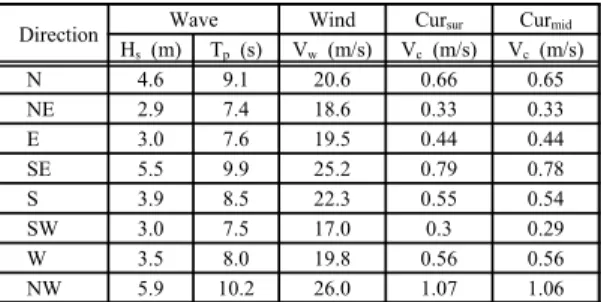
From the constraints in the configuration design of flexible riser affecting shallow water such as water depth, environmental loads, FPSO's Turret types (Internal turret or External turret position), FPSO's offset (Near, Far and Cross position and D (Diameter). The design environment condition is sum- marized in Table 1.

A JONSWAP spectrum was used to model wave, while the NPD spectrum was used to model the gust-

iness of the wind. The principal characteristics of the FPSO are shown in Table 2. Table 3 shows FPSO offset when mooring lines are connected to FPSO.

Direction Wave Wind Cur sur Cur mid

H s (m) T p (s) V w (m/s) V c (m/s) V c (m/s)

N 4.6 9.1 20.6 0.66 0.65

NE 2.9 7.4 18.6 0.33 0.33

E 3.0 7.6 19.5 0.44 0.44

SE 5.5 9.9 25.2 0.79 0.78

S 3.9 8.5 22.3 0.55 0.54

SW 3.0 7.5 17.0 0.3 0.29

W 3.5 8.0 19.8 0.56 0.56

NW 5.9 10.2 26.0 1.07 1.06

Table 2: Environment condition data

FPSO Particulars

Length overall (m) 334.67

Length between perps (m) 302.00

Breadth (m) 60.00

Depth (m) 33.00

Condition LC 012 LC 021

Ballast Fully Loaded Displacement (Te) 139114.4 405175

Draught aft (m) 8.35 23.75

Draught mid (m) 8.29 23.00

Draught forward (m) 8.24 22.20

GM 28.75 5.80

Table 3: FPSO Particulars

FPSO Offset

Near 11.5 (m)

Far 13.6 (m)

Cross 17.2 (m)

Table 4: FPSO offset

The flexible riser designs are affecting by these de- pendent variables such as loading conditions, internal fluid, buoy property, riser property, marine growth and C d (Drag coefficient). Table 4 shows that 15” ris- er property that existing installed in areas. Table 5 shows that flexible riser analysis cases. Flexible riser and buoy were designed through optimizing the HS based on various constraint and dependent conditions.

In other word, buoy was designed according to the

variables of each dependent conditions like that the

required size of the buoy, buoy number, location and

spacing of the buoy.

(5)

Parameter 15-inch Internal diameter (mm) 381.0 External diameter (mm) 491.1 Weight in air empty (kg/m) 217.87 Bending stiffness (kNm 2 ) 432.12 Axial stiffness (106N) 151.51 Torsional stiffness (108Nm 2 /rad) 0.23

Table 5: 15″ riser property

Riser S.G 0.75 0.9 1.05 1.2

C d 0.66 0.7 0.74

Marine Growth 0 50% 100%

Internal fluid API 20° API 19° API 16° Seawater Weight in air (kg/m) 145.618 174.742 203.865 232.988

Table 6: Riser analysis case

3.2 Step 2: HM initialization

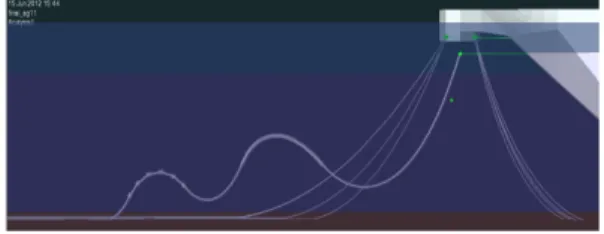
The initial HM consists of different solution vec- tors of HMS. Each solution vector has diameter and length values for each buoy component and riser system. In this study, riser design and analysis was performed according to the existing design 15” riser system. Existing design 15” risers mean configuration is shown in Figure 4. Riser was designed in the shape of the ‘double lazy-S and a total length of 195m. Buoy was divided into DB1 and DB2 were each 6 and 8 per installed.

Figure 4: 15″ riser mean configuration

3.3 Step 3: Generation of a new harmony Improvisation of a new harmony is performed based on three rules: (i) memory consideration, (ii) pitch adjustment, and (iii) random selection [8]. Riser and FSU were implemented modeling, hydrodynamic analysis and riser analysis using DNV SESAM pro- gram software. The riser weight and diameter have been evaluated for the various fluid conditions.

4. Analysis and Results

4.1 Compute line shape

In static analysis it is convenient to distinguish be- tween the following basic load types [2]:

1) Volume forces (weight and buoyancy)

2) Specified displacements (i.e. displacements from stress-free configuration to final position of nodal points with specified boundary conditions)

3) Specified forces (nodal point loads) 4) Position dependent forces (current forces)

The incremental loading procedure starting from stress-free configuration is organized in a sequence of load conditions where each load condition consists of one or more of the basic load types. Figure 5 illus- trates the compute line shape method. Each load con- dition is applied in a specified number of load incre- ments [2].

Figure 5: Compute line shape method

4.2 Analysis

Static analysis was carried out lumped load and mass formulation and dynamic analysis performed un- coupled analysis by irregular time domain. The purpose of this analysis is to find the most suitable riser config- uration, the extreme riser top excursions may be ac- commodated in the most unfavorable environmental conditions i.e. the 100-year thunder storm condition [9].

The crucial parameters of this design verification

are:

(6)

1) Minimum radii of curvature of the flexible pipe.

2) Loads induced by the risers on the top connections.

3) Loads in the risers at the TDP (Touch Down Point).

4) Relative positions of the riser sag with respect to the sea bed.

5) Relative position of the riser top section with respect to the FSU vessel shell.

6) Lateral excursion of the risers.

4.3 Results

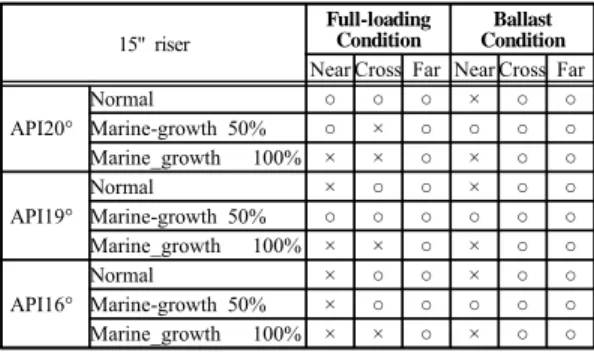
A flexible riser was analyzed by two methods such as uncoupled analysis and coupled analysis. Also, through compute line shape analysis was performed a flexible riser configuration optimization. From the configuration optimized riser, global response analysis compared with coupled analysis. The results of analy- ses for full loading and ballast conditions are ex- plained briefly below:

Full-loading condition

1) Near position: At +11.03m near position, the three cases : case 1, case 2 and case 3 are failed to have the stable solutions. However at +6m near position from the mean, case 1 satisfy the stable criteria. For marine growth of 50%, case 1 and case 2 are stable except case 3. However, for marine growth of 100%, the risers become heavy causing the riser to contact with seabed for all cases.

2) Cross position(y+20m): The cross position means when the riser moves 20m to y direction. All cases show stable for the cross position. However for 100% marine growth, none of cases is stable since the riser contacts seabed. For the 50% marine growth, case 2 and case 3 indicate stable with bottom clearance of 1~2m.

3) Far position (-11.61m): For the far position of -11.61m, all cases become stable.

Ballast condition

1) Near position (+11.3m): All cases are resulted unstable for the near position. However, for marine growth of 50%, all cases show stable.

For marine growth of 100%, the riser of all cases contacts seabed.

2) Cross position(y+20m): All cases show stable regardless of fluid properties or marine growth.

3) Far position (-11.61m): All cases are stable.

Table 6 summarizes the results of uncoupled anal- ysis and Table 7 is coupled analysis results.

Compare to the uncoupled analysis, coupled anal- ysis results are more stable especially in API 20”

case due to the weight. However, there are not much different in two analysis method.

15" riser

Full-loading Condition

Ballast Condition Near Cross Far Near Cross Far

API20°

Normal ○ ○ ○ × ○ ○

Marine-growth 50% ○ × ○ ○ ○ ○

Marine_growth 100% × × ○ × ○ ○

API19°

Normal × ○ ○ × ○ ○

Marine-growth 50% ○ ○ ○ ○ ○ ○

Marine_growth 100% × × ○ × ○ ○

API16°

Normal × ○ ○ × ○ ○

Marine-growth 50% × ○ ○ ○ ○ ○

Marine_growth 100% × × ○ × ○ ○

Table 7: 15″ riser analysis result with uncoupled method

15" riser

Full-loading Condition

Ballast Condition Near Cross Far Near Cross Far

API20°

Normal ○ ○ ○ ○ ○ ○

Marine-growth 50% ○ ○ ○ ○ ○ ○

Marine_growth 100% × ○ ○ × ○ ○

API19°

Normal × ○ ○ × ○ ○

Marine-growth 50% ○ ○ ○ ○ ○ ○

Marine_growth 100% × × ○ × ○ ○

API16°

Normal × ○ ○ × ○ ○

Marine-growth 50% × ○ ○ ○ ○ ○

Marine_growth 100% × × ○ × ○ ○

Table 8: 15″ riser analysis result with coupled

method

(7)

5. Conclusions

In this study, comparisons between the uncoupled and coupled approaches are presented. To obtain the uncoupled results, a low frequency quasi-static compu- tation was first performed using zero frequency asymptotic value for the added mass and damping co- efficient, neglecting also the line inertia. The RAO and mooring stiffness are computed once for all in the position of static equilibrium under stationary loads.

A method for coupled motion analysis of floating moored structures is outlined and applied to case ex- ample of a turret-moored ship operating in 55m water depths. Turret motions, line tensions and clearance with seabed from simulation, uncoupled analysis and coupled analysis are compared.

Through this study, the shallow water of a flexible riser design to a number of constraints that were identified and the biggest factor is the offset of the FPSO. So, riser must be having an enough stability to be ensured within the range of FSU offset. Buoy design is not easy to satisfy all the conditions of the fluids in shallow water because the production riser has different internal fluid cases.

Depending on the fluid of S.G dynamic character- istics are very different. Therefore, depending on a variety of fluid S.G under the various conditions, many case studies are required to optimize buoy design. For an economical buoy design, considering the number of buoy, size, price, spacing and etc. the detailed design is required.

Acknowledgement

This work was supported by the Manpower Development Program for Marine Energy of the Ministry of Ocean and fisheries the Korean govern- ment and the Technology Innovation Program funded By the Ministry of Trade, industry & Energy (MI, Korea). The authors grateful to INHA University for

the funding research grant.

References

[1] H. Ormberg and K. Larsen, “Coupled analysis of floater motion and mooring dynamics for tur- ret-moored ship”, Applied Ocean Research 20, 1998.

[2] DNV, Deep User Manual, Det Norske Veritas, 2008.

[3] S. Ryu, Heyl, Caspar, and A. Duggal, “Mooring cost sensitivity study based on cost-optimum mooring design”, The Korean Society of Ocean Engineers, vol. 23, no. 1, pp. 1-6, 2009 (in Korean).

[4] M. C. Cunha and J. Sousa, “Water distribution newtwork design optimization: simulated anneling approach”, American Society of Civil Engineers, vol. 125, no. 4, pp. 215-221, 1999.

[5] S. H. Kim, J. H. Kwon, and J. Kim, “Study on the airfoil shape design optimization using data- base genetic algorithms”, The Korean Society of Marine Engineering, vol. 31, no. 1, pp. 58-66, 2007 (in Korean).

[6] I. Lippai, J. P. Heaney, and M. Laguan,

“Robust water system design with commercial intelligent search optimizers”, American Society of Civil Engineers, vol. 13, no. 3, pp. 135-143, 1999.

[7] S. Ryu, A. S. Duggal, C. N. Heyl, and Z. W.

Geem, “Mooring cost optimization via harmony search”, Proceedings of the 26th International Conference on Offshore Mechanics and Arctic Engineering, pp. 355-362, 2007.

[8] Michael W. J Wyllie, “Fast track FPSO`s for deepwater and ultra-deepwater”, Proceedings of the Offshore Technology Conference, pp.

205-211, 2004.

[9] API, Design of Risers for Floating Production

Systems(FPSs) and Tension-leg Platforms (TLPs),

American Petroleum Institute, 1998.

수치

Figure 1: Illustration of traditional separated  analysis
Figure 3: Flow chart of HS algorithm for  designing a flexible riser system
Figure 5: Compute line shape method
Table 6 summarizes the results of uncoupled  anal- anal-ysis and Table 7 is coupled analanal-ysis results.

참조

관련 문서

In this paper, a methodology for estimating the parameters of non-linear system including stabilizing system(Night Vision Pedestal System) was presented.. To

The purpose of this study is a comprehensive analysis for curriculum training excellent teachers, by comparing and analyzing the training program for

~ depends on the relative importance of the turbulent transport terms For the turbulent jet motion, simulation of turbulence is important. For the horizontal motion in

This article, in terms of retrospective evaluation, intended to present a suitable alternative for the present with the normative analysis, the comparative

There are a lot of institutions for evaluation in the world, for example, Legislative Evaluation in the Continental Legal System, Regulatory Impact Analysis

In this thesis, basic design process for an icebreaker is introduced, a reamers’ effects on resistance performance in open water is examined by model tests and a

Finally, this study has an implication that the comprehensive analysis framework, rather than a single model, was more useful in analyzing a dynamic policy formation

To examine the performance of the N-PI controller proposed in this study, simulation was performed by applying the proposed controller to a water tank system; and the