The Application of the Forensic Dental Identification to Unidentified Individual Remains in Korea
Hee-Kyung Park, D.D.S.,M.S.D.,Ph.D.
Section of Forensic Dentistry, Department of Forensic Medicine National Institute of Scientific Investigation
The cases of unidentified individual remains submitted to Forensic dentistry section in National Institute of Scientific Investigation, Korea were analyzed to study the application of forensic dental identification into individual identification in the period 2002-2005. The identification cases of unidentified remains were 405 out of 493, which accounted about 82% of whole cases. The incidence of submission of skeletons at least including the skull was increased from 58% in 2002 to 80% in 2005. The numbers of cases for the full examinations were 4 times more than that for age estimation in 2005.
Twenty-four cases were submitted for skull to photographic superimposition and 15 out of 24 cases were examined, and the other 9 cases were examined by DNA analysis only. The submitted cases for dental comparison were 23 cases, 9 cases were positively identified, 4 cases were possible, 7 cases were excluded, and 3 cases ended up with insufficient evidences. The proportion of positive identification by dental methods was increased gradually from 9% in 2002 to 46% in 2005.
Forensic dental identification has become important and useful because the availability of dental records and radiographs has been increasing. Compared to DNA analysis, forensic dental identification has several advantages such as no needs for high cost equipments and low expenses. And the interpretation of results is straightforward and speedy. These advantages are based on using primary their own dental records of the individuals rather than secondary DNA reference samples from family members. The application of the forensic dental identification to unidentified individual remains will be increased because the dental comparison can complement the limitation of DNA analysis and skull to photographic superimposition in many cases.
In order to obtain positive identifications of unidentified remains, a close collaboration between the police and forensic scientists is important. The systemic approach including legislation to preserve dental records of unidentified remains and missing persons for the identification of unidentified remains should be needed.
Key words : Forensic, Dental identification, Unidentified remains, Dental records.
Corresponding author: Hee-Kyung Park
Section of Forensic Dentistry, Department of Forensic Medicine, National Institute of Scientific Investigation,
#331-1, Shinwol 7-dong, Yangcheon-gu, Seoul 158-707, Korea
E-mail : [email protected] received: 2005-11-20 accepted: 2006-01-22
I. INTRODUCTION
The definition of forensic odontology by Keiser- Nielson is described as 'proper handling and examination of the dental evidence, in the interests of justice, so that the dental findings may be properly presented and evaluated'1). This discipline covers various subjects including the interpretation of bite marks, personal identification either
individually or in the context of mass disaster, age estimation from the teeth, recognition of child abuse and neglect, and expert witness to the court2). The relevance of history for identification using teeth back to about AD 66, Nero's mistress, Sabina wanted to see the head of Nero's wife on a dish and recognized her by her black anterior tooth3). One of the first proposals for using the teeth as an aid of identification was made by Godon and his proposition was adopted by the professional dental society of Paris in 18871,4). In the last few decades, identification by dental means has been known as one of the most reliable methods for identification of victims in mass disasters5-9) as well as when one individual must be identified10,11).
National Institute of Scientific Investigation (NISI) in Korea is the institute fully dedicated to the forensic work for the police, the prosecutor's office and the court. Forensic dentistry section of NISI renamed from the Hard tissue section in 2000 is in charge of forensic dentistry discipline and identification work of unidentified remains by various examination methods except DNA methods.
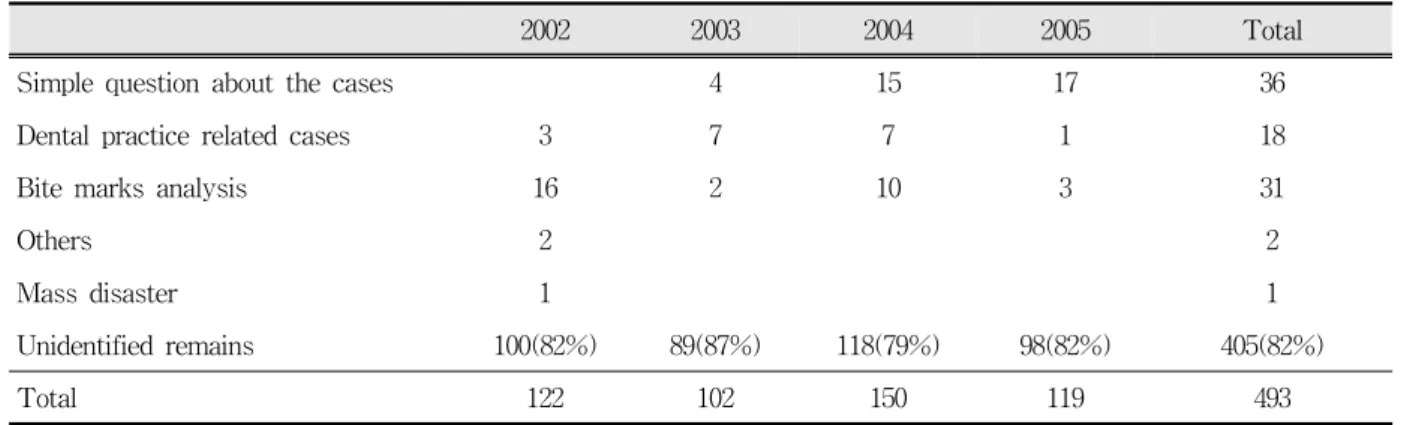
Since the dental contribution for identification in 'Sampoong department store demolition' in 1996, the dental information was used in mass disasters like 'Air China crush at Gimhae in 2002', and 'Daegu subway arson in 2003'. The recognition of dental information in mass disaster had been rapidly increased. However, compared to the DNA analysis, an individual identification by dental comparison in
2002 2003 2004 2005 Total
Simple question about the cases 4 15 17 36
Dental practice related cases 3 7 7 1 18
Bite marks analysis 16 2 10 3 31
Others 2 2
Mass disaster 1 1
Unidentified remains 100(82%) 89(87%) 118(79%) 98(82%) 405(82%)
Total 122 102 150 119 493
Table 1. Total submitted cases in the period of 2002-2005
Korea seems not well known to the police and the public. There was no relevant and comprehensive data concerning the forensic dental identification of unidentified individual remains in Korea so far.
Therefore the aim of this study was to present the systematic analysis of unidentified remains for identification submitted to Forensic dentistry section in NISI in the period of 2002-2005 and discuss the usefulness of forensic dental identification in the process of individual identification.
Ⅱ. MATERIALS AND METHODS
Four hundred-ninety three cases were submitted from the police to Forensic dentistry section in NISI in the period of 2002-2005. Submitted cases from the police were classified by the simple question about the cases, dental practice related cases, bite marks analysis and others (Table 1). Mass disaster was counted as a 1 case and was excluded in this individual identification analysis. A retrospective review of 405 unidentified remains cases was conducted. The submitted examination materials for the full examination for identification and age estimation were analyzed. The full examinations of unidentified remains included various examinations for identification such as anthropometry and anthropologic analysis of skeleton, postmortem dental charting and radiographic taking, and age estimation using teeth. Data concerning the identification results by dental comparison and skull
to photographic superimposition were carefully studied, and manner of death were indicated in the dental comparison cases. The results of positive identification were also analyzed.
Ⅲ. RESULTS
The identification cases of unidentified remains were 405 out of 493, which accounted about 82% of whole cases. Four hundred five unidentified remains cases (the actual numbers of unidentified remains) were divided into two categories. One is for the full examinations of skeletons/skulls and the other is only for age estimation (Table 2). The numbers between submitted cases and unidentified person showed some discrepancies because some bony parts from one person were found separately at different day, and commingled skeletons more than one individual from the same police agency were counted as a 1 case. For example, excavation of skeletons of 5 boys, so called frog boys who had
2002 2003 2004 2005 Total
Full examinations 58(58%) 52(58%) 91(77%) 78(80%) 279(69%)
Age estimation only 42(42%) 37(42%) 27(23%) 20(20%) 126(31%)
UI cases (UI person)* 100(99) 89(83) 118(104) 98(89) 405(375)
UI, unidentified remains; (UI person)*, actual number of unidentified person
Table 2. The cases of unidentified remains in the period of 2002-2005 were divided by the examination method for identification
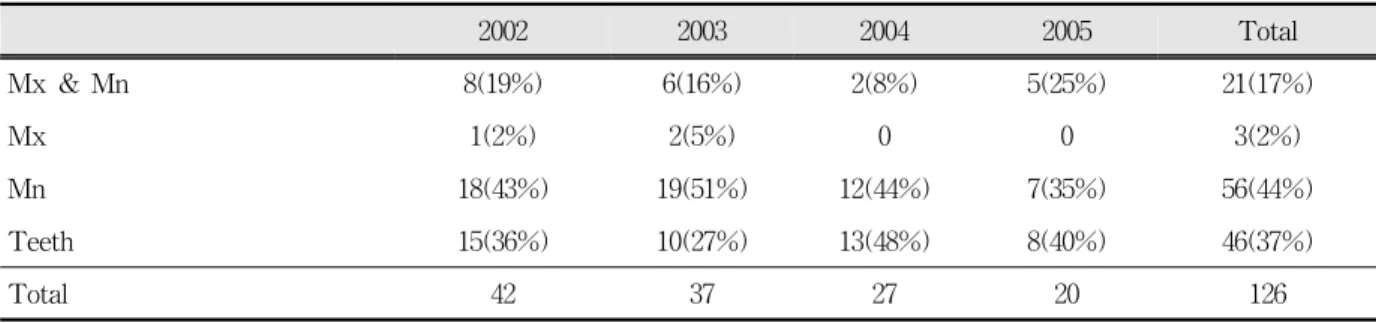
2002 2003 2004 2005 Total
Mx & Mn 8(19%) 6(16%) 2(8%) 5(25%) 21(17%)
Mx 1(2%) 2(5%) 0 0 3(2%)
Mn 18(43%) 19(51%) 12(44%) 7(35%) 56(44%)
Teeth 15(36%) 10(27%) 13(48%) 8(40%) 46(37%)
Total 42 37 27 20 126
Mx, maxilla; Mn, mandible
Table 3. The examination materials of unidentified remains submitted for age estimation
been missing for 11 years was submitted as a 1 case.
The incidence of submission of skeletons at least including the skull was increased from 58% in 2002 to 80% in 2005. The numbers of cases for the full examinations were 4 times more than that for age estimation in 2005. The submitted examination materials for age estimation were analyzed and shown in Table 3. The submitted cases for age estimation by only presented teeth were decreased from 15 cases in 2002 to 8 cases in 2005. The submitted examination materials for the full examination of unidentified remains, especially materials for dental comparison or skull to photographic superimposition, were analyzed and shown in Table 4. The examination materials in 245 cases out of 279 cases were full skeletons or at least skulls. The proportion of skull to photographic superimposition cases was decreased 19% in 2002 to 3% in 2005. The identification results from skull to photographic superimposition were shown in
2002 2003 2004 2005 Total
For dental comparison total 3(5%) 4(8%) 9(10%) 7(9%) 23(8%)
skeleton & dental record 2 2 4
skull & dental record 3 1 3 4 11
dental record 3 4 1 8
For superimposition total 11(19%) 1(2%) 10(11%) 2(3%) 24(9%)
skeleton & photograph 3 1 4
skull & photograph 4 1 5
photograph only 4 9 2 15
For full identification total 44(76%) 47(90%) 72(79%) 69(88%) 232(83%)
skeleton 27 22 33 35 117
skull 16 24 36 28 104
others 1 1 3 6 11
Total 58 52 91 78 279
Table 4. The examination materials of unidentified remains submitted for the whole examination, especially materials for dental comparison or skull to photographic superimposition were analyzed
No Year Materials Results
1 2002-1 B,P not exclusive
2 2002-2 P not exclusive
3 2002-3 B,P not exclusive
4 2002-4 S,P exclusive
5 2002-5 S,P not exclusive
6 2002-6 P not exclusive
7 2002-7 B,P not exclusive
8 2002-8 S,P not exclusive
9 2002-9 P not exclusive
10 2002-10 S,P not exclusive
11 2003-1 B,P not exclusive
12 2004-1 P not exclusive
13 2004-2 P not exclusive
14 2004-3 P exclusive
15 2004-4 P not exclusive
P, photographs; B, skeleton; S, skull
Table 5. The results of skull to photographic superimposition cases
Table 5. In the 24 cases submitted for skull to photographic superimposition, the analysis of 15 cases was done and the results were consistent with the DNA analysis results. The examinations of the other 9 cases were done by DNA analysis.
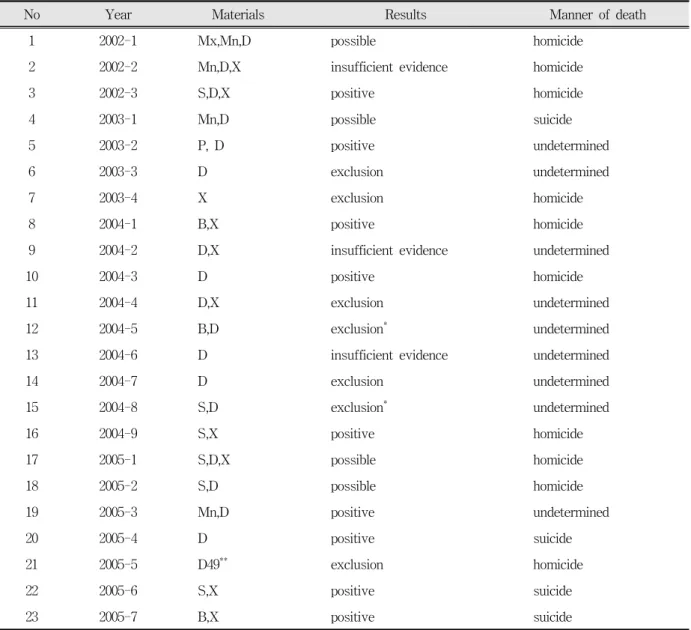
The identification results from dental comparison of unidentified remains were shown in Table 6. By American Board of Forensic Odontology (ABFO) body identification guidelines and standards, categories and terminology for body identification such as positive identification, possible, insufficient evidence, and exclusion were used. From dental comparison, 9 individuals were positively identified, 4 possible identification results were also proved by DNA analysis, and 7 cases were excluded. Three were insufficient evidence cases because of improper examination materials. The antemortem dental records and radiographs from 49 possible missing persons for an unidentified murder victim were submitted in 2005 and all missing persons were excluded. The dental identification procedure could be done within a few hours and usually reported to the police at the same day. The manner
No Year Materials Results Manner of death
1 2002-1 Mx,Mn,D possible homicide
2 2002-2 Mn,D,X insufficient evidence homicide
3 2002-3 S,D,X positive homicide
4 2003-1 Mn,D possible suicide
5 2003-2 P, D positive undetermined
6 2003-3 D exclusion undetermined
7 2003-4 X exclusion homicide
8 2004-1 B,X positive homicide
9 2004-2 D,X insufficient evidence undetermined
10 2004-3 D positive homicide
11 2004-4 D,X exclusion undetermined
12 2004-5 B,D exclusion* undetermined
13 2004-6 D insufficient evidence undetermined
14 2004-7 D exclusion undetermined
15 2004-8 S,D exclusion* undetermined
16 2004-9 S,X positive homicide
17 2005-1 S,D,X possible homicide
18 2005-2 S,D possible homicide
19 2005-3 Mn,D positive undetermined
20 2005-4 D positive suicide
21 2005-5 D49** exclusion homicide
22 2005-6 S,X positive suicide
23 2005-7 B,X positive suicide
S, skull; B, skeleton; Mx, maxilla; Mn, mandible, P, photographs; X, radiographs; D, dental record;
*, mtDNA hypervaribale region I showed the same sequences; **, dental records and radiographs from 49 persons Table 6. The results of unidentified remains for forensic dental comparison
2002 2003 2004 2005 Total
By fingerprints/others 1(5%) 2(17%) 2/2(23%) 2(15%) 9(14%)
By dental 2(9%) 2(17%) 3(18%) 6(46%) 13(21%)
By DNA 18(86%) 8(66%) 10(59%) 5(39%) 41(65%)
Id positive / UI persons 21/99 12/83 17/104 13/89 63/375
Id, identification; UI, unidentified
Table 7. The results of positive identification from unidentified remains
of death of all dental comparison cases was unnatural, and 9 out of 24 cases were homicide.
The results of positive identification from unidentified remains were shown in Table 7. These data were based on the results from dental comparison and skull to photographic superimposi- tion in addition to the result from verbal communication with the police or DNA identification section in NISI. The proportion of positive identification by dental methods was increased from 9% in 2002 to 46% in 2005.
Ⅳ. DISCUSSION
Accurate identification of the deceased remains one of the important objectives of postmortem examination. There are various reasons to identify the dead. These are for the ethical and humanitarian need, and also for official, statistical and legal purposes. These are also for administrative and ceremonial purposes in respect of burial or cremation. In addition, the identity of the deceased is important to discharge legal claims, to prove claims for life insurance contracts, and finally to facilitate police enquiries into overtly criminal or suspicious deaths12). The various methods like visual identification, personal belongings, fingerprints, dental methods, radiographic comparison, DNA analysis, skull to photographic superimposition can be used for individual identification13).
Individual identification by fingerprints is broadly used in Korea because the fingerprints cards of adults over 17 years old are on file managed by national police agency, whereas other countries have only limited database for convicted criminals in specific crimes. However, the use of the easiest methods including visual identification and fingerprints may be limited when the bodies are decomposed or mutilated. The bodies were often charred or dismembered to hide the identity of victims in the homicide cases.
The skull to photographic superimposition technique was suggested by Brash at first as an identification technique in 193514). Since then
various scientists have utilized this technique in many criminal cases15,16). In Korea, this technique was introduced in 1985 for the first time and used to identify the victim of homicide occurred in Jeju17). It was the method to identify the skeletonized remains only when the photographs of the missing person were available. However, the reliability of identification results from skull to photographic superimposition is in controversy18-20). As there is no scientific basis for any conclusion if teeth are not visible, the use of techniques is limited21). With the advent of DNA fingerprint technology, DNA comparison method surpassed skull to photographic superimposition as an identification technique. In the present study, the cases submitted for skull to photographic superimposition was 24, but actually the analysis of 15 cases were done and the results were consistent with the DNA analysis results. The examinations of other 9 cases were done by DNA analysis only.
The superimposition technique would be used as a screening method between unidentified skulls and missing persons if automated software were supported. For example, lists of 1000 missing persons would entail the comparison of 10 skulls to 1000 facial photographs. This could amount to as many as 10,000 trials.
DNA fingerprint technology achieved great development in the forensic identification area22-24). The discrimination power of nuclear DNA becomes very high. But nuclear DNA sometimes cannot be obtained from the decomposed tissues and skeletal remains. Mitochondrial DNA (mtDNA) sequencing has great application to severely decomposed and skeletonized remains because mtDNA has relatively small size compared to nuclear DNA. However, the discriminatory power is limited. Chromosomal DNA is inherited from both the mother and father, whereas mtDNA is strictly maternally inherited. In the study of the variation of the mtDNA hypervariable segments I and II in Korean population database, the random match probability was estimated at 0.66%25). In the present study, 2 cases submitted for identification showed the same
sequence of mtDNA hypervariable segment I although they were proved to be different persons by dental comparison. Individual identification by mtDNA comparison only would be interpreted with caution and need some more additional evidences.
Despite limited use in certain circumstances, DNA analysis in individual identification will be increased. The military established the DNA Registry for the purpose of human remains identification in USA. The buccal swabs and dried bloodstain DNA specimen cards of all active military has been on file26). There is an urgent need to legislate for DNA identification Act in Korea.
Dental structures are more likely to survive traumatic and decompositional changes than other traditional means of identification such as fingerprints, scars. Careful dental examination by experienced forensic dentists, combined with dental x-rays, has proven to be the most reliable and useful form of identification in many circumstances27,28). There are several advantages of dental comparison compare to the DNA comparison in identification of missing persons. There is no need for high cost equipments. And dental comparison cost relatively low and was speedy to get the results. In the case 2004-9 of Table 6, a college student reported missing where the notorious serial killing had been occurred for a long time. The body found one month later in the trail not far from the area where she was reported missing. The media and public attention grown, and there was a need to expedite the identification process. The positive identification by dental records and radiographs was done and reported to the police within a few hours. Taking of postmortem dental radiographs could be accelerated by digital sensor instead of conventional radiographic films29). The DNA analysis also showed same result one day later. It is not always possible or desirable to obtain DNA reference specimens from families. Sometimes family members are no longer alive and some individuals are adopted into other families. Reconstruction from scattered relatives is often possible, but the
statistical inference is substantially diminished. The interpretation of dental comparison is straight- forward and speedy. These advantages are based on using primary their own dental records of the individuals rather than secondary DNA reference samples from family members.
The lack of an antemortem dental records and radiographs is the most common reason for the inability to obtain identification. In the present study, availability of dental records has been increasing gradually. Dental comparisons were done in 23 cases, but in one case (2005-5 case of Table 6) dental records and radiographs of even 49 possible missing persons were submitted for dental comparison. In order to obtain a fair number of positive identifications of unidentified remains, a close collaboration between the police and forensic scientists is necessary. Rather than the referral of extracted teeth by forensic pathologists after performing the autopsy, the forensic dentist needs a full dental examination of unidentified remains for identification. The submission of teeth only for identification was decreased constantly from 42% in 2002 to 20% in 2005 whereas cases for full examination were increased from 58% in 2002 to 80% in 2005.
The results of positive identification of unidentified remains in Table 7 revealed there were lots of remaining unidentified persons to be identified. A consistent effort has to be made to computerize much of the data to improve comparative efforts between unidentified remains and missing persons. Dental information has been adding to unidentified persons file and missing persons file in National Crime Information Center (NCIC) in USA30). The two most common software programs are CAPMI (Computer Aided Postmortem Identification) and WinID31,32). The preservation and database of dental records and radiographs of unidentified remains and missing persons will be needed in Korea. Acts for identification of unidentified remains and missing persons should be legislated.
V. CONCLUSIONS
The cases of unidentified remains submitted to Forensic dentistry section in NISI, Korea were analyzed to study the application of forensic dental identification into individual identification in the period 2002-2005. Four hundred-five cases were submitted for 4 years. The incidence of submission of skeletons at least including the skull was increased from 58% in 2002 to 80% in 2005. The numbers of cases for the full examinations were 4 times more than that for age estimation in 2005.
The proportion of skull to photographic superimposition cases was decreased 19% to 3%.
Twenty-four cases were submitted for skull to photographic superimposition and 15 out of 24 cases were examined, and the other 9 cases were examined by DNA analysis only. Twenty-three cases were submitted for dental comparison, 13 cases were positively identified, 7 cases were excluded and 3 cases were insufficient evidences.
The proportion of positive identification by dental methods was increased gradually from 9% in 2002 to 46% in 2005. Compared to DNA analysis, forensic dental identification has several advantages such as no needs for high cost equipments and low expenses. And the interpretation of results is straightforward and speedy.
The application of forensic dental identification in individual identification of unidentified remains will be increased. The preservation and database of dental records and radiographs of unidentified remains and missing persons is important. Acts for identification of unidentified remains and missing persons should be legislated.
REFERENCES
1. Harvey W. Dental identification & forensic odontology. London, 1976, Henry Kimpton Publisher, pp. 1-6.
2. Whittaker DK, MacDonald DG. A colour atlas of forensic dentistry. Ipswich, 1989, Wolfe Medical Publications Ltd., pp. 7-13.
3. Keiser-Nielson S. Teeth that told. 1992, Odense
University Press, pp 5-7.
4. Gustafson G. Forensic odontology. London, 1966, Staples press, pp. 24-139.
5. Brannon RB, Morlang WM. The crash of LOT flight 007: Dental identification. Forensic Sci Int 2002;47:
1323-1325.
6. Lewis JA Jr, Shiroma CY, Guenthner KV, Dun KN.
Recovery and identification of the victims of the Ehime Mary/USS Greenville collision at sea. J Forensic Sci 2004;49:539-542.
7. Haines DH. Dental identification in the Rijeka air disaster. J Forensic Sci 1972;1:313-321.
8. Clark DH. An analysis of the value of forensic odontology in ten mass disasters. Int Dent J 1994;44:241-250.
9. Brannon RB, Morlang WM, Smith BC. The gander disaster: Dental identification in a military tragedy. J Forensic Sci 2003;48:1331-1335.
10. Kringsholm B, jakobse J, Sejrsen B, Gregersen M.
Unidentified bodies/skulls found in Danish waters in the period 1992-1996. Forensic Sci Int 2001;123:
150-158.
11. Douglas WO. Identification of the fragmentary, burned remains of two US journalists seven years after their disappearance in Guatemala. J Forensic Sci 2003;38:1372-1382.
12. Saukko P, Knight B. The establishment of identity of human remains. In, Knight's forensic pathology, 3rd ed., London, 2004, Arnold Inc., pp. 98-135.
13. Fisher BAJ. Establishing identity. In, Techniques of crime scene investigation. 6th ed., Boca Raton, 2000, CRC press Inc., pp. 99-159.
14. Gruner O. Identification of skulls: A historical review and practical applications. In, Iscan MY, Helmer RP (Ed). Forensic analysis of the skull: Craniofacial analysis, reconstruction, and identification. New York, 1993, Wiley-Liss Inc., pp. 29-45.
15. Sen NK. Identification by superimposed photographs.
Int Criminal Police Review 1962;162:284-286.
16. Ubelaker DH, Bubniak E, O'Donnell G. Computer- assisted photographic superimposition. J Forensic Sci 1992;37:750-762.
17. Kim HJ, Kang MG, Choi JH, Kim CY. Image superimposition for the individual identification using computer vision system. Korean J Oral Med 1996;21:37-54.
18. Maat GJR. The positioning and magnification of faces and skulls for photographic superimposition. Forensic Sci Int 1989;41:225-235.
19. Austin-Smith D, Maples WR. The reliability of skull/photograph superimposition in individual identification. J Forensic Sci 1994;39:446-455.
20. Shahrom AW, Vanezis P, Chapman RC, et al.
Techniques in facial identification: computer-aided facial reconstruction using a laser scanner and video superimposition. Int J Legal Med 1996;108:194-200.
21. McGivney J, Facial superimposition, In, Bowers CM, Bell GL(Ed), Manual of forensic odontology 3rd ed., Colorado Springs, 1995, A publication of the American society of forensic odontology, pp. 42-446.
22. Duncan GT, Tracey ML, Stauffer E. Techniques of DNA analysis. In, James SH, Nordby JJ(Ed).
Forensic science: An introduction to scientific and investigative techniques. Boca Raton, 2000, CRC press Inc., pp. 221-250.
23. Lee HC, Ladd C, Scherczinger CA et al. Forensic application of DNA typing: Part 2. Collection and preservation of DNA evidence. Am J Forensic Med Pathol 1998;19:10-18.
24. Hagelberg E, Gray IC, Jeffreys AJ. Identification of the skeletal remains of a murder victim by DNA analysis. Nature 1991;352:427-429.
25. Jin HJ, Kwak KD, Hong SB et al. Forensic genetic analysis of mitochondrial DNA hypervariable region I/II sequences: An expanded Korean population database. Forensic Sci Int, in press.
국문요약
신원불명 사망자의 개인식별에서 법치의학적 방법의 활용성에 관한 연구
국립과학수사연구소 법의학과 법치의학실
박 희 경
개인식별에서 치과적 방법의 유용성과 중요도에 대해서는 잘 알려져 있다. 그러나 우리나라에서 개인의 신원확인을 위하여 법치의학적 방법을 이용한 포괄적 자료에 대하여는 발표된 예가 드물다. 본 논문은 2002년에서 2005년까지 국립과학수사연구 소 법치의학실로 의뢰된 신원불상 변사자의 개인식별건을 분석하여 법치의학적 방법의 활용성에 대하여 연구하였다. 그 결과 4년 동안 법치의학실로 의뢰된 신원불상 변사자 관련 개인식별 건은 405건으로 전체 의뢰 493건의 약 82%에 이르렀다. 두개 골을 비롯한 유골이 전체 의뢰되는 건과 치아나 상, 하악만으로 연령감정을 의뢰한 건은 각각 2002년에 58건과 42건, 2003년 에 52건과 37건, 2004년에 91건과 27건, 2005년에 78건과 20건이었다. 2005년에는 개인식별을 위해 유골 전체에 대한 종합적 검사를 의뢰하는 건이 연령감정만 의뢰하는 건보다 4배에 이르렀다.
두개골과 사진을 겹치는 중첩법에 의한 동일인 식별은 접수된 24건 중 15건에서 활용되었고 나머지 9건에서는 유전자 검사 로만 결과가 판정되었다. 법치의학적 방법에 의한 개인식별을 위하여 23건이 접수되었으며, 그 결과 9건이 동일인으로 판정 되었고, 7건은 배제되었으며, 동일인으로 추정되는 4건에서는 유전자 검사 결과로 보완되어 확인되었으며, 3건은 의뢰된 자료 26. Weedn VW, DNA identification, In, Stimson PG,
Mertz CA (Ed). Forensic dentistry, Boca Raton, 1997, CRC press Inc., pp. 37-46
27. Harvey W. Identification after fire, drowning, air crasher, and other disasters. In Dental identification
& forensic odontology. London, Henry Kimpton Publisher, 1976. pp. 67-87.
28. Delattre VF. Burned beyond recognition: Systemic approach to the dental identification of charred human remains. J Forensic Sci 2000;45:589-596.
29. Park HK. Portable digital x-ray system for the forensic dental identification. Kor J Forensic Sci 2005;6:101-105.
30. Haglund WD. The national crime information center (NCIC) missing and unidentified persons system revisited. J Forensic Sci 1993;38:365-378.
31. McGivney J, Fixott RH. Computer-assisted dental identification, In, Fixott RH (Ed). The dental clinics of north America Forensic odontology, Vol 45, Philadelphia, 2001, W. B. Saunders Company, pp.
309-325.
32. Bell GL. Computer aided forensic odontology. In, Bowers CM, Bell GL(Ed). Manual of forensic odontology. 3rd ed., Colorado Springs, 1995, A publication of the American society of forensic odontology, pp. 200-226.
가 충분하지 않았다. 법치의학적 방법에 의하여 신원이 확인된 신원불상 변사자 수는 2002년 9%에서 2005년 46%로 증가되었 다.
개인식별에 있어서 법치의학적 방법은 지문이나 유전자검사와는 달리 일반인과 경찰에 비교적 덜 알려진 측면이 있으나, 점차 중요성에 대한 인식이 높아지고 있다. 치과기록이나 방사선 사진 등에 관한 정보가 잘 보존됨으로써 법치의학적 개인식 별의 활용성이 점차 증가하고 있다. 유전자처럼 혈연 관계를 증명하는 것이 아니라 본인의 기록으로 남아있는 자료에 대한 비교 분석이기 때문에 분석이 용이하고 신속하며, 유전자 검사에 비해 고가의 장비를 필요로 하지 않고 비용이 저렴하다는 장점이 있다. 또한 뼈 조직이나 조직이 부패되어 핵 유전자의 추출이 어려울 때 이용되는 미토콘드리아 유전자의 개인식별률 이 높지 않은 단점을 보완할 수 있다. 그러므로 개인식별에 있어서 유전자 분석과 두개골 사진 중첩법의 단점을 극복할 수 있는 법치의학적 방법의 활용성과 중요도는 더 증가될 것이다.
향후 개인식별률을 높이기 위하여 경찰과 법의학자와의 긴밀한 협조가 중요하며, 가출자와 실종자의 치과기록과 변사자의 치아기록을 전산자료화 할 수 있도록 관련 법과 체계의 확립이 시급한 실정이다.
주제어: 법치의학적 개인식별, 신원불상 사망자, 치과 기록