Topical Diphencyprone as an Effective Treatment for Cutaneous Metastatic Melanoma
Vol. 24, No. 3, 2012 373
Received September 9, 2011, Revised September 29, 2011, Accepted for publication September 29, 2011
Corresponding author: Young Jin Kim, M.B., B.S., Department of Dermatology, Princess Alexandra Hospital, 199 Ipswich Rd, Woolloon- gabba Queensland 4102, Australia. Tel: 61-425-247-302, Fax: 61-7- 3176-7344, Email: [email protected]
This is an Open Access article distributed under the terms of the Creative Commons Attribution Non-Commercial License (http://
creativecommons.org/licenses/by-nc/3.0) which permits unrestricted non-commercial use, distribution, and reproduction in any medium, provided the original work is properly cited.
Ann Dermatol Vol. 24, No. 3, 2012 http://dx.doi.org/10.5021/ad.2012.24.3.373
LETTER TO THE EDITOR
Fig. 1. Multiple erythematous superficial and deep nodules on right shin before the diphencyprone treatment.
Topical Diphencyprone as an Effective Treatment for Cutaneous Metastatic Melanoma
Young Jin Kim, M.B., B.S.
Department of Dermatology, Princess Alexandra Hospital, School of Medicine, The University of Queensland, Brisbane, Australia
Dear Editor:
Although melanoma mortality has levelled in many coun- tries, the incidence is still rising1. Metastatic melanoma is very resistant to standard treatment modalities, including chemotherapy and radiotherapy2. Since melanoma is known to be a very immunogenic tumour, various immune targeted therapies are under trial3. For local cutaneous melanoma metastasis, Rose Bengal, a water soluble xan- thine dye, and intralesional bleomycin have been used and are under ongoing research4.
Diphencyprone (DPCP) is a contact sensitizer with immu- nomodulator effects, commonly used for alopecia areata and warts5. DPCP was reported as an effective treatment for the local cutaneous metastatic melanoma on its own6,7 and in combination with cimetidine8 or dacarbazine and radiation therapy9. However DPCP alone as a treatment for cutaneous metastatic melanoma was reported from only one center so far6,7. We present a case of metatstatic melanoma successfully treated with DPCP.
A fifty seven year old Caucasian male presented with multiple enlarging asymptomatic pink nodules on his right shin for 6 months. He had superficial spreading malignant melanoma of Breslow thickness 1.20 mm, Clark level 4 excised from his right ankle 6 years prior.
On examination, he had multiple erythematous superficial and deep nodules on right shin ranging in size from 5 to
25 mm. Histological examination of the lesions confirmed melanoma, consistent with metastatic melanoma. Subse- quent pelvic computed tomography scan and positron emission tomography scan showed no evidence of distant metastasis. Based upon the impression of metastatic melanoma limited to local spread, he was started on DPCP therapy. Intralesional interferon and radiation therapy were considered not suitable due to the cost, location, and extent of the disease.
Initially he was sensitized with 2% DPCP in acetone in right inner upper arm. Two weeks later, he was started on 0.005% DPCP in aqueous cream weekly on the whole surface of right shin. He was instructed not to wash the area for 48 hours after the DPCP application. Subsequently the concentration of DPCP was increased to 0.01% for 3 weeks then 0.03% thereafter in order to achieve 2 to 3 days of eczematous reaction.
On examination after 18 weeks of weekly DPCP appli-
YJ Kim
374 Ann Dermatol
Fig. 3. Infiltrate of dermis by neoplastic cells with prominent nucleoli (A: H&E, ×100), staining with HMB 45 (B: ×100), consistent with metastatic melanoma, before the diphencyprone treatment.
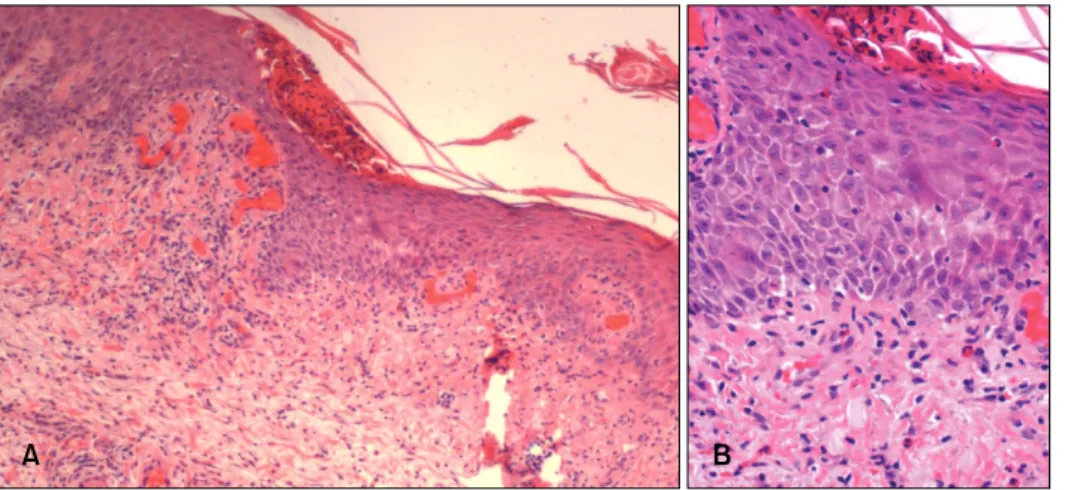
Fig. 4. Marked spongiosis with nume- rous eosinophils, consistent with allergic contact dermatitis, but no evidence of melanoma, after the diphencyprone treatment, on low- power view (A: H&E, ×100) and high-power view (B: H&E, ×200).
Fig. 2. Moderate dry eczematous changes with no evidence of nodules after 18 weeks of weekly diphencyprone application.
cation, his right shin showed moderate dry eczematous changes with no evidence of nodules. Further histological examination from the two sites of the previous nodules revealed marked spongiosis with numerous eosinophils, consistent with allergic contact dermatitis, but no evidence of melanoma. The patient has continued on the weekly 0.03% DPCP. The patient tolerated the treatment very well with no notable side effects.
A previously reported case series showed variable response to DPCP among seven patients7. Later Th17 up-regulation was implicated as a mechanism for the regression of metastatic melanoma by DPCP10. However this was based on Th17 expressions of before and after treatment biopsy specimens from a single patient. Further studies are needed to characterize patients who will respond to DPCP therapy. Th17 expression was not studied in our case.
It is not clear how long the treatment should continue once the metastatic melanoma clears. There are not enough
Topical Diphencyprone as an Effective Treatment for Cutaneous Metastatic Melanoma
Vol. 24, No. 3, 2012 375 cases to assess the response rate and survival benefits.
Since DPCP is a relatively very cheap, safe and easily accessible medication, further trials from various centers would be warranted. DPCP should be considered by the clinicians as a treatment option for the patient with cuta- neous metastatic melanoma with no distant metastases.
ACKNOWLEDGEMENT
The author would like to thank Professor Hans Peter Soyer and Dr Scott Webber for the help with treatment of this case, and Dr Duncan Lambie and Dr Christophe Rosty for histopathology images.
REFERENCES
1. Garbe C, Leiter U. Melanoma epidemiology and trends. Clin Dermatol 2009;27:3-9.
2. Gasent Blesa JM, Grande Pulido E, Alberola Candel V, Provencio Pulla M. Melanoma: from darkness to promise.
Am J Clin Oncol 2011;34:179-187.
3. Wilgenhof S, Pierret L, Corthals J, Van Nuffel AM, Heirman C, Roelandt T, et al. Restoration of tumor equilibrium after
immunotherapy for advanced melanoma: three illustrative cases. Melanoma Res 2011;21:152-159.
4. Good LM, Miller MD, High WA. Intralesional agents in the management of cutaneous malignancy: a review. J Am Acad Dermatol 2011;64:413-422.
5. Holzer AM, Kaplan LL, Levis WR. Haptens as drugs: contact allergens are powerful topical immunomodulators. J Drugs Dermatol 2006;5:410-416.
6. Damian DL, Thompson JF. Treatment of extensive cutaneous metastatic melanoma with topical diphencyprone. J Am Acad Dermatol 2007;56:869-871.
7. Damian DL, Shannon KF, Saw RP, Thompson JF. Topical diphencyprone immunotherapy for cutaneous metastatic melanoma. Australas J Dermatol 2009;50:266-271.
8. Harland CC, Saihan EM. Regression of cutaneous metastatic malignant melanoma with topical diphencyprone and oral cimetidine. Lancet 1989;2:445.
9. Trefzer U, Sterry W. Topical immunotherapy with dipheny- lcyclopropenone in combination with DTIC and radiation for cutaneous metastases of melanoma. Dermatology 2005;
211:370-371.
10. Martiniuk F, Damian DL, Thompson JF, Scolyer RA, Tchou- Wong KM, Levis WR. TH17 is involved in the remarkable regression of metastatic malignant melanoma to topical diphencyprone. J Drugs Dermatol 2010;9:1368-1372.