Corresponding author: Park, Jummi https://orcid.org/0000-0002-9321-8716
Department of Nursing, Namseoul University, 91 Dahhak-ro, Seonghwan-eup, Seobuk-gu, Cheonan 31020, Korea.
Tel: +82-41-580-2716, Fax: +82-31-780-5840, E-mail: [email protected] Received: Mar 5, 2018 / Revised: May 15, 2018 / Accepted: Jun 5, 2018
This is an open access article distributed under the terms of the Creative Commons Attribution Non-Commercial License (http://creativecommons.org/licenses/
ORIGINAL ARTICLE Open Access
Effect of Auricular Acupressure on Nausea, Vomiting, and Retching in Patients with Colorectal Cancer Receiving Chemotherapy
Shin, Nayeon1 · Park, Jummi2
1Bundang CHA Hospital, Seongnam, Korea
2Department of Nursing, Namseoul University, Cheonan, Korea
Purpose: The purpose of this study was to evaluate the effects of auricular acupressure on nausea, vomiting, and retching in patients with colorectal cancer receiving chemotherapy. Methods: A non-equivalent control group with a pretest-posttest design was used. The participants were assigned into either the control or the experimental group.
The patients were recruited from November 2013 to March 2014 from a tertiary hospital in Seongnam city, South Korea. A total of 50 patients completed the study. The Korean version of the Index of Nausea, Vomiting, and Retching (INVR) was used. Results: The experimental group showed significantly lower nausea (p=.011) and retching (p=.014) than did the control group after receiving auricular acupressure. There were significant interaction effects between time and group on auricular acupressure on nausea (F=3.11, p=.009) and retching (F=3.01, p=.010). There were significant interaction effects between time and group on auricular acupressure on total score of INVR (F=8.23, p<.001). Conclusion: Auricular acupressure therapy is effective in relieving nausea and retching after chemotherapy. Auricular acupressure intervention could be used to improve the quality of life for patients with colorectal cancer.
Key Words: Acupressure, Colorectal neoplasm, Nausea, Vomiting
INTRODUCTION
Colorectal cancer is the third and second most common cancer worldwide in men and women, respectively [1].
Westernized diet and lifestyle are considered to be some of the principal reasons for the increase in the prevalence of colorectal cancer in Korea and other developed countries [2,3].
Surgery and radiation therapy are effective conventional treatments for patients with colorectal cancer [4]. However, chemotherapy is often crucial for those with early onset cancer, and recurrence of cancer after surgery [5]. Chemo- therapy is the most common treatment; however, it can damage normal as well as cancerous cells, which could re- sult in unexpected physical side effects [6]. Such unplea- sant side effects of chemotherapy include nausea, vomit-
ing, stomatitis, constipation, diarrhea, leukopenia, and thrombocytopenia [7].
It has been reported that 70.0% to 80.0% of cancer pa- tients experience nausea, vomiting, and retching [8]. These symptoms might have serious social consequences apart from physical and psychological ones [7]. In particular, pharmacological medicines such as oxaliplatin, irinotecan, and 5-flurouracil often cause nausea and vomiting for a couple of days after administration [9]. These symptoms af- ter and during chemotherapy might lead to dystrophia due to insufficient food intake, eventually exerting a negative influence on treatments [10].
Interventions to alleviate nausea and vomiting might in- clude a combination of pharmacological and non-pharma- cological treatments [11]. Pharmacological interventions can be exemplified by serotonin antagonists, central nervous
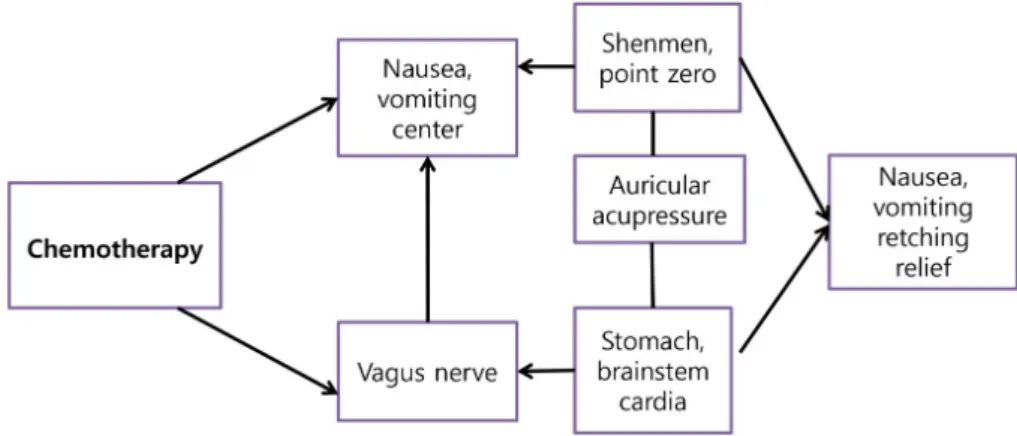
Figure 1. Conceptual framework.
system depressants, and antihistamines [9]. However, it was also reported that 56.5% of patients taking such antie- metics still suffer from nausea and vomiting [12]. Although the decrease in the incidence pharmacological prescrip- tions, studies have demonstrated that they are insufficient and suggested the use of non-pharmacological methods [10]. Acupressure is one such non-pharmacological meth- od for minimizing nausea and vomiting [13]. It has several benefits, including non-invasiveness [14], not requiring any specific tools or instruments, availability, and ease of use to such an extent that it can be learned by nurses and patients alike, which may eventually promote its applica- tion by patients themselves, thereby eliminating the need to visit the doctor’s clinics [7,15].
Auricular acupuncture is an oriental medical interven- tion that applies acupuncture or stimulates trigger points [16]. Stimulating trigger points on the ears would deliver stimuli to the contralateral side of the brain, with the in- formation eventually crossing over to the side initially stimulated [17]. Auricular acupressure on the point zero, stomach, brainstem, Shen-men, and cardia was found to help reduce nausea and vomiting [18]. In this manner, the effect of the treatment has been determined [15]. In the field of nursing, auricular acupressure instead of acupunc- ture with needles has been used to alleviate pains and ach- ieve the desired effect of treatments, placing non-invasive pressure on trigger points [16]. Some researchers have re- ported the effect of auricular acupressure on the reduction in nausea and vomiting [14-17]. However, little has been known about the effect of auricular acupressure on nausea, vomiting and retching in patients with colorectal cancer re- ceiving chemotherapy in Korea. The suggestive effects of auricular acupressure, the non-invasiveness of the inter- ventions [7,18], and its cost effectiveness [14] encourage researchers to investigate its efficacy in clinical settings.
Specifically, the purpose of this research was to investigate the effects of auricular acupressure on nausea, vomiting, and retching in patients with colorectal cancer patients re- ceiving chemotherapy.
1. Conceptual Framework
For the auricular acupressure intervention, which strives to reduce nausea, vomiting, and retching among patients undergoing chemotherapy, the conceptual framework in- cludes stimulating the reaction points, point zero, stom- ach, brainstem, Shen-men, and cardia, which are effective for controlling the aforementioned symptoms [18]. It rests on the notion that psychological responses occur when the elements of cortical stimulation and the vomiting center acting through the vagus nerve are combined, which brings signals from the gastrointestinal tract (Figure 1).
2. Research Hypotheses
Hypothesis 1. The patients receiving auricular acupres- sure (experimental group) will show less nausea, vomit- ing, and retching than those not receiving auricular acu- pressure, but a placebo intervention instead with non-acu- pressure stickers (control group).
Hypothesis 2. The patients receiving auricular acupres- sure (experimental group) will show interaction effects of groups and times in the level of nausea, vomiting, and retching.
METHODS
1. Study DesignThis study had a quasi-experimental design using a pre-
test-posttest non-equivalent control group to examine the effects of auricular acupressure on patients with colorectal cancer.
2. Setting and Samples
The subjects of the present research consisted of a group of 50 patients who were diagnosed with colorectal cancer and visited Bundang CHA General Hospital Cancer Cen- ter located in Seongnam city between November 2013 and March 2014 for their chemotherapy. The criteria for being selected as research subjects included: 1) being older than 20 years and understanding the questions, 2) having no le- sion of the ears or hearing aids, 3) having no brain injury symptom, 4) undergoing antiemetic drug therapy, 5) hav- ing no experience of undergoing auricular acupressure, and 6) having had at least two cycles of chemotherapy. The sample size was calculated with a t-test using G*Power [19]
following Cohen’s sampling method, with the level of sig- nificance set at 0.05, effect size at 0.5, and test power at 0.80 (sample size was calculated based on Yeh et al.’s [20] study, which needed 80% power at an effect size of 0.5). The com- bined results from six studies showed acupressure at the
“correct” points to be more effective than control inter- ventions, with an effect size of 0.55 (Z0.553=0.71), a result which is confirmed to have a 21.0% greater effect than the control interventions [21].
The size of a group needed to examine the differences between the averages of two groups was calculated to be 23. A total target of 50 participants was set after consider- ing a maximum 10% drop rate. The reason for limiting the use of chemotherapy to the second cycle or later is that nausea and vomiting become more severe after the second cycle of chemotherapy [22].
3. Intervention
This research started with a thorough literature review of past studies of auricular acupressure [14-17] and on nausea, vomiting, and retching. The auricular acupressure was conducted with a combination of ear massage and at- taching acupressure stickers. The treatment utilized Benja- min and Tappan’s ear massage protocol [23] and the meth- od of applying stickers on five points on the ear used in Lee et al. [24]. Nausea, vomiting, and retching were meas- ured six times in total (for two days). Auricular acu- pressure was applied to patients in the ward on the day af- ter hospitalization (chemotherapy day) thrice per day for two days. On the other hand, the control group did not re- ceive any massage, and non-acupressure stickers rather
than acupressure stickers were used for the study. Before massaging the ear, both ears were cleaned and disinfected with cotton with physiological saline solution. Adopting Benjamin and Tappan’s acupressure protocol [23], a varie- ty of massage techniques were employed to help blood cir- culation of the acupoints: pressing ears, stretching ear- lobes, crumpling ears, rubbing ears, pulling ears, and sup- pressing and pulling ears [24]. After massage treatments and checking patients’ responses, acupressure stickers were attached to the acupoints. Acupressure stickers used for the present research were those with a 1 mm grain of red clay affixed to 3M’s 0.8 cm × 0.8 cm plasters. Adopting Lee et al.’s model [24], the stickers were attached to the areas of the point zero, stomach, brainstem, Shen-men, and cardia.
Using the thumb and the index finger, pressure was ap- plied for three seconds, counting “one, two, three,” to the stickers for a set of 10 sessions. Pressure was applied at such a level that the patients experienced pain. The pa- tients were taught to apply such a treatment four times a day, or on the occurrence of nausea with a set of 10 ses- sions of pressing.
The process of applying auricular acupressure was as following. 1) The participant was instructed to assume comfortable position for applying auricular acupressure.
2) Auricular stickers with seeds were applied to the five acupoints: point zero, stomach, brainstem, Shen-men, and cardia. 3) Each area applied with sticker was pressed hard until the participant experienced mild pain. 4) Participants were then instructed to manually stimulate the areas ap- plied with paste thrice a day.
4. Measurements
Nausea, vomiting, and retching
This research adopted the Korean version of Rhodes and McDaniel’s Index of Nausea, Vomiting, and Retching (INVR) [25] and approved by the developers. The INVR was designed to measure the frequency, distress, and du- ration associated with nausea and the amount of vomiting [26]. The score for each item ranges from 0 to 4; higher scores indicate greater severity of the symptoms. It is an eight-item instrument that uses a five-point Likert scale and comprises three subscales: nausea (range, 0~12), vomit- ing (range, 0~12), and retching (range, 0~8). A total score between 0 and 32 can be obtained, with a greater score rep- resenting a greater level of these symptoms. It focuses on all three domains of the experience (nausea, vomiting, and retching) in terms of their occurrence, amount, and dura- tion [26]. Cronbach’s ⍺ of Rhodes and McDaniel’s [26]
INVR was .98, whereas that of the Korean version of the
INVR was .94 in this study.
5. Ethical Consideration and Data Collection Ethical approval for the study was granted by the in- stitutional review board of CHA general hospital (IRB no.
2013-12-127). The board confirmed that the study did not violate human rights, and all contents and processes con- formed to the conduct of appropriate research ethics.
Researchers and one assistant completed training of the auricular acupressure and were taught by a professor of oriental medicine to be able to place acupressure at accu- rate points.
Data was collected at CHA general hospital located in Seongnam city. A total of 50 patients who were scheduled to receive folinic acid, fluorouracil, and oxaliplatin (Folfox) in chemotherapy were divided into two groups of 25 each:
experimental and control. The research subjects were ex- plained the purpose of the present research and informed consent for participation was sought.
6. Data Analysis
The collected data were analyzed using SPSS 21.0. Their general characteristics were analyzed using features such as frequency, percentage, average, and standard deviation.
The homogeneity of the general characteristics of the two groups was tested using x2 test, independent t-test, and Mann-Whitney non-parametric test, while testing for nor- mality was conducted using the Kolmogorov-Smirnov me- thod. The proposed hypotheses were tested by comparing the level of nausea, vomiting, and retching through an in- dependent t-test. An analysis of variance (ANOVA) was conducted for additional verification by controlling exog- enous variables. We investigated the time effect of auric- ular acupressure as well as group effect. Therefore, a re- peated measures ANOVA was performed to examine the differences between the two groups under discussion and at three different times. To verify the sphericity assump- tion, the variance of the outcome variables was verified as being homogeneous (Mauchly’s W=.90, p=.136).
RESULTS
1. General Characteristics of the Subjects Table 1 shows the result of the chi-squared test and in- dependent t-test for the general characteristics of the two groups. The subjects had an average age 51.5 years and in- cluded 24 men and 26 women. Overall, it was found that
there was no statistically significant difference between the two groups, suggesting homogeneity of the two groups.
Disease-related characteristics of the subjects
The homogeneity of the disease-related characteristics of the two groups were examined using the chi-squared test and independent t-test (Table 1). Among the brands of antiemetic agent used, Zofran (44.0%) was the most com- mon. Most patients (70.0%) took antiemetics 0 to 3 times per day. Of the subjects, 12 patients (24.0%) were also un- dergoing radiation therapy. A significant difference be- tween the two groups in terms of disease-related charac- teristics was found for antiemetics and experience of radi- ation therapy (x2=4.71, p=.008, x2=5.12, p=.020).
2. Homogeneity of Dependent Variables between Two Groups
An independent t-test was conducted to examine the homogeneity of the dependent variables. As shown in Table 2, the two groups could be considered homogeneous in terms of nausea, vomiting, and retching before auricular acupressure treatments.
3. Test of Hypotheses
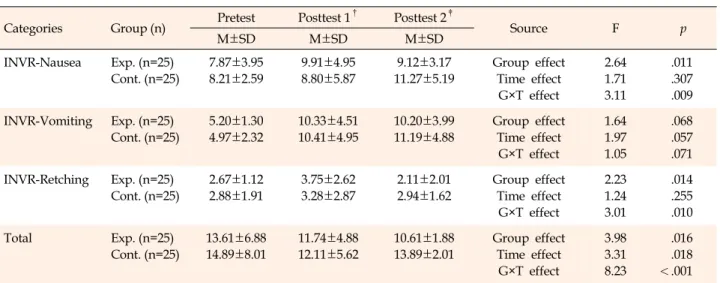
Hypothesis 1. The patients undergoing auricular acu- pressure (experimental group) will experience less nau- sea, vomiting, and retching than those (control group). In order to test Hypothesis 1, types of antiemetics and experi- ences of radiation therapy were set as covariates. The ex- perimental group had a significantly lower level of nau- sea, vomiting, and retching after auricular acupressure, with a score of 10.61 at posttest 2 (1 week after anticancer treatment) in contrast to 13.61 at pretest. Conversely, the control group showed increased nausea, vomiting, and ret- ching 1 week after the anticancer treatment at posttest 2 (F=3.31, p=.018). Therefore, Hypothesis 1 was supported.
Hypothesis 2. There will be interaction between groups and times in the level of nausea, vomiting, and retching in the experimental and control group before and after inter- vention. Hypothesis 2 was tested using repeated measures ANOVA for nausea, vomiting, and retching measured at three different times: before chemotherapy, after chemo- therapy, and 7 days after auricular acupressure. It was found that there were significant differences between the two groups and the three different times in the level of these symptoms. Changes in nausea, vomiting, and retch- ing in both groups are presented in Table 3. There was a significant difference in nausea (F=2.64, p=.011) and ret-
Table 1. Homogeneity Test of General and Disease-related Characteristics between Two Groups (N=50)
Characteristics Categories Exp. (n=25) Cont. (n=25) Total (n=50)
x2 or t (p) n (%) or M±SD n (%) or M±SD n (%) or M±SD
Gender Men
Women
11 (22.0) 14 (28.0)
15 (30.0) 10 (20.0)
26 (52.0) 24 (48.0)
2.00 (.340)
Age (year) 53.42±4.15 49.10±3.78 51.51±2.15 1.52 (.200)
Education (year) 11.45±2.02 11.37±4.23 11.40±3.79 0.69 (.480)
Diagnosis period (month) >6 6~11
≥12
10 (22.0) 8 (16.0) 6 (12.0)
9 (18.0) 12 (24.0) 5 (10.0)
19 (38.0) 20 (40.0) 11 (22.0)
2.77 (.090)
Stage II
III IV
5 (10.0) 13 (25.0) 7 (15.0)
6 (11.0) 11 (21.0) 8 (18.0)
11 (27.0) 24 (49.0) 15 (34.0)
3.57 (.070)
Experience of operation Yes No
15 (30.0) 10 (20.0)
20 (41.0) 5 (10.0)
35 (72.0) 15 (28.0)
0.53 (.400)
Antiemetics Zofran
Macperan Aloxi Emend
13 (26.0) 8 (16.0) 2 (4.0) 2 (4.0)
9 (18.0) 11 (22.0) 1 (2.0) 4 (8.0)
22 (44.0) 19 (38.0) 3 (6.0) 6 (12.0)
4.71 (.008)
Frequency of taking antiemesis medicine (per day)
0~3 4~5
≥6
16 (32.0) 7 (14.0) 2 (4.0)
19 (38.0) 4 (8.0) 2 (4.0)
35 (70.0) 11 (22.0) 4 (8.0)
0.91 (.770)
Experience of radiation therapy
Yes No
8 (16.0) 17 (34.0)
4 (8.0) 21 (42.0)
12 (24.0) 38 (76.0)
5.12 (.020)
Exp.=experimental group; Cont.=control group.
Table 2. Homogeneity Test of Dependent Variables between Two Groups (N=50)
Variables Exp. (n=25) Cont. (n=25)
t p
M±SD M±SD
INVR-Nausea 7.87±3.95 8.21±2.59 0.74 .460
INVR-Vomitting 5.20±1.30 4.97±2.32 0.50 .670
INVR-Retching 2.67±1.12 2.88±1.91 0.87 .390
Total 13.61±6.88 14.89±8.01 1.21 .090
Exp.=experimental group; Cont.=control group; INVR=Index of Nausea, Vomiting and Retching.
ching (F=2.23, p=.014) in the interaction between groups.
However, there was no statistically significant difference in nausea (F=1.71, p=.307), vomiting (F=1.97, p=.057), and ret- ching (F=1.24, p=.255) in the interaction between time. Table 3 summarizes the results of the nausea, vomiting, and retch- ing between and within the groups. There were significant interaction effects between time and group on auricular acupressure on nausea (F=3.11, p=.009) and retching (F=
3.01, p=.010). There were significant interaction effects be- tween time and group on auricular acupressure on total score of INVR (F=8.23, p<.001)(Table 3).
DISCUSSION
This study used a non-equivalent control group with a pretest-posttest design to examine the effects of auricular acupressure on nausea, vomiting, and retching in patients with colorectal cancer who received chemotherapy. Auri- cular acupressure has been practiced as a complementary treatment for nausea, vomiting, and retching [20,21,27].
This study’s results indicated that auricular acupressure significantly reduced nausea and retching scores. This find- ing is consistent with those of previous studies conducted
Table 3. Distribution Analysis of Repeated Measures of Nausea, Vomiting and Retching between Two Groups (N=50) Categories Group (n) Pretest Posttest 1† Posttest 2‡
Source F p
M±SD M±SD M±SD
INVR-Nausea Exp. (n=25) Cont. (n=25)
7.87±3.95 8.21±2.59
9.91±4.95 8.80±5.87
9.12±3.17 11.27±5.19
Group effect Time effect
G×T effect
2.64 1.71 3.11
.011 .307 .009 INVR-Vomiting Exp. (n=25)
Cont. (n=25)
5.20±1.30 4.97±2.32
10.33±4.51 10.41±4.95
10.20±3.99 11.19±4.88
Group effect Time effect
G×T effect
1.64 1.97 1.05
.068 .057 .071 INVR-Retching Exp. (n=25)
Cont. (n=25)
2.67±1.12 2.88±1.91
3.75±2.62 3.28±2.87
2.11±2.01 2.94±1.62
Group effect Time effect
G×T effect
2.23 1.24 3.01
.014 .255 .010
Total Exp. (n=25)
Cont. (n=25)
13.61±6.88 14.89±8.01
11.74±4.88 12.11±5.62
10.61±1.88 13.89±2.01
Group effect Time effect
G×T effect
3.98 3.31 8.23
.016 .018
<.001 Exp.=experimental group; Cont.=control group; INVR=Index of Nausea, Vomiting and Retching ; G×T=Group & Time;
†After chemotherapy; ‡7 days after chemotherapy.
on patients with breast cancer [20] and gynecological can- cer [27]. Although previous studies have been conducted in settings and with patient populations different from those of this study, the same positive results suggest that acupressure is a complementary therapy effective for re- ducing nausea and retching. Similarly, auricular acupres- sure was also found to prevent Chemotherapy-Induced Nausea and Vomiting (CINV) in children undergoing che- motherapy [20]. However, a previous study conducted a week after each of three rounds of chemotherapy showed unclear findings that acupuncture and sham acupressure equally reduced nausea and vomiting. Selection of the acupressure point and the frequency and duration of acu- pressure might vary the treatment effect. In this study, acupressure applied consistently thrice a day might have a therapeutic dose of acupressure that was adequate for re- ducing nausea and retching.
The results of this study are expected to provide con- vincing evidence regarding effectiveness of auricular acu- pressure for patients with colorectal cancer receiving che- motherapy. The participants who received auricular acu- pressure had reduced INVR scores on nausea and retch- ing; auricular acupressure was thus demonstrated to be an effective intervention to relieve nausea and retching. Signi- ficantly lower INVR-nausea scores in the experimental group were similar to the results from a study that report- ed lower occurrence and severity of nausea among patients through application of an ear seed at five auricular acu- points in the experimental group [20].
It was found that the experimental group showed a low- er level of nausea and retching in posttests. Additionally, vomiting level in the experimental groups improved over
the course of the study, and it was at a higher level than that of control group . However, the difference was not statistically significant. Although different instrument was used in the past study, it reported that the use of auricular acupressure led to the decrease in the number and inten- sity of nausea and vomiting in experimental group, which were significantly lower than those of the control group af- ter the acupressure [18]. The sample in Eghbali et al.’s [18]
study was different from that in this study in terms of di- agnosis and chemotherapeutic agents. However, another study used an intervention for CINV in children [20] re- ported no significant differences in nausea and vomiting between auricular acupressure intervention group and sham auricular points group. Further studies that added a sham group is required to clarify the effects of auricular acupressure.
There are several limitations to consider in our study.
First, nausea intensity was not evaluated during the ad- juvant therapy, in particular, during chemotherapy, which is a period of intense nausea. More data about frequency would have given comprehensive information about the intervention effects on nausea, vomiting, and retching intensity. Second, this study had a small sample size, which was heterogeneous in terms of the antiemetic regi- mens prescribed and the patient characteristics (including age and sex).
These results indicate that the participants in the ex- perimental group felt more comfortable than those in the control group at posttest. These positive findings regard- ing relief from nausea and retching suggest the efficacy of the intervention. Auricular acupressure is a therapy that is easy to learn. By simply stimulating acupoints on the ears,
we can expect a curative effect similar to stimulating the meridian system of the whole body. A more comprehen- sive assessment of the effect of auricular acupressure on nausea, vomiting, and retching is needed in the future.
CONCLUSION
The present research identified the effect of auricular acupressure on nausea, vomiting, and retching in color- ectal cancer patients receiving chemotherapy. The results lead us to propose that auricular acupressure should be utilized as a nursing intervention for such patients.
Based on the present results, we provide the following suggestions. First, further research is necessary to support the identified effect of auricular acupressure on nausea, vomiting, and retching. The same line of research may be conducted in patients with kinds of cancer other than colorectal. Second, further research should secure homo- geneity in terms of medication pretest and posttest, since there was no pretest homogeneity in this study.
CONFLICTS OF INTEREST
The authors declared no conflict of interest.
ACKNOWLEDGEMENT
This study was supported by the Namseoul University fund.
REFERENCES
1. American Cancer Society. Cancer facts & figures 2013 [Internet].
Atlanta: Cancer Fact And Statistics; 2013 [cited 2017 May 1].
Available from:
http://www.cancer.org/research/cancerfactsfigures/cancerf actsfigures/cancerfactsfigs;2013
2. Ministry for Health and Welfare. Cancer fact and figures 2013 in the Republic of Korea 1st ed. 2013 [Internet]. Gyeonggido:
Ministry of Health and Welfare; 2013 [cited 2017 May 1].
Available from:
http://ncc.re.kr/cancerStatsView.ncc?bbsnum=358&search Key=total&searchValue=&pageNum=1
3. Durko L, Malecka-Panas E. Lifestyle modifications and color- ectal cancer. Current Colorectal Cancer Reports. 2014;10(1):
45-54. https://doi.org/10.1007/s11888-013-0203-4
4. Khan SA, Ullah S, Ahmed J, Wilson TR, McNaught C, Hartley J, et al. Influence of enhanced recovery after surgery pathways and laparoscopic surgery on health-related quality of life.
Colorectal Disease. 2013;15(7):900-7.
https://doi.org/10.1111/codi.12191
5. van den Heijkant F, Vermeer TA, Vrijhof EJEJ, Nieuwenhuijzen GAP, Koldewijn EL, Rutten HJT. Psoas hitch ureteral reim-
plantation after surgery for locally advanced and locally re- current colorectal cancer: complications and oncological out- come. European Journal of Surgical Oncology. 2017;43(10):1869- 75. https://doi.org/10.1016/j.ejso.2017.05.018
6. Baek YA, Yi MS. Factors influencing quality of life during che- motherapy for colorectal cancer patients in South Korea. Jour- nal of Korean Academy Nursing. 2015;45(4):604-12.
https://doi.org/10.4040/jkan.2015.45.4.604
7. Suh EE. The effects of P6 acupressure and nurse-provided counseling on chemotherapy-induced nausea and vomiting in patients with breast cancer. Oncology Nursing Forum. 2012;39 (1):E1-E9. https://doi.org/10.1188/12.ONF.E1-E9
8. Roila F, Molassiotis A, Herrstedt J, Aapro M, Gralla RJ, Bruera E, et al. 2016 MASCC and ESMO guideline update for the pre- vention of chemotherapy-and radiotherapy-induced nausea and vomiting and of nausea and vomiting in advanced cancer pa- tients. Annals of Oncology. 2016;27(Issue suppl_5):v119-v133.
https://doi.org/10.1093/annonc/mdw270
9. Folprecht G, Hamann S, Schütte K, Trarbach T, Stoehlmacher- Wiliams J, Ehninger G. Dose escalating study of cetuximab and 5-FU/folinic acid (FA)/oxaliplatin/irinotecan (FOLFOXI- RI) in first line therapy of patients with metastatic colorectal cancer. BMC cancer. 2014;14(1):521.
https://doi.org/10.1186/1471-2407-14-521
10. Lee H, Choi-Kwon S. The relationships among chemothe- rapy-induced nausea and vomiting (CINV), non-pharmaco- logical coping methods, and nutritional status in patients with gynecologic cancer. Journal of Korean Academy of Nursing.
2017;47(6):731-43. https://doi.org/10.4040/jkan.2017.47.6.731 11. Moradian S, Howell D. Prevention and management of
chemotherapy-induced nausea and vomiting. International Journal of Palliative Nursing. 2015;21(5):216-24.
https://doi.org/10.12968/ijpn.2015.21.5.216
12. Mizuno M, Hiura M, Kikkawa F, Numa F, Yaegashi N, Nara- hara H, et al. A prospective observational study on chemo- therapy-induced nausea and vomiting (CINV) in patients with gynecologic cancer by the CINV study group of Japan. Gyne- cologic Oncology. 2016;140(3):559-64.
https://doi.org/10.1016/j.ygyno.2015.12.029
13. Miao J, Liu X, Wu C, Kong H, Xie W, Liu K. Effects of acu- pressure on chemotherapy-induced nausea and vomiting-a sys- tematic review with meta-analyses and trial sequential analy- sis of randomized controlled trials. International Journal of Nursing Studies. 2017;70:27-37.
https://doi.org/10.1016/j.ijnurstu.2017.02.014
14. McKeon C, Caroline AS, Janet H, Esther C. Acupuncture and acupressure for chemotherapy-induced nausea and vomiting:
a systematic review. Australian Journal of Acupuncture and Chinese Medicine. 2013;8(1):2-27.
15. Momani TG, Donna LB. Integrative therapeutic approaches for
the management and control of nausea in children undergoing cancer treatment: a systematic review of literature. Journal of Pediatric Oncology Nursing. 2017;34(3):173-84.
https://doi.org/10.1177/1043454216688638
16. Tan JY, Molassiotis A, Wang T, Suen LKP. Current evidence on auricular therapy for chemotherapy-induced nausea and vomiting in cancer patients: a systematic review of random- ized controlled trials. Evidence-Based Complement and Al- ternative Medicine. 2014;2014:430796.
https://doi.org/10.1155/2014/430796
17. Chien TJ, ChiaYL, Chung HH. Integrating acupuncture into cancer care. Journal of Traditional and Complementary Medi- cine. 2013;3(4):234-9.
https://doi.org/10.4103/2225-4110.119733
18. Eghbali M, Yekaninejad MS, Varaei S, Jalalinia SF, Samimi MA, Sa’atchi K. The effect of auricular acupressure on nausea and vomiting caused by chemotherapy among breast cancer patients.
Complementary Therapies in Clinical Practice. 2016;24:189-94.
https://doi.org/10.1016/j.ctcp.2016.06.006
19. Faul F, Erdfelder E, Lang AG, Buchner A. G*Power 3: a flexible statistical power analysis program for the social, behavioral, and biomedical sciences. Behavior Research Methods. 2007;39 (2):175-91. https://doi.org/10.3758/BF03193146
20. Yeh CH, Chien LC, Chiang YC, Lin SW, Huang CK, Ren D.
Reduction in nausea and vomiting in children undergoing cancer chemotherapy by either appropriate or sham auricular
acupuncture points with standard care. The Journal of Alter- native and Complementary Medicine. 2012;18(4):334-40.
https://doi.org/10.1089/acm.2011.0102
21. Jang SY, Park JS. The meta-analysis of the effect of acupressure for nausea and vomiting in cancer patients receiving chemo- therapy. Journal of Korean Oncology Nursing. 2011;11(2):116- 26. https://doi.org/10.5388/jkon.2011.11.2.116
22. Byun MS, Kim NH. Energy intake and fatigue in patients re- ceiving chemotherapy. Journal of Korean Biological Nursing Science. 2012;14(4):258-67.
https://doi.org/10.7586/jkbns.2012.14.4.258
23. Benjamin PJ, Tappan FM. Tappan’s handbook of healing mas- sage techniques. New York: Prentice Hall; 2005. p. 378-401.
24. Lee JO, Kim SJ, Kim JS, Park HH. Auricular acupuressure.
Seoul: Korea-China Self-Healing Power Association; 2010. p.
24-40.
25. Kim YJ, Kim JY, Choi IY, Kim MW, Rhodes V. The index of nausea,vomiting, and retching (Korean translation). Journal of Korean Academy Adult Nursing. 2000;12(2):278-85.
26. Rhodes VA, McDaniel RW. The index of nausea, vomiting, and retching: a new format of the index of nausea and vomiting.
Oncology Nursing Forum. 1999;26(5):889-94.
27. Kwon SJ, Park JS. Effects of auricular acupressure on chemo- therapy-induced nausea, vomiting, and serum serotonin level.
Korean Journal of Adult Nursing. 2014;26(3):330-40.
https://doi.org/10.7475/kjan.2014.26.3.330