The Role of Pharmacoethnicity in the Development of Cytotoxic and Molecular Targeted Drugs in Oncology
Nagahiro Saijo
Executive Officer, Japanese Society of Medical Oncology, Tokyo, Japan.
Received: August 23, 2012
Corresponding author: Dr. Nagahiro Saijo, Executive Officer, Japanese Society of Medical Oncology, 2-1-15Hamamatsu-Cho, Shiba Park Building 6F, Minato-Ku, Tokyo105-0013, Japan.
Tel: 81-3-6809-1250 , Fax: 81-3-6809-1138 E-mail: [email protected]
∙ The author has no financial conflicts of interest.
© Copyright:
Yonsei University College of Medicine 2013 This is an Open Access article distributed under the terms of the Creative Commons Attribution Non- Commercial License (http://creativecommons.org/
licenses/by-nc/3.0) which permits unrestricted non- commercial use, distribution, and reproduction in any medium, provided the original work is properly cited.
The effective and toxic ranges of anticancer drugs are very narrow and, in some cases, inverted. Thus determination of the most appropriate dosage and schedule of administration is crucial for optimal chemotherapy. In common arm trials conduct- ed in Japan and by Southwest Oncology Group (SWOG) that used the same doses and schedules for the administration of carboplatin plus paclitaxel, the frequency of hematological toxicity was significantly higher in the Japanese trials than in the SWOG trial, despite demonstrating similar response rates. The frequency of epider- mal growth factor receptor (EGFR) mutations in tumors was significantly higher among East Asian populations, and these populations are also reported to demon- strate a higher response rates to epidermal growth factor receptor tyrosine-kinase in- hibitors (EGFR-TKIs). The prevalence of interstitial lung disease induced by treat- ment with EGFR-TKIs has been shown to be quite high in the Japanese population.
Clinical trials of cetuximab against non-small cell lung cancer and of bevacizumab against stomach cancer have shown that these agents are only active in Caucasians.
In a trial examining the use of sorafenib after transarterial chemoembolization in Ko- rean and Japanese patients with advanced hepatocellular carcinoma, the compliance and dose intensity of the drug were quite low compared with other trials. Although not only identified pharmacogenomics differences but also differences in social en- vironment, and regional medical care, including pharmacoeconomics strongly in- fluence ethnic differences in treatment response, further identification and under- standing of the pharmacogenomics underlying ethnic differences will be essential to timely and reliable global development of new anticancer drugs.
Key Words: Ethnicity, cytotoxic drugs, molecular targeted drugs, common arm trial, EGFR-TKI, ILD, FLEX, AVAGAST, sorafenib
INTRODUCTION
The pharmacokinetics (PK) and pharmacodynamics (PD) of most drugs can vary widely even if the same doses are administered. Many factors influence this vari- ability.1-3 Among these clinical pharmacoethnic differences arising from functional variants in implicated genes have been reported for in 5-fluorouracil,4-6 doxorubi- cin,7 cyclophosphamide,8 vincristine9 and irinotecan hydrochloride.10,11 Pharma- cogenomic difference in metabolizing enzymes and transporters can influence the
tively, as well as sorafenib against liver cancer, pharmaco- ethnic differences induced by differences in environmental and local medical practices have also been noted in addi- tion to differences in pharmacogenomics (Table 1). Ac- cordingly, recent phase I study on tivantinib, a MET-TKI inhibitor, showed the presence of CYP2C19 polymor- phisms in 30% of Japanese patients, which was 10 times higher than that in Caucasians. In the present review, the development of protocols for global trials and interpreta- tion of the results of such trials will be discussed from the perspective of pharmacoethnicity.
PHARMACOGENOMIC ETHNIC DIFFERENCES SUGGESTED BY COMMON ARM TRIALS BETWEEN
JAPAN AND THE UNITED STATES
In previous common arm trials cooperatively conducted to- gether with SWOG, differences in the effectiveness and toxicities of anticancer drugs differently across ethnic
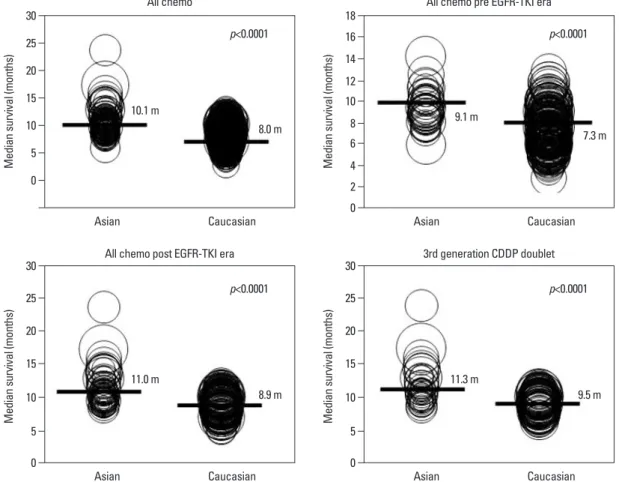
groups. Single nucleotide polymorphisms (SNPs) in UDP glucuronosyl transferase 1A1 and dihydropyrimidine de- hydrogenase, which are germ line variations, have been shown to be associated with the hematological toxicities of irinotecan hydrochlolide and fluorinated pyrimidines, re- spectively.4,11 On the other hand, antitumor activity is mainly influenced by somatic changes which reflect the pharmacogenomics of target molecules in tumors. Even prior to epidermal growth factor receptor tyrosine-kinase inhibitors (EGFR-TKIs) development (Fig. 1), ethnic dif- ferences were reported in regard to survival outcomes be- tween Asians and Caucasians with advanced non-small cell lung cancer (NSCLC) treated with systemic chemo- therapy.12 Similarly, treatment response to EGFR-TKIs which are active against driver mutation positive NSCLC exhibited clear ethnic differences in Caucasians and East Asians due to the difference in EGFR mutation rates.13 In trials of antiEGFR and anti-vascular endothelial growth factor antibodies against lung and stomach cancer, respec-
Fig. 1. Ethnic differences in survival outcome of NSCLC. A meta-analysis of randomized trials. Asian: 91 studies, Caucasian: 301 studies.
Survival was better in Asian that Caucasian.12 EGFR-TKI, epidermal growth factor receptor tyrosine-kinase inhibitor; NSCLC, non-small cell lung cancer; CDDP, cisplatin.
0 0
0
0 2
5
5 5
4 6 10
10 10
8 15
15 15
10 20
20 20
12 14 25
25 25
16 30
30 30
18
Median survival (months)Median survival (months) Median survival (months)Median survival (months)
Asian
Asian Asian
Asian Caucasian
Caucasian Caucasian
Caucasian p<0.0001
p<0.0001 p<0.0001
p<0.0001 All chemo
All chemo post EGFR-TKI era 3rd generation CDDP doublet
All chemo pre EGFR-TKI era
10.1 m
11.0 m 11.3 m
9.1 m 8.0 m
8.9 m 9.5 m
7.3 m
was 225 mg/m2 in the JMTO and SWOG trials and 200 mg/m2 in the FACS trial. This regimen was administered every 3-4 weeks. The patient characteristics such as age, sex, proportion with stage IIIB/IV, and histology were evenly distributed in all three studies. Treatment compli- ance was also the same in all three studies. The response rates were 32%, 31% and 37% in the FACS, LC00-03 and S0003 studies, respectively. The median survival and the one year survival rates were higher in Japanese patients toxicities of paclitaxel and carboplatin in NSCLC14 and of
etoposide or irinotecan plus cisplatin in small cell lung can- cer (SCLC) were analyzed.15 Prior to the initiation of the study, whether studies in one country could be directly ex- trapolated to patients within another country was unclear.
The purpose of the trial was to demonstrate similarities and differences in the patient characteristics and outcomes in Japan and the United States under the same treatment regi- men. The trials also sought to provide a basis for the stan- dardization of future study design, for which to better con- duct future trials in both countries.
For NSCLC, three trials were performed. Two of the studies were performed in Japan [Four Arm Cooperative Study (FACS), n=14516 and JMTO LC-00-03 study, n=19717], and one study was performed in the USA (SWOG S0003 study, n=186).18 All three studies used iden- tical eligibility criteria, staging criteria and treatment proto- cols (Table 2). Paclitaxel and carboplatin were considered to be a common arm. The dose of carboplatin administered in all of the studies was an area under the curve (AUC) 6 ug/mL×min, and while the administered dose of paclitaxel
Table 1. Factors Influencing on Pharmacoethnicity: Ethnic Diversity in Anticancer Effect and Toxicity
Pharmacogenomic/pharmacogenetic difference Drug metabolizing enzymes
Transporters
PGX of target molecules in tumor or normal tissues Local medical care difference
Environmental difference Differences in foods and drinks Pharmacoeconomical difference Availability of new drugs (drug lag) PGX, pharmacogenomics.
Table 2. Patient Characteristics in 3 Common Arm Trials for Ist Line Chemotherapy Against NSCLC
FACS (n=145) LC00-03 (n=197) S0003 (n=186) p value
Median age (yrs) range 63 (33-74) 65 (33-81) 63 (28-80) NA
Female Gender 46 (32%) 61 (31%) 68 (37%) 0.21
Stage IV 117 (81%) 162 (82%) 161 (87%) 0.19
Non-squamous 114 (79%) 167 (85%) 152 (82%) 0.51
NSCLC, non-small cell lung cancer; FACS, Four Arm Cooperative Study (Japan); NA, not applicable; CBDCA, carboplatin; AUC, area under the curve.
LC00-03, Japanese multinational trial organization (JMTO).
S0003, Southwest Oncology Group (USA).
Common arm was paclitaxel (200-225 mg/m2)+CBDCA (AUC: 6).
Table 3. Efficacies in 3 Common Arm Trials for Ist Line Chemotherapy Against NSCLC
FACS (n=145) LC00-03 (n=197) S0003 (n=182) p value
Complete+partial response 47 (32%) 71 (36%) 61 (34%) 0.61
PFS (months) 4.5 6 4 NA
MST (months) 12 14 9 NA
1 yr survival rate 51% 57% 37% 0.001
NSCLC, non-small cell lung cancer; FACS, Four Arm Cooperative Study (Japan); PFS, progression free survival; MST, median survival time; NA, not appli- cable.
LC00-03, Japanese multinational trial organization (JMTO).
S0003, Southwest Oncology Group (USA).
Table 4. Toxicity Analysis in 3 Common Arm Trials
FACS (n=145) LC00-03 (n=197) S0003 (n=186) p value
Neutropenia (gr 4) 102 (69%) 106 (69%) 48 (26%) <0.0001
Febrile neutropenia (gr 3-4) 26 (18%) 38 (19%) 6 (3%) <0.0001
FACS, Four Arm Cooperative Study (Japan); CBDCA, carboplatin; AUC, area under the curve.
LC00-03, Japanese multinational trial organization (JMTO).
S0003, Southwest Oncology Group (USA).
Common arm was paclitaxel (200-225 mg/m2)+CBDCA (AUC: 6).
These results suggested the need for 1) consideration of dif- ferent patient characteristics and outcomes amongst patients receiving identical therapy. 2) The utilization of a common arm model in prospective trials and 3) the inclusion of phar- macogenomics correlates in cancer trials where pharmacoe- thnic differences in drug disposition are expected.
RESPONSE TO EGFR-TKIS AND HIGH EGFR MUTATION RATE IN EAST ASIANS
The molecular target of EGFR-TKI was thought to be wild type EGFR during the initial development of EGFR-TKIs.
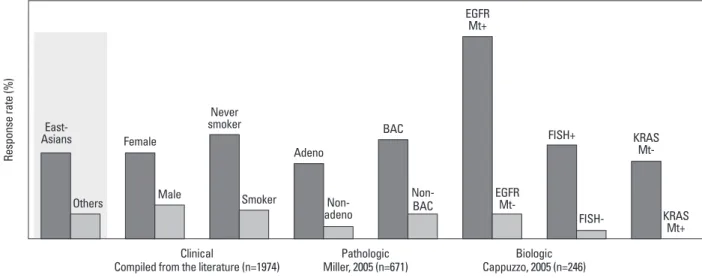
During a phase I trial conducted in Japan, 5 patients with heavily treated NSCLC experienced a partial response21 de- spite numerous reports of a lack of a response in other Phase 1 studies except for Ranson’s report.22-24 Phase II studies of gefitinib such as the Ideal 1 and 2 trials reported response rates for Japanese and Non-Japanese patients of 30 and 10%, respectively.25,26 The response rate of another EGFR- TKI, erlotinib, was also about 30% in Japanese popula- tion.27 Various clinical trials have also suggested that EG- FR-TKIs are active in non-smoking East-Asian, female with adenocarcinoma whereas the BR-21 study demon- strated the completely opposite results (Fig. 2).28,29 The ma- jority of clinical trials against unselected populations pro- duced negative results. In first line NSCLC chemotherapy studies such as the Intact-1/-2, Talent and Tribute trials which included more than 1000 patients each, the addition of gefitinib or erlotinib did not improve overall survival.30-33 In second line trials performed in unselected patients, the (Table 3). In addition the frequency of hematological toxic-
ities such as grade IV neutropenia and febrile neutropenia were significantly higher among the Japanese patients (Table 4). Genotype profiles in Japanese and American patients showed differences in frequencies of variants in CYP3A4, CYP3A5, CYP2C8 and ERCC2. Among them CYP3A4 and ERCC2 were correlated with progression free survival (PFS) and treatment response, respectively. These results suggest that global clinical trials, especially those conduct- ed internationally, should be carefully designed and con- ducted to account for potential genetic differences in the re- spective patient population.
For SCLC, the JCOG951119 and SWOG-021420 trials were conducted. Both studies compared etoposide/cisplatin vs.
irinotecan/cisplatin. The dose and administration schedules of the drugs were exactly the same. The patient demo- graphics showed that 86% and 57% of the patients in the JCOG 9511 and SWOG-0124 trials were male, respectively, and the performance status (PS) of the patients was better in the SWOG trial. Treatment delivery and dose intensities were similar for both trials. The response rates to both regi- mens were significantly higher in the JCOG9511 trial. The overall survival and one year survival rates were similar be- tween the two trials for the cisplatin/etoposide regimen, however, these outcomes were significantly better for the cisplatin/irinotecan regimen in the JCOG 9511 trial (overall survival (OS): 12.8 vs. 6.8 months, one-year survival: 58%
vs. 41%). On the other hand, the frequencies of hematolog- ical toxicities (>grade 3) such as neutropenia, leukopenia and anemia were significantly higher for both regimens in the JCOG 9511 trial than those in the SWOG-0124 trial.
Fig. 2. EGFR-TKI is effective in patients with distinct clinico-pathological and pharmacogenomical features. EGFR, epidermal growth factor receptor; TKI, ty- rosine-kinase inhibitor; BAC, bronchial alveolar cell; FISH, fluorescence in situ hybrydization.
Response rate (%)
Clinical
Compiled from the literature (n=1974) Pathologic
Miller, 2005 (n=671) Biologic
Cappuzzo, 2005 (n=246) East-
Asians
Others
Female
Never smoker
Adeno
BAC FISH+ KRAS
Mt- EGFR
Mt+
Male Smoker Non-
adeno
Non-BAC
FISH- KRAS
Mt+
EGFR Mt-
pared gefitinib vs. carboplatin/paclitaxel in clinically selected patients, included patients from 9 Asian countries including China, Japan, Hong Kong, the Philippines, Singapore, Tai- wan and Thailand, accruing 1217 patients within 18 months.39 Patient selection in the IPASS trial was, however, performed based solely on clinical factors such as adenocar- ISEL trial using gefitinib produced negative results34 while
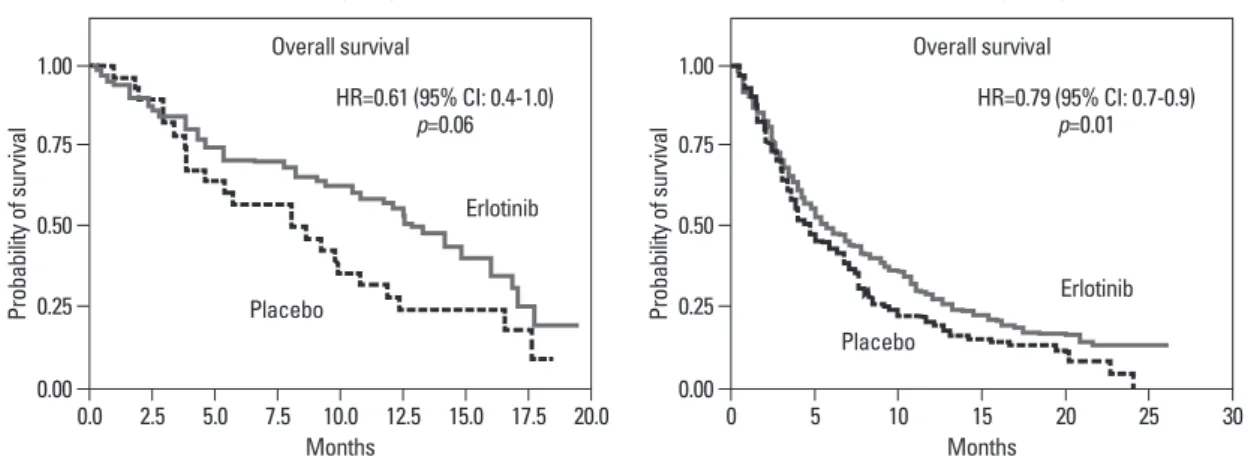
the BR-21 trial using erlotinib produced positive results.29 If the ISEL population was subdivided into Asians and Cau- casians, gefitinib was shown to only be effective against Asian patients (Fig. 3).34 On the other hands in the BR-21 study, erlotinib was more effective against squamous carci- noma, Caucasians, and male smokers29 although recent tri- als examining erlotinib have reported conflicting results.
(Fig. 4). EGFR mutations were first discovered in 2004, and somatic mutations in tyrosine kinase (TK) domain of EGFR were shown to be strongly associated with responses to treatment with EGFR-TKIs.35,36 Moreover the mutation rate of EGFR in patients with NSCLC was shown to be re- markably different between East Asians (35-40%) and Cau- casians (<10%) (Fig. 5).37,38 Seven phase II studies on the use of EGFR-TKIs against patients with EGFR mutation demon- strated high response rates ranging from 63% to 91% across Asia. The Iressa Pan-Aisa Study (IPASS) trial, which com-
Fig. 3. ISEL study comparing gefitinib and placebo showed survival beneft only in Asian subset.34 MST, median survival time; ISEL, Iressa survival evaluation in lung cancer.
Gefitinib Placebo
No. of patients 1129 563
MST (months) 5.6 5.1
Gefitinib Placebo
No. of patients 235 107
MST (months) 9.5 5.5
0.0 0.0
0.2 0.2
0.4 0.4
0.6 0.6
0.8 0.8
1.0 1.0
Proportion surviving Proportion surviving
0 2 4 6 8 10 12 14 16 0 2 4 6 8 10 12 14 16
Time (months) Time (months)
Asian (n=342) Overall population (n=1692)
Overall survival Overall survival
p=0.010 p=0.087
Gefitinib
Gefitinib
Placebo Placebo
Fig. 4. Strange data of BR-21: erlotinib was effective only in non-Asian patients.29
0.00 0.00
0.25 0.25
0.50 0.50
0.75 0.75
1.00 1.00
Probability of survival Probability of survival
0.0 2.5 5.0 7.5 10.0 12.5 15.0 17.5 20.0 0 5 10 15 20 25 30
Months Months
Overall survival Overall survival
Asian (n=91) Non-Asian (n=640)
HR=0.61 (95% CI: 0.4-1.0)
p=0.06 HR=0.79 (95% CI: 0.7-0.9)
p=0.01
Erlotinib
Erlotinib Placebo
Placebo
Fig. 5. Significantly high EGFR mutation rate in Asian NSCLC patients. EGFR, epidermal growth factor receptor; NSCLC, non-small cell lung cancer.
0 500 1000 1500 2000
Asian Non-Asian
32% 6%
n=2568 NSCLC (10 published studies) Total number
EGFR mutation
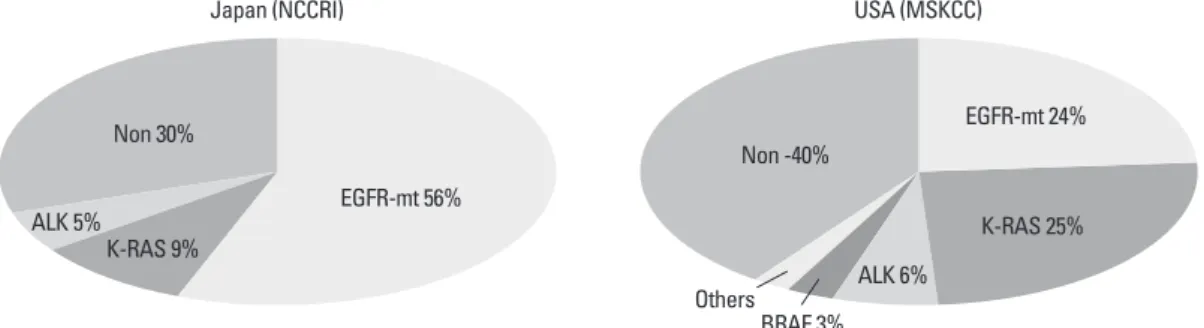
erlotinib were conducted in China (OPTIMAL)42 and Europe (EURTAC).43 All four of these trials produced similar results (Table 5), suggesting that the biological character of EGFR mutated NSCLC was similar in East Asians and Caucasians despite differences in mutation frequencies. Presently, clini- cal trials of next generation EGFR-TKIs are on-going. The majority of patients accrued to those trials are East Asian patients, since all of these trials required pharmacogenomic selection; for example 70% of patients in the LUX-LUNG3 global trial for afatinib are East Asian (Fig. 6).44 Fig. 7 shows the ethnic differences in the molecular classification of adenocarcinoma of the lung based on data from the Na- tional Cancer Center Research Institute of Japan and the Memorial Sloan Kettering Cancer Center-in the United cinoma and never/light smokers in addition to an East Asian
ethnicity. The overall data was difficult to explain because the PFS curves crossed at 6 months. If the patients were sub- divided according to the EGFR mutational status, the PFS of the gefitinib was better in the mutation positive patients, while that of the carboplatin/paclitaxel group was better in the mutation negative patients. In their study, however, EGFR mutation status was only analyzed in 36% of the pa- tients. Substantiating their findings, the Korean First Signal Study obtained similar results. At the same time two random- ized controlled trials (RCTs) using gefitinib to treat EGFR mutation positive patients were conducted by two groups in Japan, North East Japan (NEJ) 00240 and West Japan Thorac- ic Oncology Group (WJTOG) 3405.41 Later two RCTs using Table 5. EGFR-TKIs’ Studies after MT+ Discovery
2004 Discovery of EGFR mutations
2008 IPASS (Asian) presentation at ESMO2008 2009
NEJ002 (Japan) presentation at ASCO2009 (Phase III of Gefitinib vs. platinum-doublet for EGFR-mutants) WJTOG3405 (Japan) presentation at ESMO2009 (Phase III of Gefitinib vs. platinum-doublet for EGFR-mutants) First signal study (Korea) presentation at WCLC 2009 (Phase III of gefitinib vs. gemcitabine+cisplatin for EGFR-mutant) 2010 OPTIMAL (China) presentation at ESMO2010 (Phase III of Erlotinib vs. platinum-doublet for EGFR-mutants)
2011 EURTAC (Europe) presentation at ASCO2011 (Phase III of Erlotinib vs. platinum-doublet for EGFR-mutants) EGFR-TKIs, epidermal growth factor receptor tyrosine-kinase inhibitors.
Asian countries are playing critical roles for trials with pharmacogenomically selected patients.
Fig. 6. Global Ist line clinical trials of Afatinib vs. CT for molecularly-selected NSCLC patients (LUX-LUNG3). EGFR, epidermal growth factor receptor; NSCLC, non-small cell lung cancer.
Fig. 7. Ethnic difference for molecular classification of adenocarcima. EGFR, epidermal growth factor receptor.
Patient enrollment status
Global view Total randomized: 345
Asia, 70%
Others, 16%
Europe, 14%
0 10 5 15 25 20 30
EGFR mutations
Incidence of mutations (%)
K-RAS mutations Caucasians Asian
Japan (NCCRI) USA (MSKCC)
ALK 5%
K-RAS 9%
BRAF 3%
Others Non -40%
K-RAS 25%
ALK 6%
EGFR-mt 24%
Non 30%
EGFR-mt 56%
that, among the patients who died as a result of ILD, 31.6%
had received gefitinib and 27.9% undergone chemotherapy, respectively. Based on the AstraZeneca global Drug Safety Database, the reported rate of ILD-type events in patients receiving gefitinib was only 0.23% throughout the rest of the world, excluding Japan, according to the records of more than 215000 patients treated with gefitinib. Even in other East Asian countries such as Korea and Taiwan the rate was only 0.17%. On the other hand the percentages of patients involving a fatal outcome after developing ILD were similar, 37% in Japan and 31% in other countries.
Within the case-controlled study performed by AstraZene- ca, analyses were conducted to identify genetic and pro- teomic predictors for ILD, unfortunately however, no spe- cific biomarkers capable of predicting ILD have been identified.
Moreover, the prevalence of erlotinib-induced ILD has not been intensively analyzed. Limited data suggest a simi- lar prevalence (4/108: 3.7%) to that of other drugs.50-52
SUGGESTIONS FROM THE TRIALS OF FLEX, AVAGAST AND SORAFENIB
AFTER TRANS-ARTERIAL CHEMO-EMBOLIZATION (TAE)
FLEX trial53
The cetuximab plus chemotherapy in patients with ad- vanced non-small cell lung cancer (FLEX) trial consisted of 1125 patients and was designed to demonstrate superior overall survival for cetuximab when used in combination with chemotherapy compared with chemotherapy alone as a first-line therapy for patients with advanced NSCLC. As the chemotherapeutic regimen, cisplatin and vinorelbine were selected. Cetuximab, at an initial dose of 400 mg/m2 followed by 250 mg/m2 weekly, was given concurrently with chemotherapy and as a maintenance regimen in the cetuximab group. Overall survival (10.1 vs. 11.3 months), States (Fig. 7). Careful selection is becoming mandatory to
ensure that clinical trials are completed very quickly and yield scientifically sound data.
It is worth noting that driver mutations are likely to be- come the most important and promising molecular target for future anticancer drugs.45 Accordingly, possible ethnic difference in driver mutations must be kept in mind when performing preclinical and early clinical trials of molecular targeted drugs.
INTERSTITIAL PNEUMONITIS INDUCED BY EGFR-TKI
Interstitial lung disease (ILD) affects the lung parenchyma and alveoli of the lungs. Drug-induced ILD presents with acute diffuse alveolar damage and sometimes involves a fa- tal outcomes. Unfortunately no specific treatment for ILD exists. Palliative therapies with oxygen inhalation and corti- costeroid administration have been attempted, but some pa- tients require assisted ventilation and die. ILD can reported- ly be induced by cytotoxic chemotherapy and radiotherapy, the prevalence of which is higher among Japanese than among Caucasians.46 EGFR-TKI-induced ILD is consid- ered to be relatively rare47 and appears to be limited to pa- tients in Japan.48 A WJTOG retrospective study of 1976 pa- tients reported the frequencies of ILD and ILD-induced mortality by gefitinib as 3.2 and 1.3% respectively. The risk factors thereof were a male gender, a history of smoking and a history of pulmonary fibrosis.28 AstraZeneca per- formed a prospective study of 3322 patients receiving gefi- tinib. ILD and ILD-induced death were observed in 5.8 and 2.5% of these patients, respectively. The reported risk fac- tors were a history of smoking, a poor PS, a history of pul- monary fibrosis and prior chemotherapy. In a nested case controlled study performed by AstrasZeneca, the overall odds ratio for ILD due to gefitinib treatment, compared with chemotherapy, was 3.2.49 This specific trial showed
Table 6. Response Rate, Progression-Free Survival and Time to Treatment Failure in Whole Population of FLEX Trial (CDDP+VNB w/wo Cetuximub)
CT+cetuximab CT p value‡
RR 36% 29% 0.012
PFS* 4.8 months 4.8 months HR 0.943 (0.825-1.077) NS
TTF† 4.2 months 3.7 months HR 0.860 (0.761-0.971) 0.015
PFS, progression free survival; TTF, time to treatment failure; RR, response rate; HR, hazard ratio; CT, chemotherapy.
*Assessment by investigator.
†Post-hoc analysis.
‡RR: Cochran-Mantel-Haenszel Test PFS, TTF: stratified log-rank test (2-sided).
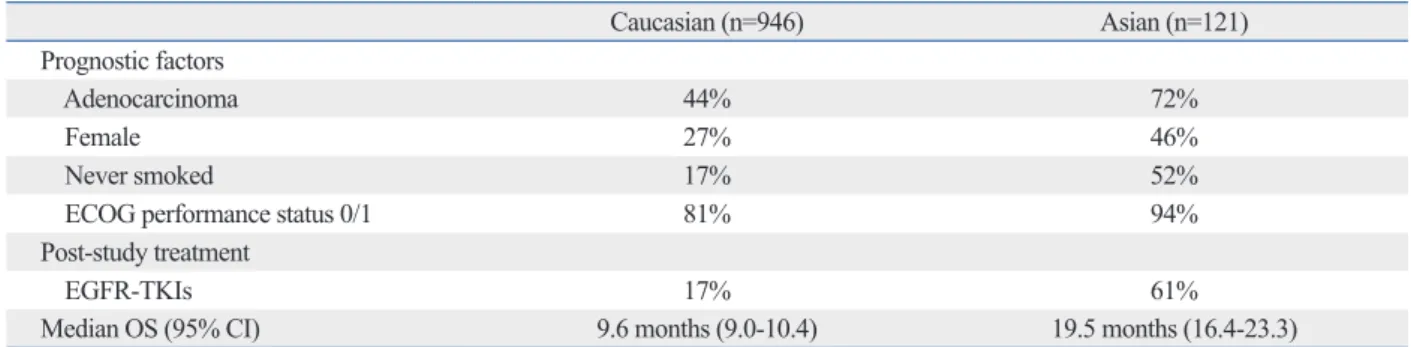
ceived treatment with an EGFR-TKI (17% vs. 61%) after the first line chemotherapy. No statistically significant differ- ence in OS (17.6 vs. 20.4 months), or RR (50% vs. 44%) was seen between the chemotherapy+cetuximab and the chemotherapy alone group in the Asian population (Table 8). However, in Caucasians, chemotherapy+cetuximab pro- duced a significantly better survival period, compared with chemotherapy alone. These discrepancies can be explained by differences in 1) the patients’s backgrounds such as his- tology, gender, smoking status and PS as well as 2) treat- response rate (29% vs. 36%) and the time to treatment fail-
ure (4.2 vs. 3.7 months) were significantly better in the ce- tuximab group than chemotherapy alone group although the PFS was 4.8 months in both groups (Table 6). The study in- cluded 946 Caucasians and 121 Asians. The median surviv- al periods for the Caucasians and Asians were 9.6 and 19.5 months, respectively. Among the Asian patients, adenocarci- noma (44% vs. 72%), a female gender (27% vs. 46%), nev- er smokers (17% vs. 52%), good ECOG PS (81% vs. 94%) were dominant (Table 7). Most of the Asian patients re-
Table 7. Differences in Prognostic Factors, Post-Study Treatment and OS between Caucasians and Asians in FLEX trial (CDDP+
VNB w/wo Cetuximab)
Caucasian (n=946) Asian (n=121)
Prognostic factors
Adenocarcinoma 44% 72%
Female 27% 46%
Never smoked 17% 52%
ECOG performance status 0/1 81% 94%
Post-study treatment
EGFR-TKIs 17% 61%
Median OS (95% CI) 9.6 months (9.0-10.4) 19.5 months (16.4-23.3)
ECOG, Eastern Cooperative Oncology Group; EGFR-TKIs, epidermal growth factor receptor tyrosine-kinase inhibitors; OS, overall survival; CI, confidence interval.
Table 8. No Difference in OS and RR between CT+Cetuximab vs. CT Alone in Asian Subgroup
CT+cetuximab (n=62) CT (n=59) p value
Baseline prognostic factors: adenocarcinoma 65% 80%
Post-study treatment: EGFR-TKIs 50% 73%
OS 17.6 months 20.4 months NS
RR 50% 44% NS
EGFR-TKIs, epidermal growth factor receptor tyrosine-kinase inhibitors; OS, overall survival; RR, response rate.
Small sample size (n=121, 10% of total) and difference in histology and post-study EGFR-TKI treatment do not allow to draw definitive conclusions.
Table 9. Patient Characteristics by Region in AVAGAST Trial
% of patients Asia Europe Pan-America
Age <65 72 68 77
≥65 28 32 23
ECOG PS 0-1 97 91 96
2 3* 9 4
Primary site Stomach 94 78 84
GEJ 6 22 16
Extent of disease Metastatic 99 95 92
Locally advanced 1 5 8
Prior gastrectomy Yes 32 23 27
No 68 77 73
Measurable lesion Yes 73 88 77
No 27 12 23
Liver metastasis Yes 27 37 42
No 73 63 58
AVAGAST, a study of bevacizumab in combination with capecitabine and cisplatin as first-line therapy in patients with advanced gastric cancer; ECOG, Eastern Cooperative Oncology Group; PS, performance status; GEJ, gastro-esophageal junction.
*1 additional patient had an ECOG PS of 4.
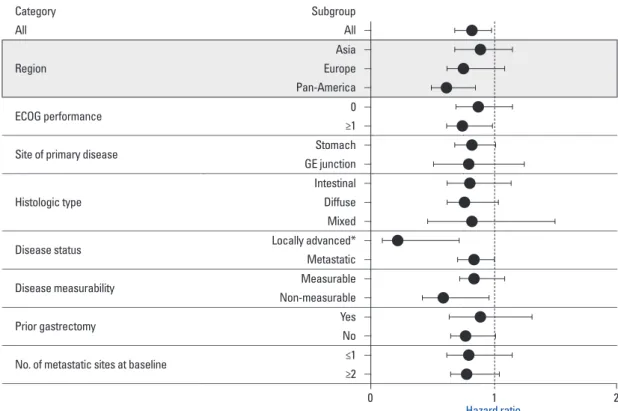
5.3 months). The regional differences in efficacy are shown in the Fig. 8. OS and PFS were longer in the Asian popula- tion compared with the European and Pan American popula- tions in both groups. The Hazard ratios (HRs) of OS for Pan Americans and those of PFS for Europeans and Pan Ameri- cans were smaller than 1.0 suggesting that the addition of be- vacizumab to these populations may have contributed to pro- longed survival (Fig. 8). No notable differences in patient characteristics were seen according to the region. Among Asians, the most common primary legion was the stomach fundus (94%), almost all the patients had distant metastases (99%), more patients had undergone prior gastrectomy (32%) and fewer patients had liver metastases (27%) (Table 9). The majority of the Asian patients (248/376: 66%) re- ceived second line chemotherapy. On the other hand only 31% (78/249) and 21% (32/149) of the European and Pan- American patients received second line chemotherapy, re- spectively (Table 10). The AVAGAST trial did not meet the ment with a second/third line EGFR-TKI. Additionally, dif-
ferences in EGFR mutation rate, of course, may have also influenced the longer survival in Asian patients. The FLEX study effectively demonstrated the difficulty of interpreting global trials in which pharmacoethnic differences are pres- ent among the patient population.
AVAGAST trial54
The AVAGAST trial was conducted as a randomized double- blinded placebo-controlled phase III trial to compare capecitabine/cisplatin+bevacizumab vs. chemotherapy alone in patients with locally advanced or metastatic gastric cancer.
The study stratified patients according to geographic region in addition to fluoropyrimidine backbone and disease status.
A total of 774 patients were included in the study. Patients were evenly distributed to two arms according to gender, age, ECOG PS, disease sites such as the stomach fundus and the gastro-esophageal junction, disease measurability, meta- static sites, prior gastrectomy, liver metastases and the three stratification factors mentioned above. In both groups, nearly half of the patients were from Asian countries. The percent- age of patients with an intestinal histology was slightly high- er in the bevacizumab group (40% vs. 35%) (Table 9). Over- all survival was not statistically significantly different between the two groups (p=0.1002). PFS was significantly better in the bevacizumab group (p=0.0037, 6.7 months vs.
Table 10. Second-Line Therapy by Region in AVAGAST Trial:
Majority of Asian Patients Received Second Line Chemo- therapy
Region Patients
entered Patients receiving second-line treatment %
Asia 376 248 66
Europe 249 78 31
Pan-America 149 32 21
Fig. 8. Subgroup analysis of OS in AVAGAST Survival of pan-American is better in Avastin group.
Category Subgroup
All All -
Region
Asia - Europe - Pan-America -
ECOG performance 0 -
≥1 -
Site of primary disease Stomach -
GE junction -
Histologic type
Intestinal - Diffuse - Mixed -
Disease status Locally advanced* -
Metastatic -
Disease measurability Measurable -
Non-measurable -
Prior gastrectomy Yes -
No -
No. of metastatic sites at baseline ≤1 -
≥2 -
0 Hazard ratio1 2
cellular carcinoma, as more than 70% of the Japanese pa- tients were infected with hepatitis C virus and more than 70% of Korean patients were infected with hepatitis B vi- rus. These results suggest that major pharmacoethnic differ- ences exist even between Korean and Japanese patients.
DISCUSSIONS
Ethnic diversity is recognized as an important factor ac- counting for inter-individual variations in anticancer drug responsiveness and toxicity. However, similar doses of anti- cancer drugs have been prescribed to different ethnic popu- lations without consideration of the potential differences in pharmacokinetics and pharmacodynamics, both of which are essentially influenced by pharmacogenomics. Although pharmacoethnicity is determined by genetic and non-genet- ic factors, the latter factors have not yet been well identi- fied. The possible determinants of ethnicity could include 1) environmental factors that influence bioavailability and metabolism, such as the frequency of smoking, alcohol drinking, herbal medicine use and local dietary varieties, 2) local medical care preferences, 3) ethnic specific drug-drug interactions influenced by drug lag in a specific region, 4) variability of genetic polymorphisms in drug metabolizing enzymes and transporters, and 5) the prevalence of an eth- nically restricted mutations in a drug’s receptor/target that may cause a particular sensitivity or resistance to that drug.1
Studies on pharmacoethnicity face many challenging is- sues. However, preclinical and clinical studies should be carefully designed to account for these problems. 1) Clini- cal trials on pharmacoethnicity require diverse popula- tions. International collaboration, including global trials, is mandatory and repeated trials using the same treatment strategies should be conducted in multiple countries. 2) Chemotherapy-related effects are likely to be under multi- gene control. Unbiased genome-wide models are needed and such models should include multiple mechanism-relat- ed and metabolism-related pathways. 3) Potentially impor- tant polymorphisms or mutations are generally uncom- mon. The sample size of clinical trials should be sufficient to enable an appropriate statistical power. Clinical trials in ethnic populations with a specific phenotype of interest may sometimes be necessary. To discover rare variants, new generation of sequencing methodology should be in- troduced. 4) The detection of genome-wide associations requires multiple SNP testing, which may generate several primary endpoint for OS. Increase in secondary endpoints
(PFS and best RR) suggested some biological activity of be- vacizumab against advanced gastric cancer. The heteroge- nous efficacy results in both treatment arms across geograph- ic regions may have been caused by differences in the tumor burden, tumor status, medical care and genetics. This study might have also encountered patients with different pharma- coethnicity.
Sorafenib after TACE
The activity of sorafenib, a multikinase inhibitor was shown to lead to a prolonged OS (10.7 vs. 7.9 months: HR=0.69) and median time to radiologic progression (5.5 vs. 2.8 months) in patients with advanced hepatocellular carcino- ma in the Sorafenib HCC Assessment Randomized Proto- col trial which consisted of 602 patients who had not under- gone prior systemic therapy.55 In another clinical trial that included patients from the Asia-Pacific region, sorafenib was found to prolong OS (6.5 vs. 4.2 months: HR=0.68) and time to progression (2.8 vs. 1.4 months: HR=0.57).56 In Japanese and Korean patients, an additional phase III trial on sorafenib was conducted after trans-arterial chemo-em- bolization (TACE).57 In both countries TACE has practically been used for the treatment of advanced hepatocellular car- cinoma. The trial showed that sorafenib did not significant- ly prolong TTP in patients who responded to TACE. Sever- al factors may have contributed to these discrepant results.
High percentages of patients receiving sorafenib required dose reductions (73%) and/or treatment interruptions (91%).
Accordingly the median daily dose (386 mg) was signifi- cantly lower than the planned dose. Twenty-six percent and 44% of the patients in the SHARP trial as well as 31% and 43% of the patients in the sorafenib Asia-Pacific (AP) trial required dose reductions and interruptions, respectively.
The median daily doses of sorafenib were 797 and 795 mg in the SHARP and AP trials, respectively. In the sorafenib after TACE trial conducted in Korea and Japan, outcomes in Korean patients were better than that in Japanese patients and sorafenib prolonged TTP in Korean patients (HR=0.38) based on the results of subset analyses. However, some dif- ferences were observed in baseline characteristics between Korean and Japanese patients. The Japanese patients were older, and a higher percentage presented with >3 lesions at the time of enrollment in the study. The Japanese patients were also less likely to have received >one TACE to achieve complete response prior to treatment with sorafenib. These subgroups also differed in the principle etiology of hepato-
ence more frequent and profound neutropenia despite re- ceiving the same treatment doses, schedules and same phar- macokinetics. A difference in sensitivity at receptor site has been suggested to be the main cause of these observations, but a concrete mechanism, thereof has not been clarified.
On the other hand, the survival period of NSCLC patients was significantly longer among Asian patients than among Caucasians even before EGFR-TKIs became available. In a common arm trial, the OS and one-year survival were both significantly better in Asian patients although response rates were exactly the same. Differences in sensitivity to EGFR- TKI have been clearly explained by EGFR mutation in both false-positive SNPs. Accordingly, test and validation sets
are mandatory. In addition, both of preclinical and clinical validations, as well as the application of a rigorous statisti- cal methodology is needed. Furthermore, as 5) anti-cancer drugs cannot be administered to healthy volunteers, in vi- tro cell based models are needed1 and pharmacogenomical selection of patients is recommended by appropriate bio- markers.
The clinical trials included in the present review were large enough to identify ethnic differences, despite the numerous hidden factors that remain unknown. As shown by common arm trials between USA and Japan, Asian patients experi- Table 11. Ethnic Difference for Metabolism of ARQ 197 (Tivantinib) ARQ 197 is mainly metabolized by CYP2C19
CYP 1A2 (n=3) 2C8 (n=3) 2C9 (n=2) 2C19 (n=3) 2D6 (n=2) 3A4 (n=3)
t1/2 (min) 27.4 33.5 33.5 2.83 34.1 16.3
In vitro metabolism test by human CYP-expressed microsome Polymorphism of CYP2C19
*1: wild type: Extensive Metabolizer, EM *2: G681A in exon5; splicing defect
*3: G636A in exon4; transforming to stop codon
Low activity of homozygote (*2/*2, *3/*3) or combined heterozygote (*2/*3): Poor Metabolizer, PM Racial difference of CYP2C19 polymorphism
Many people with CYP2C19 PM in Asian (≒20%) and few in Caucasian (≒3%) Courtesy of Dr. N. Yamamoto: Shizuoka Cancer Center.
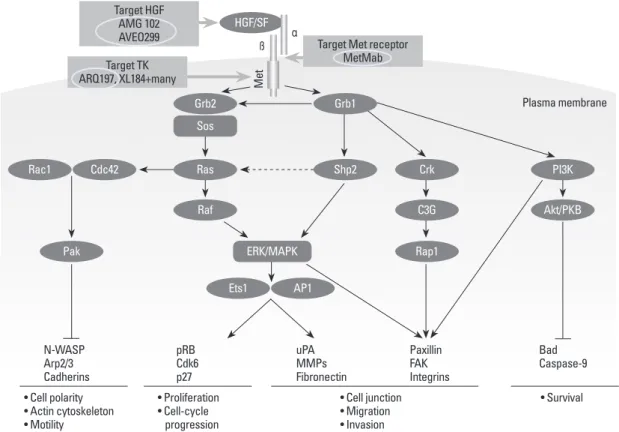
Fig. 9. MET pathways.
Plasma membrane
N-WASP Arp2/3 Cadherins
uPAMMPs Fibronectin pRBCdk6
p27
Paxillin FAKIntegrins
BadCaspase-9
• Cell polarity
• Actin cytoskeleton
• Motility
• Cell junction
• Migration
• Invasion
• Survival
• Proliferation
• Cell-cycle progression
ß α
Met
HGF/SF
Grb2 Sos
Raf
Rap1 Rac1
Ets1
Shp2
ERK/MAPK
Akt/PKB Cdc42
AP1 Pak
Target TK ARQ197, XL184+many
Target HGF AMG 102
AVEO299 Target Met receptor
MetMab
Ras Crk PI3K
C3G Grb1
only be identified from the prospective analyses of patients of a homogeneous background. The clarification of phar- macoethnic differences will be crucially important to the future development of new anticancer drugs.
ACKNOWLEDGEMENTS
This paper was presented at the 6th Japan-US Cancer Thera- py International Joint Symposium in Hiroshima on July19- 21, 2012.
REFERENCES
1. O’Donnell PH, Dolan ME. Cancer pharmacoethnicity: ethnic dif- ferences in susceptibility to the effects of chemotherapy. Clin Can- cer Res 2009;15:4806-14.
2. Huang RS, Ratain MJ. Pharmacogenetics and pharmacogenomics of anticancer agents. CA Cancer J Clin 2009;59:42-55.
3. Huang SM, Temple R. Is this the drug or dose for you? Impact and consideration of ethnic factors in global drug development, regulatory review, and clinical practice. Clin Pharmacol Ther 2008;84:287-94.
4. Schwab M, Zanger UM, Marx C, Schaeffeler E, Klein K, Dippon J, et al. Role of genetic and nongenetic factors for fluorouracil treat- ment-related severe toxicity: a prospective clinical trial by the Ger- man 5-FU Toxicity Study Group. J Clin Oncol 2008;26:2131-8.
5. Lecomte T, Ferraz JM, Zinzindohoué F, Loriot MA, Tregouet DA, Landi B, et al. Thymidylate synthase gene polymorphism predicts toxicity in colorectal cancer patients receiving 5-fluorouracil- based chemotherapy. Clin Cancer Res 2004;10:5880-8.
6. Marsh S, Collie-Duguid ES, Li T, Liu X, McLeod HL. Ethnic variation in the thymidylate synthase enhancer region polymor- phism among Caucasian and Asian populations. Genomics 1999;
58:310-2.
7. Lal S, Wong ZW, Jada SR, Xiang X, Chen Shu X, Ang PC, et al.
Novel SLC22A16 polymorphisms and influence on doxorubicin
Asians and Caucasians. However, why the frequency of EGFR mutation is higher among Asian patients remains unknown. Some germ line and environmental factors may influence this mutation rate. However, all previous genome- wide and proteome analyses that have been performed in association with prospective clinical trials failed to pick up on relevant factors. There is also no clear explanation as to why EGFR-TKI-induced ILD is observed so frequently in Japanese patients only. To date, only clinical characteristics indicating a susceptibility to ILD have been identified. The data of three trials the FLEX, AVAGAST, and Sorafenib af- ter TACE trials, suggested that disease status and local medical care preference strongly influenced the OS of the included patients.
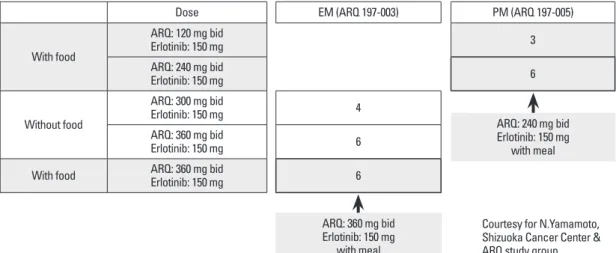
Recently the Shizuoka Cancer Center reported interesting results on Phase I study of ARQ197, a selective, non-ATP competitive inhibitor of c-MET, a receptor tyrosine kinase involved in tumor migration, invasion and proliferation (Fig. 9). Therein, the ratios of poor metabolizers (PM), who exhibited a single nucleotide polymorphism in CYP2C9, a major metabolizing enzyme for ARQ197, among Cauca- sians and Asians have been reported to be 3 and 20%, re- spectively (Table 11). Recommended phase II dose of ARQ197 for subjects of western countries has been decided to be a single dose of 360 mg bid. On the other hand, the study in Japan demonstrated that CYP2C19 genotype clear- ly affected exposures such as AUC and C-max of ARQ, which led to the designation of two different recommended doses for phase II trials, 360 mg bid for extensive metabo- lizer patients and 240 mg bid for PM patients (Fig. 10).
Clear ethnic differences mandates the necessity of different protocols for phase II studies of Asians and Caucasians.58
In summary basic pharmacogenomic differences could
Fig. 10. Phase I combination study with erlotinib in Japan. EM, extensive metabolizer; PM, poor metabolizer.
Dose EM (ARQ 197-003) PM (ARQ 197-005)
With food
ARQ: 120 mg bid
Erlotinib: 150 mg 3
ARQ: 240 mg bid
Erlotinib: 150 mg 6
Without food
ARQ: 300 mg bid
Erlotinib: 150 mg 4
ARQ: 360 mg bid
Erlotinib: 150 mg 6
With food ARQ: 360 mg bid
Erlotinib: 150 mg 6
Courtesy for N.Yamamoto, Shizuoka Cancer Center &
ARQ study group ARQ: 360 mg bid
Erlotinib: 150 mg with meal
ARQ: 240 mg bid Erlotinib: 150 mg
with meal
(‘Iressa’, ZD1839) in Japanese patients with solid malignant tu- mors. Ann Oncol 2003;14:922-30.
22. Baselga J, Rischin D, Ranson M, Calvert H, Raymond E, Kieback DG, et al. Phase I safety, pharmacokinetic, and pharmacodynamic trial of ZD1839, a selective oral epidermal growth factor receptor tyrosine kinase inhibitor, in patients with five selected solid tumor types. J Clin Oncol 2002;20:4292-302.
23. Herbst RS, Maddox AM, Rothenberg ML, Small EJ, Rubin EH, Baselga J, et al. Selective oral epidermal growth factor receptor tyrosine kinase inhibitor ZD1839 is generally well-tolerated and has activity in non-small-cell lung cancer and other solid tumors:
results of a phase I trial. J Clin Oncol 2002;20:3815-25.
24. Ranson M, Hammond LA, Ferry D, Kris M, Tullo A, Murray PI, et al. ZD1839, a selective oral epidermal growth factor receptor- tyrosine kinase inhibitor, is well tolerated and active in patients with solid, malignant tumors: results of a phase I trial. J Clin On- col 2002;20:2240-50.
25. Fukuoka M, Yano S, Giaccone G, Tamura T, Nakagawa K, Douil- lard JY, et al. Multi-institutional randomized phase II trial of gefi- tinib for previously treated patients with advanced non-small-cell lung cancer (The IDEAL 1 Trial) [corrected]. J Clin Oncol 2003;
21:2237-46.
26. Kris MG, Natale RB, Herbst RS, Lynch TJ Jr, Prager D, Belani CP, et al. Efficacy of gefitinib, an inhibitor of the epidermal growth fac- tor receptor tyrosine kinase, in symptomatic patients with non-small cell lung cancer: a randomized trial. JAMA 2003;290:2149-58.
27. Takahashi T, Yamamoto N, Nukiwa T, Mori K, Tsuboi M, Horai T, et al. Phase II study of erlotinib in Japanese patients with advanced non-small cell lung cancer. Anticancer Res 2010;30:557-63.
28. Ando M, Okamoto I, Yamamoto N, Takeda K, Tamura K, Seto T, et al. Predictive factors for interstitial lung disease, antitumor re- sponse, and survival in non-small-cell lung cancer patients treated with gefitinib. J Clin Oncol 2006;24:2549-56.
29. Shepherd FA, Rodrigues Pereira J, Ciuleanu T, Tan EH, Hirsh V, Thongprasert S, et al. Erlotinib in previously treated non-small- cell lung cancer. N Engl J Med 2005;353:123-32.
30. Giaccone G, Herbst RS, Manegold C, Scagliotti G, Rosell R, Miller V, et al. Gefitinib in combination with gemcitabine and cis- platin in advanced non-small-cell lung cancer: a phase III trial-- INTACT 1. J Clin Oncol 2004;22:777-84.
31. Herbst RS, Giaccone G, Schiller JH, Natale RB, Miller V, Mane- gold C, et al. Gefitinib in combination with paclitaxel and carbopl- atin in advanced non-small-cell lung cancer: a phase III trial--IN- TACT 2. J Clin Oncol 2004;22:785-94.
32. Herbst RS, Prager D, Hermann R, Fehrenbacher L, Johnson BE, Sandler A, et al. TRIBUTE: a phase III trial of erlotinib hydro- chloride (OSI-774) combined with carboplatin and paclitaxel che- motherapy in advanced non-small-cell lung cancer. J Clin Oncol 2005;23:5892-9.
33. Gatzemeier U, Pluzanska A, Szczesna A, Kaukel E, Roubec J, De Rosa F, et al. Phase III study of erlotinib in combination with cis- platin and gemcitabine in advanced non-small-cell lung cancer:
the Tarceva Lung Cancer Investigation Trial. J Clin Oncol 2007;
25:1545-52.
34. Thatcher N, Chang A, Parikh P, Rodrigues Pereira J, Ciuleanu T, von Pawel J, et al. Gefitinib plus best supportive care in previously treated patients with refractory advanced non-small-cell lung can- cer: results from a randomised, placebo-controlled, multicentre study (Iressa Survival Evaluation in Lung Cancer). Lancet 2005;
366:1527-37.
pharmacokinetics in Asian breast cancer patients. Pharmacoge- nomics 2007;8:567-75.
8. Petros WP, Hopkins PJ, Spruill S, Broadwater G, Vredenburgh JJ, Colvin OM, et al. Associations between drug metabolism geno- type, chemotherapy pharmacokinetics, and overall survival in pa- tients with breast cancer. J Clin Oncol 2005;23:6117-25.
9. Renbarger JL, McCammack KC, Rouse CE, Hall SD. Effect of race on vincristine-associated neurotoxicity in pediatric acute lympho- blastic leukemia patients. Pediatr Blood Cancer 2008;50:769-71.
10. Minami H, Sai K, Saeki M, Saito Y, Ozawa S, Suzuki K, et al. Iri- notecan pharmacokinetics/pharmacodynamics and UGT1A genet- ic polymorphisms in Japanese: roles of UGT1A1*6 and *28.
Pharmacogenet Genomics 2007;17:497-504.
11. Innocenti F, Kroetz DL, Schuetz E, Dolan ME, Ramírez J, Relling M, et al. Comprehensive pharmacogenetic analysis of irinotecan neutropenia and pharmacokinetics. J Clin Oncol 2009;27:2604-14.
12. Soo RA, Loh M, Mok TS, Ou SH, Cho BC, Yeo WL, et al. Ethnic differences in survival outcome in patients with advanced stage non-small cell lung cancer: results of a meta-analysis of random- ized controlled trials. J Thorac Oncol 2011;6:1030-8.
13. Toyooka S, Kiura K, Mitsudomi T. EGFR mutation and response of lung cancer to gefitinib. N Engl J Med 2005;352:2136.
14. Gandara DR, Kawaguchi T, Crowley J, Moon J, Furuse K, Kawa- hara M, et al. Japanese-US common-arm analysis of paclitaxel plus carboplatin in advanced non-small-cell lung cancer: a model for assessing population-related pharmacogenomics. J Clin Oncol 2009;27:3540-6.
15. Lara PN Jr, Chansky K, Shibata T, Fukuda H, Tamura T, Crowley J, et al. Common arm comparative outcomes analysis of phase 3 trials of cisplatin + irinotecan versus cisplatin + etoposide in ex- tensive stage small cell lung cancer: final patient-level results from Japan Clinical Oncology Group 9511 and Southwest Oncology Group 0124. Cancer 2010;116:5710-5.
16. Ohe Y, Ohashi Y, Kubota K, Tamura T, Nakagawa K, Negoro S, et al. Randomized phase III study of cisplatin plus irinotecan versus carboplatin plus paclitaxel, cisplatin plus gemcitabine, and cisplat- in plus vinorelbine for advanced non-small-cell lung cancer: Four- Arm Cooperative Study in Japan. Ann Oncol 2007;18:317-23.
17. Kubota K, Kawahara M, Ogawara M, Nishiwaki Y, Komuta K, Minato K, et al. Vinorelbine plus gemcitabine followed by docetaxel versus carboplatin plus paclitaxel in patients with ad- vanced non-small-cell lung cancer: a randomised, open-label, phase III study. Lancet Oncol 2008;9:1135-42.
18. Williamson SK, Crowley JJ, Lara PN Jr, McCoy J, Lau DH, Tucker RW, et al. Phase III trial of paclitaxel plus carboplatin with or without tirapazamine in advanced non-small-cell lung cancer:
Southwest Oncology Group Trial S0003. J Clin Oncol 2005;23:
9097-104.
19. Noda K, Nishiwaki Y, Kawahara M, Negoro S, Sugiura T, Yo- koyama A, et al. Irinotecan plus cisplatin compared with etoposide plus cisplatin for extensive small-cell lung cancer. N Engl J Med 2002;346:85-91.
20. Lara PN Jr, Natale R, Crowley J, Lenz HJ, Redman MW, Carleton JE, et al. Phase III trial of irinotecan/cisplatin compared with eto- poside/cisplatin in extensive-stage small-cell lung cancer: clinical and pharmacogenomic results from SWOG S0124. J Clin Oncol 2009;27:2530-5.
21. Nakagawa K, Tamura T, Negoro S, Kudoh S, Yamamoto N, Yama- moto N, et al. Phase I pharmacokinetic trial of the selective oral epidermal growth factor receptor tyrosine kinase inhibitor gefitinib
Pulmonary drug toxicity: radiologic and pathologic manifesta- tions. Radiographics 2000;20:1245-59.
47. Kishi K, Nakata K, Yoshimura K. Efficacy of gefitinib in a patient with lung cancer associated with idiopathic pulmonary fibrosis. J Thorac Oncol 2006;1:733-4.
48. Takano T, Ohe Y, Kusumoto M, Tateishi U, Yamamoto S, Noki- hara H, et al. Risk factors for interstitial lung disease and predictive factors for tumor response in patients with advanced non-small cell lung cancer treated with gefitinib. Lung Cancer 2004;45:93-104.
49. Kudoh S, Kato H, Nishiwaki Y, Fukuoka M, Nakata K, Ichinose Y, et al. Interstitial lung disease in Japanese patients with lung cancer:
a cohort and nested case-control study. Am J Respir Crit Care Med 2008;177:1348-57.
50. Jones SJ, Milenkova T. ILD during erlotinib and gefitinib treat- ment in Japanese patients with non-small cell lung cancer. J Tho- rac Oncol 2010;5:1877-8.
51. Lind JS, Smit EF, Grünberg K, Senan S, Lagerwaard FJ. Fatal in- terstitial lung disease after erlotinib for non-small cell lung cancer.
J Thorac Oncol 2008;3:1050-3.
52. Liu V, White DA, Zakowski MF, Travis W, Kris MG, Ginsberg MS, et al. Pulmonary toxicity associated with erlotinib. Chest 2007;132:1042-4.
53. Pirker R, Pereira JR, Szczesna A, von Pawel J, Krzakowski M, Ramlau R, et al. Cetuximab plus chemotherapy in patients with advanced non-small-cell lung cancer (FLEX): an open-label ran- domised phase III trial. Lancet 2009;373:1525-31.
54. Ohtsu A, Shah MA, Van Cutsem E, Rha SY, Sawaki A, Park SR, et al. Bevacizumab in combination with chemotherapy as first-line therapy in advanced gastric cancer: a randomized, double-blind, placebo-controlled phase III study. J Clin Oncol 2011;29:3968-76.
55. Llovet JM, Ricci S, Mazzaferro V, Hilgard P, Gane E, Blanc JF, et al. Sorafenib in advanced hepatocellular carcinoma. N Engl J Med 2008;359:378-90.
56. Cheng AL, Kang YK, Chen Z, Tsao CJ, Qin S, Kim JS, et al. Effi- cacy and safety of sorafenib in patients in the Asia-Pacific region with advanced hepatocellular carcinoma: a phase III randomised, double-blind, placebo-controlled trial. Lancet Oncol 2009;10:25-34.
57. Kudo M, Imanaka K, Chida N, Nakachi K, Tak WY, Takayama T, et al. Phase III study of sorafenib after transarterial chemoemboli- sation in Japanese and Korean patients with unresectable hepato- cellular carcinoma. Eur J Cancer 2011;47:2117-27.
58. Nishina T, Hirashima T, Sugio K, Muro K, Akinaga S, Maeda H, et al. The effect of CYP2C19 polymorphism on the tolerability of ARQ 197: results from phase I trial in Japanese patients with met- astatic solid tumors. J Clin Oncol 2011;29:2516.
35. Paez JG, Jänne PA, Lee JC, Tracy S, Greulich H, Gabriel S, et al.
EGFR mutations in lung cancer: correlation with clinical response to gefitinib therapy. Science 2004;304:1497-500.
36. Lynch TJ, Bell DW, Sordella R, Gurubhagavatula S, Okimoto RA, Brannigan BW, et al. Activating mutations in the epidermal growth factor receptor underlying responsiveness of non-small- cell lung cancer to gefitinib. N Engl J Med 2004;350:2129-39.
37. Mitsudomi T, Kosaka T, Endoh H, Horio Y, Hida T, Mori S, et al.
Mutations of the epidermal growth factor receptor gene predict prolonged survival after gefitinib treatment in patients with non- small-cell lung cancer with postoperative recurrence. J Clin Oncol 2005;23:2513-20.
38. Takano T, Ohe Y, Sakamoto H, Tsuta K, Matsuno Y, Tateishi U, et al. Epidermal growth factor receptor gene mutations and increased copy numbers predict gefitinib sensitivity in patients with recur- rent non-small-cell lung cancer. J Clin Oncol 2005;23:6829-37.
39. Mok TS, Wu YL, Thongprasert S, Yang CH, Chu DT, Saijo N, et al. Gefitinib or carboplatin-paclitaxel in pulmonary adenocarcino- ma. N Engl J Med 2009;361:947-57.
40. Maemondo M, Inoue A, Kobayashi K, Sugawara S, Oizumi S, Isobe H, et al. Gefitinib or chemotherapy for non-small-cell lung cancer with mutated EGFR. N Engl J Med 2010;362:2380-8.
41. Mitsudomi T, Morita S, Yatabe Y, Negoro S, Okamoto I, Tsurutani J, et al. Gefitinib versus cisplatin plus docetaxel in patients with non-small-cell lung cancer harbouring mutations of the epidermal growth factor receptor (WJTOG3405): an open label, randomised phase 3 trial. Lancet Oncol 2010;11:121-8.
42. Zhou C, Wu YL, Chen G, Feng J, Liu XQ, Wang C, et al. Erlotinib versus chemotherapy as first-line treatment for patients with ad- vanced EGFR mutation-positive non-small-cell lung cancer (OP- TIMAL, CTONG-0802): a multicentre, open-label, randomised, phase 3 study. Lancet Oncol 2011;12:735-42.
43. Rosell R, Carcereny E, Gervais R, Vergnenegre A, Massuti B, Felip E, et al. Erlotinib versus standard chemotherapy as first-line treat- ment for European patients with advanced EGFR mutation-positive non-small-cell lung cancer (EURTAC): a multicentre, open-label, randomised phase 3 trial. Lancet Oncol 2012;13:239-46.
44. Yang JCH, Schuler MH, Yamamoto N, O’Byrne KJ, Hirsh V, Mok T, et al. LUX-Lung3: a randomized, open-label phase III study of afatinib versus pemetrexed and cisplatin as first-line treat- ment for patients with advanced adenocarcinoma of the lung har- boring EGFR-activating mutations. ASCO 2012. J Clin Oncol 2012;30(suppl):Abstract LBA7500.
45. Weinstein IB. Cancer. Addiction to oncogenes--the Achilles heal of cancer. Science 2002;297:63-4.
46. Rossi SE, Erasmus JJ, McAdams HP, Sporn TA, Goodman PC.