http://e-nrp.org
Dual effects of a mixture of grape pomace (Campbell Early) and Omija fruit ethanol extracts on lipid metabolism and the
antioxidant defense system in diet-induced obese mice
Hye Jin Han
1,2, Un Ju Jung
1, Hye-Jin Kim
3, Byoung Seok Moon
3, Su-Jung Cho
1,2, Yong Bok Park
4, Dong Gun Lee
4and Myung-Sook Choi
1,2§1Department of Food Science and Nutrition, Kyungpook National University, 80 Daehakro, Bukgu, Daegu 702-701, Korea
2Center for Food and Nutritional Genomics Research, Kyungpook National University, Daegu 702-701, Korea
3Food R&D, CJ Cheiljedang Corp., Seoul 152-051, Korea
4School of Life Science & Biotechnology, Kyungpook National University, Daegu 702-701, Korea
BACKGROUND/OBJECTIVES: We investigated the effects of a combination of grape pomace (Vitis labrusca, Campbell Early) and Omija fruit (Schizandra chinensis, Baillon) ethanol extracts on lipid metabolism and antioxidant defense system in diet-induced obese mice.
MATERIALS/METHODS: Forty male C57BL/6J mice were divided into four groups and fed high-fat diet (control group, CON) or high-fat diet added 0.5% grape pomace extract (GPE), 0.05% Omija fruit extract (OFE) or 0.5% GPE plus 0.05% OFE (GPE+OFE) for 12 weeks.
RESULTS: In contrast to the GPE- or OFE-supplemented groups, the GPE+OFE group showed significantly lower body weight and white adipose tissue weights than the CON group. Moreover, GPE+OFE supplementation significantly decreased plasma total cholesterol and increased the plasma HDL-cholesterol/total-cholesterol ratio (HTR) compared to the control diet. The hepatic triglyceride level was significantly lower in the GPE+OFE and GPE groups by increasing β-oxidation and decreasing lipogenic enzyme compared to the CON group. Furthermore, GPE+OFE supplementation significantly increased antioxidant enzyme activities with a simultaneous decrease in liver H
2O
2content compared to the control diet.
CONCLUSIONS: Together our results suggest that supplementation with the GPE+OFE mixture may be more effective in improving adiposity, lipid metabolism and oxidative stress in high-fat diet-fed mice than those with GPE and OFE alone.
Nutrition Research and Practice 2015;9(3):227-234; doi:10.4162/nrp.2015.9.3.227; pISSN 1976-1457 eISSN 2005-6168
Keywords: Grape pomace, Omija fruit, high-fat diet, lipid-regulating enzyme, antioxidant enzyme
INTRODUCTION
2)Obesity is defined as a disease in which excess body fat has accumulated to the extent that it may impair health. In particular, obesity causes or exacerbates diabetes mellitus, dyslipidemia, hypertension, coronary heart disease, and certain forms of cancer [1]. It is also associated with the development of nonal- coholic fatty liver disease [2]. Although some synthetic anti- obesity drugs effectively reduce body weight and the risk of comorbidities, pharmacological treatment strategies have been limited by their undesirable side effects [3]. For this reason, there has recently been a growing interest in nutraceuticals, which have been used since ancient times [4]. A nutraceutical is a food containing health-promoting ingredients or natural components that may provide desirable health benefits and
contribute to the prevention of chronic diseases [5]. It has been suggested that nutraceuticals have the potential to regulate imbalances between energy intake and output and to amelio- rate the development of oxidative stress and inflammation in obesity [6].
Grape pomace, which is an industrial waste from wine production and consists of grape seeds, skins, and stems, contains a large number of polyphenolic compounds [7]. The major phenolics found in grape skin include anthocyanin, ellagic acid, myricetin, quercetin, kaempferol, and trans-resveratrol.
Gallic acid, catechin, and epicatechin are found in grape seeds, while grape stems contain rutin, quercetin 3-O-glucuronide, trans-resveratrol, and astilbin [8,9]. A previous study has reported that grape pomace has antioxidant and anti-inflammatory effects in diet-induced obese mice [10]. Schizandra chinensis,
This work was supported by the High Value-added Food Technology Development Program (No. 110129-3), the Ministry for Food, Agriculture, Forestry and Fisheries and by the National Research Foundation of Korea (NRF, 2012M3A9C4048818 & 2015R1A5A6001906), Seoul, Korea.
§Corresponding Author: Myung-Sook Choi, Tel. 82-53-950-7937, Fax. 82-53-950-1230, E-mail. [email protected] Received: September 18, 2014, Revised: January 8, 2015, Accepted: February 5, 2015
This is an Open Access article distributed under the terms of the Creative Commons Attribution Non-Commercial License (http://creativecommons.org/licenses/by-nc/3.0/) which permits unrestricted non-commercial use, distribution, and reproduction in any medium, provided the original work is properly cited.
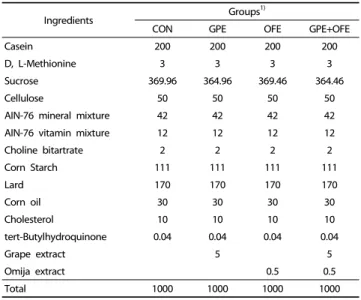
Ingredients Groups1)
CON GPE OFE GPE+OFE
Casein 200 200 200 200
D, L-Methionine 3 3 3 3
Sucrose 369.96 364.96 369.46 364.46
Cellulose 50 50 50 50
AIN-76 mineral mixture 42 42 42 42
AIN-76 vitamin mixture 12 12 12 12
Choline bitartrate 2 2 2 2
Corn Starch 111 111 111 111
Lard 170 170 170 170
Corn oil 30 30 30 30
Cholesterol 10 10 10 10
tert-Butylhydroquinone 0.04 0.04 0.04 0.04
Grape extract 5 5
Omija extract 0.5 0.5
Total 1000 1000 1000 1000
1)CON: high-fat diet (20% fat, w/w) control; GPE: high-fat diet+grape pomace ethanol extract (0.5%, w/w); OFE: high-fat diet+Omija fruit ethanol extract (0.05%, w/w); GPE+OFE: high-fat diet+grape pomace ethanol extract (0.5%, w/w)+Omija fruit ethanol extract (0.05%, w/w)
Table 1. Composition of experimental diets (g of diet, w/w)
Baillon is known as Omija in South Korea, which literally means a five-flavor (salty, sweet, sour, pungent and bitter) berry. Its seeds and fruits have been used in traditional medicine for dry cough, asthma, night sweats, nocturnal seminal emissions, and chronic diarrhea [11-13]. A recent article has reported that phenolic phytochemicals, including anthocyans and flavonols, from Omija displayed high antioxidant activity and anti-inflam- matory effects in in vitro and in vivo models [14,15]. Further, the ethanol extract of Omija not only inhibited preadipocyte differentiation and adipogenesis in 3T3-L1 cells, but also reduced body weight gain, adiposity, and plasma triglyceride and total cholesterol levels in high-fat diet-induced obese rats [16].
There are many different grape varieties around the world.
The major varieties of grape produced in Korea are the Muscat Bailey A and Campbell Early. Choi et al. have reported that the Campbell Early variety has higher levels of cyanidin, peonidin, pelargonidin, gallic acid, catechin, and epicatechin in its skins and seeds, and the Campbell Early seeds exhibit more effective free radical scavenging effects than those of the Muscat Bailey A variety [17]. In a previous study, we demonstrated that Muscat Bailey A grape pomace extract did not significantly affect fat accumulation and hepatic steatosis in high-fat diet-induced obese mice, but, interestingly the combined extracts of Muscat Bailey A grape pomace and Omija fruit improved adiposity, hepatic steatosis, and inflammation [18]. However, there are no reports on the anti-obesity and antioxidant effects of Campbell Early grape pomace combined with Omija in diet-induced obese mice. Accordingly, in the present study, we examined the effects of ethanol extracts of Campbell Early grape pomace and Omija fruit, alone or in combination, on adiposity, lipid metabolism, and the antioxidant defense system in mice fed a high-fat diet.
MATERIALS AND METHODS
Preparation of grape pomace and Omija fruit extracts
The grapes (Vitis labrusca, Campbell Early) and Omija fruit (Schizandra chinensis, Baillon) were purchased from Gimcheon and Sangjusi, Gyeonsangbuk-do, Korea and Mungyeong-si, Gyeongsangbuk-do, Korea, respectively. In this study, grape pomace and Omija fruit (Fructus Schisandrae) harvested in 2013 were used. Samples were prepared by adding 1 L of 80% or 50% ethanol to 100 g of dried grape pomace or Omija fruit, respectively, followed by extraction at 80°C for 2 h and then cooling. The solution was filtered (Whatman paper no. 2), concentrated with a rotary vacuum evaporator, and stored at -70°C. The final weight of the lyophilized powder of grape pomace ethanol extract (GPE) was 17.9 g (17.9%) and of Omija fruit ethanol extract (OFE) was 39.7 g (39.7%). The GPE included 1 mg/g resveratrol, 30 mg/g flavonoids, 64 mg/g polyphenol, 1.35 mg/g catechin, and 17 mg/g gallic acid. The OFE contained 8 mg/g schizandrin, 7 mg/g flavonoids, and 17 mg/g polyphenol.
Animals and diets
Male mice (strain C57BL/6J) were purchased from the Jackson Laboratory (Bar Harbor, ME, USA) at 4 weeks of age. The animals were individually housed with a constant temperature (24°C) and 12 h light/dark cycle, and fed a pelletized commercial nonpurified diet for 1 week after arrival. The mice were then
randomly divided into 4 groups (n = 10) and fed experimental diets for 12 weeks: high-fat diet (20% fat, w/w) control (CON), high-fat diet with 0.5% (w/w) grape pomace extract (GPE), high-fat diet with 0.05% (w/w) Omija fruit extract (OFE), and high-fat diet with 0.5% (w/w) GPE plus 0.05% (w/w) OFE (GPE+OFE). Based on previous published reports, we chose the dose of experimental materials [18,19]. The composition of each diet is presented in Table 1. The mice had free access to food and distilled water during the experimental period. Their food intake and body weight were measured daily and weekly, respectively. This animal study was approved by the Ethics Committee for animal studies at Kyungpook National University, Republic of Korea (No. 2014-0029).
Preparation of samples
At the end of the experimental period, mice were anaes- thetized with diethylether and sacrificed after 12 h of fasting.
Blood was taken from the inferior vena cava and then centrifu- ged at 1000 × g for 15 min at 4°C, and the plasma was separated to analyze plasma biomarkers. After blood collection, the liver and white adipose tissues (WATs), including the epididymal, perirenal, retroperitoneal, mesenteric, subcutaneous, and inter- scapular WATs, were promptly removed, rinsed, weighed, frozen in liquid nitrogen, and stored at -70°C.
The enzyme source fraction from the liver was prepared and
analyzed according to Hulcher and Oleson with slight modifi-
cations in order to measure the hepatic lipid-regulating and
antioxidant enzyme activities [20]. A 20% (w/v) homogenate was
prepared in a buffer containing 0.1 mol triethanolamine, 0.02
mol ethylenediaminetetraacetic acid (EDTA) and 2 mmol dithio-
threitol (pH 7.0) and then centrifuged at 600 x g for 10 min
to remove any cell debris. The supernatant was centrifuged at
10,000 x g and again at 12,000 x g for 20 min at 4°C to remove
the mitochondrial pellet. Subsequently, the supernatant was
Groups1) CON GPE OFE GPE+OFE Body weight gain (g) 17.25 ± 1.27a 17.95 ± 1.26a 17.00 ± 0.98a 13.03 ± 1.29b Food intake (g/day) 3.25 ± 0.07ab 3.45 ± 0.07a 3.09 ± 0.08b 3.39 ± 0.11a FER2) 0.06 ± 0.004a 0.06 ± 0.004a 0.07 ± 0.004a 0.05 ± 0.006b Data are mean ± SE.
Superscripts not sharing a common letter within the same row are significantly different among groups at P< 0.05.
1)CON: high-fat diet (20% fat, w/w) control; GPE: high-fat diet+grape pomace ethanol extract (0.5%, w/w); OFE: high-fat diet+Omija fruit ethanol extract (0.05%, w/w); GPE+OFE: high-fat diet+grape pomace ethanol extract (0.5%, w/w)+Omija fruit ethanol extract (0.05%, w/w)
2)FER: food efficiency ratio
Table 2. Effects of supplementation with grape pomace and Omija fruit ethanol extracts on body weight gain, food intake, and food efficiency ratio in C57BL/6J mice fed a high-fat diet
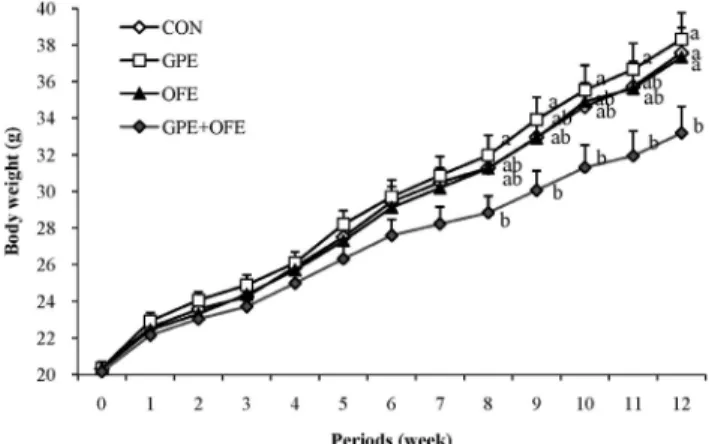
Fig. 1. Effects of supplementation with grape pomace and Omija fruit ethanol extracts for 12 weeks on changes in body weight in C57BL/6J mice fed a high-fat diet. Data are mean ± SE. Superscripts not sharing a common letter are significantly different among groups at P< 0.05. CON: high-fat diet (20% fat, w/w) control;
GPE: high-fat diet+grape pomace ethanol extract (0.5%, w/w); OFE: high-fat diet+Omija fruit ethanol extract (0.05%, w/w); GPE+OFE: high-fat diet+grape pomace ethanol extract (0.5%, w/w)+Omija fruit ethanol extract (0.05%, w/w).
ultracentrifuged twice at 100,000 x g for 60 min at 4°C to obtain the cytosolic supernatant. The mitochondrial and microsomal pellets were then dissolved in 800 μL of homogenization buffer and the protein content was determined using the Thermo Scientific Pierce BCA Protein Assay Kit.
Plasma and hepatic lipids
Plasma total cholesterol, triglyceride, and high-density lipop- rotein (HDL)-cholesterol concentrations were determined using commercially available kits (Asan, Seoul, Republic of Korea). The hepatic lipids were extracted using the procedure developed by Folch et al. [21]. The dried lipid residues were dissolved in 1 mL of ethanol for the cholesterol and triglyceride assays.
Triton X-100 and a sodium cholate solution in distilled water were added to 200 μL of the dissolved lipid solution to produce final concentrations of 5 g/L and 3 mmol/L, respectively. The hepatic cholesterol and triglyceride were analyzed using the same enzymatic kit used in the plasma analysis. Levels of plasma alanine aminotransferase (ALT) and aspartate aminotransferase (AST) were determined using enzymatic kits (Asan, Seoul, Republic of Korea).
Hepatic lipid-regulating enzyme activity
Malic enzyme (ME) activity was measured according to the method of Ochoa by monitoring the production of NADPH at 340 nm, where activity was represented by the formation of nicotinamide adenine dinucleotide phosphate (NADPH) nmol/
min/mg protein [22]. Glucose-6-phosphate dehydrogenase (G6PD) activity was assayed using spectrophotometric methods according to the procedures described by Pitkanen et al. where the activity was expressed as the reduced NADPH nmol/min/mg protein [23]. Fatty acid synthase (FAS) activity was determined using a spectrophotometric assay according to the method by Carl et al. [24]; one unit of FAS activity represented the oxidation of 1 nmol of NADPH per minute at 30°C. Phosphatidate phos- phohydrolase (PAP) activity was determined using the method of Walton and Possmayer [25]. The fatty acid β-oxidation was determined using the method of Lazarow by monitoring the reduction of NAD to NADH at 340 nm, where the activity was expressed as the reduced NAD nmol/min/mg protein [26].
Hepatic antioxidant enzyme activity and hydrogen peroxide content
The superoxide dismutase (SOD) activity was estimated according to the method of Marklund, which is based on the color change due to the auto-oxidation of pyrogallol [27]. The catalase (CAT) activity was measured using Aebi's method, in which the decrease of hydrogen peroxide was monitored spect- rophotometrically at 240 nm for 5 min using a spectrophoto- meter [28]. The glutathion peroxidase (GSH-Px) activity was measured using a spectrophotometric assay, as described previously by Paglia and Valentine with a slight modification [29]. The reaction mixture included 30 mmol glutathione, 6 mmol NADPH, and hydrogen peroxide (H
2O
2) in a 0.1 mol Tris-HCl (pH 7.2) buffer. The reaction was initiated by adding the enzyme source and the absorbance was measured at 340 nm for 5 min. The glutathione reductase (GR) activity was measured by monitoring the oxidation of NADPH at 340 nm
[30]. The H
2O
2levels in the liver were measured using Wolff’s method [31]. FOX 1 (ferrous oxidation) reagent was prepared from 0.25 mol H
2SO
4, 1 mol sorbitol, 2.5 mmol ammonium iron (II), and 1 mmol xylenol orange, and H
2O
2levels were deter- mined at 560 nm absorbance.
Statistical analysis
Data were expressed as the mean ± standard error of the mean. Significant differences among the groups were deter- mined using one-way analysis of variance (ANOVA) in SPSS (version 11.0, SPSS Inc., Chicago, IL, USA). Duncan’s multiple- range test was performed if differences were identified between the groups at P < 0.05.
RESULTS
Effect on body weight, body weight gain, food intake, and food efficiency ratio (FER)
The time courses for changes in body weights are shown in
Fig. 1. Compared with the control, neither GPE nor OFE alone
significantly altered body weight in high-fat diet-fed mice. The
GPE and OFE alone groups also showed no difference in body
weight gain and FER (Table 2). However, the body weight of
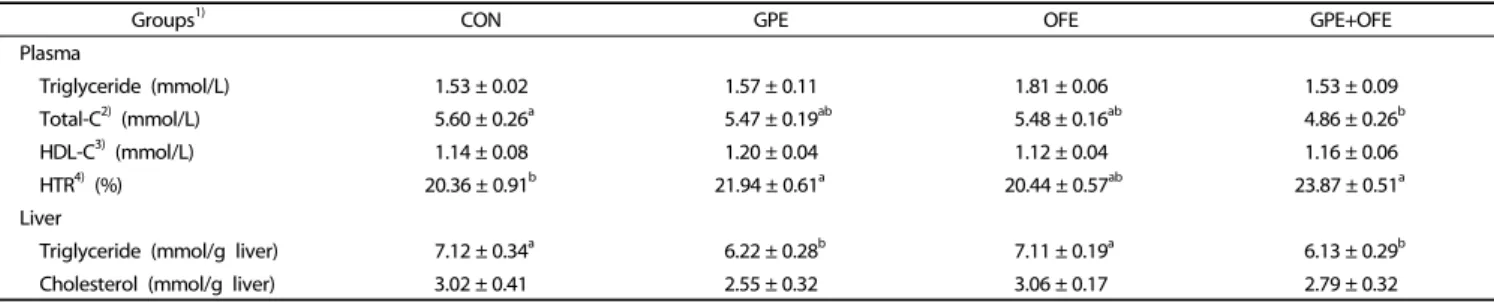
Groups1) CON GPE OFE GPE+OFE Plasma
Triglyceride (mmol/L) 1.53 ± 0.02 1.57 ± 0.11 1.81 ± 0.06 1.53 ± 0.09
Total-C2) (mmol/L) 5.60 ± 0.26a 5.47 ± 0.19ab 5.48 ± 0.16ab 4.86 ± 0.26b
HDL-C3) (mmol/L) 1.14 ± 0.08 1.20 ± 0.04 1.12 ± 0.04 1.16 ± 0.06
HTR4) (%) 20.36 ± 0.91b 21.94 ± 0.61a 20.44 ± 0.57ab 23.87 ± 0.51a
Liver
Triglyceride (mmol/g liver) 7.12 ± 0.34a 6.22 ± 0.28b 7.11 ± 0.19a 6.13 ± 0.29b
Cholesterol (mmol/g liver) 3.02 ± 0.41 2.55 ± 0.32 3.06 ± 0.17 2.79 ± 0.32
Data are mean ± SE.
Superscripts not sharing a common letter within the same row are significantly different among groups at P< 0.05.
1)CON: high-fat diet (20% fat, w/w) control; GPE: high-fat diet+grape pomace ethanol extract (0.5%, w/w); OFE: high-fat diet+Omija fruit ethanol extract (0.05%, w/w); GPE+OFE:
high-fat diet+grape pomace ethanol extract (0.5%, w/w)+Omija fruit ethanol extract (0.05%, w/w)
2)Total-C: total cholesterol
3)HDL-C: high-density lipoprotein cholesterol
4)HTR: HDL-C/Total-C ratio ([HDL-C]/[Total-C]×100)
Table 3. Effects of supplementation with grape pomace and Omija fruit ethanol extracts on plasma lipid profiles in C57BL/6J mice fed a high-fat diet 0
20 40 60 80 100 120 140 160 180
Epididymal WAT
Perirenal WAT
Retroperitoneal WAT
Mesenteric WAT
Subcutaneous WAT
Interscapular WAT
Total WAT
Fat weight (g/kg body weight)
CON GPE OFE GPE+OFE
a a b
a ab ab b a a a b
b abab a
a
Fig. 2. Effects of supplementation with grape pomace and Omija fruit ethanol extracts on white adipose tissue (WAT) weights in C57BL/6J mice fed a high-fat diet.
Data are mean ± SE. Superscripts not sharing a common letter are significantly different among groups at P< 0.05. CON: high-fat diet (20% fat, w/w) control; GPE: high-fat diet+grape pomace ethanol extract (0.5%, w/w); OFE: high-fat diet+Omija fruit ethanol extract (0.05%, w/w); GPE+OFE: high-fat diet+grape pomace ethanol extract (0.5%, w/w)+Omija fruit ethanol extract (0.05%, w/w).
Groups1) FAS2) ME3) G6PD4) PAP5) β-oxidation6)
nmol/min/mg protein
CON 11.31 ± 0.29a 119.01 ± 7.43a 22.80 ± 1.90a 36.52 ± 0.58a 33.07 ± 1.51b
GPE 9.91 ± 0.60b 92.37 ± 5.47b 17.07 ± 1.86b 32.32 ± 1.40b 47.24 ± 3.53a
OFE 11.21 ± 0.54ab 99.22 ± 6.95ab 18.69 ± 1.66ab 33.49 ± 1.27ab 40.40 ± 2.31ab
GPE+OFE 10.87 ± 0.23ab 95.77 ± 7.78b 21.73 ± 0.96ab 32.76 ± 1.21b 42.53 ± 1.82a
Data are mean ± SE.
Superscripts not sharing a common letter within the same column are significantly different among groups at P< 0.05.
1)CON: high-fat diet (20% fat, w/w) control; GPE: high-fat diet+grape pomace ethanol extract (0.5%, w/w); OFE: high-fat diet+Omija fruit ethanol extract (0.05%, w/w); GPE+OFE:
high-fat diet+grape pomace ethanol extract (0.5%, w/w)+Omija fruit ethanol extract (0.05%, w/w)
2)FAS: fatty acid synthase
3)ME: malic enzyme
4)G6PD: glucose-6-phosphate dehydrogenase
5)PAP: phosphatidate phosphohydrolase
6)Fatty acid β-oxidation
Table 4. Effects of supplementation with grape pomace and Omija fruit ethanol extracts on hepatic lipid-regulating enzyme activities in C57BL/6J mice fed a high-fat diet
the GPE+OFE group tended to be lower than that of the CON group between 8 and 11 weeks of the experimental period, and at 12 weeks, but final body weight was significantly lower in the GPE+OFE group than in the CON group (Fig. 1). Moreover, the GPE+OFE group showed significantly lower body weight gain than the CON group (Table 2). FER was significantly lower in the GPE+OFE group than in the control group, although food intake was not different between these 2 groups. Diet supple- mentation with OFE led to slightly lower food intake than that with GPE or GPE+OFE.
Effect on white adipose tissue weights
The weights of the WATs are shown in Fig. 2. Supplementa- tion with GPE or OFE alone only tended to reduce the perirenal WAT and total WAT weights from those seen in the CON group.
However, in the GPE+OFE group the weights of epididymal,
perirenal, retroperitoneal and total WATs were significantly
lower than those in the CON group. The mesenteric, subcutaneous,
and interscapular WAT weights were not significantly different
among groups.
0 2 4 6 8 10 12 14 16 18 20
CON GPE OFE GPE+OFE
SOD(unit/mg protein)
a
b ab ab
(A) (A)
0
1 2 3 4 5 6 7 8 9
CON GPE OFE GPE+OFE
CAT (μmol/min/mg protein)
a
c ab bc
(B) (B)
0 10 20 30 40 50 60 70
CON GPE OFE GPE+OFE
GSH-Px(nmol/min/mg protein) a
b b b
(C) (C)
0
50 100 150 200 250
CON GPE OFE GPE+OFE
GR(nmol/min/mg protein)
a
b
b b
(D) (D)
0 50 100 150 200 250 300
CON GPE OFE GPE+OFE
H2O2 (mmol/mgprotein) a
ab ab
b (E) (E)
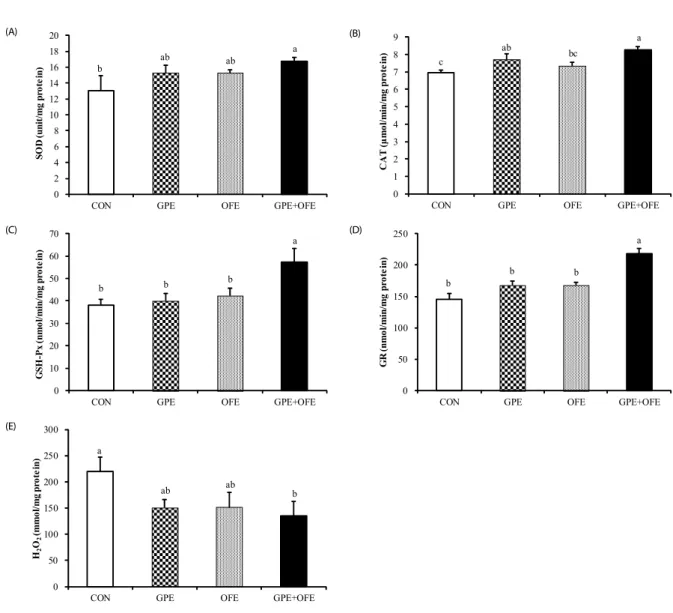
Fig. 3. Effects of supplementation with grape pomace and Omija fruit ethanol extracts on hepatic antioxidant enzyme activities and hydrogen peroxide content in C57BL/6J mice fed a high-fat diet. Data are mean ± SE. Superscripts not sharing a common letter are significantly different among groups at P< 0.05. CON: high-fat diet (20% fat, w/w) control; GPE: high-fat diet+grape pomace ethanol extract (0.5%, w/w); OFE: high-fat diet+Omija fruit ethanol extract (0.05%, w/w); GPE+OFE: high-fat diet+grape pomace ethanol extract (0.5%, w/w)+Omija fruit ethanol extract (0.05%, w/w). (A) SOD: superoxide dismutase, (B) CAT: catalase, (C) GSH-Px: glutathion peroxidase, (D) GR: glutathione reductase, (E) H2O2: hydrogen peroxide
Effect on plasma and hepatic lipid levels
As shown in Table 3, there was no significant difference in plasma triglyceride concentrations among groups. However, plasma total cholesterol concentration was significantly lower in the GPE+OFE group than in the CON group. Although plasma HDL-cholesterol levels were not significantly different among groups, the HDL-C/Total-C ratio (HTR) was significantly higher in the GPE alone and GPE+OFE groups than in the CON group.
Hepatic triglyceride levels were also significantly lower in the GPE alone and GPE+OFE groups than in the CON group, but there were no significant differences in hepatic total cholesterol levels among the groups.
Effect on lipid-regulating enzyme activities in the liver
The activities of lipogenic enzymes and β-oxidation in the liver are shown Table 4. The GPE group showed significantly lower activities of hepatic lipogenic enzymes, including ME,
G6PD, FAS and PAP, than the CON group. The hepatic ME and PAP activities were significantly lower in the GPE+OFE group than in the CON group. In contrast to the lipogenic enzyme activities, fatty acid β-oxidation was significantly higher in the GPE alone and GPE+OFE groups than in the CON group. The OFE group exhibited no significant differences in lipid-regula- ting enzyme activities.
Effect on antioxidant enzyme activities and hydrogen peroxide content in the liver
When examining the antioxidant enzyme activities, hepatic
SOD, CAT, GSH-Px, and GR activities were significantly higher
in the GPE+OFE group than in the CON group (Fig. 3). Compared
to the control group, the group with GPE supplementation also
showed significantly increased hepatic CAT activity and tended
to have increased hepatic SOD activity. The hepatic SOD and
CAT activities observed in the OFE group tended to be higher
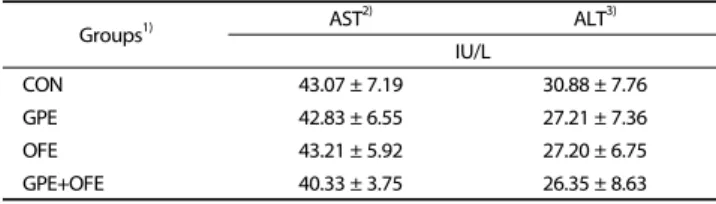
Groups1) AST2) ALT3) IU/L
CON 43.07 ± 7.19 30.88 ± 7.76
GPE 42.83 ± 6.55 27.21 ± 7.36
OFE 43.21 ± 5.92 27.20 ± 6.75
GPE+OFE 40.33 ± 3.75 26.35 ± 8.63
Data are mean ± SE.
1)CON: high-fat diet (20% fat, w/w) control; GPE: high-fat diet+grape pomace ethanol extract (0.5%, w/w); OFE: high-fat diet+Omija fruit ethanol extract (0.05%, w/w); GPE+OFE: high-fat diet+grape pomace ethanol extract (0.5%, w/w)+Omija fruit ethanol extract (0.05%, w/w)
2)AST: aspartate aminotransferase
3)ALT: alanine aminotransferase
Table 5. Effects of supplementation with grape pomace and Omija fruit ethanol extracts on plasma aminotransferase activities in C57BL/6J mice fed a high-fat diet
than those of the CON group, but these differences were not statistically significant. The hepatic mitochondrial hydrogen peroxide content was the lowest in the GPE+OFE group.
Effect on plasma aminotransferase activities
The AST and ALT activities in plasma are shown in Table 5.
There were no significant differences in plasma AST and ALT activities among groups.
DISCUSSION
Our study was carried out to clarify whether a plant mixture containing grape pomace and Omija fruit ethanol extracts synergistically affects lipid and antioxidant metabolism in diet- induced obese mice. Compared with the control, supplemen- tation with GPE+OFE significantly decreased body weight, body weight gain, body fat accumulation, and FER in mice fed a high-fat diet, although supplementation with GPE or OFE alone did not influence these parameters. Similarly, previous studies reported no significant effects of GPE on body weight gain and fat mass in high-fat diet-induced obese mice or fructose-fed obese rats [18,32,33], but GPE+OFE supplementation signifi- cantly lowered body weight gain in high-fat diet-fed mice [18].
On the other hand, in contrast to our results, Park et al.
demonstrated that supplementation with OFE (50 mg/kg body weight and 200 mg/kg body weight) for 6 weeks decreased body weight in a dose-dependent manner in high-fat diet-fed rats, which may be due to higher doses of OFE and different animal models [16].
Adipose tissue is not simply an energy storage organ but it also regulates lipid metabolism locally as well as at distant sites such as the liver, muscle, and brain [34]. Obesity is associated with an increased risk of dyslipidemia and nonalcoholic fatty liver disease [35,36]. In the present study, we found that compared with the control, supplementation with GPE+OFE led to significant reductions in the levels of plasma total cholesterol and hepatic triglyceride and a marked increase in the plasma HTR, a good predictor of cardiovascular risk [37]. Compared with the control, GPE supplementation also significantly increased the plasma HTR and markedly decreased hepatic triglyceride content, whereas OFE supplementation did not alter plasma and hepatic lipid profiles. Consistent with the decreased hepatic triglyceride content, GPE with or without OFE, significantly
decreased the activities of hepatic fatty acid synthesis-related enzymes (FAS, G6PD, and/or ME) from those seen in the CON group. FAS catalyzes the reductive synthesis of long-chain fatty acids, and its inhibition reduced food intake and body weight in mice [38]. Cellular NADPH, which is required for the biosyn- thesis of fatty acids and cholesterol, can be produced by enzymatic reaction of ME and G6PD. A previous study observed that the enzyme activity and expression levels of G6PD were significantly elevated in obese mice models [39]. In our previous study in which Muscat Bailey A was used instead of the Campbell Early grape variety, the mRNA expression of hepatic lipogenic genes (FAS, acetyl-CoA carboxylase, or ME) and their transcription factor (PPAR γ) was significantly down-regulated by a mixture of GPE and OFE extracts [18]. In the present study, we also found that the activity of PAP, a central enzyme in the synthesis of triglycerides, was significantly lower in the GPE and GPE+OFE groups than in the CON group, and hepatic fatty acid β-oxidation was higher in the GPE and GPE+OFE groups than in the CON group, which supports the finding of lower hepatic triglyceride content.
A study by Furukawa et al. reported fat accumulation correlated with oxidative stress in obese mice [40]. Oxidative stress contributes to tissue injury by reactive oxygen species (ROS) attack, and tissues are protected from ROS damage by antioxidant enzymes [41]. Among the antioxidant enzymes, SOD catalyzes the dismutation of the superoxide anion to hydrogen peroxide, and CAT and GSH-Px can break down hydrogen peroxide. GSH-Px also oxidizes glutathione to glutathione disulfide (GSSG). The reduction of GSSG to GSH can be catalyzed by GR again. In the present study, hepatic SOD, CAT, GSH-Px, and GR activities were significantly higher in the GPE+OFE group than in the CON group, whereas hepatic H
2O
2content was lower.
It is well known that GPE contains substantial amounts of
antioxidant phenolic compounds, in particular anthocyanins,
catechin, epicatechin, and several phenolic acids [10]. In rats
fed a high-fat diet, grape skin supplementation was effective
in protecting against oxidative damage caused by lipid peroxi-
dation [42]. Phenolic compounds from Omija dose-dependently
promote antioxidant activities such as electron donating ability,
SOD-like ability, hydroxyl radical scavenging ability, and nitrite
scavenging ability in vitro [43]. In the present study, the
beneficial effects on hepatic antioxidant capacity as well as
adiposity were greater with the GPE+OFE mixture than with
GPE or OFE alone. This suggests a synergistic effect of the
bioactive phytochemical compounds in grape pomace and
Omija. Anthocyanins from grape and Omija improved obesity
induced by high-fat feeding [44]. Resveratrol present in grapes
is also effective for protecting against diet-induced obesity in
vivo [45,46]. Thus, phytochemical combinations have greater
additive and synergistic effects on health benefits than single
preparations [5]. It is supposed that some flavonoids and
polyphenols in GPE+OFE may have synergistic effects via their
interaction, although we did not determine it in the present
study. This hypothesis is supported by a previous our study
in which the effects of GPE+OFE were compared with those
of resveratrol and schizandrin mixture (RS), which is a mixture
of the major index components of GPE+OFE [47]. GPE+OFE have
more protective effect on hyperglycemia, adiposity and hepatic
steatosis in type 2 diabetic mice than RS [47]. Another possibility is that other unknown active components present in extracts of GPE+OFE also play important in their biological effects. To confirm the safety of the experimental supplements in the liver, AST and ALT were measured in plasma, because increased AST and ALT activities have been observed in liver injury [48]. The ethanol extracts used did not exhibit hepatic toxicity.
In conclusion, supplementation with a GPE+OFE mixture, in which the Campbell Early grape variety was used, improves adiposity, lipid metabolism, and antioxidant capacity in high-fat diet-fed mice by suppressing hepatic lipogenic enzyme activities and simultaneously increasing hepatic antioxidant enzyme activities. The anti-adiposity and antioxidant effects of GPE+OFE supplementation appeared to be more potent than that of GPE and OFE alone. These results suggest that GPE+OFE is more beneficial for the prevention of obesity than GPE or OFE alone.
REFERENCES
1. Kopelman PG. Obesity as a medical problem. Nature 2000;404:
635-43.
2. Fabbrini E, Sullivan S, Klein S. Obesity and nonalcoholic fatty liver disease: biochemical, metabolic, and clinical implications. Hepatology 2010;51:679-89.
3. Bray GA, Tartaglia LA. Medicinal strategies in the treatment of obesity. Nature 2000;404:672-7.
4. Yun JW. Possible anti-obesity therapeutics from nature--a review.
Phytochemistry 2010;71:1625-41.
5. Liu RH. Health benefits of fruit and vegetables are from additive and synergistic combinations of phytochemicals. Am J Clin Nutr 2003;78:517S-520S.
6. Kota SK, Jammula S, Kota SK, Satya Krishna SV, Meher LK, Rao ES, Modi KD. Nutraceuticals in pathogenic obesity; striking the right balance between energy imbalance and inflammation. J Med Nutr Nutraceuticals 2012;1:63-76.
7. Gehm BD, McAndrews JM, Chien PY, Jameson JL. Resveratrol, a polyphenolic compound found in grapes and wine, is an agonist for the estrogen receptor. Proc Natl Acad Sci USA 1997;94:
14138-43.
8. Pastrana-Bonilla E, Akoh CC, Sellappan S, Krewer G. Phenolic content and antioxidant capacity of muscadine grapes. J Agric Food Chem 2003;51:5497-503.
9. Makris DP, Boskou G, Andrikopoulos NK, Kefalas P. Characterisation of certain major polyphenolic antioxidants in grape (Vitis vinifera cv. Roditis) stems by liquid chromatography-mass spectrometry. Eur Food Res Technol 2008;226:1075-9.
10. Hogan S, Canning C, Sun S, Sun X, Zhou K. Effects of grape pomace antioxidant extract on oxidative stress and inflammation in diet induced obese mice. J Agric Food Chem 2010;58:11250-6.
11. Saunders RM. Monograph of Kadsura (Schisandraceae). Syst Bot Monogr 1998;54:1-106.
12. Lin Q, Duan L, Yao B. Notes on three species of the genus Kadsura Juss. (Schisandraceae). Acta Phytotaxonomica Sinica 2005;43:567- 70.
13. Zhang CL, He XL. Advances in research on Schisandra chinesis (Turcz.) Baill. J Baoding Teach Coll 2005;17:36-9.
14. Kim SH, Joo MH, Yoo SH. Structural identification and antioxidant properties of major anthocyanin extracted from Omija (Schizandra
chinensis) fruit. J Food Sci 2009;74:C134-40.
15. Guo LY, Hung TM, Bae KH, Shin EM, Zhou HY, Hong YN, Kang SS, Kim HP, Kim YS. Anti-inflammatory effects of schisandrin isolated from the fruit of Schisandra chinensis Baill. Eur J Pharmacol 2008;591:293-9.
16. Park HJ, Cho JY, Kim MK, Koh PO, Cho KW, Kim CH, Lee KS, Chung BY, Kim GS, Cho JH. Anti-obesity effect of Schisandra chinensis in 3T3-L1 cells and high fat diet-induced obese rats. Food Chem 2012;134:227-34.
17. Choi SY, Lee Y, Lee P, Kim KT. Comparison of the antioxidative effects and content of anthocyanin and phenolic compounds in different varieties of Vitis vinifera ethanol extract. J Food Sci Nutr 2011;16:24-8.
18. Cho SJ, Jung UJ, Park HJ, Kim HJ, Park YB, Kim SR, Choi MS.
Combined ethanol extract of grape pomace and omija fruit amelio- rates adipogenesis, hepatic steatosis, and inflammation in diet- induced obese mice. Evid Based Complement Alternat Med 2013;
2013:212139.
19. Cho SJ, Jung UJ, Choi MS. Differential effects of low-dose resveratrol on adiposity and hepatic steatosis in diet-induced obese mice. Br J Nutr 2012;108:2166-75.
20. Hulcher FH, Oleson WH. Simplified spectrophotometric assay for microsomal 3-hydroxy-3-methylglutaryl CoA reductase by measure- ment of coenzyme A. J Lipid Res 1973;14:625-31.
21. Folch J, Lees M, Sloane Stanley GH. A simple method for the isolation and purification of total lipides from animal tissues. J Biol Chem 1957;226:497-509.
22. Ochoa S. Malic enzyme: malic enzymes from pigeon and wheat germ. Methods Enzymol 1995;1:323-6.
23. Pitkänen E, Pitkänen O, Uotila L. Enzymatic determination of unbound D-mannose in serum. Eur J Clin Chem Clin Biochem 1997;35:761-6.
24. Nepokroeff CM, Lakshmanan MR, Porter JW. Fatty-acid synthase from rat liver. Methods Enzymol 1975;35:37-44.
25. Walton PA, Possmayer F. Mg2-dependent phosphatidate phospho- hydrolase of rat lung: development of an assay employing a defined chemical substrate which reflects the phosphohydrolase activity measured using membrane-bound substrate. Anal Biochem 1985;
151:479-86.
26. Lazarow PB. Assay of peroxisomal β-oxidation of fatty acids.
Methods Enzymol 1981;72:315-9.
27. Marklund S, Marklund G. Involvement of the superoxide anion radical in the autoxidation of pyrogallol and a convenient assay for superoxide dismutase. Eur J Biochem 1974;47:469-74.
28. Aebi H. Catalase. In: Bergmeyer HU, Gawehn K, editors. Methods of Enzymatic Analysis. 2nd ed. Weinheim: Academic Press; 1974.
p.673-84.
29. Paglia DE, Valentine WN. Studies on the quantitative and qualitative characterization of erythrocyte glutathione peroxidase. J Lab Clin Med 1967;70:158-69.
30. Pinto RE, Bartley W. The effect of age and sex on glutathione reductase and glutathione peroxidase activities and on aerobic glutathione oxidation in rat liver homogenates. Biochem J 1969;112:
109-15.
31. Wolff SP. Ferrous ion oxidation in presence of ferric ion indicator xylenol orange for measurement of hydroperoxides. Methods Enzymol 1994;233:182-9.
32. Yunoki K, Sasaki G, Tokuji Y, Kinoshita M, Naito A, Aida K, Ohnishi
M. Effect of dietary wine pomace extract and oleanolic acid on plasma lipids in rats fed high-fat diet and its DNA microarray analysis. J Agric Food Chem 2008;56:12052-8.
33. Khanal RC, Howard LR, Rogers TJ, Wilkes SE, Dhakal IB, Prior RL.
Effect of feeding grape pomace on selected metabolic parameters associated with high fructose feeding in growing Sprague-Dawley rats. J Med Food 2011;14:1562-9.
34. Samra JS. Sir David Cuthbertson Medal Lecture. Regulation of lipid metabolism in adipose tissue. Proc Nutr Soc 2000;59:441-6.
35. Wanless IR, Lentz JS. Fatty liver hepatitis (steatohepatitis) and obesity:
an autopsy study with analysis of risk factors. Hepatology 1990;12:
1106-10.
36. Brown CD, Higgins M, Donato KA, Rohde FC, Garrison R, Obarzanek E, Ernst ND, Horan M. Body mass index and the prevalence of hypertension and dyslipidemia. Obes Res 2000;8:605-19.
37. Lu W, Resnick HE, Jablonski KA, Jones KL, Jain AK, Howard WJ, Robbins DC, Howard BV. Non-HDL cholesterol as a predictor of cardiovascular disease in type 2 diabetes: the strong heart study.
Diabetes Care 2003;26:16-23.
38. Loftus TM, Jaworsky DE, Frehywot GL, Townsend CA, Ronnett GV, Lane MD, Kuhajda FP. Reduced food intake and body weight in mice treated with fatty acid synthase inhibitors. Science 2000;288:
2379-81.
39. Park J, Rho HK, Kim KH, Choe SS, Lee YS, Kim JB. Overexpression of glucose-6-phosphate dehydrogenase is associated with lipid dysregulation and insulin resistance in obesity. Mol Cell Biol 2005;
25:5146-57.
40. Furukawa S, Fujita T, Shimabukuro M, Iwaki M, Yamada Y, Nakajima
Y, Nakayama O, Makishima M, Matsuda M, Shimomura I. Increased oxidative stress in obesity and its impact on metabolic syndrome.
J Clin Invest 2004;114:1752-61.
41. Betteridge DJ. What is oxidative stress? Metabolism 2000;49:3-8.
42. Lee SJ, Choi SK, Seo JS. Grape skin improves antioxidant capacity in rats fed a high fat diet. Nutr Res Pract 2009;3:279-85.
43. Kim JS, Choi SY. Physicochemical properties and antioxidative activities of omija (Schizandra chinensis Bailon). Korean J Food Nutr 2008;21:35-42.
44. Tsuda T. Regulation of adipocyte function by anthocyanins; possi- bility of preventing the metabolic syndrome. J Agric Food Chem 2008;56:642-6.
45. Lagouge M, Argmann C, Gerhart-Hines Z, Meziane H, Lerin C, Daussin F, Messadeq N, Milne J, Lambert P, Elliott P, Geny B, Laakso M, Puigserver P, Auwerx J. Resveratrol improves mitochondrial function and protects against metabolic disease by activating SIRT1 and PGC-1α. Cell 2006;127:1109-22.
46. Kim S, Jin Y, Choi Y, Park T. Resveratrol exerts anti-obesity effects via mechanisms involving down-regulation of adipogenic and inflammatory processes in mice. Biochem Pharmacol 2011;81:
1343-51.
47. Cho SJ, Park HJ, Jung UJ, Kim HJ, Moon BS, Choi MS. The beneficial effects of combined grape pomace and omija fruit extracts on hyperglycemia, adiposity and hepatic steatosis in db/db mice: a comparison with major index compounds. Int J Mol Sci 2014;15:
17778-89.
48. Drotman RB, Lawhorn GT. Serum enzymes as indicators of chemically induced liver damage. Drug Chem Toxicol 1978;1:163-71.