pISSN 1229-3008 eISSN 2287-6251
Progress in Superconductivity and Cryogenics
Vol.21, No.3, (2019), pp.18~21 https://doi.org/10.9714/psac.2019.21.3.018
```
1. INTRODUCTION
Early research found that defect plays a crucial role in the performance of superconducting properties. The effects of defect concentration on superconductivity have been widely investigated using various methods (e.g. doping and irradiation). In case of MgB2 thin film, Carbon (C) doping is one of the most effective ways, and C-doped MgB2 thin films with an excellent performance of Hc2 have been reported [1]. Various kinds of irradiation were also carried out on MgB2 thin films to study the change of Hc2. The obtained results significantly depended on MgB2 samples and also the particles using for irradiation [2]. However, the typical irradiation energy is usually up to order of MeV in all study. In this study, we investigated the effect of low energy Fe ion irradiation on single-crystalline MgB2 thin films. The perfect quality of pristine MgB2 film is a prerequisite for variation of defect concentrations on samples. Despite low irradiation energy of 140 keV, Hc2
shows a significant increase with the increasing irradiation doses. These results imply an effective method to develop the performance of superconducting properties in MgB2.
2. EXPERIMENTAL
The 410 nm Single-crystalline MgB2 thin films were fabricated by a hybrid physical-chemical vapour deposition (HPCVD) system, which is known to be one of the best methods to deposit high-quality MgB2 thin films.
The detailed fabrication process of the HPCVD system has been described elsewhere [3]. The susceptor-contained Mg pieces and we heated Al2O3 (000l) (10 mm × 10 mm) to
700 °C in 200 Torr of 100 sccm H2 gas flow rate. Then, B2H6 (5% in H2) gas was flowed into quartz tube chamber to start deposition of MgB2 thin films. Finally, we cooled these MgB2 films to room temperature in H2 carrier gas. A clean environment and pure sources of Mg and B are essential for the growth of high-quality MgB2 thin films.
We confirmed the high-quality of the thin films in our previous study [4]. We carried out the Fe irradiation process in Korea Multi-purpose Accelerator Complex (KOMAC). The fixed energy at 140 keV with various doses of 11014, 21014 and 41014 ions/cm2 were used to induce the different defects density and consequently the flux pinning strength on the films. The mean projected ranges (δ) of Fe ions were estimated using the Monte Carlo simulation program SRIM [5]. We investigated crystal structure and epitaxial growth of MgB2 thin films by X-ray diffraction (XRD). The electrical transport was measured using a physical property measurement system (PPMS 9T, Quantum Design).
3. RESULTS AND DISCUSSIONS
Figure 1 shows the temperature-dependent resistivity (R-T curve) of 410 nm thick single-crystalline MgB2 thin film. The low residual resistivity (defined as the resistivity value just above Tc) (ρ0 = 1.2 μΩ cm ) indicates high purity of the film with long electron mean free path (l) [2]. High critical temperature (T(c,onset) = 39.5 K) and very sharp superconducting transition (ΔTc = 0.5 K) reflecting the film has a clean and homogenous phase [6]. The top-inset of figure 1 shows the cross-sectional image was observed with a scanning electron microscope (SEM), which is very dense without any grain boundaries. The bottom-inset shows the
Enhanced upper critical fields in low energy iron-irradiated single- crystalline MgB
2thin films
Duong Phama, Soon-Gil Jungb, Duc H. Tranc, Tuson Parkb, and Won Nam Kanga,*
a Department of Physic, Sungkyunkwan University, Suwon 16419, Republic of Korea.
b Center for Quantum Materials and Superconductivity (CQMS) and Department of Physics, Sungkyunkwan University, Suwon 16419, Republic of Korea.
c Faculty of Physics, VNU-University of Science, Ha Noi, Viet Nam.
(Received 9 September 2019; revised or reviewed 26 September 2019; accepted 27 September 2019)
Abstract
We studied the effect of Fe ion irradiation on the upper critical field (Hc2) of 410 nm single-crystalline MgB2 thin films. The irradiation energy was fixed at 140 keV when we increased the irradiation doses from 1×10¹⁴ ion/cm2 to 4×10¹⁴ ion/cm2. We found that Hc2 significantly increase with increasing irradiation dose, despite the low irradiation energy. The enhancement of Hc2 could be explained by the reduction of electron mean free path caused by defects induced from irradiation, leading to a decrease of coherence length (ξ). We also discussed the effect of irradiation on temperature-dependent resistivity in details.
Keywords: MgB2, Fe ion irradiation, upper critical field
* Corresponding author: [email protected]
Duong Pham, Soon-Gil Jung, Duc H. Tran, Tuson Park, and Won Nam Kang
X-ray diffraction (XRD) pattern of MgB2 thin film. The high c-axis orientation without any impurity peaks and the narrow full-width at half-maximum (FWHM (0002) ~ 0.15o) reflects a clean film with good crystallinity [7].
More details about the study of single-crystalline quality MgB2 thin films can be found in our previous report [4].
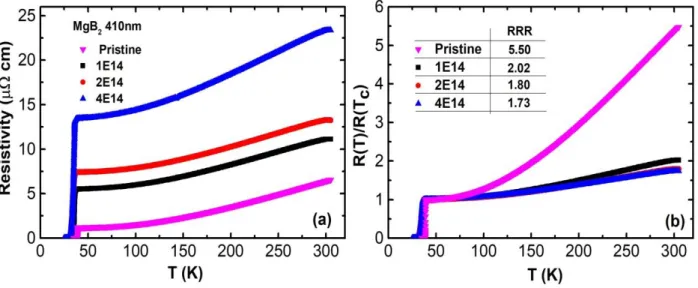
Figure 2 (a) shows the comparatively R-T curves of pristine and Fe ion irradiated MgB2 films. The resistivity increases at all temperatures, when the Tc decreases systematically from 39.5 K in pristine film to 36.9 K in largest dose irradiated-film. Figure 2 (b) shows the residual resistivity ratio (RRR = ρ300K/ρ0) of the films before and after Fe irradiations. RRR values were systematically decreased from 5.5 in pristine film to 1.73 in 4×10¹⁴ ion/cm2 irradiated film. This is widespread behavior of MgB2 observed under the various kinds of irradiation [2, 8].
Fig. 1. The temperature-dependent resistivity (R-T curve) of 410 nm pristine single-crystalline MgB2 thin film. The top-inset shows the cross-sectional SEM image of MgB2
thin film when the bottom-inset shows its XRD pattern.
We widely accepted within the two-gap model for MgB2 that active suppression of Tc to 11 K mainly comes from the interband impurity scattering. On the other hand, below 11 K when the two-gap merged to a single-gap, the intraband scattering plays a central role in determining of Tc [2, 9]. Therefore, with the irradiation level in this study, the reduction of Tc is mainly caused by irradiation-induced the interband scattering. The significant increase of ρ0 indicating defects caused by Fe irradiation increases the scattering rate and consequently, reducing the electron mean free path [7-9]. Interestingly, despite the significant change of Tc and ρ0, the value Δρ
= ρ300K - ρ0 shows a small change. In principle, Δρ is mostly due to phonon scattering; this result implies that the Fe irradiation increased the intragrain scattering without reducing the connected cross-section [2]. We will discuss details about the role of Fe ions in inducing defects below.
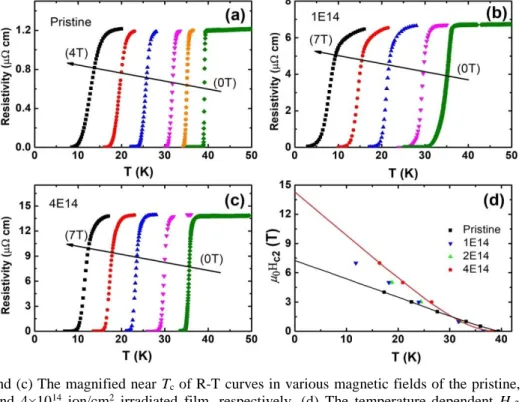
Figure 3 (a), (b) and (c) show the R-T curves in various fields of pristine, 1×10¹⁴ ion/cm2 irradiated film and 4×10¹⁴ ion/cm2 irradiated film, respectively. Figure 3 (d) shows the comparatively upper critical fields (Hc2) for all samples. The Hc2 values were determined from T(c,onset)
of R-T curves in fields. The solid lines are extrapolated function for pristine and 4×10¹⁴ ion/cm2 irradiated film.
Increasing irradiation level significantly increased the Hc2 and obtained highest value at dose of 4×10¹⁴ ion/cm2. The enhancement of Hc2 in this study is smaller than that of other irradiation methods on MgB2 such as neutrons, α-particles and so on [2]. However, irradiation energy in this study is minimal compared to typically irradiation energy (usually up to order of MeV). In a type-II superconductor, Hc2 is a thermodynamic property which we can calculate using: Hc2 = Φ0 / (2πξ2), where Φ0 is superconducting magnetic flux quantisation and ξ is coherence length [11]. The Fe ion irradiation-induced the defects in films, which reduce the electron mean free path and consequently, the coherence length, producing an increase in Hc2 [2, 8].
Fig. 2. (a) R-T curves of MgB2 thin films before and after multiple doses of irradiation. (b) R-T curves normalised at Tc
for comparison of residual resistivity ratio (RRR).
19
Enhanced upper critical fields in low energy iron-irradiated single-crystalline MgB2 thin films
Lastly, we are going to discuss the role of Fe ion irradiation in inducing defects on films. When the Fe ion penetrates the film, it leaves a track from sample’s surface and collides with atom in film to produce the displacement.
This process can be observed using the transport of ion in matter (TRIM) program [5]. The defects induced by Fe including ion track, point defect (Fe ion) and displacements.
Figure 4 shows distribution of displacements in irradiated films using (TRIM). At fixed energy of 140 keV, one Fe ion can induce around 1.4 displacements at average depth.
Therefore, the total displacements will increase systematically with the increasing irradiation dose. This ensures a precise change of defects concentration on samples. However, the increasing of Hc2 is monotonical with irradiation dose, since it also depends on other factors like superconducting band structure and pairing interaction.
The details about the study on the effect of irradiation on Hc2 can be found in [2, 8].
4. CONCLUISION
In conclusion, we have substantially enhanced the Hc2 in single-crystalline in MgB2 thin films by Fe ion irradiation at low energy of 140 keV and various doses. The defects induced by Fe ion irradiation (including ion tracks, point defects and displacements) reduce the electron mean free path in the film, leading to an increase of Hc2. We can expect a better performance of Hc2, which could be obtained at higher irradiation energy since it provides a higher ion mean projected ranges into samples and decreases the electron mean free path.
Fig. 4. The displacements induced by Fe ion irradiation in MgB2. The data estimated using the TRIM program.
ACKNOWLEDGMENT
We wish to acknowledge the outstanding support of the accelerator group and operators of the Korea Multi- purpose Accelerator Complex (KOMAC), KAERI. the National Research Foundation (NRF) of Korea by a grant funded by the Basic Science Research Program through the National Research Foundation of Korea (NRF) funded by the Ministry of Education (NRF-2016R1D1A1B03934513) supported this work.
Fig. 3. (a), (b) and (c) The magnified near Tc of R-T curves in various magnetic fields of the pristine, 1×10¹⁴ ion/cm2 irradiated film and 4×10¹⁴ ion/cm2 irradiated film, respectively. (d) The temperature-dependent Hc2 of pristine and irradiated samples.
20
Duong Pham, Soon-Gil Jung, Duc H. Tran, Tuson Park, and Won Nam Kang
REFERENCES
[1] W. Dai, et al., “High-field properties of carbon-doped MgB2 thin films by hybrid physical-chemical vapor deposition using different carbon sources”, Supercond. Sci. Technol., vol. 24, pp. 125014- 125026, 2011.
[2] M. Putti, R. Vaglio, and J. M. Rowell, “Radiation effects on MgB2: a review and a comparison with A15 superconductors”, Supercond.
Sci. Technol., vol. 21, pp. 043001-043026, 2008.
[3] M. Ranot, P. V. Duong, A. Bhardwaj, and W. N. Kang, “A review on the understanding and fabrication advancement of MgB2 thin and thick films by HPCVD”, Prog. Supercond. Cryo., vol. 17, pp. 1-17, 2015.
[4] D. Pham, S. -G. Jung, D. H. Tran, T. Park, and W. N. Kang, “Effects of oxygen ion implantation on single-crystalline MgB2 thin films”, J. Appl. Phys., vol. 125, pp. 023904, 2019.
[5] J. F. Ziegler, “SRIM-2003”, Nucl. Instrum. Methods Phys. Res. B, vol. 219-220, pp. 1027, 2004.
[6] W. K. Seong, S. J. Oh, and W. N. Kang, “Perfect Domain-Lattice Matching between MgB2 and Al2O3: Single-crystal MgB2 thin films grown on Sapphire”, Jap. J. Appl. Phys., vol. 51, pp. 083101, 2012.
[7] D. Pham, S.-G. Jung, K. J. Song, M. Ranot, J. H. Lee, N. H. Lee, and W. N. Kang, “Effect of vortex-vortex interactions on the critical current density of single-crystalline MgB2 thin films”, Cur. Appl.
Phys., vol. 16, pp. 1046-1051, 2016.
[8] S.-G. Jung, S. K. Son, D. Pham, W. C. Lim, J. H. Song, W. N. Kang, and T. Park, “Influence of carbon-ion irradiations on the superconducting critical properties of MgB2 thin films”, Supercond.
Sci. Technol., vol. 32, pp. 025006-025017, 2019.
[9] S.-G. Jung, S. K. Son, D. Pham, W. N. Kang, W. C. Lim, J. H. Song, and T. Park, “Enhanced Critical Current Density in the Carbon-ion irradiated MgB2 thin films”, J. Phys. Soc. Jpn., vol. 88, pp. 034716, 2019.
[10] D. Pham, H. V. Ngoc, S. -G. Jung, D. J. Kang, and W. N. Kang,
“Enhanced critical current density of MgB2 thin films deposited at low temperatures by ZnO seed impurity”, Cur. Appl. Phys., vol. 18, pp. 762-766, 2018.
[11] G. Blatter, M. V. Feigel’man, V. B. Geshkenbein, A. I. Larkin, and V. M. Vinokur, “Vortices in high-temperature superconductors”, Rev. Mod. Phys., vol. 66, pp. 1125, 1994.
21