J Vet Sci 2018, 19(1), 107-115ㆍhttps://doi.org/10.4142/jvs.2018.19.1.107 JVS
Received 7 Feb. 2017, Revised 4 Apr. 2017, Accepted 5 May 2017
*Corresponding author: Tel: +86-27-87286251; E-mail: [email protected]
†
Present address: University College of Veterinary and Animal Sciences, The Islamia University of Bahawalpur 63100, Pakistan
Journal of Veterinary Scienceㆍⓒ 2018 The Korean Society of Veterinary Science. All Rights Reserved.
This is an Open Access article distributed under the terms of the Creative Commons Attribution Non-Commercial License (http://creativecommons.org/licenses/
pISSN 1229-845X eISSN 1976-555X
Tibial dyschondroplasia is closely related to suppression of expression of hypoxia-inducible factors 1 α, 2α, and 3α in chickens
Shucheng Huang
1, Mujeeb U. Rehman
1, Gang Qiu
1,2, Houqiang Luo
1,3, Muhammad K. Iqbal
1, Hui Zhang
1, Khalid Mehmood
1,†, Jiakui Li
1,2,*
1
College of Veterinary Medicine, Huazhong Agricultural University, Wuhan 430070, China
2
Laboratory of Detection and Monitoring of Highland Animal Disease, Tibet Agriculture and Animal Husbandry College, Linzhi 860000, Tibet, China
3
Animal Science Department, Wenzhou Vocational College of Science and Technology, Wenzhou 325006, China
Tibial dyschondroplasia (TD) cases has not been reported in Tibetan chickens (TBCs), but it is commonly seen in commercial broilers characterized by lameness. The underlying mechanism remains unclear. Hypoxia-inducible factors (HIFs) are important regulators of cellular adaptation to hypoxic conditions. In this study, we investigated the role of HIF-1α, -2α, and -3α in hypoxia and thiram-induced TD and their effect on tibial growth plate development in Arbor Acres chickens (AACs) and TBCs. RNA and protein expression levels of HIF-1α, -2α, and -3α were determined by using quantitative reverse transcriptase polymerase chain reaction and western blotting analyses, respectively.
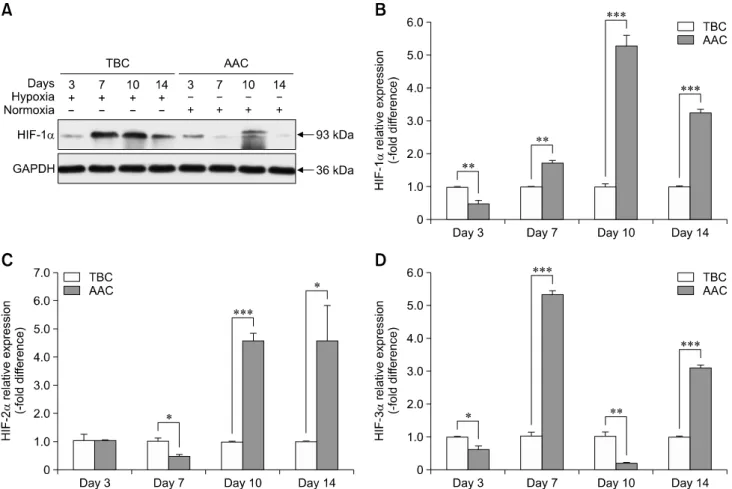
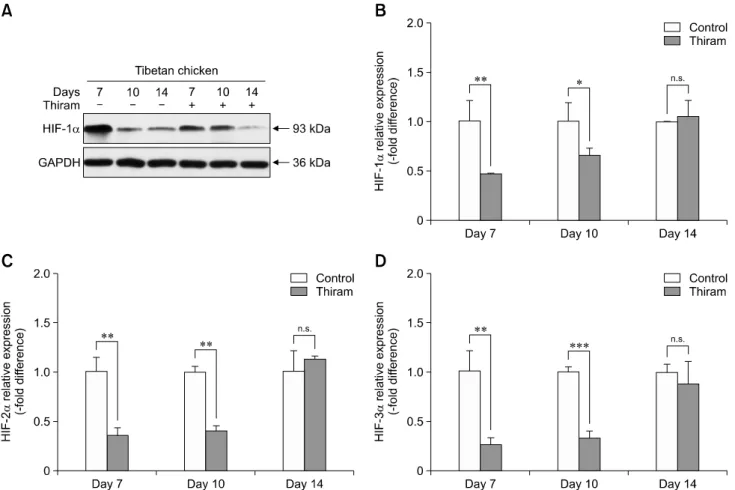
Interestingly, the results showed that HIF-1α, -2α, and -3α expressions in the tibial growth plate of TBCs were upregulated by hypoxia and the change was more significant in TBCs than in AACs. However, these factors were downregulated in thiram-induced TD. To further clarify the effect of thiram on tibial growth plate in commercial broilers, AACs were observed to exhibit more pronounced changes in their growth plate that that in TBCs. Taken together, these results demonstrate that HIF-1α, -2α, and -3α may be important in tibial growth plate development and in the prevention of TD. The present study contributes novel insights on a therapeutic target for poultry TD.
Keywords: Tibetan chickens, growth plate, high altitude, hypoxia-inducible factors-1α, tibial dyschondroplasia
Introduction
Tibial dyschondroplasia (TD) is a particularly common leg problem worldwide with unknown natural etiology in commercial broilers and is characterized by abnormal proximal tibial bone formation and avascular cartilage [5,16,18]. The avascular and noncalcified cartilage leads to an apparent locomotion problem, and there is a prevalence of approximately 30% (and rising) in broiler flocks [15,18]. In general, precise prevalence estimates of TD are not readily accessible due to its mostly sub-clinical symptoms [5], but TD does result in leg weakness and motion reduction, which contribute to reduced production performance and compromised poultry welfare.
Tibetan chickens (TBCs) are a native poultry breed distributed on the Tibetan Plateau (2,600–4,500 m above sea level), where the environment is highly oxygen deficient (hypoxic) compared
with that at sea level [12,21]. We noticed that this unique breed has never been reported to exhibit leg disorders, especially TD, which may be related to the long-term growth of TBC populations in a high altitude hypoxic environment [9].
Hypoxia-inducible factors (HIFs) consist of two regulatory
factors, HIF- α and HIF-β, which act as defense mechanisms
against hypoxia [23]. As a transcription factor, HIF-1 α can be
activated in a hypoxic microenvironment and has been
subdivided into three subunits: HIF-1 α, HIF-2α, and HIF-3α
[4]. HIF- α is a key regulator in the induction of genes that
promote tumor angiogenesis and growth under normoxia and
hypoxia [7], and they modulate chondrogenesis [8]. HIF-2 α,
generally recognized as endothelial PAS domain-containing
protein 1 (EPAS-1), is associated with a reduction in cellular
oxygen tension, is very similar to HIF-1 α, and is expressed in
chondrocytes [2,20,25]. The biological role of HIF-3 α is