© 2020 The Korean Ophthalmological Society
This is an Open Access article distributed under the terms of the Creative Commons Attribution Non-Commercial License (http://creativecommons.org/licenses /by-nc/3.0/) which permits unrestricted non-commercial use, distribution, and reproduction in any medium, provided the original work is properly cited.
Original Article
Glaucoma is a leading cause of blindness globally. Intra- ocular pressure (IOP) currently is the only factor proven to
prevent or reduce the risk of development and/or progres- sion of glaucoma [1]. Several previous studies have shown the importance of IOP lowering to the reduction of glauco- ma progression risk [2-4].
The standard first-line therapy for IOP-lowering is the administration of topical ocular hypotensive medications [5]. Typically, the initial treatment is monotherapy. If the first-choice drug proves ineffective or if adverse effects are seen, the regimen is altered. In cases where the target IOP Purpose: We sought to compare the efficacy as well as the safety of two maximum medical therapy combina-
tions applied to lower the intraocular pressure (IOP) in different primary open-angle glaucoma (POAG) age groups.
Methods: This was a retrospective, consecutive case series study that included 60 eyes of 60 subjects with POAG, specifically 20 subjects aged 40 to 54 years, 21 aged 55 to 69 years, and 19 aged 70 years or older.
All had been treated for at least 12 months with triple maximum medical therapy (TMT; dorzolamide/timolol, brimonidine, and latanoprost) to lower their IOP, which subsequently was changed to double maximum medi- cal therapy (DMT, fixed drug combinations of tafluprost/timolol and brinzolamide/brimonidine). The rate of IOP change and adverse drug reactions were compared amongst the three age groups.
Results: The mean IOP change at three months after converting from TMT to DMT was -0.65 ± 1.42 mmHg (-3.84% ± 9.31%) among the overall study group, but this finding was not statistically significant (p = 0.108). In the 40 to 54 years and 55 to 69 years groups, the mean IOP change rates were +0.29 ± 0.96 mmHg (+2.40%
± 6.85%, p = 0.087) and -0.50 ± 0.99 mmHg (-3.05% ± 6.40%, p = 0.084) respectively. In the 70 years or older group, the mean IOP change, interestingly, was -1.80 ± 1.46 mmHg (-11.29% ± 9.31%, p < 0.001) and nine (47.4%) of the 19 subjects showed additional IOP reductions of 10% or more after converting from TMT to DMT. In all three age groups, the incidence rate of dry eye was significantly lower for DMT than for TMT (p = 0.031).
Conclusions: In POAG patients, DMT was proven to be both effective and safe for lowering the IOP, especially in those 70 years or older group, when compared with the TMT protocol.
Key Words: Disease management, Intraocular pressure, Open-angle glaucoma, Treatment adherence and compliance
Received: August 2, 2019 Final revision: September 23, 2019 Accepted: September 23, 2019
Corresponding Author: Ahnul Ha, MD. Department of Ophthalmology, Seoul National University Hospital, Seoul National University College of Medicine, 101 Daehak-ro, Jongno-gu, Seoul 03080, Korea. Tel: 82-2- 2072-3110, Fax: 82-2-741-3187, E-mail: [email protected]
Comparison of Two Combinations of Maximum Medical Therapy for Lowering Intraocular Pressure in Primary Open-angle Glaucoma
Seoyoung Wy, Young Kook Kim, Jin Wook Jeoung, Ki Ho Park, Ahnul Ha
Department of Ophthalmology, Seoul National University Hospital, Seoul National University College of Medicine, Seoul, Korea
is not reached, switching to another monotherapy is an op- tion [6]. However, if, after switching, the target IOP still cannot be reached, a different class of ocular hypotensive medication should be added [4,7,8]. As many patients must continue with topical medication for long durations of time, often for the rest of their lives, it is important to elu- cidate the combinations of ocular hypotensive medications that best reconcile maximal therapeutic efficacy with min- imal adverse drug reactions (ADRs).
Many types of fixed drug combinations (FDCs) are cur- rently available. FDC treatment entails the administration of two drugs in one bottle, with the chief advantage of this being the simplicity and convenience of the dosing regi- men [9,10]. The introduction of various FDCs has led to changes in drug prescription patterns and increased num- bers of possible drug combinations. Especially in patients who need maximum medical therapy, FDCs have advan- tages over multidrop or multi-bottle regimens in terms of patient convenience and adherence without any great sac- rifice of the additive effects of the unfixed combinations.
This study’s purpose was to compare the efficacy as well as the safety of two maximum medical therapy combina- tions for lowering the IOP in primary open-angle glauco- ma (POAG) patients stratified by age.
Materials and Methods
Ethics statement
The institutional review board of Seoul National Univer- sity Hospital approved (1909-119-1066). this cross-sectional study, which adhered faithfully to the tenets of the Decla- ration of Helsinki. Informed consent was waived due to the study’s retrospective nature.
Study subjects
Eligible-patient data were enrolled from the Seoul Na- tional University Hospital Web database and CDW SU- PREME (compiled between January 2016 and August 2019). These retrospectively reviewed electronic medical records were those of POAG patients who had visited the Seoul National University Hospital’s glaucoma clinic for regular check-ups and who had an antiglaucoma medica- tion treatment history of using two different maximum
medical therapy regimens.
All of the subjects underwent a complete ophthalmic ex- amination, including a best-corrected visual acuity assess- ment, refraction, slit-lamp biomicroscopy, gonioscopy, Goldmann applanation tonometry (Haag-Streit, Koniz, Switzerland), and dilated stereoscopic optic disc examina- tion. Additionally, central corneal thickness measurements (Orbscan 73 II; Bausch & Lomb, Rochester, NY, USA), ste- reo disc photography, red-free retinal nerve fiber layer pho- tography, Cirrus HD-OCT imaging (Carl Zeiss Meditec, Dublin, CA, USA), and central 24-2 threshold testing via the Humphrey visual field (VF) analyzer (HFA II; Hum- phrey Instruments, Dublin, CA, USA) were undertaken.
Our clinical maximum medical therapy protocol for low- ering of IOP entails triple maximum medical therapy (TMT; dorzolamide/timolol, brimonidine, and latanoprost) or double maximum medical therapy (DMT, tafluprost/
timolol and brinzolamide/brimonidine). Patients eligible for inclusion in this study were those who met the follow- ing criteria: (1) POAG on TMT for at least 12 months; (2) stable IOP for the three most recent months of TMT (in other words, in all cases, the IOP had been lowered by 20%
or more from the untreated IOP and maintained at this point without any subsequent laser or surgical glaucoma treatments); and (3) at least nine months of follow-up fol- lowing conversion to DMT. Conversely, the exclusion cri- teria were (1) a history of intraocular surgery (including cataract surgery that had been performed during the pres- ent study’s time period), (2) eyes showing any other active ocular pathology, (3) any uncontrolled systemic disease, and (4) usage of topical and/or oral medications possibly affecting IOP (e.g., steroids) over the course of the current study.
The diagnosis of POAG was based on the appearance of the optic disc (localized or diffuse neuroretinal rim thin- ning/notching) on stereo disc photography with retinal nerve fiber layer defect in the corresponding region (based on red-free fundus imaging), an open angle as confirmed by gonioscopic examination, and the presence of glauco- matous VF defect. Glaucomatous VF defects were defined as follows: (1) a cluster of three points having probabilities of less than 5% in at least one hemifield on a pattern devia- tion map, including at least one point having a probability of less than 1% or a cluster of two points having a proba- bility of less than 1%; (2) glaucomatous hemifield test re- sults that were outside the normal limits; and (3) a pattern
standard deviation of more than 95% of the normal limits, as confirmed by at least two reliable examinations (false-positives/negatives <15%, fixation losses <15%). If both eyes of a single patient were eligible, one was chosen randomly.
Antiglaucoma medications
Details on the antiglaucoma eye drops used in this study—namely, the concentrations, the preservatives, and the manufacturer names—are as follows: latano- prost/0.005%/benzalkonium chloride (BAK)/Xalatan (Pfizer, New York, NY, USA); brimonidine/0.15%/purite/
Alphagan P (Allergan, Dublin, Ireland); dorzolamide/tim- olol FCD/2%,0.5%/ BAK/Cosopt (Santen Pharmaceuticals, Osaka, Japan) for TMT; tafluprost/timolol FCD/0.0015%/
BAK/Tapcom (Santen Pharmaceuticals, Osaka, Japan);
and brinzolamide/brimonidine FCD/1%, 0.2%/BAK/Sim- brinza (Alcon, Geneva, Switzerland) for DMT.
Patients administered latanoprost or tafluprost/timolol were instructed to instill one drop of latanoprost or taflu- prost/timolol once per day at 8 p.m. Patients receiving bri- monidine, a dorzolamide/timolol FDC, or a brinzolamide/
brimonidine FDC were instructed to instill one drop of brimonidine, dorzolamide/timolol FDC, or brinzolamide/
brimonidine FDC twice per day at 8 a.m. and 8 p.m. Thus, with the TMT and DMT protocols, the total numbers of antiglaucoma eye drops administered were five and three, respectively.
Most of the study subjects had used at least one topical antiglaucoma medication before starting TMT. For all of the patients, TMT was changed to DMT without any washout period between the two regimens.
Measurement of IOP
Goldmann applanation tonometry was used to measure IOP at baseline and during every follow-up visit thereafter.
The collected IOP measurements were compared between the two regimens at one, three, and six months before the conversion to DMT and at one, three, and six months after the conversion.
Assessment of ADRs
Clinical signs of conjunctival hyperemia were deter-
mined based on reference photographs (Contact Lens Re- search Unit grading scales). Another ADR sign, dry eye, was defined as follows: mild to moderate dry eye corre- sponded to a dry eye severity level of 1 or greater, as sug- gested by both the Delphi Panel Consensus for Dry Eye Management and the International Dry Eye Workshop.
Allergic conjunctivitis associated with antiglaucoma medi- cations was diagnosed based on clinical symptoms and signs including pruritus, conjunctival injection, follicular conjunctival reaction, contact dermatitis of the eyelids, and eyelid swelling. Other side effects such as eye irritation, blurred vision, foreign body sensation, or symptoms of dry mouth were subjectively assessed and reported by each pa- tient.
Statistical analysis
The three age groups’ normally distributed demographic and clinical characteristics were compared by one-way analysis of variance with Tukey’s post-hoc test. Categorical data were analyzed using either Fisher’s exact test or Mc- Nemar’s test. Each group’s IOPs with TMT and DMT were compared by paired t-test. In each analysis, either para- metric or nonparametric tests were employed according to the results of a normality test. Statistical analyses were performed using the IBM SPSS Statistics ver. 22.0 (IBM Corp., Armonk, NY, USA). A two-tailed p-value of less than 0.05 was considered to represent statistical signifi- cance.
Results
During the study period from January 2016 to August 2019, a total of 68 patients met all of the inclusion criteria.
Among those, six patients were excluded due to cataract surgery performed during the study’s follow-up period, leaving a final cohort of 60 POAG patients (60 eyes).
Demographics and clinical characteristics of study sub- jects
The age groups’ demographics and clinical characteris- tics are compared in Table 1. There were no significant in- tergroup differences regarding sex distribution, follow-up duration, or systemic factors (e.g., diabetes mellitus, hy-
pertension). Likewise, there were no significant spherical equivalent, central corneal thickness, or baseline VF mean deviation variations either.
Comparison of IOP between TMT and DMT according to age group
With TMT, the mean IOP for the most recent three months was 15.3 ± 2.02 mmHg, while, with DMT, it was lower, albeit only slightly and insignificantly so (14.7 ± 2.04 mmHg, p = 0.108). Fig. 1 compares the IOP measurements between TMT and DMT during the follow-up period.
A subgroup analysis was performed to assess any possi-
ble differences related to age. The recruited subjects’ ages ranged from 40 to 83 years, and they were divided so that the age intervals were similar among the groups as fol- lows: group 1 (age, 40–54 years), group 2 (age, 55–69 years), and group 3 (age, ≥70 years). Table 2 compares the three age groups’ IOP variables between TMT and DMT.
In the 40 to 54 years group (n = 20), the mean IOP change at three months after conversion from TMT to DMT was +0.29 ± 0.96 mmHg (+2.40% ± 6.85%), while in the 55 to 69 years group (n = 21), it was -0.50 ± 0.99 mmHg (-3.05%
± 6.40%), with neither of these findings being statistically significant (p = 0.087 and p = 0.084). In the 70 years or older group (n = 19), the mean IOP change, interestingly, was -1.80 ± 1.46 mmHg (-11.29% ± 9.31%, p < 0.001), with nine (47.4%) of the 19 subjects showing additional IOP re- ductions of 10% or more after conversion to DMT.
Frequency of ADRs
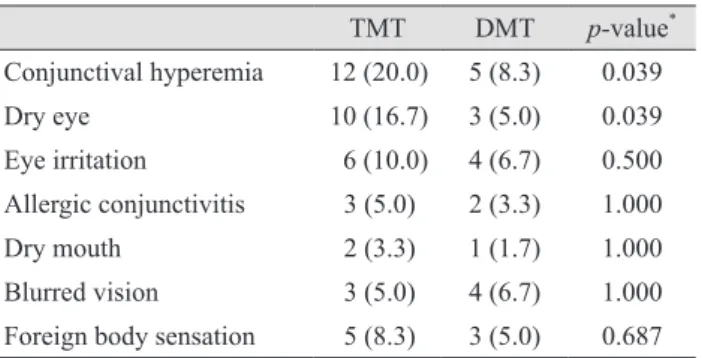
The ADRs reported for each treatment are provided in Table 3. As is apparent, there were no serious ADRs en- countered in this study. Dry eye occurred significantly less frequently with DMT (4 patients, 6.7%) than with TMT (10 patients, 16.7%; p = 0.031).
Discussion
In our results, the mean IOPs for the TMT and DMT regimens were statistically equivalent. The data obtained from the subgroup analysis indicated that the mean rate of IOP change after converting from TMT to DMT was not Table 1. Clinical and demographic data of the sudy subjects (n = 60)
Characteristics Age 40–54 yr (n = 20) Age 55–69 yr (n = 21) Age ≥70 yr (n = 19) p-value
Age (yr) 48.3 ± 4.3 62.3 ± 3.9 74.6 ± 4.9 <0.001*
Sex, male : female 10 : 10 9 : 12 8 : 11 0.708†
Diabetes mellitus 2 (10) 4 (19) 5 (26) 0.418†
Hypertension 3 (15) 5 (24) 6 (32) 0.472†
Refractive error (diopters) -0.53 ± 1.67 -0.54 ± 2.23 -1.04 ± 1.80 0.636*
CCT (µm) 531.0 ± 26.6 540.9 ± 30.7 532.1 ± 39.4 0.554*
Baseline MD (decibels) -8.28 ± 4.13 -8.12 ± 3.92 -9.27 ± 3.27 0.612*
Values are presented as mean ± standard deviation, number, or number (%).
CCT = central corneal thickness; MD = mean deviation.
*One-way analysis of variance; †Fisher’s exact test.
Fig. 1. Graph depicting changes in intraocular pressure (IOP) during triple maximum medical therapy (TMT) and double max- imum medical therapy (DMT). IOPs were compared between the two regimens at one, three, and six months before the conversion to DMT and one, three, and six months after the conversion in each age group. Note that the X-axis is not to scale but does de- pict the times at which the IOPs were measured. The Y error bars indicate the standard deviation of the mean.
IOP (mmHg)
15 20 25
10
All patients Age 40–54 yr Age 55–69 yr Age ≥70 yr
Baseline -6 mon -3 mon -1 mon +1 mon +3 mon +6 mon TMT
to DMT
statistically significant in either the 40 to 54 years or the 55 to 69 years groups. In the 70 years or older group, howev- er, the mean IOP, interestingly, was significantly lower with DMT than with TMT.
Although both of the regimens—that is, TMT and DMT—entailed maximum medical therapy, their different constituents should be taken into account. TMT consisted of latanoprost, brimonidine, dorzolamide, and timolol, while DMT included tafluprost, brimonidine, brinzol- amide, and timolol. However, according to previous re- ports, 2% dorzolamide and 1% brinzolamide share similar IOP-lowering efficacies [11], and those of 0.005% latano- prost and 0.0015% tafluprost are comparable as well [12-14].
Suzuki et al. [15] reported randomized controlled study re- sults comparing the efficacy and safety of a tafluprost/tim- olol fixed combination and a latanoprost/timolol fixed combination. In their study, there were no significant dif- ferences observed between the two groups in terms of IOP, superficial punctate keratopathy score, tear breakup time, or hyperemia score after 12 weeks. However, eye irritation and eye pain were significantly decreased in the tafluprost/
timolol group when compared with in the latanoprost/tim- olol group. Additionally, the capacity difference between brimonidine-purite 0.15% and brimonidine 0.2% should be considered. Previous studies have shown comparable IOP-lowering efficacies of brimonidine-purite 0.15% and brimonidine 0.2% over the course of three to 12 months both in glaucoma and ocular hypertension [16-18]. There- fore, the IOP-lowering efficacies of TMT and DMT would be expected to be similar too and, in fact, our present re- sults indicated equivalent IOP-lowering efficacies between TMT and DMT for the 60 POAG patients studied.
Table 2. Comparison of intraocular pressure between TMT and DMT according to the age groups All patientsG1 Age 40–54 yr (n = 20) G2 Age 55–69 yr (n = 21)
G3 Age ≥70 yr (n = 19)p-value* Post hoc test Baseline IOP20.1 ± 2.7219.4 ± 2.8319.9 ± 2.9120.9 ± 2.230.185 With TMT Mean IOP (mmHg)† 15.3 ± 2.0215.0 ± 2.2215.4 ± 2.0915.7 ± 1.730.526 Reduction in IOP (%)† 23.3 ± 3.8722.8 ± 3.0722.2 ± 3.6024.8 ± 4.480.061 With DMT Mean IOP (mmHg)† 14.7 ± 2.0415.3 ± 2.0614.9 ± 2.0313.9 ± 1.880.097 Reduction in IOP (%)† 26.2 ± 8.2121.0 ± 6.0324.6 ± 5.8233.5 ± 7.36<0.0010.224‡ (G1 = G2), <0.001‡ (G1 < G3), <0.001‡ (G2 < G3) Difference (TMT-DMT, mmHg)-0.65 ± 1.420.29 ± 0.96-0.50 ± 0.99-1.80 ± 1.46<0.0010.096‡ (G1 = G2), <0.001‡ (G1 < G3), 0.002‡ (G2 < G3) Difference (TMT-DMT, %)-3.84 ± 9.312.40 ± 6.85-3.05 ± 6.40-11.29 ± 9.31<0.0010.075‡ (G1 = G2), <0.001‡ (G1 < G3), 0.003‡ (G2 < G3) TMT = triple maximum medical therapy; DMT = double maximum medical therapy; G = group; IOP = intraocular pressure. * One way analysis of variance;† Recent 3 months; ‡ Tukey’s post hoc test.
Table 3. Adverse drug reactions (n = 60)
TMT DMT p-value*
Conjunctival hyperemia 12 (20.0) 5 (8.3) 0.039
Dry eye 10 (16.7) 3 (5.0) 0.039
Eye irritation 6 (10.0) 4 (6.7) 0.500
Allergic conjunctivitis 3 (5.0) 2 (3.3) 1.000
Dry mouth 2 (3.3) 1 (1.7) 1.000
Blurred vision 3 (5.0) 4 (6.7) 1.000
Foreign body sensation 5 (8.3) 3 (5.0) 0.687 Values are presented as number (%).
TMT = triple maximum medical therapy; DMT = double maxi- mum medical therapy.
*McNemar’s test.
Joh and Jin [19] analyzed two different combinations of maximum medical therapy for lowering the IOP adminis- tered in 82 POAG subjects. Specifically, they compared the IOP-lowering efficacies between a TMT group including patients who were treated with tafluprost, brimonidine, and a brinzolamide/timolol FDC and a DMT group includ- ing patients who were treated with a tafluprost/timolol FDC and a brinzolamide/brimonidine FDC, respectively.
Thus, in their study, the active ingredients of the medica- tions were identical in the two groups, and the differences were the capacity of brimonidine and the type of preserva- tive. They demonstrated that the two regimens’ IOP reduc- tion rates were statistically equivalent but that the inci- dence rates of conjunctival hyperemia and dry eye were significantly lower in the DMT group during the 12 months of follow-up. In the current study as well, we found similar IOP-lowering efficacies between the two dif- ferent maximum medical therapies and a lower incidence of dry eye with DMT in POAG patients whose regimen had been switched from TMT to DMT.
According to the subgroup analysis, with DMT, the mean IOP was significantly lower, especially in the elderly (≥70 years) group. Age-related physical or mental condi- tions can have adverse effects on adherence to daily topi- cal medication regimens [20]. Winfield et al. [21] reported a high noncompliance prevalence compounded by an in- ability among older patients to properly instill eye drops.
Patients older than 60 years of age relative to younger pa- tients have been found to experience greater difficulty with the physical application of eye drops, to more fre- quently require additional assistance, and to encounter in- creased difficulty with remembering to apply eye drops [22]. In this respect, too, it is known that the frequency of dosing is inversely correlated with medication adherence [23]. In the current study, the total numbers of instilled an- tiglaucoma eye drops for TMT and DMT were five and three, respectively. From this point of view, improved medication compliance could make DMT’s IOP-lowering efficacies better than TMT’s among elderly patients.
The differences in pH levels and preservative composi- tion between the two regimens could be other factors af- fecting both patient compliance and IOP-lowering effica- cies. DMT presents a more physiological pH than TMT (6.5–7.2 vs. 5.8–7.4) [24], and the impact of physiological pH on compliance has previously been reported [25,26]. In terms of preservative composition, TMT contains purite as
well as BAK, whereas DMT includes only BAK. However, since purite has been reported to improve safety and toler- ability relative to BAK [27,28], the differences due to pre- servatives between the two groups are not considered to be significant. In light of these facts, further investigation of the pH levels or preservative compositions of antiglaucoma medications and their associations with patient compliance and IOP-lowering effects is warranted.
There are several limitations to our study that should be considered. First, the study subjects maintained the TMT regimen for longer than 12 months, whereas the DMT reg- imen was followed for only a minimum of nine months.
Although with DMT, we observed a significantly lower frequency of ADRs (e.g., dry eye), the significant differ- ence in treatment duration might have affected the ADR-frequency results. Additionally, although the absence of a washout period between the two regimens reflected a real-world clinical setting, the remaining IOP-lowering ef- fects of TMT might have affected the IOP during the DMT regimen. Second, while we suggested “compliance”
as one of the factors supporting DMT’s better IOP-lower- ing effect relative to TMT in older age, we did not objec- tively compare or assess the compliance level in each pa- tient. Further studies assessing compliance level with structured questionnaires or interviews should be conduct- ed to more thoroughly investigate the effects of medica- tion-regimen simplification for elderly patients. Third, our study population was limited to subjects aged older than 40 years, so caution needs to be exercised in any attempts to generalize our results to younger age groups. Fourth, patients who had changed their regimen from TMT to DMT owing to poor IOP control were not included in the final analysis. The rationale for the regimen change in most of our cases was reduced dosing and thus improved patient convenience. These factors could have affected the difference in the degree of IOP reduction between TMT and DMT. Fifth and finally, the follow-up period was somewhat short. Future studies with longer follow-up peri- ods are needed for more thorough comparisons of the two regimens’ long-term IOP-lowering efficacies.
In conclusion, DMT relative to TMT was shown to be an effective and safe maximum medical therapy for lowering of IOP in POAG patients, especially in elderly patients.
This suggests, albeit tentatively, a possibility of that the simplification of drug administration may improve adher- ence in elderly patients.
Conflict of Interest
No potential conflict of interest relevant to this article was reported.
References
1. European Glaucoma Society Terminology and Guidelines for Glaucoma, 4th Edition - Chapter 3: Treatment princi- ples and options Supported by the EGS Foundation: Part 1:
Foreword; Introduction; Glossary; Chapter 3 Treatment principles and options. Br J Ophthalmol 2017;101:130-95.
2. The Advanced Glaucoma Intervention Study (AGIS): 7.
The relationship between control of intraocular pressure and visual field deterioration.The AGIS Investigators. Am J Ophthalmol 2000;130:429-40.
3. Leske MC, Heijl A, Hussein M, et al. Factors for glaucoma progression and the effect of treatment: the early manifest glaucoma trial. Arch Ophthalmol 2003;121:48-56.
4. Kass MA, Heuer DK, Higginbotham EJ, et al. The Ocular Hypertension Treatment Study: a randomized trial deter- mines that topical ocular hypotensive medication delays or prevents the onset of primary open-angle glaucoma. Arch Ophthalmol 2002;120:701-13.
5. Friedman DS, Nordstrom B, Mozaffari E, Quigley HA.
Variations in treatment among adult-onset open-angle glaucoma patients. Ophthalmology 2005;112:1494-9.
6. 6. Webers CA, Beckers HJ, Nuijts RM, Schouten JS. Phar- macological management of primary open-angle glaucoma:
second-line options and beyond. Drugs Aging 2008;25:729- 59.
7. Quigley HA, Enger C, Katz J, et al. Risk factors for the de- velopment of glaucomatous visual field loss in ocular hy- pertension. Arch Ophthalmol 1994;112:644-9.
8. Inoue K, Ishida K, Tomita G. Effectiveness and safety of switching from prostaglandin analog monotherapy to pros- taglandin/timolol fixed combination therapy or adding ri- pasudil. Jpn J Ophthalmol 2018;62:508-16.
9. Barnebey HS, Orengo-Nania S, Flowers BE, et al. The safety and efficacy of travoprost 0.004%/timolol 0.5% fixed combination ophthalmic solution. Am J Ophthalmol 2005;140:1-7.
10. Lee AJ, McCluskey P. Fixed combination of topical brimo- nidine 0.2% and timolol 0.5% for glaucoma and uncon- trolled intraocular pressure. Clin Ophthalmol 2008;2:545-55.
11. Seong GJ, Lee SC, Lee JH, et al. Comparisons of intraocu- lar-pressure- lowering efficacy and side effects of 2% dor- zolamide and 1% brinzolamide. Ophthalmologica 2001;215:188-91.
12. Uusitalo H, Pillunat LE, Ropo A; Phase III Study Investi- gators. Efficacy and safety of tafluprost 0.0015% versus lat- anoprost 0.005% eye drops in open-angle glaucoma and ocular hypertension: 24-month results of a randomized, double-masked phase III study. Acta Ophthalmol 2010;88:12-9.
13. Uusitalo H, Egorov E, Kaarniranta K, et al. Benefits of switching from latanoprost to preservative-free tafluprost eye drops: a meta-analysis of two Phase IIIb clinical trials.
Clin Ophthalmol 2016;10:445-54.
14. Ikeda Y, Mori K, Tada K, et al. Comparison study of intra- ocular pressure reduction efficacy and safety between lata- noprost and tafluprost in Japanese with normal-tension glaucoma. Clin Ophthalmol 2016;10:1633-7.
15. Suzuki K, Otsuka N, Hizaki H, et al. Multicenter, random- ized, controlled study comparing tafluprost/timolol fixed combination with latanoprost/timolol fixed combination in primary open-angle glaucoma and ocular hypertension.
Adv Ther 2018;35:796-808.
16. Mundorf T, Williams R, Whitcup S, et al. A 3-month com- parison of efficacy and safety of brimonidine-purite 0.15%
and brimonidine 0.2% in patients with glaucoma or ocular hypertension. J Ocul Pharmacol Ther 2003;19:37-44.
17. Kim CY, Hong S, Seong GJ. Brimonidine 0.2% versus bri- monidine Purite 0.15% in Asian ocular hypertension. J Ocul Pharmacol Ther 2007;23:481-6.
18. Katz LJ. Twelve-month evaluation of brimonidine-purite versus brimonidine in patients with glaucoma or ocular hypertension. J Glaucoma 2002;11:119-26.
19. Joh HJ, Jin SW. Comparison of different combinations of maximum medical therapy for lowering intraocular pres- sure in primary open angle glaucoma: 12-month retrospec- tive consecutive case series. Jpn J Ophthalmol 2019;63:322- 7.
20. Broadway DC, Cate H. Pharmacotherapy and adherence issues in treating elderly patients with glaucoma. Drugs Aging 2015;32:569-81.
21. Winfield AJ, Jessiman D, Williams A, Esakowitz L. A study of the causes of non-compliance by patients pre- scribed eyedrops. Br J Ophthalmol 1990;74:477-80.
22. Lacey J, Cate H, Broadway DC. Barriers to adherence with glaucoma medications: a qualitative research study. Eye
(Lond) 2009;23:924-32.
23. Jin H, Kim Y, Rhie SJ. Factors affecting medication adher- ence in elderly people. Patient Prefer Adherence 2016;10:2117- 25.
24. Lockington D, Macdonald EC, Stewart P, et al. Free radi- cals and the pH of topical glaucoma medications: a lifetime of ocular chemical injury? Eye (Lond) 2012;26:734-41.
25. Manni G, Denis P, Chew P, et al. The safety and efficacy of brinzolamide 1%/timolol 0.5% fixed combination versus dorzolamide 2%/timolol 0.5% in patients with open-angle glaucoma or ocular hypertension. J Glaucoma 2009;18:293- 300.
26. Mundorf TK, Rauchman SH, Williams RD, et al. A patient preference comparison of Azarga (brinzolamide/timolol fixed combination) vs Cosopt (dorzolamide/timolol fixed combination) in patients with open-angle glaucoma or ocu- lar hypertension. Clin Ophthalmol 2008;2:623-8.
27. Noecker RJ, Herrygers LA, Anwaruddin R. Corneal and conjunctival changes caused by commonly used glaucoma medications. Cornea 2004;23:490-6.
28. Mundorf T, Wilcox KA, Ousler GW 3rd, et al. Evaluation of the comfort of Alphagan P compared with Alphagan in irritated eyes. Adv Ther 2003;20:329-36.