Veterinary Science
*Corresponding author
Tel: +82-2-880-1256; Fax: +82-2-880-1256
E-mail: [email protected]
Protective and therapeutic effects of an extract mixture of alder tree, labiate herb, milk thistle green bean-rice bran fermentation, and turnip against ethanol-induced toxicity in the rat
Min-Won Baek
1, Seung-Hyeok Seok
1, Hui-Young Lee
1, Dong Jae Kim
1, Byoung-Hee Lee
2, Young-Tae Ahn
3, Kwang-Sei Lim
3, Chul-Sung Huh
3, Jae-Hak Park
1,*
1
Department of Laboratory Animal Medicine, College of Veterinary Medicine, Seoul National University, Seoul 151-742, Korea
2
Department of Animal Experimentation, College of Medicine, Seoul National University, Seoul 110-799, Korea
3
Dairy Product Research Team, Korea Yakult R&D Center, Yongin 446-901, Korea
An herbal extract mixture and yogurt added to the herbal extract mixture were tested for their protective and therapeutic effects on ethanol-induced liver injury. The herbal extract mixture, yogurt and commercial drugs were used for treatment for two weeks prior to administering a single oral dose of ethanol (3 g/kg body weight). The herbal extract mixture and yogurt added to the herbal extract mixture were found to provide protection against ethanol- induced toxicity comparable to the commercial drug treat- ment, according to the serum and histopathological analysis.
It was also shown that co-treatment with herbal extract mixture and yogurt against a triple oral dose of ethanol (2 g/kg body weight, over one week) provided protection against ethanol toxicity. After the initial set of experiments, the herbal extract mixture and yogurt treatments were extended for three more weeks. When compared to the positive control, further treatment with both the herbal extract and yogurt significantly reduced liver injury and resulted in a lower grade of lipid deposition.
Keywords: ethanol-induced toxicity, herbal extract mixture, pro- tective effect, rat, yogurt
Introduction
Functional foods and food additives are substances that provide health benefits beyond basic nutrition due to certain physiologically active components. Some of these
substances may help prevent disease, reduce the risk of developing disease, or enhance general health, especially in the liver. Consumer interest in functional foods has increased during the late twentieth century as people have become more focused on achieving and maintaining a healthy lifestyle [9].
Alcoholic liver disease (ALD) remains a serious health problem. ALD is a common consequence of prolonged and heavy alcohol intake. Changes fatal to the liver include fatty liver, hepatitis and hepatic cirrhosis [5,6,12]. Multiple mechanisms are likely to be involved in the pathogenesis of these problems; especially those associated with the toxic substances generated during alcohol metabolism.
Accumulated evidence has demonstrated that both oxidative stress and abnormal cytokine production are important factors in the development of alcoholic liver damage [2, 3,8].
Although much progress has been made in understanding the pathogenesis of alcoholic liver disease, there remains no effective therapy for this disease. In the absence of reliable drugs to protect the liver, herbs may play role in treating liver disorders. Many plants and herbal extracts demonstrate hepatoprotective activity; hence, many attempts have been made to formulate herbal preparations as functional foods [5,9].
This study was undertaken to investigate the protective
and therapeutic effects of an herbal extract mixture and
yogurt added to the herbal extract mixture on ethanol
induced hepatic injury in a rat model.
Table 1. Results from serum analysis and histopathological grade of the protective effect of herbal extract mixture and yogurt to a single ethanol challenge (n = 5)
Treatments
Serum analysis Histopathological grade
AST (IU/ml)
ALT (IU/ml)
Total bilirubin (IU/ml)
Sum of steatosis and inflammation score*
Herbal extract mixture
Yogurt
NC PC 1 × 2 × NC PC Drug Yogurt
87.2 ± 9.3
a
141.4 ± 11.5
b
108.7 ± 13.4
a
99.9 ± 2.3
a
94.3 ± 3.7
a
161.5 ± 7.9
b
121.4 ± 18.4
c
99.2 ± 6.6
a
34.1 ± 4.9
a
57.5 ± 12.0
b
41.0 ± 16.8
a
38.3 ± 7.6
a
38.6 ± 3.5
a
71.3 ± 8.8
b
43.8 ± 7.3
a
52.7 ± 5.3
c
0.032 ± 0.023
a
0.099 ± 0.041
b
0.051 ± 0.017
a
0.050 ± 0.012
a
0.037 ± 0.013
a
0.156 ± 0.009
b
0.062 ± 0.008
c
0.065 ± 0.007
c
0.1 ± 0.2
a
3.8 ± 0.6
b
2.3 ± 0.5
c
0.8 ± 0.5
d
0.2 ± 0.2
a
4.2 ± 0.7
b
2.8 ± 1.0
b
2.1 ± 0.7
c
Superscript letters (
a, b, c, d) indicate groups that are significantly different (p < 0.05) from each other. *Scores of steatosis and inflammation
were analyzed through the description of Materials and Methods. NC: negative control, PC: positive control, 1 ×: herbal extract mixture 1 ×
pretreatment, 2 ×: herbal extract mixture 2 × pretreatment, Drug: commercial liver drug pretreatment, Yogurt: yogurt pretreatment.
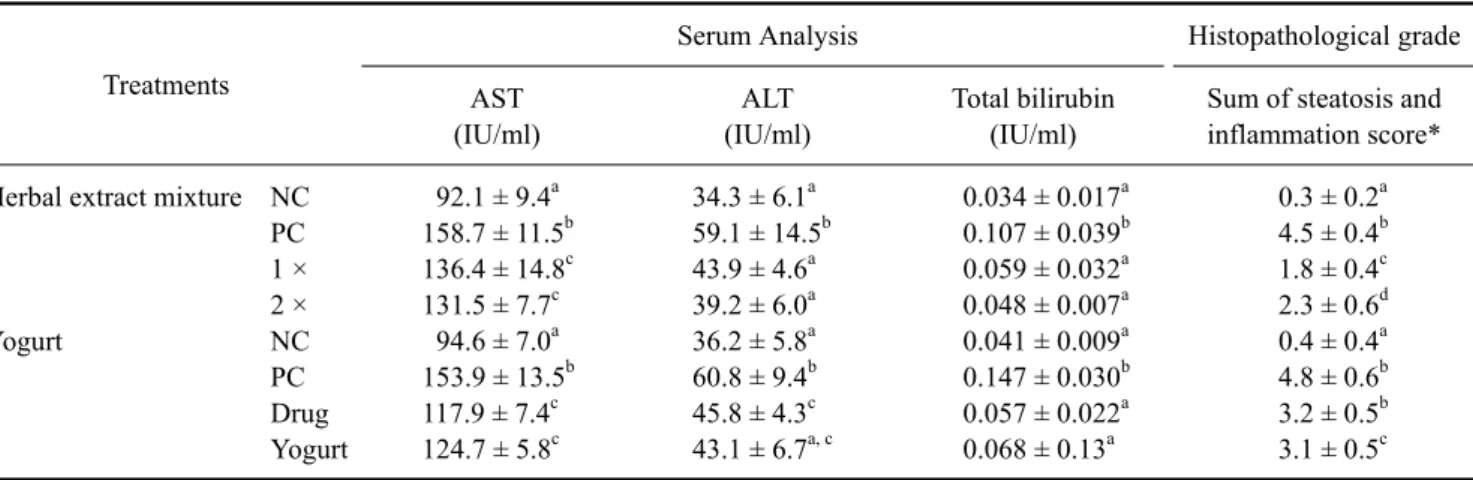
Table 2. Results from serum analysis and histopathological grade of the protective effect of herbal extract mixture and yogurt to a triple ethanol challenge (day 7, n = 5)
Treatments
Serum Analysis Histopathological grade
AST (IU/ml)
ALT (IU/ml)
Total bilirubin (IU/ml)
Sum of steatosis and inflammation score*
Herbal extract mixture
Yogurt
NC PC 1 × 2 × NC PC Drug Yogurt
92.1 ± 9.4
a
158.7 ± 11.5
b
136.4 ± 14.8
c
131.5 ± 7.7
c
94.6 ± 7.0
a
153.9 ± 13.5
b
117.9 ± 7.4
c
124.7 ± 5.8
c
34.3 ± 6.1
a
59.1 ± 14.5
b
43.9 ± 4.6
a
39.2 ± 6.0
a
36.2 ± 5.8
a
60.8 ± 9.4
b
45.8 ± 4.3
c
43.1 ± 6.7
a, c
0.034 ± 0.017
a
0.107 ± 0.039
b
0.059 ± 0.032
a
0.048 ± 0.007
a
0.041 ± 0.009
a
0.147 ± 0.030
b
0.057 ± 0.022
a
0.068 ± 0.13
a
0.3 ± 0.2
a
4.5 ± 0.4
b
1.8 ± 0.4
c
2.3 ± 0.6
d
0.4 ± 0.4
a
4.8 ± 0.6
b
3.2 ± 0.5
b
3.1 ± 0.5
c
Superscript letters (
a, b, c, d) indicate groups that are significantly different (p < 0.05) from each other. *Score of steatosis and inflammation were
analyzed through the description of Materials and Methods. NC: negative control, PC: positive control, 1 ×: herbal extract mixture 1 ×
treatment, 2 ×: herbal extract mixture 2 × treatment, Drug: commercial liver drug treatment, Yogurt: yogurt treatment.
Serum and histopathological analysis
The serum analysis showed that the herbal extract mixture, 1 × and 2 ×, treatment did not reach dose- dependent significance, but did indicate a trend. The yogurt treatment did not reduce the levels of AST or total bilirubin similar to the results of the commercial drug. On the other hand, the ALT levels in the herbal extract mixture and yogurt treatment group showed a further decrease when compared to the commercial drug treatment (Table 2).
The histopathological grade also showed a significant reduction in steatosis and inflammation in accordance
with the yogurt treatments, but the commercial drug administration did not reduce the histopathological lesions as did the herbal extract mixture and yogurt preparations (Table 2).
To investigate the therapeutic effects of the herbal extract mixture and yogurt, the animals were treated for an additional three weeks with the triple administration of ethanol, the herbal extract mixture and the yogurt preparation.
Two serum markers in the herbal extract mixture and
yogurt treatment groups (AST and ALT) had lower levels
on the day seven analysis and these differences were
statistically significant. However, the total bilirubin
showed no significant changes. The total bilirubin levels
Fig. 2. Oil red O stain of the liver in the experimental groups. (A) negative control, (B) positive control, (C) herbal extract mixture 1 × treatment, (D) herbal extract mixture 2 × treatment, (E) com- mercial liver drug treatment, (F) yogurt treatment, Oil red O stain, ×200.
Table 3. Results from serum analysis and histopathological grade of the protective effect of herbal extract mixture and yogurt to triple ethanol challenge (day 28, n = 5)
Treatments
Serum Analysis Histopathological grade
AST (IU/ml)
ALT (IU/ml)
Total bilirubin (IU/ml)
Sum of steatosis and inflammation score*
Herbal extract mixture
Yogurt
NC PC 1 × 2 × NC PC Drug Yogurt
88.5 ± 5.6
a
117.3 ± 7.1
b
98.7 ± 10.2
a
90.2 ± 6.4
a
91.2 ± 7.8
a
126.5 ± 9.4
b
94.1 ± 8.3
a,c
104.4 ± 5.1
c
39.0 ± 6.7
a
67.5 ± 5.9
b
47.2 ± 2.8
c
37.4 ± 2.1
a
39.0 ± 6.7
a
67.5 ± 5.9
b
47.2 ± 2.8
a,c
37.4 ± 2.1
c
0.024 ± 0.019
a
0.051 ± 0.012
b,c
0.046 ± 0.011
a,c
0.063 ±0.025
c
0.045 ±0.039
a
0.050 ± 0.025
a
0.041 ± 0.015
a
0.047 ±0.026
a
0.4 ±0.3
a
1.7 ± 0.5
b
0.5 ± 0.3
a
1.5 ± 0.5
b
0.3 ± 0. 3
a
1.6 ± 0.6
a,b
1.1 ± 0.4
a,b
1.2 ± 0.5
b
Superscript letters (
a, b, c, d) indicate groups that are significantly different (p < 0.05) from each other. *Score of steatosis and inflammation were
analyzed through the description of Materials and Methods. NC: negative control, PC: positive control, 1 ×: herbal extract mixture 1 ×
treatment, 2 ×: herbal extract mixture 2 × treatment, Drug: commercial liver drug treatment, Yogurt: yogurt treatment.
Fig. 1. Histopathology of the liver in the experimental groups (A) negative control, (B) positive control, (C) commercial liver drug treatment, (D) yogurt treatment, H&E stain, ×200.
did not show any trend at the end of experiment (Table 3).
For the histopathological grading, only the herbal extract mixture 1× and yogurt treatment groups showed signi- ficantly decreased scores. By contrast, the herbal extract mixture 2× and commercial drug treatment showed no significant changes (Table 3). It was difficult to estimate the level of steatosis because of glycogen deposits in the liver (Fig. 1). To determine the lipid distribution, oil red O staining was carried out and the lipid areas were analyzed (Fig. 2 and 3). The lipid accumulation showed only a high level in positive control (Fig. 3); however, the herbal extract mixture, yogurt and commercial drug treatment groups had significantly lower lipid accumulation similar
to negative control.