Labor union associates' perception and participation on the safety and health education at work
Kyoung-Ok Park
Department of Health Education & Management in Ewha Womans University
CONTENTS
Ⅰ. Introduction
Ⅱ. Methods
Ⅲ. Results
IV. Discussion References Abstract
Corresponding Author: Kyoung-Ok Park
11-1 Daehyun-dong Seodaemun-gu
Department of Health Education & Management
Ewha Womans University, Seoul 120-750, Korea (South)
Office: +82-2-3277-4649, Fax: +82-2-3277-2867, Email: [email protected]
Ⅰ. Introduction
Workplace is a major channel of a large percentage of the adult population to safety and health education which encourages desirable safety and health behaviors at work (Linnan et al. 2001). Based on the fundamental significance of behavioral control on occupational injury and illness, occupational safety and health education at work has the succinct mandatory hours every month in Korea; which is two hours every month for manual workers and one hour
every month for office workers (Ministry of Government Legislation 2007). However, this legal hour for safety and health education practically has serious quality problems both in organizational and individual levels in terms of reluctant implementation and participation (Lee, Park, and Lee 2006).
It has been well documented that safety and health education at work (SHEW) had significant beneficial effects on preventing injury and illness at work through increasing workers' control of risk behaviors in their own work processes. However, both
Journal of Korean Society for Health Education and Promotion
Vol. 24, No. 5, 2007, pp.87-101
employer's perception and investment and employees' perception and participation were still poor because the effects of SHEW are usually indirect and not easy to clearly estimate in public (Korea Occupational Safety and Health Research Institute 2004).
In reality, the prevalence rate of occupational injury in Korea had decreased from 2.66% in 1987 to 0.68% in 1998 but the rate of occupational injury slightly increased to 0.74% in 2005 after the abolition of SHEW legal training hours for safety and health supervisors at work related to the traumatic crisis of national finance in 1998. In other words, it was a significant evidence that less SHEW significantly linked to the increase of occupational injury (Kang and Jang 2004).
Furthermore, the percentage of occupational injury are likely to increase because the proportion of accident-sensitive working population such as the aged, the unskilled, or the foreign workers has increased in Korean working population. Therefore, it is urgently necessary of the effective management and strategies to improve the SHEW quality in Korea.
Primary concerns on SHEW quality control should be improvement of workers' perception and participation on safety and health education in their workplace because
positive perception and voluntary participation directly link to quality improvement of SHEW (Korea Ministry of Labor 2005). Organizational support for SHEW can be addressed in terms of employer, supervisor, and labor union, and among these support sources, labor union can represent not only workers themselves but also another within-workplace force which has its unique roles for SHEW different from employer or supervisor because workplace labor union can take the supportive role and supervisory role on the SHEW provided by the employers or safety and health supervisors.
Most research for SHEW focused on workers' perception or practical implementation characteristics in Korea (Park 2007; Lee et al.
2006; Kang and Jang 2004); however, it had little intention or research on the labor union related to SHEW in Korea although workplace labor union's potential roles for SHEW can be diverse and powerful as mentioned in the previous paragraph.
Therefore, it must be meaningful to check
Korean workplace-level labor union
associates' perception and participation
characteristics. The purposes of this study
were to understand the labor union
associates' perception and participation status
on SHEW and to identify the correlations between theses two constructs in manufacture and construction industries.
II. Methods
1. Participants and D ata Collection Self-administered survey was successfully finished by 103 labor union associates (91 employed in 78 manufacturing companies and 12 employed in 12 constructing companies over 12 areas over Korea). The labor union associates in constructing industry were selected in the unit of area because the labor unions for constructing industry were mostly organized per rather than per company. Federation of Korean Trade Unions provided the mailing lists of company labor union associates for this survey.
Two questionnaires, survey direction slip, the official letter to ask survey participation from Korea Ministry of Labor, and a posted envelop to return were delivered to each workplace labor union office in conveniently selected companies. The survey associate made phone calls to the listed labor union offices to ask survey participation in a week from the postal delivery.
Most participants' companies were at least medium to large in manufacturing industry but the company size in constructing industry seemed opposite to that. Most associates were men (93.4% in manufacturing industry and 83.3% in constructing industry) and the married associates were 86.8% in manufacturing industry and 66.7% in constructing industry (Table 1).
2. Measures
A survey questionnaire was developed to examine demographic characteristics, SHEW status (participation status included), and perceptions of SHEW. Demographic characteristics were region of company, company size, sex, age, marital status, education, carrier in labor union, and title in company labor union. SHEW status was estimated by regularity of SHEW in general, schedule of SHEW, types of SHEW, and labor union participation on SHEW.
Perceptions on SHEW were diversely
accessed: Perceived infrastructures at work
for SHEW, perceived competencies of
current safety and health educators,
expectations of SHEW, needs of safety and
health educators' competencies, and needs of
training topics for occupational safety and
health educators.
Contents Manufactur
e workplace Constructio n workplace Region
Metropolitan cities 37(42.0) 11(91.7) Suburban areas 51(58.0) 1( 8.3) Company size (Unit: employes)
Less than 50 2( 2.3) 8(80.0) Equal or more than 50 84(97.7) 2(20.0) Sex
Man 85(93.4) 10(83.3)
Woman 6( 6.6) 2(16.7)
Age (Unit: year)
- 29 3( 3.3) 0( .0)
30 - 39 38(41.8) 9(75.0)
40 - 49 46(50.5) 3(25.0)
50 - 4( 4.4) 0( .0)
Marital status
Married 79(86.8) 8(66.7)
Single 12(13.2) 4(33.3)
Education
- High school 51(58.6) 3(27.3) Community college 22(25.3) 0( .0)
University 12(13.8) 8(72.7)
Graduate school - 2( 2.3) 0( .0) Carrer in labor union (Unit: year)
- 2.9 17(22.4) 1( 8.3)
3 - 4.9 19(25.0) 1( 8.3)
5 - 9.9 19(25.0) 10(83.3)
10 - 19.9 18(23.7) 0( .0)
20 - 3( 3.9) 0( .0)
Title in company labor union
Member 3( 3.9) 0( .0)
Health&Safety supervisor 30(39.5) 1(12.5) Executive supervisor 31(40.8) 4(50.0)
Chairman 12(15.8) 3(37.5)
Total 91(100.0) 12(100.0)
Table 1. General characteristics of survey participants
Infrastructures or SHEW were composed of 15 questions (five processes and human infra questions and 10 environment and facility infra questions) and they were estimated in four-point Likert scale. The higher the score the better the perception on SHEW infrastructures. It's Cronbach's alpha, the internal reliability indicator, was .97.
Competency level and competency needs of current safety and health educators at work were measured with 10 questions in four-point Likert scale. These questions were developed based on the 10 core competency areas of National Commission for Health Education Credentialing (NCHEC) in the United States (NCHEC 1996). Cronbach's alpha values for the competency level measure and the competency need measure were .96 and .94 each. Expectations of SHEW were measured with expectation for SHEW objectives and outcomes. The needs of training topics for occupational safety and health educators were measured by 29 sub-topics which were about safety and health general and educational skills, advanced occupational safety management, and advanced occupational health management measured in four-point Likert scale. It's Cronbach's alpha value was .97 which indicated highly reliable.
3. D ata A nalyses
Collected data were entered into a
computerized database using the Statistical
Contents Manufacture
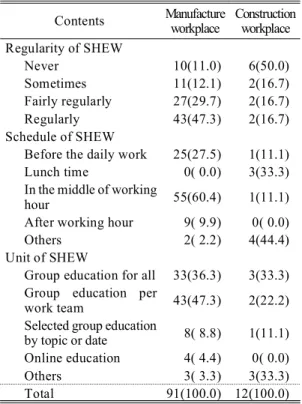
workplace Construction workplace Regularity of SHEW
Never 10(11.0) 6(50.0)
Sometimes 11(12.1) 2(16.7)
Fairly regularly 27(29.7) 2(16.7)
Regularly 43(47.3) 2(16.7)
Schedule of SHEW
Before the daily work 25(27.5) 1(11.1)
Lunch time 0( 0.0) 3(33.3)
In the middle of working
hour 55(60.4) 1(11.1)
After working hour 9( 9.9) 0( 0.0)
Others 2( 2.2) 4(44.4)
Unit of SHEW
Group education for all 33(36.3) 3(33.3) Group education per
work team 43(47.3) 2(22.2)
Selected group education
by topic or date 8( 8.8) 1(11.1) Online education 4( 4.4) 0( 0.0)
Others 3( 3.3) 3(33.3)
Total 91(100.0) 12(100.0)
(Note) Total frequency of each variable was not exactly same as each other because of no responses.
Table 2. Status of safety and health education at work
Package for the Social Sciences (SPSS) version 12.0 (Norusis 2001). Data entry accuracy was validated using a double check process. To understand the status of the associates' demographic characteristics and SHEW status, basic statistics such as frequency, %, mean, and standard deviation were generated dependent on the scale of each variable. Industry comparisons between manufacture and construction were identified with Chi-square analysis and t-test. The differences of the participation scores by demographics and SHEW status were identified by t-test or One-way analysis of variance. The correlation between the labor union participation and its perceptions on SHEW were examined with simple correlation coefficient analysis.
Ⅲ. Results
1. Status and participation of safety and health education at w ork
1) General status of safety and health education at work
General SHEW status of labor union associates' companies were measured with regularity, schedule, and type of SHEW (Table 2). Participants who answered that their companies had regularly implemented
SHEW were 47.3% in manufacturing companies and but only 16.7% in constructing companies. SHEW was usually implemented during the working hour (60.4%) in manufacturing companies but much of SHEW was implemented in irregular time such as in lunch time or others.
Unit of SHEW were usually determined in
total or per team in manufacturing companies
but diverse other types of SHEW were also
driven in constructing companies.
Competency area Manufacture workplace
Construction
workplace t p
Process and implementation infra (total) 2.60±.84 2.38±.78 .943 .361
Review and pretest before planning 2.84±.87 2.33±1.15 1.467 .167
Building annual plan for S&H education 2.94±1.05 2.75±1.22 .527 .607 Cooperative determining of educators, topics, and
methods at work 2.11±.98 2.25±1.36 -.455 .650
Evaluating S&H education and developing final report
of that 2.62±1.03 2.17±1.19 1.255 .231
Assigning S&H education within annual management
schedules at work 2.90±1.06 1.92±1.08 2.949 .011
Environment and facility infra (total) 2.82±.94 2.23±.70 2.525 .023
Easy to access to S&H education materials 2.72±1.06 2.33±1.07 1.195 .252
Diverse educational aids at work 2.82±1.09 2.42±.90 1.411 .178
Rooms for S&H education at work 3.01±1.03 3.08±.90 -.255 .802
Appropriate assignment of educators 2.68±1.01 2.25±1.22 1.176 .260
Financial support for S&H education and campaign 2.63±1.03 2.58±1.00 .135 .894 Easy to use the authorized organization 2.60±1.03 2.33±.98 .882 .392
S&H educators within workplace 3.02±1.01 2.91±.83 .417 .683
Active in workplace committees for occupational S&H 2.95±1.09 1.50±.67 6.413 .000 Within-workplace regulations for S&H management 3.01±1.03 1.75±.87 4.617 .000 Active in honored occupational safety inspector at work 2.77±1.17 1.50±.90 4.397 .000
Grand mean of S&H education infra 2.72±.88 2.27±.63 2.126 .050
Table 4. Perceived infrastructures at work for safety and health education
(Unit: mean±S.D.) Participation of company
labor union on SHEW
Manufacture workplace
Constructio n workplace
Never 1( 1.1) 2(22.2)
Sometimes 27(30.7) 4(44.4)
Participatory 40(45.5) 3(33.3) Very participatory 20(22.7) 0( 0.0)
Total 91(100.0) 12(100.0)
Table 3. Company labor union's participation on SHEW
Company labor union participation levels on SHEW were different between manufacturing and constructing industries. 'Participatory' or 'Very participatory' of labor unions on SHEW were 68.2% in manufacturing companies;
however, the participatory level of labor union on SHEW weas lower in constructing companies than in manufacturing companies.
2) Perceived expectations and needs on safety and health education at work
Overall SHEW infra scores were greater in manufacturing companies than in constructing companies (Table 4, p< .05).
The scores of process and implementation were not different but the scores of environment and facility infra were different by industry (p< .05).
Labor union associates' perceived
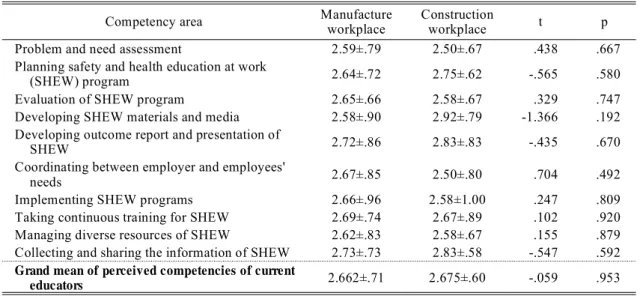
Competency area Manufacture
workplace Construction
workplace t p
Problem and need assessment 2.59±.79 2.50±.67 .438 .667
Planning safety and health education at work
(SHEW) program 2.64±.72 2.75±.62 -.565 .580
Evaluation of SHEW program 2.65±.66 2.58±.67 .329 .747
Developing SHEW materials and media 2.58±.90 2.92±.79 -1.366 .192
Developing outcome report and presentation of
SHEW 2.72±.86 2.83±.83 -.435 .670
Coordinating between employer and employees'
needs 2.67±.85 2.50±.80 .704 .492
Implementing SHEW programs 2.66±.96 2.58±1.00 .247 .809
Taking continuous training for SHEW 2.69±.74 2.67±.89 .102 .920
Managing diverse resources of SHEW 2.62±.83 2.58±.67 .155 .879
Collecting and sharing the information of SHEW 2.73±.73 2.83±.58 -.547 .592 Grand mean of perceived competencies of current
educators 2.662±.71 2.675±.60 -.059 .953
Table 5. Perceived competencies of current safety and health educators at work (Unit: mean±S.D.)
Contents Manufacture
workplace
Construction
workplace t p
Objectives expectation of safety and health education 3.23± .54 2.58± .66 3.83 .000 Outcome expectation of safety and health education 3.22± .70 3.08± .67 .65 .520 Table 6. Perceived expectations of safety and health education at work
(Unit: mean±S.D.) competencies of their company safety and
health educators were not different between manufacturing and constructing companies and the average scores of perceived competencies were 'moderate' level not high (Table 5; p= .95).
Expectation scores for SHEW objectives were greater in the labor union associates of manufacturing companies than of constructing companies; where as outcome expectations were not significantly different between them
(Table 6, P= .00). Objectives expectation means the expected level of which a SHEW obtains at the end of the program and outcome expectation means the perceived effects whose labor union associates had on SHEW for workplace safety and health promotion.
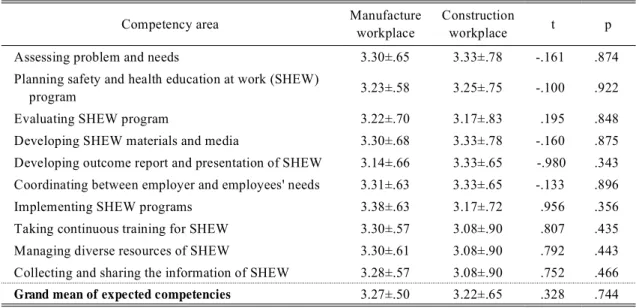
Perceived expectations for safety and
health educators' competencies were overall
moderate to high level and there was no
significant difference over 10 sub-areas of
Competency area Manufacture workplace
Construction
workplace t p
Assessing problem and needs 3.30±.65 3.33±.78 -.161 .874
Planning safety and health education at work (SHEW)
program 3.23±.58 3.25±.75 -.100 .922
Evaluating SHEW program 3.22±.70 3.17±.83 .195 .848
Developing SHEW materials and media 3.30±.68 3.33±.78 -.160 .875
Developing outcome report and presentation of SHEW 3.14±.66 3.33±.65 -.980 .343 Coordinating between employer and employees' needs 3.31±.63 3.33±.65 -.133 .896
Implementing SHEW programs 3.38±.63 3.17±.72 .956 .356
Taking continuous training for SHEW 3.30±.57 3.08±.90 .807 .435
Managing diverse resources of SHEW 3.30±.61 3.08±.90 .792 .443
Collecting and sharing the information of SHEW 3.28±.57 3.08±.90 .752 .466
Grand mean of expected competencies 3.27±.50 3.22±.65 .328 .744
Table 7. Perceived expectations for safety and health educators' competencies at work (Unit: mean±S.D.)
Training area Manufacture
workplace
Construction
workplace t p
Occupational safety and health training (Grand mean) 3.26±.53 3.00±.49 1.657 .121
S&H general and educational skills 3.26±.55 3.03±.69 1.071 .306
Advanced occupational safety management 3.34±.60 3.10±.61 1.212 .248 Advanced occupational health management 3.05±.59 2.65±.71 1.792 .099 Table 8. Perceived needs of training for safety and health educators at work
(Unit: mean±S.D.) safety and health educator competency (Table
7). Generally, labor union associates' expectations for educators' competencies were greater than their perceived competencies for current educators of their companies.
Labor union associates' training needs for their company safety and health educators were generally 'moderate' to 'high' level (Table 8). Training need scores seemed
greater in manufacturing companies than in constructing companies but the differences were not significant.
2. Labor union participation on the safety and health education at w ork
1) Labor union participation on SHEW by company characteristics
In terms of company characteristics, labor
Company characteristics Participation score of
S&H education t or F p
Region of company Metropolitan area
Suburban or rural area 2.61±.78
3.02±.77 -2.53 .013
Industry classification Manufacture
Construction 2.90±.76
2.11±.78 2.88 .017
Company size
Less than 50 employees
Equal or more than 50 employees 2.57±.98
2.87±.78 -.95 .345
D aily working hours Equal or less than 8 hours
More than 8 hours 2.95±.77
2.62±.78 2.04 .044
A ssignment of S&H supervisor at w ork Yes
No 2.98±.82
2.41±.57 3.31 .001
Table 9. Labor union participation on SHEW by company characteristics
(Unit: mean±S.D.)
union participation on SHEW was better in the companies in suburban or rural areas than in metropolitan areas and was better in manufacturing companies than in constructing companies (Table 9; p< .05). Less hours for daily work and safety and health supervisor employment were significant factors for better participation of labor unions on SHEW (p< .05).
2) Labor union participation on SHEW by perceptions on education
Using simple correlation analysis to identify the correlations between labor union participation and the associates' perceptions on SHEW were described in Table 10.
Educational infrastructures had high
correlations with labor union participations on SHEW (r= .601, p< .01). Associates' perceived competencies of current company safety and health educators were also significantly correlated with labor union participation on SHEW (r= .496, p< .01).
Needs for educators' training and competencies had not high correlations with labor union participation rather than current infrastructures or competencies; which means that current organizational readiness for SHEW also encourages labor union's perceptions and participations on SHEW.
Employer support and labor union support on
SHEW were significantly correlated with
labor union participation on SHEW (p< .01).
Associates' educational perceptions Correlation with participation S&H education infrastructures
Total educational infra
Process and implementation infra Environment infra
.601
**.555
**.584
**Perceptions of S&H education Objectives expectations Outcome expectations
Current educator's competencies
.219
*.110 .496
**Needs of S&H education Competency needs for educator Training needs for educators (Total) S&H general and education skills Advanced occupational safety Advanced occupational health
.119 .196 .194 .247 .133
*Support for S&H Employer support Employee support Labor union support Community support
.445
**.372
**.465
**.372
***
p< .05,
**p< .01
Table 10. Correlation between associates' educational perceptions and labor union participation on SHEW
Ⅳ. Discussion
This study identified the labor union associates' perception and participation status on SHEW and analyzed these two variables' correlations with SHEW in manufacture and construction industries. Overall, manufacturing companies had better infrastructures for SHEW, employer support for SHEW, and current educators' competencies than constructing companies. These infrastructures for SHEW were closely correlated with company labor
union participation on SHEW and the correlation coefficients were greater than any other expectations or needs variables for SHEW.
The correlation between the implementation infra and labor union participation on SHEW was .55 which indicated a midium-high level of correlation. This result also described that company labor union participation on SHEW was dependent on the organizational infra of SHEW. Considering that better organizational infra for SHEW link to the company sizes and large businesses seem to have more support from their labor unions for safety and health education at work. Linnan and her colleagues (2001) discussed that 'access to facilities/ programs at work' had positive relationship with workplace health promotion program participation. They also discussed that 'employer- employee relations' was a positive factor indicating better workplace health promotion participation. Employer-employee relation usually link to human and environmental support from organization (employer) to employees including labor union associates. Therefore, organizational infrastructures for workers' well-being encourage company labor union support, too.
This result about the positive effects of
organizational support implies another
important point in terms of governmental support. The related governmental agencies such as KOSHRI and Ministry of Labor make lots of effort to build better governmental support or program to improve SHEW. Based on the above result, government should increase its support for small size companies and certain underrepresentative employees such as the elderly, women, and foreigners because organizational infra for SHEW is relatively weak in small size companies, in particular for such under-representative employees.
Australian government established five national priorities for occupational safety and health by 2012 and one of the priorities was to develop the capacity of business operators and workers to manage OSH effectively and that plan included more support for OSH of small business (Australian Safety and Compensation Council, 2005). Korea Ministry of Labor should also consider encouraging strategies for SHEW in small business and the under-representative working population using national substantial support. Fine and the colleagues (2004) also reported the importance of support for health promotion feasibility in small workplace.
This study found that there was a significant relationship between workplace
social support and labor union participation on SHEW. Particularly, employer support and labor union support were significant factors and the correlation size was in the midium level for labor union participation on SHEW in this study. This finding reinforced the premise that organizational performance should be considered in organizational health studies including job performance, turnover, and absenteeism (Sorensen et al. 1996;
Busbin and Campbell 1990). Diverse obstacles decreasing organizational participation and performance could be reduced by the buffering effects of social support at work (Cohen and Wills 1985; House 1981) and the result of the positive correlation between employer support and labor union participation on SHEW was explained well in House's (1981) organizational framework.
Thus, government should encourage employers' communication and concerns on SHEW, in particular for large business employers' perception changes through such as public campaigns or public advertisement.
The competency level of current
occupational safety and health educators had
significant correlation coefficient (r= .50)
with labor union participation on SHEW,
which was a moderate to high level in
correlation. That is, as a human infrastructure
of the organization for SHEW seems to give certain confirmation and credit for quality care of SHEW to the company labor union.
Therefore, systematic continuing education and training programs of occupational safety and health education for current company safety and health supervisors should be provided and strengthened.
In conclusion, the primary strategy for better participation and support from labor union is to strengthen environment and facility infrastructures related to SHEW and to increase safety and health education human resources in particular, training programs for supervisors or educators at work.
References
Austrailan Safety and Compensation Council 2005. National OHS strategy 2002-2012.
Australian Government.
Baker, E., Israel, B.A. and Schurman, S.
1996. The integrated model: Implications for worksite health promotion and occupational health and safety practice:
Health Education Quarterly 23:175-190.
Busbin, J.W, Campbell, D.P. 1990. Employee wellness programs: A strategy for
increasing participation: J Health Care Management 10(4):22-30.
Cohen, S., and Wills, T.A. 1985. Stress, social support, and the buffering hypothesis: Psychological Bulletin 98:310-357.
Crum, C., Earp, J., Kozma, C., and Hertz- Picciotto, I. 1996. Effect of organization- level variables on differential employee participation in 10 federal worksite health promotion programs: Health Education Quarterly 23(2):204-223.
Fine, A., Ward, M., Burr, M., Tudor-Smith, C., and Kingdon, A. 2004. Health promotion in small workplaces-a feasibility study. Health Education Journal 63(4):334-346.
Glasgow, R.E., Hollis, J., Ary, D., and Lando, H. 1990. Employee and organizational factors associated with participation in an incentive-based worksite smoking cessation program.
Journal of Behavioral Medicine 13(4):
403-418.
Goetze, R., Jacobsen, B., Aldana, S., Vardell,
K., and Yee L. 1998. Health care cosets
of worksite health promotion participants
and non-participants. Journal of
Occupational and Environmental Medicine
40(4):341-346.
Heaney, C.A. 1991. Enhancing social support at the workplace: Assessing the effects of the caregiver support program:
Health Education Quarterly 18: 477-494.
House, J.S. 1981. Work stress and social support. Massachusetts: Addison-Wesley Publishing Company.
Kang, J.C., and Jang, S.R. 2005. An incentive model for occupational safety and health education: Korea Journal of Safety 19(4):129-134.
Korea Occupational Safety and Health Research Institute. 2004. Promotion strategies for occupational safety and health education in small businesses.
Research report funded by KOSHRI.
Korea Ministry of Labor. 2005. Improving strategies for within-workplace safety and health education.
Lee, M.S., Park, K.O., and Lee, G.H. 2006.
Management factors associated with health and safety education in Korean manufacturing companies: Journal of Korean Society for Health Education and Promotion 23(2):121-140.
Linnan, L.A., Sorensen, G., Colditz, G., Klar, N., and Emmons, K.M. 2001. Using theory to understand the multiple determinants of low participation in worksite health promotion programs:
Health Education & Behavior 28(5):
591-607.
Ministry of Government Legislation. (2007).
Occupational Safety and Health Act.
[http://www.moleg.go.kr/main/main.do]
National Commission for Health Education Credentialing. 1996. A competency-based framework for professional development of certified health education specialists.
Norusis, M.J. 2001. SPSS Base 10.0 User's Guide. Chicago: SPSS.
Park, K.O. 2007. Safety and health education in workplace and its quality improuewent strategies. Research report. Korea Occupational Safety and Health Association.
Sorensen, G., Stoddard, A., Ockene, J., Hunt, MK, and Youngstrom, R. 1996. Worker participation in an integrated health promotion/health protection program:
Results from the WellWorks project.
Health Education Quarterly 23(2):191-203.
Terborg, J.R., Hibbard, J., and Glasgow, R.E.
1995. Behavior change at the worksite:
Does social support make a difference?:
American Journal of Health Promotion
10:125-131.
ABSTRACT
Objectives: This study identified the labor union associates' perception and participation status on SHEW and analyzed these two Constructs correlations with Safety and health education at work(SHEW) in manufacture and construction industries.
Methods: Self-administered survey was successfully finished by 103 labor union associates (91 employed in 78 manufacturing companies and 12 employed in 12 constructing companies over 12 areas). Two questionnaires, survey direction slip, the official letter to ask survey participation from Korea Ministry of Labor, and a posted envelop to return were delivered to each workplace labor union office in conveniently selected companies. Most participants' companies were at least medium to large in manufacturing industry and most associates were men and married. A survey questionnaire examined demographic characteristics, SHEW status (participation status included), and perceptions of SHEW.
Results: Overall, manufacturing companies had better infrastructures for SHEW, employer support for SHEW, and current educators' competencies than constructing companies. These infrastructures for SHEW were closely correlated with company labor union participation on SHEW and the correlation coefficients were greater than any other expectations or needs variables for SHEW.
Conclusions: The primary strategies for better participation and support from labor union need to be developed in supporting for organizational infrastructures related to SHEW and strengthening safety and health education training programs for supervisors or educators at work.
Key Words: Safety and health education, workplace, labor union, participation, perception
<국문초록>