Chloroplast DNA Spacers로 분석한 국내 Rubus 재배종의 계통학적 유연관계
유기석*·박명렬*·백소현**·윤성중***†
*전북대학교 농업생명과학대학 농업과학기술연구소, **농촌진흥청 국립식량 과학원,
***전북대학교 농업생명과학대학 작물생명과학과
Phylogenic Relationship of Rubus Cultivated in Korea Revealed by Chloroplast DNA Spacers
Gee Suck Eu*, Myoung Ryoul Park*, So Hyeon Baek** and Song Joong Yun***†
*
Institute of Agricultural Science and Technology, Chonbuk National University, Jeonju 561-756, Korea.
**
National Institute of Crop Science, RDA, Suwon 441-857, Korea
***
Department of Crop Science, Institute of Agricultural Science and Technology, Chonbuk National University, Jeonju 561-756, Korea.
ABSTRACT : There is a considerable difference in morphological traits between Bokbunja cultivated in Korea (KCB) and Korea native Rubus coreanus , contrary to the conviction that the cultivated Bokbunja is the domestication of R. coreanus . To infer the phylogenetic relationship of KCB with other Rubus species, we compared the chloroplast DNA spacers of KCB with those of several Rubus species including black raspberry, R. occidentalis . The three chloroplast DNA spacers,
atpB~rbcL , trnL~trnF , and trnT~trnL , were amplified using the specific primer pairs and converted to Single Strand Confor- mational Polymorphism (SSCP) markers. The SSCP makers of the chloroplast DNA spacers showed a considerable varia- tion both within and among Rubus species. In the phylogenetic tree generated by the SSCP markers, KCB accessions were located in the same clade with R. occidentalis , but R. coreanus accessions in the different clade. Also, in the phylogenetic tree by the nucleotide sequences of the chloroplast DNA spacer trnL~trnF , KCB located in the same clade with R. occidentalis but not with R. coreanus . These results suggest that the three KCB accessions share higher similarity with R. occidentalis than with R. coreanus in the three chloroplast DNA spacers.
Key Words : Rubus Species, Phylogenetic Relationship, Single Stranded Conformational Polymorphism (SSCP)
INTRODUCTION
Rubus belongs to the family Rosaceae, and there are over 250 species of Rubus in the world. Among them, most frequently found species are black ( R. occidentalis ) and red ( R. idaeus L.) raspberries (Jennings, 1988). Blackberries belong to the subgenus Eubatus, which is the different subgenus from Idaeobatus where red and black raspberries belongs to subgenus Idaeobatus (Jennings, 1988).
Fresh or dried fruit of Korea native Rubus coreanus Miq.
has been known as Bokbunja and used as a traditional herbal medicine for mental, kidney, liver, face, muscle and sexual disorders (Chang, 2003). Increasing attention has been given to Bokbunja with recent scientific findings supporting
its beneficial effects on human health (Jeong et al ., 2009;
Jeong and Sin, 1996; Park et al ., 2003). Timely meeting of the new findings with interests of food industry in natural functional substances triggered increased demand for ‘Bokbunja’
leading transition from gathering to cultivation of Bokbunja.
Cultivation of Bokbunja was initiated in Gochang-Gun, Jellabuk-do in 1980's and has been expanded to the whole country. Though the history of Bokbunja cultivation is not longer than 50 years, little scientific documentation is available on its process of cultivation. Most farmers cultivating Bok- bunja recognize it as a domesticated R. coreanus . However, leaf shape and flower color of cultivated Bokbunja are different from those of R. coreanus and rather similar to those of black raspberry, R. occidentalis L. Thus, it is
†
Corresponding author: (Phone) +82-63-270-2508 (E-mail) [email protected]
Received 2010 May 11 / 1st Revised 2010 July 29 / 2nd Revised 2010 August 17 / 3rd Revised 2010 August 18 / Accepted 2010 August 19
important to get scientific evidences explaining whether the cultivated Bokbunka is a domestication of wild R. coreanus or unintentional introduction of cultivated Rubus species such as R. occidentalis .
In the previous study we compared the nuclear genomic background of cultivated Bokbunka with that of several Rubus species including R. coreanus and R. occidentalis using Random Amplified Polymorphic DNA (RAPD) and the Internal Transcribed Spacer (ITS) markers. The genetic background of cultivated Bokbunja inferred from the RAPD and ITS markers was more similar to that of R.
occidentalis than to that of R. coreanus (Eu et al ., 2008;
Eu et al ., 2009). These findings are in line with the speculation based on the morphological similarities that the cultivated Bokbunja shares more close similarity to R.
occidentalis than to R. coreanus .
Uncertainty about the identity of cultivated Bokbunja is also reflected in the use of its scientific name in the papers and literature. Among over 80 publications on Bokbunja in the recent two decades, considerable inconsistency is found in the use of scientific name for Bokbunja. In 53 cases, R.
coreanus or R. occidentalis (Kee and Lim, 2007; Jung et al ., 2009) was used without a clear indication whether the materials used were wild or cultivated Bokbunja. This inconsistency in the use of scientific name of cultivated Bokbunja mostly stems from the ambiguity regarding the original plants used for the cultivation of Bokbunja.
One simple way to investigate the identity of cultivated Bokbunja is to compare its genetic background with that of other Rubus species. Chloroplast genome is often used for phylogenetic analysis due to its structural and sequence
stability (Markowicz and Loiseaux-de Goer, 1991; Waugh et al ., 1990). Conversely, variations in nucleotide sequences of chloroplast genome have been used as valuable markers for phylogenetic analysis. Frequently targeted genes for sequence analysis include rbcL (Chase et al ., 1993), ndhF (Kim and Jansen, 1995), atpB (Wolf, 1997) and matK (Steele and Vilgalys, 1994). Additionally, noncoding regions of the chloroplast genome have been explored as the regions providing greater levels of variation for phylogenetic analyses (Gielly and Taberlet, 1994). The regions frequently explored include the trnT~trnL and trnL~trnF region (Taberlet et al ., 1991), the atpB~rbcL intergenic spacer (Golenberg et al ., 1993), and the noncoding intron portions of the trnK / matK region (Johnson and Soltis, 1994; Steele and Vilgalys, 1994).
In this study we compared the three chloroplast DNA spacers among the cultivated Bokbunja, R. coreanus , black and red raspberries and blackberries to obtain phylogenetic information about the origin of the cultivated Bokbunja.
MATERIALS AND METHODS
1. Plant materials
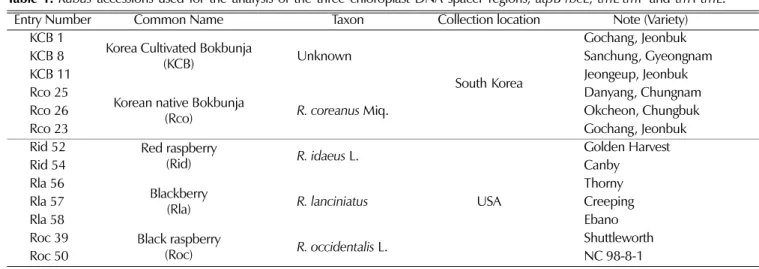
A total of thirteen accessions of Rubus species were used in this study. Three accessions of cultivated Bokbunja were from the major cultivation areas in South Korea. Black raspberry (Roc, R. occidentalis , two cultivars) was obtained from National Clonal Germplasm Repository, Corvallis, Oregon, USA. R. coreanus (Rco, three species), red raspberry (Rid, R. idaeus , two species) and blackberry (Rla, R. lanciniatus , three species) were obtained from the Korean Black Raspberry Experiment Station, Gochang, Korea (Table 1).
Table 1.Rubus
accessions used for the analysis of the three chloroplast DNA spacer regions,
atpB-
rbcL,
trnL-
trnF and
trnT-
trnL.
Entry Number Common Name Taxon Collection location Note (Variety)
KCB 1 Korea Cultivated Bokbunja
(KCB) Unknown
South Korea
Gochang, Jeonbuk
KCB 8 Sanchung, Gyeongnam
KCB 11 Jeongeup, Jeonbuk
Rco 25 Korean native Bokbunja
(Rco)
R. coreanusMiq. Danyang, Chungnam
Rco 26 Okcheon, Chungbuk
Rco 23 Gochang, Jeonbuk
Rid 52 Red raspberry
(Rid)
R. idaeusL.
USA
Golden Harvest
Rid 54 Canby
Rla 56 Blackberry
(Rla)
R. lanciniatusThorny
Rla 57 Creeping
Rla 58 Ebano
Roc 39 Black raspberry
(Roc)
R. occidentalisL. Shuttleworth
Roc 50 NC 98-8-1
2. Chemicals
DNA extraction kits were from Gentra Systems (Minnea- polis, MN, USA). The DNA plasmid vector pGEM-T-Easy was purchased from Promega (Madison, WI, USA). All chemicals and enzymes were purchased from Sigma (St.
Louis, MO, USA), unless otherwise indicated.
3. Extraction of chloroplast DNA
DNA was isolated from fresh young leaves using the Puregene DNA purification kit following the instruction provided by the manufacturer. Fresh leaf samples (30 ㎎ ) were ground with a mortar and pestle in liquid nitrogen.
Cells of the ground leaf tissue were lysed by incubating in lysis solution at 65 ℃ for 60 min. Cell lysate was collected by centrifugation and treated with proteinase K (6 ㎎ / ㎖ ) for 60 min at 55 ℃ . RNA was degraded by adding RNase A (1.5 ㎎ / ㎖ ) in the cell lysate and incubating the lysate at 37
℃ for 15 min. Proteins were precipitated by adding the protein precipitation solution to the cell lysate followed by inverting racks containing the samples for about 2 min and centrifuging at 13,000-16,000 × g for 3 min. DNA in the supernatant was precipitated using isopropanol. Precipitated DNA was collected by centrifugation and DNA pellet was washed with 70% ethanol. DNA pellet was dried and hydrated in 50 ㎕ DNA hydration solution by incubating the DNA sample overnight at room temperature. DNA concen- tration was measured by both spectrophotometric assay and gel electrophoresis. The resulting DNA sample contained chloroplast and nuclear DNAs and were successfully used for PCR for chloroplast genome.
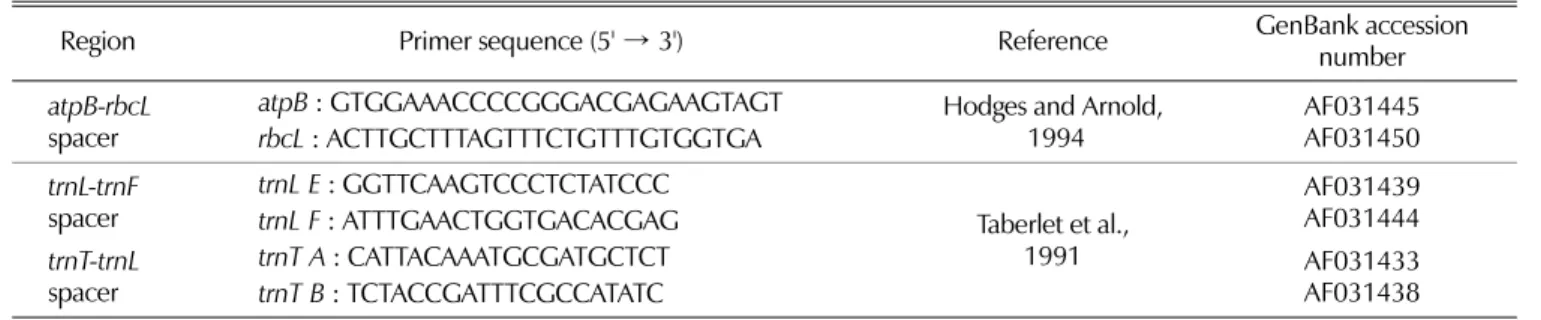
4. Analysis of the spacer regions of chloroplast DNA The three chloroplast DNA spacers ( atpB~rbcL ; Hodges and Arnold, 1994; trnL~trnF and trnT~ t rnL ; Taberler et al ., 1991) were amplified using the specific primer pairs. The orientation and approximate positions of the primers are indicated in Fig. 1A, and the primer name and sequences are as in Table 2. Chloroplast DNA amplification and Single Strand Conformational Polymorphism (SSCP) analysis of the PCR product were performed as described previously (Kong et al ., 2003).
Polymerase Chain Reaction (PCR) was performed in a total volume of 25 ㎕ . Each reaction was consisted of 0.01- 0.1 ng of template DNA, 10 pmol each primer for either atpB (F) and rbcL (R), trnL (F) and trnF (R), or trnT (F)
and trnL (R) pair, dNTPs (0.2 mM each), and Taq polymerase (1 unit, Ex Taq PCR, TaKaRa). PCR reactions were conducted essentially the same as in ITS amplification reactions (Eu et al ., 2009). For SSCP analysis, the PCR reaction products were separated on non-denaturing polyacry- lamide gels. 1 ㎕ of individual PCR products was mixed with 9 ㎕ of the denaturing buffer (95% formamide, 20 mM EDTA and 0.05% bromophenol blue). After a brief spin, mixtures were heated at 96 ℃ for 10 min then chilled on ice. Five micro liter of each mixture was loaded on 8%
acrylamide : Bis (29 : 1) nondenaturing gel cast using a Hoefer SE 600 Series (Amersham Pharmacia Biotech, USA).
Denatured PCR products were separated in prechilled 1X TBE buffer (Tris borate 89 mM, 2 mM EDTA, pH 8.0) at 200 V for 10 h ( atpB (F) ~rbcL (R) and trnT (F) ~trnL (R) regions) and 6 h ( trnL (F) ~trnF (R) region) at room temperature. After electrophoresis, polyacrylamide gels were peeled from glass plates and soaked in 150 ㎖ (per gel) of Sol A (mixture of 135 ㎖ ddH
2O, 15 ㎖ ethyl alcohol and 810 ㎕ glacial acetic acid) for 5 min, and gels were stained in the same amount of Sol B (mixture of 135 ㎖ ddH
2O, 15 ㎖ ethyl alcohol, 810 ㎕ glacial acetic acid and 0.3 g silver nitrate) for 10 min. Then rinsed three times in 200 ㎖ ddH
2O, gels were developed by briefly rinsing in 150 ㎖ Sol C (mixture of 135 ㎖ ddH
2O, 410 ㎕ formaldehyde and 4 g NaOH) until desired band intensity was reached. Gel images were captured using a camera (Nikon COOLPIX 995, Japan).
5. Sequence and data analysis
SSCP markers were analyzed by UPGMA (Unweighted Pair-Group Method with Arithmetic Average) method using NTSYS (Numerical Taxonomy and Multi-Variate Analysis System) program (Sneath and Sokal, 1973). The nucleotide sequences were blasted against the sequences in GenBank and annotated based on the sequence similarity. Sequence homology searches were performed using the program BLAST (Altschul et al ., 1997) against DNA and protein sequences in GenBank.
Nucleotide and deduced amino acid sequence analyses
were performed using DNASIS (Hitachi, USA), and the
programs and databases offered by the National Center for
Biotechnology Information (NIH, USA) and European
Bioinformatics Institute (EBI, UK). Multiple sequence analysis
was performed using the program AliBee (Brodsky et al .,
1995). The GC content of sequence was analyzed using the
SeqApp program (version 1.9a169, Gilbert, 1994).
RESULTS AND DISCUSSION
A total of thirteen accessions were selected from each Rubus species which formed a separate subclade by the RAPD markers (Eu et al. , 2008) for the analysis of the chloroplast DNA spacers, atpB~rbcL , trnL~trnF , and trnT~
trnL (Table 2 and Fig. 1A). The size of the amplified
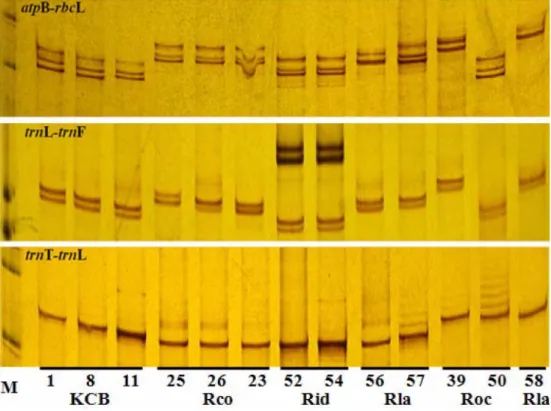
fragments for atpB~rbcL , trnL~trnF , and trnT~trnL spacers were about 0.9 kb, 0.5 kb and 1.0 kb, respectively. There was little variation in the size of the amplified fragments among all Rubus accessions tested for all the three spacers (Fig. 1B). Therefore, SSCP analysis was conducted. All the spacers showed two to four SSCP markers among the Rubus accessions (Fig. 2).
Fig. 1.
A. The three chloroplast DNA noncoding regions sampled. B. DNA fragments amplified with the primers specifically designed for the three targeted regions,
atpB(F)-
rbcL(R),
trnL(F)-
trnF(R) and
trnT(F)-
trnL(R). F and R in parenthesis indicate forward and reverse primers, respectively. M; marker, KCB; Korea cultivated Bokbunja, Rco; Bokbunja native to Korea (
R. coreanus), Rid; red raspberry (
R. idaeus), Rla; blackberry (
R. lanciniatus), Roc; black raspberry (
R. occidentalis).
Table 2.
The primer sequences targeted at the three chloroplast DNA spacer regions.
Region Primer sequence (5'
→3') Reference GenBank accession
number
atpB-rbcL
spacer
atpB: GTGGAAACCCCGGGACGAGAAGTAGT Hodges and Arnold,
1994 AF031445
AF031450
rbcL
: ACTTGCTTTAGTTTCTGTTTGTGGTGA
trnL-trnF
spacer
trnL E: GGTTCAAGTCCCTCTATCCC
Taberlet et al., 1991
AF031439 AF031444
trnL F
: ATTTGAACTGGTGACACGAG
trnT-trnL
spacer
trnT A: CATTACAAATGCGATGCTCT AF031433
AF031438
trnT B
: TCTACCGATTTCGCCATATC
In the atpB~rbcL spacer, KCB, R. occidentalis , and black raspberry had three, two, and two or three SSCP bands, respectively. One of the black raspberry accessions Roc 50 shared all three bands, but the other accession Roc 39 shared no bands in common with the three KCB accessions.
R. coreanus accessions shared only one band in common with KCB accessions. In the trnL~trnF spacer, all Rubus species had two SSCP bands except R. idaeus , which had two additional distinct bands. KCB shared one of the bands with R. coreanus but none with black raspberry. In the trnT~trnL spacer, all Rubus species had one SSCP band which was shared among all Rubus species except black raspberry which had unique SSCP band (Fig. 2).
A phylogenetic tree was constructed using the SSCP markers. A clade was formed at the genetic distance of 0.55 with four subclades. Subclade A contained the three KCB, subclade B the two black raspberry and two red raspberry accessions. Subclade C contained three R. coreanus accessions and subclade D three blackberry accessions (Fig. 3).
SSCP markers for the three chloroplast DNA spacers
suggest a similar phylogenetic relationship as revealed by RAPD and ITS markers (Eu et al. , 2008; Eu et al. , 2009).
The SSCP markers of the three KCB accessions, KCB 1, 8 and 11, clustered more closely to two black raspberry accessions, Roc 39 and Roc 50 than to those of R.
coreanus . Accessions of KCB were remotely related to R.
Fig. 2.
Single Strand Conformational Polymorphism (SSCP) analyses for the amplified DNA fragments of the three chloroplastid regions.
M; marker, KCB; Korea cultivated Bokbunja, Rco; Bokbunja native to Korea (
R. coreanus), Rid; red raspberry (
R. idaeus), Rla;
blackberry (
R. lanciniatus), Roc; black raspberry (
R. occidentalis).
Fig. 3.
Phylogenetic relationships of 13
Rubusspecies based on the 11 SSCP plastome markers. KCB; Korea cultivated Bokbunja, Rco; Bokbunja native to Korea (
R. coreanus), Rid; red raspberry (
R. idaeus), Rla; blackberry (
R.lanciniatus
), Roc; black raspberry (
R. occidentalis).
coreanus . This result implies that there is a considerable variation in the spacer sequences among Rubus species. The result also suggests that some KCB accessions share a significant similarity with black raspberry in the three chloroplast spacer regions.
To conform this result in nucleotide sequence level, we analyzed nucleotide sequences for the trnL~trnF region.
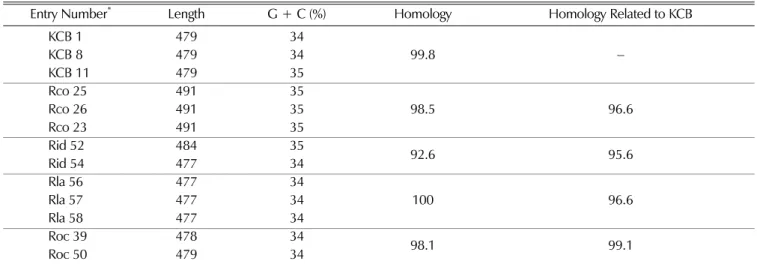
Sequences of the trnL~trnF region of each Rubus species were determined and their similarity to the known trnL-trnF region sequences were calculated. The nucleotide of the trnL~trnF region ranged from 479~491 bp in Rubus species tested and its average G + C content ranged from 34% to 35%. The homology between each accessions in each taxon ranged from 96.2% to 99.6%. The homology of Roc accessions related to KCB accessions was higher than that of Rco assession (Table 3).
A phylogenetic tree based on the sequences of the trnL~trnF region contained two strongly supported clade and three subclades. All KCB accessions were found nested within subclade A containing the two black raspberry accessions, Roc 39 and Roc 50. However, three R. coreanus were found included in subclade B (Fig. 4). Phylogenetic relationships inferred from the trnL~trnF region sequences share a significant similarity with those from SSCP, RAPD and ITS analysis (Eu et al ., 2008; Eu et al ., 2009).
In summary, the SSCP markers for the three chloroplast DNA spacers, atpB~rbcL , trnL~trnF and trnT~trnL, and the nucleotide sequences of trnL~trnF region imply that some
KCB accessions share a significantly higher similarity with R. occidentals than with R. coreanus in the chloroplast genome. This result does not support the common conviction that KCB is a domesticated R. coreanus . Thus, the result also brings up the need for close and systematic investi- gations on the genetic identity of KCB. Clarification of the identity of KCB might be a prerequisite for accurate communications on scientific findings on KCB and also for proper advertisement and business on KCB products.
LITERATURE CITED
Altschul SF, Madden TL, Schaffer AA , Zhang J, Zang ZW,
Table 3.
Size and base composition of the chloroplast
trnL~trnFspacer sequences of
Rubusspecies.
Entry Number
*Length G + C (%) Homology Homology Related to KCB
KCB 1 479 34
99.8
−KCB 8 479 34
KCB 11 479 35
Rco 25 491 35
98.5 96.6
Rco 26 491 35
Rco 23 491 35
Rid 52 484 35 92.6 95.6
Rid 54 477 34
Rla 56 477 34
100 96.6
Rla 57 477 34
Rla 58 477 34
Roc 39 478 34 98.1 99.1
Roc 50 479 34
* KCB; Korea cultivated Bokbunja, Rco; Bokbunja native to Korea (R. coreanus), Rid; red raspberry (R. idaeus), Rla; blackberry (R. lanciniatus), Roc; black raspberry (R. occidentalis).
Fig. 4.
Phylogenetic relationships of 13
Rubusspecies based on the sequence of the
trnL~trnFspacer region. KCB; Korea cultivated Bokbunja, Rco; Bokbunja native to Korea (
R.coreanus