241
"J. Korean Soc. Radiol., Vol. 8, No. 5, August 2014"
Clinical Correlation between the Autoimmune Thyroid Disease for the Thyroid Autoimmune Antibodies and the Maximum Standardized Uptake
Value: Base on the Hashimoto's Thyroiditis and the Graves' Disease
Minsun Woo * , Chulin Baek * , Jueun Yoo * , Jongwoo Song * , Inchul Im * , Juchul Son ** , Soodong Cho *** , Jaeseung Lee *
Department of Radiological Science, Dongeui University * ,
Department of Nuclear Medicine, Southeastern Institute of Radiological Hospital ** , Department of Radiology, Busan Veterans Hospital ***
자가 면역 갑상선 질환에 대한 최대 표준섭취계수와 갑상선 자가 항체의 임상적 상관관계: 하시모토 갑상선염과
그레이브스병 중심으로
우민선
*
, 백철인*
, 유주은*
, 송종우*
, 임인철*
, 손주철**
, 조수동***
, 이재승*
동의대학교 방사선학과 * , 동남권원자력의학원 핵의학과 ** , 부산보훈병원 영상의학과 ***
Abstract
The purpose of this study were to analyze the clinical correlation between the thyroid autoimmune antibodies (anti-TPO Ab, anti-TG Ab, and TSH) and the maximum standardized uptake value (SUV
max
) base on the Hashimoto's thyroiditis and the Graves' disease in diffusely18
F-FDG uptake of the thyroid gland to the PET/CT image. To achieve this, we was performed the PET/CT examination for the 1,097 subjects from May 2010 to April 2013 in the health screening, and was detected the diffused FDG thyroid uptake, and was additionally performed the thyroid function test (TFT) and the ultrasound (US). As a results, the autoimmune thyroid disease with the diffused FDG thyroid uptake were discovered 39 patients (3.9%), of this, the Hashimoto's thyroiditis was 43.6% and the Graves' disease was 23.1%. Hashimoto's thyroiditis was shown the positive reaction of high titer between the anti-TPO Ab and the anti-TG Ab level, and the correlation coefficient between the SUVmax
and the anti-TPO Ab was a statistically significant (r>04, p<0.05). Also, Graves' disease was shown the positive reaction of high titer most of the thyroid autoimmune antibodies, and the correlation coefficient between the SUVmax
and the anti-TPO Ab was a statistically significant (r>05, p<0.01). Therefor, when have a high standard of the SUVmax
due to the diffusely18
F-FDG uptake of the thyroid gland, Hashimoto's thyroiditis and Graves' disease were proportionally increased the anti-TPO Ab and TSH level, respectively. The correlation coefficient between the SUVmax
and the thyroid autoimmune antibodies will be the most influential criterion that was a standard of judgment for the epihpenomenon of the autoimmune thyroid disease, and it will be available for the clinical application.Key Words : Diffused FDG thyroid uptake, Maximum standardized uptake vale (SUV max ), Thyroid autoimmune antibodies, Hashimoto's thyroiditis, Grave's disease.
http://dx.doi.org/10.7742/jksr.2014.8.5.241
Corresponding Author: Jae-seung Lee E-mail:[email protected] Tel: +82-51-890-2679
No. 614-714, Dong-Eui University, 995 Eomgwang-no, Busanjin-gu, Busan, korea
요 약
본 연구는 미만성
18
F-FDG 갑상선 섭취를 보이는 PET/CT 영상에서 최대 표준섭취계수(SUVmax
)와 갑상선 자가 항체(anti-TPO Ab, anti-TG Ab, TSH)들 사이의 임상적 상관관계를 하시모토 갑상선염과 그레이브스병 중심으로 분 석하였다. 이를 위하여 2010년 5월부터 2013년 4월까지 건강검진에서 PET/CT 검사를 시행한 환자 1,097명을 대상 으로 미만성 FDG 갑상선 섭취 여부를 분석하여 갑상선 기능 검사와 초음파 검사를 추가적으로 시행하였다. 결과 적으로 미만성 18F-FDG 갑상선 섭취를 보이는 자가 면역 갑상선 질환 환자는 39명(3.6%)이 발견되었으며 하시모 토 갑상선염은 43.6%, 그레이브스병은 23.1% 이었다. 하시모토 갑상선염은 anti-TPO Ab와 anti-TG 수준이 높은 역 가의 양성 반응을 보였으며 SUVmax
와 anti-TPO Ab간 상관계수가 통계적으로 유의하였다(r>0.4, p<0.05). 또한 그레 이브스병은 대부분의 갑상선 자가 항체의 수준이 높은 역가의 양성 반응을 보였으며 SUVmax
와 TSH간 상관계수가 통계적으로 유의하였다(r>0.5, p<0.01). 따라서 미만성 18F-FDG 갑상선 섭취 증가에 따른 SUVmax
수준이 높을수록 하시모토 갑상선염은 anti-TPO Ab 수준이, 그레이브스병은 TSH 수준이 비례적으로 증가됨을 알 수 있었고 이러한 상관관계는 자가 면역 갑상선 질환에 대한 부대 징후를 판단할 수 있는 가장 영향력 있는 척도로서 임상적 적용이 가능할 것으로 판단하였다.중심단어 : 미만성 FDG 섭취 , 최대 표준섭취계수 , 갑상선 자가 항체 , 하시모토 갑상선염 , 그레이브병
Ⅰ. INTRODUCTION
미토콘드리아(mitochondria)가 결핍된 대부분의 암세 포는 해당 경로(glycolytic pathway)의 에너지(adenosine triphosphate. ATP) 생성 효율이 낮기 때문에 정상 세포 보다 약 4배 이상의 포도당 대사가 증가하는 것으로 밝혀지면서
18
F-FDG(Fluoro-2-Deoxy-D-Glucose)를 이용 한 PET/CT(positron emission tomograph/computed tomograph)는 암 진단 및 영상의학적 검사에 중요한 역할을 하고 있다[1]
. PET/CT 검사에서 유리지방산을 주 영양소로 소비하는 갑상선(thyroid gland)은 포도당 으로 구성된18
F-FDG의 섭취(uptake)가 없거나 낮기 때 문에 최대강도투사(maximum intensity projection. MIP) 영상에서 관찰되지 않은 것으로 알려져 있다[2]-[4]
. 그 러나 PET/CT 영상에서 우연하게 미만성18
F-FDG 갑 상선 섭취(diffusely18
F-FDG uptake in the thyroid gland) 가 발견되고 있으며 환자의 임상적 관리 및 전반적인 건강에 중대한 영향을 미칠 수 있기 때문에 정확한 임 상적 의의를 판단하는 것은 매우 중요하다[5]-[7]
. 일반 적으로 미만성18
F-FDG 갑상선 섭취 증가는 PET/CT 검사 환자의 0.6-3.3% 정도로 보고되었으며[8]-[11]
자가 면역 갑상선 질환(autoimmune thyroid disease)과 관련 있음을 보고하였다[12]-[15]
.유전 및 환경적 요인에 따라 비특이적 양상이 나타 나는 자가 면역 갑상선 질환은 티로글로불린 (thyroglobulin. TG), 갑상선과산화효소(thyroperoxidase.
TPO), 갑상선자극호르몬(thyroid-stimulating hormone.
TSH) 수용체가 자가 항원으로 알려져 있으며 대표적 으로 하시모토 갑상선염(Hashimoto's thyroiditis)과 그레 이브스병(Graves' disease)이 있다
[16],[17]
. 하시모토 갑상 선염에 대한 발생 원인은 정확하게 알려져 있지 않으 나 갑상선 자가 항체(thyroid autoimmune antibodies) 역 가가 높다는 것을 감안할 때 갑사선기능저하증 (hyporthyroidism)을 유발하는 자가 면역성 질환으로 분 류할 수 있다[18]
. 그레이브스병은 B림프구가 생산한 면 역 글로블린(globulin)들이 TSH 수용체에 결합하고 이 를 자극하여 갑상선 호르몬 분비를 증가시키기 때문 에 갑상선기능항진증(hyperthyroidism)을 유발하며 혈청 유리 T4, 총 T3, TSH 측정 등으로 감별할 수 있다[19]
. 이러한 자가 면역 갑상선 질환의 정확한 진단을 목적 으로 방사성옥소를 이용한 갑상선 스캔, 갑상선 초음 파 검사, 갑상선 기능 검사(thyroid function test. TFT) 등이 시행되고 있다. 특히 항갑상선과산화효소항체 (anti-thyroperoxidase antibody. 이하 anti-TPO Ab), 항갑 상선글로불린항체(anti-thyroglobulin. 이하 anti-TG Ab), 갑상선자극호르몬 (이하 TSH) 등의 갑상선 자가 항체"J. Korean Soc. Radiol., Vol. 8, No. 5, August 2014"
를 이용한 갑상선 기능 검사는 자가 면역 갑상선 질환 에 대한 병인뿐 만 아니라 감별 진단, 치료 방침을 결 정하는 중요한 지표가 되고 있다
[20]
.따라서 본 연구는 건강검진을 목적으로 시행한 PET/CT 영상에서 미만성
18
F-FDG 갑상선 섭취 증가 를 보였던 환자들을 대상으로 갑상선 섭취 정도를 정 량적으로 분석할 수 있는 최대 표준섭취계수(maximum standardized uptake value. 이하 SUVmax
)와 갑상선 자가 항체(anti-TPO Ab, anti-TG Ab, TSH) 수준에 대한 임상 적 상관관계를 분석하고 자가 면역 갑상선 질환에 대 한 부대 징후(epihpenomenon)를 판단할 수 있는 가이 드라인을 제시하고자 하였다.Ⅱ. MATERIAL AND METHOD
1. 연구 대상
본 연구는 2010년 5월부터 2013년 4월까지 건강검진 에서 건강검진을 목적으로 PET/CT 검사를 시행한 환 자 1,097명 중 갑상선 기능 검사 및 초음파 검사를 시 행한 환자 210명을 편의 추출하여 후향적으로 연구하 였다. 본 연구에서 국소적
18
F-FDG 갑상선 섭취(focal thyroid18
F-FDG uptake) 환자와 갑상선 질환과 관련된 약물을 복용하는 환자는 제외하였다. 연구 대상자는 PET/CT 최대강도투사영상에서 미만성18
F-FDG 갑상 선 섭취를 보이는 PDU(presence of diffused thyroid uptake) 그룹과18
F-FDG 갑상선 섭취를 보이지 않는 ADU(absence diffused thyroid uptake) 그룹으로 구분하 였다.2. PET/CT 검사, 갑상선 기능 검사, 초음파 검사 PET/CT(Biograph mCT64, Siemens Healthcare, Knoxville, Germany) 검사를 시행한 모든 환자는 검사 전 최소 6시간 이상의 금식과 1L 이상의 충분한 수분 섭취를 하였다. 소변 배설을 촉진시키기 위하여 이뇨 제(LasixⓇ, Handok, Korea) 20mg을 정맥 주사하고 7.03MBq/kg(0.19mCi/kg)의
18
F-FDG을 정맥 내 주입한 후 약 60분간 안정을 취하도록 하였다. PET/CT scan은 두개골 기저부에서 근위 대퇴부까지 2min/bed로 전신 영상을 획득하였으며 TrueX+TOF 방법으로 영상을 재구성하였고 CT영상을 이용하여 감쇠 보정하였다.
갑상선 기능 검사는 경쟁력 있는 제조사의 검사 지 침에 따라 화학 발광 미세입자 면역검사법 (chemiluminescent microparticle immunoassay. CMIA, IMMULITE 2000, SIEMENS, Germany)을 이용하여 anti-TPO Ab, anti-TG Ab, TSH를 각각 측정하였다. 결 과 판정은 제조사의 참고를 기준하여 anti-TPO Ab는
>35IU/mL, anti-TG Ab는 >120IU/mL, 그리고 TSH는
>4.2
IU/mL 일 때 양성으로 판단하였다.갑상선 초음파 검사(IU22, Philips Healthcare, USA)는 12MHz 선형 탐촉자(linear probe)를 사용하여 2명의 숙 련된 임상 초음파 전문의들에 의해 수행되었다. 환자 는 바로 누운 상태(supine)에서 sponge pillow를 어깨에 놓고 목을 충분하게 신전되도록 하였으며 종단면 영 상은 목뿔뼈(hyoid bone)에서 흉곽 입구까지, 횡단면 영상은 양쪽 목빗근(sternocleidomatoid muscle) 바깥쪽 의 level 6까지 충분하게 포함되도록 검사하였다. 세로 및 가로 스캔을 포함한 두 개 이상의 투영에서 갑상선 의 좌‧우엽, 그리고 갑상선 협부가 충분히 평가되도록 하여 갑상선의 크기 및 실질 에코 변화, 주변 해부학 적 구조물들의 이상 여부를 판단하였다. 최종적으로 2 명의 숙련된 임상 초음파 전문의들의 합의에 의해 명 백하게 확진이 결정된 환자(PDU 그룹: 그레이브 병과 하시모토 갑상선염, ADU 그룹: 정상)를 대상으로 하였 으며 초음파 검사에서 경계가 불분명한 낮은 에코를 보이면서 동시에 결절 내부에 석회화 또는 낭성 변화 가 동반되거나 갑상선 암을 시사하는 초음파 소견이 보여 초음파 유도 미세침 흡인 세포 검사를 시행한 환 자는 제외하였다.
3. PET/CT 영상 분석 및 통계 분석
미만성
18
F-FDG 갑상선 섭취 정도는 축(axial) PET/CT 융합(fusion) 영상에서 2명의 핵의학 전문의가 개별적으로 판독한 후 합의에 의해 결정되었으며 Tateishi 등의 연구에서 소개된 종격동의 혈액풀 (mediastinal blood pool)의 섭취 정도와 같거나 높은 경 우 섭취 증가로 판단하였다[21]
. 갑상선 섭취 정도를 정 량적으로 분석할 수 있는 표준섭취계수(standardized uptake value. SUV)의 측정은 갑상선 엽에서 섭취 강도역(region of interest. ROI)을 설정하고 자동으로 SUV
max
를 측정하였다.
통계 분석은 SPSS 18.0(Statistical package for social science for WindowTM release 18.0, SPSS Inc., Chicago, IL, USA)을 통해 수행되었다. PDU 그룹과 ADU 그룹 에 대한 일반적 특성은 기술통계분석를 이용하여 평 균 및 표준편차를 구하였으며 두 그룹간 상관관계는 독립표본 T 검정(independent sample T-test)을 실시하였 다. PDU 그룹에서 SUV
max
와 갑상선 자가 항체 수준에 대한 상관관계는 이변량 상관분석(bivariate correlation) 과 선형 회귀분석(linear regression)을 이용하여 분석 하 였다. 모든 상관계수의 유의확률은 0.05 또는 0.01 이하 수준에서 유의하다고 판단하였다.Ⅲ. RESULT
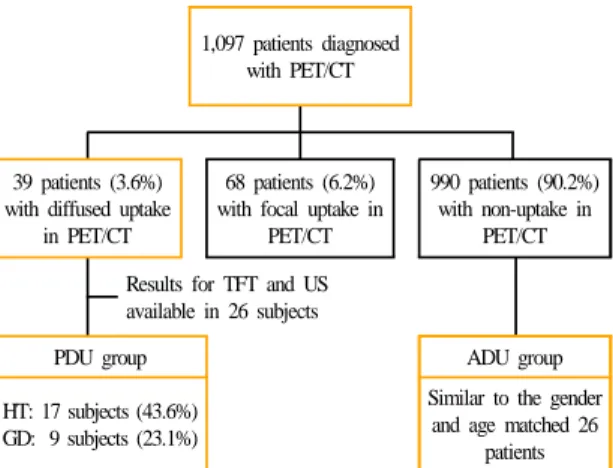
PET/CT 검사를 시행한 1,097명의 환자 중 미만성
18
F-FDG 갑상선 섭취 증가를 보이는 자가 면역 갑상 선 질환 환자는 39명(3.6%)이 발견되었다. 갑상선 기능 검사 및 초음파 검사를 통해 하시모토 갑상선염과 그 레이브스병으로 확진 받은 환자는 각각 17명(43.6%)과 9명(23.1%)이었으며(PDU 그룹: 26명) 남성이 3명 (11.5%), 여성이 23명(88.5%), 평균 연령은 48.53±8.49세 이었다(Fig. 1).1,097 patients diagnosed with PET/CT
39 patients (3.6%) with diffused uptake
in PET/CT
68 patients (6.2%) with focal uptake in
PET/CT
990 patients (90.2%) with non-uptake in
PET/CT Results for TFT and US
available in 26 subjects
PDU group ADU group
HT: 17 subjects (43.6%) GD:
09 subjects (23.1%)
Similar to the gender and age matched 26
patients Fig. 1. Distribution of the Hashimoto's thyroiditis (HT) and the Grave's thyroiditis (GT) by results for the thyroid function test
(TFT) and ultrasound (US) available in 26 subjects.
ADU 그룹은 PDU 그룹과 성별 및 연령 비율을 유사 하게 일치(남성: 3명, 여성: 23명)시켰으며 평균 연령은 46.18±9.53세이었다(Fig. 1).
Table 1은 하시모토 갑상선염과 그레이브병으로 확 진 받은 PDU 그룹에 대한 SUV
max
와 갑상선 자가 항 체(anti-TPO Ab, anti-TG Ab, TSH)에 대한 측정 결과를 보여준다. PET/CT 영상에서 측정한 PDU 그룹의 SUVmax
는 ADU 그룹(정상 대조군)과 비교하여 약 3배 이상 높게 나타났다.(n=26)
PDU ADU
HT GD
TFT
Anti-TPO Ab (IU/mL) Anti-TG Ab (IU/mL) TSH ( U/mL)
862.7±168.2 374.3±104.4 4.2±2.8
227.6±43.2 460.1±94.6 10.3±1.9
24.8±10.4 65.5±23.1 3.8±1.7 PET/CT findings
SUV
max6.4±1.2 7.1±1.9 2.1±0.8
PDU: presence of diffused thyroid uptake, ADU: absence diffused thyroid uptake, HT: Hashimoto's thyroiditis, GD: Graves' disease, TFT: thyroid function test, anti-TPO Ab: anti-thyroperoxidase antibody, anti-TG Ab:
anti-thyroglobulin, TSH: thyroid stimulating hormone, SUV
max: maximum standardized uptake value.
When reference values were satisfied with the anti-TPO Ab >35 IU/mL, anti-TG Ab >120 IU/mL, and TSH >4.2 IU/mL, we determined the positive value. But, the TFT measured values does not show a 95% of normal distribution.
Table 1. Results for the thyroid function test (TFT) and the
maximum standardized uptake value (SUV max ) according to the
Hashimoto's thyroiditis and Graves' disease in the presence of
diffused thyroid uptake (PDU) group.
"J. Korean Soc. Radiol., Vol. 8, No. 5, August 2014"
(n=26)
HT
*GD
*t-value p-value t-value p-value
TFT Anti-TPO Ab Anti-TG Ab TSH
5.443 1.558 2.385
0.001 0.123 0.019
5.378 7.861 1.560
0.001 0.001 0.120
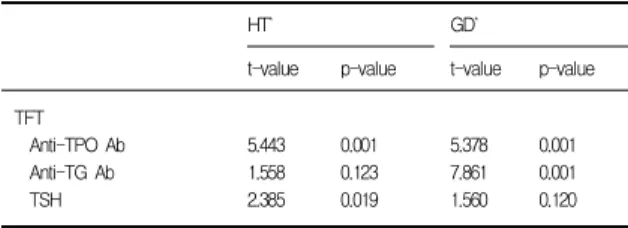
HT: Hashimoto's thyroiditis, GD: Graves' disease, TFT: thyroid function test, anti-TPO Ab: anti-thyroperoxidase antibody, anti-TG Ab: anti-thyroglobulin, TSH: thyroid stimulating hormone.
*
Significant difference between the PDU and ADU groups by using the independent samples T-test (p<0.05).
Table 2. The relationship between the PDU groups and the ADU group for the thyroid autoimmune antibodies in the thyroid function test (TFT).
(n=26)
HT_SUV
maxGD_SUV
maxr-value
+p-value r-value p-value
TFT Anti-TPO Ab Anti-TG Ab TSH
0.445 0.032 0.128
0.024
*0.773 0.242
0.268 0.132 0.564
0.057 0.356 0.000
**HT: Hashimoto's thyroiditis, GD: Graves' disease, TFT: thyroid function test, anti-TPO Ab: anti-thyroperoxidase antibody, anti-TG Ab: anti-thyroglobulin, TSH: thyroid stimulating hormone.
+
, Pearson correlation coefficient.
*
p<0.05 by bivariate correlation analysis.
**
p<0.01 by bivariate correlation analysis.
Table 3. Results of the bivariate correlation analysis between the maximum standardized uptake values (SUV
max) and the thyroid autoimmune antibodies for the Hashimoto's thyroiditis and the Graves's disease in the PDU group.
(n=26)
HT_SUV
maxGD_SUV
maxR
2 -value
+p-value R
2 -value
+p-value
HT_TFT Anti-TPO Ab Anti-TG Ab TSH
0.494 0.336 0.192 0.110
0.012
*0.151 0.317
0.401 0.213 0.153 0.576
0.074 0.199 0.000
**HT: Hashimoto's thyroiditis, GD: Graves' disease, TFT: thyroid function test, anti-TPO Ab: anti-thyroperoxidase antibody, anti-TG Ab: anti-thyroglobulin, TSH: thyroid stimulating hormone.
+
,Standardized coefficient.
*
p<0.05 by linear regression analysis.
**
p<0.01 by linear regression analysis.
Table 4. Results of the linear regression analysis between the maximum standardized uptake values (SUV
max) and the thyroid autoimmune antibodies for the Hashimoto's thyroiditis and the Graves's disease in the PDU group.
또한 두 질환에 대한 갑상선 자가 항체가 모두 양성 으로 나타났으며(anti-TPO Ab: >35IU/mL, anti-TG Ab:
>120IU/mL, and TSH: >4.2
IU/mL) 하시모토 갑상선 염 환자의 anti-TPO Ab와 그레이브스병 환자의 anti-TG Ab가 특징적으로 항진되어 나타났다. 특히 하 시모토 갑상선염은 anti-TPO Ab와 TSH, 그레이브스병 환자의 경우 anti-TPO Ab와 TSH가 통계적으로 유의하 게 높게 나타났으며(p<0.05) anti-TPO Ab는 두 질환에 공통적으로 직접 길항하는 갑상선 자가 항체임을 알 수 있었다(Table 2).Table 3과 4는 PDU 그룹에서 종속변수 SUV
max
에 따른 독립변수 갑상선 자가 항체들 사이의 상관관계 분석 결과를 보여준다. 하시모토 갑상선염은 SUVmax
와 anti-TPO Ab간의 상관계수(r)가 0.445로서 유의수준 0.05에서 약한 양(+)의 상관관계를 나타냈으며 통계적 으로유의하였다(r<0.5, p<0.05, Table 3). 또한 그레이브 스병은 SUV
max
와 TSH간의 상관계수(r)가 0.564로서 유 의수준 0.01에서 강한 양(+)의 상관관계를 나타냈으며 통계적으로 유의하였다(r>0.5, p<0.01, Table 3). 이러한 결과는 PDU 그룹에서 미만성18
F-FDG 갑상선 섭취 증가에 따른 SUVmax
수준이 높을수록 하시모토 갑상 선염의 anti-TPO Ab와 그레이브스병의 TSH에 대한 갑 상선 자가 항체 수준이 비례적으로 증가됨을 알 수 있 었다. 또한 SUVmax
와 갑상선 자가 항체들 사이의 인과 관계를 선형 회귀(linear regression) 분석한 결과 미만성18
-FDG 갑상선 섭취에 대한 SUVmax
수준은 하시모토 갑상선염과 그레이브스병에 대하여 유의확률 0.05와 0.01 수준에서 각각 49.4%와 40.1%의 높은 신뢰성을 보였으며(R2
>0.4, p<0.05 or p<0.01) SUVmax
수준에 대 하여 하시모토 갑상선염은 anti-TPO Ab, 그레이브스병 은 TSH가 자가 면역 갑상선 질환에 대한 부대 징후 (epihpenomenon)를 판단할 수 있는 가장 영향력 있는 척도로서 통계적으로 유의하였다(HT: 0.336, p<0.05;GD: 0.576, p<0.01).
Ⅳ. DISCUSSION
18
F-FDG PET/CT는 비침습적으로 암의 진단 및 추 적 관찰이 용이하기 때문에 임상적으로 이용이 급증 하고 있다. 일반적으로 유리지방산을 주 영양소로 소취되지 않으나 주 갑상선 세포막의 기능적 자극 및 TSH 등에 의존하는 글루코스 수송체(glucose transporter: GLUT-1, FRTL-5 등)가 포도당 유사체 (FDG: 2-Deoxy-D-Glucose)의 흡수를 증가시켜 우연하 게
18
F-FDG 갑상선 섭취가 발견되고 있다[22],[23]
. 이러 한18
F-FDG 갑상선 섭취 양상은 형태에 따라 갑상선 의 일부에 국한되어 섭취 증가가 나타나는 국소적 섭 취(focal uptake), 전반적 갑상선 섭취 증가를 보이는 미 만성(diffuse uptake) 섭취, 그리고 두 가지 양상이 모두 나타나는 혼합형 갑상선 섭취의 세 가지 범주로 나눌 수 있다. 국소적18
F-FDG 갑상선 섭취 증가는 27-50%이내에서 악성종양과 유두 갑상선암과 관련 있으며 미만성
18
F-FDG 갑상선 섭취의 경우 0.6-3.3% 이내에 서 자가 면역성 갑상선 질환과 갑상선 기능 저하와 관 련 있다고 보고하였다[2],[9],[11],[24],[25]
.따라서 본 연구는 미만성
18
F-FDG 갑상선 섭취를 보이는 PET/CT 영상에서 SUVmax
와 갑상선 자가 항체 (anti-TPO Ab, anti-TG Ab, TSH)들 사이의 임상적 상관 관계를 하시모토 갑상선염과 그레이브스병 중심으로 분석하였다. 갑상선 호르몬 치료제를 복용하는 경우18
F-FDG 갑상선 섭취 증가가 50% 이상 발생할 수 있 다고 보고한 Karantanis 등[15]
의 연구를 토대로 갑상선 질환과 관련된 약물을 복용하는 환자는 본 연구에서 제외되었다. 전체 대상자 중에서 자가 면역 갑상선 질 환 은 3.6% 이었으며 하시모토 갑상선염(Hashimoto's thyroiditis) 환자가 43.6%로 유병률이 가장 높았고 23.1%를 차지하는 그레이브스병(Graves' disease)이 갑 상선에 주요 병소를 두고 발생하였다. 이와 관련하여 1974년에서 2000년 사이의 갑상선 질환에 대한 최근 연구에서 19,944명의 환자 중 하시모토 갑상선염과 그 레이브스병의 유병률을 각각 37.3%, 24.1%으로 보고한 Ieiri 등[26]
의 연구와 유사하였다.하시모토 갑상선염은 인간 주조직적 합성 복합체 (Human Leukocyte Antigen. HLA)와 관련이 있으며 높 은 역가의 갑상선 자가 항체로 검사할 수 있다. 검사 소견상 anti-TPO Ab가 90%, anti-TG는 60% 이상에서 대체로 높은 역가의 양성을 보이며 T4와 TSH 수준은 정상보다 약간 증가한다
[27],[28]
. 17명의 하시모토 갑상 선염 환자들은 anti-TPO Ab와 anti-TG 수준이 높은 역간 증가하였다. 특이적인 소견은 만성 자가 면역 갑상 선 질환 중에서 갑상선 기능 저하증이 나타난 3명의 환자에 대한 TSH 역가가 높게 나타났다(TSH:
18.2±2.7>4.2
IU/mL). 또한 갑상선 호르몬의 과잉 생 산 및 과잉 분비와 미만성 갑상선종이 가장 뚜렷한 소 견을 보인 그레이브스병은 대부분의 갑상선 자가 항 체들이 높은 역가의 양성 반응을 보였다. 이와 관련하 여 Karantanis 등[15]
과 Kim 등[29]
은 미만성18
F-FDG 갑 상선 섭취를 보이는 환자의 대부분은 갑상선 호르몬 (TSH)를 자극하였으나 TSH 수준과18
F-FDG 섭취 수 준간 유의한 상관관계가 없다고 지적하였으며 Weetman은[19]
B림프구가 생산한 면역글로블린들이 TSH를 자극하여 갑상선 호르몬 분비를 증가시키기 때 문에 혈청 유리 T4 및 T3, TSH 측정은 그레이브스병 에 대한 진단적 가치가 있다고 하였다.최근 PET/CT 영상에서 미만성
18
F-FDG 갑상선 섭 취 증가에 대한 임상적 의의를 SUVmax
와 갑상선 자가 항체간 상관관계를 분석한 연구들이 진행되어 왔었다.Chen 등
[30]
은 미만성18
F-FDG 갑상선 섭취 환자 1,925 명 중 간(liver)의 섭취보다 같거나 증가된 환자 39명을 연구하여 표준섭취계수와 갑상선 자가 항체간 상관관 계는 낮지만 자가 면역성 갑상선 질환 환자가 정상 갑 상선을 가진 사람보다 더 큰 포도당 대사를 보여주었 다는 것을 제안하였다. 또한 Han 등[31]
은 SUVmax
와 티 록신 및 갑상선 호르몬(TSH)이 유의확률 0.001 수준에 서 유의한 차이가 있다고 보고하였으며 Karantanis 등[15]
의 연구에 의하면 anti-TPO Ab의 역가와 SUVmax
사 이의 상관관계가 관찰되며 세포의 사멸과 섬유화 활 성 형성 등의 추가적 메카니즘의 연구가 필요하다고 언급하였다. 그러나 Bonabi 등[32]
은 미만성18
F-FDG 갑 상선 섭취는 주로 자가 면역성 갑상선 질환과 관련이 있으나 갑상선 질환간 SUVmax
에 대한 통계적 유의한 차이는 없었고 추가적 진단 또는 세포학적 검사를 제 안하였다. 그럼에도 불구하고 본 연구에서 하시모토 갑상선염 환자의 경우 SUVmax
와 anti-TPO Ab간의 상 관계수(r)는 0.445로서 유의수준 0.05에서 약한 양(+)의 상관관계가 통계적으로 유의하게 나타났으며 그레이 브스병 환자의 경우 SUVmax
와 TSH간의 상관계수(r)는 0.564로서 유의수준 0.01에서 강한 양(+)의 상관관계가"J. Korean Soc. Radiol., Vol. 8, No. 5, August 2014"
통계적으로 유의하게 나타났다(HT: r<0.5, GD: r>0.5).
이러한 결과는 높은 신뢰성을 보였으며 (R
2
>0.4, p<0.05 또는 p<0.01) 미만성18
F-FDG 갑상선 섭취 증 가에 따른 SUVmax
수준이 높을수록 하시모토 갑상선 염의 경우 anti-TPO Ab가, 그레이브스병의 경우 TSH 의 갑상선 자가 항체 수준이 비례적으로 증가됨을 알 수 있었다. 따라서 본 연구는 미만성18
F-FDG 갑상선 섭취 증가를 보이는 PET/CT 영상에서 SUVmax
수준이 높고 하시모토 갑상선염에서 anti-TPO Ab와 그레이브 스병에서 TSH의 역가가 높을수록 자가 면역 갑상선 질환에 대한 부대 징후를 판단할 수 있는 가장 영향력 있는 척도로서 임상적으로 적용 가능할 것으로 판단 하였다.V. CONCLUSION
본 연구는 미만성
18
F-FDG 갑상선 섭취 증가를 보 였던 PET/CT 영상에서 갑상선 섭취 정도를 정량적으 로 분석할 수 있는 SUVmax
와 갑상선 자가 항체 (anti-TPO Ab, anti-TG Ab, TSH)의 임상적 상관관계를 분석하였다. 많은 연구자들에 의해 SUVmax
와 갑상선 자가 항체들간의 임상적 상관관계가 통계적으로 유의 하거나 또는 유의하지 않은 것으로 보고되었으나 본 연구에서 하시모토 갑상선염의 경우 SUVmax
와 anti-TPO Ab간의 상관관계가 높은 수준의 신뢰성에서 통계적으로 유의하다고 판단하였으며 그레이브스병의 경우 SUVmax
와 TSH간의 상관관계가 높은 수준의 신 뢰성에서 통계적으로 유의하다고 판단하였다. 이러한 결과는 미만성18
F-FDG 갑상선 섭취 증가에 따른 SUVmax
수준이 증가할수록 하시모토 갑상선염은 anti-TPO Ab 수준이 증가되고 그레이브병은 TSH 수준 이 증가되기 때문에 향후 자가 면역 갑상선 질환에 대 한 부대 징후를 판단할 수 있는 가장 영향력 있는 척 도로서 임상적 적용이 가능할 것으로 판단하였다.Acknowledgements
이 논문은 2014 학년도 동의대학교 교내연구비에 의해 연구되었음(과제번호 2014AA189).