1. INTRODUCTION
The standard way for document searching on internet is through keywords, phrases and clauses.
Search engines like Bing, Yahoo, Naver, Google and others of alike routinely use machine learning algorithms to provide information requested by the user at an outstanding performance. The tools mentioned above perform better but when the process of searching involves large documents, they may get poor performance [1]. On the other hand, topic modeling and classification help a per- son to identify the topics and main themes for large collection of documents.
Topic modeling is a technique that uses stat-
istical models to discover topics and themes that occur in a collection of documents known as corpus [2]. Topic models are also known as probabilistic models that use statistical algorithms for discover- ing the latent semantic structures of a corpus [3].
They deal with categorizing texts into organized groups for the purpose of getting insights about them, discovering main topics, and describing themes [4]. Topic modeling with LDA gives a sum- mary about the theme of a corpus. It works under an assumption that each document has a mixture of topics and each topic has a collection of words [5]. The applicable techniques for topic modeling include LDA based on probabilistic graphical mod- els while Latent Semantic Analysis (LSA), Latent
Generative probabilistic model with Dirichlet prior distribution for similarity analysis of research topic
John Milyahilu†, Jong Nam Kim††
ABSTRACT
We propose a generative probabilistic model with Dirichlet prior distribution for topic modeling and text similarity analysis. It assigns a topic and calculates text correlation between documents within a corpus. It also provides posterior probabilities that are assigned to each topic of a document based on the prior distribution in the corpus. We then present a Gibbs sampling algorithm for inference about the posterior distribution and compute text correlation among 50 abstracts from the papers published by IEEE. We also conduct a supervised learning to set a benchmark that justifies the performance of the LDA (Latent Dirichlet Allocation). The experiments show that the accuracy for topic assignment to a certain document is 76% for LDA. The results for supervised learning show the accuracy of 61%, the precision of 93% and the f1-score of 96%. A discussion for experimental results indicates a thorough justification based on probabilities, distributions, evaluation metrics and correlation coefficients with respect to topic assignment.
Key words: Gibbs Sampling, Corpus, Machine Learning, Probabilistic Model, Topics
※ Corresponding Author : Jong Nam Kim, Address:
(48513) Yongso-ro 45, Nam-gu, Busan, Korea, TEL : +82-51-629-6259, FAX : +82-51-629-6263, E-mail : [email protected]
Receipt date : Apr. 7, 2020, Revision date : Apr. 14, 2020 Approval date : Apr. 16, 2020
††Dept. of IT Convergence & Application Eng. Pukyong National University
(E-mail : [email protected])
††Dept. of IT Convergence & Application Eng. Pukyong National University
※ This research was supported by HK+ Research Pro- gram through the National Research Foundation of Korea (NRF) funded by the Ministry of Education, Science and Technology (NRF–2017S1A6A3A01079869)
Semantic Indexing (LSI) and Non-negative Matrix Factorization (NMF) base on linear algebra [6].
The motivation of this work bases on the chal- lenge that mega projects are subjected to pub- lications of journal papers via reputable ones. This model has the capacity to assign a particular topic to a document within a corpus based on the ob- jectives of the project and calculate the correlation coefficients among the documents. The model serves as a proof to some projects whether they correlate with the papers published through differ- ent journals with respect to the project’s goals and objectives. Basically, the proposed work will be able to accept or reject some papers that belongs or do not belong to a certain project’s objectives.
In this work we propose a generative topic model that is capable of jointly modeling the words in a corpus arising from a mixture of topics within a corpus. This model generates both a per-document topic distribution and a per-topic word distribution that is used to determine the posterior distribution.
Using posterior probabilities assigned to docu- ments in a corpus, we determine the relationship among documents in the corpus and determine whether they belong to a certain project or not. The reason of the better performance from the proposed work is the highest probability assigned to the cor- responding word in a document term matrix.
This work is organized into five sections. The second section presents the related works and the third section describes the proposed work. Section four gives experimental results and discussion.
Lastly, section five presents concluding remarks.
2. RELATED WORKS
Topic modeling and classification are not new fields, but their significant contribution to the study of natural language processing is pivotal up to recently. There are several approaches that are used to model topics such as dimensionality reduc- tion techniques, unsupervised learning such as
clustering and form of tagging techniques [7]. Due to their essence, research works for topic modeling and classification are tremendously increasing [8].
Notable progress has been made on solving topic modeling problems by using the popular TF-IDF (Term Frequency-Inverse Document Frequency) algorithm that employs words or terms and their respective frequencies for each document in a cor- pus [9]. This popular algorithm has some short- comings such as small reduction in descriptive length for documents and limited discovery of topic and sub-topic in a collection [10].
In addressing the shortcomings of the previous schema, Deerwester et al. introduced the most eminent schema known as LSI [11]. It uses sin- gular value decomposition as a dimension reduc- tion algorithm which creates a document term ma- trix that captures most of the variance within a corpus. The schema was criticized by many schol- ars while substantiating the weaknesses of the schema that were outlined by Hofmann [12]. The model could handle multiple documents however, it had some shortcomings which are overfitting caused by the increase in number of parameters due to the size of document and assigning proba- bility to a document outside the training set was not clearly put into description. Blei et al. in- troduced LDA algorithm which performs better than other described algorithms on topic modeling because it employs variational methods and ex- pectation maximization algorithms for estimating empirical Bayes parameters [10].
LDA model performs better than TF-IDF sche- ma due the use of variational Bayesian estimation that overcomes the shortcomings mentioned in the previous paragraphs of this section. LDA model as unsupervised learning technique is a basis for text classification and performs better than supervised learning techniques in terms of accuracy. There are several classifiers which are used in text analysis such as Naïve Bayes classifier, Support Vector Machines (SVM), Decision Trees, and Nearest
neighborhood. Among others, Naïve Bayes classi- fier has better performance than SVM in text cate- gorization as described in [13]. Currently, text classification is efficiently done by deep learning algorithms including convolutional neural net- works as described in [14]-[17].
We are interested in determining a probabilistic model for topic modeling that assigns probability to each document in a corpus and has an ability to determine the relationship among documents by assigning similarity coefficients.
3. PROPOSED WORK
LDA is a is unsupervised machine learning al- gorithm produces two matrices which are a docu- ment-topic matrix and a topic-terms matrix. We certainly run unsupervised method and transform the data using the algorithm for better descriptions of the results. We subsequently examine how a method performs on the transformed data, and compare the results based on precision, f1-score and recall when used on the same corpus trans- formed by LDA and TF-IDF algorithms [10],[16].
The LDA posterior cannot determine document similarity but might be used to determine topic similarity. The assigned probabilities can therefore be used to determine the document similarity. The proposed work helps to assign topic on different documents in a corpus by using the posterior prob- abilities that are obtained from the model. LDA posterior probabilities are obtained from the multi- nomial distribution using conjugate Dirichlet prior.
We use the Diritchlet prior because our problem is a multivariate and is difficult to do direct sam- pling but its probability distribution belongs to the same family of the posterior distribution.
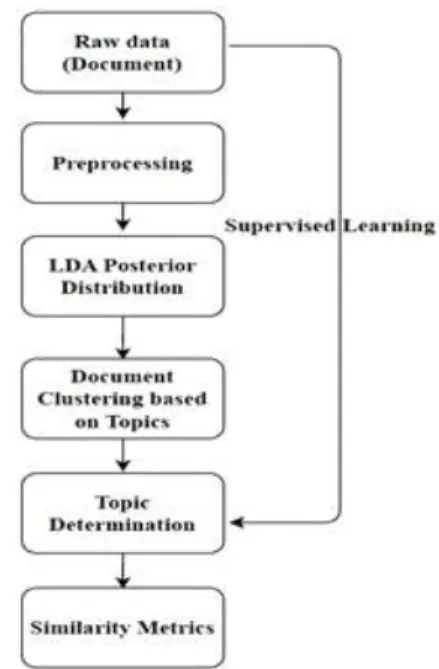
The procedure of the proposed algorithm is summarized in Fig. 1 whereby the first block with Raw data represents a corpus made up by some texts. The second block with the Preprocessing re- moves spaces, numbers, special characters and stop words in the document. The third block with
LDA Posterior Distribution calculates posterior distribution from text of the Preprocessing block.
It contains Gibbs sampler which is the conjugate prior of the posterior distribution (multinomial).
The conjugate prior is the exact distribution of the posterior distribution. The fourth block with Docu- ment Clustering designates topics randomly after obtaining the posterior probabilities from LDA Posterior Distribution block. The fifth block with Topic Determination assigns topics that can be done by both supervised learning and LDA algo- rithms. The last block with Similarity Metrics de- termines correlation coefficients from the clustered documents in the Document Clustering block.
The LDA Posterior block receives output from the Preprocessing block and uses Gibbs sampler to generate the outputs that are finally used in Document Clustering block. Gibbs sampling is a Markov Chain Monte Carlo (MCMC) algorithm for obtaining sequence of observations which are ap- proximately from the multivariate distribution. We propose Gibbs sampling technique because direct sampling is difficult to perform i.e. the probability density functions of the samples are not analytical.
Fig. 1. Procedure of the proposed algorithm.
From Fig. 2 we determine the posterior distribution by letting the parameters for the Gibbs sampler as follows; prior parameter alpha (α) be the per-docu- ment topic proportions, be the per-word topic proportion, be the observed word in a document,
be per-topic word proportions, beta () be topic hyperparameter, and be a number of documents in a corpus.
That means, there are topics that are shared among all documents, and each document
in a corpus D. The corpus is assumed as a mix- ture of topics indicated by . We can first sample a topic assignment from the topic proportions to generate the words for each document. We as- sume that the generative model has topics, a corpus D of documents and a vocabulary con- sisting of unique words. We choose the Dirichlet parameter as the prior for distribution of the generative model and present the process using the following pseudocode supported by the graphical model representation.
Pseudocode of Gibbs Sampling algorithm
∙ For ∊
Generate the multinormial distribution over top- ics in a corpus ∼
∙ For ∊
Generate multinormial distributions over the documents in a corpus ∼
For ∊
Generate topic ∼
Generate term ∼
Calculate the correlation coefficients for each document in a corpus D.
The graphical representation of the LDA algo- rithm is given in Fig. 2. The outer block represents documents, while the inner block represents the re- petitive choices of topics and words within a document.
The LDA algorithm in Fig. 2 is divided into three parts which are unigram model, mixture of un- igrams and probabilistic latent sematic indexing model. In the inner block of this figure which con- stitutes of and from a corpus , the terms() of every document are drawn independently from a multinormial distribution expressed by Eq. (1).
This stage represents the unigram model within the LDA model for discrete text data.
, (1)
The second stage is the combination of the pre- vious stage and that makes a mixture of un- igrams stage. In this stage each document is gen- erated by choosing a topic and then generate terms from multinormial distribution as shown in Eq. 2.
(2)
The third stage is the probabilistic latent index- ing, which is the combination of the first stage, the second stage with the document from . In this stage, the mixture of topics in and the term
are conditionally independent for unknown topic as expressed in Eq. 3.
(3)
where is a document chosen in a multinormial distribution with a probability density function of
. This stage determines the possibility that a document contains multiple topics because of
acts as a mixture of weights of topics in a Fig. 2. Graphical representation of LDA.
document. The probability distribution of is a multivariate Dirichlet distribution given by Eq. 4.
(4)
where is the Gamma function and is the pa- rameter within simplex or vector also known as a multinormial distribution of k words.
Lastly, we use Pearson correlation coefficient in Eq. (5) to determine the relationship (similarities) among documents using the probabilities assigned to the topics of each document.
(5)
4. EXPERIMENTAL RESULTS AND DISCUSSION
The experiments of this work were conducted through a computer operating on windows 10 in- stalled with Python and R programs that were used for data analysis. Text mining, natural language processing, machine learning and topic models’ li- braries were employed to analyze the performance.
The dataset were the extracted abstracts from sci- entific papers published by IEEE journals from 2010 to 2019 in the field of “motion estimation”,
“image classification”, “image segmentation”, “object detection” and “3D reconstructions”. Each field has a total 10 papers with different titles and contents while some papers share the methodologies and techniques for analysis.
The preprocessing steps involve transforming to
lower case, removing special symbols, numbers, punctuations, white spaces and general errors via tm library which is related to text mining. The ini- tial entry argument in the topic model function is the document-term matrix associated with param- eters such as number of clusters. We set a few initial steps of a random walk (Gibbs Sampler) and skip the steps that are not related to the prior dis- tribution through the burn-in period and perform 2000 iterations dividing them into four steps in or- der to overcome multicollinearity. The random walk finds only a local optimal solution that is ob- tained by implementing different settings on the parameters for many times.
The algorithm with a Gibbs sampler performs batter than the supervised learning approach whose results are displayed in different tables showing that this method is robust and efficient on topic modeling problems. Based on the document term matrix, the assigned topics are image segmenta- tion, image classification, 3D reconstruction, mo- tion estimation and object detection. The following tables show the most frequently used terms in each topic, document-topic distribution, probabilities, evaluation metrics and correlation coefficients.
Table 1 describes the topic word distribution with the most frequently used terms for each as- signed topic to every document in a corpus. In the first topic the most frequent words are “image”,
“methods”, “use” and “segmentation.” If we as- sume that the word “use” and “method” are stop words then, the only significant words could repre- sent the topic of “image segmentation". The same procedure applies to the rest of the topics starting from the second topic to fifth one that ignores the
Table 1. Showing topic-word distribution for each assigned topic
Term Topic 1 Topic 2 Topic 3 Topic 4 Topic 5
1 image network paper algorithm learn
2 method feature reconstruction propose detect
3 use model present search object
4 segment classify result motion deep
term “learn” and “deep” to represent the topic
“object detection”.
Results in Table 2 show that, from documents named abstract10-13.txt, there are only two ab- stracts that are correctly assigned to a correspond- ing topic and the rest were wrongly assigned, ab- stracts30-34.txt were correctly assigned except for the document named abstract30.txt. The topic as- signment accuracy is equivalent to 76% for 50 documents involved in the experiment.
The highest probabilities are observed for docu-
ments assigned to topic 4 and 5 while topic 1 and 3 contained smallest probability values. The model performed poorly on assigning topics to documents named as abstracts1-10.txt whereby the correctly assigned documents were only four.
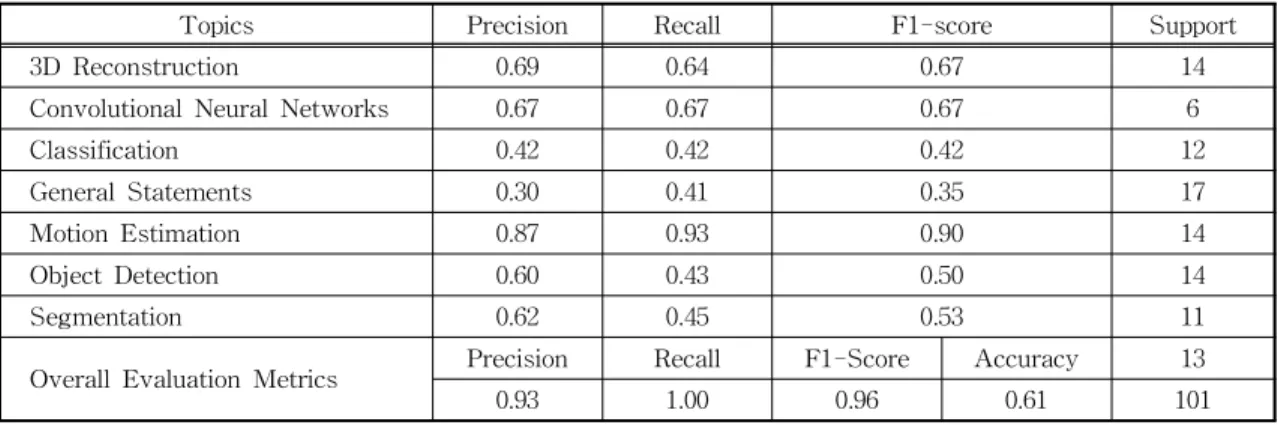
Table 4 displays the evaluation metrics for a su- pervised learning approach classifying texts per predefined labels or topics. We randomly divided the training dataset into two parts. The one is 25%
of the data for training the classifier and the other is 75% of the dataset for testing it [13]. Using Naïve Bayes classifier, we obtained 61% of accu- racy, which is correctly assigned to a topic. Addi- tionally, we got 93% of precision that the classifier correctly tagged each document to a topic. The fraction of the relevant documents that are suc- cessfully retrieved is 100% and f1-score is 96%.
Table 5 shows the similarity between topics as- signed to different documents in a corpus. Docu- ments assigned to “image classification” and
“image segmentation” were closely related to each other while documents assigned to “image classi- fication” and “3D reconstructions” were not related to each other. The topics assigned as “motion esti- mation” and “object detection” indicate positive correlation coefficients while the documents as- signed to “3D reconstructions” are negatively cor- related to the documents assigned to “Image seg- mentation”. From the experimental results above, it is noted that the proposed algorithm is efficient Table 2. Document-topic distribution
Document Topic Document Topic
abstract1.txt 2 abstract30.txt 2 abstract10.txt 3 abstract31.txt 4 abstract11.txt 2 abstract32.txt 4 abstract12.txt 2 abstract33.txt 4 abstract13.txt 1 abstract34.txt 4
Table 3. Topic probabilities by documents (abstracts) Abstracts Topic
1 Topic
2 Topic
3 Topic
4 Topic
5
20 0.44 0.13 0.11 0.11 0.21
21 0.51 0.08 0.15 0.08 0.18
25 0.09 0.08 0.11 0.60 0.11
27 0.11 0.13 0.12 0.59 0.07
28 0.12 0.14 0.12 0.55 0.06
39 0.11 0.16 0.09 0.08 0.56
42 0.12 0.17 0.06 0.09 0.56
Table 4. Evaluation metrics for text classification
Topics Precision Recall F1-score Support
3D Reconstruction 0.69 0.64 0.67 14
Convolutional Neural Networks 0.67 0.67 0.67 6
Classification 0.42 0.42 0.42 12
General Statements 0.30 0.41 0.35 17
Motion Estimation 0.87 0.93 0.90 14
Object Detection 0.60 0.43 0.50 14
Segmentation 0.62 0.45 0.53 11
Overall Evaluation Metrics Precision Recall F1-Score Accuracy 13
0.93 1.00 0.96 0.61 101
and accurate for assigning topics to documents and obtains correlation coefficients for related and un- related documents.
5. CONCLUSION
In the paper, we proposed a generative proba- bilistic model with Dirichlet prior distribution for topic modeling and text similarity analysis. The characteristics of the proposed algorithm was to determine the posterior distribution based on the Gibbs sampler. The algorithm determined docu- ment similarity based on the posterior probabilities assigned to each topic of a document in a corpus.
The meaning of the results is that the highest or lowest probability on a topic assigned to a docu- ment can affect the correlation coefficient among documents. The experimental results indicate that 76% of the documents in a corpus were correctly assigned to specific topics using the unsupervised learning technique. On the other hand, supervised learning technique based on a Naïve Bayes classi- fier achieved an accuracy of 61% which is smaller than that of the proposed algorithm. From the re- sults, we can conclude that the proposed algorithm has good performance for assigning topics to docu- ments and text similarity analysis.
REFERENCE
[ 1 ] H. Yuening, J.B. Graber, B. Satinoff, and A.
Smith, "Interactive Topic Modeling,"Machine Learning, Vol. 95, pp. 423-469, 2014.
[ 2 ] H. Jelodar, Y. Wang, C. Yuan, X. Feng, X.
Jiang, Y. Li, et al., “Latent Dirichlet Allocation (LDA) and Topic Modeling: Models, Applica- tion, A Survey,” Multimedia Tools and Applications, Vol. 78, pp. 15169-15211, 2019.
[ 3 ] A. Beykikhoshk, O. Arandjelovic, D. Phung, and S. Venkatesh, “Discovering Topic Struc- tures of a Temporary Evolving Document Corpus,” Knowledge and Information Sys- tems, Vol. 55, pp. 599-632, 2018.
[ 4 ] K. Kowsari, K.J. Meimandi, M. Heidarysafa, S. Mendu, L. Barnes, and D. Brown, “Text Classification Algorithms: A Survey,”Infor- mation, Vol. 10, No. 3, pp. 1-68, 2019.
[ 5 ] N. Pladeau, and E. Davoodi, “Comparison of Latent Dirichlet Modeling and Factor Anal- ysis for Topic Extraction,"Proceeding of the Hawaii International Conference on System Sciences, pp. 615-623, 2018.
[ 6 ] J. Rashid, S.M. Shah, A. Irtaza, T. Mahmood, M. Shafiq, and A. Gardezi, “Topic Modeling Technique for Text Mining Over Biomedical Text Corpora Through Hybrid Inverse Docu- ments Frequence and Fuzzy K-Means Clus- tering,” IEEE Access, Vol. 7, pp. 146070- 146080, 2019.
[ 7 ] J. Clark, and F. Provost, “Unsupervised Dimension Reduction versus Supervised Re- Table 5. Document similarity based on Pearson correlation coefficient
A1 A5 A11 A15 A21 A25 A31 A35 A41 A45
A1 1.00 0.71 0.78 -0.42 -0.11 -0.02 0.16 0.32 0.48 0.54
A5 0.71 1.00 0.75 -0.82 0.22 -0.81 -0.84 -0.71 0.60 -0.02
A11 0.78 0.75 1.00 0.99 -0.48 -0.47 -0.83 -0.51 0.02 -0.08
A15 -0.42 -0.82 0.99 1.00 0.71 0.68 0.39 0.24 -0.52 0.59
A21 -0.11 0.22 -0.48 0.71 1.00 0.80 -0.03 -0.42 0.51 0.48
A25 -0.02 -0.81 -0.47 0.68 0.80 1.00 -0.56 0.22 0.45 0.66
A31 0.16 -0.84 -0.83 0.39 -0.03 -0.56 1.00 0.94 0.36 0.44
A35 0.32 -0.71 -0.51 0.24 -0.42 0.22 0.94 1.00 0.64 0.73
A41 0.48 0.60 0.02 -0.52 0.51 0.45 0.36 0.64 1.00 0.86
A45 0.54 -0.02 -0.08 0.59 0.48 0.66 0.44 0.73 0.86 1.00
gularization for Classification from Sparse Data," Data Mining and Knowledge Discov- ery, Vol. 33, pp. 871-916, 2019.
[ 8 ] T.R. Hannigan, R.F. Haans, K. Vakili, H.
Tchalian, V.L. Glaser, M.S. Wang, et al., “Topic Modeling in Management Research,"Acade- my of Management Annals, Vol. 13, No. 2, pp.
586-632, 2019.
[ 9 ] Z. Gou, Z. Huo, K. Vakili, Y. Liu, and Y. Yang,
“A Method for Constructing Supervised Topic Model Based on Term Frequency-Inverse Topic Frequency,"Symmetry, Vol. 11, pp. 1-9, 2019.
[10] D.M. Blei, A.Y. Ng, and M.I. Jordan, “A Latent Dirichlet Allocation," J ournal of Machine Learning Research, Vol. 3, pp. 993-1022, 2003.
[11] S. Deerwester, S.T. Dumais, G.W. Furnas, T.K. Landauer, and R. Harshman, “Indexing by Latent Semantic Analysis," J ournal of American Society for Information Science, Vol. 41, No. 6, pp. 391-407, 1990.
[12] T. Hofmann, “Probabilistic Latent Semantic Indexing,"Proceeding of International ACM SIGIR Conference on Research and Develop- ment in Information Retrieval, pp. 50-57, 1999.
[13] M.K. Dalal, X. Chuangbai, I. Izahar, and T.
Shanshan, “Automatic Text Classification: A Technical Review," International J ournal of Computer Applications, Vol. 28, No, 2, pp. 37- 40, 2011.
[14] H. Sundus, and R. Muhammed, and M. Shaikh,
“Comparing SVM and Naive Bayes Classi- fiers for Text Categorization with Wikitology as Knowledge Enrichment," Proceeding of IEEE International Conference, pp. 1-3, 2012.
[15] M.L. Prabha, and G.U. Srikanth, “Survey of Sentiment Analysis Using Deep Learning Techniques,"Proceeding of International Con- ference on Innovations, in Information and Communication Technology, pp. 1-9, 2019.
[16] R.K. Roul, J.K. Sahoo, and K. Arora, “Modified TF-IDF Term Weighting Strategies for Text Categorization," P roceeding of IEEE India Council International Conference, pp. 1-6, 2017.
[17] M. Nam, E. Lee, and J. Shin, “A Method for User Sentiment Classification using Insta- gram Hashtags," Journal of Korea Multimedia Society, Vol. 18, No. 11, pp. 1391-1399, 2015.
John Mlyahilu
2009. 12. : BS Mathematics, University of Dares Salaam
2014. 2. : MS Statistics, Pukyong National University 2018. 9.∼ Now : Ph.D. Student,
Pukyong National University
Research fields: multimedia and image processing, computer vision, AI
Jong Nam Kim
1997. 2. : MS Information Telecommunication, GIST
2001. 8. : Ph.D. Mechatronics, GIST
2001. 8.∼2004.2. : Researcher at KBS
2004. 3.∼Now : Professor at Dept. of IT Conv. & Apps Engineering, Pukyong National University
Research fields: video compression, image processing, computer vision, deep learning