Multimodal Face Biometrics by Using Convolutional Neural Networks
Leslie Ching Ow Tiong
†, Seong Tae Kim
††, Yong Man Ro
†††ABSTRACT
Biometric recognition is one of the major challenging topics which needs high performance of recognition accuracy. Most of existing methods rely on a single source of biometric to achieve recognition.
The recognition accuracy in biometrics is affected by the variability of effects, including illumination and appearance variations. In this paper, we propose a new multimodal biometrics recognition using convolutional neural network. We focus on multimodal biometrics from face and periocular regions.
Through experiments, we have demonstrated that facial multimodal biometrics features deep learning framework is helpful for achieving high recognition performance.
Key words: Multimodal Biometrics Recognition, Face Recognition, Convolutional Neural Networks
※ Corresponding Author : Yong Man Ro, Address:
(34141) KAIST 291, Daehak-ro, Yuseong-gu, Daejeon, Korea, TEL : +82-42-350-3494, FAX : +82-42-350-5494, E-mail : [email protected]
Receipt date : Jan. 12, 2017, Approval date : Jan. 20, 2017
†
Dept. of Global Information and Telecommunication Technology, KAIST (E-mail : [email protected])
†††
School of Electrical Engineering, KAIST (E-mail : [email protected])
†††
School of Electrical Engineering, KAIST
※ This work was partially supported by the National Research Foundation of Korea (NRF) grant funded by the Korea government (MSIP) (No.2015R1A2A2A0100 5724).
1. INTRODUCTION
Majority of biometric system applications have been unimodal, which relies on a single source of biometric to achieve recognition. In [1], the authors introduced multimodal biometrics, which combined two or more biometric sources in order to prevent unacceptable error rates of unimodal biometric rec- ognition and spoofing attack. In other words, the basic concept is to use multiple biometric sources to satisfy authentication and identification require- ments.
Traditionally, the usage of different biometrics may increase recognition accuracy and precision.
In particular, by obtaining dual features such as face and periocular regions from the same source, one can obtain more favorite results. This is a quick way of improving system performance, as this does not deploy multiple sensors alongside with additional feature extraction.
Convolutional Neural Network (CNN) is becom- ing mainstream in pattern and image recognition in recent years. Due to the uniqueness in its archi- tecture, it performs segmentation, feature ex- traction and classification in one module, which has widely been used in a variety of areas, including face detection [2], face recognition [3], speech rec- ognition [4], video analysis [5], and so forth.
Therefore, using CNN typically leads to better per- formance for image and speech processing with the introduction of higher computation complexity requirements.
In this paper, we investigate face and periocular regions which are obtained from same source.
Generally, the face is the most expressive bio-
metric feature, and hence, it is a challenge to effi-
ciently extract the identity information. Face rec-
ognition measures nodal points on the face, the dis-
tance between the eyes, and other distinguishable
features by reorganizing an individual’s face. The
identity challenge is often related to aging, camera pose, and illumination [6].
However, in recent years, the periocular region as a facial local region in the surrounding area of the eye, has been identified as an extended form of iris recognition, and become an active research area. The feature has made rapid strides in the fea- sibility as a biometric trait of an individual [7].
Several research studies have proven that the peri- ocular is one of the several discriminating features in the face [8], [9]. The shape and texture of the periocular can also be extracted as individual bio- metric features, which differs from the entire face in order to provide an additional feature in recog- nition performance.
In this work, we propose facial multimodal bio- metrics recognition where multimodal biometrics are used as core components. The core components are used as inputs for CNN to take advantage of both features for feature learning. The contribu- tions of this paper can be summarized as follows:
∙ The effectiveness of multimodal biometrics is investigated through latent features formed in CNN. Our experimental results show that latent features in CNN from multimodal biometrics could provide complementary information.
∙ Multimodal biometrics features are extracted by an effective learning with CNN, which sig- nificantly improves the recognition accuracy.
We have observed that the latent feature from periocular is useful in providing additional in- formation to achieve higher performance under variations including poses, illumination, and appearance.
This paper is structured in the following way.
Section 2 reviews the background and related work in multimodal biometrics recognition. Section 3 provides the presentation of our approach of using multimodal biometrics with CNN architecture for recognition. Section 4 describes the presentation of experimental results and analysis. The conclusion and future work of the proposed approach conclude
this paper.
2. BACKGROUND AND RELATED WORK Several approaches have been applied to im- prove the performance of biometrics recognition whenever it is affected by variability including il- lumination, appearance, and spoofing attacks. In [10], the authors addressed these limitations of un- imodal biometric involving a large number of classes. This was motivated by the combination of multiple biometric traits to design new biometric systems for improving the performance of recog- nition and deterred spoofing, which is known as multimodal biometrics.
Multimodal biometrics consist of multiple units, sensors, biometrics, snapshots, and matchers. In this paper, we will focus only on the multiple units of the same biometric source and the performance of recognition. In [1], the authors conducted an ex- periment by combining multiple units of the same biometric characteristics, which was directly re- lated to the improvement in performance of the combination. In addition, the performance depended on the decision level, which includes majority vot- ing and behavior knowledge.
According to Chang et al. [11], Kang and Park [12], the limitations of unimodal biometric ob- servation could be caused by several conditions, including the sensors and the individual’s appear- ance. Thus, they proposed a new multimodal bio- metric approach at the score level, which increased the performance and efficiency in authenticating and recognizing an individual. They concluded that multimodal biometrics is more secure and robust when compared to unimodal biometric systems.
[13] studied the feasibility of periocular recog- nition under various circumstances. The authors highlighted the benefits of periocular biometric of- fered the eyes’ shapes information to achieve high accuracy, especially compared to iris recognition.
[8] also demonstrated the combination of face and
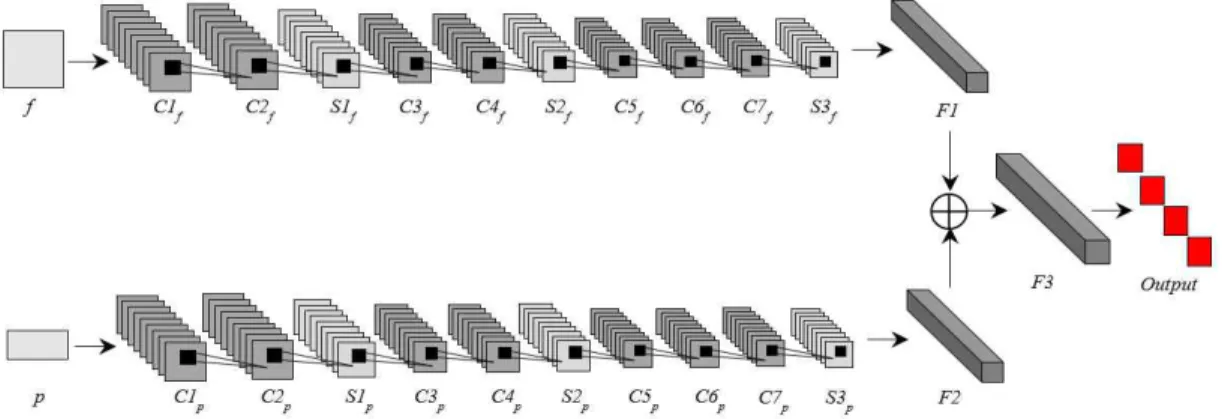
Fig. 1. The structure design of proposed CNN architecture.
periocular features for authenticating individuals.
The experimental results showed their proposed authentication method is more robust and more convenient than others.
Another research which conducted by [9], dis- covered that maximizing the correlation of face and periocular, which helped in increasing the perform- ance and precision. Although face region comprises of periocular features, [8] and [9] justified that the periocular feature can be used independently as in- dividual biometric due to its uniqueness in texture information, minimizing variations in aging, cam- era pose, and illumination. Another interesting work [14] demonstrated that periocular included the eyebrows, left and right eyes information, and local features effectiveness, which had accom- plished high accuracy recognition. The high accu- racy performance was achieved by fusion with face and periocular biometrics, but also minimized com- putational complexity.
In recent years, CNN is increasingly used in computer vision field with the great successes in image and video recognition. CNN is a feed-for- ward network with the ability to extract features from the input images, and then classifying the ex- tracted features. [15] proposed using CNN to clas- sify 1.2 million high-resolution images, thereby achieving impressive results to learn thousands of objects from millions of images. [16] also con- ducted experiments in image classifications. Their
experimental results achieved the state-of-the-art on the classification tasks. We, therefore, conclude that CNN is outperforming in the recognition pipe- lines, which is built with visual representations for the classification.
In order to achieve better accuracy for reorgan- izing an individual, we proposed a new approach with the combination of face and periocular latent features via CNN. To the best of our knowledge, combining the face and the periocular latent feature through CNN in a multimodal way has never been attempted.
3. PROPOSED FRAMEWORK OF MULTI- MODAL BIOMETRICS RECOGNITION VIA CNN
This section describes our proposed approach by combining face and periocular as the core compo- nents of the CNN to recognize an individual as de- picted in Fig. 1. We first denote the face as f and its periocular as p for the input features:
× (1)
and
× (2)
where
and
are the height and width are the
height and width of face image and
and
are
the height and width of periocular image, re-
spectively. The inputs f and p were presented in
(a)
(b)
Fig. 2. Sample images of f (a) RGB color and (b) color-based HE.
RGB color space.
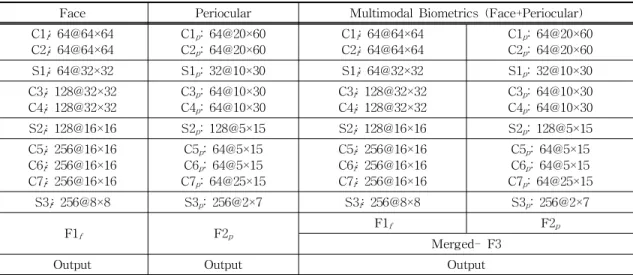
We also investigate the behavior and correlation between the face and periocular features for CNN in feature learning. The proposed approach (see Fig. 1) is designed with the same principles, as in- spired by [16] and [17]. The baseline consisted of seven convolutional layers (C1
f, C2
f, C3
f, C4
f, C5
f, C6
f, and C7
f) for f and (C1
p, C2
p, C3
p, C4
p, C5
p, C6
p, and C7
p) for p; three subsampling layers for both f (S1
f, S2
f, and S3
f) and p (S1
p, S2
p, and S3
p), re- spectively; and four fully connected layers (F1 as f, F2 as p, a merged layer, and an output layer with softmax function).
The proposed CNN architecture was designed to learn multimodal biometrics, in order to achieve an increased accuracy in biometric recognition along with the variability of effects. Let the feature map in the convolution layer C be denoted as Y, which is computed as:
(3)
where
denotes the a
thfeature map in the l
thC layer with the input f or p consisting of RGB channels.
is defined as bias matrix,
as the filter, and m is the number of feature maps in the l
thlayer. Layer subsampling is used to reduce the resolution of features. The fully-connected layers (F1 and F2) are convolution layers with 1×1 con- volution kernels and a full connection table. By concatenating all the features, the merged layer (F3) is formed as follows:
× (4)
where y denotes output of concatenated layer with 1×d dimension.
In the recognition stage, the output of F3 layer produced N class labels, which can be defined as: