Effect of Gamiojeoksan Remnants used as Fertilizer on Growth and Yield of Korean mint
Jaihyunk Ryu, Seongkyu Choi*, Kyeong Won Yun, Youngnam Seo
1, Kyoungsun Seo
2and Hyunjin Kim
Department of Oriental Medicine Resources, Sunchon National University, Suncheon 540-742, Korea
1
Kumkangdang Oriental Medicine Dispensary, Yeosu 550-200, Korea
2
Shinhung pharmaceuticals Company, Yeosu 540-955, Korea
Abstract - In these experiments Gamiojeoksan remnant components were analyzed to recycle this medicinal herb remnant fertilizers. The basic growth of Korean mint by application of Gamiojeoksan remnants were higher than control. As the amount of fertilizers were increased, plant height, stem diameter, number of leaves and number of branches were increased. The growth and yield were the highest in the treatment of 30 g/pot. Weight of whole plant of Korean mint has a tendency to be heavy in application of herbs remnant than that of control.
Key words - Application, fertilizer, Gamiojeoksan remnant, growth character, Korean mint
* Corresponding author. E-mail : [email protected]
Introduction
The oriental medicine has been used not only treatment for disease but also restorative (Choi et al., 2004).
In the past, the oriental medicine herb remnants were posed for little problem because the oriental medicines were packaged and boiled down personally. However, professional clinics for medical decoctions have opened recently. And the amount of herb remnants production has been increasing abruptly.
Most herb remnants are disposed of landfills, river dumping or composting. So, the solutions to the problems are strongly demanded for the matter of the protection of environment (Jin and Park, 1997; Jin, 1999). Gamiojeoksan has been used for a sedative and treating stress origin disease.
Therefore, recycling of the remnants as fertilizer is required for protection of environment and it will make short period of plant growth. And we are sure that this method is able to increase the yield of medicinal plants that have high contents of useful components.
According to the Korean Herbal Pharmacopoeia, Agastache
rugosa is the source of Korean mint (Korean Herbal Pharma- copoeia, 2007). Pogostemon cablin is listed in Korean Pharma- copoeia and Chinese Pharmacopoeia. It is different from Agastache rugosa.
The optimal sowing season of the Agastache rugosa is the end of March (Rural Development Administration, 2005). Ryu et al. (1998) reported that the optimal seed germination temperature is ranged 20 - 25℃, and the early growth was good at 30% shading, weight of whole plant is the heaviest in planting distance 15×15 cm (Choi and Seo, 2007).
Korean mint is used for various purposes including fresh vege- table, seasoned green, herbal tea and using the leaves and flowers.
Industrialized agriculture system dependent on large inputs of fertilizers and pesticides has generally the potential for maximum yield being inevitably associated with risks due to the instability of ecosystem (Bezdicek et al., 1984). But organic farmers do not use synthetic fertilizers and pesticides and attempt close nutrient cycle on their farms, protect the quality of environ- ment, and enhance beneficial biological interactions and pro- cesses (Vandermer, 1995).
The purpose of this study was examined the effect of Gami-
ojeoksan remnant on the growth of Korean mint.
Table 1. The composition of Gamiojeoksan
Prescription Gamiojeoksan
Herbs
Atractylodes japonica Plantago asiatica Pueraria lobata
Astragalus membranaceus Pachymae fungus Inula helenium Agastache rugosa Glycyrrhiza uralensis Myristica fragrans Psoralea corylifolia Rosa laevigata Alisma canaliculatum Dioscorea japonica Dolichos lablab Amomum xanthioides Silver magnolia Zingiber officinale
Table 2. Physicochemical composition of Gamiojeoksan remnant (%)
Items Moisture Organic matter Salt Organic/Nitrogen N P K
*
Ga. R. 5.3±0.2 90.8±1.1 0.1±0.0 40.6±0.3 2.2±0.1 0.2±0.0 0.6±0.0
Official Fixture
Standard 50(max) 25(min) 1.0(max) 50(max) - - -
*
Ga. R..: Gamiojeoksan remnant.
Materials and methods
Plant materials
The seeds of Korean mint were procured on October 2007 from the medicinal plant garden of Sunchon National University.
The seeds were soaked in a tap water for 24 hours and then sowed in GP pot (Jiffy-7, Norway) on september 7th.
The GP pot as transplanted in experimental pot (20 cm dia- meter, 25 cm depth) within a week. The experimental pots were incubated at 20℃ for 6 month. The light intensity was main- tained at 2,000 lux.
Gamiojeoksan remnant remnants used in experiments The Gamiojeoksan remnant was procured from the Kum- gangdang dispensary of oriental medicine in Yeosu on July 2007.
Sample analysis
Three samples were air dried and then the samples were taken from 5 parts. Those samples were dried at 105℃ in drying oven for 6 hours to measure water content, which was taken into consideration in the calculation of dry matter basis (A.O.
A.C., 1990).
The content of nitrogen was measured by macro-Kjeldahl analysis procedure (Walinga et al, 1995).
The concentration of salt was measured by method of the association of official analytical chemists (A.O.A.C., 1990).
The analysis of component was performed using an atomic absorption spectrophotometer (AAS, Perkin Elmer Analyst 300, USA) and inductively coupled plasma (ICP, Agilent 8453, USA).
Experimental design and treatments
The Gamiojeoksan remnants were used for growth experi- ments of Korean mint. Experimental plots were layed out in randomized complete block design with nine replications (Ok and Chae, 1998). The amount of Gamiojeoksan remnants appli- cation used in the experiments were; 0, 10, 20, 30, 40, and 50 g.
The composition of Gamiojeoksan remnants were shown in Table 1.
Items of investigation
Individual samples were tagged to examined for the growth characteristics such as stem length, branch length, the number of branches and the length and width of leaves. General cultural procedure and management such as weed control followed conventional culture methods for medicinal plants (R.D.A., 1995). All measurements for plant growth and yield were referred to standard measurement of R.D.A.(1989).
Results and discussion
Table 3. Contents of heavy metal in Oriental medicine remnant (ppm)
Inorganic elements As Cr Zn Cu Cd Ni Pb
*/
Ga. R. 2.91±0.1 2.75±0.1 48.17±1.2 12.45±0.4 1.00±0.0 2.68±0.2 8.50±0.1 Official fixture standard 50(max) 300(max) 900(max) 300(max) 5(max) 50(max) 150(max)
*/
Ga. R..(Gamiojeoksan); kind of Herbs remnant.
Fig. 1. Comparison of the plant height by application amount of Gamiojeoksan remnants
*
Ga. R. : Gamiojeoksan
Fig. 2. Comparison of the number of leaves by application amount of Gamiojeoksan remnants
*
Ga. R. : Gamiojeoksan
Composition of herbs remnant Proximate composition Table 2 showed concentration of organic matter, salt, moisture, ratio of organic and nitrogen, phosphoric acid and potassium in Herbs remnant.
The organic matter content of the remnant was 90.8%. The salinity was 0.1%, this is too low to inhibit the growth of herbs.
Gamiojeoksan remnant has a high content of nitrogen, phos- phoric acid and potassium. Nitrogen content of the remnant was 2.2%. The content of phosphoric acid and potassium was 0.2% and 0.6%, respectively.
The chemical composition of Gamiojeoksan remnant were
similar to that of medicinal herbs for feeds (Jin, 1999).
The contents of heavy metals in the oriental medicine herb remnants were shown in Table 3.
The content of arsenic was 2.91 ppm too low to in inhibit herb growth. chromium was contained as 2.75 ppm.
The contents of zinc and copper were 48.17 ppm and 12.45 ppm, respectively. cadmium was contained as 1.0 ppm and nickel was contained as 2.68 ppm. The plumbum was contained as 8.50 ppm.
These results showed that these remnants were safe because the concentration of heavy metals was low. It was different with the effect of cadmium and leed on the growth of Salvia spendens (Chang et al., 1977; Kim and Park, 1992; Page et al, 1972).
The variation of Korean mint by an application of herbs remnant.
An application of Gamiojeoksan remnants were effective to the height of Korean mint (Fig. 1).
Effects on increased the plant height with applications of Gamiojeoksan remnants. But the application of 10 g and 20 g Gamiojeoksan remnant were not affect to height of Korean mint. The plant height with an application of 30 g Gamiojeoksan remnant was the highest among treatments.
In addition to, Choi (2007) has reported that the application of Sta-green and activated carbon was effective to growth of Korean mint. It was similar with an application of Gamiojeoksan remnants.
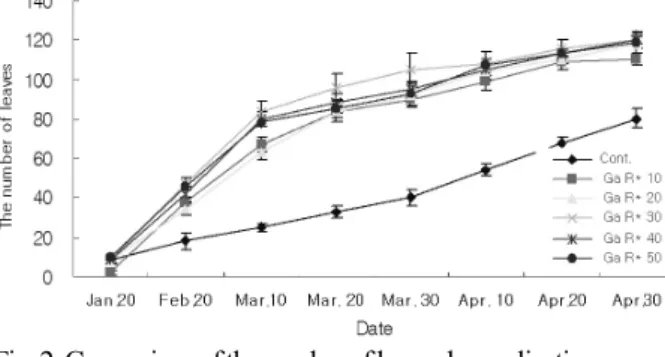
An application of Gamiojeoksan remnants were effective to the number of leaves in Korean mint (Fig. 2).
The application of Gamiojeoksan remnants had the effect to increased the number of leaves.
The vegetables were grown in three treatment combination
plots and in conventional fertilizer plot with recommended
levels of nitrogen, phosphorus and potassium. The leaf number
were no significant in differences fertilizer levels (Kim et al.,
Fig. 3. Comparison of the stem diameter by application amount of Gamiojeoksan remnants.
*
Ga. R. : Gamiojeoksan
Fig. 4. Comparison of the number of branch by application amount of Gamiojeoksan remnants
*
Ga. R. : Application of Gamiojeoksan remnants
Fig. 5. Comparison of different application amount of Gamio- jeoksan remnants on the whole plant weight of Korean mint
1)
Values are significant for each groups at P<0.05 by Duncan's multiple range test
Table 4. The flowering time of Korean mint by remnants Remnants
Blooming stage Control Ga. R.*30 g
Blooming begin Feb.5 Feb.4
Blooming full Feb.26 Feb.27
Blooming end Mar.20 Mar.19
*