JESK
http://dx.doi.org/10.5143/JESK.2014.33.2.125 http://jesk.or.kr eISSN:2093-8462Evaluation of Integral Seat Desk used in Universities based on KS/ISO Standard and Questionnaire Survey
Dohyung Kee
Department of Industrial and Management Engineering, Keimyung University, Daegu, 704-701
Corresponding Author Dohyung Kee
Department of Industrial and Management Engineering, Keimyung University, Daegu, 704-701 Mobile : +82-10-5656-1260 Email : [email protected]
Received : February 13, 2014 Revised : February 20, 2014 Accepted : April 11, 2014
Objective: The purpose of this study is to evaluate integral seat desk used in universities through comparison of real dimension values of the desk with KS/ISO standard and questionnaire survey.
Background: School furniture that helps students sit comfortably for longer periods of time and allows for better concentration on learning is important. However, seat and desk have been generally designed based on the industry practice rather than user's anthropometry, and seats and desks used in universities of Korea have not been ergonomically evaluated.
Method: Real 13 dimensions of the desk used in K University were measured using tape measure and inclinometer, and the dimension values were compared to the KS standard of desk and chair for lecture room (KS G 4210) and ergonomic design principles found in relevant references. Subjective appropriacies and preference for the desk were investigated based on questionnaire survey, in which 121 (male: 91, female: 30) college students participated.
Results: Several dimensions for the desk and chair investigated except desk depth and width, leg room width, seat width have not met the KS standard, but all dimensions satisfied ergonomic design principles available in references. The questionnaire survey revealed that appropriacies for desk surface size, seat pan depth, seat pan cushion and backrest curvature were under middle point of 3.0, and that those for the other dimensions showed higher scores exceeding 3.0.
Conclusion: The integral seat desk widely used in universities showed some design problems in terms of standards of KS G 2010 and KS G 4210, and ergonomic design principles. Compared to the general desk with separated desk and seat, subjective preference on the integral seat desk was low.
Application: This would be used as a valuable guideline when designing or choosing new integral seat desk with high satisfaction of students.
Keywords: Desk, Seat, Chair, Integral seat desk
Copyright@2014 by Ergonomics Society of Korea. All right reserved.
○cc This is an open-access article distributed under the terms of the Creative Commons Attribution Non-Commercial License (http://
creativecommons.org/licenses/by-nc/3.0/), which permits unrestricted non-commercial use, distribution, and reproduction in any medium, provided the original work is properly cited.
1. Introduction
The elementary, middle and high school students together with collegians spend most of the day at school with sitting postures (Troussier et al., 1999). The students use furniture like chairs and desks not suitable for human body size in many cases (Castellucci et al., 2010; Saarni et al., 2007; Savanur et al., 2007). Also, the use of the unstable furniture negatively affects the students, and makes them take no good
Special Topic
Ergonomics in Seating
postures (Geldhof et al., 2007; Koskelo et al., 2007). No good postures cause musculoskeletal disorders like low back pain, and ergonomic design of the furniture used in school becomes an important factor (Corlett, 2006; Milanese and Grimmer, 2004;
Murphy et al., 2007; Trevelyan and Legg, 2011).
The ergonomically well designed desks and chairs enable students to take an appropriate posture, and enhance work efficiency or concentration, and reduce fatigue and discomfort in a sitting posture (Agha, 2010; Fernandez and Poonawala, 1998). From this point of view, it is important to ergonomically design school furniture enabling to sit comfortably for a long time, and concentrate on study, and anthropometric data become an important factor in the ergonomic design of school furniture (Dianat et al., 2013).
In elementary, middle and high schools, adjustable desks separated from chairs are widely used. In college, the integral seat desk, not adjustable, is widely used. Based on 10 measured anthropometric data for 1,248 students aged 6-17, Jeong and Park (1990) asserted that desks and chairs with different dimensions need to be offered for male and female students, respectively. Kim and Park (2009) investigated discomfort on the desks and chairs targeting elementary, middle and high school students. However, it is difficult to find studies on ergonomic evaluation on the integral seat desk used in colleges in Korea.
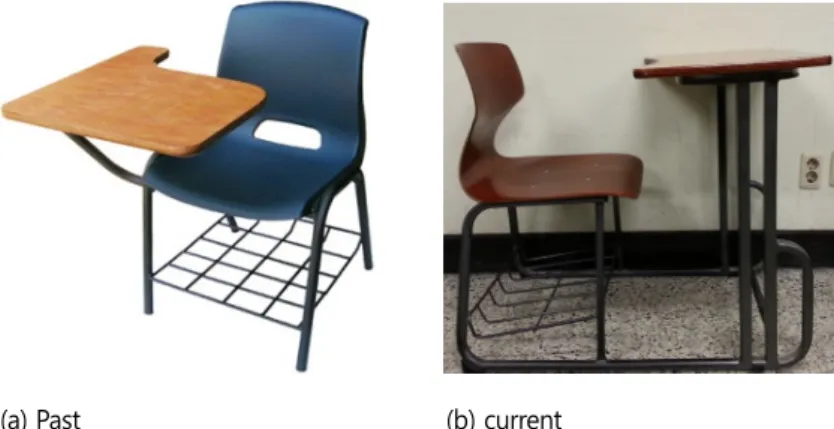
This study evaluates the integral seat desk used in many universities through comparison with the standard of sizes and dimension of fixed desk and chair for lecture room (KS G 4210) (KATS, 2005) and ergonomic design principles, and also through questionnaire survey. For evaluation on the integral seat desk used in universities, this study selected the integral seat desk used in K University as the study target. In K University, the integral seat desk with dimensions of [500mm (width) x 760mm (length) x 720mm (height)] was used as shown in Figure 1a), and a bit bigger and higher priced integral seat desk (600mm x 800mm x 720mm) has been used as shown in Figure 1b) as part of learning environment improvement activity about 10 years before. The study target is the integral seat desk currently used, which is shown in Figure 1b).
2. Methods
2.1 Seat and desk evaluation
There are three basic methods to evaluate seats and desks: comparing seat or desk against anthropometric data and ergonomic design principles, using fitting trials to adjust seat or desk, and having users subjectively evaluate the seat and desk (Drury and Coury, 1982). This study used the first method. To this end, three anthropometric data required in designing of seat, namely, (a) Past (b) current
Figure 1. Past and existing integral seat desk in K university
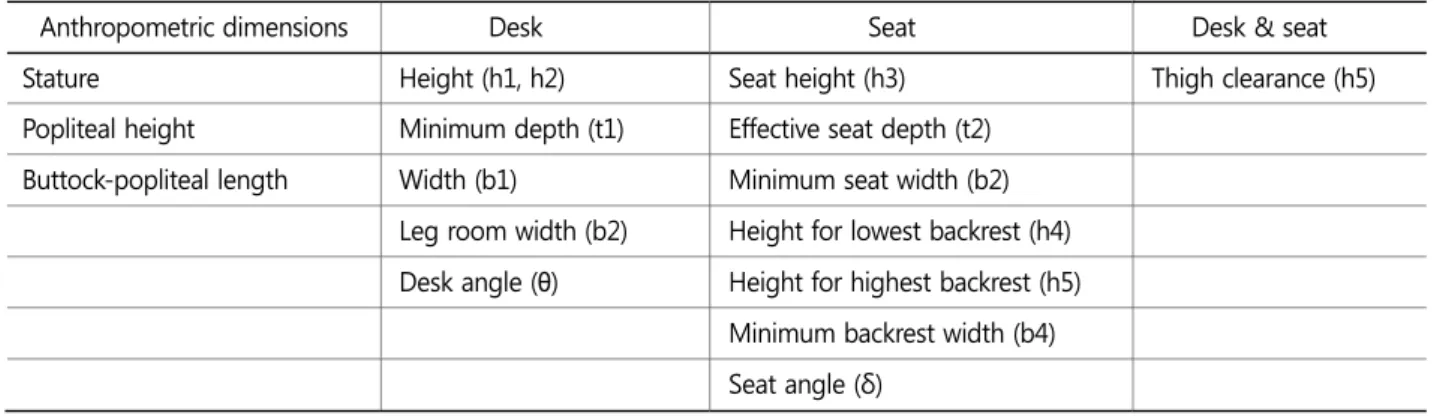
stature, popliteal height, and buttock-popliteal length were used (Table 1) (Dianat et al., 2013). For the anthropometric data, the 6th Size Korea Project results of Korean Agency for Technology and Standards (Size Korea, 2014) were used. Concerning the anthropometric data, the data of male and female collegians aged 20 to 24, who used the integral seat desk researched in this study, were used. For the seat and desk dimensions, 13 dimensions of 5 desks, 7 seats, and 1 seat desk were measured by referring to the dimensions of the integral seat desk for lecture room (KS G 4210) (Dianat et al., 2013; KATS, 2011). As for the definition of seat and desk, the dimensions of the integral seat desk were referred to standard of sizes and dimension of fixed desk and chair for lecture room (KS G 4210) (Figure 2). Based on the measurement data, the evaluation was carried out through comparison of actual measurement data of the integral seat desk with the dimensions of standard of sizes and dimension of fixed desk and chair for lecture room (KS G 4210) and the design principles of desk and seat (Niebel and Freivalds, 1993; Pheasant, S., 1995; Sanders and McCormick, 1987). The standard of chairs and tables for educational institutions (KS G 2010) was also applied (KATS, 2011), if necessary.
Table 1. Anthropometric, desk and seat dimensions
Anthropometric dimensions Desk Seat Desk & seat
Stature Height (h1, h2) Seat height (h3) Thigh clearance (h5)
Popliteal height Minimum depth (t1) Effective seat depth (t2) Buttock-popliteal length Width (b1) Minimum seat width (b2)
Leg room width (b2) Height for lowest backrest (h4) Desk angle (θ) Height for highest backrest (h5)
Minimum backrest width (b4) Seat angle (δ)
t1
t2
t1 t2
h2 h1
b1 b3 b4
h5
h4
δ
b2 h3
Figure 2. Dimensions of desk and seat
2.2 Questionnaire survey
This study conducted a questionnaire survey, in which 121 male and female collegians aged 19 to 28 (average age: 22.4) (male:
91 students, female: 30 students) participated. The questionnaire consisted of 15 questions including 2 demographic questions on gender and age, 3 questions on desk, 8 questions on seat, 1 question on the most discomfort upon using the integral seat desk, and 1 question on the preference for the integral seat desk. Questions on the seat and desk consisted of the appropriacies of specific design dimensions (Is the height of seat pan currently used appropriate?). The answer to the question was measured with 5-point Likert scale (1: Very inappropriate, 2: Inappropriate, 3: Fair, 4: Appropriate, 5: Very appropriate). The preferences on the integral seat desk and general desk with separated seat and desk were surveyed with a scale of 0-10 points. Since the students who participated in the questionnaire survey did not know the terms of desk and seat well, the subjects answered, after an experimenter explained each question one by one. Sufficient time for explanation and answer for each question was offered for the subjects to answer with ample thinking.
3. Results
3.1 Dimensions of integral seat desk
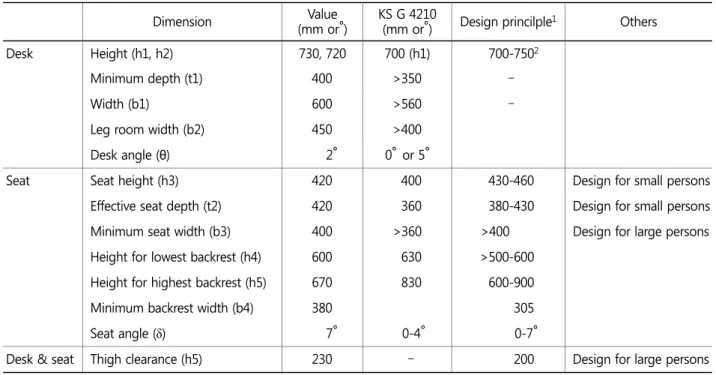
The measurement values of 13 dimensions of the integral seat desk, which is the study target, are presented in Table 2 along with the standard of sizes and dimension of fixed desk and chair for lecture room (KS G 4210), and dimensions according to ergonomic design principles. Among four types of A1, A2, B1 and B2 in KS G 4210, the dimensions for A2 were used, because in the standard, the dimension of u, which is the horizontal distance between seat's end of sitting pan and seat backrest point, for A2 type (370mm) matched the dimension of the study-targeted desk. The ergonomic design principles of seat and desk were
Table 2. Dimensions of integral seat desk
Dimension Value
(mm or°) KS G 4210
(mm or°) Design princilple1 Others
Desk Height (h1, h2) 730, 720 700 (h1) 700-7502
Minimum depth (t1) 400 >350 -
Width (b1) 600 >560 -
Leg room width (b2) 450 >400
Desk angle (θ) 2° 0° or 5°
Seat Seat height (h3) 420 400 430-460 Design for small persons
Effective seat depth (t2) 420 360 380-430 Design for small persons
Minimum seat width (b3) 400 >360 >400 Design for large persons Height for lowest backrest (h4) 600 630 >500-600
Height for highest backrest (h5) 670 830 600-900
Minimum backrest width (b4) 380 305
Seat angle (δ) 7° 0-4° 0-7°
Desk & seat Thigh clearance (h5) 230 - 200 Design for large persons
1: based on Niebel and Freivalds (1993), Pheasant (1995), Sanders and McCormick (1987);
2: dimension for female
put together by referring to three references (Niebel and Freivalds, 1993; Pheasant, 1995; Sanders and McCormick, 1987).
3.1.1 Desk
The heights of desks measured in this study (720mm, 730mm) were slightly higher than the standard height of KS G 4210 (700m), but they had no problem from a design principle viewpoint, based on females (Sanders and McCormick, 1987) (700- 750mm). The desk surface depth was 400m, which met the depth of the standard of KS G 4210, and the width was 600mm, which also met the standard width (560mm or more). Meanwhile, in comparison with the standard of chairs and tables for educational institutions (KS G 2010), the study target desk depth and width were much smaller than the standard dimensions (450mm and 500mm, and 650mm and 700mm, respectively). The study target desk surface angle was 2°, and did not meet the standard of sizes and dimension of fixed desk and chair for lecture room (KS G 4210) (0° or 5°).
3.1.2 Seat
The height of the study target seat was 420mm, which was highger than 400m of the standard for sizes and dimension of fixed desk and chair for lecture room (KS G 4210), but was lower than 430-460mm of the design principle, based on females (Sanders and McCormick, 1987). The seat pan depth was 420mm, which met the design principle (Sanders and McCormick, 1987), but was bigger than the standard of KS G 4210 by 60mm. Because there is maximum 50mm of desk curvature in front central part of the study target integral seat desk, and the seat cannot be moved alone (See Figure 1), real seat pan depth becomes 470mm, as the curvature depth can be added, when a student uses the desk. The seat pan width was 400mm, which met the design principle (Sanders and McCormick, 1987), and was bigger than the dimension of the standard of KS G 4210 by 40mm. Since it needs to be designed based on larger person (tall person), it can be said to meet the standard. Backrest width was 380mm, which exceeded the ergonomic design principles (305mm). The backrest was generally designed based on large person (tall person). Thus, backrest width met the design principles.
3.2 Questionnaire survey 3.2.1 Desk and seat
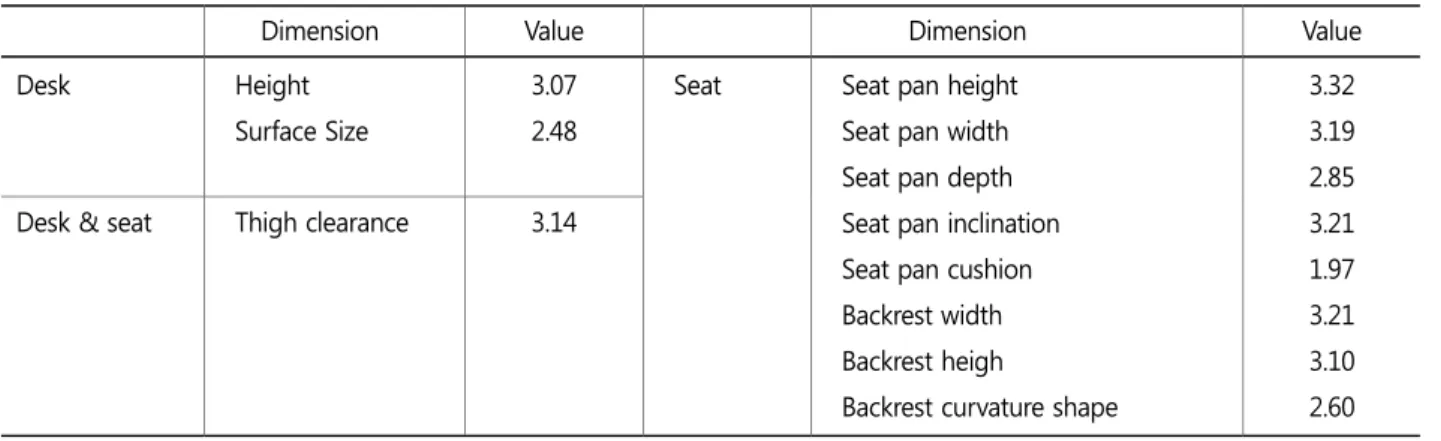
The questionnaire survey results on desks and seats are summarized in Table 3. The responses to this study target integral seat desk's height, thigh clearance, seat pan height, width and inclination, and backrest width and height slightly exceed 'fair' level
Table 3. Results of questionnaire survey
Dimension Value Dimension Value
Desk Height
Surface Size
3.07 2.48
Seat Seat pan height Seat pan width Seat pan depth Seat pan inclination Seat pan cushion Backrest width Backrest heigh
Backrest curvature shape
3.32 3.19 2.85 3.21 1.97 3.21 3.10 2.60 Desk & seat Thigh clearance 3.14
(3.0). Meanwhile, desk surface size, seat pan depth, and backrest inclination, and curvature shape were in between 'fair' and 'not appropriate' (2.0). Seat pan cushion's appropriacy was the lowest at 1.97, which did not even meet the 'not appropriate level'.
In the question asking the most discomfort on the integral seat desk, 89 respondents answered type of the integral seat desk, which was the most answer, followed by 56 respondents with seat pan cushion, 43 with desk size and fixed seat and desk, instead of adjustable type, and 38 with no storage space.
3.2.2 Preference for integral seat desk
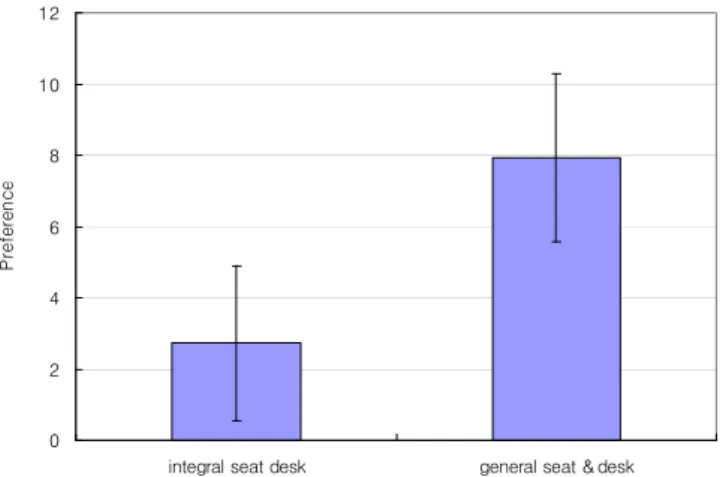
Figure 3 shows the survey results on preferences for integral seat desk and general seat and desk that a user can randomly change the seat location, since the desk and seat are separated. As a result of a pair-wise t-test on the preference for two types of desks, the general seat and desk were analyzed to be significantly preferred, compared to the integral seat desk (p<0.01).
4. Discussion and Conclusion
This study selected the integral seat desk used in K University to evaluate the integral seat desks used in Korea's universities, and measured their dimensions, and compared with the standard of sizes and dimension of fixed desk and chair for lecture room (KS G 4210) and ergonomic design principles. Through a questionnaire survey that targeted users, subjective appropriacies and preference for the integral seat desk design dimensions were investigated. Although the study target desk height was slightly higher than that of the standard, it met ergonomic design principle, and also the desk surface depth, width, and leg room width met the standard of sizes and dimension of fixed desk and chair for lecture room (KS G 4210). Meanwhile, desk surface inclination deviated from the standard. The seat pan height, depth, and height for the lowest backrest, height for the highest backrest, seat angle deviated from the standard of KS G 4210, but met ergonomic design principles. Thigh clearance met ergonomic design principle. Only backrest width met both the standard of KS G 4210 and ergonomic design principle.
The desk height of the study target integral seat desk was 720mm, which was slightly higher than 700m of both standards for chairs and tables for educational institutions (KS G 2010), based on 165cm of student's height, and for sizes and dimension of fixed desk and chair for lecture room (KS G 4210). Given that the height of the standard of KS G 4210 was 700mm, and the average height of females aged 20-24 was 160.4cm, and 75%ile of the height was 163.9cm (close to standard group of 165cm
0 2 4 6 8 10 12
integral seat desk general seat & desk
Preference
Figure 3. Preference for integral seat desk and general seat & desk
for the standard of sizes and dimension of fixed desk and chair for lecture room (KS G 4210)), there is a possibility that minimum 75% of the females may feel the desk is slightly high. Since average male and female height was 167.7cm, and 25%ile of the height (50%ile: 168.1cm) was 161.5cm, discomfort can be felt by about minimum 25% of the total users, due to desk height.
The seat pan height of the integral seat desk was 420mm, which was lower than the ergonomic design principle (Sanders and McCormick, 1987) by minimum 10mm and more. However, 5%ile of popliteal height, which is the base body dimension for ergonomic design of seat pan height, for American males and females was 39cm and 36cm, respectively, and also for Korean males and females was 39cm and 36cm, respectively. Namely, the heights of Korean males and females were lower by about 1cm than those of American counterparts, respectively. This implies that the seat pan height of the integral seat desk has no big problem from a design principle standpoint.
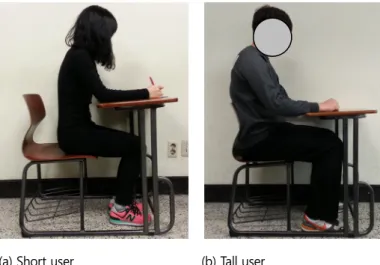
Practical seat pan depth 470mm, due to front curvature of the desk, greatly exceeded 360mm of the standard of sizes and dimension of fixed desk and chair for lecture room (KS G 4210), and was also bigger than 430mm of the ergonomic design principle. Seat pan depth is generally designed on the basis of small person (short person). So, if the depth is increased beyond the buttock-popliteal length (5%ile women: 435mm), the user will not able to be able to engage the backrest efficiently without unacceptable pressure on the backs of knees (Pheasant, 1995). Due to such a large seat pan depth, discomfort may be caused to desk users. Average Korean females' buttock-popliteal length (aged 20-24) was 418mm, and thus, the current integral seat desk's seat pan depth is considered excessive. Therefore, a female student with 158cm in height, close to 25%ile stature of 156.7cm, can take an unstable posture sitting just in the front part of the seat, not leaning against the backrest in using the integral seat desk [Figure 4(a)]. Meanwhile, to a male student with the stature of 183cm, space between the seat and desk (seat pan depth + leg clearance) seems appropriate or insufficient [Figure 4(b)]. The reason is that male’s height 183cm is close to about 98%ile stature (181.5cm), and 525.5mm of buttock-popliteal length corresponding to 95%ile stature actually greatly exceeds real seat pan depth of 470mm. Because 50%ile of total males' and females' buttock-popliteal length was 475.5mm, about half of the total users cannot effectively use the backrest, and therefore, they may feel discomfort.
Subjective appropriacies on the seat and desk design dimensions felt by the subjects in the questionnaire survey are related to the status of actual integral seat desk dimensions' meeting the standards of chairs and tables for educational institutions (KS G (a) Short user (b) Tall user
Figure 4. Sitting postures of short and tall users
4210) and of sizes and dimension of fixed desk and chair for lecture room (KS G 2010), or ergonomic design principles. The reason why subjective appropriacies for desk surface size and seat pan depth were low at 2.48 and 2.85, respectively, is conjectured that desk width and desk depth and seat pan depth do not meet the standard of chairs and tables for educational institutions (KS G 2010). The desk height, thigh clearance, seat pan height, seat pan width, seat pan angle, backrest width and height (based on the highest height of backrest), which the study subjects' subjective appropriacies exceeded fair level (3.0), generally met the standards or ergonomic design principles (See Tables 2 and 3). The reason why appropriacy of seat pan cushion was the lowest (1.97) is that the seat pan of the study target integral seat desk has no cushion at all, although appropriate thickness of cushion is recommended (Kee et al., 2001). The backrest curvature's appropriacy is estimated to be low (2.60), because many students find it is difficult to use, due to high seat pan depth.
The desk surface size and seat pan depth that did not meet the dimensions of the integral seat desk according to the standard of chairs and tables for educational institutions (KS G 4210) and that showed low-evaluated subjective appropriacies should be improved to be suitable for the standard and design principles. Also, preference for the general desk, for which seat and desk are separated, was very high, compared to the integral seat desk. Although the general desk has some problems, such as a control problem in moving the seat and desk separately in the case of cleaning or moving to another place, or some inconvenience like a difficulty to secure distance between students in the case of exam, the merits of the general desk are needed to be fully considered, when the seat and desk are designed or purchased in the future. The most inconvenient thing of the integral seat desk in the free-answering question of the questionnaire survey was height-unadjustable integral seat desk, and thus, height- adjustable seat and desk, and the desk with adjustable seat to the front and back directions are recommended. In universities, seat and desk users may vary every hour or every few hours unlike elementary, middle and high schools, where seat and desk users are the same for a year, and therefore, it may be unrealistic to design adjustable seat and desk. From this point of view, the adoption of a desk, where seat and desk are separated, or improvement to a direction to adjust horizontal distance between seat and desk (despite integral seat desk), should be made, in order to enhance student’s satisfaction and concentration on classes.
This study just investigated subjective appropriacies or preference through a questionnaire survey on the integral seat desk dimensions, but a further study using objective measures including EMG is required.
References
Agha, S.R., School furniture match to students' anthropometry in the Gaza Strip, Ergonomics, 53, 344-354, 2010.
Castellucci, H.I., Arezes, P.M. and Viviani, C.A., Mismatch between classroom furniture and anthropometric measures in Chilean schools, Applied Ergonomics, 41, 563-568, 2010.
Corlett, E.N., Background to sitting at work: research-based requirements for the design of work seats, Ergonomics, 49, 1538- 1546, 2006.
Dianat, I., Karimi, M.A., Hashemi, A.A. and Bahrampour, S., Classroom furniture and anthropometric characteristics of Iranian high school students: Proposed dimensions based on anthropometric data, Applied Ergonomics, 44, 101-108, 2013.
Drury, C.G. and Coury, B.G., A methodology for chair evaluation, Applied Ergonomics, 13(3), 195-202, 1982.
Fernandez, J.E. and Poonawala, M.F., How long should it take to evaluate seats subjectively? International Journal of Industrial Ergonomics, 22, 483-487, 1998.
Geldhof, E., De Clercq, D., De Bourdeaudhuij, I. and Cardon, G., Classroom postures of 8e12 year old children, Ergonomics, 50, 1571-1581, 2007.
Jeong, B.Y. and Park, K.S., Sex differences in anthropometry for school design, Ergonomics, 33(12), 1511-1521, 1990.
KATS (Korean Agency for technology and Standard), Sizes and dimensions of fixed desk and chair for lecture rooms (KS G 4210), 2005.
KATS (Korean Agency for technology and Standard), Furniture-Chairs and tables for educational institutions-Functional sizes (KS G 2010), 2011.
Kee, D., Lee, K.T., Park, J.H. and Choi, K.I., Ergonomics for industrial safety and health managers, 3rd ed., Hankyungsa, 2011.
Kim, E.H. and Park, J.H., A survey on the students' discomfort to school desks and chairs, Proceedings of Fall Conference of Korea Society of Emotion and Sensibility, 2009.
Koskelo, R., Vuorikari, K. and Hänninen, O., Sitting and standing postures are corrected by adjustable furniture with lowered muscle tension in high-school students, Ergonomics, 50, 1643-1656, 2007.
Milanese, S. and Grimmer, K., School furniture and the user population: an anthropometric perspective, Ergonomics, 47, 416-426, 2004.
Murphy, S., Buckle, P. and Stubbs, D., A cross-sectional study of self-reported back and neck pain among English schoolchildren and associated physical and psychological risk factors, Applied Ergonomics, 38, 797-804, 2007.
Niebel, B. and Freivalds, A., Methods standards & Work design, 10th ed., McGraw-Hill Inc., 1993.
Pheasant, S., Bodyspace:Anthropometry, Environments and the design of work, Taylor & Francis, 1995.
Trevelyan, F.C. and Legg, S.J., Risk factors associated with back pain in New Zealand school children, Ergonomics, 54, 257-262, 2011.
Troussier, B., Tesniere, C., Fauconnier, J., Grisons, J., Juvin, R. and Phelip, X., Comparative study of two different kinds of school furniture among children, Ergonomics, 42, 516-526, 1999.
Saarni, L., Nygård, C.H., Kaukiainen, A. and Rimpelä, A., Are the desks and chairs at school appropriate? Ergonomics, 50, 1561- 1570, 2007.
Savanur, C.S., Altekar, C.R. and De, A., Lack of conformity between Indian classroom furniture and student dimensions: proposed future seat/table dimensions, Ergonomics, 50, 1612-1625, 2007.
Sanders, M.S. and McCormick, E.J., Human factors in engineering and design, 6th Ed., McGraw-Hill Inc., 1987.
Size Korea Home Page, http://sizekorea.kats.go.kr/ (retrieved January 10, 2014).
Author listings
Dohyung Kee: [email protected]
Highest degree: Ph.D., Department of Industrial Engineering, POSTECH
Position title: Professor, Department of Industrial and Management Engineering, Keimyung University
Areas of interest: Population stereotype, Product design, Posture classification scheme, Industrial safety, Musculoskeletal disorders