44(2) : 110∼ 117 (2013)
110
엉겅퀴 추출물의 기능 성분 분석 및 TGF-beta에 의한 간 성상 세포 활성 억제 효과
김선영1·김상준1·최영지1·유강열1·정창호1·심재석2·장선일3·유동현4·정승일1*
1(재)전주생물소재연구소, 2임실생약조합,
3전주대학교 대체의학대학, 4전라북도농업기술원 특화작목연구소
Analysis of Active Components in Cirsium japonicum var. ussuriense Extracts and Their Effect on TGF-beta Induced
Hepatic Stellate Cells Activation
Seon-Young Kim1, Sang-Jun Kim1, Young Ji Choi1, Kang-Yeol Yu1, Chang-Ho Chung1, Jae-Suk Shim, Seon-Il Jang, Dong-Hyun Yu4, and Seung-Il Jeong1*
1Jeonju Biomaterials Institute, Jeonju 561-301, Korea
2Imsil Herbal Medicine Association, Imsil 566-895, Korea
3College of Alternative Medicine, Jeonju University, Jeonju 560-759, Korea
3Jeollabukdo ARES Specialization Crop Research Institute, Jinan 567-807, Korea
Abstract − Cirsium japonicum (CJ) leaf (L) alcoholic extracts were investigated for analysis their active components (fla- vonoids and flavanolignans; silymarins) and inhibitory effect on transforming growth factor (TGF)-β induced hepatic stellate cells (HSCs, LX-2 cells) activation. The CJ root (R) extracts were also analyzed and compared with leaf extracts. Total fla- vonoid and polyphenol contents of the leaf extracts showed higher than those of the root extracts. The content of each flavonoid compound, which was analyzed by HPLC, in CJ-L extracts was also higher than in CJ-R extracts. The results of flavanolignans content in CJ-L and CJ-R extracts were consistent in flavonoid and polyphenol. We studied inhibitory effect of two extracts against TGF-β1 induced HSCs activation. The CJ-L extracts significantly suppressed overexpression of profibrogenic factor, α-smooth muscle actin and collagen-α1(I). The CJ-R extract also showed inhibitory effect on TGF-β1 induced HSCs acti- vation, but the efficacy was lower than in CJ-L extract. These results suggest that CJ-L may contribute to the fibrotic liver treat- ment.
Key words − Cirsium japonicum, Flavonoids, Flavonolignans, Hepatic stellate cells
2011년 통계청에서 발표한 자료에 의하면 간 질환은 우리 나라 10대 주요 사망원인 중 8위에 해당한다. 연령별 3대 사인 중 간질환이 사회활동이 왕성한 40대에서 암, 자살 다 음으로 주요 사망원인으로 보고되었다.1) 간섬유화는 바이러 스나 알코올 등과 같은 원인으로 만성적인 간손상에 따른 창상 치유의 과정으로서 초기단계는 가역적이지만 이 과정 이 지속되면 비가역적으로 세포외기질에 교원질 침착 및 정 상 간조직의 변형이 일어나며 궁극적으로 간경변증을 초래 한다.2,3)
간섬유화에 관여하는 세포는 간성상세포(hepatic stellate cells), 쿠퍼세포(kuffer cells), 내피세포(endothelial cells)등이 있다. 그 중 간성상세포는 세포외기질을 생산하는 주요한 세포로서 교원질을 포함한 각종 세포외 기질의 생성에 관 여한다. 간섬유화 과정에서 핵심적인 역할을 하는 세포는 간성상세포(hepatic stellate cells)이다.4,5) 간성상세포의 활성 화를 유도하는 인자는 platelet-derived growth factor (PDGF), transforming growth factor-β (TGF-β) 등이 있다. 간 손상시 이러한 인자들에 의해 간 성상세포의 수는 급격하게 증가 하게 된다.5)
국화과(Compositae)에 속하는 엉겅퀴(Cirsium japonicum
*교신저자(E-mail):[email protected] (Tel): +82-63-711-1050
var. ussuriense)는 다년초로 한의학적으로 지상부 또는 지하 부를 대계라 하여 약용으로 이용해 왔다. 지상부는 개화기 에, 지하부는 가을에 채취하여 경혈, 지혈, 소종의 효능으로 토혈, 혈뇨, 대하, 간염, 고혈압 등의 치료에 사용되어 왔다.6,7) 엉겅퀴속 식물에서 다양한 이차대사산물이 보고되어 있 는데, 그 가운데 생리활성이 뛰어난 apigenin, luteolin, myricetin, kaempferol, pectolinarin, 5,7-dihydroxy-6,4'- dimethoxyflavone, hispidulin-7-neo-heperioside를 포함한 약 78종의 flavonoids가 확인되었다.6) 흰무늬엉겅퀴(Silybum marianum L. Gaertner)에 함유된 silymarin은 flavanolignan 으로 간장 보호작용과 알코올 유도지질 산화의 예방 및 알 코올성 간경화 등에 보호효과가 있다고 보고되었다.8,9)
최근 연구결과에 따르면 엉겅퀴 추출물이 대식세포에서 heme oxygenase-1의 발현을 조절하여 항염증 작용을 한다 고 보고되었으며,10) 본 연구진은 지상부 중 꽃과 지하부인 뿌리 추출물에서 간 성상세포의 활성억제 효능을 비교하여 보고한 바 있다.11)
본 연구는 엉겅퀴 지상부중 잎과 지하부인 뿌리를 알코올 추출물들의 polyphenol, flavonoids, flavanolignans의 성분 함량과 TGF-β1에 의한 간 성상 세포 활성 억제 효능을 비 교하였다.
재료 및 방법
시료의 추출 − 본 실험에 사용한 엉겅퀴(Cirsium japonicum var. ussuriense)는 2012년 전라북도농업기술원 특화작목연 구소에서 재배한 것을 우석대학교 한의과대학 본초방제학 교실의 김홍준 교수에게 의뢰하여 동정하였고, 표본(JBMI- 012)은 전주생물소재연구소 식의약소재사업단에 보관하고 있다. 시료를 추출하기 위해 수세, 음건 한 잎과, 뿌리를 적 당한 크기로 마쇄한 후 시료 50 g에 대해 10배의 MeOH를 넣어 60oC에서 4시간동안 2회 온침 추출하였다. 추출된 시
료는 여과 후 수욕상에서 감압농축하여 완전 건고시킨 다 음 시료로 사용하였다.
총페놀(Total Phenolic Content, TPC) 측정 − 총 페놀 의 함량은 Folin-Denis법12)을 이용하여 엉겅퀴 잎과 뿌리 추 출물의 TPC 함량을 측정하였다. MeOH (Sigma-Aldrich, USA)에 1 mg/mL 농도로 맞춘 시료액 100 µL와 Folin- Cicalteu reagent (Sigma-Aldrich) 40 µL를 혼합하여 3분간 실온에서 반응시킨 뒤 2% Na2CO3 (w/v) 수용액 2 mL를 혼 합하여 1시간 동안 암실에서 반응시킨 후, UV-Spectrophoto- meter (Beckman Coulter Inc., USA)를 사용하여 750 nm에 서 흡광도를 측정하였다. 표준물질로 gallic acid (Sigma- Aldrich)를 0~500 µg/mL의 농도로 제조하여 시료와 동일한 방법으로 분석하여 표준 검량선을 작성하고 페놀성 화합물 함량을 mg/g gallic acid로 나타내었다.
총플라보노이드 함량(Total Flavonoid Content, TFC) 측정 − Moreno등의 방법을 변형하여 다음과 같이 측정하였 다.13) MeOH에 1 mg/mL의 농도로 맞춘 시료액 250 µL에 증류수 1 mL, 5% NaNO2 (aq, w/v) 75 µL를 가한 뒤 5분간 반응시켰다. 10% AlCl3 (aq, w/v) 150 µL를 가하여 실온에 서 6분간 방치하고 1N NaOH (w/v) 500 µL를 가하였다. 11 분 후 UV-spectrophotometer (Beckman Coulter)로 510 nm 에서 흡광도를 측정하였다. 표준물질로 quercetin (Sigma- Aldrich)을 0~500 µg/mL의 농도로 제조하여 시료와 동일한 방법으로 표준 검량선을 작성하고 총 flavonoid 함량을 mg/
g quercetin으로 나타내었다.
Flavonoids, Flavanolignans 함량 분석 − 엉겅퀴 부위별 건고물 1 g에 MeOH 10 mL을 넣고 30분간 초음파추출 하 였다. 현탁액을 원심분리(13,475×g, 5 min)하여 상등액을 취 하고 50% MeOH (aq. v/v)로 희석하였다. 분석을 위해 Gemini-NX C18 (Phenomenex Inc., USA) 및 Zorbax SB C18 (Agilent Technologies Inc., USA) 컬럼과 MWD (Multi- wavelength detector)를 장착한 HPLC (Agilent 1200 series) Table I. HPLC conditions for analysis of flavonoids and flavonolignans
Flavonoids Syringin Silymarins
Column Gemini-NX C18 (4.6×250 mm, 5 µm), temp. 35oC
Zorbax SB C18 (4.6×150 mm, 5 µm), temp. 35oC
Gemini-NX C18 (4.6×250 mm, 5 µm), temp. 40oC Mobile
phase
0.3% Acetic acid (aq, v/v, A)/
Acetonitrile (B) as gradient elution:
0 min-15% B, 5 min-15% B, 13 min-30% B, 17 min-35% B, 25 min-50% B, 28 min-65% B, 31 min-65% B, 35 min-15% B
Deionized water (A)/Acetonitrile (B) as gradient elution: 0 min-5% B,
10 min-25% B, 15 min-35% B, 20 min-65% B, 25 min-35% B,
30 min-5% B
0.1% Formic acid (aq, v/v, A)/
Acetonitrile (B) as gradient elution:
0 min-15% B, 17 min-45% B, 52 min-55% B, 55 min-15% B
Flow rate (mL/min)
0.8 1.0 1.7
Detector (nm) 260 268 288
를 사용하였다. 각 화합물에 대한 분석조건은 Table I에 나 타내었다.
세포 배양 − 인간 간 성상세포(LX-2 cells, obtained from Dr. Fridemann, Columbia University, New York, USA)의 배양은 37oC 대기와 5% CO2 조건에서 시행하였다. 간 성 상세포를 100 mm 배양접시(Falcon, Becton Dickinson, Fanklin Lakes, NJ, USA)에서 배양하였으며, 10% heat inactivated fetal bovine serum (FBS, Invitrogen, USA)와 항생제(Invitrogen)가 포함된 DMEM (Dulbecco's modified Eagle's, Invitrogen)을 사용하였다.
RT-PCR − LX-2 cells을 6-well plate에 분주하고(2.5×10⁵/ well) 24시간 후 엉겅퀴 각 추출물을 농도별로 처리하고, 3 시간 뒤 TGF-β1 (10 ng/mL)을 24시간 동안 처리하였다.
RNA의 분리는 TRIZOL reagent (MRC, Cincinnati, OH, USA)를 사용하여 제조사의 방법에 따라 total RNA를 분리 하였다. 분리된 RNA는 나노분광광도계(Applied Biosystems, Foster City, CA)를 사용하여 정량하였다. 분리된 RNA (1 µg) 는 cDNA 합성을 위해 ImProm-IITM Reverse Transcription System (Promega, Madison, WI, USA)을 사용하였다. 합성 된 cDNA는 α-smooth muscle actin (SMA)와 collagen- α1(I)의 primer를 사용하여 PCR을 수행하고 생성된 product 는 1% agarose gel로 전기 영동하여 ethidium bromide와 결 합, 가시화하여 결과를 확인하였다. RT-PCR을 위해 사용한 각각의 primer 서열은 Table II에 나타내었다.
Real-time PCR− 각 처리 조건별로 얻어진 RNA (1 µg) 는 ImProm-IITM Reverse Transcription System (Promega, USA)를 이용하여 cDNA 용액을 합성하고, 합성된 cDNA는 나노분광광도계(Applied Biosystems, Foster City, CA)를 사 용하여 정량하였다. 합성된 cDNA (200 ng)는 SYBR green master mix kit (Invitrogen, USA)를 사용하여 RG-6000 Real-Time PCR system (Corbett Life Sciences, Sydney, NSW, Australia)으로 실시하였다.
통계처리 − RT-PCR의 발현치는 GAPDH (glyceraldehyde 3-phosphate dehydrogenase)와의 상대적인 발현량을 정량화 하였고, 각 실험 결과를 종합하여 평균 ± 표준편차로 나타 내었다. 통계적 분석은 Student's t-test를 사용하였으며 P <
0.05일 경우 유의한 것으로 판정하였다.
결과 및 고찰
총 Polyphenol 및 Flavonoid 함량 − 페놀성 화합물은 식 물계에 분포되어 있는 2차 대사산물로서 flavonoid, catechin, tannin류로 크게 구분되며, 이들 물질들은 항균 활성, 항산 화 효과, 항염증 작용, 콜레스테롤 저하작용, 지방간 억제작 용 등이 보고되어 있으며, 또한 여러 종양 세포의 성장 및 분화를 저해시키는 효과도 다수 보고되어 있다.14,15) 엉겅퀴 잎 및 뿌리의 MeOH 추출물의 총 polyphenol과 flavonoid 함량 측정 결과 잎 추출물이 뿌리 추출물에 비해 총 flavonoid의 경우 약 6배 이상, polyphenol은 3배 이상 높게 나타난 것을 확인할 수 있었다(Fig. 1). 본 연구진은 엉겅퀴 지상부 중 꽃 추출물과 지하부인 뿌리 추출물을 비교 분석 하여 보고한 바 있다.11) 잎 추출물에서 꽃 추출물보다 총 polyphenol과 총 flavonoid 함량이 보다 높게 함유되어 있는 것으로 나타났다.
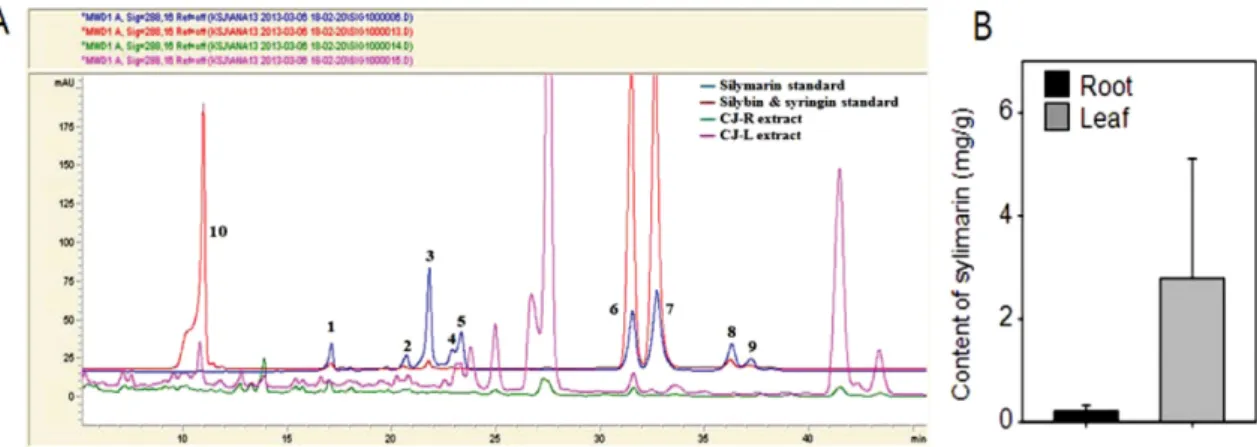
Flavonoid 계 화합물 함량 − 상기 결과를 바탕으로 silymarin계 화합물과 polyphenol/flavonoids 화합물을 HPLC 를 이용하여 정량 분석하였다. 정량 분석에 사용된 화합물 의 구조는 Fig. 2A와 B에서 나타낸 바와 같다. Silymarin은 국화과 유래의 flavonolignan 혼합물로서 항산화 및 항암효 능 및 간장의 해독능 증가와 glutathione 보존작용 등의 기 전으로 간질환 치료제 및 보조제로 이용되고 있다. Silymarin 에는 silybin, isosilybin, silychiristin 및 4가지 이성체가 존재 는 것으로 알려져 있다.8,9,15,16) Silymarin 정량은 Liu등에17) 의해 보고된 방법을 참고 하였으며, 표준물질에서 9개의 peak를 확인하였다(Fig. 3A). 엉겅퀴 잎과 줄기 추출물에서 정량 결과 silymarin계 화합물의 함량은 뿌리보다 잎 추출
Fig. 1. Contents of total flavonoid (TFC) and polyphenol (TPC) in Cirsium japonicum (CJ) root (R) or leaf (L) extracts.
A: TFC contents was expressed as quercetin equivalent (QE).
B: TPC contents was expressed as a gallic acid equivalent (GAE).
Table II. Primer sequences of α-smooth muscle actin (SMA), type I collagen, and GAPDH
Traget Primer sequence
α-SMA sense: 5'-TTCGTTACTACTGCTGAGCGTGAGA-3' antisense: 5'-AAGGATGGCTAAGGCAGGGTC-3' Collagen
α1(I)
sense: 5'-TGGATTCCAGTTCGAGTATG-3' antisense: 5'-AAGGATGGCTGGAACAGGGTC-3' GAPDH sense: 5'-TGAAGGTCGGTGTCAACGGA-3'
antisense: 5'-AGGGATCTCGCTCCTGGAAG-3'
물에서 다량 함유되어 있는 것으로 확인되었다(Fig. 3B, C).
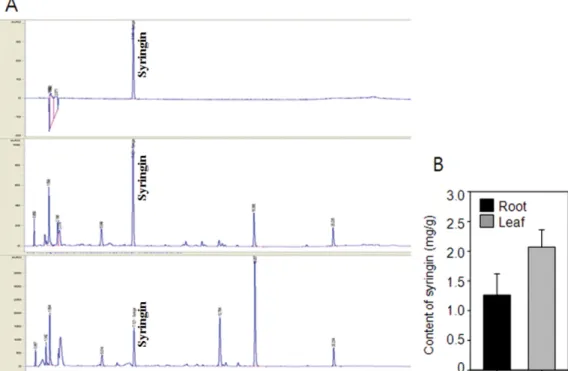
엉겅퀴 잎과 뿌리 추출물 중 flavonoid 화합물의 정량을 위 해 rutin, luteolin, quercetin, apigenin, kaempferol과 페놀성 물질 중 엉겅퀴에서 분리정제 된 바 있는 syringin을18) 표준 물질로 사용하였다(Fig. 4A, Fig 5A). Syringin을 제외한 flavonoids 화합물의 분석은 동일한 조건에서 수행하였다.
정량분석 결과 rutin과 luteolin의 함량은 잎과 뿌리에서 비슷 한 수준으로 존재하는 반면 quercetin, apigenin, kaempferol 의 함량은 잎 추출물에서 상대적으로 다량 함유되어 있는 것으로 분석되었다(Fig. 4B). Syringin은 잎과 뿌리 추출물 모두에서 mg 수준으로 존재하였으며 잎 추출물에서 1.5배
이상 다량 함유되어 있는 것으로 확인되었다(Fig. 5B). 각 표준물질을 retention time과 correlation coefficient는 Table III에 나타내었다.
TGF-β1에 의해 간성상세포(LX-2) 활성 억제 − TGF-β1 은 간 손상에서 아주 중요한 전섬유생성인자(profibrogenic factor)로 작용하며 일반적으로 모든 간 손상에서 TGF-β1의 생성이 증가한다. TGF-β1은 간세포 및 간의 기질 세포들뿐 만 아니라 림프구, 단핵구, 탐식구와 같은 염증세포와 활성 화된 간성상세포에서도 생성되며 간손상 및 간섬유화를 유
발한다.19-21) TGF-β1은 초기에 손상된 간세포와 간의 조직
탐식구인 쿠퍼 세포에서 방출된다.21) LX-2 cells에 각 엉겅 Fig. 2. Chemical structures of silymarins and flavonoids. A: Structure of silymarin compounds. B: Structures of flavonoid compounds.
Fig. 4. Representative flavonoid and flavonoid contents in CJ-R or CJ-L extracts. Chromatogram of A: flavonoid standard. Peak 1;
rutin, 2; luteolin, 3; quercetin, 4; apigenin, 5; kaempferol. B: CJ extracts. C: Comparative contents of flavonoids in CJ-R or CJ-L extract.
Fig. 3. Representative silymarin chromatogram and silymarin contents in CJ-R or CJ-L extracts. Chromatogram of A: silymarin standard. Peak 1; taxifolin, 2; unknown, 3; silychristin A, 4; silydianin, 5; silychristin B, 6; silybin A, 7; silybin B, 8; isosilybin A, 9; isosilybin B, 10; syringin. B: Silymarin concentration in CJ-R or CJ-L extracts.
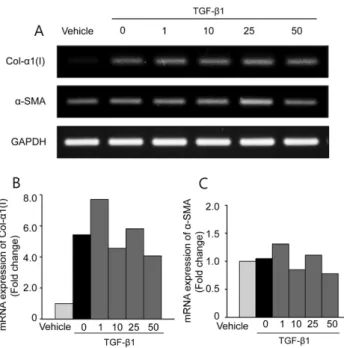
퀴 추출물을 농도 의존적으로 전처리한 뒤 TGF-β1을 24시 간 동안 처리하여 간성상세포의 활성에 주요한 지표인 α- SMA (smooth muscle actin)과 세포외기질 관련 유전자인
type I collagen (Col-α1(I))의 mRNA 발현을 관찰하였다.
TGF-β1을 처리한 군에서는 α-SMA와 Col-α1(I)의 발현이 증가하는 반면 엉겅퀴 잎과 뿌리 추출물을 처리한 실험군 Fig. 5. Representative syringin chromatograms and contents in CJ-R or CJ-L extracts. A: Chromatograms of syringin standard (upper panel), CJ-L extract (middle panel), CJ-R extract (lower panel). C: Comparison contents of syringin in CJ-R or CJ-L extract.
Table III. Retention time (tR/min), regression equation and correlation coefficient for the simultaneous detection of active components of flavonols by HPLC.
Active components† tR/min Regression equation R2
Flavonols Rutin 14.14 y= 31.512x+1.427 0.99937
Luteolin 21.28 y= 55.016x–3.641 0.99954
Quercetin 21.57 y= 58.573x+0.654 0.99971
Apigenin 24.42 y= 62.478x+7.673 0.99975
Kaempferol 25.09 y= 58.096x+1.912 0.99973
Silymarin &
diastereoisomer
Taxifolin 17.10 y= 1.322x+5.814 0.99914
Unkwnon 20.70 y= 0.768x+5.485 0.99932
Silychristin A 21.78 y= 5.050x+24.313 0.99921
Silydianin 22.88 y= 1.117x+3.858 0.99884
Silychristin B 23.33 y= 2.478x+11.569 0.99930
Silybin A 31.51 y= 4.660x+13.515 0.99945
Silybin B 32.68 y= 7.450x+28.568 0.99918
Isosilybin A 36.27 y= 2.321x+1.124 0.99951
Isosilybin B 37.16 y= 1.118x–6.748 0.99964
Silybin A 31.46 y= 23.160x–20.079 0.99975
Silybin B 32.63 y= 28.154x–23.630 0.99976
Syringin 7.13 y= 34.021x–6.126 0.99940
에서는 각 유전자의 발현이 농도 의존적으로 감소하는 것 을 확인하였다. 잎과 뿌리 추출물 모두 α-SMA와 Col-α1(I) 의 발현을 유의하게 억제하였지만 뿌리 추출물은 50 µg/mL 이상에서 효능을 보인 반면 잎 추출물은 1 µg/mL 농도부터 유의한 효능을 보였다(Fig. 6, 7).
결 론
본 연구에서는 엉겅퀴 잎과 뿌리 추출물에서 polyphenol 과 flavonoid 함량 비교 및flavanolignan인 silymarin계 각 화 합물을 HPLC로 비교 분석하였다. Polyphenol 및 flavonoids 함량은 엉겅퀴 잎 추출물은 뿌리 추출물 보다 높은 것으로 확인 되었고, flavonoid 화합물은 뿌리 추출물과 동등하거나 많은 양이 함유된 것으로 나타났다. 또한, silymarin계 화합 물의 경우에서도 잎 추출물에서 다량 함유되어 있는 것으 로 확인되었다. TGF-β1에 의한 간성상세포의 활성과 세포 외기질 유전자인 Col-α1(I)의 발현을 뿌리 추출물 보다 잎 추출물에서 보다 우수한 효능을 보였다. 이는 잎 추출물에 서 polyphenol, flavonoid, flavonolignan 다량 분석된 결과에 상응하는 하는 것이다.
결론적으로 향후 간섬유화 모델에서 엉겅퀴 지상부의 효 능 기전 규명과 동물모델에서의 효과 입증을 통해 엉겅퀴
의 지상부가 지하부에 비해 간질환 관련 치료제 및 보조제 개발을 위해 보다 유용할 것으로 사료된다.
사 사
본 연구는 2011년 지식경제부와 한국산업기술진흥원의 지 역산업기술개발사업(국화과 약용식물 유래 혈행개선 소재발 굴에 의한 로하스 식품개발, R0000122)으로 수행된 연구결 과입니다.
인용문헌
1.통계청 (2011) 사망원인통계.
2. Tsukada, S., Parosns, C. J. and Ripe, R. A. (2006) Mechanism of liver fibrosis. Clin. Chim. Acta. 364: 33-60.
3. Pinzani, M. (1995) Hepatic stellate (Ito) cells: expanding roles for a liver specific pericyte. J. Hepatol. 22: 700-706.
4. Friedman, S. L., Roll, J. F., Boyles, J. and Bissell, D. M.
(1985) Hepatic lipocytes. the principal collagen producing cells of normal rat liver. Proc. Natl. Acad. Sci. USA. 82:
8681-8685.
5. Bedossa, P., Houglum, K., Trautwein, C., Holstege, A. and Chojkier, M. (1994) Stimulation of collagen a1(I) gene expres- Fig. 6. Inhibitory effects of CJ-L extract on TGF-β1 induced
hepatic stellate cells activation in a dose-dependent manner. A:
TGF-β1-induced Col (collagen)-α1(I) and α-SMA (smooth muscle actin) expression levels were was significantly blocked by CJ-L extracs in LX-2 cells. A: using RT-PCR, B: Col-α1(I) using real time PCR and C: α-SMA expression using real time PCR. All results were normalized with respect to the expression of GAPDH.
Fig. 7. Inhibitory effects of CJ-R extract on TGF-β1 induced hepatic stellate cells activation in a dose-dependent manner. A:
TGF-β1-induced Col-α1(I) and α-SMA mRNA expression level was abolished by CJ-R extracts in LX-2 cells.
Quantitative analysis of B: Col-α1(I) and C: α-SMA expression using real time PCR. All results were normalized with respect to the expression of GAPDH
sion is associated with lipid peroxidation in hepatocellular injury: a link to tissue fibrosis. Hepatology 19: 1262-1271.
6. Ishida, H., Umino, T., Tsuji, K. and Kosuge, T. (1987) Studies on antihemmorhagic substances in Herbs classified as hemo- statics in Chinese medicine. VII. On the anthihmorrhagic principle in Cirsium japonicum DC. Chem. Pharm. Bull. 35:
861-864.
7. Chung, M. S., Um, H. J., Kim, C. K. and Kim, G. H. (2007) Development of functional tea product using Circium japoi- nucum. Korean J. Food Culture 22: 261-265.
8. Wallace, S. N., Carrier, D. J. and Clausen, E. C. (2005) Batch solvent extraction of flavanolignans form milk thistle (Sily- bum marianum L. Gaertner). Phytochem. Anal. 16: 7-16 9. Saller, R., Meier, R. and Brignoli, R. (2001) The use of sily-
marin in the treatment of liver diseases. Drugs 61, 2035- 2063.
10. Lee, D. S., Kim, K.-S., Li, B., Choi, H.-G., Keo, S., Jun K.- Y., Park, J.-H. and Kim, Y.-C. (2012) Anti-inflammatory effects of the Cirsium japonicum var. ussuriense 70% eth- anolic extract in RAW264.7 cells by heme oxygenase-1 expression. Kor. J. Pharmacogn. 43: 39-45.
11. Kim, S.-J., Kim, S.-Y., Kim, J.-A., Park, I. S., Yu, K.-Y., Chung, C.-H., Shim, J.-S., Jang, S.-I. and Jeong, S.-I. (2012) Inhibitory effect of Cirsium japonicum root or flower extract on hepatic stellate cells activation. Kor. J. Pharmacogn. 43:
27-31.
12. Otto, F. and Denis, W. (1912) On phosphotungstic-phosph- omolybdic compounds as color reagents. J. Biol. Chem. 12:
239-243.
13. Moreno, M. I. N., Isla, M. I. N., Sampietro, A. R. and Vat- tuone, M. A. (2000) Comparison of the free radical-scav- enging activity of propolis from several region of Argentina.
J. Ethnopharmacol. 71: 109-114.
14. Cha, J. T., Cho, Y. S., Kim, I., Anno, T., Rahman, S. M. and Yanagita, T. (2001) Effect of hesperetin, a citrus flavonoid, on the liver triacylglycerol content and phosphatidate phospho- hydrolase activity in orotic acid-fed rats. Pant. Foods Human Nutri. 56: 349-358.
15. Vogel, G., Trost, W. and Braatz, R. (1975) Studies on the pharmacodynamics, including site and mode of action of sily- marin: The antihepatotoxic principle from Silybum mar (L) Gaertn. Arzeiittelforsch 25: 2-9.
16. Gazák, R. D. and Walterova, Kren, V. (2007) Silybin and sily- marin-new and emerging applications in medicine. Curr.
Med. Chem. 14: 315-338.
17. Liu, H., Du, Z. and Yuan, Q. (2009) A novel rapid method for simultaneous determination of eight active compounds in silymarin using reversed-phased UPLC-UV detector. J. Chro- matogr. B. 877: 4159-4163.
18. Jung, M. J., Heo, S.-I. and Wang, M.-H. (2008) Rat lens aldose reductase inhibitory of Taraxacum mongolicum and two Cirsium species. J. Appl. Biol. Chem. 51: 302-306.
19. Bissell, D. M., Wang, S. S., Jargagin, W. R. and Roll, F. J.
(1995) Cell-specific expression of transforming growth fac- tor-beta in rat liver. Evidence for autocrine regulatin of hepa- tocyte proliferation. J. Clin. Invest. 96: 447-455.
20. Gao, C. Gressner, G., Zoremba, M. and Gressner, A. M.
(1996) Transforming growth factor beta (TGF-beta) expres- sion in isolated and cultured rat hepatocytes. J. Cell Physiol.
167: 394-405.
21. Liu, X., Hu, H. and Yin, J. Q. (2006) Therapeutic strategies against TGF-beta signaling pathway in hepatic fibrosis. Liver Int. 26: 8-22.
(2013. 4. 25 접수; 2013. 5. 7 심사; 2013. 5. 21 게재확정)