The Korean Journal of Mycology 한국균학회지
© The Korean Society of Mycology Kor. J. Mycol. 39(1) : 7-10 (2011)
DOI:10.4489/KJM.2011.39.1.0007
7
울릉도의 자생란과 공생하는 난균근균의 분자생물학적 동정
염재영1·정재민2·이병천2·엄안흠1
*
1한국교원대학교 생물교육과, 2국립수목원 산림자원보존과
Molecular Identification of Orchid Mycorrhizal Fungi of Native Orchids in Ulleung Island
Jae-young Youm
1, Jae-min Chung
2, Byung-chun Lee
2and Ahn-Heum Eom
1*
1Department of Biology Education, Korea National University of Education, Chungbuk 363-791, Republic of Korea
2Department of Forest Resources Conservation, Korea National Arboretum, Gyeonggi 487-821, Republic of Korea (Received 10, December 2010., Accepted 7, March 2011)
ABSTRACT : Orchid mycorrhizal fungi (OMF) were examined in roots of the six terrestrial species of orchids collected in Ulleung Islands. Seven OMF isolates from the roots of orchids were identified based on morphological and molecular characters. Internal transcribed spacer region of OMF DNA was amplified using basidiomycete-specific ITS primers, ITS1-OF and ITS4-OF. OMF beloning to Tulasnellaceae and Ceratobasidaceae was identified through molecular analysis.
KEYWORDS : Ceratobasidaceae, ITS, Orchid mycorrhizal fungi, Peloton, Tulasnellaceae
서 론
난과는 세계적으로 25,000종 이상이 알려진 식물계에서 가장 큰 분류군 중의 하나이다(Cribb et al., 2003). 우리 나라에는 2아과, 5족, 46속에 속하는 약 100여 종의 난과 식물이 있는 것으로 알려져 있다(김과 이, 1997). 난과 식물은 서식환경에 따라 토양에 서식하는 지생란, 다른 식물에 착 생하는 착생란, 바위 표면에 서식하는 암생란으로 구분할 수 있다(Dearnaley, 2007). 착생란은 주로 열대와 아열대에 서식하는 종으로 난과 식물의 가장 일반적인 형태이다.
지생란은 주로 온대나 아한대에서 자생하는 종으로 지표에 뿌리를 내려 줄기를 지탱하며, 흙속의 수분이나 무기양분을 흡수하며 착생란에 비해 뿌리가 가늘고 잎의 폭이 넓은 것이 특징이다. 세계적으로는 약 25% 정도가 지생란이며, 약 70% 정도가 착생란의 형태를 가지고 있으나(Arditti and Gandawijaja, 1983), 한반도에는 기후와 생태적인 특성상 지생란이 약 70%를 차지하고 있다(김과 이, 1997).
난과 식물은 난균근균(Orchid Mycorrhizal Fungi, OMF) 과 공생관계를 맺고 있는데, 이들은 탄소화합물 등의 양분을 난에게 공급하여 종자의 발아를 도와주고, 난의 초기 엽록소 생성 및 생장에 영향을 준다(Peterson et al., 1998; Smith and Read, 2008). 또한 난균근균은 난의 생존, 분포 그리고
경쟁관계에도 영향을 주는 것으로 알려져 있다(Rasmussen and Whigham, 1993; Batty et al., 2006). 대부분의 난균근균 은 Rhizoctonia 속에 속하는 것으로 알려져 있다(Currah et al., 1997; Roberts, 1999). Rhizoctonia 속에 속하는 균은 유성세대형을 정의하는 데 필수적인 생식포자형성(sexual sporulation)이 나타나지 않기 때문에 무성세대의 형태적 유사성만으로는 난균근균 분류는 불가능하다(Roberts, 1999;
Currah et al., 1997). 따라서 분자생물학적 방법을 통한 난균근균의 동정은 무성세대 분류에 매우 절대적이다 (Zelmer, 1996).
울릉도는 동경 130o47´37´´~130o55´20´´, 북위 37o14´14´´~
37o33´01´´에 걸치는 화산섬으로 규모는 작으나 많은 생 물들의 보고로 알려져 있다. 울릉도는 생물서식지와 관련 하여 8곳이 천연기념물로 지정되어 있으며, 금난초와 주 름제비란 등은 문화재청 지정 천연기념물 제 139호인 성 인봉 일대에 서식하고있다. 또한 울릉도에 자생하는 감자 란초(Oreochis patens), 보춘화(Cymbidium goeringii), 주 름제비란(Gymnadenia camtschatica), 금난초(Cephalanthera falcata)는 동아시아 특산종이며, 특히 보춘화(Cymbidium goeringii)는 환경부 지정 특정야생식물 제 48호로 지정되어 보호되고 있어 생물 종 다양성 유지와 유전자원의 보전을 위해 중요한 지역이다(김과 이, 1997).
난과 식물은 원예학적인 가치와 자생식물의 재배에 대한 관심이 높아짐에 따라 남채에 의한 피해가 급증하고 있다.
*Corresponding author <E-mail : [email protected]>
8 염재영 등 또한 산림훼손으로 인한 자생지 파괴와 기후변화 등으로 인 한 생태계의 변화는 자생지의 교란과 개체수의 감소로 이어 지고 있으며, 최근의 연구는 난균근균과 난과 식물사이의 특이적 공생관계는 난과식물의 개체수 변화에 중요한 역 할을 하는 것을 보여주고 있다(Swarts et al., 2010). 따라서 난 과 식물의 개체수 감소에 따른 종 보존에 대한 요구가 시 급하지만, 난균근균과 난과 식물과의 공생관계에 기반을 둔 관련 연구는 거의 이루어지고 있지 않다. 따라서 난과 식물 의 다양성 유지와 이의 보전을 위해서는 난과 식물의 뿌리 에 공생하며 난과식물의 발아와 생장에 결정적인 역할을 하고 있는 난균근균에 대한 연구가 필요하다. 본 연구에서 는 울릉도에 자생하는 난을 채집하여, 난균근균의 감염여부 를 확인하고 난균근균을 순수 분리한 후 형태적, 분자적 인 동정을 하였다.
재료 및 방법
난뿌리의 채집
2010년 5월과 2010년 10월 2차례에 걸쳐 울릉도의 여러 지역에서 금난초(Cephalanthera falcata), 보춘화(Cymbidium goeringii), 주름제비란(Gymnadenia camtschatica), 감자 난초(Oreochis patens), 타래난초(Spiranthes sinensis), 큰 나도잠자리난(Tulotis asiatica) 등 총 6종의 난에서 건강한 뿌리를 채집하였다(Table 1). 채집된 뿌리들은 ice packing하 여 보관하였고, 실험실로 옮겨져 바로 균분리에 이용하였다.
공생균 감염여부 관찰
난의 뿌리를 2~3 cm 길이로 잘라 증류수로 여러 번 세척 후 Koske 와 Gemma (1989)의 방법을 변형하여 염색하 였다. 각각의 뿌리 절편을 2.5% KOH 용액에 넣어 121oC에 서 10분간 고압멸균하여 뿌리를 연화시킨 후 여러 번 물로 헹구어 KOH를 제거하였다. 1%의 HCl 용액에 24시간 담 가둔 후, 0.05% tryphan blue에 넣어 121oC에서 10분간 고 압멸균하여 염색하고 acidic glycerol에서 탈색 후 광학현 미경(AXIO Imager A1, Zeiss)으로 관찰하였다.
뿌리조직으로부터의 균분리 및 배양
채집된 뿌리샘플에서의 균분리는 Richardson 등(1993)의
방법을 변형하여 사용하였다. 우선 난 뿌리를 증류수로 세 척 후 clean bench 내에서 50% 알코올 용액에 1분, 5%
차아염소산나트륨(NaClO) 용액에 1분간 표면살균하여 멸 균수로 여러 번 세척하였다. 뿌리표면의 물기를 제거한 후 멸균된 가위를 이용하여 약 5 mm 길이로 잘라서 Water Agar(WA) 배지에 이식하였다. 페트리디쉬에 1개당 4개의 뿌리절편들을 이식한 후 25oC의 암소에서 보관하였다. 뿌리 로부터 균사가 자라나오면 Potato Dextrose Agar 배지로 옮겼으며, 3회 정도 계대배양하여 균을 순수분리하였다. 순 수분리된 균은 Riddel(1950)의 방법에 따라 배양하여 관찰 하였다. 각 배지 1 L당 조성은 다음과 같다; Water Aar(WA) 배지, agar 12 g; Potato Dextrose Agar 배지, Potato Extract 4.0 g, Dextrose 20.0 g, Agar 15.0 g.
DNA 추출 및 PCR
순수분리된 균의 샘플을 DNeasy Plant mini kit(Quigen, USA)의 방법에 따라 genomic DNA를 추출하였다. 추출된 genomic DNA는 20ng/ml로 농도를 맞춘 후 PCR 반응에 사용하였다. 실험에 사용된 PCR 반응액은 0.2 microtube 에 Prime Taq DNA Polymerase 1 units/10, 2×reaction buffer, 4 mM MgCl2, enzyme stabilizer, 침강제, loading dye, 2 mM dNTP를 모두 혼합한 pH 9.0의 용액인 (주 )GENET BIO사의 Prime Taq Premix(G-2000) 제품을 사 용하였다. PCR 반응은 담자균류에 특이적 primer인 ITS1- OF와 ITS4-OF를 쌍으로 사용하여 rDNA의 internal transcribed spacer (ITS) 지역을 증폭하였다(Taylor and McCormick, 2008). PCR 반응은 2720 Thermal cycler(Applied Biosystems, USA)를 이용하여 수행하였으며, PCR의 반응조건은 다음과 같다. 먼저 96oC에서 2분간 pre- denaturation하였다. 다음으로 94oC에서 30초간 denaturation, 64oC에서 40초간 annealing, 72oC에서 1분간 elongation 하 였고, 이 3단계를 1 cycle로 하여 총 35 cycle을 진행하였다.
마지막으로 72oC에서 10분간 안정화시킨 다음, 전기영동하 기 전까지 4oC에서 보관하였다. 증폭된 PCR 산물은 1X TAE buffer(40 mM Tris-acetate, 1 mM EDTA, pH 8.0)를 사용하여 1.5% agarose gel에서 약 20분간 전기영동을 실시 하였으며, 0.5 µg/ml ethidium bromide로 1분간 염색하고 흐 르는 물에서 5분간 탈색한 후 UV transilluminator 상에서 밴드를 확인하였다.
염기서열 분석 및 계통 분석
증폭된 DNA는 정제하여 ABI 3730XL capillary DNA Sequencer (Perkin-Elmer, USA)로 염기 서열을 분석하였다.
분석된 염기서열은NCBI(http://www.ncbi.nlm.nih.gov/)에서 BLAST(Basic Local Alignment Search Tool)하여 일치도가 가장 높은 종을 확인하였다(Table 2). 확인된 종들에 대한 염기서열을 NCBI로부터 선별한 후 실험을 통해 분석된 염기서열들은 MEGA 4(for Windows, Tamura and Dudley, Table 1. Orchid species collected from Ulleung Island in this study
Orchid plant species Latitude Longitude Cephalanthera falcata N 37o27´ E 130o50´
Cymbidium goeringii N 37o27´ E 130o50´
Gymnadenia camtschatica N 37o29´ E 130o52´
Oreochis patens N 37o29´ E 130o52´
Spiranthes sinensis N 37o28´ E 130o53´
Tulotis asiatica N 37o28´ E 130o53´
Orchid mycorrhizal fungi of native orchid in Ulleung Island 9
2007)를 이용하여 alignment 후 계통도로 나타내었다. 계통 도에서 각 분지의 신뢰도를 계산하기 위하여 실행한 bootstrap 분석은 1000 replicates를 선택하였고, 계통 분석을 위한 outgroup으로 Pyrorchis nigricans를 사용하였다.
결과 및 고찰
뿌리를 trypan blue로 염색하여 관찰한 결과 주름제비 란을 제외한 5종의 난에서 난균근균이 공생하고 있는 것을 확인할 수 있었다. 분리된 균사는 코일 모양으로 감겨서 균구 (peloton)를 형성하고 있음을 확인할 수 있었으며 종에 따른 차이는 관찰할 수 없었다. 금난초를 제외한 5종의 난에서 총 7개의 균주를 분리하였으며, 현미경 상에서 Rhizoctonia의 특징적인 형태를 관찰할 수 있었으나 균주사이의 형태적 차이를 구분할 수는 없었다. 본 연구에서는 광학현미경상 으로만 형태적 특징을 관찰하였으나, 전자현미경을 이용 한 격벽의 초미세구조(Shimura et al., 2009) 등과 같은 균사 의 자세한 형태를 확인할 필요가 있을 것이다.
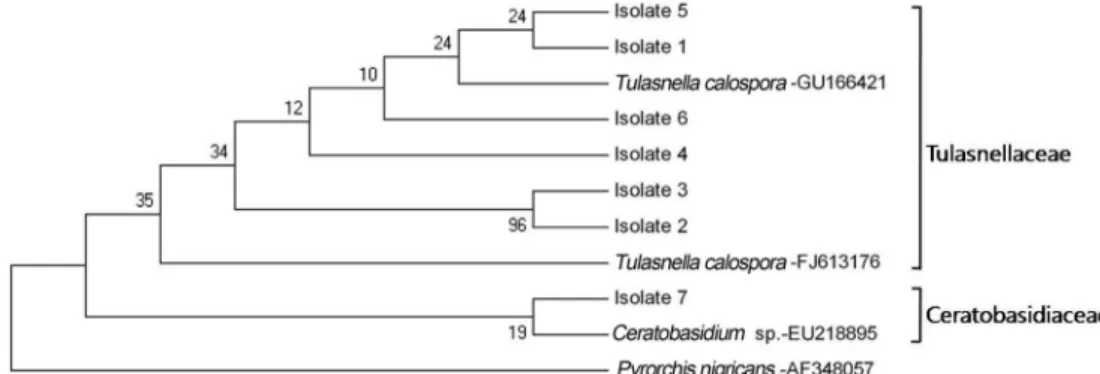
염기서열을 이용한 동정결과 총 7 균주 중에서 6개의 균주가 Tulasnella calospora 였으며, 큰나도잠자리난에서 Ceratobasidium sp.가 확인되었다(Table 2, Fig. 1).
Rhizoctonia 속의 난균근균은 유성세대의 특징에 따라 크게 Tulasnellaceae, Ceratobasidiaceae, Sebacinaceae 세 개의 과 로 구분할 수 있다(Taylor and Bruns, 1999). 본 연구에서는
보춘화, 주름제비란, 감자난초, 타래난초에서 Tulasnellaceae에 속하는 Tulasnella calospora가 공생하고 있음을 확인하였 으며, 큰나도잠자리난에서 Ceratobasidiacea 중 Ceratobasidium 속에 속하는 균을 확인할 수 있었다. Terashita(1982)는 타 래난초로부터 Rhizoctonia repens(유성세대 : Tulasnella calospora)와 Rhizoctonia solani(유성세대 : Thanatephorus cucumeris)를 분리하였다. 북미, 유럽, 동아시아(일본과 대 만)에서 수집된 Cypripedium 속의 종들에 관한 연구에서는 Tulasnellaceae에 속하는 난균근균과의 공생이 매우 높은 상관관계가 있음을 보여주었다(Shefferson et al., 2007;
Shimura et al., 2009). 우리나라에서는 Lee 와 You(2000)가 보춘화에서 Tulasnella repens를 분리하였는데, 본 연구결 과도 대부분 Tulasnella calospora 가 동정되었으며 이상의 연구들을 종합하면 대다수의 난과 식물들이 공생하는 난균 근균은 Tulasnellaceae에 속하는 균이 우점하고 있음을 알 수 있다(Smith and Read, 2008; Dearnaley, 2007).
본 연구에서는 5종의 난과 식물로부터 총 7균주의 난균 근균을 분리하였으며 이는 염기서열 분석을 통하여 2종의 난균근균으로 동정할 수 있었다. Zhu 등 (2008)은 3종의 난 을 대상으로 한 연구에서 총 15균주를 획득하였으며, 3개의 속에 속하는 난균근균을 확인하였다. 또한 Bonnardeaux 등 (2007)의 연구에서는 3종의 지생란에서 뿌리조직과 peloton으 로부터 3개의 속에 속하는 10균주의 난균근을 분리하였다.
이처럼 다양한 균을 분리하기 위해서는 보다 다양한 종류의
Fig. 1. NJ Phylogenetic tree based on a fragment of ITS rDNA sequences of orchid mycorrhizal fungi isolated from orchid roots of Uleung island. Pyrorchis nigricans was used as outgroup. Numbers at nodes are bootstrap vaulues in percent from NJ bootstrap analyses.
Table 2. Molecular identification of orchid mycorrhizal fungi using ITS sequence of rDNA
Isolates Host species Genebank accession No. The Closest genebank taxa Maximum identity
Isolate 1 Cymbidium goeringii AB369940 Tulasnella calospora 99%
Isolate 2 Gymnadenia camtschatica EF393621 Tulasnella calospora 99%
Isolate 3 Oreochis patens EF393621 Tulasnella calospora 74%
Isolate 4 Oreochis patens FJ613176 Tulasnella calospora 93%
Isolate 5 Oreochis patens EF393621 Tulasnella calospora 74%
Isolate 6 Spiranthes sinensis EF393621 Tulasnella calospora 95%
Isolate 7 Tulotis asiatica EU218895 Ceratobasidium sp. 91%
10 염재영 등 배지와 다양한 조건에서의 배양 그리고 peloton의 추출을 통 한 균분리(Zhu et al., 2008) 등과 같이 다양한 기술을 이용 하면 보다 더 다양한 균을 분리해낼 수 있을 것이다.
난의 생활사에서 공생균은 절대적인 역할을 차지하고 있다. 따라서 난 공생균에 대한 연구는 난의 보호를 위해 매우 중요하다. 분리된 균을 이용하여 종자의 발아, 원괴체 (protocorm)의 발달 및 성체의 생장에 특정 공생균이 미치는 영향을 확인하는 후속 연구는 위기에 처한 이들 난의 보 존노력에 중요한 정보를 제공할 것이다.
적요
울릉도에서 채집된 6종의 지생란의 뿌리에서 난균근균을 확인하였다. 난균근균의 감염이 확인되었다. 각 종의 뿌리로 부터 분리된 난균근균이 분자적인 분석을 통하여 확인되 였다. 뿌리로부터 분리된 균에서 DNA를 추출하여, 담자 균류에 특이적인 프라이머인 ITS1-OF와 ITS4-OF를 사용 하여 ITS 지역을 증폭한 후 염기서열을 분석하여 두 식물의 뿌리에 공생하는 난균근균을 동정하였다. 분자적인 분석을 통해 Tulasnellaceae 와 Ceratobasidaceae에 속하는 난균 근균이 확인되었다.
감사의 글
이 연구는 2009년도 한국 교원 대학교 (KNUE) 학술연 구비를 받아 수행하였음.
참고문헌
김수남, 이경서. 1997. 한국의 난초. 교학사. 서울. 495p.
Arditti, J. and Gandawijaja, D. 1983. The orchids of Krakatau:
Evidence for a mode of transport. Ann. Bot. 52:127-130.
Batty, A. L., Brundrett, M. C., Dixon, K. W. and Sivasithamparam, K. 2006. New methods to improve symbiotic propagation of terrestrial orchid seedlings from axenic culture to soil. Aust.
J. Bot. 54:367-374.
Bonnardeaux, Y., Brundrett, M., Batty, A., Dixon, K., Koch, J. and Sivasithamparam, K. 2007. Diversity of mycorrhizal fungi of terrestrial orchids : compatibility webs, brief encounters, lasting relationships and alien invasions. Mycol. Res. 111:51-61.
Cribb, P. J., Lell, S. P., Dixon, K. W. and Barrett, R. L. 2003. Orchid conservation: a global perspective. In: Orchid conservation, pp. 1-24. Eds. K. W. Dixon, S. P. Kell, R. L. Barrett, P. J. Cribb.
Natural History Publications (Borneo): Kota Kinabala, Sabah.
Currah, R. S., Zettler, L. W. and McInnis, T. M. 1997. Epulorhiza
nquilina sp. nov. from Platanthera (Orchidaceae) and a key to Epulorhiza species. Mycotaxon 61:335-342.
Dearnaley, J. D. 2007. Further advances in orchid mycorrhizal research. Mycorrhiza 17:475-486.
Koske, R. E. and Gemma, J. N. 1989. A modified procedure for staining roots to detect VA mycorrhizas. Mycol. Res. 92:486-488.
Lee, S. S. and You, J. H. 2000. Identification of the orchid mycorrhizal fungi isolated from the roots of Korean native orchid. Mycobiology 28:17-26.
Peterson, R. L., Uetake, Y. and Zelmer, C. 1998. Fungal symbioses with orchid protocorms. Symbiosis 25:29-55.
Rasmussen, H. N. and Whigham, D. F. 1993. Seed ecology of dust seeds in situ: a new study technique and its application in terrestrial orchids. Am. J. Bot. 80:1374-1378.
Richardson, K. A., Currah, R. S. and Hambleton, S. 1993.
Basidiomycetous endophytes from the roots of neotropical epiphytic orchidaceae. Lindleyana 8:127-137.
Riddel, R. W. 1950. Permanent stained mycological preparations obtained by slide culture. Mycologia 42:265-270.
Robert, P. 1999. Rhizoctonia-forming fungi: a taxonomic guide.
Royal Botanic Gardens, Kew. 239p.
Shefferson, R. P., Taylor, D. L., Weiß, M., Garnica, S., McCormick, M. K., Adams, S., Gray, H. M., McFarland, J. W., Kull, T. and Tali, K. 2007. The evolutionary history of mycorrhizal specificity among lady's slipper orchids. Evolution 61:1380-1390.
Shimura, H., Sadamoto, M., Matsuura, M., Kawahara, T., Naito, S.
and Koda, Y. 2009. Characterization of mycorrhizal fungi isolated from the threatened Cypripedium macranthos in a northern island of Japan: two phylogenetically distinct fungi associated with the orchid. Mycorrhiza 19:525-534.
Smith, S. E. and Read, D. J. 2008. Mycorrhizal symbiosis. pp. 419- 506. Academic Press, NY.
Swarts, N. D., Sinclair, E. A., Francis, A. and Dixon, K. W. 2010.
Ecological specialization in mycorrhizal symbiosis leads to rarity in an endangered orchid. Mol. Ecol. 19:3226-3242.
Tamura, K. and Dudley, J. 2007. “MEGA4: molecular evolutionary genetics analysis (MEGA) software version 4.0.” Mol. Biol.
Evol. 24:1596.
Taylor, D. L. and Bruns, T. D. 1999. Population, habitat and genetic correlates of mycorrhizal specialization in the ‘cheating’ orchids Corallorhiza maculata and C. mertensiana. Mol. Ecol. 8:1719-1732.
Taylor, D. L. and McCormick, M. K. 2008. Internal transcribed spacer primers and sequences for improved characterization of basidiomycetous orchid mycorrhizas. New Phytol. 177:1020-1033.
Terashita, T. 1982. Fungi inhabiting wild orchids in Japan. Isolation of symbionts from Spiranthes sinensis var. amoena. Tran. Mycol.
Soc. Jap. 15:121-133.
Zelmer, C. D., Cuthbertson, L. and Currah, R. S. 1996. Fungi associated with terrestrial orchid mycorrhizas, seeds and protocorms.
Mycoscience 37:439-448.
Zhu, G. S., Yu, Z. N., Gui, Y. and Liu, Z. Y. 2008. A novel technique for isolating orchid mycorrhizal fungi. Fungal Diversity 33:123-137.