JKSCI
Effect of Family-Friendly Corporate culture on Organizational Commitment and Job Performance-Focus on ICT companies in Korea
1)
Won-Hee Lee*, Dal-Nim Yang**
*Professor, Division of Business Administration, Kyungnam College of Information & Technology, Busan, Korea
**Adjunct Professor, Department of Dental Hygiene, Kyungnam College of Information & Technology, Busan, Korea [Abstract]
This study is an empirical study to examine how the family-friendly corporate culture affects organizational commitment and job performance for ICT companies in Korea. Therefore, the purpose of the study is to investigate the effects of family-friendly culture of ICT companies on the organizational commitment and job performance of their employees. To this end, the impacts of internal factors of family-friendly corporate culture on their organizational commitment and job performance of the employees of ICT companies in South Korean are empirically analyzed. And the findings of the empirical investigation are as follows: Family-friendly Organizational culture and Family-Friendly Welfare System have positive effects on the organizational commitment, and Organizational commitment, in return, has positive effects on the job performance. But the Family-friendly working environment is found to have NO significant effects on the Organizational commitment. These results confirm the characteristics of workers who prefer family-friendly welfare systems with economic rewards rather than formal family-friendly programs.
▸Key words: Family-friendly working environment, Family-friendly Organizational culture, Organizational commitment, Family-Friendly Welfare System, Job performance
[요 약]
본 연구는 한국 ICT기업들을 대상으로 가족친화적 기업문화가 조직몰입 및 직무성과에 어떠한 영향을 주는지를 살펴보고자 하는 실증연구이다 . 따라서 본 연구는 한국 ICT 기업조직에서 가족 친화적 기업환경이 조직몰입 및 직무성과에 어떠한 영향을 주는지 알아보고자 하는데 그 목적이 있다. 이를 위해 본 연구에서는 한국 ICT 기업의 종사자를 대상으로 가족친화적 기업문화의 내부
요인들이 조직몰입과 직무성과에 어떠한 영향을 주는지를 실증분석 하였다 . 본 연구의 실증분석
결과 한국 ICT 기업 조직의 가족친화적 조직문화, 가족친화적 복지제도는 조직몰입에 긍정적인 영향을 미치는 것으로 나타났고 조직몰입은 직무성과에 긍정적인 영향을 미치는 것으로 나타났 다 . 하지만 본 연구에서 제시한 가설 중 가족친화적 근무환경은 조직몰입에 유의한 영향을 주지 않는 것으로 확인되었다. 이러한 결과는 형식적인 가족친화형 프로그램 보다는 경제적 보상이 따 르는 가족친화적 복지제도를 더 선호하는 종사자들의 특성을 확인하였다.
▸주제어: 가족친화적 근무환경, 가족친화적 조직문화, 조직몰입, 가족친화적 복지제도, 직무성과
∙First Author: Won-Hee Lee, Corresponding Author: Dal-Nim Yang
*Won-Heeg Lee ([email protected]), Division of Business Administration, Kyungnam College of Information &
Technology
**Dal-Nim Yang ([email protected]), Department of Dental Hygiene, Kyungnam College of Information & Technology
∙Received: 2019. 10. 31, Revised: 2019. 11. 15, Accepted: 2019. 11. 15.
Copyright ⓒ 2019 The Korea Society of Computer and Information http://www.ksci.re.kr pISSN:1598-849X | eISSN:2383-9945
I. Introduction
A family-friendly organizational culture is one in which organizations support policies and services so that workers can be balanced at work and home [1] and share those values and beliefs. [2] defined a family-friendly organizational culture as an organizational effort to support workers responsible for family support. This is defined in terms of work and family and includes the organization's support for workers' extra-day lives. In the mist of rapid economical developments, South Koreans face increasing discordance between home life and career development. And their interdependency and expectations on each other tend to digress that it may be inevitable for them to face discordance while carrying out their dual roles [3]. Salary workers may experience a lot of discordance and stress under their dual responsibilities for their family and employer, and it is likely that meeting such dual responsibilities can contribute to increased negligence of duty, absence, churn rate, or inefficient execution of their job. Instability of family life and decreased family unity, in return, can result in disintegration of family and this can contribute to social unrest, leading to such repetition of the vicious cycle. Faced with such dual responsibilities, companies find it necessary to foster family-friendly culture within the company.
But despite the expected effects of family-friendly culture, the real number of companies that introduce and make use of the system is pretty small, therefore more awareness of the importance of family-friendly culture should be emphasized because it is pointed out that most of the employees do not know the existence of such system regardless the system is, in fact, implemented or not.
According to ‘the empirical study of food services companies’ by [4], the higher the collective job efficacy and job satisfaction is, the higher family-friendly culture is. And the collective efficacy appears to play intermediary role between
family-friendly culture and job satisfaction. And we can tell from the findings that collective efficacy and job satisfactions can be increased when corporations consider the aspect of the family life of their employees as well and provide adequate measures in support.
The purpose of the study is to analyze the effects of family-friendly culture on the organizational commitment and job performance of the employees of the ICT companies in South Korea.
Speaking of the ICT companies in South Korea, the speed of corporate environmental change has been fast and the portion of time that used to be devoted to home life decreased a lot that the employees find it increasingly difficult to meet their dual responsibilities for their family and employer.
Therefore, the empirical analysis of this study was to see the impacts of Family-friendly working environment, Family-friendly Organizational culture and Family-friendly Welfare system on the Organizational commitment and the job performance.
II. Theoretical Background
The definition of family-friendly culture varies depending on the investigator. According to [6], the means of ‘family-friendliness’ of their company provides the employees with system and services, to help them to be able to have balanced and harmonious life between their home and company life, therefore here ‘family-friendly culture’ is defined as sharing theses values and belief among the concerned parties.
Regarding existing studies, it is also confirmed by [5] through the empirical analysis in ‘the study of the impacts of family-friendly system on the job performance within police organizations’ that the internal factors of family-friendly culture has significant impacts on the organizational life and welfare, and welfare, in return, has significant effects on the job performance.
According to [6], imbalance between home life and
corporate life has negative effects on individuals and their families, colleagues and their companies, and the expansion of family-friendly culture and the introduction of family-friendly system are proposed as means to solve such issues.
However, as can be seen in the study by [7], it is necessary, though, to recognize that such system itself cannot solve such discordance problem between home life and corporate life, even though such family-friendly system can help with their dual responsibilities for their family and company.
Organizational commitment means a certain state where people are committed to something and in the fields of psychology and social science, this concept is used to analyze individual and organizational behaviors. In a committed state, people tend to do their best and achieve better performance than otherwise. And there have been many studies about organizational commitment since 1960s.
In general, the members of the organization are likely to identify themselves with heir organization and thereby provide innovation and motivations for their organizational development.
Churn rate among the members of a company with low level of immersion tends to be higher.
According to ‘the empirical study of the family-friendly system within police organizations’
by [5], family-friendly culture and welfare system have significant effects on organizational commitment and job performance.
[8] defines organizational commitment as unity with and commitment to their organization and, as a prominent scholars who insisted the multi-dimension of organizational commitment, conceptualizes organizational commitment as emotional commitment, persistent commitment and normative commitment.
[9] interprets organizational commitment as trust in and attachment to the goal and value of the organization, commitment and devotion to the organization, and desire to remain as a members.
[10] classifies organizational commitment into
persistent commitment and value commitment.
Persistent commitment is psychological attachment to their organization to remain as a member of the organization while value commitment means willingness to achieve the goal of the organization being confident in the organization.
Job performance is a result of the efforts made by its members to achieve the goal or task of the organization [11].
[12] sees job performance being a result of activities that can be measured objectively and defines it as a measure of multiple goals achieved despite various limiting factors.
In organization management, job performance of the members is used as an indicator of the effectiveness of its members.
Companies systematically measure the job performance of individual members to help individual members make use of their best ability, thereby to improve organizational productivity. The factors that impact job performance vary depending on the investigator.
According to ‘the empirical study of project performance of domestic companies’ by [13], managerial autonomy and level of compensatory reward appear to have positive effects on the project achievement.
[14] uses job performance as a reference point to measure functional knowledge, technical knowledge, reliability, collaboration, desired behavior and aggressiveness and organizational performance, [15], on the other hand, uses job performance as an indicator for task achievement, such as productivity, effectiveness and efficiency, and employees’ responsiveness, such as job satisfaction, absence and churn rate.
III. Research Method
1. Research Model and Hypotheses
The purpose of this study is an empirical study
to examine how the family-friendly corporate
culture affects organizational commitment and job performance for ICT companies in Korea.
In this study, making use of the existing findings, the hypotheses are as follows.
Hypothesis 1: family-friendly work environment will have a positive impact on organizational commitment.
Hypothesis 2: family-friendly Organizational culture will have a positive impact on organizational commitment.
Hypothesis 3: family-friendly Welfare System will have a positive impact on organizational commitment.
Hypothesis 4: organizational commitment will have a positive impact on Job performance.
Fig. 1. Research model and Hypothesis
2. Sampling
The demographics of the sample in the study as follows: First, regarding marital status, the 93(35.4%) respondents were married, while the 170 (64.6%) respondents were single. When it comes to their job titles, the 113 (43.0%) respondents were entry level employees, which was the largest number in the sample, the 107 (40.7%) respondents were acting section chiefs/section chiefs, the 31(11.7%) respondents were deputy head/head of the department, and the 12(4.6%) respondents were directors (board members) of the companies. As for their average employment period, 4-5 years was for the 125(47.5%) respondents, 2-3 years was for the 107(40.7%) respondents, less than 1 year was for the 22(8.4%) respondents and 6-7 years was for the 9(3.4%) respondents.
IV. Results
1. Exploratory Factor Analysis
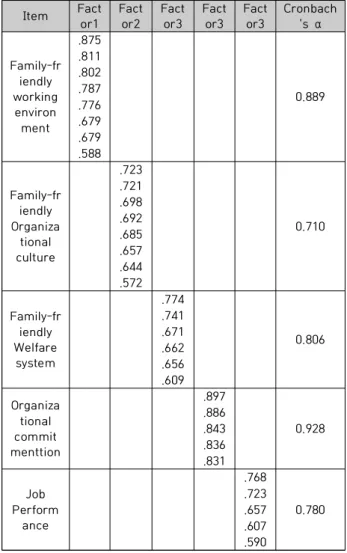
For this study, Exploratory Factor Analysis is carried out with SPSS Windows 23.0 and the confidence interval is estimated with Cronbach`s alpha>0.6.
Item Fact
or1 Fact
or2 Fact
or3 Fact
or3 Fact
or3
Cronbach 's α
Family-fr iendly working
environ ment
.875
0.889
.811
.802
.787
.776
.679
.679
.588
Family-fr iendly Organiza
tional culture
.723
0.710
.721
.698
.692
.685 .657 .644 .572
Family-fr iendly Welfare
system
.774
0.806
.741
.671
.662
.656
.609 Organiza
tional commit menttion
.897
0.928
.886
.843
.836
.831
Job Perform
ance
.768
0.780 .723
.657 .607 .590 Table 1. Results of exploratory factor analysis
Principle Component Analysis is employed for Factor extraction and Varimax Rotation is used for the factor rotation. The questionnaire items are modified in line with the purpose of the study.
Single dimensional factor analysis is conducted for the Factor Loadings (FL>0.6) that represents correlations between the evaluation factors.
First, exploratory factor analysis is conducted for
the questionnaire items, using the SPSS 23.0, and
this has resulted in the extraction of the 5 factors
that are Family-friendly working environment, Family-friendly Organizational culture, Family-Friendly Welfare System, Organizational commitment and Job performance.
2. Analysis of the Structural Model
Correlations are used to represent how the factors are related each other [16]. Covariance structure analysis is employed in the study to analyze their correlations between the 5 factors that are Family-friendly working environment program, Family-friendly Organizational culture, Family-Friendly Welfare System, Organizational commitment, Job performance
The structural model testing with AMOS 18.0 for the correlations between all the actors has resulted in c = 78.158(df=6), p = 0.000,
2c /df = 13.026, GFI =
20.904, RMR = 0.05, and general goodness-of-fit indicators, GFI, AGFI, RMR, CFI, RMSEA, etc. have not been found to meet their baseline values.
Fig. 2. Research Results
But despite that the analysis data have not met the criteria; the model can still be modified with modification index, assuming that there are also other aspects that can also interact between the variables [17]. So to this end, the Modification index is employed in the study [18], [19].
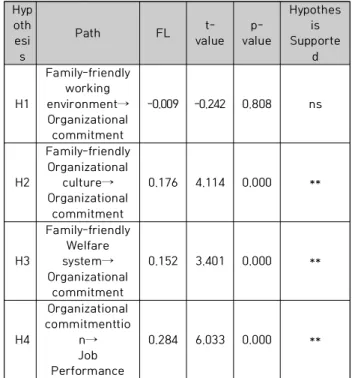
The <Fig. 2> and <Table. 2> show standardized coefficients and significance levels. According to the findings of the study, Family-friendly Organizational culture(H2), Family-Friendly Welfare System(H3) is found to have positive effects on the
Organizational commitment. And Organizational commitment(H4) is found to have positive effects on Job performance.
But Family-friendly working environment(H1) is found to have no effects on Organizational commitment.
Hyp oth esi s
Path FL t-
value p- value
Hypothes is Supporte
d
H1
Family-friendly working environment→
Organizational commitment
-0.009 -0.242 0.808 ns
H2
Family-friendly Organizational
culture→
Organizational commitment
0.176 4.114 0.000 **
H3
Family-friendly Welfare system→
Organizational commitment
0.152 3.401 0.000 **
H4
Organizational commitmenttio
n→
Job Performance
0.284 6.033 0.000 **
*: P<0.05, **: P<0.01, ns: not significant Table 2. Results of hypotheses
V. Conclusions
The study can be summarized as follows: among the other factors of the ICT companies in South Korea, family-friendly culture (H2), Family-friendly welfare system (H3) appeared to have positive effects on the organizational commitment. And the Organizational commitment (H4), in return, appeared to have positive effects on job performance.
But Family-friendly working environment (H1) did
not appear to have significant effects on the
Organizational commitment in the study and this
finding confirmed that the employees of ICT
companies in South Korea prefer practical and
economically rewarding family-friendly welfare
system rather than the family-friendly program of formality. Some limitation of the study is the small sample of the employees of ICT companies in South Korea, so that it is hard to generalize the findings to broader group of companies. Therefore, it is desired to have a larger group of sample for the empirical analysis of bigger data that can shed light on the characteristics by industry.
REFERENCES
[1] C. A. Thompson, L. L. Beauvais, and K. S. Lyness, "When work-family benefits are not enough; The influence of work-family culture on benefit utilization, organizational attachment, and work-family conflict," Journal of Vocational Behavior, Vol. 54, pp. 392-415, 1999.
[2] L. T. Thomas, and D. C. Ganster, "Impact of Family-Supportive Work Variables on Work-Family Conflict and Strain: A Control Perspective," Journal of applied psychology, Vol. 80, pp. 6-15, 1995.
[3] L. E. Duxbury, and C. A. Higgins, "Gender difference in work-family conflict," Journal of Applied Psychology, Vol. 76, pp. 60-74, 1991.
[4] B. H. Kwon, and G. O. Lee, "An Influence of Family Friendly Organizational Culture and Collective Efficacy on the Job Satisfaction of the Organizational Members in the Food Service Industry", Journal of Hotel & Resort, Vol. 12, No. 1, pp. 21-35, 2013.
[5] W. H. Lee, S. S. Eum, W. H. Kim, and Y. J. LEE, "A study on the Influence of Family-Friendly Program on Organizational Life and Job Commitment and Performance", Journal of The Korea Society of Computer and Information, Vol. 22, No. 12, pp.
171-178, 2017.
[6] G. Powell, "Determinants of Employee Participation in Organizations’ Family-friendly Programs: A Multi-level Approach," Journal of Business & Psychology, Vol. 22, No. 2, pp. 111-122, 2007.
[7] M. Mulvaney, "A Study of the Role of Family-Friendly Employee Benefits Programs, Job Attitudes, and Self-Efficacy among Public Park and Recreation Employees," Journal of Park Administration, Vol. 29, No. 1, pp. 58-79, 2011.
[8] N. D. Allen and J. P. Meyer, "The measurement and antecedents of affective, continuance and normative commitment to the organization," Journal of Occupational and Organizational Psychology, Vol. 63, pp. 1-18, 1990.
[9] R. T. Mowday, "Reflections on the Study and Relevance of
Organizational Commitment," Human Resource Management Review, Vol. 8, No. 3, pp. 387-401, 1979.
[10] H. Angle, and J. Perry, "An Empirical Assessment of Organizational Commitment and Organizational Effectiveness,"
Administrative Science Quarterly, Vol. 26, pp. 1-14, 1981.
[11] M. G. Millar, and A. Tesser, "Effects of affective and nonaffective on the attitude-behavior relation”, Journal of Personality and Social Psychology, Vol. 51, pp. 270-276, 1986.
[12] L. W. Porter, and E. E. Lawler, "Managerial Attitudes and Performance," Richard D, Irwin. 1976.
[13] W. H. Lee, and J. Y. Moon, "A Study on the Effect of Knowledge Sharing and Utilization on Field Project Performance", Journal of The Korea Society of Computer and Information, Vol. 23, No.
8, pp. 151-156, 2018.
[14] J. W. Slocum, "Motivation in Managerial Level: Relationship of Need Satisfaction to Job performance," Journal of Applied Psychology, Vol. 55, No. 4, pp. 312-316, 1971.
[15] A. D. Szilagyi and M. J. Wallace, "Organizational Behavior and Performance," Foresman and Company, 1990.
[16] G. S. Kim, "AMOS Structural Equstion Model Analysis,"
Hannarae, 2006.
[17] S. G. Kim, and M. S. Chae, "An Empirical Study On The Impact Of The Strategic Human Resource Development On Organization Effectiveness : Focusing On Intermediating Effect Of Learning Organization," Korea Academy of Hunman Resource Management, Vol. 15, No. 4, pp. 21-55, 2008.
[18] B. S. Kang, "The Research Methodology for Causal Analysis", MuYugGyungYung: Seoul, 2002.
[19] G. S. Kim, "The Analysis of Amos 7.0 Structural Equation Modeling", Hannarae, Seoul, 2007.
Authors
Won-Hee Lee received the M.S. and Ph.D.
degrees in International Commerce & Logistics from Pukyong National University, Korea, in 2005 and 2017. Dr. Lee is currently a professor at Division of Business
Administration Kyungnam College of Information &
Technology. He is interested in International Management, Business Statistics and International Business Environments, and International Enterprise.
Dal-Nim Yang received the M.S. and Ph.D.
degrees in Department of Dentistry from Kyung Hee University, Korea, in 2015. Dr.
Yang is currently a Adjunct professor at Department of Dental Hygiene, Kyungnam College of Information & Technology since 2018. She is interested in Preventive dental hygiene, Dental biomaterials.