• 검색 결과가 없습니다.

Correlation of Acoustic Cues in Stop Productions of Korean and English Adults and Children

N/A
N/A
Protected

Academic year: 2021

Share "Correlation of Acoustic Cues in Stop Productions of Korean and English Adults and Children"

Copied!
9
0
0

로드 중.... (전체 텍스트 보기)

전체 글

(1)

말소리와 음성과학 제2권 제4호 (2010) pp. 29~37

Correlation of Acoustic Cues in Stop Productions of Korean and English Adults and Children

Kong, Eun Jong 1) ․Weismer, Gary 2)

ABSTRACT

Previous studies have investigated a between-category relationship of multiple acoustic cues for a laryngeal contrast by examining the distributions of VOT, f0 and H1-H2. The current study examined within-category correlations between cues comprising stops by Korean- and English-speaking adults and children to understand how children master the internal structure of stop phonation types in two languages. Word-initial stops were collected from about 70 children and 15 adults speaking English and Korean, and were analyzed in terms of VOT, f0 and H1-H2 to compute correlation coefficients. Findings in adults’ productions included a gender-differentiated cue-correlation pattern associated with H1-H2 in Korean tense stops and a trading relationship between f0 and VOT in Korean lax and aspirated stops and English voiced and voiceless stops. Children did not necessarily have adult-like cue-correlation patterns even in early-acquired categories, suggesting that the mastery of intra-category structure of phonation type might occur later than inter-category structure.

Keywords: correlation, stop laryngeal contrast, Voice Onset Time, f0, H1-H2

1. Introduction

A speech-sound category is typically associated with multiple acoustic cues in order to be differentiated from other contrastive categories. For example, the acoustic cues for the stop voicing contrast include not only Voice Onset Time (VOT) but also fundamental frequency (f0), F1 “cutback”, and voice quality at the following vocalic onset (Lisker & Abramson, 1964; Whalen, Abramson, Lisker & Mody, 1993; Sundara, 2005). While a single cue, typically VOT in many languages, primarily differentiates one category of stops from the other categories in terms of voicing, the other cues pattern consistently in the signal, serving as secondary cues for a voicing contrast.

The multiple acoustic parameters associated with a voicing

1) University of Wisconsin-Madison [email protected], corresponding author

2) University of Wisconsin-Madison [email protected]

Received: October 30, 2010

Revision received: December 14, 2010 Accepted: December 15, 2010

category tend to be intercorrelated. Park (2000) examined the relationship between ‘duration of aspiration’ and onset of F1 in Korean stop productions. The two acoustic properties co-varied in a way that the onset frequency of F1 (F1 cutback) was delayed by as much as ‘duration of aspiration’, which differentiates tense stops from lax stops. This relationship between F1 and voicing contrast has been extensively discussed in English (Stevens &

Klatt, 1974; Summerfield & Hagaard, 1977; Benkí, 2001).

Likewise, fundamental frequency is correlated with stop consonant voicing in many languages. Word-initial voiceless (phonetically aspirated) stops, which have longer VOTs, have higher f0 at vowel onset than voiced (phonetically voiceless, unaspirated) stops in English (Ohde, 1980), Thai (Gandour, 1974) and Cantonese (Francis, Ciocca, Wong & Chan, 2006).

In perception, the correlated acoustic cues resulted in a

trade-off effect in categorization in which an ambiguous acoustic

cue is compensated by the presence (and appropriate values) of

other cues. The phonemic boundaries of VOT between voiced and

voiceless stops can be shifted by the independent manipulation of

acoustic cues such as f0, F1 or amplitude of aspiration noise

(Summerfield & Hagaard, 1977; Lisker, 1978; Repp, 1978;

(2)

Abramson & Lisker, 1985; Whalen et al., 1993; Benkí, 2001).

One may view that the correlation between acoustic parameters derives from speech physiology, in which the multidimensional acoustic output is an automatic outcome of articulatory behavior (Ohala, 1983; Honda, 1995; Whalen & Levitt, 1995). For example, f0 is thought to be higher in high versus low vowels because the high tongue position for high vowels pulls on the larynx via their common connection―the hyoid bone―and makes the entire laryngeal structure stiffer (Honda, 1995). An alternative view is that each of the several acoustic components may be independently manipulated in production. Ní-Chasaide & Gobl (1993) investigated the carry-over effect of stop voicing categories on vowels in German, English, Swedish, French and Italian. The degree of breathy voicing was not predicted by the phonetic categories in the languages, but was rather language-specific, suggesting speaker control over the influence of stop laryngeal configuration on the acoustic characteristics of the initial part of the following vowel. Kingston & Diehl (1994) argued that speaker control of the various acoustic parameters associated with a single contrast are in the service of perceptual enhancement.

Speakers control the different contrasts, in this view, to maximize the contrastivity of sound categories and make the listener’s task relatively easy.

These two different views on the multiple acoustic characteristics that define sound-category contrasts yield contradictory predictions concerning the pattern of correlations among the cues in children’s productions. On one hand, high correlations would be expected, if the underlying physiology explains the interdependencies among the acoustic cues.

Alternatively, if the cues are controllable more or less independently, lower correlations would be expected because the kids have not yet learned to stabilize the acoustic representation of the category. Vihman (1993) related children’s production variability to early phonological systems in babbling. As they explore babbling, children find a link between articulatory gestures and acoustic consequences, building an articulatory filter based on adults’ “salient or memorable” sounds. If within-child variability results from less robust ‘systematic word-production routines’, a relatively high correlation between the multiple acoustic cues for a given sound category and its contrast with another category may not be seen consistently across children’s productions.

As one step to explore these two hypotheses, this paper examines the correlation patterns of acoustic parameters present in stops produced by adults and children. The target languages are

Korean and English. The two languages are different in that Korean stops have a three-way voicing contrast (tense vs. lax vs.

aspirated), while English stops have a two-way voicing contrast (voiced vs. voiceless). The two languages are interesting to compare because they differ in how the acoustic parameters contribute to differentiating the categories. In English, VOT plays a sufficient role in differentiating voiced stops from voiceless stops in that there is no overlap between VOT ranges of the two categories (see VOT histograms in Lisker & Abramson, 1964 and Kong, 2009). In addition, acoustic parameters such as f0, F1 and spectral tilt (as an index of voice quality) present at the vocalic onset also help to differentiate the phonation categories as shown in trading relationship between VOT and each of these parameters (Summerfield & Hagaard, 1974; Lisker, Lieberman, Erickson, Dechovitz, Mandler, 1977; Abramson & Lisker, 1985; Whalen et al., 1993; Benkí, 2001 among others). In contrast, it is not only VOT but also f0 that differentiates the three categories in Korean.

While tense stops are primarily separated from lax and aspirated stops by having a short lag vs. long lag VOT, lax stops are separated from aspirated stops by having lower f0 values (Jun 1993, 1998; Kim, M. 2004; Silva, 2006; Wright, 2007; Kang &

Guion, 2009; Kong, 2009). The different roles of acoustic parameters in cuing the phonological voicing contrast in the two languages may influence the ways in which the parameters are correlated in producing the stops in English and Korean. While previous research studied the distributional differences of each acoustic parameter in different languages, the correlation of the acoustic cues to the voicing distinction has rarely been examined in adults. More importantly, this has not been examined in children’s productions. Independently of the order of mastering stop voicing categories, the cue-correlation pattern in children’s productions may suggest the way children refine the internal structure of stop categories. The goal of this study is to describe the patterns of correlations between acoustic cues in the stop voicing categories collected from adults and children in Korean and English.

2. Experiment 2.1 Database

2.1.1 Materials, participants and task

Stop consonants by children (ages 2;0-5;11, year; month) and adults (18;0-29;11) were examined to measure acoustic properties.

They were a subset of a larger cross-language production database

(3)

collected by the Paidologos project, which investigates phonological development across languages (Edwards & Beckman, 2008). Target consonants were word-initial stops with lingual constriction (/t’/, /t/, /t

h

/, /k’/, /k/ and /k

h

/ in Korean, /d/, /t/, /g/

and /k/ in English) followed by various vowel contexts (/a/, /i/

and /u/ in Korean and /i/, /ɪ/, /e/, /ɛ/, /ɔ/, /o/, /u/ and /ʊ/ in English). They were elicited in words such as /t’al.gi/ strawberry, /tubu/ tofu, /thak.ʒa/ table in Korean and dove, gift, tent and car in English; see Kong (2009) for complete lists of words and pictures used.

The target stops were elicited in a word-repetition task.

Pre-recorded audio stimuli were presented in a sound field, and speakers were asked to repeat the words immediately after hearing them. The word repetition requests were aided by culture-appropriate pictures shown on the monitor. The recording sessions did not exceed 20 minutes, taking into account younger children’s attention span.

Table 1. Number of participants by age and sex in each language.

Korean English

female male female male

2;0-2;11 12 9 6 7

3;0-3;11 11 9 7 4

4;0-4;11 7 8 6 6

5;0-5;11 5 6 6 8

adults 10 10 8 7

Table 2. Number of target stop consonants (tense /t’/, /k’/, lax /t/, /k/ and aspirated /t

h

/, /k

h

/) by age group and sex of speakers:

Korean.

2;0-2;11 3;0-3;11 4;0-4;11 5;0-5;11 adults

tense f 181 173 125 86 170

m 119 148 140 101 174

lax f 165 175 117 83 180

m 110 144 137 101 179

asp. f 166 161 109 85 180

m 121 135 131 97 176

Table 3. Number of target stop consonants (voiced /b/, /g/ and voiceless /t/, /k/) by age group and sex of speakers: English.

2;0-2;11 3;0-3;11 4;0-4;11 5;0-5;11 adults

unasp. f 79 134 125 153 167

m 109 76 124 120 147

asp. f 135 167 173 211 240

m 155 106 172 172 208

Subjects were recruited and recorded in Seoul, Korea and Columbus Ohio, USA for each language. Recordings of children were made in day-care centers or their homes. <Table 1>, <Table 2> and <Table 3> show distributions of participants and tokens by age and sex.

2.1.1 Transcription & Acoustic measurements

The children’s productions were transcribed by native speaker transcribers, in order to eliminate acoustically unmeasurable tokens (i.e., non-plosives) in children’s productions. The transcriber of each language first judged whether the token was on-target or off-target and then provided the substituted categories for off-target productions.

All plosive productions by children and adults were subjected to acoustic measurements. Three acoustic measurements were made for each token: VOT, f0 and H1-H2 (a measure of spectral tilt, estimated by the amplitude difference between the first and the second harmonics, Holmberg, Hillman & Perkell, 1988;

Hanson, 1997; Gordon and Ladefoged, 2002).

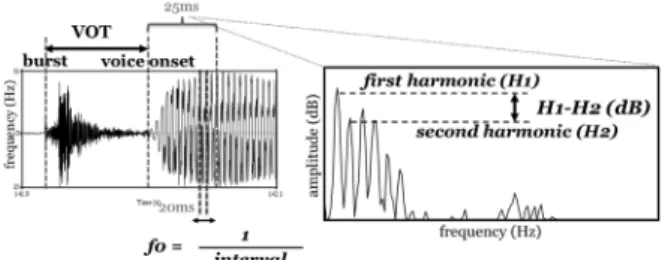
VOT values were obtained by subtracting the time-stamp of the stop burst from the time-stamp of voicing onset, indicated by a voicing bar in the spectrogram and a regular cycle of waveform. F0 values were measured at 20 ms into the vowel by taking the inverse of the interval between two adjacent glottal pulses. H1-H2 values were measured from the spectrum of a 25 ms fixed analysis window taken after the voicing onset. <Figure 1> illustrates the three acoustic measurements.

Figure 1. Acoustic measurements: VOT, f0 and H1-H2.

2.1.2 Correlation coefficients

The three acoustic parameters were paired (i.e., VOT and f0,

f0 and H1-H2 and H1-H2 and VOT) to estimate correlation

coefficients in each voicing category. A coefficient was computed

within speaker and within voicing category, using Pearson's

product moment correlation coefficient method in R (R

Development Core Team, 2010). On average, 16 tokens for

Korean stops and 22 tokens for English stops contributed to the

calculation of correlation coefficients. A hypothesis test with

(4)

respect to the significance of correlation between parameters is not discussed in this study, because the purpose of the study is to document the magnitude and direction of the correlation coefficients.

2.2 Results: correlation patterns in Korean and English speakers

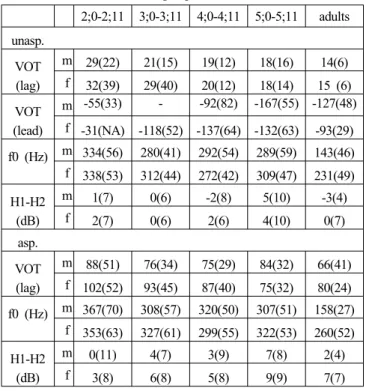
The mean values and standard variations of three acoustic parameters in each stop category in Korean and English are summarized in <Table 4a> and <Table 4b>. The results of correlation coefficients are graphically presented in boxplots where the distributions of correlation coefficients between each pair of acoustic parameters are presented separated by age group (2-years, 5-years and adults) and sex (male vs. female).

Table 4a. Mean values (standard deviations in parentheses) of VOT, f0 and H1-H2 separated by Korean speakers’ sex and age

groups.

2;0-2;11 3;0-3;11 4;0-4;11 5;0-5;11 adults tense

VOT (ms.)

f 29(26) 23(25) 13(21) 19(21) 17(10) m 25(30) 18(22) 16(16) 14(12) 12(8) f0 (Hz) f 353(81) 348(70) 326(60) 296(65) 149(21)

m 348(63) 355(59) 326(70) 333(59) 244(74) H1-H2

(dB)

f 0(10) 2(6) 0(6) 1(6) -3(4)

m 2(7) 1(7) 3(6) 0(7) 0(9)

lax VOT (ms.)

f 60(41) 68(34) 65(30) 72(29) 59(17) m 53(44) 77(29) 64(27) 62(23) 61(18) f0 (Hz) f 302(56) 288(47) 278(29) 264(37) 122(14)

m 297(65) 285(44) 279(54) 288(34) 227(24) H1-H2

(dB)

f 4(7) 6(5) 6(5) 5(4) 0(4)

m 4(7) 6(6) 7(5) 5(6) 6(5)

asp.

VOT (ms.)

f 70(44) 71(38) 73(34) 80(32) 75(21) m 58(46) 84(34) 78(37) 71(29) 70(19) f0 (Hz) f 365(70) 345(68) 348(57) 294(64) 161(26)

m 348(67) 364(51) 358(54) 351(79) 304(46) H1-H2

(dB)

f 1(10) 6(6) 6(6) 5(5) 1(4)

m 4(8) 5(8) 8(6) 6(9) 8(7)

2.2.1 Korean adult speakers

<Figure 2> shows boxplots of correlation coefficients separated by three pairs of acoustic parameters (VOT & H1-H2, VOT & f0 and f0 & H1-H2) in each column and by the three phonation types (tense, lax and aspirated types) in each row. In each panel,

the rightmost pair of bars indicates the adults’ correlation coefficients. In tense stop productions (top right panel), Korean adults had a consistent correlation pattern between f0 and H1-H2, which appears to be associated with speakers’ sex. As f0 of the tense stops increased, the associated H1-H2 values increased in female’s productions (positive relationship) but decreased in male’s productions (negative relationship). The inter-quartile ranges of females’ coefficients were located above y = 0 (i.e., r

> 0), while those of males’ coefficients were below y = 0.

Table 4b. Mean values (standard deviations in parentheses) of VOT, f0 and H1-H2 separated by English speakers’ sex and age

groups.

2;0-2;11 3;0-3;11 4;0-4;11 5;0-5;11 adults unasp.

VOT (lag)

m 29(22) 21(15) 19(12) 18(16) 14(6) f 32(39) 29(40) 20(12) 18(14) 15 (6) VOT

(lead)

m -55(33) - -92(82) -167(55) -127(48) f -31(NA) -118(52) -137(64) -132(63) -93(29) f0 (Hz) m 334(56) 280(41) 292(54) 289(59) 143(46) f 338(53) 312(44) 272(42) 309(47) 231(49) H1-H2

(dB)

m 1(7) 0(6) -2(8) 5(10) -3(4)

f 2(7) 0(6) 2(6) 4(10) 0(7)

asp.

VOT (lag)

m 88(51) 76(34) 75(29) 84(32) 66(41) f 102(52) 93(45) 87(40) 75(32) 80(24) f0 (Hz) m 367(70) 308(57) 320(50) 307(51) 158(27)

f 353(63) 327(61) 299(55) 322(53) 260(52) H1-H2

(dB)

m 0(11) 4(7) 3(9) 7(8) 2(4)

f 3(8) 6(8) 5(8) 9(9) 7(7)

In addition, in producing tense stops, male speakers’

correlation coefficients between VOT and H1-H2 were different in sign from those of female speakers as indicated by opposite locations of boxes in the top center panel of <Figure 2>: the correlation was mostly positive in females, and mostly negative in males. Longer VOT values were associated with higher H1-H2 in females’ tense stops, but with lower H1-H2 in males’ tense stops.

The middle row of <Figure 2> shows the correlations

calculated for lax stops. A negative correlation between VOT and

f0 was observed in lax stop productions. As shown in the mid

left panel of <Figure 2>, the correlation coefficients of most

speakers were below zero. This was true in both sexes of adult

speakers. Similarly, a negative correlation between VOT and f0

was also found in aspirated stops, although the tendency was less

strong than in lax stops (see box locations in the bottom left

(5)

panel of <Figure 2>).

Figure 2. Boxplots of correlation coefficients obtained from Korean child- and adult speakers’ stop productions (2-years, 5-years and adults). Different box colors represent speaker’s sex.

Each column indicates three different pairs of acoustic parameters.

Rows are separated by the target stop phonation category (tense, lax and aspirated types).

2.2.2 Korean child speakers

The left two pairs of boxes in each panel of <Figure 2> show the correlation patterns in children’s productions. We plotted only the youngest (2-years) and the oldest (5-years) age groups to describe age-related differences. Children’s tense stops had an age-differentiated pattern in correlation coefficients between f0 and H1-H2 (top right panel of <Figure 2>). 5-year-old children had positive correlation between f0 and H1-H2 in tense stops, indicated by the locations of inter-quartile ranges above zero. By contrast, 2-year-olds lacked this pattern of positive correlation.

Older children followed the correlation pattern of adult females’

tense stops, while younger children’s correlation pattern was similar neither to females’ nor to males. Unlike adults’ patterns, there was no gender-related difference in signs of correlation coefficient in children’s tense stops.

Most children of both age groups had positive correlation coefficients between VOT and H1-H2 in tense stops (top center panel in <Figure 2>). This result followed the correlation pattern of two cues in adult females’ tense stops, but differed from the pattern of negative correlation in adult males’ tense stops.

In children’s lax stops, the correlation coefficients between VOT and f0 were mostly negative, which was similar to the adults’ pattern (mid left panel of <Figure 2>). This tendency was more consistent in 5-year-olds’ lax stops than 2-year-olds’ as

indicated by relatively lower locations of inter-quartile ranges for older children at a negative coefficient dimension. Nevertheless, children of both age groups had negative coefficients in general as indicated by box locations below zero. This negative correlation between VOT and f0 was also found in children’s aspirated stops, although it was observed only in 5-year old children and was less clear than the pattern in lax stops (bottom left panel of <Figure 2>).

For the aspirated type, there was an age-related separation in correlation coefficients between f0 and H1-H2 (bottom right panel of <Figure 2>). 5-year olds girls, in particular, tended to have positive correlation coefficients between two cues, as indicated by inter-quartile ranges above zero, while most 2-year-old children had negative correlation coefficients. This age-related correlation pattern between H1-H2 and f0 in the aspirated stops was similar to the observation made in tense stops, although less clear. It is also noted that 5-year-old girls were similar to adult females by having a positive correlation between H1-H2 and f0 in aspirated stops. The magnitude of correlation was greater in 5-year-old girls than in adult females, as indicated by a higher box location of 5-year-old girls than that of adult females.

2.2.3 English adult speakers

<Figure 3> shows boxplots of correlation coefficients separated by three combinations of acoustic parameters (VOT & H1-H2, VOT & f0 and f0 & H1-H2) in each column, and by the two voicing types (voiced and voiceless stops) in each row. The adults’ patterns are shown by the rightmost pair of boxes in each panel. As shown in the top left panel of <Figure 3>, English adults did not have a consistent direction of correlation coefficients between VOT and f0 in voiced stops. The medians of coefficients were close to zero, and the inter-quartile ranges were narrow in both males’ and females’ voiced stops. In contrast, voiceless stops (bottom left panel of <Figure 3>) consistently had negative correlation coefficients between two cues, as indicated by inter-quartile ranges located below zero. Voiceless stops with shorter VOT values tended to have higher f0 values.

In addition, voiceless stops by male speakers tended to have negative correlation coefficients between f0 and H1-H2 (bottom right panel of <Figure 3>) and positive correlation coefficients between VOT and H1-H2 (bottom center panel of <Figure 3>).

Female speakers did not have a consistent tendency of correlating

these pairs of cues in voiceless stops in that coefficients between

f0 and H1-H2 were mostly near zero and those between VOT

and H1-H2 had more variations at the positive dimension. In

(6)

general, a clearer indication of correlation was found in voiceless stops than in voiced stops of English adult speakers.

Figure 3 Boxplots of correlation coefficients calculated in English child- and adult-speakers’ stop productions (2-year-olds, 5-year-olds and adults). Different box colors represent speakers’

sex. Each column indicates three different parameter pairs. Rows were separated by the target stop phonation category (voiced and

voiceless stops).

2.2.4 English child speakers

<Figure 2> shows the correlation patterns in English children’s production at the left two pairs of boxes in each panel. The age-related correlation patterns between f0 and H1-H2 were observed in children’s voiced and voiceless stops (rightmost panels of <Figure 3>). In voiceless stops, 5-year-olds tended to have positive correlation coefficients between f0 and H1-H2. In contrast, many 2-year-olds (boys, in particular) had negative correlation coefficients between the two cues. In voiceless stops, 2-year-olds were different from 5-year-olds in that younger children tended to have negative correlation coefficients between f0 and H1-H2, whereas this tendency was absent in older children. A negative correlation between two cues in 2-year-olds’

voiceless stops was similar to adult males’ pattern in voiceless stops.

Differently from English adults’ negative correlation between VOT and f0, children’s voiceless stops did not show any indication of correlation between the two cues (bottom left panel of <Figure 3>). Medians of correlation coefficients between VOT and f0 were close to zero and inter-quartile ranges were wide, covering both positive and negative dimensions at y-axis. Among children’s voiceless stops, 5-year old girls’ productions patterned most similar to the adults’ pattern in that the inter-quartile range of correlation coefficients between two cues was at a negative dimension.

3. Discussion

The current study explored the correlation patterns of acoustic cues in English and Korean word-initial stops produced by adults and children. Results showed that there were consistent patterns of correlation coefficients associated with speakers’ age, sex and stop phonation type. In Korean, tense stops (but not lax and aspirated stops) produced by adults carried gender-related patterns of correlation. The acoustic measure of H1-H2 was correlated with f0 and VOT values in both males’ and females’ tense stops, yet the relationship between them was opposite for males and females. One possible interpretation of this finding is that voice quality, measured in H1-H2, in tense stops played a role as an indexical cue of speaker’s sex (i.e., creaky voice for male speakers). Alternatively, this can be interpreted in terms of a diachronic sound change in Korean stop laryngeal contrasts.

Although Korean tense stops have been characterized as having laryngeal-muscle tension in articulation (Hirose, Lee & Nimii, 1974; Kagaya, 1974), tense stops are differentiated from lax and aspirated stops primarily along VOT dimension with little effect of f0 dimension (Silva, 2006; Wright, 2007; Kang & Guion, 2009). The analysis of weighting cues showed that the relative roles of f0 and H1-H2 were much smaller than the role of VOT (Kong, 2009). This changing role of acoustic properties in tense stops leads us to speculation that pressed voice quality may no longer be required for tense stops productions to be contrastive with the other two stops, and that tense stops allow this non-primary acoustic dimension (i.e., voice quality) to accommodate indexical information such as a speaker’ sex.

Both in Korean and English, it was observed that VOT in the

adults’ stops was negatively correlated with f0 in the phonation

categories in which the values of two acoustic cues could overlap

with those of adjacent categories. Such categories were lax and

aspirated stops in Korean and voiced and voiceless stops in

English. Negative correlation coefficients indicate that two

acoustic cues were traded in a way that an increase of one

acoustic parameter was associated with a decrease of the other

acoustic parameter (Abramson & Lisker, 1985; Whalen et al.,

1993). Although a trading relationship between VOT and f0 was

observed in adults’ productions of two languages, children

patterned differently in realizing this trading relationship between

two cues. Korean-speaking children as young as 2 years

consistently had negative correlations between VOT and f0 in lax

and aspirated stop. However, English-speaking children, except for

5-year-old girls, did not have a clear negative correlation between

(7)

two cues. This difference could be explained by different roles of f0 cues in differentiating the phonation types in the two languages. In English, unaspirated stops are differentiated from aspirated stops by VOT alone, as a long lag range of VOT for aspirated stops is perfectly separated from a short lag (and/or lead) range of VOT for unaspirated stops (Lisker & Abramson, 1964). Given this, the f0 cue can be a secondary component in making a voicing contrast (Abramson & Lisker, 1985). In contrast, Korean lax stops are not differentiated from aspirated stops by VOT alone due to a recent diachronic sound change (Silva, 2006; Wright, 2007; Kang & Guion, 2009). While lax and aspirated stops have long lag VOT values, lax stops are separated from aspirated stops by having lower f0 values. Thus, f0 is not a secondary (or redundant) but an equally primary dimension for a phonation-type contrast in Korean. These given roles of f0 could affect children differently between two languages so that mastery of an intra-category relationship as well as of inter-category relationship is facilitated for Korean-speaking children, but is less so for English-speaking children. The absence of a trading relationship between f0 and VOT in English children’s productions implies that a category internal structure is mastered later than a between-category contrast, of which the reported age in English is before 2;0 (Smit, Hand, Freilinger, Renthal & Bird, 1990).

Third, the age-related differences of correlation coefficients in children’s productions suggest that articulations of the categories change gradually over time. This is of interest particularly for early-mastered phonation types in transcription-based studies of Korean and English (i.e., Korean tense, English unaspirated stops). A single acoustic goal can be achieved by various articulatory gestures, meaning that the adult-like acoustic values in children’s production do not assure that children articulate the acoustic target in an adult-like manner. The age-related differences of inter-parameter correlation in the current study provide evidence that children’s productions undergo refinement in terms of how the acoustic components are inter-related, even though adult-like acoustic outputs were achieved in each parameter. More evidence needs to be obtained from the articulatory point of view.

Finally, the current analysis suggests that the interrelationships between these various measures, that have the potential to implement the voicing distinction, is complex, making it hard to find a clear-cut answer as to whether they are controlled or physiologically constrained parameters. The 2-year-olds’ cue correlation patterns were inconsistent in showing higher

magnitudes of correlation within a language and across languages, implying less dependency between acoustic parameters. However, there does seem to be some reason to buy into some physiological determinants of certain interrelationships, because of the adult sex effects and children’s pattern of the current analysis.

Tense stops in Korean had a positive relationship between H1-H2 and f0 for females, but a negative one for males; exactly the same sex tendency was observed for the aspirated stops of English. Well-documented phonation "style" differences for males and females could be considered consistent with these sex differences for articulatory functions of the larynx. The younger children of Korean and English in our study followed male’s correlation pattern by showing negative correlation coefficients. It seems very unlikely that young children in two different languages would choose to implement these two dimensions of the voicing distinction in the same way to adult females given the morphological characteristics of vocal organs.

4. Conclusion

We investigated the correlations between acoustic parameters used for laryngeal contrasts in Korean and English stops produced by adults and children. The results showed that the multiple acoustic cues used for a between-category laryngeal contrast characterized the internal structure of each category. The acoustic parameters comprising a voicing category were structured in a way that the correlation patterns were consistent according to speaker’s sex and phonation type. Children seem to learn this internal structure of the category with age as indicated by age-associated differences in correlations. The ages of having adult-like correlation pattern varied by phonation categories and by languages, suggesting that the mastery of inter-category relationship does not necessarily imply the mastery of intra-category relationship between acoustic cues.

Acknowledgement

We thank the children who participated in the study, the

parents who gave their consent, and the child-care centers at

which the data were collected. The data collection of Korean was

supported by an Ohio State University, Dept. of Linguistics

Targeted Investment in Excellence award to the first author.

(8)

Reference

Abramson, A. & Lisker, L. (1985). “Relative power of cues: F0 shift versus voice timing, A cross-language study of voicing in initial stops: acoustical measurements”, Phonetic linguistic;

essays in honor of Peter Ladefoged, pp. 25-33.

Benkí, J. R. (2001). “Place of articulation and first formant transition pattern both affect perception of voicing in English”, Journal of Phonetics, Vol. 29, pp. 1-22.

Edwards, J. & Beckman, M. E. (2008). “Methodological questions in studying consonant acquisition”, Clinical Linguistics &

Phonetics, Vol. 22, pp. 939-958.

Francis, A. L., Ciocca, V., Wong, V. K. M. & Chan, J. K. L.

(2006). “Is fundamental frequency a cue to aspiration in initial stops?” Journal of the Acoustical Society of America, Vol. 120, pp. 2884-2896.

Gandour, J. (1974). “Consonant types and tone in Siamese”, Journal of Phonetics, Vol. 2, pp. 337-350.

Gordon, M. & Ladefoged, P. (2002). “Phonation types: a crosslinguistic overview”, Journal of Phonetics, Vol. 29, pp.

383-406.

Hanson, H. M. 1997. Glottal characteristics of female speakers:

Acoustic correlates. Journal of acoustical society of America, 101, pp. 466-481.

Holmberg, E. B., Hillman, R. E. & Perkell, J. S. (1988). “Glottal airflow and transglottal air pressure measurements for male and female speakers in soft, normal and loud voice”, Journal of Acoustical Society of America, Vol. 84, pp. 511-529.

Hombert, J. M. (1977). “Consonant types, vowel height and tone in Yoruba”, Studies in African Linguistics, Vol. 8, pp. 173-190.

Jun, S.-A. (1993). The phonetics and phonology of Korean prosody.

Ph.D. thesis, Ohio State University.

Jun, S.-A. (1998). “The accentual phrase in the Korean prosodic hierarchy”, Phonology, Vol. 15, pp. 189-226.

Kang, K-H & Guion, S. (2008). “Clear speech production of Korean stops: Changing phonetic targets and enhancement strategies”, The Journal of the Acoustical Society of America, 124, pp.

3909-3917

Kim, M. (2004). “Correlation between VOT and F0 in the Perception of Korean Stops and Affricates”, In proceedings of INTERSPEECH-2004, 49-52.

Kingston, J., & Diehl, R. L. (1994). “Phonetic knowledge,”

Language, Vol. 70, pp. 419–494.

Kong, E. (2009). The Development of phonation-type contrasts in plosives: Cross-linguistic Perspectives. unpublished dissertation,

Dept. of Linguistics, Ohio State University, Columbus, Ohio, USA.

Lisker, L. & Abramson, A. (1964). “A cross-language study of voicing in initial stops: acoustical measurements”, Words, 20. pp.

384-442.

Lisker, L., Lieberman, A. M., Erickson, D. M., Dechovitz, D. &

Mandler, R. (1977). “On pushing the voice-onset-time boundary about”, Language and Speech, Vol. 20, pp. 209–216.

Lsker, L. (1978). “In qualified defense of VOT”, Language and Speech, Vol. 21, pp. 375–383.

Ohala, J. J. (1983). “The origin of sound patterns in vocal tract constraints”, In: P. F. MacNeilage (ed.), The production of speech. New York: Springer-Verlag, pp. 189 - 216.

Ohde, R. N. (1984). “Fundamental frequency as an acoustic correlate of stop consonant voicing”, Journal of Acoustical Society of America, Vol. 75, pp. 224-230.

Park, H. (2002). “The time course of F1 and F2 as a descriptor of phonation types”, Eoneohag, Vol. 33, pp. 87-108.

R Development Core Team (2010). R: A language and environment for statistical computing. R Foundation for Statistical Computing, Vienna, Austria. ISBN 3-900051-07-0, URL http://www.R-project.org.

Whalen, D. H., Abramson, A., Lisker, L. & Mody, L. (1993). “F0 gives voicing information even with unambiguous voice onset times”, Journal of the Acoustical Society of America, Vol. 93, pp. 2152-2159.

Whalen, D. H., Levitt, A. (1995). “The universality of intrinsic F0 of vowels”, Journal of Phonetics, Vol. 23, pp. 349-366.

Silva, D. J. (2006). “Acoustic evidence for the emergence of tonal contrast in contemporary Korean”, Phonology, Vol. 23, pp.

287-308.

Sundara, M. (2005). “Acoustic-phonetics of coronal stops: A cross-language study of Canadian English and Canadian French”, Journal of the Acoustical Society of America, Vol. 118, pp. 1026 –1037.

Smit, A. B., Hand, L., Freilinger, J., Renthal, J. & Bird, A. (1990).

“The Iowa articulation norms project and its Nebraska replication”, Journal of Speech and Hearing Disorders, Vol. 55, pp. 779-798.

Stevens, K. N. & Klatt, D. H. (1974). “Role of formant transitions

in the voiced-voiceless distinction for stops”, Journal of

Acoustical Society of America, Vol. 55, pp. 653-659.

(9)

∙Eun Jong Kong corresponding author University of Wisconsin at Madison 1500 Highland Ave. Waisman Center #493 Madison, WI, 53705 USA

Tel: 1-608-262-6768 Fax: 1-608-263-0529 Email: [email protected]

area of interest: Acoustic phonetics, phonological development Ph.D Linguistics, The Ohio State University

2009~present Post-doctoral research associate

∙Gary Weismer

University of Wisconsin at Madison Department of Communicative Disorders 1975 Willow Drive

Madison, WI, 53706, USA

Tel: 1-608-262-6472 Fax: 1-608-262-6466 Email: [email protected]

area of interest: normal speech production, motor speech disorders

Ph.D Department of Communicative Disorders, University of Wisconsin-Madison

1984~present Professor

수치

Table 2. Number of target stop consonants (tense /t’/, /k’/, lax /t/,  /k/ and aspirated /t h /, /k h /) by age group and sex of speakers:
Table 4a. Mean values (standard deviations in parentheses) of  VOT, f0 and H1-H2 separated by Korean speakers’ sex and age
Figure 2. Boxplots of correlation coefficients obtained from  Korean child- and adult speakers’ stop productions (2-years,  5-years and adults)
Figure 3 Boxplots of correlation coefficients calculated in English  child- and adult-speakers’ stop productions (2-year-olds,  5-year-olds and adults)

참조

관련 문서