A Study on the Process of Forming Peer Relations between Students with Disabilities and Non-disabled Students
*
Woo-Hong Cho*, Young-Shin Joo**
Abstract
The purpose of this study was to find out the necessary conditions and factors what effect as a society member through the students with disabilities to have a positive and mutual peer relationship with their classmates in the school and by them analyzed formation process and elucidate signification. The research method focused on the data summarized and enumerated through the investigation methods such as two in-depth interviews and two observation activities part, and the data which are commonly stated or observed in the data. The results of this study start that the factors of peer relationship formation between children with disabilities and their with non-disabled children are caused by lack of prejudice or lack of awareness. However, continuous cognizance improvement program, teacher's education guidance, the age have presence sense and subject about friend equating idea was mainly shown of school education or local community.
▸Keyword: Disabled, Non-disabled, Special Education, Communication, Environment.
I. Introduction
As of 2014 School administrations usually rejected admission of children with disabilities to school and forced the children with disabilities to transfer to another school. When the children with disabilities requested convenience services, the request was refused without proper reasons. Their participation in all the school or extracurricular activities was refused or excluded because of disability. The school admission was reluctant to admit children with disabilities by demanding even unnecessary documents needed for admission in addition to educational purposes for disabilities[1].
It is defined that people need only one or a few friends who have satisfactory relationships during elementary school periods. As such friendship is important to form social relationships for children, it has more meaning than accidental and intermittent interaction between peers and
is a basis for future human relationship.
It is certain that entering into elementary school was strange and exciting both to children with disabilities and non-disabled children. Children with physical and mental disabilities who had been positively protected and supported by their families or social welfare centers had to meet peers at new environment and felt stress or tension from the fact that they had to deal with the process of dependence on or cooperation with peers.
Children with disabilities had as much stress from entering school as non-disabled children, but they had less social skills to deal with it or are slow at learning and being familiar with school rules.
As non-disabled students were able to make active and direct communications of what they want, it was difficult for them to be mature enough to understand children with
disabilities. When they met students with disabilities in educational setting, they may have positive relationships with them through natural perception of disabilities, but they may consider them objects of ridicule or have prejudice against disabilities.
Therefore, this study collected data of intensive interview with students with disabilities, non-disabled students and parents and analysed the meaning of real experiences of peer relationship and influential factors in order to facilitate understanding of integrated education for students with disabilities and non-disabled students and provide data for enhanced perception on disabilities.
Ⅱ. Theoretical Background
1. Disability Education
"Special Education" under Article 2(1) of the Special Education Law for Disabled Persons in Korea means education that meets the educational needs of the special education subject and that is provided through the provision of special education related services according to Item 2 It says.
In addition, the term "integrated education" as defined in Article 2 of the Special Education Law for Disabled Persons refers to the case where a student who is in a special education receives education appropriate to the educational needs of an individual with peers without discrimination according to the type of disability or disability in the general school.
Starting with the enactment of the Special Education Promotion Act for Disabled Persons in 1977, special education has begun to be established, such as full-scale installation of special public schools and special classes, individualized education, and the introduction of special education steering committees.
Understanding of people with disabilities and their social interest has been changing radically in recent years. From the traditional point of view of shame, shame, and guilt, to the development of a social model to find a concept of disability in the context of human and environment interaction in the late 1970s, According to the Ministry of Education, Science and Technology, the Act on the Prohibition of Discrimination against Persons with Disabilities and the Right to Bribery Act, enacted on April 11, 2008, further promotes the establishment of social rights for people with disabilities.
2. Status of education for the disabled
According to the above-mentioned national policy change and social interest, special education subjects are classified according to the selection criteria, and classified into special education students(full-time integrated class) and integrated class students (part-time integrated class) in general classes. However, appropriate educational support for students with disabilities according to these categories is not keeping up with the reality.
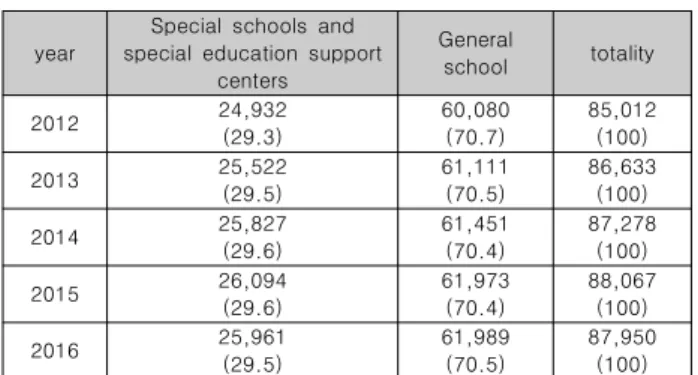
According to the statistics of the Ministry of Education, Science and Technology, there are several trends as follows.
year
Special schools and special education support
centers
General
school totality
2012 24,932
(29.3)
60,080 (70.7)
85,012 (100)
2013 25,522
(29.5)
61,111 (70.5)
86,633 (100)
2014 25,827
(29.6)
61,451 (70.4)
87,278 (100)
2015 26,094
(29.6)
61,973 (70.4)
88,067 (100)
2016 25,961
(29.5)
61,989 (70.5)
87,950 (100) Source: Ministry of Education, ⌜Statistics on Special Education⌟, 2016.
Table 1. Special Education Status (Unit, person)
As shown in <Table 1>, the number of special schools has not increased significantly due to the recent increase in the number of special schools and the number of special classes, but the number of special classes continues to increase. As the number of students to be educated increases, the students of special schools have a tendency to increase the number of students with middle and multiple disabilities with severe disabilities.
In addition, as the number of special education students who receive integrated education in general schools increases, the number of students with special needs is increasing. The number of students enrolled in special schools and special education centers has risen by 1,029 from 24,932 in 2012 to 25,961 in 2016.
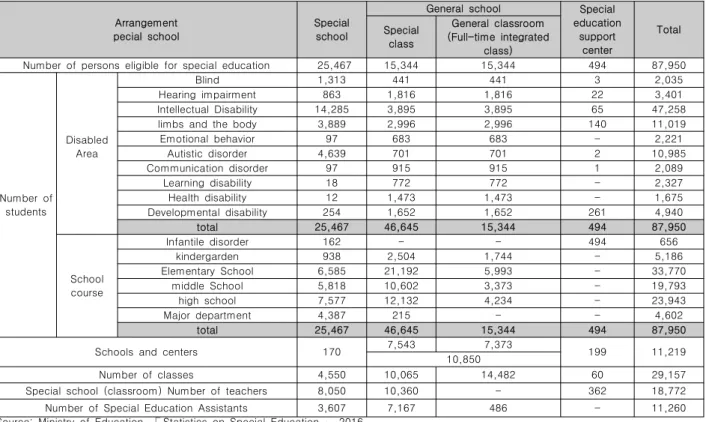
As shown in <Table 2>, the number of students
enrolled as special education students is steadily
increasing due to the expansion of education opportunities
students is 25,467 in 2016, 46,645 in special class
students, 15,344 in full-time integrated class students,
and 494 in special education support centers.
(3)
Arrangement pecial school
Special school
General school Special
education support
center
Total Special
class
General classroom (Full-time integrated
class)
Number of persons eligible for special education 25,467 15,344 15,344 494 87,950
Special school (classroom) Number of teachers 8,050 10,360 - 362 18,772
Number of Special Education Assistants 3,607 7,167 486 - 11,260
Source: Ministry of Education, ⌜Statistics on Special Education⌟, 2016.
Table 2. Special education placement status (Unit, person)
The number of special education teachers was 18,772 and the number of special education assistants was 11,260. This ratio is based on the fact that the standard of placement of special schools and special class teachers is limited to one per 4 students in the Special Education Law for Persons with Disabilities.
3. Peer relationship between disabled and non-disabled children
A peer is a critic who is able to share personal information, a critic who can accept advice, a mentor, a collaborator who understands himself, and a mentor in crisis. This study was supported by the support of a friend [2]. It was studied that it had a greater influence on the elementary school than teacher 's support. In this study, we examine the effects of social policy on the social maturity of non-disabled elementary school students or children with disabilities[3][4], although they have dealt with children with disabilities, it is important to focus on the parenting of disabled children[5], there is no research on the process of peer-relationship formation in the field of integrated education for disabled children and non-disabled children.
In addition, research on integrated education in Korea also supports foreign cases, but other studies have found
that integrated education has a positive effect on both students with disabilities and non-disabled students[6].
Also, a comparative study of the perceptions of parents of children with disabilities and parents of children with disabilities in Korea and China on integrated education also suggests that if students with disabilities learn together with non-disabled students in general classes and have appropriate learning experiences and support[7]. In addition, it is reported that children with learning disabilities are more effective in learning disabilities[8][9].
Therefore, The benefits for students with disabilities through integrated education are that they can be generalized in the integrated classroom, and because the integrated education does not allow for the activities allowed in the separate education.
Ⅲ. Research Design
1. Research Method
The grounded theory methodology is to discover the
theory from the data. It is a method to analyze based on
the theoretical sensitivity of the researcher and the
(4)
accumulated data from the beginning of the research to the collection and analysis. This conceptualizes and categorizes meaningful contents from the original data, and divides the relationship between each category and its attributes.
The basis theory is a comparison between existing and existing cases, as well as a comparison between cases and other cases in order to clarify the relationship between categories. In comparison with existing theories, existing theories are used as a pool of ideas for evaluating data, which enables the reconstruction of the results of the research and thus ensures mutual subjectivity.
2. Selected Research Participants
Participants in this study selected a significant sampling method that artificially sampled the appropriate subjects, This study was designed for students with disabilities and non-disabled students who are studying with one disabled student and nine non-disabled students (5 males and 4 females).
The child with disability A is a 14-year-old girl who is enrolled in the sixth grade of elementary school and is in second degree of disability. Because the physical therapy and weekly care service for the disabled welfare center before school was used, the formation of the bond with the researcher was very positive.
The results of this study are as follows. First, the students with disabilities were consistently in the same class with students with disabilities from first grade to sixth grade.
3. Data Collection Methods
Data collection is a continuous process of verifying the daily life data obtained from research subjects through comparative studies with existing literature. Depending on the focus of the theoretical and theoretical topics that emerged during the course of the research, data collection is more specific and specific.
The interview period is from August 2016 to December 2017, The interviews were held in the classroom and the common room, and the observations were conducted in the classroom. The activities were mainly conducted during field trips such as gardening experience centers and parks. The interview method was based on a 1:1 interview but retained the objectivity of the study as a consistent question using the prepared questionnaire, and repeated similar questions twice and secured credibility of the answer.
4. Data analysis method
- Recorded interview contents Warrior - Summarize the whole contents - Reaffirmation to participants or subjects
- Increased reliability through text segmentation analysis - Categorization is done by open coding, axis coding, and diagrammatic model.
Table 3. Data analysis
Ⅳ. Results
1. Open Coding
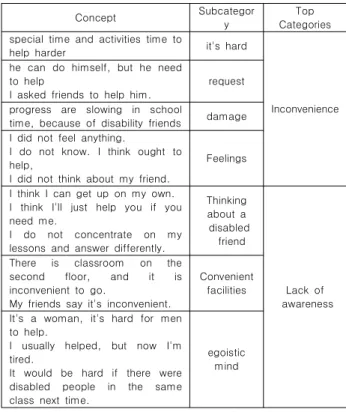
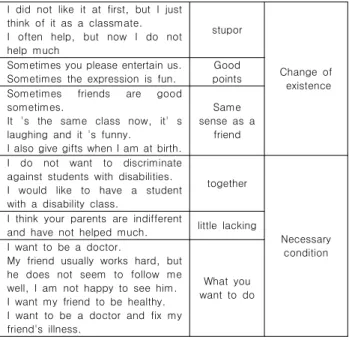
Open coding is a process of analyzing data and naming and categorizing phenomena, so we repeated the analysis of words and words or paragraphs and paragraphs from interviews. In other words, I have summarized the development process of friendship from the first encounter feeling of the non-disabled students to the students with disabilities to the reminiscences of the events in the school life and the semis class relations. On the contrary, students with disabilities were given the chance of reverse-circulation, and the process was analyzed in the same way to verify the contents of the coding.
Concept Subcategor
y
Top Categories special time and activities time to
help harder it's hard
Inconvenience he can do himself, but he need
to help
I asked friends to help him.
request
progress are slowing in school
time, because of disability friends damage I did not feel anything.
I do not know. I think ought to help,
I did not think about my friend.
Feelings
I think I can get up on my own.
I think I'll just help you if you need me.
I do not concentrate on my lessons and answer differently.
Thinking about a disabled
friend
Lack of awareness There is classroom on the
second floor, and it is inconvenient to go.
My friends say it's inconvenient.
Convenient facilities
It's a woman, it's hard for men to help.
I usually helped, but now I'm tired.
It would be hard if there were disabled people in the same class next time.
egoistic
mind
Table 4. Coding Contents1
(5)
I did not like it at first, but I just think of it as a classmate.
I often help, but now I do not help much
stupor
Change of existence Sometimes you please entertain us.
Sometimes the expression is fun.
Good points Sometimes friends are good
sometimes.
It 's the same class now, it' s laughing and it 's funny.
I also give gifts when I am at birth.
Same sense as a
friend
I do not want to discriminate against students with disabilities.
I would like to have a student with a disability class.
together
Necessary condition I think your parents are indifferent
and have not helped much. little lacking I want to be a doctor.
My friend usually works hard, but he does not seem to follow me well, I am not happy to see him.
I want my friend to be healthy.
I want to be a doctor and fix my friend's illness.
What you want to do Table 5. Coding Contents2
He usually says that you have to
help him. education
The Power of Education I helped you first, it seemed like
a lot of hard work,
If no one can help, push the wheelchair.
spontaneity
You are a great teacher.
The teacher usually helps me.
Sometimes I get angry, but it's not that bad.
Assessment of teachers
Supportive help There are many times when I am
alone in an activity or a physical arts class.
Your body does not move at will.
I can not stand it.
Understanda ble
I want to make the classroom more convenient.
Convenient for the handicapped.
Thinking about others Table 6. Coding Contents3
2. Axis coding
Fig. 1. Axis Coding
Ⅴ. Conclusion
According to increased integrated education, the rate of students with disabilities who are educated in regular schools is increasing, and teachers of integration classrooms as well as special education teachers have to share responsibility for education of students with disabilities[10].
This study emphasized the importance of sympathy between students with disabilities and non-disabled students and suggested that training to improve perception on disabilities should be regularly provided at school.
As for children with physical disabilities, there were activity limitations derived from insufficient convenience facilities at school. Most of the children with disabilities were deprived of opportunities of social integration as they attended special schools in the past. Finally, parents of children with disabilities selected integration education places as they realized the limitations of special schools to overcoming disabilities.
Feeling of unity between peers preceded difference between disabilities and non-disabilities. Participation in school life was positively reflected in formation of relationships, and class teachers' interests and support worked meaningfully for formation of relationship.
Confidence and sympathy were meaningful for formation of personal relationship.
Schools, medical staff, educational offices, and social welfare centers should share responsibility to develop specific service models which both children with disabilities and non-disabled children and families of non-disabled children can enjoy.
REFERENCES
[1] Hyeon Su, Lee. “Educational Discrimination in the Law of Prevent Discriminating the Disabled and Suggesting the Future's Tasks”, Crisisonomy, Vol.7 No.3, 2011.
[2] Chan Ung, Park . “The Sociality Developmental Characteristic of Students with Intellectual Disabilities by the Integration Degree”, Intellectual Disability Research, Vol.17 No.4, 2015.
[3] In Ju, Kong & Joong Il, Shin. “The Effects of the Awareness
of Disorder and Self-esteem on the Social Maturity of
Children with Developmental Disabilities”, Journal of
Korea entertainment industry, Vol.9 No.2, 2015.
(6)
[4] Hye Ju, Jang & Ji Young, Lim. “A Comparative Study on Perception of Teachers and Parents on Peer Victimization of Children with Disabilities in Integrated Class”, Research on Children's Literature Education, Vol.16 No.1, 2015.
[5] Lee Seong, Gyu & Jung Hee, Young & Lim Dong, Kwon.
“ Influence of Peer express language development of children with hearing impaired”, Early childhood education, child care welfare research, Vol.19 No.2, 2015.
[6] Seok Soon, Gang & Ja Kyoung, Kim & Hye Jin, Kang.
“Relationship between Classroom Climate Perceived by General Children and Acceptive Attitude of Disability in Inclusive Classroom of Elementary school”, Special Education Journal, Vol.15 No.4, 2014.
“Comparison of the Awareness for inclusive education between General Children"s Parents and Handicapped Children"s Parents in Korea and China”, Special Education Rehabilitation Science Research, Vol.52 No.4, 2013.
[8] Ock Ryeo, Kang. “The Ideals and Practices of Assessment for Children with Disabilities in Inclusive Education Settings”, The Journal of Korea elementary education, Vol.21 No.2, 2011.
[9] Hee Soon, Woo & Gi Yeon, Jang. “A Correlation Between the Adaptive Behavior of Children in Special Class of Elementary School and the Ability of Functional Performance in School, Journal of Korean Society of Occupational Therapy, Vol.21 No.4, 2013.
[10] Mi Suk, Lee & So Hyun, Yang. “Perception of Elementary Inclusive Classroom Teachers on Involvement of Parents with Children with Disabilities”, The Journal of Special Children Education, Vol.17 No.1, 2015.
Authors
Woo-Hong Cho Received the Ph.D. degrees in Social Welfare department of Chosun University, in 2007. Dr. Cho joined the faculty of the Department of Social Welfare at Seowon University, Chungbuk, Korea, in 2014. The main interesting fields are social welfare and social welfare policy, social welfare administration, elderly welfare, community welfare.