• 검색 결과가 없습니다.

The Effects of Controlling the Aphis gossypii Glover (Homoptera, Aphididae) on Cucumber of Entomopahtogenic Fungus, Beauveria bassiana

N/A
N/A
Protected

Academic year: 2021

Share "The Effects of Controlling the Aphis gossypii Glover (Homoptera, Aphididae) on Cucumber of Entomopahtogenic Fungus, Beauveria bassiana"

Copied!
10
0
0

로드 중.... (전체 텍스트 보기)

전체 글

(1)

The Effects of Controlling the Aphis gossypii Glover (Homoptera, Aphididae) on Cucumber of Entomopahtogenic

Fungus, Beauveria bassiana

Min Ah Kang

1

․ Young Nam Youn

1*

1

ABSTRACT

Beauveria bassiana can be used as a biological insecticide to control a number of pests. It has been known as that B. bassiana TBI-1 have a insecticidal effect on the twospotted spider mite (Teranychus urticae) and the greenhouse whitefly (Trialeurodes vaporariorum) these days. The biological pest control agent, B. bassiana, showed somewhat insecticidal activities against the cotton aphid, Aphis gossypii, too. After treatment with biological insecticide, the mean of increasing rate of aphids was at around recorded at around 0.21 while at around 0.24 in non-treated TBI-1 biological insecticide condition during 1 week. Consequently, it was found that treatment of Beauveria bassiana reduced an increasing rate of aphid population. Also, we could visually observe dead aphids changed as a reddish mold due to this insecticidal fungus. B.

bassiana TBI-1 can significantly reduce an increasing rate of aphid population, so effective biological control against the cotton aphid are possible.

Key words : Biological control, Beauveria bassiana, Aphis gossypii Glover

Received Jan. 14, 2008; Accepted Jun. 19, 2008

1
Department of Applied Biology, College of Agriculture and Life Science, Chungnam National University, Daejeon, 305-764, Korea

* Correspondence: Young Nam Youn(E-mail: [email protected])

(2)

초 록

곤충병원성 곰팡이인 Beauveria bassiana는 미생물 살충제로서 다양한 해충들을 방제하는데 사용 해오고 있다. 최근에 B. bassiana TBI-1균주가 두점박이응애, 온실가루이에 살충효과가 있는 것으로 보고되었다. 생물학적 방제 인자인 B. bassiana TBI-1를 목화진딧물에도 어느 정도의 살충활성을 나 타내었다. B. bassiana TBI-1 균주를 처리한 후 일주일 동안 평균 진딧물의 증가율은 0.21로 나타났 으나 처리하지 않은 대조군에서는 0.24의 증가율로 약간 높게 나타나 보였다. 이러한 결과에서 백강 균의 처리구에서 진딧물의 평가 증가율이 0.03 낮게 나타나는 것을 알 수 있었다. 또한 오이 잎에 B.

bassiana TBI-1 균주에 의하여 붉은빛 곰팡이의 형태로 죽은 진딧물의 죽은 흔적을 육안으로 확인할 수 있었다. 적정농도로 B. bassiana TBI-1을 처리하면 목화진딧물의 개체군 증가율을 현저히 감소시 킴으로 효과적으로 진딧물을 방제할 수 있을 것이다.

검색어 : 생물학적 방제, 백강균, 목화진딧물

Ⅰ. Introduction

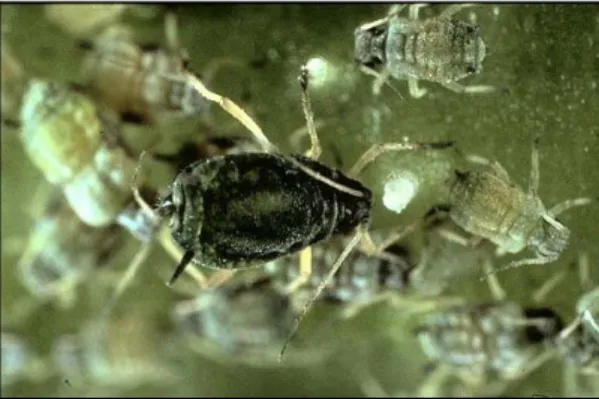
The cotton aphid, Aphis gossypii Glover (Homoptera, Aphididae), is one of the most polyphagous species of aphid, and have focused on its performance on economic plants (Liu and Perng, 1987)(Fig. 1).

Aphids feed by sucking sap from their host plants. Infested leaves often become cupped downwards and may appear wrinkled. Heavy infestations on some hosts may result in wilting.

Moreover young plants may have reduced or stunted growth. The cotton aphid is an important vector of over 50 plant viruses. Also, aphids produce copious amounts of honeydew. Honeydew serves as a medium on which sooty mold grows.

Sooty mold blackens the leaf and decreases photosynthetic activity (Elmer and Brawner, 1975). When found on the fruit, honeydew and

sooty mold reduces the marketability of the fruits.

The life cycle differs greatly between winter and summer types (Fig. 2). There is no need for an over wintering egg stage. Reproduction does not involve mating and egg laying.

Females give birth to live female nymphs. As a consequence of this type of reproduction, populations are composed solely of females and there are no males present. Cotton aphid can complete its development and reproduce in as little as a week, so numerous generations are possible under suitable environment conditions.

As it has a short development period, high

fecundity and is polyphagous, the cotton aphid

has the potential for high population growth on

a variety of crop plants. The wingless

(apterous) parthenogenetic females adult are 1

to 2 mm in length. The body's color is light

green mottled with dark green. It is most

(3)

common, but also occurring are whitish, yellow, pale green, and dark green forms. The legs are pale with the tips of the tibiae and tarsi black.

The cornicles also are black. Winged (alate) parthenogenetic females measure 1.1 to 1.7 mm in length. The head and thorax are black, and the abdomen yellowish green except for the tip of the abdomen, which is darker. The wing veins

Fig. 1. Aphis gossypii Glover (Rabasse J.-M.

/ INRA Antibes) Colony on a leaf of cucumber

Fig. 2. General life cycle of aphids. Asexual reproduction occurs during most of the year (summer cycle). Some aphid species produce a generation of sexual individuals that produce overwintering eggs as shown in the winter cycle

are brown. The egg-laying (oviparous) female is dark purplish green; the male is similar. The duration of the adult's reproductive period is about 15 days, and the post-reproductive period five days. These values vary considerably, mostly as a function of temperature. The optimal temperature for reproduction is reported to be about 21 to 27 degrees. Viviparous females produce a total of about 70 to 80 offspring at a rate of 4.3 per day.

Fig. 3. Microscopic spores of Beauveria bassiana

TBI-1 in 1 medium

(4)

B. bassiana is a fungus which causes a disease known as the white muscadine disease in insects.

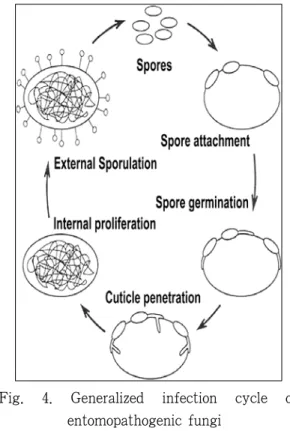
When spores of this fungus come in contact with the cuticle (skin) of susceptible insects, they germinate and grow directly through the cuticle to the inner body of their host. Here the fungus proliferates throughout the insect's body, producing toxins and draining the insect of nutrients, eventually killing it (Fig. 4). Therefore, unlike bacterial and viral pathogens of insects, B. bassiana and other fungal pathogens infect the insect with contact and do not need to be consumed by their host to cause infection. Once the fungus has killed it's host, it grows back out through the softer portions of the cuticle, covering the insect with a layer of white mold (hence the name white muscadine disease).

This downy mold produces millions of new infective spores that are released to the environment. B. bassiana is an aggressive parasite of many different insect host species. Not only does it have a wide host range but insects are attacked at larval or adult stages.

B. bassiana can be used as a biological insecticide to control a number of pests such as termites, whitefly, and many other insects.

However, some kinds of chemicals such as deltamethrin, acetamiprid, imidacloprid should be commonly used to control cotton aphid on cucumber. So, this studied that B. bassiana will be effective to Aphis gossypii Glover on cucumber.

Purpose of this study investigated the effects of controling the cotton aphids on cucumber of

entomopathogenic fungus, B. bassiana.

Fig. 4. Generalized infection cycle of entomopathogenic fungi

Ⅱ. Materials and Methods

1. Plants and Insects

Cucumber (Cucumis sativus) plants were used as host plant in this experiment. Seeds were planted in the chief ingredient of zeolite soil composed with vermiculite, perlite and coir dust in pots with 8cm diameter. Five to seven weeks old plants were moved from laboratory into greenhouse.

The cotton aphids, A. gossypii, were reared on cucumber in laboratory condition (Temp.:

25±2℃; R.H.: 40-60%), and among them,

(5)

Fig. 5. Cucumis sativus and inoculation cucumber with Aphis gossypii

Fig. 6. More than 50 indiciduals of A. gossypii on cucumber and the round nozzle

apterous adults of the aphids collected from cucumber were used in this experiment (April 2)(Fig. 5). The experimental condition was similar to rearing conditions.

2. Bioassay (Insecticide application experiments) On 10th of April 2008, purpose of this study investigated the effects of controling the cotton aphids on cucumber of B. bassiana TBI-1 for this experiment at greenhouse, which is to control A. gossypii on cucumber. Also, This 12

experimental host plants, at the stage of four fully expanded leaves and more than 50 A.

gossypii on cucumber, were used in this treatment(Fig. 6). Such as, three pots of cucumber were used to control (control 1, 2 and 3) and nine pots of cucumber were used to spray with B. bassiana TBI-1 for aphid control.

The treatments were: (I) control (application

of water); (II) B. bassiana TBI-1 (product C,

D corporation) applied at the concentration of

1ml with 500ml of water. The treatments were

(6)

applied using a sprayer with two kinds of round nozzle(Fig. 6). One of the round nozzle is for control (application of water) and The other is for B. bassiana TBI-1. Each of the applications was checked 3rd, 5th and 7th days after the first application (April 10).

3. Biological insecticide

1) Character of Beauveria bassiana

B. bassiana is a fungus that grows naturally in soils throughout the world and acts as a parasite on various insect species, causing white muscardine disease; it thus belongs to the entomopathogenic fungi(Fig. 7). It is being used as a biological insecticide to control a number of pests such as termites, whitefly, different beetles. The species is named after the Italian entomologist Agostino Bassi who discovered it in 1835 as the cause of the muscardine disease of domesticated silkworms.

It was formerly also known as Tritirachium shiotae.

The insect disease caused by the fungus is called white muscardine disease. When the microscopic spores of the fungus come into contact with the body of an insect host, they germinate, penetrate the cuticle, and grow inside, killing the insect within a matter of days. Afterwards a white mold emerges from the cadaver and produces new spores. A typical isolate of B. bassiana can attack a broad range of insects; various isolates differ in their host range. The factors responsible for host susceptibility are not known.

Fig. 7. Russian wheat aphid infected with the entomopathogenic fungus Beauveria bassiana

2) Beauveria bassiana TBI-1 (product C, D corporation)

This biological insecticide, Beauveria bassiana TBI-1 (product C, D corporation), is suspension concentrate (SC) so it should used to shaking the bottle of chemistry before used. Also, B.

bassiana TBI-1 had effect on honey bee and silkworm so do not use during the time of flowering and cross to the mulberry field

Fig. 8. The chemical structure of the entomoparasitic fungus, Beauveria bassiana

4. Data analyses

Increasing rate of aphids were estimated with

(7)

fellow formula. The total increasing rate of aphids y is:

y =      



  

 

; where (t+1)-t is Survey period, N

t+1

is number of aphids in 3, 5 and 7 days, N

t

is Incipient number of aphids. It also used the mean number of each days of living aphids.

Ⅲ. Results

1. Investigation of an increasing rate of the cotton aphid according to the treatment of B. bassiana

First of all, According to the table 1, in control,

Table 1. The number and increasing rates of Aphis gossypii in control condition

Days Control

Ave. of IR*

1 2 3

0 75 43 27

3 131 135 50

5 209 132 55

7 474 274 102

IR* 0.26 0.26 0.19 0.24±0.04

*Increasing rate

Table 2. The number and increasing rates of Aphis gossypii in Beauveria bassiana condition

Days Beauveria bassiana

Ave. of IR*

1 2 3 4 5 6 7 8 9

0 82 64 31 92 52 14 89 81 41

3 166 128 96 95 127 50 153 125 63

5 183 128 174 138 178 90 236 102 80

7 318 202 265 224 331 143 362 160 166

IR* 0.19 0.16 0.31 0.13 0.26 0.33 0.20 0.10 0.20 0.21±0.08

*Increasing rate

the number of aphids were steadily increasing all pots of cucumbers in 7th day because Aphis gossypii can complete its development and reproduce in as little as a week.

On the other hands, in B. bassiana condition, it can be seen that the number of A. gossypii on cucumber had slightly significant increase on A. gossypii compared to the control (Table 2).

According to the table 1, Those were a

considerable discrepancy between 0th and 7th

days in both condition. For example, the

number 1 in 7th days control condition rose

almost six times more than in 0th days

however, this table 2 shows that the number 8

in 7th days B. bassiana condition improved

almost doubled more than in 0th days. Whereas

the number 6 from 0th to 7th days B. bassiana

(8)

condition increased at around 10 times more than in 0th days.

This multiple line in Figure. 9 graphs show that the mean number of Aphis gossypii before control condition were 48.3, in 3rd days control condition were 105.3, in 5th days control condition were 132 and in 7th days control condition were 283.3. It can be seen that the mean number of A. gossypii before B. bassiana condition were 109.2, in 3rd days B. bassiana condition were 200.6, in 5th days B. bassiana condition were 261.8 and in 7th days B.

bassiana condition were 434.2.

To sum up, B. bassiana TBI-1 had slightly significant effect on A. gossypii compared to the control. Such as, totally the mean number of A. gossypii in control condition increased almost one and half times more than in B.

bassiana condition.

Fig. 9. The mean number of aphids in control and B. bassiana condition.

The multiple line in Figure. 10 graph is the increasing rate of aphids were estimated with the formulae provided by Bombosh(1936). The

increasing rate of aphids reached a peak in 3rd days at around 0.23 in B. bassiana condition but, decreased from 3rd to 5th days and the increasing rate of aphids reached a peak in 3rd days at around 0.26 in control condition but, decreased from 3rd to 5th days. However, the increasing rate of aphids in both conditions reached the lowest increasing rate in 5th days.

The most notable trend is the increasing rate of aphids in the control condition rose at around 1.1 times more than the B. bassiana condition in 3rd days also, those were not a considerable discrepancy from 3rd to 5th days and from 5th to 7th days between the control condition and B. bassiana condition.

Overall, the increasing rate of aphids rose dramatically over the three-day period but, dropped in 3rd and 5th days and then a increase between 5th and 7th days in both conditions.

Ⅳ. Discussions

Biological control of pests in agriculture is a method of controlling pests including insects, mites, weeds and plant diseases that relies on predation, parasitism, herbivory, or other natural mechanisms. It can be an important component of integrated pest management (IPM) programs.

Natural enemies of insect pests, also known as

biological control agents, include predators,

parasitoids, and pathogens. Predators, such as

lady beetles and lacewings, are mainly

(9)

free-living species that consume a large number of prey during their lifetime. Parasitoids are species whose immature stage develops on or within a single insect host, ultimately killing the host. Most have a very narrow host range.

Many species of wasps and some flies are parasitoids. Pathogens are disease-causing organisms including bacteria, fungi, and viruses.

They kill or debilitate their host and are relatively specific to certain insect groups.

Fig. 10. The increasing rate of aphids in both conditions between 0th and 7th days

B. bassiana can be used as a biological insecticide to control a number of pests such as termites, whitefly, and many other insects.

Nowadays B. bassiana TBI-1, had effect on twospotted spider mite (Teranychus urticae) and whitefly (Trialeurodes vaporariorum).

Nevertheless biological insecticide, B. bassiana, had slightly significant effect on A. gossypii compared to the untreated aphids in this study.

On the other hand, It had some symptoms on

the cucumber leave. It were death of aphids and looked like red spots (Fig. 11). I think when it used the more concentration of B.

bassiana TBI-1 the better effect on Aphis gossypii.

There are many species of aphids but almost all respond to the same control and treatments.

A large variety of chemical sprays are available from farmland center to treat aphids, but all will have some bad affect on other beneficial insects and wildlife.

In this study, the multiple line graphs give information about how the increasing rate of aphids differ between in control and B. bassiana condition.

Consequently, the mean of increasing rate of aphids was at around 0.24 in control condition and at around 0.21 in B. bassiana condition over the seven day period. Therefore, the mean of increasing rate of aphids was just at around 0.03 more than in B. bassiana condition.

Fig. 11. The symptoms on the cucumber leave

after treatment of B. bassiana

(10)

These results might be considered that the insecticidal activity of entomopathogenic fungus, B. bassiana is physical infection so that need a more time for exterminating pests, Therefore, further experimentation should have a long the period of the investigation.

References

1. Biological Control: A Guide to Natural Enemies in North America.

2. Blackman, R. L. and V. F. Eastop. 1984. Aphids on the world's crops: an identification and information guide. John Wiley & Sons. New York. 466pp.

3. Cheah, C., M. E. Montgomery, S. Salom, B. L.

Parker, S. Costa, and M. Skinner, 2004. Biological control of hemlock woolly adelgid. USDA For.

Serv. FHTET-2004-04, Reardon, R. and B. Onken (Tech. Coordinators), 22pp.

4. McNeil Jr., D. G. 2005. Fungus fatal to mosquito may aid global war on Malaria, The New York Times, 10 June.

5. Elmer, H.S. and O.L. Brawner. 1975. Control of Brown Soft Scale in Central Valley. Citrograph.

60(11): 402-403.

6. Wäckers, F., P. van Rijn and J. Bruin. 2005.

Plant-provided food for carnivorous insects- a protective mutualism and its applications (eds.).

Cambridge University Press, UK, 2005.

7. Hill, D.S. 1983. Aphis gossypii Glover. In agricultural insect pests of the tropics and their control, 2nd Edition. (eds.). pp. 201. Cambridge University Press. 746 pages.

8. Kennedy, G. G. and A. N. Kishaba. 1976:

Bionomics of Aphis gossypii on resistant and susceptible cantaloupe. Enciron. Entomol. 5, 357-361.

9. Liu, Y.-C.; Perng, J.-J., 1987: Population growth and temperature-dependent effect of cotton aphid Aphis gossypii Glover. Chin. J. Entomol.

7, 95-112(in Chinese, English abstract).

10. Pests of the Garden and Small Farm, UC DANR Publ. 3332; Fig. 3: Natural Enemies Handbook, UC DANR Publ. 3386.

11. In Aphids on the World's Crops: An Identification and Information Guide. John Wiley & Sons, Chichester, New York, Brisbane, Toronto, Singapore.

466 pages.

12. U.S. Congress, Office of Technology Assessment.

1995. Biologically based technologies for pest control.

US Government Printing Office, Washington, DC.

수치

Fig. 2. General life cycle of aphids. Asexual reproduction occurs during most of the year  (summer cycle)
Fig.  4.  Generalized  infection  cycle  of   entomopathogenic fungi
Fig. 7. Russian wheat aphid infected with the  entomopathogenic  fungus  Beauveria  bassiana
Table 2. The number and increasing rates of Aphis gossypii in Beauveria bassiana condition
+3

참조

관련 문서