Screening of aldose reductase inhibitory activity of white-color natural products
So-Youn Mok
1, Hyun Cheol Shin
2, Sanghyun Lee
1*
1
Department of Integrative Plant Science, Chung-Ang University, Anseong 456-756, Korea
2
Southern Forest Research Center, Korea Forest Research Institute, Jinju 660-300, Korea
화이트 칼라소재의 알도즈 환원효소 억제작용 탐색
목소연
1ㆍ신현철
2ㆍ이상현
1*
1중앙대학교 식물시스템과학과, 2국립산림과학원 남부산림연구소
Received on 27 December 2011, revised on 16 January 2012, accepted on 23 March 2012
Abstract : The purpose of this study was to evaluate the potential of naturally occurring aldose reductase (AR) inhibitors from white-color natural products (Aruncus dioicus var. kamtschaticus, Chionanthus retusa, Cosmos bipinnatus, Hibiscus syriacus, Hydrangea paniculata, Magnolia denudata, Prunus padus, Robinia pseudo-accacia, Rhododendron mucronulatum for. albiflorum, Spiraea blumei, and Spiraea prunifolia var. simpliciflora). The MeOH extract of white-color natural products were tested on rat lens AR inhibition in vitro. Among them, the MeOH extract of R. mucronulatum for. albiflorum showed highest inhibition on AR (IC
50value, 1.07 μg/ml). These results suggested that R. mucronulatum for. albiflorum, a white-color natural product, could be a useful resource in the development of a novel AR inhibitory agent against diabetic complications.
Key words : Aldose reductase inhibition, Diabetic complications, Rhododendron mucronulatum for. albiflorum, White-color natural product
*Corresponding author: Tel: +82-31-670-4688
I. Introduction
Aldose reductase (AR) is a rate limiting enzyme in the polyol pathway associated with the conversion of glucose to sorbitol. This reaction is vital for the function of various organs in the body and for the cataract formation in the lens (Van Heyningen, 1959).
In a diabetic condition, sufficient glucose can enter the tissues, but this pathway operates to produce sorbitol and fructose. These abnormal metabolic products have been reported to be factors responsible for diabetic complications such as cataracts, retinopathy (Engerman and Kern, 1984), neuropathy (Ward, 1973),
and nephropathy (Beyer-Mears et al ., 1984; 1985; Kato et al ., 2009). AR inhibitors (ARIs) can prevent or reverse early stage diabetic complications.The AR inhibitors such as zopolrestat, ponalrestat, sorbinil, tolrestat, epalretat, and ranireatat have been developed with promising results in the past years (Constantino et al ., 1999; Drel et al ., 2008; Hotta et al ., 2006;
Matsumoto et al ., 2008; Sun et al ., 2006). However, no ARIs have achieved worldwide use because of limited efficacy or undesirable side-effects (Chalk et al ., 2007;
Ziegler, 2004). Evaluating natural sources of ARIs potential may lead to the development of safer and more effective agents against diabetic complications (De la Fuente and Manzanaro, 2003).
There are many flowers from white-color natural
products. White-color natural products such as Magnolia denudata and Hibiscus syriacus used as traditional medicine are commonly used as medicinal herbs with a long history of clinical application in many Asian countries for symptomatic management of allergic rhinitis, sinusitis and headache. Various biologically active compounds such as eudesmin, magnolin, epimagnoli, neolignans, lignans, phenyl propanoids, sesquiterpenes, saponarin, vitexin, rhamnosylvitexin, and alkaloids have been also isolated from white-color natural products (Kelm and Nair, 2000; Seo, 2010; Shen et al ., 2008; Yoo et al ., 1996).
In a series of investigations to evaluate potential ARIs from the natural products, we have shown that some MeOH extracts from herbal medicines exhibited a significant inhibition of AR in vitro (Kim et al ., 2010; Mok et al ., 2011a) and a number of flavonoids compounds were isolated and characterized as ARIs from natural products (Mok et al ., 2011a; Mok et al ., 2011b).
In the present paper, as a preliminary step for the evaluations of potential of naturally occurring ARIs, we tested the effects of the flowers from white-color natural products on rat lens AR inhibition.
II. Materials and methods
1. General instruments and reagents
Fluorescence was measured with a Hitachi U-3210 spectrophotometer. Solvents such as DL-glyceraldehyde, β -NADPH, sodium phosphate buffer, potassium phosphate buffer, and DMSO (Sigma-Aldrich Chemical Co.) were used for rat lens AR assay.
2. Plant materials
The flower of Rhododendron mucronulatum for.
albiflorum was collected at Mt. Chilgap in 2009, Korea.
3. Sample preparation
The flowers of R. mucronulatum for. albiflorum (2.3 kg) were dried and finely powdered, then extracted with MeOH for 3 h (6 L × 5) under reflux at 65-75℃. After filteration and removal of solvent in vacuo , the MeOH extract (255.1 g) was collected. The MeOH extract of ten white color flowers ( Aruncus dioicus var. kamtschaticus, Chionanthus retusa, Cosmos bipinnatus, Hibiscus syriacus, Hydrangea paniculata, Magnolia denudata, Prunus padus, Robinia pseudo-accacia, Spiraea blumei, and Spiraea prunifolia var. simpliciflora ) were purchased from Korea Plant Extract Bank, KRIBB, Korea.
4. Measurement of AR activity
Rat lenses were removed from Sprague-Dawley male rats (weighing 250 - 280 g, 7 weeks) and preserved rat lenses by freezing it until use. These were hom- ogenized and centrifuged at 10,000 rpm (4℃, 20 min) and the supernatant was used as an enzyme source.
AR activity was spectrophotometrically determined by measuring the decrease in absorption of NADPH at 340 nm for a 4 min period at room temperature with DL-glyceraldehydes as a substrate (Sato and Kador, 1990). The assay mixture contained 0.1 M potassium phosphate buffer (pH 7.0), 0.1 M sodium phosphate buffer (pH 6.2), 1.6 mM NADPH, and test extract sample (in DMSO) with 0.025 M DL-glyceraldehyde as substrate in quartz cell. Each sample (1.0 mg) of the MeOH extract was dissolved in DMSO (1 ml) for AR activity test. Total volume of assay mixture is 1 ml for the test.
The reaction occurred in a quartz cell. IC
50values, the
concentration of inhibitors giving 50% inhibition of
enzyme activity, were calculated from the least-squares
regression line of the logarithmic concentrations plotted
against the residual activity. Quercetin known as one of
typical AR inhibitors was used as a positive control.
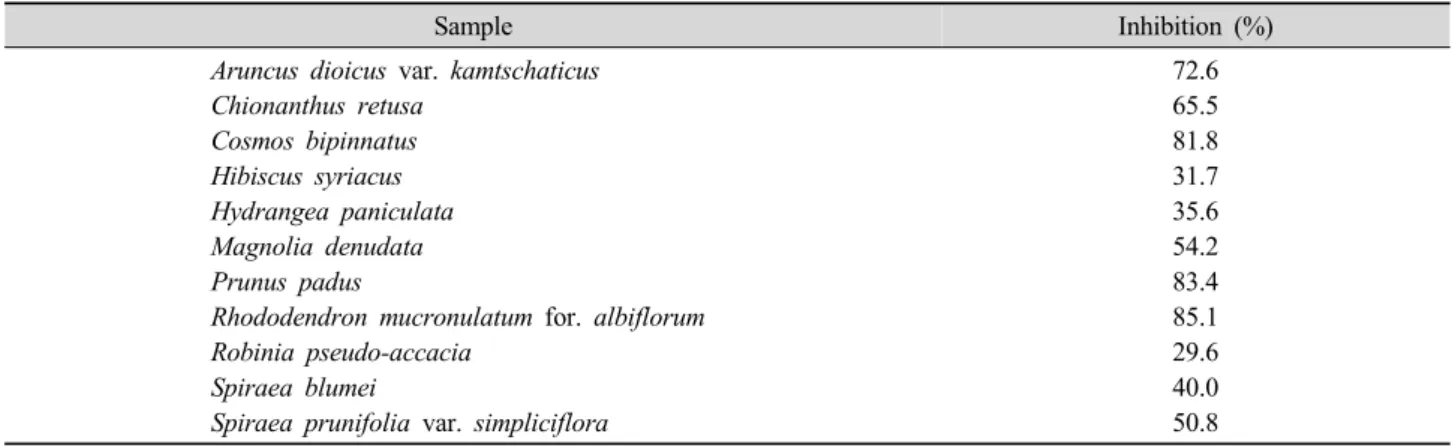
Table 1. Rat lens AR inhibitory activity of the MeOH extracts from white-color natural products.
Sample Inhibition (%)
Aruncus dioicus var. kamtschaticus Chionanthus retusa
Cosmos bipinnatus Hibiscus syriacus Hydrangea paniculata Magnolia denudata Prunus padus
Rhododendron mucronulatum for. albiflorum Robinia pseudo-accacia
Spiraea blumei
Spiraea prunifolia var. simpliciflora
72.6 65.5 81.8 31.7 35.6 54.2 83.4 85.1 29.6 40.0 50.8
III. Results and discussion
The MeOH extracts from white-color natural products were tested for their inhibitory effects on rat lens AR, and summarized in Table 1. Among white-color natural products tested, the MeOH extracts from A. dioicus var. kamtschaticus , C. retusa , C. bipinnatus , M. deundata , P. padus , R. mucronulatum for. albiflorum and S.
prunifolia var. simpliciflora were demonstrated to show good inhibitory potencies on rat lens AR. Among them, the MeOH extracts of A. dioicus var. kamtschaticus , C. bipinnatus , P. padus , R. mucronulatum for. albiflorum were exhibited high degree of inhibition (> 70% at 10 μg/ml) on rat lens AR, compared with other samples.
The extract of R. mucronulatum for. albiflorum, C.
bipinnatus , and P. padus was particularly exhibited highest inhibitory value of 85.1, 81.8 and 83.4 % on rat lens AR.
To evaluate the rat lens AR inhibitory activity, their inhibitory percentage and IC
50values were calculated.
Quercetin known as a very strong AR inhibitor (IC
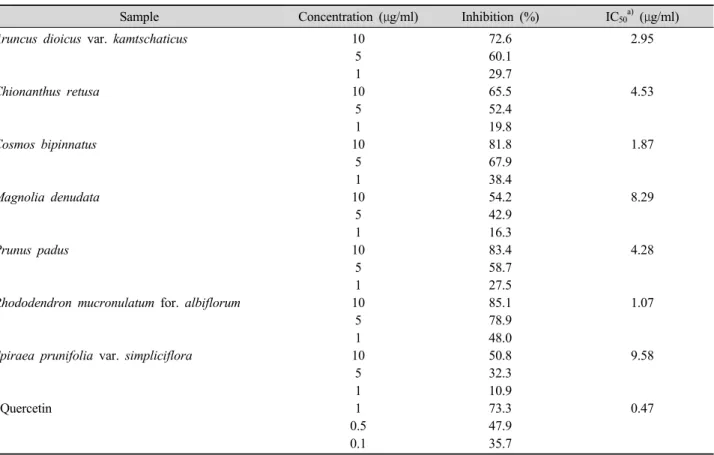
50value, 0.47 μg/ml) was used as a positive control and the results were indicated in Table 2. The IC
50values of the extracts of A. dioicus var. kamtschaticus , and P.
padus were demonstrated 2.95 and 4.28 μg/ml, respectively. The extracts of C. bipinnatus also had inhibitory activity with IC
50value 1.87 μg/ml. In particular, R. mucronulatum for. albiflorum extracts had
predominant inhibitory activities with IC
50value 1.07 μ g/ml, comparable to that of the positive control, quercetin.
R. mucronulatum flower and their leaves have long been known to have high pharmacological potency such as tonic, diuretic and stomachic in Chinese medicine (Chung and Lee, 1991). Koreans have been using the R. mucronulatum flower to make wine, honeyed flower juice, and flower-patterned griddle cakes (Lee et al ., 2007). Home-made R. mucronulatum flower wine showed a significant antioxidant activity in an in vitro fatty acid peroxidation assay and which improves blood circulation and decreases cholesterol levels (An et al ., 2005; Cho et al ., 2008; Chung et al ., 1996). The flavonoid and simple phenol contents have already been reported for R. mucronulatum flowers, leaves, and stems (Cho et al ., 2008; Chung et al ., 1996; Lee et al ., 2005;
Li et al ., 2008). In additions, several flavonoids such as quercetin and quercitrin have been reported to have inhibitory activity against AR (Andrew et al ., 2008).
To the best of our knowledge, the white-color flowers
of R. mucronulatum for. albiflorum was found to
demonstrate high inhibitory activities on AR from in
vitro data. Therefore, we suggest that white-color
natural products such as R. mucronulatum for. albiflorum
has a possibility of new natural resources for the
inhibition of AR. As a result, it can be used to study
the preliminary data for new active substances. Further
investigations on the bioactivity of constituents from
Table 2. IC
50values of the MeOH extract from white-color natural products on rat lens AR inhibition.
Sample Concentration (μg/ml) Inhibition (%) IC
50a)(μg/ml)
Aruncus dioicus var. kamtschaticus
Chionanthus retusa
Cosmos bipinnatus
Magnolia denudata
Prunus padus
Rhododendron mucronulatum for. albiflorum
Spiraea prunifolia var. simpliciflora
*Quercetin
10 5 1 10
5 1 10
5 1 10
5 1 10
5 1 10
5 1 10
5 1 1 0.5 0.1
72.6 60.1 29.7 65.5 52.4 19.8 81.8 67.9 38.4 54.2 42.9 16.3 83.4 58.7 27.5 85.1 78.9 48.0 50.8 32.3 10.9 73.3 47.9 35.7
2.95
4.53
1.87
8.29
4.28
1.07
9.58
0.47
a)