Abstract
Overview for Pattern and Results of Herbal Medicine-derived Atopic Dermatitis Clinical Researches
Kim Yunhee
Korea Institute of Oriental Medicine
Objectives
To make comprehensive feature of clinical trials using herbal medicine and their results by today, then help a strategy for herbal medication–derived clinical studies in the future.
Methods
Through medical website (Pubmed․EBSCO․Medline), foreign clinical literatures about atopic dermatitis and herbal medicine were searched. And domestic clinical literatures about atopic dermatitis using internet website (OASIS) and hand-searching. Analysis was performed according to distribution mainly by subject, study design, number by year and its efficacy.
Results and Conclusions
Seventy-nine (Domestic literatures: Fifty, Foreign literatures: Twenty-nine) literatures were selected according to inclusion criteria of clinical study. 80% of domestic clinical literatures were observational studies, 50% of foreign were intervention. There were six adverse effect case studies, two follow-ups, one case report, four translational and four uncontrolled clinical trials in foreign literatures. And nineteen case reports, eighteen case series, two follow-up and five uncontrolled clinical studies in domestic. Six RCTs have established by four external herb therapy and two decoctions in Korea, showed positive effects. Three out of four external applications RCTs, four out of seven decoctions showed positive results in foreign studies. This study revealed the current status of atopic dermatitis clinical research using herbal drugs. To put clinical trials to use of herbal medicine in the treatment atopic dermatitis, scientific and objective-based studies should be needed.
Key words : Herbal medicine, Clinical trial, RCT
Received: April 26, 2012 ∙ Revised: May 20, 2012 ∙ Accepted: May 21, 2012 Corresponding Author: Kim Yunhee
Korea Institute of Oriental Medicine,
1672 Yuseong-daero, Yuseong-gu, Daejeon 305-811, Republic of Korea Tel: +82-42-868-9326
E-mail: [email protected]
ⓒ The Association of Korean Oriental Pediatrics. All rights reseved. This is an open-access article distributed under the tenus of the Creative Commons Attribution Non-Commercial License (http://creativecommons.org/licenses/by-nc/3.0/), which permits unrestricted non-commercial use, distribution, and reproduction in any medium, provided the original work is properly cited.
한약을 이용한 아토피 임상연구의 경향에 관한 연구
김윤희
한국한의학연구원
ISSN 1226-8038
Ⅰ. Introduction
아토피피부염은 아동인구의 약 18%에서 25% 정도 의 유병률을 보이는 가장 흔한 피부의 만성 염증성 질 환 중 하나이며1,2) 산업화된 국가를 중심으로 유병률이 점차 증가하고 있다3,4). 국내에서도 증가 경향을 보이 나5) 완치가 가능한 치료법이 없기 때문에 보습제 및 국소 steroid, 국소 tacrolimus, 항히스타민제, 항알러지 제, cyclosporine 투여 등을 증상 경감 또는 제어하는 목 적으로 이용하고 있으며6,7) 아시아에서는 한약 치료 등 이 널리 이용되고 있다. 아시아 외의 지역에 있어서도 아토피피부염을 포함한 접촉성 피부염 및 건선 등의 피부의 만성 염증성 질환에 한약을 포함한 보완대체의 학의 수요가 꾸준히 증가하고 있다8,9). 이에 본 연구는 향후 아토피피부염 치료에 있어서 한약의 효과를 검증 하기 위한 과학적 임상연구 수행의 기초자료로 삼기 위해 2011년 12월까지 국내 및 국제학술지에 발표된 아토피피부염에 관한 임상연구의 동향을 살펴보고자 한다.
Ⅱ. Materials and methods
1. 연구관련 자료수집
1) 국외 논문 데이터베이스
Pubmed, EBSCO, Medline 데이터베이스를 이용하여 1970년부터 2011년 12월까지의 논문을 대상으로 검색 하였다.
2) 국외 논문 검색어
title 및 abstract를 대상으로 ‘atopic dermatitis’ (or
‘atopic eczema’) AND (‘clinical trial’ (or ‘clinical study’
or (‘randomized controlled trial’) OR ‘case series’ (or ‘case study’ or ‘case report’)) AND ‘herbal medicine’ (or ‘herb’
or ‘herbal’ or ‘chinese herb’)의 term을 이용하여 검색하 였다.
3) 국내 논문 데이터베이스
Oasis 데이터베이스를 이용하여 1970년부터 2011년 12월까지의 논문을 대상으로 검색하였다.
2) 국내 논문 검색어
국내 논문의 경우 국외와 같은 Database system이 없 기 때문에 tilte 및 abstract를 대상으로 ‘아토피’ term을 이용하여 검색한 뒤 관련 논문을 Hand-searching 하였다.
2. 연구대상 선정 1) 대상 논문 형식
한약 혹은 단미제를 이용하여 아토피피부염을 치료 한 논문 중 임상 논문을 대상으로 하였다.
2) 대상 논문 선정 조건 (1) 논문 선정 조건
주증상이 아토피피부염으로 연구된 논문을 선정하 였다.
임상연구, 임상보고 등 사람을 대상으로 연구한 논 문을 선정하였다.
국외 논문의 경우 초록 및 본문이 영어로 쓰여진 논 문을 선정하였다.
(2) 논문 배제 조건
아토피피부염이 치료의 주증상이 아닌 논문은 배제 하였다.
사람을 대상으로 하지 않은 논문은 배제하였다.
사람에서 채취한 검체를 이용하여 세포레벨의 실험 에 한약을 이용한 연구는 배제하였다.
임상연구 논문 중 체계적 고찰 논문은 제외하였다.
Ⅲ. Results
1. 임상연구 논문의 수와 연도별 분석
국내에서는 총 191건의 논문이 검색되었으며 이중 중복된 논문과 review 논문 및 아토피피부염과 관련된 설문논문, 삶의 질 및 아토피피부염 척도에 관련한 논 문을 제외하고 총 50편의 논문을 본 연구의 분석에 사 용하였다. 국외에서는 총 105건의 논문이 검색되었으 며 이중 중복된 논문과 review 논문 및 아토피피부염과 관련된 설문논문, 삶의 질 및 아토피피부염 척도, 실험 에 관련한 논문을 제외하고 총 29편의 논문을 본 연구 의 분석에 사용하였다. 국내논문은 증례 연구가 19건, 사례군 연구가 18건이었으며 치료 후의 추적관찰 연구
가 2건 있었다. 대조군을 설정하지 않은 임상연구가 5 건, 대조군을 설정하고 무작위 배정한 RCT 연구가 총 6건이었다. 국외논문은 증례 보고가 1건이었으며, 한 약 혹은 단미제, 외용제 등을 이용한 아토피 치료 과정 중 나타난 부작용 연구가 6건, 치료 후의 추적관찰 연 구가 2건, 중개연구가 4건 있었다. 대조군을 설정하지 않은 임상연구는 4건, RCT 연구는 12건으로 나타났다.
국내의 경우 1개의 증례를 보고하거나 2개 이상의 증 례를 보고한 관찰연구가 전체의 약 80%를 차지하였으 며, 1개 증례 보고의 경우는 모두 한약탕약을 이용한 연구였다. 이와 대조적으로 국외에는 1개 증례를 보고 한 경우는 1건에 그쳤으며, 약 50% 이상의 논문이 개 입연구의 형태를 취하였다 (Fig. 1, 2).
Fig. 1. Flow chart of the retrieved literature (domestic literatures) UCCT: Uncontrolled clinical trial.
RCT: Randomized controlled trial.
Fig. 2. Flow chart of the retrieved literature (foreign literatures)
기간별로 발표된 임상논문 수를 살펴본 결과, 국내 의 경우 1975년을 증례보고를 시작으로 1991년 이후 약 49편의 임상논문이 발표되었으며, 2006년 이후에만
약 30편의 논문이 발표되었다. 국외의 경우 1992년 이 후 약 29편의 논문이 발표되었다 (Fig. 3). RCT에 관련 한 임상연구는 국외의 경우 1992년도 이후 12편의 논 문이 보고되었다. 국내의 경우 RCT에 관련한 임상연 구는 2005년까지는 한건도 없었으며 모두 2006년 이 후 발표되었다 (Fig. 4).
Fig. 3. Number of atopic dermatitis with herbal medicine researches
Fig. 4. Number of atopic dermatitis with herbal medicine RCT
2. 연구주제와 임상시험 결과의 분석
50편의 국내 논문 중 RCT 6건, 추적관찰 연구 2건 을 제외한 42건의 논문 중 외용제에 관한 임상연구는 8편, 단미제 (식품포함) 1건을 제외한 33건은 모두 복 합처방을 투여한 임상연구였다. 29편의 국외 논문 중 RCT와 부작용, 추적관찰 연구를 제외한 총 9건의 임상 연구 중 단미제 (식품포함)를 이용한 것은 4건, 복합제 나 혼합제를 사용한 것은 4편, 침치료와 복합제를 사용 한 것은 1건으로 나타났다. 국내 RCT의 경우 6건 중 4건이 외용제에 관한 연구였으며, 국외 RCT의 경우 4 건은 외용제, 단미제 1건, 복합 또는 혼합제제 7건으로 나타났다 (Fig. 5).
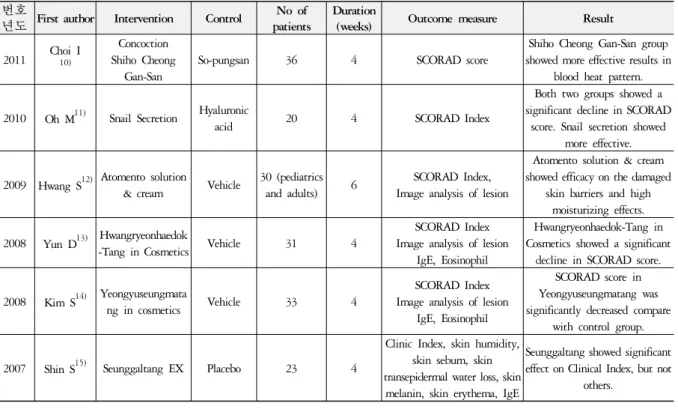
번호
년도 First author Intervention Control No of patients
Duration
(weeks) Outcome measure Result
2011 Choi I
10)
Concoction Shiho Cheong
Gan-San
So-pungsan 36 4 SCORAD score
Shiho Cheong Gan-San group showed more effective results in
blood heat pattern.
2010 Oh M11) Snail Secretion Hyaluronic
acid 20 4 SCORAD Index
Both two groups showed a significant decline in SCORAD
score. Snail secretion showed more effective.
2009 Hwang S12) Atomento solution
& cream Vehicle 30 (pediatrics
and adults) 6 SCORAD Index,
Image analysis of lesion
Atomento solution & cream showed efficacy on the damaged
skin barriers and high moisturizing effects.
2008 Yun D13) Hwangryeonhaedok
-Tang in Cosmetics Vehicle 31 4
SCORAD Index Image analysis of lesion
IgE, Eosinophil
Hwangryeonhaedok-Tang in Cosmetics showed a significant
decline in SCORAD score.
2008 Kim S14) Yeongyuseungmata
ng in cosmetics Vehicle 33 4
SCORAD Index Image analysis of lesion
IgE, Eosinophil
SCORAD score in Yeongyuseungmatang was significantly decreased compare
with control group.
2007 Shin S15) Seunggaltang EX Placebo 23 4
Clinic Index, skin humidity, skin sebum, skin transepidermal water loss, skin
melanin, skin erythema, IgE
Seunggaltang showed significant effect on Clinical Index, but not
others.
Table 1. Domestic Randomized Trials on Herbal Medicine for Atopic Dermatitis
Fig. 5. Distribution of atopic dermatitis with herbal medicine researches according to treatment methods
3. 국내 RCT 대조군의 처치방법 및 치료 기간, 대상자 숫자 및 그룹 설정
국내의 RCT 형태의 임상시험 연구는 복합처방 및 외용제를 연구대상으로 선택한 경우였으며 모두 유의 한 효과를 보였다. 치료기간을 분석해본 결과 6주인 1 건을 제외하고는 모두 4주였다. 외용제의 시험의 경우 에는 시험 대상을 mild to moderate한 아토피피부염으 로 설정하였으며 시험군과 비교하기 위한 대조군을 분 석해본 결과 외용제 대조군은 vehicle을 사용하였으며, 외용제 시험 1건에서만 Hyaluronic acid를 대조군으로 사용하였다. 복합 처방과 관련된 연구에서는 다른 복
합처방을 대조군으로 설정하였다. 연구 디자인과 관련 된 주요 사항을 분석해본 결과, 시험대상자는 평군 28.8명으로 가장 적게는 20명에서 가장 많게는 36명 까지 있었으며 실험군과 대상군의 설정에서 모두 two-arms의 그룹을 설계한 형태였으며 전체 RCT 중에 서 소아를 대상으로 포함 한 것은 1편이었다. 6건 모두 이상반응은 나타나지 않았다고 보고되었다 (Table 1).
4. 국외 RCT 대조군의 처치방법 및 치료 기간, 대상자 숫자 및 그룹 설정
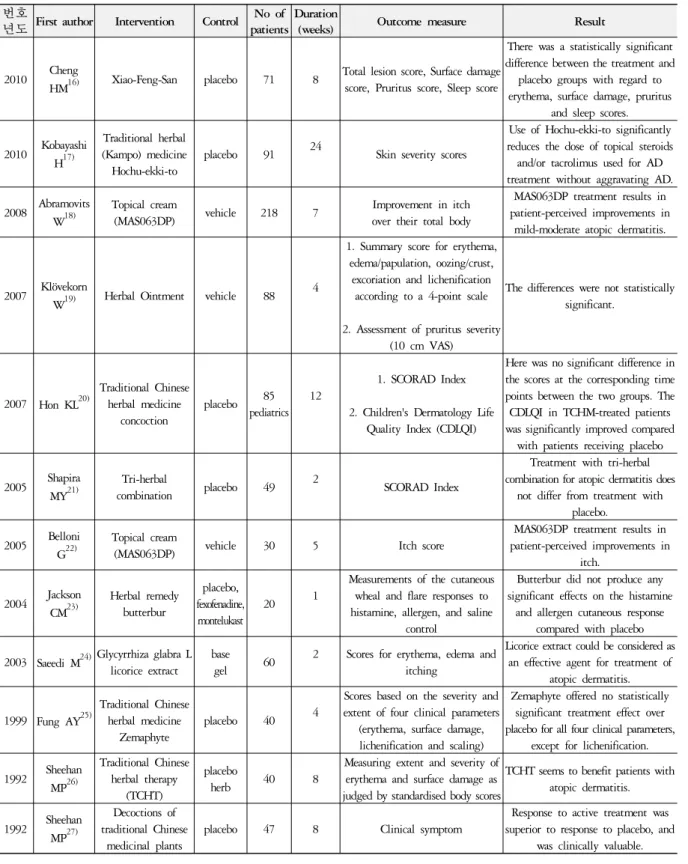
국외의 RCT 형태의 임상시험 연구에서는 4건의 외 용제 시험 중 3건은 유의한 효과, 1건은 효과 없음으로 나타났으며, 단미제는 효과 없음으로 나타났다. 복합 또는 혼합제제 7개 중 4건은 유의한 효과, 3건은 효과 없음으로 나타났으나, 효과 없음 3건 중 1건은 평가 지 표상 점수는 효과가 없었으나, 임상증상의 개선은 나 타났다. 치료기간을 분석해본 결과 1주부터 24주까지 다양하게 나타났다. 연구 디자인과 관련된 주요 사항 을 분석해본 결과, 시험대상자는 가장 적게는 20명에 서 가장 많게는 218명까지 있었으며 항히스타민제와 효과를 비교한 1건을 제외하고는 실험군과 대상군의 설정에서 모두 two-arms의 그룹을 설계한 형태였으며 외용제의 시험의 경우에는 시험 대상을 mild to moder-
번호
년도 First author Intervention Control No of patients
Duration
(weeks) Outcome measure Result
2010 Cheng
HM16) Xiao-Feng-San placebo 71 8 Total lesion score, Surface damage score, Pruritus score, Sleep score
There was a statistically significant difference between the treatment and placebo groups with regard to erythema, surface damage, pruritus
and sleep scores.
2010 Kobayashi H17)
Traditional herbal (Kampo) medicine
Hochu-ekki-to
placebo 91 24
Skin severity scores
Use of Hochu-ekki-to significantly reduces the dose of topical steroids and/or tacrolimus used for AD treatment without aggravating AD.
2008 Abramovits W18)
Topical cream
(MAS063DP) vehicle 218 7 Improvement in itch
over their total body
MAS063DP treatment results in patient-perceived improvements in
mild-moderate atopic dermatitis.
2007 Klövekorn
W19) Herbal Ointment vehicle 88 4
1. Summary score for erythema, edema/papulation, oozing/crust,
excoriation and lichenification according to a 4-point scale
2. Assessment of pruritus severity (10 cm VAS)
The differences were not statistically significant.
2007 Hon KL20)
Traditional Chinese herbal medicine
concoction
placebo 85 pediatrics
12
1. SCORAD Index
2. Children's Dermatology Life Quality Index (CDLQI)
Here was no significant difference in the scores at the corresponding time points between the two groups. The CDLQI in TCHM-treated patients was significantly improved compared
with patients receiving placebo
2005 Shapira MY21)
Tri-herbal
combination placebo 49 2
SCORAD Index
Treatment with tri-herbal combination for atopic dermatitis does
not differ from treatment with placebo.
2005 Belloni G22)
Topical cream
(MAS063DP) vehicle 30 5 Itch score
MAS063DP treatment results in patient-perceived improvements in
itch.
2004 Jackson CM23)
Herbal remedy butterbur
placebo, fexofenadine, montelukast
20 1
Measurements of the cutaneous wheal and flare responses to histamine, allergen, and saline
control
Butterbur did not produce any significant effects on the histamine
and allergen cutaneous response compared with placebo 2003 Saeedi M24)Glycyrrhiza glabra L
licorice extract
base
gel 60 2 Scores for erythema, edema and itching
Licorice extract could be considered as an effective agent for treatment of
atopic dermatitis.
1999 Fung AY25)
Traditional Chinese herbal medicine
Zemaphyte
placebo 40 4
Scores based on the severity and extent of four clinical parameters
(erythema, surface damage, lichenification and scaling)
Zemaphyte offered no statistically significant treatment effect over placebo for all four clinical parameters,
except for lichenification.
1992 Sheehan MP26)
Traditional Chinese herbal therapy
(TCHT)
placebo
herb 40 8
Measuring extent and severity of erythema and surface damage as judged by standardised body scores
TCHT seems to benefit patients with atopic dermatitis.
1992 Sheehan MP27)
Decoctions of traditional Chinese
medicinal plants
placebo 47 8 Clinical symptom
Response to active treatment was superior to response to placebo, and
was clinically valuable.
Table 2. Foreign Randomized Trials on Herbal Medicine for Atopic Dermatitis
ate한 아토피피부염으로 설정하였으며 전체 RCT 중에 서 소아를 대상으로 한 것은 1건이었다 (Table 2).
5. 국외 논문 중 한약으로 인한 부작용 보고
임상연구 논문 중 6건이 아토피피부염에 한약복합 제 혹은 단미제 캡슐을 복용하였을 때 나타난 부작용 사례를 보고하였다 (Table 3).
번호
년도 First author Intervention Result
2008 Kang KD28) Herbal medicine Aggravating cataract formation
2006 Chang YP29) Licorice Hypokalemic paralysis
2002 Motoyama O30) Herbal decoction Hemorrhagic cystitis
2001 Wong HC31) Herbal decoction Acute urticaria
2000 Uejima E32) Herbal decoction without prescription Aristolochia nephropathy 1997 Ferguson JE33) Herbal decoction without prescription Reversible dilated cardiomyopathy Table 3. Adverse Effect on Herbal Medicine for Atopic Dermatitis
Ⅳ. Discussion
아토피피부염은 여러 가지 인자가 복합적으로 관여 하여 만성적인 피부 염증을 일으키는 질환으로 발병기 전이 명확하지 않을뿐 아니라 환자 개개인에 따라 혹은 같은 환자라도 시기에 따라 서로 다른 기전을 보이며34) 명확한 치료법이 없어 증상경감 혹은 관리 위주의 치료 법만 제시되고5,6) 있다. 아토피피부염과 같은 피부의 만 성 염증성 질환에도 한약을 포함한 보완대체의학의 수 요가 꾸준히 증가하고 있는데9) 보완대체의학의 수요가 급증하는 것과 관련하여 근거중심의 대체의학이 중요 한 이슈로 대두되고 있다35,36). 향후 과학적 근거를 확립 하기 위한 한의학 연구에 가장 권장되는 연구는 엄격한 원칙을 적용한 RCT 임상연구라 할 수 있는데37) 아토피 피부염의 한약적용 RCT는 다른 질환에 비하여 대체적 으로 적은편으로 2005년에 발표된 Cochrane systematic review에 따르면 한약관련한 아토피피부염 RCT 임상연 구는 4건이 존재한다고 보고되어 있다38). 따라서 향후 한약을 이용한 아토피피부염 임상연구에 대한 정보를 제공하고자 본 연구를 수행하였다.
국내의 경우 전체 50편의 임상연구 논문 중 30편이 2006년 이후에 발표된 것으로 아토피피부염에 대한 한 약의 효과 검증이 임상을 기반으로 활발하게 이루어지고 있으나, 임상연구 중 1개의 증례를 보고하거나 2개 이상 의 증례를 보고한 관찰연구가 전체 연구의 약 80%로 나 타났다. 이와 대조적으로 국외에는 증례를 보고한 임상 연구 논문의 경우는 1건에 그쳤으며, 약 50% 이상의 논 문이 개입연구의 형태를 취하였다. 의학계에서도 점차 과학적으로 설계된 임상시험 근거를 요구하게 되면서 RCT가 의학연구의 가장 중요한 수단으로 활용39)되는 것 에 비추어 볼 때 한약의 치료 효과를 검증하기 위해서는 단순 증례보고 형식의 관찰연구가 아닌 RCT형식의 개입 연구가 필요하다 할 수 있다. 국내에도 2006년부터 2011 년까지 매년 1편의 RCT 연구가 보고 되었으나, 4편은
한약을 포함한 화장품 혹은 보습제에 관한 연구로 mild 한 아토피피부염을 대상으로 증상경감 관찰을 위주로 진 행된 것이었다. 50편의 국내 논문 중 RCT 6건, 추적관찰 연구 2건을 제외한 42건의 논문 중 33건의 증례보고가 복합처방을 이용하였으며 유의한 치료효과에 대한 보고 인바, 이를 이용한 RCT 연구 설계의 필요성이 있으며 이와 관련하여 최근 아토피피부염에 관한 복합처방의 protocol 설계 연구가 보고40)되었다. 국외 RCT의 경우 4 건은 외용제, 단미제 1건, 복합 또는 혼합제제 7건으로 나타났으며 단미제의 경우 유의한 효과가 없었다고 보고
23)되었는데, 연구의 치료기간 설정이 1주로 치료효과를 검증하기에는 적합하지 않기 때문일 가능성이 있다. 이 와 대조적으로 복합제를 이용해 유의한 효과를 얻은 경 우 치료기간 설정이 8주, 12주, 24주 등16,17,26,27)으로, 이 로 보아 한약의 임상연구에 있어서 한약의 특성을 충분 히 고려한 기간 설정이 필요하다고 사료된다. 또한 위약 군의 설정을 위해 연구에 적합한 제제 및 제형개발 뿐 아니라, 공정표준화 및 품질표준화 등을 고려한 연구 설 계시 신뢰성 있는 임상연구 결과를 도출 할 수 있을 것이 라 생각된다. 국외 임상논문 중 4건은 중개연구41-44)의 형 태를 취하였는데, 단미제 혹은 혼합제를 복용시킨 뒤 임 상증상의 경감 관찰 외에도, 환자의 blood sample을 채취 하여 약물의 작용기전 및 결과를 보고한 것으로 이는 신 약개발과 관련하여 권장되는 연구형태일 뿐 아니라 투여 약의 효능 및 안정성에 대한 객관적 데이터를 제시할 수 있는 방법이라 생각된다. 임상연구 논문 중 6건은 아토 피피부염에 한약 복합제 혹은 단미제 캡슐을 복용하였을 때 나타난 부작용에 대한 것으로 모두 1개의 증례에 대 한 보고였으며, 2건은 처방 없이 자가조제, 혹은 구입후 혼합하여 복용한 것32,33)이였으며, 한약치료와 질병과의 명확한 인과관계를 보이지 않은 것28), 단일성분의 캡슐 제형을 과량 복용으로 인한 것29) 등의 사례로 현재 국내 임상에서 사용되는 한약과는 차이가 있는 것으로 파악되 었으나 향후 배제조건 설정 등의 적합한 임상시험 설계
를 위하여 국내에서도 부작용에 대한 증례보고가 이루어 져야 할 것으로 생각된다.
이번 연구는 인터넷 검색 엔진을 대상으로 한국어 및 영어 논문을 대상으로 검색이 이루어져 중국어 및 일본어로 보고된 연구가 누락될 가능성이 있다. 또한 현재까지 한약을 이용한 아토피피부염 연구는 다른 질 환에 비하여 상대적으로 적은 건수만이 존재하여 분석 대상에 한계가 있었다.
Ⅴ. Conclusion
국내․외 저널에 발표된 한약을 이용한 임상연구 논 문 79건의 분석을 통하여 다음과 같은 결론을 얻었다.
1. 국내의 아토피피부염 관련 임상연구는 50편이 있으 며 증례 연구가 19건, 사례군 연구가 18건이었으며 치료 후의 추적관찰 연구가 2건 있었다. 대조군을 설정하지 않은 임상연구가 5건, 대조군을 설정하고 무작위 배정한 RCT 연구가 총 6건이었다.
2. 국외 논문은 29건을 분석에 사용하였고 이중 증례 보고가 1건이었으며, 중개연구와 임상연구를 함께 시행한 경우가 4건 아토피 치료 과정중 나타난 부작 용 연구가 6건, 치료 후의 추적관찰 연구가 2건 있었 다. 대조군을 설정하지 않은 임상연구는 4건, RCT 연구는 12건으로 나타났다.
3. 국내의 경우 1개의 증례를 보고하거나 2개 이상의 증례를 보고한 관찰연구가 전체의 약 80%를 차지하 였으며, 1개 증례 보고의 경우는 모두 한약탕약을 이용한 연구였다. 이와 대조적으로 국외에는 1개 증 례를 보고한 경우는 1건에 그쳤으며, 약 50% 이상 의 논문이 개입연구의 형태를 취하였다.
4. 국내의 경우 50건의 논문 중 2006년 이후에만 약 30편의 논문이 발표되었으며, RCT에 관련한 임상 연구 6편은 모두 2006년 이후 발표되었다. 추적관 찰 연구 2편을 제외한 48편의 논문 중 외용제에 관 한 임상연구는 13편, 단미제 (식품포함) 1건을 제외 한 34건은 모두 복합처방을 투여한 임상연구였다.
5. 국외 임상연구의 경우 단미제 (식품포함)를 이용한 것은 6건, 복합제나 혼합제를 사용한 것은 10편, 외 용제를 사용한 것은 4건 침치료와 복합제를 사용한 것은 1건으로 나타났다.
6. 국내의 RCT형태의 임상시험 연구는 복합처방 2건 및 4건의 외용제를 연구대상으로 선택한 경우였으 며 모두 유의한 효과를 보였다. 국외의 RCT형태의 임상시험 연구에서는 4건의 외용제 시험 중 3건은 유의한 효과, 1건은 효과 없음으로 나타났으며, 단 미제 1건은 효과 없음으로 나타났다. 복합 또는 혼 합제제 7개 중 4건은 유의한 효과, 3개는 효과 없음 으로 나타났으나, 효과 없음 3건 중 1건은 평가 지표 상 점수는 효과가 없었으나, 임상증상의 개선은 나타 났다. 국내, 국외 모두 이상반응은 나타나지 않았다.
7. 전체 RCT 중에서 소아를 대상으로 한 것은 2건이 었다.
8. 임상연구 논문 중 6건이 아토피피부염에 한약복합 제 혹은 단미제 캡슐을 복용하였을 때 나타난 부작 용 사례를 보고하였다.
이상과 같이 현재까지의 국내외 아토피피부염 임상 연구 경향을 관찰하여 보았으며, 이는 향후 과학적 연 구를 수행하기 위한 하나의 기초자료가 될 수 있을 것 으로 생각한다. 이후 본 연구에 이용된 임상논문의 질 평가를 통해 한약을 이용한 아토피피부염 임상연구에 적합한 방법론에 대한 고찰 및 검토가 필요할 것으로 사료된다.
References
1. Peroni DG, Piacentini GL, Bodini A, Rigotti E, Pigozzi R, Boner AL. Prevalence and Risk Factors for Atopic Dermatitis in Preschool Children. Br J Dermatol.
2008;158:539-43.
2. Stensen L, Thomsen SF, Backer V. Change in Prevalence of Atopic Dermatitis between 1986 and 2001 among Children. Allergy Asthma Proc. 2008;29:392-6.
3. Williams HC. Epidemiology of Atopic Dermatitis. Clin Exp Dermatol. 2000;25:522-9.
4. Fennessy M, Coupland S, Popay J, Naysmith K. The Epidemiology and Experience of Atopic Eczema during Childhood: a Discussion Paper on the Implications of Current Knowledge for Health Care, Public Health Policy and Research. J Epidemiol Community Health.
2000;54:581-9.
5. Jee HM, Kim KW, Kim CS, Sohn MH, Shin DC, Kim KE. Prevalence of Asthma, Rhinitis and Eczema in Korean Children Using the International Study of Asthma and Allergies in Childhood (ISAAC) Questionnaires. Pediatr Allergy Respir Dis. 2009;19(2):165-72.
6. Katayama I, Kohno Y, Akiyama K, Ikezawa Z, Kondo N, Tamaki K, Kouro O; Japanese Society of Allergology.
Japanese Guideline for Atopic Dermatitis. Allergol Int.
2011;60:205-20.
7. Schmitt J, Schüel K, Schmitt N, Meurer M. Systemic Treatment of Severe Atopic Eczema: a Systematic Review.
Acta Derm Venereol. 2007;87:100-11.
8. Hon KL, Ma KC, Wong Y, Leung TF, Fok TF. A Survey of Traditional Chinese Medicine Use in Children with Atopic Dermatitis Attending a Paediatric Dermatology Clinic. J Dermatolog Treat. 2005;16:154-7.
9. Boneberger S, Rupec RA, Ruzicka T. Complementary Therapy for Atopic Dermatitis and Other Allergic Skin Disease: Facts and Controversies, Clin Dermatol.
2010;28:57-61.
10. Choi I, Kim S, Kim Y, Yun Y. A Clinical Study of Shi Ho Cheong Gan-San on Blood Heat Pattern Atopic Dermatitis: a Randomized, Double-blind Clinical Trial.
J Korean Med Opthalmol Otolaryngol Dermatol.
2011;24(1):96-110.
11. Oh M, Park S, Kim H. The Effects of Snail Secretion Filtrate on the Damaged Skin Barrier's Recovery of the Atopic Dermatitis. J Korean Med Opthalmol Otolaryngol Dermatol. 2010;23(3):138-53.
12. Hwang S, Park S, Oh M, Kim H. A Double-blind, Randomized, Placebo-controlled Intervention Study of the Efficacy and Safety of 'Atomento solution & cream' in Patients with Atopic Dermatitis. J Korean Med Opthalmol Otolaryngol Dermatol. 2009;22(2):223-37.
13. Yun D, Kim H, Kim E, Ho D. Clinical Research of Atopic Dermatitis Treated by Hwangryeonhaedok-Tang in Cosmetics. J Orient Physiol Pathol. 2008;22(6):
1611-20.
14. Kim S, Yun D, Kim H, Ho D, Yoon K. A Clinical Research of Atopic Dermatitis Treated by Yeongyuseungmatang in Cosmetics. J Korean Med Opthalmol Otolaryngol Dermatol. 2008;21(2):126-41.
15. Shin S, Kim J, Kim M, Yoon H, Lyu S, Lee S, Lee
M, Kim K, Ko W. A Clinical Research about the Effects of Seunggaltang on Patients with Atopic Dermatitis. J Korean Med Opthalmol Otolaryngol Dermatol.
2007;20(2):199-212.
16. Cheng HM, Chiang LC, Jan YM, Chen GW, Li TC.
The Efficacy and Safety of a Chinese Herbal Product (Xiao-Feng-San) for the Treatment of Refractory Atopic Dermatitis: a Randomized, Double-blind, Placebo-con- trolled Trial. Int Arch Allergy Immunol. 2011;
155(2):141-8.
17. Kobayashi H, Ishii M, Takeuchi S, Tanaka Y, Shintani T, Yamatodani A, Kusunoki T, Furue M. Efficacy and Safety of a Traditional Herbal Medicine, Hochu-ekki-to in the Long-term Management of Kikyo (Delicate Constitution) Patients with Atopic Dermatitis: A 6-month, Multicenter, Double-blind, Randomized, Placebo-controlled Study. Evid Based Complement Alternat Med. 2010;7(3):367-73.
18. Abramovits W, Hebert AA, Boguniewicz M, Kempers SE, Tschen E, Jarratt MT, Lucky AW, Cornelison RL, Swinyer LJ, Jones TM. Patient-reported Outcomes from a Multicenter, Randomized, Vehicle-controlled Clinical Study of MAS063DP (Atopiclair) in the Management of Mild-to-moderate Atopic Dermatitis in Adults. J Dermatolog Treat. 2008;19(6):327-32.
19. Klövekorn W, Tepe A, Danesch U. A Randomized, Double-blind, Vehicle-controlled, Half-side Comparison with a Herbal Ointment Containing Mahonia Aquifolium, Viola Tricolor and Centella Asiatica for the Treatment of Mild-to-moderate Atopic Dermatitis. Int J Clin Pharmacol Ther. 2007;45(11):583-91.
20. Hon KL, Leung TF, Ng PC, Lam MC, Kam WY, Wong KY, Lee KC, Sung YT, Cheng KF, Fok TF, Fung KP, Leung PC. Efficacy and Tolerability of a Chinese Herbal Medicine Concoction for Treatment of Atopic Dermatitis: a Randomized, Double-blind, Placebo-con- trolled Study. Br J Dermatol. 2007;157(2):357-63.
21. Shapira MY, Raphaelovich Y, Gilad L, Or R, Dumb AJ, Ingber A. Treatment of Atopic Dermatitis with Herbal Combination of Eleutherococcus, Achillea Millefolium, and Lamium Album Has No Advantage over Placebo:
a Double blind, Placebo-controlled, Randomized Trial.
J Am Acad Dermatol. 2005;52(4):691-3.
22. Belloni G, Pinelli S, Veraldi S. A Randomised, Double-blind, Vehicle-controlled Study to Evaluate the Efficacy and Safety of MAS063D (Atopiclair) in the Treatment of Mild to Moderate Atopic Dermatitis. Eur J Dermatol. 2005;15(1):31-6.
23. Jackson CM, Lee DK, Lipworth BJ. The Effects of Butterbur on the Histamine and Allergen Cutaneous Response. Ann Allergy Asthma Immunol.
2004;92(2):250-4.
24. Saeedi M, Morteza-Semnani K, Ghoreishi MR. The Treatment of Atopic Dermatitis with Licorice Gel. J Dermatolog Treat. 2003;14(3):153-7.
25. Fung AY, Look PC, Chong LY, But PP, Wong E.
A Controlled Trial of Traditional Chinese Herbal Medicine in Chinese Patients with Recalcitrant Atopic Dermatitis.
Int J Dermatol. 1999;38(5):387-92.
26. Sheehan MP, Rustin MH, Atherton DJ, Buckley C, Harris DW, Brostoff J, Ostlere L, Dawson A. Efficacy of Traditional Chinese Herbal Therapy in Adult Atopic Dermatitis. Lancet. 1992;340:13-7.
27. Sheehan MP, Atherton DJ. A Controlled Trial of Traditional Chinese Medicinal Plants in Widespread Non-exudative Atopic Eczema. Br J Dermatol.
1992;126(2):179-84.
28. Kang KD, Kang SM, Yim HB. Herbal Medication Aggravates Cataract Formation: a Case Report. J Korean Med Sci. 2008;23(3):537-9.
29. Chang YP, Cheng CJ, Lin SH. Licorice-induced Hypokalemic Paralysis in a Patient with Chronic Atopic Dermatitis. J Med Sci. 2006;26(4):129-32.
30. Motoyama O, Shigetomi Y, Ohara A, Iitaka K. A Boy with Recurrent Hemorrhagic Cystitis during Treatment with Chinese Herbal Medicine. Clin Exp Nephrol.
2002;6(2):121-4.
31. Wong HC. Acute Urticaria Associated with Chinese Herbal Medicine Used for Atopic Dermatitis. Canadian J Allergy Clin Immunol. 2001;6(2):77-9.
32. Uejima E, Takahashi K, Ohishi M, Arakawa I, Kurokawa N, Izumi M, Imai E, Azuma J. The Risks of Using Personally Imported Traditional Chinese Drugs (Decoction). Japanese J Clin Pharmacol Ther.
2000;31(6):693-9.
33. Ferguson JE, Chalmers RJ, Rowlands DJ. Reversible
Dilated Cardiomyopathy Following Treatment of Atopic Eczema with Chinese Herbal Medicine Ferguson. Br J Dermatol. 1997;136(4):592-3.
34. Van Bever HP, Llanora G. Features of Childhood Atopic Dermatitis. Asian Pac J Allergy Immunol. 2011;29:15-24.
35. Tinsley JA. The Hazards of Psychotropic Herbs. Minn Med. 1999;82(5):29-31.
36. Siow YL, Gong Y, Au-Yeung KK, Woo CW, Choy PC, O K. Emerging Issues in Traditional Chinese Medicine. Can J Physiol Pharmacol. 2005;83(4):321-34.
37. Son C. Overview for Pattern and Results of Moxibustion-derived Clinical Trials. J Meridian Acupoint.
2009;26:41-49.
38. Hon KL, Chan BC, Leung PC. Chinese Herbal Medicine Research in Eczema Treatment. Chinese Med. 2011;6:17.
39. Coulter ID. Evidence Based Complementary Medicine:
Promise and Problems. Forsch komplenentmed.
2007;14(2):102-8.
40. Kim NK, Lee DH, Seo HS, Sun SH, Oh YL, Kim JE, Yoon IH, Zaslawski C. Hwangryunhaedoktang in Adult Patients with Atopic Dermatitis: a Randomised, Double-blind, Placebo-controlled, Two-centre trial - Study Protocol. BMC Complement Alternat Med.
2011;11:68.
41. Lee J, Jung E, Park B, Jung K, Park J, Kim K, Kim KH, Park D. Evaluation of the Anti-inflammatory and Atopic Dermatitis-mitigating Effects of BSASM, a Multicompound Preparation. J Ethnopharmacol.
2005;4(96):211-9.
42. Xu XJ, Banerjee P, Rustin MH, Poulter LW. Modulation by Chinese Herbal Therapy of Immune Mechanisms in the Skin of Patients with Atopic Eczema. Br J Dermatol.
1997;36(1):54-9.
43. Latchman Y, Banerjee P, Poulter LW, Rustin M, Brostoff J. Association of Immunological Changes with Clinical Efficacy in Atopic Eczema Patients Treated with Traditional Chinese Herbal Therapy (Zemaphyte). Int Arch Allergy Immunol. 1996;109(3):243-9.
44. Henderson CA, Morris A, Wilson A, Llchyshyn A.
An Open Study Comparing the Efficacy of Two Different Chinese Herbal Therapy Formulations in Atopic Eczema and Their Effects on Circulating Activated T-lymphocytes.
J Dermatolog Treat. 2000;11(2):91-6.