• 검색 결과가 없습니다.

B-Cell Translocation Gene 2 Regulates Hepatic Glucose Homeostasis via Induction of Orphan Nuclear Receptor Nur77 in Diabetic Mouse Model

N/A
N/A
Protected

Academic year: 2021

Share "B-Cell Translocation Gene 2 Regulates Hepatic Glucose Homeostasis via Induction of Orphan Nuclear Receptor Nur77 in Diabetic Mouse Model"

Copied!
11
0
0

로드 중.... (전체 텍스트 보기)

전체 글

(1)

Yong Deuk Kim,

1

Sun-Gyun Kim,

2

Seung-Lark Hwang,

3

Hueng-Sik Choi,

4

Jae-Hoon Bae,

1

Dae-Kyu Song,

1

and Seung-Soon Im

1

B-Cell Translocation Gene 2 Regulates Hepatic Glucose Homeostasis via Induction of Orphan Nuclear Receptor Nur77 in Diabetic Mouse Model

Diabetes 2014;63:1870–1880 | DOI: 10.2337/db13-1368

B-cell translocation gene 2 (BTG2) is a member of an emerging gene family that is involved in cellular func- tions. In this study, we demonstrate that BTG2 regu- lates glucose homeostasis via upregulation of Nur77 in diabetic mice. Hepatic BTG2 gene expression was elevated by fasting and forskolin. Overexpression of Btg2 increased the expression of hepatic gluconeogenic genes and blood glucose output and subsequently im- paired glucose and insulin tolerance. Upregulation of the transcriptional activity of Nur77, gluconeogenic genes, and glucose production by forskolin was ob- served by Btg2 transduction, but not in Btg2 knockdown.

BTG2-stimulated glucose production and glucose-6- phosphatase promoter activity were attenuated by dominant-negative Nur77. Coimmunoprecipitation and chromatin immunoprecipitation assays showed that BTG2 induced Nur77 occupancy on the glucose-6- phosphatase promoter via a physical interaction.

Btg2 gene expression was increased in streptozotocin- treated and db/db mice. Finally, impairment of glucose homeostasis, such as the increase of blood glucose, glucose intolerance, and insulin intolerance, was ele- vated in diabetic mice, whereas this phenomenon was abolished in knockdown of Btg2. Together, these data suggest that BTG2 participates in the regulation of he- patic glucose homeostasis, which means that BTG2

might serve as a potential therapeutic target for com- bating metabolic dysfunction.

The liver plays a crucial role in glucose homeostasis by maintaining a balance between uptake and storage of glucose via glycogenesis and in the release of glucose by both glycogenolysis and gluconeogenesis (1,2). Gluconeo- genesis is commonly triggered by key hormones including insulin, glucagon, and glucocorticoid, which contribute to the expression of key metabolic enzymes, such as phospho- enolpyruvate carboxykinase (Pck1), fructose biphosphatase (Fbp) 1, and glucose-6-phosphatase (G6pc) (3). A variety of transcriptional factors and cofactors regulated by the cAMP signaling pathway such as cAMP-responsive element–binding protein (CREB), FoxA 2 (also known as hepatocyte nuclear factor [HNF]-3b), HNF-4a, glucocor- ticoid receptor (GR), forkhead box protein O1, peroxi- some proliferator-activated receptor g coativator-1a (PGC-1a), and transducer of regulated CREB activity 2 con- trol the expression of hepatic gluconeogenic genes (4–9). Es- pecially CREB acts as a critical transcriptional checkpoint for the upregulation of gluconeogenesis by binding cAMP- response element. Multiple genes involved in the gluco- neogenic genes including Pck1, G6pc, and Pgc-1a were

1

Department of Physiology, Keimyung University School of Medicine, Daegu, Republic of Korea

2

Neuroscience Section, Department of Pediatrics, Papé Family Pediatric Research Institute, Oregon Health and Science University, Portland, OR

3

College of Pharmacy, Yeungnam University, Gyeongsan, Republic of Korea

4
School of Biological Sciences and Technology, National Creative Research Ini- tiatives Center for Nuclear Receptor Signals, Hormone Research Center, Chon- nam National University, Gwangju, Republic of Korea

Corresponding authors: Seung-Soon Im, [email protected], and Dae-Kyu Song, [email protected].

Received 5 September 2013 and accepted 5 February 2014.

© 2014 by the American Diabetes Association. See http://creativecommons.org /licenses/by-nc-nd/3.0/ for details.

METABOLISM

(2)

shown to be increased by recruiting CREB to the pro- moters of these genes (4,10,11).

The nuclear receptor Nur77/NR4A1 is a member of a family of the NR4A receptor, which has highly conserved DNA- and ligand-binding domains. Nur77 binds to its cognate DNA sequence, called NGFI-B (Nur77)- binding response elements (NBREs) or Nur response elements (NurREs), and induces transcription of target genes involved in the gluconeogenesis and steroidogen- esis (12,13). In addition, hepatic expression of NR4A receptors induced by cAMP in response to glucagon and fasting is increased in diabetic mice with elevated gluconeogenesis, and ectopic overexpression of the Nur77 gene induces upregulation of hepatic gluconeogenic genes, glucose production, and increased blood glucose level (12). Consistent with these results, Nur77-null mice on a high-fat diet also show decrease of hepatic glucose production and insulin resistance in the liver (14).

B-cell translocation gene 2 (BTG2) is a member of the BTG/TOB gene family of antiproliferative genes, which are highly conserved among various species (15). BTG2 is reported to be the initial gene induced by growth factors and tumor promoters in several cell types (16,17). Re- cently, we demonstrated that BTG2 acts as a crucial coac- tivator of CREB to regulate hepatic gluconeogenesis, and the increase of BTG2 by glucagon–CREB signaling resulted in the elevation of glucose production from hepa- tocytes (18). However, the interrelationship between BTG2 and Nur77 in terms of the regulation of hepatic gluconeo- genesis has not been addressed yet.

In the current study, we identi fied that transcrip- tional coregulator BTG2 acts as a novel coactivator of hepatic gluconeogenesis and elucidated a molecular mechanism that links to Nur77 in the regulation of glucose homeostasis in the livers of fasted and diabetic mice.

RESEARCH DESIGN AND METHODS Reagents

Forskolin and streptozotocin were purchased from Sigma- Aldrich (St. Louis, MO). Cell-culture media were pur- chased from Gibco-Brl (Grand Island, NY).

Animal Studies

Male C57BL6 mice (8 weeks of age; Samtako, Osan, Republic of Korea) were used in the experiments. For studies in the fasting and feeding conditions, mice were fed and fasted for 12 h. Diabetes was induced in wild-type (WT) and db/db mice by intraperitoneal injections of streptozotocin (80 mg/kg body weight). For overexpression of BTG2, WT mice were infected with adenoviral vector expressing Btg2 (13 10

9

plaque-forming units) by tail vein injection.

To disruption BTG2, db/db mice were intravenously injected with lentivirus short hairpin Btg2 (shBtg2; a single dose of 13 10

9

transducing units/mL). Total RNA was prepared from the livers of streptozotocin-treated dia- betic mice and adenovirus (Ad)- or lentivirus-infected

mice for quantitative reverse transcription-PCR (qPCR) analysis. Before the isolation of the liver, the blood glucose levels of all mice were measured with Glucostix Accu-Check (Roche Diagnostics, Mannheim, Germany).

All animal experiments were performed in accordance with the rules and regulations of the Institutional Animal Use and Care Committee at Keimyung University School of Medicine.

Metabolic Parameters

Plasma glucose was measured using a glucometer (Roche Diagnostics) in blood collected from the tail of mice as previously described (19). For the glucose tolerance test, a single dose of 2.5 mg/kg glucose was injected intraper- itoneally after a 14-h fast. For the insulin tolerance test, mice fasted for 4 h were administered intraperitoneally with insulin (0.5 units/kg), and glucose concentrations were measured at 0, 30, 60, 90, and 120 min. Blood glucose was analyzed under the same conditions.

Construction of Plasmids and DNA

The reporter plasmids NBRE-Luc, NurRE-Luc, Pck1-Luc, and G6pc-Luc were described previously (13,18). Expres- sion vectors of HA-Nur77, dominant-negative (DN)- Nur77, Hnf4-a, Pgc-1a, GR, and Flag-Btg2 were described previously (13,18,20–23). The small interfering RNAs for Btg2 were prepared as described previously (18). The point mutant form of human G6PC-Luc or mouse G6pc- Luc was constructed using a site-directed mutagenesis kit (Stratagene, La Jolla, CA) and the following primers: hu- man G6PC (hG6PC)-Luc forward, 5 9-CTGTAACTTTAATTT CATTAAATG-3 9 and reverse, 59-CATTTAATGAAATTAAA GTTACAG-3 9 and mouse G6pc (mG6pc)-Luc forward, 59- TAACTT-AAAATTTCACTTCCG-3 9 and reverse, 59-CGGAA GTGAAATTTTAAGTTA-3 9. All plasmids were confirmed by sequencing analysis.

Cell Culture and Transient Transfection Assays

AML-12 immortalized mouse hepatocytes were cultured in DMEM/F-12 medium (Gibco-Brl) supplemented with 10% FBS, insulin-transferrin-selenium (Gibco-Brl), dexa- methasone (40 ng/mL; Sigma-Aldrich), and antibiotics in a humidified atmosphere containing 5% CO

2

at 37°C (24).

Transient transfections were carried out as previously de- scribed (18,24).

Isolation and Culture of Primary Mouse Hepatocytes Mouse primary hepatocytes were isolated from the livers of 8-week-old male mice (Samtako). The protocol for isolation of hepatocytes was described previously (8).

Preparation of Recombinant Ad

Ads encoding full-length Btg2 and green fluorescence protein (GFP) have been described previously (18,24).

Recombinant lentiviral delivery of Btg2-targeted short

hairpin RNA (shRNA) was purchased from Dharmacon

(Lafayette, CO). Ad-expressing DN-Nur77 was gifted from

Dr. In-Kyu Lee at Kyungpook National University School

of Medicine.

(3)

Measurement of mRNA

Total RNA was isolated from liver tissue and used for qPCR as previously described (25,26). The expression of all transcripts using qPCR data was normalized to ribo- somal L32 expression.

Glucose Production Assay

Glucose production from mouse primary hepatocytes was measured according to the manufacturer ’s protocol using a colorimetric glucose oxidase assay (Sigma-Aldrich).

Brie fly, after designated times, the cells were washed three times with PBS and then incubated for 3 h at 37°C in an atmosphere containing 5% CO

2

in glucose production buffer (glucose-free DMEM [pH 7.4] containing 20 mmol/L sodium lactate, 1 mmol/L sodium pyruvate, and 15 mmol/L HEPES without phenol red). The glucose assays were carried out in triplicate, and the intra-assay coefficient of variation was 5% as described previously (27).

Immunoblotting and Coimmunoprecipitation Assay Proteins were isolated from mouse primary hepatocytes and liver tissues and analyzed according to the methods described previously (19). The membranes were probed with BTG2 and Nur77 (Santa Cruz Biotechnology, Santa Cruz, CA) and then developed using an ECL Western blot detection kit (Amersham Biosciences, Piscataway, NJ).

For immunoprecipitation, total protein extracts from AML-12 cells and mouse liver were probed for BTG2, Nur77, hemagglutinin (HA) (Santa Cruz Biotechnology), and FLAG antibody (Sigma-Aldrich) and then blotted with these antibodies (21). Signals were developed using an ECL Western blot detection kit (Amersham Biosciences).

Chromatin Immunoprecipitation Assay

The chromatin immunoprecipitation (ChIP) assay was performed as described previously (18,19). Brie fly, 36 h after infection with Ad-Btg2 in mouse primary hepato- cytes, cells were treated with forskolin (10 mmol/L). The cells were subsequently harvested, and the ChIP assay was performed with anti-Nur77. The final DNA extractions were quantified by PCR with two pairs of primers for the proximal (21,070/2860 and 2529/2310) and distal (22,000/21,790 and 21,679/21,460) regions of the hG6PC and mG6pc promoters. The specific primers used for PCR are as follows: hG6PC promoter, proximal, for- ward, 59-AGTGAGCCGTGATTATGCCA-39 and reverse, 59-TGGGAGATCAACCCCCTTCC-39; distal, forward, 59- TGGAATGCTGTC-AACTTTT-39 and reverse, 59-CTCAAC CTAGCAAAGCATT-G-3 9; mG6pc promoter, proximal, forward, 5 9-CAGAGGTGGACCCCAGATCC-39 and reverse, 5 9-AGAGTCTGTTT-CAACCATGA-39; and distal, forward, 5 9-GGTGGCTCACAACCATCTGT-39 and reverse, 59- TG-AGCTGGTGTCATGTGACT-39.

Statistical Analysis

Data calculation and statistical analyses were performed using GraphPad Prism 3-5.0 software (GraphPad). The statistical signi ficance of differences between groups were

determined using the Student t test, and multiple com- parisons were analyzed using one-way ANOVA under treatment and experiment as factors. All data are pre- sented as means 6 SEM. All P values ,0.05 were consid- ered significant.

RESULTS

BTG2 Gene Expression Is Induced by Fasting and Glucagon Signaling in the Liver

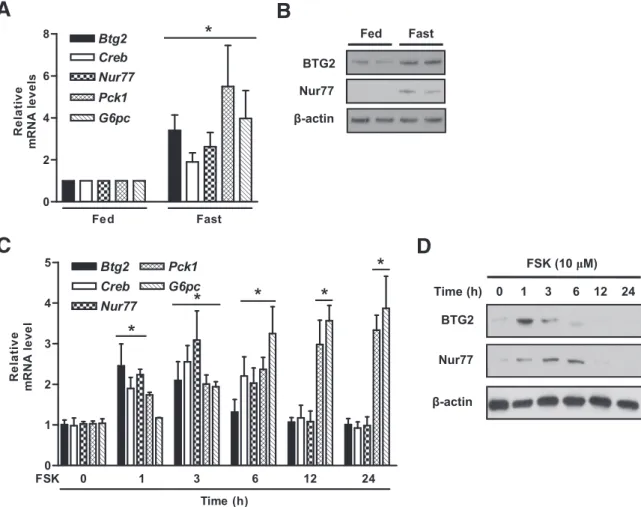
BTG2 acts as a coactivator of CREB to positively regulate hepatic gluconeogenesis in vitro (18). To investigate whether BTG2 is regulated by fasting and glucagon stim- ulation in vivo, we performed qPCR analysis from mouse liver. As shown in Fig. 1A, Btg2 gene expression was in- duced by fasting along with Creb, Nur77, Pck1, and G6pc.

Also, protein levels of BTG2 and Nur77 were induced in the fasted state (Fig. 1B). Btg2 mRNA was induced by forskolin, a cAMP agonist, with expression reaching a maximal stimulation at 1 h. Similar results were ob- served for Creb, Nur77, Pck1, and G6pc mRNA levels (Fig. 1C), consistent with previous studies (12,18). Inter- estingly, the increase of BTG2 and Nur77 proteins by 1–6-h treatment of forskolin reached the peak level, and it sub- sequently declined after 12 h (Fig. 1D). These results sug- gest that BTG2 plays a pivotal role in the upregulation of gluconeogenic genes in vivo.

Overexpression of BTG2 Gene Induces Hepatic Gluconeogenesis

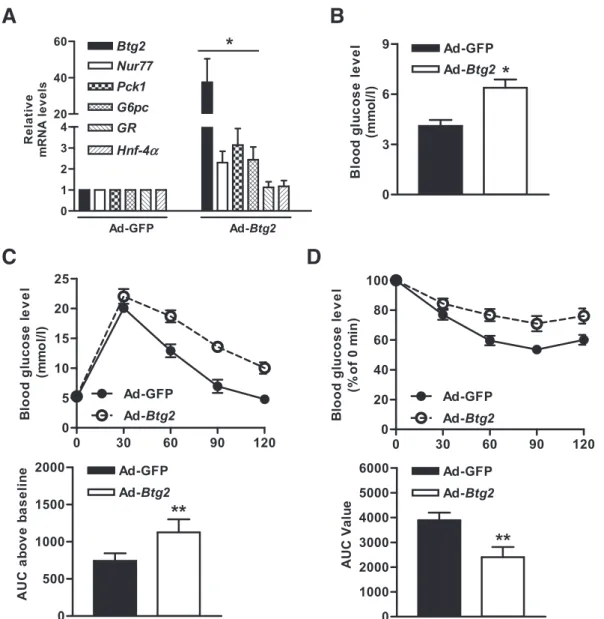
Our findings predict that BTG2 would be involved in the regulation of gluconeogenic genes for hepatic glucose production in liver. To test this hypothesis, we examined the effect of ectopic expression of BTG2 on the tran- scription of hepatic gluconeogenic genes using an Ad vector to drive expression of Btg2 (Ad-Btg2). Indeed, the expressions of Nur77, Pck1, and G6pc were significantly increased by administration of Ad-Btg2 in the liver (Fig.

2A). However, expression of other transcription factors related to gluconeogenesis like GR and Hnf-4a was not affected (Fig. 2A). Moreover, consistent with the expres- sion of gluconeogenic genes, blood glucose level was sig- nificantly increased by Ad-Btg2 (Fig. 2B). To evaluate whether ectopic expression of BTG2 also affects glucose homeostasis and insulin sensitivity, glucose and insulin tolerance tests were performed in the Ad-Btg2–infected mice. As predicted, there was signi ficant impairment in glucose tolerance in mice infected with Ad-Btg2 (Fig. 2C).

The insulin tolerance test also showed a marked decrease in insulin sensitivity (Fig. 2D). Taken together, these results indicate that BTG2 plays a key role in hepatic glucose production and directly influences whole-body glucose metabolism.

Glucagon Signal –Dependent Hepatic Gluconeogenic Gene Expression Is Mediated by BTG2

To determine whether Btg2 was directly regulated by the

fasting hormone glucagon, as shown in Fig. 3A, Btg2

gene expression was overexpressed well by Ad-Btg2, and

(4)

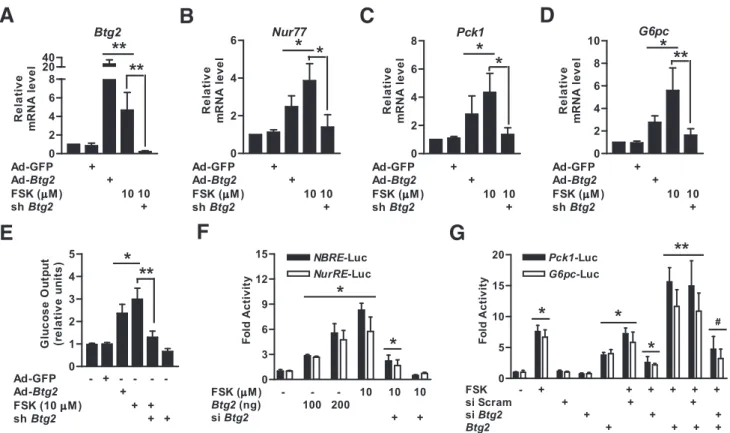
glucagon signaling–induced Btg2 gene expression was suc- cessfully decreased by shBtg2. In addition, forskolin- stimulated gluconeogenic gene expression was significantly reduced by knockdown of endogenous Btg2 in primary hepatocytes (Fig. 3B–D). We also tested whether BTG2 regulates glucose production in primary hepatocytes. Inter- estingly, like forskolin treatment, Ad-Btg2 significantly in- creased hepatic glucose production compared with untreated control and Ad-GFP –infected cells, whereas this effect was attenuated by silencing of Btg2 (Fig. 3E).

Because Nur77 is one transcription factor involved in gluconeogenesis, we hypothesized that BTG2 might function as a coactivator along with Nur77. To test this prediction, luciferase assays were performed with the Nur77 reporter plasmids NBRE-Luc and NurRE-Luc. Btg2 significantly increased reporter activity of both NBRE- and NurRE-mediated transcription in a dose-dependent man- ner (Fig. 3F). Moreover, forskolin did not activate these reporters when Btg2 was suppressed by small interfering Btg2 (siBtg2) (Fig. 3F). Ectopic expression of Btg2 signif- icantly increased promoter activities of the Pck1 and G6pc

(Fig. 3G). Interestingly, forskolin-stimulated promoter ac- tivities of G6pc and Pck1 were significantly decreased when siBtg2 was transfected, and overexpression of Btg2 rescued the promoter activities (Fig. 3G). These results indicate that BTG2 regulates glucagon-mediated gluconeo- genic gene expression. This phenomenon raises an inter- esting possibility that BTG2 may serve as a major player in regulating Nur77-mediated transcription of gluconeogenic genes in liver.

BTG2 Physically Interacts With Nur77 and Mediates Nur77 Occupancy on the G6pc Promoter

Based on our results of the role of BTG2 regulating NBRE- and NurRE-mediated transcription, we observed a physical interaction between BTG2 and Nur77 using a coimmuno- precipitation assay. Flag-Btg2 was coprecipitated with HA- Nur77 (Fig. 4A). In the coimmunoprecipitation assay, endogenous Nur77 was coprecipitated with endogenous BTG2 (Fig. 4B). Collectively, these results demonstrate that BTG2 physically interacts with Nur77 both in vitro and in vivo.

Figure 1 —Effect of fasting and forskolin in the expression of BTG2 in the liver. A: C57BL6 mice (n = 5) were fed ad libitum and fasted for 12 h.

Total RNAs were prepared from the livers of the mice. Btg2 and gluconeogenic gene expression were measured by qPCR. B: Whole-cell

extracts were prepared from mouse livers and then Western blot analysis performed. C and D: qPCR and Western blot of BTG2 and

gluconeogenic pathway genes in mouse primary hepatocytes treated with forskolin (FSK) for the indicated time periods. *P < 0.05 vs. fed

mice or untreated control.

(5)

Next, we investigated whether Btg2 modulates the pro- moter activity of mouse G6pc gene as well as human G6PC gene through Nur77. Like forskolin, overexpression of Nur77 signi ficantly increased the promoter activity of G6pc in a dose-dependent manner and luciferase activity by Btg2 was synergistically increased by cotransfection of the Nur77. Introduction of mutation at the NBRE resulted in a decrease of promoter activity (Fig. 4C and D). To further confirm whether interaction of BTG2 with Nur77 affects the direct DNA binding of Nur77 protein on the promoters of these target genes, a ChIP assay was per- formed. The endogenous binding activity of Nur77 to its proximal region by forskolin treatment was significantly increased by Ad-Btg2 compared with that of control (Fig. 4E and F). However, the nonspecific distal region of the hG6PC and mG6pc promoter was unable to recruit

Nur77 under all conditions (Fig. 4E and F). These re- sults indicate that BTG2 could contribute to the Nur77- dependent regulation of G6pc gene expression via a physical interaction.

BTG2-Mediated Induction of Hepatic Gluconeogenesis Is Mediated by Nur77

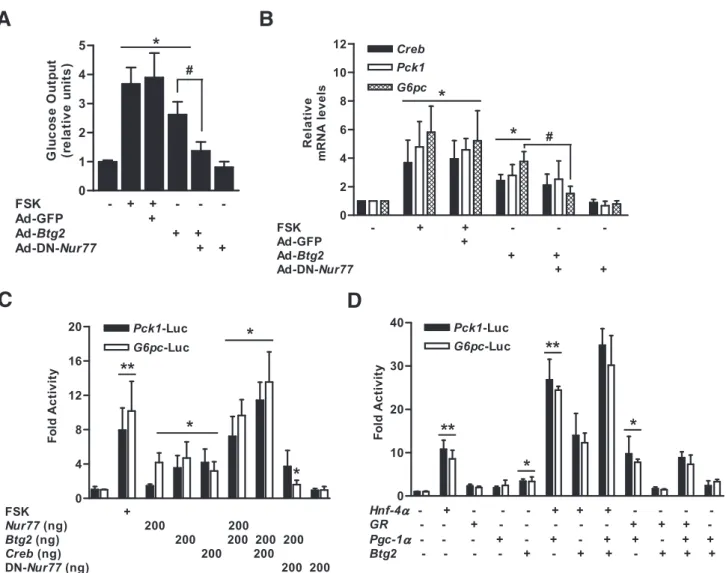
To determine whether the BTG2-induced regulation of hepatic gluconeogenesis is mediated by Nur77, we eval- uated the effect of Nur77 on BTG2-mediated hepatic glucose production and gluconeogenic gene expression in primary hepatocytes. Increased glucose production and gene expression of Creb as well as G6pc by Ad-Btg2 were attenuated by DN-Nur77, but not Pck1 gene expression (Fig. 5A and B). Next, we confirmed whether Nur77 also regulates transcriptional activity of gluconeogenic genes.

Figure 2 —Overexpression of BTG2 resulted in an increase in hepatic gluconeogenesis. A: qPCR of gluconeogenic gene expression. B:

Blood glucose levels from Ad-GFP – and Ad-Btg2–infected mice for 7 days (n = 4–6). C and D: Glucose and insulin tolerance tests from mice

infected with Ad-Btg2 at day 4 intravenously. *P < 0.05; **P < 0.01 vs. Ad-GFP. AUC, area under the curve.

(6)

G6pc and Pck1 promoter activities were synergistically in- creased by Btg2, Nur77, and Creb. It is notable that G6pc promoter activity was decreased by DN-Nur77 (Fig. 5C).

Although Pck1 gene promoter was significantly upregu- lated by Btg2, its promoter activities were not affected by DN-Nur77 (Fig. 5C). Interestingly, while overexpression of Hnf-4a, GR, and Pgc-1a genes significantly increases the promoter activities of Pck1 and G6pc, which is con- sistent with previous reports (4,5,7,9). Remarkably, this stimulatory effect of Btg2 was not synergistically in- creased by cotransfection of the Hnf-4a, GR, and Pgc-1a (Fig. 5D). Thus, it is speculated that BTG2 acts as a coac- tivator upregulating the gluconeogenesis network with Nur77 and CREB (18), whereas it does not act as a crucial coactivator of Hnf-4a, GR, and Pgc-1a. Taken together, these results indicate that BTG2 functions together with Nur77 in the upregulation of gluconeogenesis in the pri- mary hepatocytes.

Expression of Gluconeogenic Genes in Diabetic Models Are Increased by BTG2

Excessive hepatic gluconeogenesis contributes to the fasting hyperglycemia in diabetes (28). To access the func- tional contribution of BTG2 to the increase of hepatic

glucose production in diabetes, streptozotocin-treated and db/db mice were used. qPCR analysis showed that streptozotocin injection strongly induced expression of the Btg2 as well as the Creb, Nur77, Pck1, and G6pc genes in liver (Fig. 6A). Moreover, mRNA levels of Btg2, Creb, Nur77, Pck1, and G6pc are increased in the liver of db/db mice when compared with those of WT mice (Fig. 6B).

These data indicate that BTG2 contributes to elevated gluconeogenesis in diabetes. When db/db mice were infected with shBtg2, Btg2 was significantly reduced in the liver. mRNA levels of Btg2, Creb, Nur77, Pck1, and G6pc were signi ficantly elevated in liver of db/db mice, and these mRNAs were attenuated by shBtg2 (Fig. 6B).

These findings suggest that BTG2 plays a pivotal role in transcriptional regulation of hepatic gluconeogenic genes in diabetic mouse models.

Hepatic Gluconeogenesis in db/db Mice Is Altered by BTG2

Finally, we investigated the crucial role of BTG2 on glucose homeostasis in fasted db/db mice. Administration of shBtg2 to db/db mice resulted in the amelioration of glucose tolerance (Fig. 7A). An insulin tolerance test revealed that db/db mice were significantly improved by

Figure 3 —Induction of hepatic gluconeogenesis by glucagon is BTG2-dependent. A–D: Relative mRNA levels of Btg2 and gluconeogenic

pathway genes in mouse primary hepatocytes infected with Ad-GFP, Ad-Btg2, and lentivirus-shBtg2 (sh Btg2) at a multiplicity of infection

of 60 and then exposed for 3 –6 h in the presence or absence of forskolin (FSK). Total RNAs extracted from hepatocytes were subjected to

qPCR analysis. E: Measurement of hepatic glucose production. A glucose output assay in primary hepatocytes was performed using

glucose-free media supplemented with sodium lactate (20 mmol/L) and sodium pyruvate (1 mmol/L). F and G: AML-12 cells were trans-

fected with siBtg2 and siScram. After transfection for 36 h, cells were cotransfected with the indicated reporter genes and Btg2 and then

treated with FSK for 6 h. *P < 0.05; **P < 0.01 vs. untreated control and/or FSK-treated cells; #P < 0.05 vs. FSK- and siBtg2-exposed cells.

(7)

Figure 4 —Identification of interaction between BTG2 and Nur77. A: Coimmunoprecipitation assays. Flag-Btg2 and HA-Nur77 were trans- fected to AML-12 cells. Cell lysates were precipitated (immunoprecipitation [IP]) with anti-Flag antibody and immunoblotted (IB) with HA antibody. B: Interaction between BTG2 and Nur77 in the liver of mice fasted for 12 h. Liver extracts were precipitated with Nur77 and immunoblotted with anti-BTG2 antibody. C and D: Effect of NurRE mutation on the Nur77-mediated activation of hG6PC and mG6pc promoters. Site-directed mutation was introduced into the hG6PC and mG6pc-NurRE sequence located at 2957/2950 bp and 2416/

2409 bp, respectively. AML-12 cells were cotransfected with wild-type (wt) and mutant (mt) forms of the hG6PC and mG6pc gene

promoter and Nur77. Forskolin (FSK) was used as a positive control. ChIP assay for the recruitment of Nur77 on the hG6PC (E) and

mG6pc (F) gene promoter. Primary hepatocytes were infected with Ad-Btg2 for 36 h and then treated with FSK for 6 h. Cell lysates were

precipitated with anti-Nur77 antibody, and DNA was ampli fied using PCR primers binding to the specific proximal (Pro) and nonspecific

distal (Dis) regions on these gene promoters. The quantity of immunoprecipitated DNA was normalized to input chromatin (10% of

the chromosomal DNA used for immunoprecipitation). *P < 0.05 vs. untreated control or forskolin- and Nur77-treated cells. IgG,

immunoglobulin G.

(8)

shBtg2 (Fig. 7B). In addition, the increase of blood glucose levels in db/db mice was markedly reduced by silencing of Btg2 (Fig. 7C). These results indicate that systemic glucose homeostasis in both physiology and diabetes is mediated by BTG2.

DISCUSSION

Our recent study revealed another physiological function of BTG2, namely hepatic gluconeogenesis in primary hepatocytes (18). BTG2 gene expression was increased during fasting, resulting in elevated transactivity of he- patic gluconeogenic genes. Moreover, the function of BTG2 has not been addressed in metabolic diseases like diabetes. In this study, Nur77 was identified as a new target of BTG2 involved in hepatic gluconeogenesis. The current study demonstrates that BTG2 increases hepatic glucose production through the upregulation of G6pc gene

expression by physical interaction with Nur77 during both fasted and diabetic conditions. Overexpression of Btg2 induced impaired glucose and insulin tolerances dur- ing glucose tolerance testing and insulin tolerance testing in mice. Administration of shBtg2 signi ficantly improved glucose disposal in db/db mice.

Time-sequential expression of the Btg2 gene increased soon after forskolin treatment, with mRNA expression of Creb and Nur77 genes induced concurrently. Finally, both Pck1 and G6pc genes were expressed in primary hepato- cytes (Fig. 1C). Based on these data, we speculate that BTG2 may play a key role in modulation of gluconeogen- esis at the upstream level of glucagon signaling.

A recent study suggested that BTG2 increases Pck1 gene transcription through the induction of CREB in primary hepatocytes (18). CREB is a pivotal regulator of hepatic glucose production during fasting in the liver

Figure 5 —BTG2-mediated hepatic gluconeogenesis is mediated by Nur77. A: Mouse primary hepatocytes were infected with Ad-GFP, Ad- Btg2, and Ad-DN-Nur77 at a multiplicity of infection of 60, and then hepatic glucose output was measured using glucose-free media supplemented with the sodium lactate (20 mmol/L) and sodium pyruvate (1 mmol/L). B: qPCR analysis for expression of Creb and hepatic gluconeogenic genes. Total RNAs were prepared from primary hepatocytes under the same conditions. C and D: AML-12 cells were transiently transfected with Btg2, Nur77, Creb, DN-Nur77, Hnf-4 a, GR, Pgc-1a, and the indicated reporter genes. *P < 0.05, **P < 0.01 vs.

untreated control or individual transfected cells; #P < 0.05 vs. Ad-Btg2. FSK, forskolin.

(9)

through binding to the cis-element of CREB on the target gene promoter. Gluconeogenesis is activated by regula- tion of Pck1 through the interaction of BTG2 and CREB as well as glucagon signaling with cAMP and dexameth- asone (4,12,18). However, even though G6pc gene ex- pression was presently increased by overexpression of Btg2 in primary hepatocytes, the regulatory mechanism by BTG2 has not been clear to explain an increase of G6pc gene expression both in vitro and in vivo. The current study expands upon these findings to show that transcription of G6pc gene is activated by BTG2 through regulation of Nur77 gene expression, which is a novel copartner of BTG2 in the liver during fasted and diabetic conditions.

Nur77 is induced by multiple extracellular signals in a tissue-specific manner. Nur77 is also involved in 3T3- L1 adipogenesis response to cAMP signaling without peroxisome proliferator–activated receptor g agonist (29). In the liver, Nur77 modulates hepatic gene expres- sion (10). Nur77 is also a mediator of cAMP action in the regulation of hepatic glucose metabolism (12). The ex- pression of Nur77 in hepatocytes is increased by cAMP in vitro and by glucagon during fasting in vivo (12). In this study, Nur77 mRNA level was induced by Btg2 over- expression and abolished by its knockdown using shRNA (Fig. 3B). Moreover, Nur77 gene expression was accelerated by Creb in fasted liver, consistent with a previous report (30). These results suggest that Nur77 gene expression is stimulated by the BTG2 –CREB axis during fasting and diabetes. Therefore, Nur77 is not only increased in mRNA expression, but also induces protein interaction with BTG2 to elevate hepatic glucose production.

Pei et al. (12) demonstrated that various genes in- volved in the gluconeogenesis including G6pc, Fbp1, and Fbp2 were upregulated by Nur77, but not Pck1.

Moreover, promoter activity of these genes was in- creased by direct binding of Nur77 (12). In the current study, the Nur77 binding region was confirmed on the

G6pc promoter, and deletion of the Nur77 response ele- ment site abolished BTG2-induced G6pc transcription. In- terestingly, although a Nur77 response cis-element has been not identified on the Pck1 gene promoter, endoge- nous Pck1 gene expression as well as promoter activity was induced by overexpression of Btg2 (Figs. 2A and 3G). Thus, it is speculated that Nur77 directly upregulates the expression of multiple genes involved in glucose me- tabolism, whereas Pck1 may be regulated by Nur77 in an indirect manner both in vitro and in vivo. In addition, a previous study addressed not only BTG2-induced phys- ical interaction with CREB in fasting, but also discovered the binding region of the CREB protein on the Pck1 pro- moter (18). The data indicate that Pck1 gene expression might be induced by BTG2 through CREB, not Nur77, in liver during fasting and in diabetes. Administration of shBtg2 into db/db mice ameliorated blood glucose levels by inhibiting Pck1 and G6pc gene expression via decrease of Nur77 and CREB. In addition, gene silencing of Btg2 by lenti-shRNA significantly improved both glucose and insu- lin tolerance in db/db mice. These findings in vivo are consistent with our previous study that reported the function of BTG2 in vitro (18). Although the physiolog- ical role of BTG2 has been verified in diabetic mouse model, the role of BTG2 still needs to validate among human samples to develop as a new therapeutic agent in diabetes.

In conclusion, the current study demonstrates that Nur77 is a novel target of BTG2 and BTG2 regulates hepatic glucose production through Nur77-mediated G6pc gene expression. We characterized the role of BTG2 as a novel transcriptional coactivator of hepatic gluconeo- genesis in vivo and elucidated the molecular mechanism of regulation of glucose homeostasis mediated by a link of BTG2 and Nur77 as a key regulator of gluconeogenesis.

Moreover, disruption of BTG2 ameliorates glucose dis- posal and insulin resistance in diabetic animal model.

Thus, as we depict in the novel schematic model shown in Fig. 7D, regulation of BTG2 may offer an effective

Figure 6 —BTG2 regulates gluconeogenic gene expression in diabetic mouse models. qPCR analysis of Btg2 and gluconeogenic genes

from streptozotocin (STZ)-induced (80 mg/kg) diabetic mice (n = 4 –6) (A) and db/db mice (B). At 7 days after shRNA administration, total

RNA was extracted from 12-h fasted livers. *P < 0.05 vs. control or WT mice; **P < 0.01 vs. db/db mice. Con, control.

(10)

means to control hepatic glucose homeostasis in diabetes and may guide the development of novel therapeutic target for metabolic diseases like diabetes.

Acknowledgments. The authors thank Dr. Yong-Ho Ahn (Yonsei Univer- sity College of Medicine) and Dr. Timothy F. Osborne (Sanford-Burnham Medical Research Institute) for helpful discussions and thank Dr. Hye-Young Seo (Keimyung University School of Medicine) for excellent technical suggestions.

Funding. This study was supported by a grant from the Korea Health Tech- nology R&D Project, Ministry of Health and Welfare, Republic of Korea (A120864) and by a Keimyung University Medical School Research Promoting Grant launched in 2013 (to S.-S.I.).

Duality of Interest. No potential con flicts of interest relevant to this article were reported.

Author Contributions. Y.D.K. contributed to the conception, design, and performance of experiments; analysis and interpretation of data; and writing the draft. S.-G.K. and S.-L.H. contributed to the design and analysis Figure 7 —Disruption of BTG2 improves glucose homeostasis in diabetic mice. A and B: Blood glucose profiles of glucose and insulin tolerance tests at day 4 after shBtg2 infection. The respective area under the curve (AUC) values for glucose and insulin tolerance tests were represented. C: Blood glucose levels measured 7 days after shBtg2 infection. Blood was withdrawn from fasted mice (n = 5 –10). D:

Scheme of the role of BTG2 in the regulation of glucose homeostasis. In the fasting and diabetic states, G6pc gene expression is induced

by BTG2-Nur77 as well as BTG2 transcription factors (TFs) and a coactivator signaling system for which the mechanism involves either

upregulation of Nur77 or TF occupancy on its promoter. *P < 0.05; **P < 0.01; ***P < 0.001 vs. WT or db/db mice. PKA, protein kinase A.

(11)

and interpretation of experimental results. H.-S.C. and J.-H.B. contributed to the analysis and interpretation of data and critical review of the manuscript. D.-K.S.

and S.-S.I. contributed to the conception and design of the experiments, wrote the manuscript, and performed the critical review of the manuscript. D.-K.S. and S.-S.I. are the guarantors of this work and, as such, had full access to all the data in the study and take responsibility for the integrity of the data and the accuracy of the data analysis.

References

1. Shao J, Qiao L, Janssen RC, Pagliassotti M, Friedman JE. Chronic hyper- glycemia enhances PEPCK gene expression and hepatocellular glucose pro- duction via elevated liver activating protein/liver inhibitory protein ratio. Diabetes 2005;54:976 –984

2. Vidal-Puig A, O ’Rahilly S. Metabolism. Controlling the glucose factory. Na- ture 2001;413:125 –126

3. Pilkis SJ, Granner DK. Molecular physiology of the regulation of hepatic gluconeogenesis and glycolysis. Annu Rev Physiol 1992;54:885 –909

4. Herzig S, Long F, Jhala US, et al. CREB regulates hepatic gluconeogenesis through the coactivator PGC-1. Nature 2001;413:179 –183

5. Yoon JC, Puigserver P, Chen G, et al. Control of hepatic gluconeogenesis through the transcriptional coactivator PGC-1. Nature 2001;413:131 –138

6. Koo SH, Flechner L, Qi L, et al. The CREB coactivator TORC2 is a key regulator of fasting glucose metabolism. Nature 2005;437:1109 –1111

7. Rhee J, Inoue Y, Yoon JC, et al. Regulation of hepatic fasting response by PPARgamma coactivator-1alpha (PGC-1): requirement for hepatocyte nuclear factor 4alpha in gluconeogenesis. Proc Natl Acad Sci U S A 2003;100:4012 –4017

8. Zhang L, Rubins NE, Ahima RS, Greenbaum LE, Kaestner KH. Foxa2 in- tegrates the transcriptional response of the hepatocyte to fasting. Cell Metab 2005;2:141 –148

9. Puigserver P, Rhee J, Donovan J, et al. Insulin-regulated hepatic gluco- neogenesis through FOXO1-PGC-1alpha interaction. Nature 2003;423:550 –555 10. Berriel Diaz M, Lemke U, Herzig S. Discovering orphans ’ sweet secret:

NR4A receptors and hepatic glucose production. Cell Metab 2006;4:339 –340 11. Mayr B, Montminy M. Transcriptional regulation by the phosphorylation- dependent factor CREB. Nat Rev Mol Cell Biol 2001;2:599 –609

12. Pei L, Waki H, Vaitheesvaran B, Wilpitz DC, Kurland IJ, Tontonoz P. NR4A orphan nuclear receptors are transcriptional regulators of hepatic glucose me- tabolism. Nat Med 2006;12:1048 –1055

13. Song KH, Lee K, Choi HS. Endocrine disrupter bisphenol a induces orphan nuclear receptor Nur77 gene expression and steroidogenesis in mouse testicular Leydig cells. Endocrinology 2002;143:2208 –2215

14. Chao LC, Wroblewski K, Zhang Z, et al. Insulin resistance and altered sys- temic glucose metabolism in mice lacking Nur77. Diabetes 2009;58:2788 –2796 15. Matsuda S, Rouault J, Magaud J, Berthet C. In search of a function for the TIS21/PC3/BTG1/TOB family. FEBS Lett 2001;497:67 –72

16. Bradbury A, Possenti R, Shooter EM, Tirone F. Molecular cloning of PC3, a putatively secreted protein whose mRNA is induced by nerve growth factor and depolarization. Proc Natl Acad Sci U S A 1991;88:3353 –3357

17. Fletcher BS, Lim RW, Varnum BC, Kujubu DA, Koski RA, Herschman HR.

Structure and expression of TIS21, a primary response gene induced by growth factors and tumor promoters. J Biol Chem 1991;266:14511 –14518

18. Hwang SL, Kwon O, Lee SJ, Roh SS, Kim YD, Choi JH. B-cell translocation gene-2 increases hepatic gluconeogenesis via induction of CREB. Biochem Biophys Res Commun 2012;427:801 –805

19. Kim YD, Kim YH, Cho YM, et al. Metformin ameliorates IL-6-induced hepatic insulin resistance via induction of orphan nuclear receptor small heterodimer partner (SHP) in mouse models. Diabetologia 2012;55:1482 –1494

20. Lim IK. TIS21 (/BTG2/PC3) as a link between ageing and cancer: cell cycle regulator and endogenous cell death molecule. J Cancer Res Clin Oncol 2006;

132:417 –426

21. Nedumaran B, Hong S, Xie YB, et al. DAX-1 acts as a novel corepressor of orphan nuclear receptor HNF4alpha and negatively regulates gluconeogenic enzyme gene expression. J Biol Chem 2009;284:27511 –27523

22. Park TJ, Kim JY, Oh SP, et al. TIS21 negatively regulates hepatocarcino- genesis by disruption of cyclin B1-Forkhead box M1 regulation loop. Hepatology 2008;47:1533 –1543

23. Xie YB, Park JH, Kim DK, et al. Transcriptional corepressor SMILE recruits SIRT1 to inhibit nuclear receptor estrogen receptor-related receptor gamma transactivation. J Biol Chem 2009;284:28762 –28774

24. Kim YD, Park KG, Lee YS, et al. Metformin inhibits hepatic gluconeogenesis through AMP-activated protein kinase-dependent regulation of the orphan nu- clear receptor SHP. Diabetes 2008;57:306 –314

25. Im SS, Kang SY, Kim SY, et al. Glucose-stimulated upregulation of GLUT2 gene is mediated by sterol response element-binding protein-1c in the hep- atocytes. Diabetes 2005;54:1684 –1691

26. Im SS, Yousef L, Blaschitz C, et al. Linking lipid metabolism to the innate immune response in macrophages through sterol regulatory element binding protein-1a. Cell Metab 2011;13:540 –549

27. Lee JM, Seo WY, Song KH, et al. AMPK-dependent repression of hepatic gluconeogenesis via disruption of CREB.CRTC2 complex by orphan nuclear re- ceptor small heterodimer partner. J Biol Chem 2010;285:32182 –32191 28. Gastaldelli A, Baldi S, Pettiti M, et al. In fluence of obesity and type 2 di- abetes on gluconeogenesis and glucose output in humans: a quantitative study.

Diabetes 2000;49:1367 –1373

29. Chao LC, Bensinger SJ, Villanueva CJ, Wroblewski K, Tontonoz P. Inhibition of adipocyte differentiation by Nur77, Nurr1, and Nor1. Mol Endocrinol 2008;22:

2596 –2608

30. Ohkubo T, Sugawara Y, Sasaki K, Maruyama K, Ohkura N, Makuuchi M.

Early induction of nerve growth factor-induced genes after liver resection-

reperfusion injury. J Hepatol 2002;36:210 –217

수치

Figure 1 —Effect of fasting and forskolin in the expression of BTG2 in the liver. A: C57BL6 mice (n = 5) were fed ad libitum and fasted for 12 h.
Figure 2 —Overexpression of BTG2 resulted in an increase in hepatic gluconeogenesis. A: qPCR of gluconeogenic gene expression
Figure 3 —Induction of hepatic gluconeogenesis by glucagon is BTG2-dependent. A–D: Relative mRNA levels of Btg2 and gluconeogenic pathway genes in mouse primary hepatocytes infected with Ad-GFP, Ad-Btg2, and lentivirus-shBtg2 (sh Btg2) at a multiplicity of
Figure 4 —Identification of interaction between BTG2 and Nur77. A: Coimmunoprecipitation assays
+3

참조

관련 문서

Glutamate excitotoxicity induced by excessive activation of NMDA receptor causes various damage to cells, which leads to cell death.. In previous studies, increased ROS

• Theory can extent to molten polymers and concentrated solutions.. The single-molecule bead spring models.. a)

Moreover, we found that treatment of HSC with resveratrol increased Lipin1 expression and inhibited TGF- b-activated fibrogenic gene expression via Lipin1 regulation,

This study supports that flavonoids present in PCE has anti-adipogenic and anti- diabetic effects by activating AMPK and normalizing the expression of

The associations of hepatic steatosis and fibrosis using fatty liver index and BARD score with cardiovascular outcomes and mortality in patients with new‑onset type 2

b Network representation of enriched Gene Ontology (GO) biological processes, enriched in HFD‑fed mice treated with B. bifidum_MG731 compared to HFD‑fed mice treated with

iMSC‑EVs decreased itching, which was supported by reduced inflammatory cell infiltration and mast cells in AD mouse skin; reduced IgE receptor expression and

(D) RORa ChIP-qPCR analysis of the Rorc(t) + 11 kb locus with ectopic over-expression (OE) of Tbx21 in in vitro polarized mouse Th17 cells, followed by ChIP with rabbit