Correlations Between Parenting Stress and Adolescents’ Depression, Coping Responses, and Self-Concept
Kyung Mi Sung
1,21Department of Nursing, College of Nursing, Gyeongsang National University, Professor
2Department of Gyeongsang Institute of Health Sciences, Committee member
부모의 양육스트레스와 청소년 자녀의 우울, 대응기전, 자아개념 간의 상관관계
성경미1,2
1경상대학교 간호대학 교수, 2건강과학연구원 위원
Abstract This descriptive study aimed to explore the correlations between mothers’ parenting stress and adolescents’
coping responses, depression, and self-concept. Methods: Participants were 320 adolescents and their parents. The adolescents completed Self-concept Scale, Coping Responses, and Depression Scale-2, and their parents completed Parenting Stress Scale. Results: The adolescents used approach coping frequently and their depression was 54.87(±14.06). However, adolescents’ approach coping and overall self-concept were negatively correlated with parenting stress, and were significantly correlated with parenting stress in both mothers and fathers including depression. Mothers’ and fathers’ mean parenting stress scores and patterns were similar, but relationship patterns for parenting stress and adolescents’ Seeking Guidance subscale scores differed between mothers and fathers. Conclusion:
These findings could be useful in supporting school-based mental health services for adolescents, through the development of parenting roles.
Key Words : parenting, adolescent, depression, coping, self-concept
요 약 본 연구는 양육스트레스와 청소년 자녀의 대응기전, 우울, 및 자아개념 간의 상관관계를 파악한 연구이다. 자료 수집은 청소년(n=320)과 이들의 부모를 대상으로 실시하였으며 청소년 대상으로 자아개념, 대응기전, 우울도구를 사용하고 부모를 대상으로 양육스트레스 도구를 사용하였다. 연구결과 청소년은 적극적 대응을 많이 사용하였고, 우울은 평균 54.87(±14.06)점이었다. 청소년의 적극적 대응과 자아개념은 모두 양육스트레스와 부적 상관관계가 있는 것으로 나타났으며 청소년의 우울을 포함하여 어머니와 아버지 각각의 양육스트레스와도 유의한 상관관계를 보였다. 어머니와 아버지의 양육 스트레스는 비슷한 수준이었으나, 청소년 자녀의 도움추구 대응과 어머니 혹은 아버지의 양육스트레스와의 관계에서는 다 른 양상을 보였다. 이상의 연구결과는 부모역할개발을 위한 학교기반 정신건강서비스에 유용한 기초자료가 될 것이다.
주제어 : 양육, 청소년, 우울, 대응기전, 자아개념
*Corresponding Author : Kyung Mi Sung([email protected]) Received January 29, 2019
Accepted April 20, 2019
Revised March 14, 2019 Published April 28, 2019
1. Introduction
1.1 Background
Most parents with adolescent children face various challenges in the parent-adolescent relationship, because of developmental changes in both individuals [1]. In addition, parenting stress affects the quality of parent-adolescent relationships, and previous research has shown that close, mutually supportive parent-adolescent relationships were associated with lower levels of parenting stress [2]. Therefore, parenting stress should be explained using varied and detailed information about the history of parents’ or adolescents’ growth and development.
Some studies have consistently shown a strong association between adolescents’ mental health and parenting stress. For example, Abraham and Christopherson [3] showed that perceived competence in middle school children was associated with parenting styles, and parental support was significantly positively correlated with high levels of perceived competence.
The results of these studies indicate that positive parental behaviors are associated with a competent view of the self in children. In the results of the meta analysis study, depression of adolescents was negatively associated with self-esteem and functional parenting attitudes [4]. And the positive parenting style made a positive effect on self-efficacy, and reduced children’s stress and depression, eventually affected their school adjustment positively [5]. However, additional research is required to verify this assumption. Most previous research has reported relationships between different parenting styles and various types of behavior in adolescents [6-8].
Generally, mothers with high levels of parenting stress have been found to perceive their children’s behavioras problematic, but the causality in this relationship remains unclear [9]. Furthermore, McClun and Merrell [8] reported that poor self-concept was strongly associated with maladaptive social and emotional behavior and low academic achievement. In addition,
Lee and Kim [10] identified self-concept as one of the factors influencing mental health status, and Lee [11]
reported that parenting stress was negatively correlated with children’s self-concept. Moreover, parenting stress has been found to exert negative effects on the formation of mothers’ attachment to their children [12], and psychosocial adaptation in adolescents [13]. Chung [14] also reported that there is significant relationship between family stress and adolescent’ scoping. Lee and Choi [15] suggest that the risk factors of the family environment not only exert direct in fluence on the problem behaviors of early adolescents, they also have indirect influences on the problem behaviors of early adolescents by way of the mediation of ego resilience. Also, child’s ego strength also mediated the relationship between affectionate or hostile parenting attitudes and the pursuit of social support coping style. Therefore, it is necessary to expand good parenting education according to the stages of development for children so that parents can acquire more desirable parenting attitudes [16].
However, few studies have examined the relationship between parental behavior and adolescents’
self-concept. Therefore, this research demonstrated relationships between parenting and psychological factors, such as locus of control, life satisfaction, and self-concept, in adolescents, to our knowledge, associations between parenting stress and adolescents’
mental health have not been examined in previous research.
1.2 Purpose
we aimed to explore the correlations between parenting stress and adolescents’ coping responses, depression, and self-concept in the current study.
2. Methods 2.1 Study design
We conducted a descriptive study to examine the
correlations between parenting stress and adolescents’
coping responses, depression, and self-concept.
2.2 Participants and Procedure
Ethical approval for the study was granted by the institutional review board for human subjects at the institution with which the authors were affiliated. The research team obtained approval for data collection from each three school principles. The research team sent consent forms to students’ homes, for both the students and their parents to sign, and obtained consent from all participants’ parents. The sample size was calculated to be 319 students and their parents using G*power 3.1 for bivariate correlation analysis with a power of .95, correlation ρ H1 of 0.2. We increased the number of subjects by 5% (16 persons) to account for potential dropout. We surveyed 335 adolescents who were in Grades 8–10 in three urban middle-high schools in South Korea in 2014–2015, to participate in the study. The adolescents’ parents (N = 652) also participated in the study by mail survey. A total of 954 subjects were included. Of the 326 participants, six adolescents’ parents had passed away or left home;
therefore, 320 adolescents and their parents (N = 634) were included in the final analysis.
2.3 Measurements
2.3.1 Parenting StressThe Adolescent Parenting Stress Scale to measure parenting stress consists of 51 items divided between three subscales: Adolescent Domain, Parent Domain, and Adolescent-Parent Relationship Domain [20].
Cronbach’s α for the scale was .93.
2.3.2 Depression
We used the Korean version of the Reynolds Adolescent Depression Scale 2nd Edition [19], which is a self-report measure of depressive symptomatology developed specifically for use with adolescents, to measure adolescents’ depression. The scale consists of 30 items divided between four sub-scales: Dysphoric
Mood, Anhedonia/Negative Affect, Negative Self-Evaluation, and Somatic Complaints. Responses are provided using a four-point Likert scale ranging from 1 (almost never) to 4 (most of the time), and higher scores indicate depressed mood of greater severity. Reynolds [19]
identified a cutoff score of 76 to identify adolescents with depressive symptomatology. The scale was approved for use with Korean populations in 2009 [17].
Cronbach’s α for the scale was .93, and test-retest reliability for the subscales ranged from .77 to .84.
2.3.3 Coping Response
Coping Response Inventory-Youth [18] used to measure adolescents’ coping responses. The scale consists of 48 items divided between four approach-coping sub-scales (Logical Analysis, Positive Reappraisal, Seeking Guidance and Support, and Problem Solving) and four avoidance-coping sub-scales (Cognitive Avoidance, Acceptance/Resignation, Seeking Alternative Rewards, and Emotional Discharge), which measure cognitive and behavioral efforts to cope with various stressful life events in adolescents aged between 12 and 18 years. Responses are provided using a four-point Likert scale ranging from 1 (not at all) to 4 (fairly often), and higher scores indicate more frequent use of the corresponding coping strategies. The scale was approved for use with Korean populations in 2009.
Cronbach’s αs for the subscales ranged from .69 to .79.
2.3.4 Self-concept
The Korean version of the Self-concept Scale [17] is a self-report questionnaire to measure adolescents’
self-concept. The scale consists of 80 items divided between four subscales: Physical Self-Concept, which is affected by direct and indirect feedback regarding physical attributes; Emotional Self-Concept, which is affected by others’ responses to one’s behavior; Social Self-Concept, which is affected by others’ reactions to one’s competence in social activities and interpersonal relationships; and Academic Self-Concept, which involves self-recognition of individual achievements related to schoolwork. The scale was developed as a
self-evaluation instrument, to measure self-concept in children and adolescents. Cronbach’s αs for the subscales ranged from .90 to .95, and Cronbach’s α for the overall scale was .97.
2.4 Data Analysis
We used SPSS (version 18.0, SPSS Inc., Chicago, IL) to perform all data analyses. We calculated descriptive statistics to examine parenting stress and adolescents’
coping responses, self-concept, and depression. In addition, we performed bivariate correlation analysis to examine the associations between parenting stress and adolescents’ self-concept, depression, and coping.
3. Results
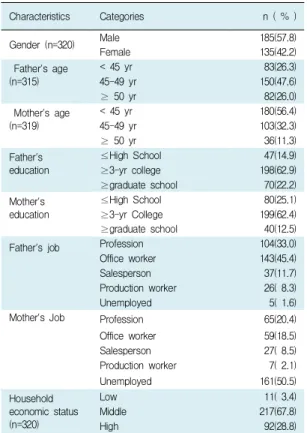
As described in Table 1, most mothers and fathers were younger than 45 and 50 years of age. Most fathers were office workers (44.7%) or professionals (32.6%), and most mothers were homemakers (50.6%).
The proportions of participants of middle, high, and low household economic status were 67.8%, 28.8%, and 3.4%, respectively.
3.1 Adolescents’ Depression, Coping Responses, and Self-Concept
The results regarding adolescents’ depression, coping responses, and self-concept are displayed in Table 2. The adolescents’ mean depression score was 54.87 (SD=14.06). Only twelve adolescents (3.7%) reported depression levels above the cutoff point suggested by Reynolds (2002). They used approach coping more frequently relative to avoidance coping.
The Logical Analysis subscale score was highest (M=10.87, SD=3.21) and the Acceptance/Resignation subscale score was lowest (M=6.65, SD=3.13). In these adolescents, the Social Self-Concept score was highest (M=48.74, SD=5.88), and the Academic Self-Concept subscale score was lowest (M=43.38, SD=5.86); in addition, their mean overall self-concept score was
185.07 (SD=21.12). The mean overall parenting stress score was 101.13 (SD=5.92), and mothers’ (M=100.74, SD=5.06) and fathers’ (M=100.87, SD=5.51) scores were similar.
Characteristics Categories n ( % )
Gender (n=320) Male 185(57.8)
Female 135(42.2)
Father's age (n=315)
< 45 yr 83(26.3)
45-49 yr 150(47.6)
≥ 50 yr 82(26.0)
Mother's age (n=319)
< 45 yr 180(56.4)
45-49 yr 103(32.3)
≥ 50 yr 36(11.3)
Father's education
≤High School 47(14.9)
≥3-yr college 198(62.9)
≥graduate school 70(22.2)
Mother's education
≤High School 80(25.1)
≥3-yr College 199(62.4)
≥graduate school 40(12.5)
Father's job Profession 104(33.0)
Office worker 143(45.4)
Salesperson 37(11.7)
Production worker 26( 8.3)
Unemployed 5( 1.6)
Mother's Job Profession 65(20.4)
Office worker 59(18.5)
Salesperson 27( 8.5)
Production worker 7( 2.1)
Unemployed 161(50.5)
Household economic status (n=320)
Low 11( 3.4)
Middle 217(67.8)
High 92(28.8)
Adolescents: n=320; Parents: n=634
Table 1. Subjects’ General Characteristics (N=954)
3.2 Correlations Between Parenting Stress and Adolescent’s Depression, Coping Responses, and Self-Concept
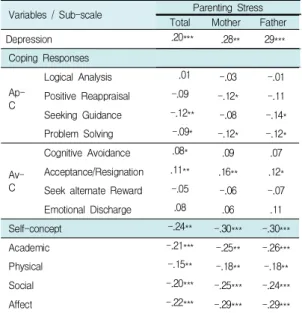
Pearson’s correlation coefficients for the associations between parenting stress and adolescents’ depression, coping responses, and self-concept are presented in Table 3. Parenting stress was strongly correlated with adolescents’ depressive symptoms (r=.20, p<.001). In addition, overall parenting stress was positively correlated with two avoidance-coping strategies (cognitive avoidance: r=.08, p<.05; acceptance/
resignation: r=.11, p<.01) and negatively correlated with two approach-coping strategies (seeking
guidance: r=-.12, p<.01; problem solving: r=-.09, p<.05) and overall self-concept (r=-.24, p<.001). Moreover, all aspects of adolescents’ self-concept were strongly negatively correlated with parenting stress. Mothers’
and fathers’ mean parenting stress scores and patterns were similar (see Table 4). However, relationship patterns for parenting stress and adolescents’ coping subscale scores for seeking guidance and positive reappraisal differed between mothers and fathers.
4. Discussion
In this study, we examined the correlations between parenting stress and adolescents’ coping responses, depression, and self-concept. The results showed that parenting stress was significantly positively correlated with adolescents’ avoidance coping and depressive symptoms; however, it was significantly negatively correlated with adolescents’ approach coping and self-concept. These findings support those of previous studies. Harsh parenting has been shown to intensify adolescents’ emotional dysregulation, which increased the likelihood of Internet addiction through parent-child conflict [21]. Narusyte et al [22] reported that maternal criticism occurred primarily because of evocative attitudes resulting from their adolescents’ externalizing behavior, and fathers’ critical remarks tended to affect adolescents’ problem behavior directly in an environmental context. The researchers also strongly recommended that adolescents whose parents used an authoritarian parenting style exhibited the most extreme orientation toward an external locus of control and the most negative self-concept.
Our main results indicated that adolescents with parents who experienced high stress levels exhibited a higher number of avoidant coping responses, higher depression levels, and stronger negative self-concepts relative to those of adolescents with parents who experienced lower stress levels. The finding indicating that many of the adolescents’ mental health variables
Variables Sub-scale Mean SD
Depression 54.87 14.06
Coping Responses
Approach coping
Logical Analysis 10.87 3.21
Positive Reappraisal 10.66 3.26
Seeking Guidance 8.67 4.01
Problem Solving 10.32 3.30
Avoidance coping
Cognitive Avoidance 9.44 3.38
Acceptance/Resignation 6.65 3.13 Seek alternate Rewards 9.25 3.44
Emotional Discharge 7.46 3.30
Self-concept 185.07 21.12
Academic 43.38 5.86
Physical 44.76 6.11
Social 48.74 5.88
Affect 48.20 8.19
Parenting Stress
Mother
Adolescent domain 29.29 5.28
Parent domain 42.20 5.80
A-P Relationship domain* 29.25 4.95
Total 100.74 5.06
Father
Adolescent domain 29.28 5.30
Parent domain 41.07 6.20
A-P Relationship domain* 30.52 4.73
Total 100.87 5.51
Total
Adolescent domain 29.28 5.12
Parent domain 42.00 6.10
A-P Relationship domain* 29.85 6.65
Total 101.13 5.92
Adolescents: n=320; Parents: n=634
*A-P: Adolescent-Parent
Table 2. The level of study variables (N=954)
Variables / Sub-scale Parenting Stress Total Mother Father
Depression .20*** .28** 29***
Coping Responses
Ap- C
Logical Analysis .01 -.03 -.01
Positive Reappraisal -.09 -.12* -.11
Seeking Guidance -.12** -.08 -.14*
Problem Solving -.09* -.12* -.12*
Av- C
Cognitive Avoidance .08* .09 .07
Acceptance/Resignation .11** .16** .12*
Seek alternate Reward -.05 -.06 -.07
Emotional Discharge .08 .06 .11
Self-concept -.24** -.30*** -.30***
Academic -.21*** -.25** -.26***
Physical -.15** -.18** -.18**
Social -.20*** -.25*** -.24***
Affect -.22*** -.29*** -.29***
Note: *p < .05, **p < .01, ***p < .001 (two-tailed); Ap-C: Approach coping; Av-C: Avoidance coping
Table 3. Pearson’s correlations of the study variables (N=954)
were strongly correlated with parents’ stress levels is interesting. Similarly, some studies have reported that punitive parenting and high levels of parenting stress were associated with the perpetration of bullying [23-25] and victimization in children [24,25]. In our study, mothers’ and fathers’ parenting stress patterns were similar; however, the patterns of the relationships between parenting stress and adolescents’ approach coping differed between mothers and fathers. Maternal parenting stress has been associated with negative outcomes for children, attesting to the broader significance of such problems [26]. In the current study, mothers’ parenting stress was negatively associated with positive reappraisal, among the approach coping skills, in their children. In addition, only fathers’
parenting stress was significantly negatively correlated with their children seeking guidance. Thus far, there has been little information available to explain the difference in the effects of maternal and paternal parenting stress. Future studies should focus on this difference, because help-seeking behavior in adolescents could be a pathway to the future use of services for certain problems [27]. VanDoorn et al [1]reported that adolescents and their parents discontinued their use of conflict resolution in early adolescence in favor of horizontal, symmetrical relationships in middle adolescence, as indicated by changes in both positive problem solving and conflict engagement. Therefore, parenting stress could disrupt the development of child-parent relationships. Indeed, Patterson’s [28] model posited that parenting behavior affected children’s behavior such as that involved in determining antisocial tendencies and aggression.
However, parenting behavior and child adjustment are influenced by sociological, environmental, behavioral, and developmental variables, which are included in the model of relationships between parent and child behaviors [29]. According to a systematic review conducted by Moon and Kim [30], protective variables related to adolescents’ suicidal ideation were predominantly psychological factors such as self-esteem. Further,
parenting behavior in the context of family environmental factors has also been identified as an influential protective variable related to adolescents’
suicidal ideation. Another important finding in our study was that significant relationships between avoidance coping and depression and self-concept were observed in adolescents. The magnitude of the strength of the negative and positive correlations between these measures was high and indicated that avoidance coping in adolescents was associated with greater depression severity and negative self-concept in most sub-scales.
Although the findings provided some interesting and potentially important new evidence regarding the relationship between parenting stress and adolescents’
mental health, the study was subject to some limitations that could reduce the generalizability of the findings, which should be considered carefully. The main limitation of the study was that adolescents’ and parents’ variables were assessed using only self-report questionnaires, which are known to involve response bias. Further studies examining the relationship between parenting stress and adolescents’ mental health using different methods are required, to inform the development of standard guidelines for comprehensive adolescent mental health care that includes parental involvement, and encourage school nurses to implement a network of programs involving schools and family members, as a means of improving adolescents’ mental health and reduce parenting stress.
5. Conclusion
In this study, we aimed to explore correlations between parenting stress and adolescents’ coping responses, depression, and self-concept. All self-concept types of adolescents were strongly negatively correlated with parenting stress. And Depression, coping responses, and self-concept in adolescents were significantly correlated with parenting stress in both mothers and fathers. Especially, this
study results showed that adolescents with parents who experienced high stress levels exhibited a higher number of avoidant coping responses, higher depression levels, and stronger negative self-concepts relative to those of adolescents with parents who experienced lower stress levels. The finding indicating that many of the adolescents’ mental health variables were strongly correlated with parents’ stress levels is interesting. The findings provide basic data regarding parenting stress and adolescents’ coping responses, depression, and self-concept, which could be useful in supporting adolescents' mental health services through the development of parenting roles.
REFERENCES
[1] M. D. VanDoorn, S. J. T. Branje & W. H. J. Meeus.
(2011). Developmental changes in conflict resolution styles in parent-adolescent relationships: A four-wave longitudinal study. Journal of Youth and Adolescence, 40(1), 97-107. DOI : 10.1007/s10964-010-9516-7 [2] A. Josh & B. J. Gutierrez. (2006). Parenting stress in
parents of Hispanic adolescents. North American Journal of Psychology, 8(2), 209-216.
[3] K. G. Abraham & V. A. (1984). Perceived competence among rural middle school children: Parental antecedents and relation to locus of control. The Journal of Early Adolescence, 4(4), 343-351.
DOI : 10.1177/0272431684044005
[4] S. Kim, H. Ko, S. Park & E. Yang. (2012). Factors related to depression of children and adolescents in the South Korea: A meta analysis. Korean Journal of Culture and Social Issues, 18(4), 533-555.
[5] S. N. Seo, S. G. Lee & S. H. Lim. (2012). The effect of positive parenting style, self-efficacy, stress, and depression on school adjustment of adolescents. Journal of Digital Convergence, 10(8), 327-333.
[6] A. Abubakar, F. Van de Vijver, A. O. Suryani, P.
Handayani, & W. S. Pandia. (2015). Perceptions of parenting styles and their associations with mental health and life satisfaction among urban Indonesian adolescents. Journal of Child Family Study, 24(9), 2680-2692.
DOI : 10.1007/s10826-014-0070-x
[7] D. Baumrind. (1991). The influence of parenting style on adolescent competence and substance use. Journal of Early Adolescence, 11(1), 56–95.
[8] L. A. McClun & K. W. Merrell. (1998). Relationship of perceived parenting styles, locus of control orientation, and self-concept among junior high age students.
Psychology in the Schools, 35(4), 381-390.
[9] B. D. Liles et al. (2012). Perceived child behavior problems, parenting stress, and maternal depressive symptoms among prenatal methamphetamine users.
Child Psychiatry and Human Development, 43(6), 943-957. DOI : 10.1007/s10578-012-0305-2
[10] H. J. Lee & H. K. Kim. (2012). Factors influencing mental health among late school age children. The Journal of Korean Academic Society of Nursing Education, 18(2), 149-158.
DOI ; 10.5977/jkasne.2012.18.1.149
[11] M. R. Lee. (2013). A study on the influencing factors of mother`s parenting stress with the context of multicultural families. Korea Journal of Child Studies, 34(4), 143-162.
DOI : 10.5723/KJCS.2013.34.4.143
[12] J. Y. Noh, H. S. (2012). The effects of mothers' parenting stress and parental satisfaction on attachment formation with their children. Korean Living Science Association, 21(2), 27-40.
DOI : 10.5934/KJHE.2011.21.1.27
[13] S. Y. Soh, J. Y. Ahn, D. H. Yang & K. M. Kim. (2014).
Parental and adolescent perceptions of transitions during early adolescence: With a focus on the FGI of adolescents and parents. The Korean Journal of Youth Counseling, 22(1), 247-279.
[14] H. S. Chung. (1993). Family Stress and Coping in Early-adolescence (Middle School Students). Journal of Korean Public Health Nursing, 7(2), 89-97.
[15] S. O. Lee & Y. H. Choi. (2014). Influences of family environment risk factors and ego resilience on the early adolescents’ problem behaviors. Journal of Korean Public Health Nursing, 28(3), 484-494. DOI : 10.5932/JKPHN.2014.28.3.484
[16] B. Cho & S. Ahn. (2017). The mediating effects of ego-resilience on the association between parenting attitudes as perceived by adolescents and stress copying styles. Studies on Korean Youth, 28(4), 225-253.
[17] K. M. Sung. (2012). Development of a self-evaluation scale to measure self-concept for children and adolescents. Journal of Korean Academy of Psychiatric and Mental Health Nursing, 21(4), 292-302.
[18] R. H. Moos. (1993). Professional Manual for Coping Responses Inventory-Youth Form. Odessa, FL:
Psychological Assessment Resources.
[19] W. Reynolds. (2002). Reynolds adolescent depression scale professional manual. 2nd ed. Odessa, FL:
Psychological Assessment Resources; 2002.
[20] K. M. Sung. (2013). Development of a scale to measure stress in parents of adolescents. Journal of Korean Academy of Psychiatric and Mental Health Nursing, 22(3), DOI : 10.12934.jkpmhn.2013.22.3.216
[21] M. Wang & Qi W. (2017). Harsh parenting and problematic Internet use in Chinese adolescents: Child emotional dysregulation as mediator and child forgiveness as moderator. Computers in Human Behavior, 77, 211-219.
DOI : 10.1016/j.chb.2017.09.005
[22] J. Narusyte et al. (2011). Parental criticism and externalizing behavior problems in adolescents: The role of environment and genotype–environment correlation.
Journal of Abnormal Psychology, 120(2), 365-376.
[23] J. S. Hong & D. H. Kim. (2017). Assessing the links between punitive parenting, peer deviance, social isolation and bullying perpetration and victimization in South Korean adolescents. Child Abuse & Neglect, 73, 63-70.
DOI : 10.1016/j.chiabu.2017.09.017
[24] E. Y. Hwang, D. H. Sim & J. H. Shin. (2008). Marital conflict, maternal parenting behavior, and children’s friendship quality as a function of bully/victim groups.
Korea Journal of Family Management Studies, 26, 419-432.
[25] K. S. Roh & H. O. Sim. (2004). Bullying and victimization with perception of parenting behaviors among elementary school children. Korean Association of Child Studies, 25, 241-257.
[26] M. C. Lovejoy, P. A. Graczyk, E. O’Hare & G. Neuman.
(2000). Maternal depression and parenting behavior: A meta-analytic review. Clinical Psychology Review, 20, 561-592.
[27] S. E. Beals-Erickson & M. Roberts. (2016). Youth development program participation and changes in help-seeking intentions. Journal of Child and Family Studies, 25(5), 1634-1645.
DOI : 10.1007/s10826-015-0342-0
[28] G. Patterson. (2013). Depression and aggression in family interaction. London: Routledge.
[29] R. R. Abidin. (1992). The determinants of parenting behavior. Journal of Clinical Child Psychology, 21(4),
407-412.
[30] D. K. Moon, Y. H. Kim. (2012). A meta-regression analysis on related protective variables of adolescents’
suicidal ideation. Korean Journal of Youth Studies, 19(1), 59-83.
성 경 미(Sung, Kyung Mi) [정회원]
․1992년 9월 : 연세대학교 간호대 학(간호학석사)
․2003년 2월 : 연세대학교 간호대 학(간호학박사)
․2008년 9월 ~ 현재 : 경상대학교 간호대학 교수
․관심분야 : 청소년 정신건강, 조현병, 양육스트레스
․E-Mail : [email protected]