• 검색 결과가 없습니다.

The Effect of Vinegar Fermentation on the Nutritional Quality of Lotus Flower Fermented Product

N/A
N/A
Protected

Academic year: 2021

Share "The Effect of Vinegar Fermentation on the Nutritional Quality of Lotus Flower Fermented Product"

Copied!
9
0
0

로드 중.... (전체 텍스트 보기)

전체 글

(1)

The Effect of Vinegar Fermentation on the

Nutritional Quality of Lotus Flower Fermented Product

Mikyung Nam

1

, Maynanda Brigita Chrysta

1

, Eunsuk Lee

1

, Wonsik Choi

1*

<Abstract>

All the parts of lotus, including the seed, rhizome, leaf, stalk, petal, anther, pericarp, and fruit receptacle, have been used in traditional medicine system as a health beneficial supplement. However the most usually used from lotus plant is only the root. Therefore in this study, it will be discussed more the utilization of other parts of the lotus, namely the flower of lotus. The petals and stamens of lotus actually are also rich in bioactive components such as flavonoids and alkaloids, are used in the treatment of tissue inflammation, cancer, skin disease, and also for us as antidotes. One of the biotechnological process that can be used to improve the nutritional content, sensory, and also antioxidant activities is fermentation process. The final product desired from the fermentation process in this study is vinegar. The microbial strain powder used is Uinkin fermented powder with three variations of fermentation. The variations given in this study were initial sugar 32%, 24%, and 14%

with the same fermentation temperature, 35

o

C for 3 months. The results obtained showed that the pH value and sugar content of products during the fermentation process were decreasing during the fermentation process, with total polyphenol content of 283.7 ± 97.6 mg / 100 g QAE, and total flavonoid content of 3.3 ± 0.0 mg / 100 g QAE. For the DPPH radical scavenging ability of the fermentation product also increased in a concentration dependent manner, with ORAC activity of the product showed a high activity of 20.7 ± 0.4 1 μM TE. Therefore, fermentation process can be the one of method for improving the product. The efficiency of lotus flower vinegar fermentation can be reached with an initial sugar condition of 25% (sample B).

Keywords : Antioxidant activity, fermentation, lotus, nutritional quality, vinegar

1* Department of Bio-industrial Machinery Engineering Pusan National University, Korea Zip Code : 50463

E-mail: [email protected], Tel: 055-350-5100

(2)

1. Introduce

Sacred lotus (Nelumbo nucifera) also known as Indian lotus, bean of India or Egyptian bean has been cultivated as a crop in Asia for thousands of years. The oldest recorded lotus germination being from that of seeds 1,300 years old recovered from a dry lakebed in northeastern China, the seeds of this aquatic perennial may remain viable for many years under favorable circumstances[1].

All parts of the lotus plant such as seed, rhizome, leaf, stalk, petal, anther, pericarp, and fruit receptacle are used as food or medicine virtually [1]. According to the previous study, sacred lotus root is rich in protein, amino acid, reducing sugar, dietary fiber, mineral, beta-carotene, and vitamin also consumed as economical vegetables in Southeast Asia especially in China and Korea [2,3].

Among many kinds of vegetables, lotus root is one of the most popular vegetables worldwide due to its unique color, nutrient abundance, and crispness with high nutritive and antioxidant capacities. It has been traditionally used as a folk medicine for dispersing summer heat. A number of studies have confirmed the pharmacological and physiological activities of lotus leaf, including antioxidant, anti-HIV and anti-obesity effects [4-8].

Fermentation as a biotechnological process is able to preserve and improve the safety and nutritional, sensory and shelf life

properties of many food products, in addition to antioxidant activities. Type of fermentation show different result, basically, fermentation could transform NADH and pyruvate that produced in glycolysis into organic product and NAD+. The first step of the fermentation is alcoholic fermentation and the second step is vinegar fermentation process.

Vinegar is a highly acceptable condiment used in pickling and preserving cucumbers and other vegetables. The alcoholic and acetic acid fermentations can be used to insure safety in foods [9]. Acetic acid fermentation is different from alcohol fermentation or lactic acid fermentation, organic matter is decomposed with oxygen by acetic acid fermentation, this condition is called oxidation fermentation.

According to the preliminary statistic, the lotus production in Korea can be producing approximately two thousand kilograms of dried seed kernels and ten thousand kilograms of desiccated lotus leaves each year. The remaining tissues of lotus are mostly wasted every year. Therefore, the comprehensive development of uses for various lotus tissues is believed to be a promising avenue of inquiry.

Due to the abundant availability during

harvest session, the vinegar fermentation is

the best solution to enhancing the lotus

quality, increase shelf-life and produce the

unique fermented products which have

economical and beneficial value. Therefore,

the fermented sacred lotus part was

(3)

fermented with various treatments to increase its consumption and promote its part to enhance the economical and beneficial value.

2. Material and Methods

The main ingredients were used in this study were sacred lotus and ages of Paeoniae, which are collected in the northwestern part of Miryang city, Gyeongsangnam-do, South Korea. The strains used for fermentation was Uinkin Weissella koreensis BSS10 contains beneficial microbial such as Lactobacillus salivarius SW709, Lactobacillus brevis BSS04, Lactobacillus casei BSS05, In addition, Lactobacillus strains purchased from Busan city, South Korea, which are developed by Daejeon Research Institute, contains Lactobacillus plantarum HS729, Lactobacillus sakei MG521 Leuconostoc citreum BSS07, Leuconostoc mesenteroides SY1118, Streptococcus thermophilus BSS08, Saccharomyces cerevisiae BSS01, Bacillus subtilis BSS09, and Bacillus subtilis BSS11.

2.1 Fermentation Process

In this study, three variants of control group with different initial sugar content or Brix were used to obtain the sacred lotus fermentation. The initial sugar content or Brix of the first treatment sample was 31.2 %,

second treatment was 24%, and the third treatment was 14.6%.

The treatment contains sacred lotus stem (100g) was soaked with tap water and cleaned with a brush to remove the aphid by immersing it in the activated yeast activity solution, then washed with tap water three times, and finely ground the clean stem using a blender so that the sacred lotus stem could be well leached. The 2 tsp of silver salt powder and 2 tsp microbial strain powder were added to each treatment. The flower and the leaves part of sacred lotus have been treated in the same manner of the sacred lotus stem fermentation treatment, then the final samples has been storage in the fermentation chamber or incubator at temperature 35

o

C. The development of sugar content and pH value has been measured every 10 days during fermentation period.

After 30 days of fermentation period, the

alcoholic fermentation was performed

sufficiently the sediment or sludge and liquid

of the fermented samples have been

separated by filtering the samples using

cheesecloths. Additionally, 300 ml of mineral

water has been added to the undiluted liquid

of the samples solution and then acetic acid

fermentation or vinegar fermentation was

carried out in a the incubator at 35

o

C. Stir

the fermentation samples with the disinfected

wooden sticks gently, to agitate the

fermented samples solution so as the bacteria

in the fermentation environment could enter

the jar of fermented samples.

(4)

(NFE, Nelumbo nucifera Gaertn. Stem fermentation extract) at a ratio of 50 g of sugar, 30 g of sugar, 1 g of salt, 1 g of P.

aeruginosa and 500 mL of water was used as a sample, and hot water extract 1: 50g of age, 500mL of water, and 2 of control: 50g of age, 30g of sugar, 1g of salt, 500mL of water). The control group was subjected to hot-water extraction at 121 ℃ for 15 minutes, followed by filtration with a filter paper (Whatman No. 1).

2.2 Total Polyphenol and Total Flavonoid Content Measurements

Total polyphenol content was determined by colorimetry according to the Folin-Denis method. 2 ml of 1 N Folin-Ciocalteu’s phenol reagent was added, and the mixture was allowed to stand at room temperature for 3 minutes. 2 ml of 10% Na2CO3 solution was added, and the mixture was left at room temperature for 1 hour. After 1 hour, the mixture was centrifuged at 13,400 g for 5 minutes, and the supernatant (200 μL) was taken and absorbance was measured at 690 nm using an ELISA reader (Sunrise, Tecan Co.

Ltd., Grödig, Austria).

The total flavonoid content was quantified in color by Davis method. 1 mL of diethyl glycol is added to 0.1 mL of fermented water sample, and the mixture is allowed to stand at room temperature for 5 minutes. Then, 0.1 mL of 1 N NaOH solution is added, and the mixture is left at room temperature for 30

minutes. The absorbance of the mixture was measured at 420 nm using UV / VIS spectrometer- (UV 1601, shimadzu, Kyoto, Japan).

2.3 DPPH Radical Scavenging Ability Measurement

The DPPH radical scavenging ability was measured by modifying the method of Mensor et al. For 20 μL of the yeast fermented sample, add 80 μL of 0.4 mM DPPH ethanol solution, mix well for 10 seconds, and incubate at room temperature for 10 minutes. The absorbance of the mixture was measured at 492 nm using an ELISA reader (Sunrise, Tecan Co. Ltd., Grödig, Austria). Obtain an IC50 of 50% inhibition of DPPH radicals.

2.4 Oxygen Radical Absorbance Capacity (ORAC) Value Measurement

Peroxyl radical scavenging capacity

(ORACROO) assay is used to measure

antioxidant activity through peroxyl radical

scavenging activity. For 50 μL of the yeast

fermentation sample, add 100 μL of buffer,

80 μM of AAPH, and 50 μL of 80 nM

fluorescein to generate peroxyl radical. Using

a GENios fluorescence plate reader (Tecan

Trading AG, Salzburg, Austria), emission

wavelength is measured at 535 nm every 2

(5)

minutes for 2 hours. The final reaction concentration, 1 μM trolox, was used as the control standard. The ORAC value was calculated as 1 μM trolox equivalents (TE) by calculating the net area under the curve where the fluorescence of each sample decreased.

2.5 Statistical Analysis

Statistical analysis of all data was performed using SPSS Windows 14.0 (IBM, Chicago, IL, USA) and the results were expressed as means ± SD (SD) Verification of significance. Each item was subjected to one-way ANOVA to determine the F value, and Duncan’s multiple range test was used to verify the significance of each interval.

3. Result and Discussion

3.1 pH and Brix value

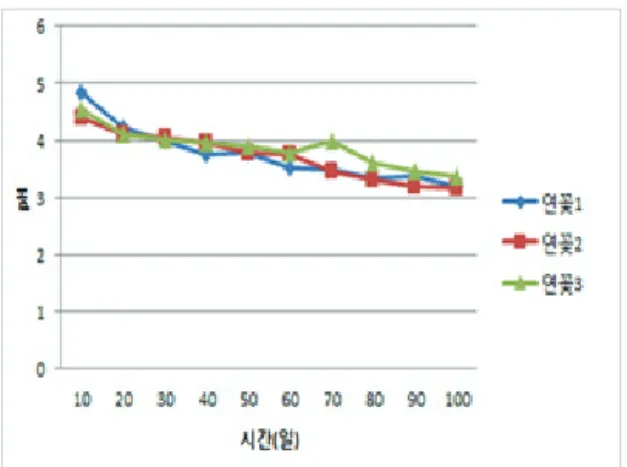
The pH value of lotus flower with different sugar addition is shown in Figure 1. At the initial stage of fermentation the pH was fixed at 5. After 100 days the pH value was decreased to 3.2. The fermentation process in the first 10 days, then reached a higher level at the 20th day before gradually decreasing until completing the acetic fermentation process at the 50th day. Whereas, the brix

development of lotus flower with different sugar addition is shown in Figure 2.

Fig. 1 pH value of product with time.

Fig. 2 Brix value of product with time.

As well as the pH value, the sugar content

of product during the fermentation process

also decreased. Although sugar cane juice is

typically about 90% sucrose and 10% glucose

plus fructose, sucrose could hardly be

detected in the vat where the

monosaccharides were always the

predominant sugars. All the glucose normally

(6)

was consumed after 12 hours though fructose continued to be used for another 6 h but residual sugar was left in the sample at the final experiment. The final brix for initial 32% is 20%, for 24% is 10%, and for initial 14% is 4%.

In lactic acid fermentation, glucose and six-carbon changes in sugar become cellular energy and metabolite lactate. The excitant of oxygen in the cell of organisms make many organisms bypass fermentation and allow cellular respiration. However, facultative anaerobic organisms need oxygen to ferment and take respiration.

Acetic Acid Bacteria is called a process to convert ethanol into acetic acid when oxygen is available. Oxygen decomposes ethanol into acetic acid and water but oxygen is not completely decomposed into carbon dioxide and water. One of product that is produced from acetic acid fermentation is vinegar.

Acetic acid fermentation is different from alcohol fermentation or lactic acid fermentation, organic matter is decomposed with oxygen by acetic acid fermentation, this condition is called oxidation fermentation.

Due ti the decomposition of sugar into acetic acid this also causes sugar content and the pH value in the product decreases.

3.2 Total Polyphenol and Total Flavonoid Content

There is a closer correlation between phenolic content and antioxidant activity of a

product. This is because phenolic compounds are indeed the main source of antioxidants and free radical scavengers. Phenolic compounds and flavonoids themselves are secondary metabolites that can be found in many plants. Flavonoids have properties that are easily digested by humans and also show important anti-inflammatory, anti-allergic, and anti-cancer activities [10].

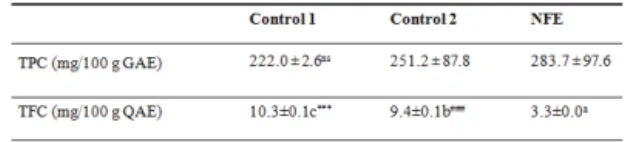
The total polyphenol content of the fermentation product was 283.7 ± 97.6 mg / 100 g QAE, which was 12.9∼27.8% higher than the control, but no significant difference was observed. The total flavonoid content of the fermentation product was 3.3 ± 0.0 mg / 100 g QAE, which was significantly lower than that of the control group.

Table 1. Total polyphenol and flavonoid contents of product

Values are means ± SD. Values were not significantly different from one another (p

<0.05) by Duncan’s multiple range test. ns:

no significant.

***

p<0.001, Significantly different between control2 and NFE by Student t-test.

3.3 DPPH Radical Scavenging Ability

Recent studies actually have shown that

there is no universal method to evaluate

(7)

antioxidant activity quantitatively and accurately (Prior et al., 2005). However there is one method that usually used to asses the antioxidant activity of beverage products, namely DPPH method.

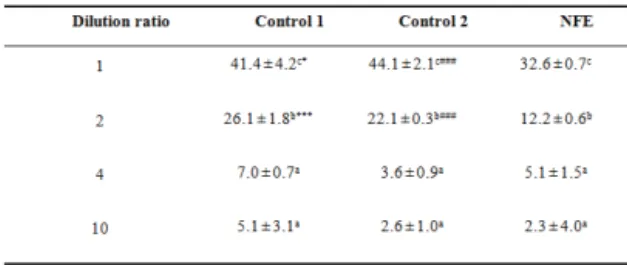
Table 2. DPPH radical scavenging ability of product

Values are means ± SD. Values were not significantly different from one another (p

<0.05) by Duncan’s multiple range test. ns:

no significant.

***

p<0.001, Significantly different between control2 and NFE by Student t-test.

The DPPH radical scavenging ability of the fermentation product increased in a concentration dependent manner and showed 32.6 ± 0.7% DPPH radical scavenging ability at the highest concentration. However, the DPPH radical scavenging ability of the agar fermented product was significantly lower than that of the control.

3.4 ORAC Activity in Product

The Oxygen Radical Absorption Capacity (ORAC) assay is said to have utilizes a biologically relevant radical source (Prior et al., 2003). The ORAC assay is a classic tool for measuring the antioxidant capacity of

biomolecules from a variety of samples. The ORAC Activity assay is based on the oxidation of a fluorescent probe by peroxyl radicals by way of a hydrogen atom transfer (HAT) process. The ORAC activity of the fermentation product showed a high activity of 20.7 ± 0.4 1 μM TE and was significantly lower than that of the control.

Table 3. ORAC activity of fermentation product

Values are means ± SD. Values were not significantly different from one another (p

<0.05) by Duncan’s multiple range test. ns:

no significant.

***

p<0.001, Significantly different between control2 and NFE by Student t-test.

Actually there is a correlation between the total phenolic content and free radical scavening activity of some product, including fermenattion product and also fruit polyphenolic extracts like yogurt [11,12].

Thus, the antioxidant activity of the En-GSE polyphenols incorporated into yoghurt remained stable during product preparation, in accordance with their total phenolic level.

The decrease in ORAC values of the GSE

product might be a result of protein-

polyphenol interactions including casein and

whey proteins [13].

(8)

3.5 Effect of Fermenattaion Process to Color of The Product

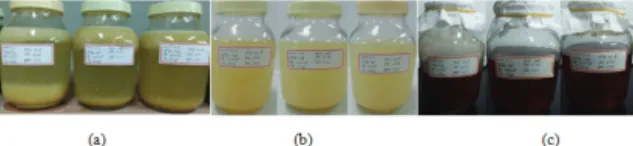
The lotus flower fermentation results are shown in Figure 3. As shown in Figure 3a, within 24 hours, the solid had settled to the bottom of the jar and little or no signs of fermentation. After 1 month fermentation (Figure 3b), a pleasant flavor and nice amount of bubble indicate that it had fermented nicely. When the organism ferments carbohydrates, acidic organic by products (Lactic acid, formic acid or acetic acid) is accumulated which turns the medium into yellow color with reduction in the pH (acidic). In Figure 3c the transformation of ethanol into acetic acid by the metabolism of acetate bacteria produces red color.

Fig. 3 Color changes to lotus flower fermentation products during the process after 24 hours (a), 1 month (b), and 3 months (c).

4. Conclusion

The sugar content and pH value of product gradually decreases with time of fermentation. The color of lotus flower fermentation products changed from transparant yellow to red. The total

polyphenol content of the fermented product was 283.7 ± 97.6 mg / 100 g QAE, which was 12.9∼27.8% higher than the control, but no significant difference was observed. For the total flavonoid content of the fermented product was 3.3 ± 0.0 mg / 100 g QAE, which was significantly lower than that of the control group. The DPPH radical scavenging ability of the agar fermented product was significantly lower than that of the control. Whereas the ORAC activity of the fermented product showed a high activity of 20.7 ± 0.4 1 μM TE and was significantly lower than that of the control.

The efficiency of lotus flower vinegar fermentation can be maximized by comparing the excellent characteristics of lotus flower fermentation products, where it can be seen that products with an initial sugar condition of 25% (sample B) give the best results compared to other samples.

References

[1] Shen-Miller, J., J.W. Schopf, G. Harbottle, R.J.

Cao, S. Ouyang, K.S. Zhou, and G.H. Liu.

“Long-living lotus: Germination and soil γ -irradiation of centuries-old fruits, and cultivation, growth, and phenotypic abnormalities of offspring”. American Journal of Botany.

https://doi.org/10.3732/ajb.89.2.236.2002.

[2] Chen, H., C. Zhao, J. Li, S. Hussain, S. Yan, and Q. Wang. “Effects of extrusion on structural and physicochemical properties of soluble dietary fiber from nodes of lotus root”.

Lwt.93:204–211. 2018.

(9)

[3] Yang, D., Q. Wang, L. Ke, J. Jiang, and T.

Ying. Antioxidant activities of various extracts of lotus (Nelumbo nuficera Gaertn) rhizome.

Asia Pacific Journal of Clinical Nutrition 16(SUPPL.1): 158–163. 2007.

[4] Hwang, D., H. Charchoghlyan, J.S. Lee, and M.

Kim. Bioactive compounds and antioxidant activities of the Korean lotus leaf (Nelumbo nucifera) condiment: Volatile and nonvolatile metabolite profiling during fermentation.

International Journal of Food Science and Technology 50(9): 1988–1995. 2015.

[5] Lin, H. Y., Y.H. Kuo, Y.L. Lin, and W.

Chiang. 2009. Antioxidative effect and active components from leaves of lotus (Nelumbo nucifera). Journal of Agricultural and Food Chemistry 57(15): 6623–6629.2009.

[6] Shukla, S., J.S. Lee, J. Park, D.J. Hwang, J.H.

Park, and M. Kim. Quantitative analysis of functional components from nelumbo nucifera root fermented broth with antioxidant and tyrosinase inhibitory effects. Journal of Food Biochemistry 40(2): 248–259.2016.

[7] Shukla, S., J.S. Lee, V.K. Bajpai, S.H. Nile, Y.S. Huh, Y.K. Han, and M. Kim. Detection of biogenic amines and microbial safety assessment of novel Meju fermented with addition of Nelumbo nucifera, Ginkgo biloba, and Allium sativum. Food and Chemical Toxicology 119: 231–236. 2018.

[8] Wu, M.J., L. Wang, C.Y. Weng, and J.H. Yen.

Antioxidant activity of methanol extract of the lotus leaf (Nelumbo nucifera Gertn.). The American Journal of Chinese Medicine 31(5):

687–698. 2003.

[9] Steinkraus, K.H. Classification of fermented foods:

worldwide review of household fermentation techniques. Food Control 8(5–6): 311–317. 1997.

[10] Crozier, A., and H. Ashihara. Clifford M.N.

Plant Secondary Metabolites and the Human Diet, Blackwell Publishing, Oxford, England.2006.

[11] Skrede, G., V.B. Larsen, K. Aaby, S. Jorgensen.,

and S.E. Birkeland. Antioxidant properties of commercial fruit preparations and stability of bilberry and black currant extracts in milk products. Journal of Food Science 69:

351-356.2004.

[12] Caillet, S., S. Salmieri, and M. Lacroix.

Evaluation of free radical scavenging properties of commercial gra[e phenol extracts by a fast colorimetric method. Food Chemistry 95: 1-8.2006.

[13] Rawel, H.M., J. Kroll, and U.C. Hohlo. Model studies on reaction of plant phenols with whey proteins. Nahrung 45: 72-81.2001.

(Manuscript received October 2, 2018;

revised December 25, 2018; accepted January 8, 2019)

수치

Fig.  1  pH  value  of  product  with  time.
Table  1.  Total  polyphenol  and  flavonoid  contents  of  product
Table  2.  DPPH  radical  scavenging  ability  of  product
Fig.  3  Color  changes  to  lotus  flower  fermentation  products  during  the  process  after  24  hours  (a),  1  month  (b),  and  3  months  (c).

참조

관련 문서

Changes in pH (A) and total acidity contents (B) of vinegar added with different levels of Akebia quinata during acid fermentation period.. Values are mean±standard deviations

진생베리 구성 유기산 분석을 위하여 ion chromatography 를 이용하였고, 그 결과는 Table 1과 같다. 발효 전 진생베리 추출물의 경우에는 lactic acid와 acetic acid

Con: Fermented lotus root and Platycodon grandiflorum extracts with sugar without lactic acid fermentation, La: Lactobacillus acidophilus, Lb: Lactobacillus brevis,

Changes in organic acid content of vinegar added with different levels of black garlic during fermentation period (mg/100 mL)... 초산 발효시 균주 사

Yoon SR, Kim GR, Lee JH, Lee SW, Yeo SH, Jeong YJ, Kwon JH (2010) Properties of organic acid and volatile components in brown rice vinegar prepared using different

Abstract Following supplementation with organic acids (acetic, citric, and lactic acids), the pH of the alcohol mash changed from 4.2 control to 3.73-3.97 supplemented, the acidity

The addition of LAB is intended to ensure the fermentation process via increasing organic acid content of silages particularly lactic acid was dominant acid in