Rethinking University Dining Services: Role of Value in the Formation of Customer Satisfaction and Revisit Intention
Seonok Ham
Dept. of Tourism Management, Gachon University, Seongnam 461-701, Korea
대학 푸드 서비스의 재고찰: 고객만족도와 재방문의도 형성에서 가치의 역할
함 선 옥
가천대학교 관광경영학과
Abstract
University dining services have received less attention than commercial food services or other institutional food services.
Marketing practitioners and researchers recognize the major impact that perceived value has on consumer behavior. The mediating role of value has not been verified in relation to satisfaction in university dining establishments, including Korea.
This study intends to investigate the relationships among value, satisfaction and revisit intention of university dining attributes.
This study also examines whether university dining service attributes dimensions influence value. Further, this study verifies the role of value as a mediator in the formation of customer satisfaction and revisit intention. Structural Equation Modeling has been applied to the collected data from students of three universities in Korea. The study resulted in that university dining attributes, such as food, menu and convenience, positively affected value of the university dining services. Further analysis with examination of indirect effects confirmed the positive impact of value on satisfaction in university dining services. This study verified the mediating role of value on satisfaction as student’s satisfaction is enhanced through the elevation of value of university food services. Enhanced satisfaction via value also led to improvement in revisit intention. This study contributes to the academia by verifying the mediating role of value in the formation of customer satisfaction in a university dining context. This study also offers practical implications to the industry, such as suggestions on developing strategies for value-added products and services to the university dining establishments. This value research for university dining services is also meaningful by triggering future research on market segmentation, product differentiation and positioning policies. In the long run, improving value and satisfaction with university dining services need to be realized to enhance overall college experiences and other competitive advantages, such as student recruitment and enrollment, student academic evaluations, and university reputation.
Key words : University dining services, value, attributes, satisfaction, revisit intention.
†
Corresponding author : Seonok Ham, Tel : +82-31-750-8669, E-mail : [email protected]
Introduction
University dining services have been in a very competitive business environment for the last two decades (Gramling et al 2005, Kwun DJ 2010). That is also in reality in Korea. Custo- mers in university dining services, college students, get to have higher expectations toward university dining services resulted from wider experiences with restaurants. They expe- rience a variety of menu and tastes, high quality food, and sophisticated services from outside commercial restaurants (Kim et al 2009). There is a growth of off-campus commer- cial restaurants whose primary customers are college students.
To compete with outside commercial restaurants and to retain
student customers, university dining services adopted contract
food service systems on campus (Yang et al 2000). In parti-
cular, as college students stay on campus for long hours, and
tend to have all meals of a day on campus, they can hardly
tolerate a few menu items and old-style services. With the
growth of institutional food services, it is needless to make a
distinction between outside commercial restaurants and uni-
versity food services. In the situation, to gain competition in
the market, university food services feel a need to offer
specialized tastes, a variety of menu selection, recognized-
branding and personalized services in order to meet the ex-
pectations of customers (Park M 2007). In an effort to for-
mulate strategies to develop certain food selections and ser-
vices that customers desire, university food services ought to understand their customers in order to offer what they want.
However, university dining services have received less atten- tion than other institutional food services, such as hospital and business & industry food establishments (Choi & Lee 2011, Yang et al 2000).
Marketing practitioners and researchers recognize the major impact that perceived value has on consumer behavior (Ga- llarza & Saura 2006). Perceived value is known as an ante- cedent to customer satisfaction and loyalty, while it is in- fluenced by product quality (Yoon et al 2010). It has been recognized that consumer behavior is better understood as it is related to perceived value (Nilson TH 1992, Ostrom &
Iacobucci 1995). To marketing practitioners, customer’s per- ceived value is one of the most important measures, because customers tend to have purchase-related behaviors to maxi- mize the value of products they purchase. Thus, value is linked to market strategies, such as market segmentation, product differentiation and positioning policies (Tellis & Gaeth 1990, Heskett et al 1997). Many researchers emphasize that value is a key to take a competitive advantage (Gale BT 1994, Wood- ruff & Gardial 1996, Day GS 1999). During the last two de- cades, the value concept has received constant interests by consumer and marketing researchers. Marketing literature supports that product quality has an effect on perceived value, which in turn, influences customer satisfaction, loyalty, and other behavioral intentions (Cronin et al 2000, Parasurman &
Grewal 2000). This indicates the linkages among product qua- lity, value, satisfaction and revisit intention, while recognizing value as an important construct in the formation of customer satisfaction. Value has been examined in relating to satisfac- tion and behavioral intentions in tourism context, such as university students’ travel behavior (Gallarza & Saura 2006) and festival attendees’ behavior (Yoon et al 2008). Food service operations have been investigated for customer satis- faction and revisit intention to achieve the business goal of financial success (Kim et al 2009, Kwun DJ 2010). Previous research related university dining attributes to satisfaction and revisit intention (Kim et al 2009, Kwun DJ 2010). Although a few studies included value in the examinations of satis- faction and behavioral intentions in the US university dining establishments (Kwun DJ 2010, Kim et al 2009), they did not clarify the mediating role of value in the relationship to satis- faction . Thus, the mediating role of value has not been veri- fied in relation to satisfaction in university dining establish-
ments, including Korea.
Herein, this study proposes a conceptual model of relation- ships among university dining attributes, value, satisfaction and revisit intention, and tests whether attributes dimensions influence value in university dining establishments. In addi- tion, this study examines the concept of value if it behaves as a mediator in the formation of customer satisfaction in a uni- versity dining context. This study differentiates itself from previous research in that it intends to identify the mediating role of value in the customer satisfaction in the university dining services, while this study focuses on the importance of value in customer perceptions and behaviors. In doing so, this study employed Structural Equation Modeling (SEM) instead of multiple regressions. This study would offer academic contribution by expanding knowledge on the role of value in the customer perception and behaviors in university food service environment. It also benefits industry by providing im- plications on the suggestions to improve the value students have on the university food services. This study also offers practical implications to the industry, such as suggestions on developing strategies for value-added products and services to the university dining establishments. This value research for university dining services is also meaningful by triggering fu- ture research on market segmentation, product differentiation and positioning policies. Therefore, in the long run, this study would contribute to the university food service industry by improving revenues of the operations. By offering higher va- lue on university food services, university academics may enhance the quality of educational environment. As a result, college students may have more attachments with universities, which may result in improvement in academic performance.
Literature Review
1. Customer’s Perception and Behavioral Intentions toward University Dining Services
There have been publications on the university dining ser- vices in Korea in relating to customer’s perceptions and be- havioral intentions. Kim H (2006a) examined the causal rela- tionships among customer’s perceived service quality, affect and overall satisfaction in the college dining services context.
Based on DINESERVE, he used five dimensions of restaurant
service quality, such as tangibles, reliability, responsiveness,
assurance, and empathy. Only one dimension, empathy, in-
fluenced college student’s positive affect significantly, while
overall satisfaction was positively impacted by positive affect.
Likewise, customer’s negative affect had a negative effect on overall satisfaction. The study noted that when college stu- dents feel caring and personalized attention from the univer- sity food services, they tend to show positive affect and satis- faction. The study is meaningful in terms of eliciting the con- cept of customer’s affect in relation to satisfaction in the uni- versity food services environment. By applying the same per- ceived service quality, Kim et al (2009) also investigated college food services to determine how perceived service quality influences trust, customer satisfaction and loyalty. The study yielded that perceived service quality had a positive effect on trust and customer satisfaction, and thus customer loyalty.
However, perceived service quality did not have a direct in- fluence on customer loyalty. Trust impacted customer satis- faction positively. Kim et al (2008) adopted another construct of physical environment in examining university dining ser- vices. They examined the impact of perceived physical envi- ronment on customer’s affect and perceived service quality.
The empirical study resulted in that perceived physical envi- ronment had a positive effect on student’s affect, while the emotional response affected perceived service quality of cam- pus dining services. Kim H (2006b) also showed that per- ceived quality of university dining services had a positive effect on intention to revisit and to recommend. Selection attributes are the important factors determining customer satis- faction and behavioral intentions of university cafeteria custo- mers (Choi & Lee 2011). Choi & Lee (2011), by using four- teen selection attributes, identified five factors, such as ingre- dients, food, menu, maintenance and internal environment.
While three factors, ingredients, maintenance, and internal en- vironment affected customer satisfaction which influenced fu- ture behavioral intentions positively.
Hyun and colleagues made efforts on customer’s satisfac- tion and behavioral intentions in the chain restaurants. In a study of examining the relationship quality and loyalty (Hyun SS 2010), he used five dimensions influencing restaurant pat- ron’s behavior, such as food quality, service quality, price, location, and environment. The study concluded that the five attributes impact satisfaction, while satisfaction leads to lo- yalty formation directly and indirectly via trust. Hyun et al (2011) contributed to the restaurant industry by examining the effect of advertising on customer responses. Four dimensions of advertising (relevant news, stimulation, empathy, familia- rity) were significant in inducing emotional responses in
patrons. The study also confirmed that advertising-induced emotional responses made a positive effect on perceived value which also influenced behavioral intention. In a study of tes- ting a model of customer equity for chain restaurant brand equity, Hyun SS (2009) demonstrated that value, brand, and relationship management are all important in improving cus- tomer equity. Later, Hyun & Kim (2011) expanded previous restaurant equity study and showed that brand awareness, brand image, perceived quality and brand loyalty are all con- tributing factors to restaurant’s brand equity. The study also revealed that brand awareness impacts brand loyalty forma- tion, while its effect is mediated by the influences of brand image and perceived quality.
Almanza et al (1994), by examining college students’ lunch meals in a university cafeteria, found that quality of food, cleanliness, convenient location, reasonable price, nutritious food and speed of service as being important attributes at the university food services. Kim et al (2009), by using DINESERV factors, showed that food quality, atmosphere, service quality, convenience, and price and value are important attributes that positively affected both customer satisfaction and return in- tention. Lam’s study investigated food services at Hong Kong universities, and indicated crucial factors effecting customer satisfaction, and they were food quality, price, hygiene and food variety (Lam & Heung 1998). An interesting note from the study is that service quality was not a significant contri- butor to the customer satisfaction. In the study, it was also revealed that customers’ satisfaction had a positive effect on their perceived level of performance regarding the university food services. Kwun DJ (2010) stated that performance in ser- vice and product quality, menu and facility yielded signifi- cantly positive impacts on perceived value, satisfaction, and consumer attitudes. While his study examined value, the role of value as a mediator has not been confirmed because he used regressions. In his study, males and females made a difference in the attitude-formation process and perceived values and satisfaction.
Among the factors customers consider being important for
food service operations, the most crucial factor has been food
quality. In studies of fast food restaurants (Pettijohn et al
1997) and Chinese restaurants (Qu H 1997), food quality was
the most important determinants customers consider revisiting
the restaurants, while the next important elements were clean-
liness, value, price, and convenience. While food quality has
been ranked as the most important one in most of studies, it
was ranked as second in importance in Lee SS’s study (2004) on the college students’ perception of college students at universities in Midwest in the US. Similarly to food quality, menu also remains as an important consideration for choosing university food services (Kim et al 2004, Kwun DJ 2010).
Menu factor contains the items of variety, healthy menu, con- venient menu, promotional menu, and ethnic menu. Service quality is also an important consideration of dining services.
In a study of Hong Kong restaurants (Kivela et al 2000), service quality has been identified critically important in re- sulting in customer satisfaction and revisit intention.
Another factor being important to customer’s satisfaction is environment or atmosphere (Soriano DR 2002). The environ- ment may include seating arrangement, decoration, lights, music etc. Customers would like to be in an environment of comfort and pleasure. Convenience is, in particular, important for student customers to visit dining facilities, because they use dining facilities in most cases between classes while they stay on campus. They would like to visit dining facilities with easy access in a campus setting, near classrooms, residential halls, and libraries (Klassen et al 2005). Shoemaker S (1998) analyzed data on segment of university food service custo- mers, and indicated that they want “short walking distance to classes and offices” for the convenience. While customers visit food services mainly for food and services, they also would like to be compensated for the money they pay for.
While price is rather lower than outside commercial establish- ments, price is also a determinant for students to go for food services on campus (Klassen et al 2005).
Summary of literature review shows that university dining services have examined attributes, such as food quality, ser- vice quality, atmosphere, convenience, price and value, and so on (Kwun DJ 2010, Kim et al 2009, Kim et al 2006, Lam
& Heung 1998). Food service operations have been investi- gated for customer satisfaction and behaviors to achieve the business goal of financial success (Kim et al 2009, Kwun DJ 2010). Previous research related university dining attributes to satisfaction and revisit intention, respectively, however the role of value as a mediator has not been verified in the university dining services.
2. Importance of Value and Its Relation to Satis- faction and Behavioral Intentions
Gallarza & Saura (2006) noted the importance of value has
on consumer behavior. Perceived value leads to customer sa- tisfaction and loyalty, while it is influenced by product quality (Yoon et al 2010). Scholars emphasize value in that consumer behavior is better understood as it is related to perceived value (Nilson TH 1992, Ostrom & Iacobucci 1995). Many researchers emphasized that value is a key to take a compe- titive advantage (Gale BT 1994, Woodruff & Gardial 1996, Day GS 1999), because customer’s purchase behavior is oriented to maximizing the value of product they purchase. During the last two decades, the value concept has received constant in- terests by consumer and marketing researchers, while empiri- cal studies on the relationships among quality, value and satis- faction have been demonstrated (Gallarza & Saura 2006).
While many researchers have suggested concepts of value, it is noted that Zeithaml VA (1988) proposed a precise de- finition of the term. “Value is the consumer’s overall assess- ment of the utility of a product based on perceptions of what is received and what is given” (Zeithaml VA 1988). In other words, value is determined by trading off between perceived quality or the benefit that they receive and their monetary sacrifice (Monroe KB 1990). They stated that quality enhances value, while monetary (e.g. price, traveling cost) and non-mo- netary sacrifices (e.g. time, efforts, search cost, convenience) diminishes value. When customers perceive more quality than sacrifices, they tend to perceive or assess higher value. It is general that quality is perceived as the salient “get” (having benefit) characteristic (Heskett et al 1990). In the context of university dining service attributes such as food, services, menu, atmosphere, sanitation and convenience, as college dining customers perceive more “get” from the attributes in return for sacrifice that they pay for, the value they have on the dining services is more highly evaluated. Although a few stu- dies included value in the examinations of satisfaction and behavioral intentions in university dining establishments (Kwun DJ 2010, Kim et al 2009), they did not clarify the mediating role of value in the relationship to satisfaction. Thus, the mediating role of value has not been verified in relation to satisfaction in university dining establishments, including Ko- rea.
This study investigates the impact of attributes on value of university dining services. The attributes customers view being important have been identified from the previous publications.
The university dining attributes selected for the present study
are food quality, service quality, menu, atmosphere, sanitation,
and convenience. Above-mentioned literature on value and perceived quality proposes the following hypotheses.
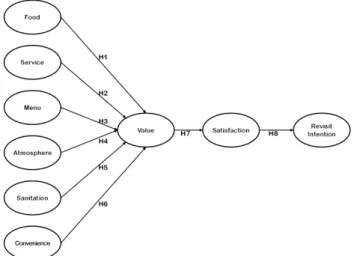
H1: Food quality has a positive impact on value of univer- sity dining establishments.
H2: Service quality has a positive impact on value of uni- versity dining establishments.
H3: Menu has a positive impact on value of university di- ning establishments.
H4: Atmosphere has a positive impact on value of univer- sity dining establishments.
H5: Sanitation has a positive impact on value of university dining establishments.
H6: Convenience has a positive impact on value of univer- sity dining establishments.
It is a general notion that value is linked to satisfaction, while quality is used as input to value (Zeithmal VA 1988, Monroe KB 1979, 1992, Bolton & Drew 1991). Thus it is proven by researchers that value has been antecedents to satis- faction in the marketing and hospitality literature (Grewal et al 1998, Lee et al 2007, Oh H 2000). Value also affects purchase-related behavioral intentions positively. Revisit inten- tion has been one of the most crucial topics to the industry managers because keeping existing customers are worthy as it is directly related to revenues and profits (Zeithmal et al 1996). Satisfaction has also been demonstrated as a positive antecedent to revisit intention in the consumer marketing literature (Baker & Crompton 2000, Lee et al 2007b, Oliver RL 1999, Getty & Thompson 1994, McDougall & Levesque 2000). Value has been examined in relating to satisfaction and behavioral intentions in tourism context, such as university students’ travel behavior (Gallarza & Saura 2006) and festival attendees’ behavior (Yoon et al 2008). Thus, the following hypotheses are proposed on the relationships among value, satisfaction and revisit intention.
H7: Value affects satisfaction positively in university dining establishments.
H8: Satisfaction affects revisit intention positively in uni- versity dining establishments.
The hypotheses are depicted in the proposed research frame- work. Fig. 1 describes the relationships among the hypo- thesized variables, such as university dining attributes, value, satisfaction and revisit intention.
Fig. 1. Proposed research model.
Methods
1. Survey Instrument
The research instrument was developed based on the li-
terature on university dining services and customer perception
studies (Kwun DJ 2010, Kim et al 2009, Kim et al 2006,
Lam & Heung 1998, Gallarza & Saura 2006, Yoon et al
2010). The survey is comprised of four parts. Part 1 includes
questions about perceived evaluation of the attributes of uni-
versity dining services. The selected university dining attri-
butes adopted from previous research (Kwun DJ 2010, Kim et
al 2009, Kim et al 2006, Lam & Heung 1998, Almanza et al
1994, Qu 1997) include six constructs and they are food
quality (taste, appearance, nutrition, freshness, portion size,
temperature), service quality (prompt and quick service, frien-
dly employee, additional service, attentiveness, offering nutri-
tional information), menu (variety, healthy menu, promotional
menu, harmony of menu, portable menu), atmosphere (enough
chairs and tables, locations of chairs and tables, comfortable
interior, lighting, appropriate temperature and ventilation),
sanitation (sanitation for food, plates and utensils, eating place,
serving employees, serving and return area) and convenience
(good location on campus, easy access, open for long enough,
time for line up). Part 2 are questions about value (4 items),
satisfaction (3 items) and revisit intention to the university
dining services (3 items), while the constructs were adopted
from previous studies on consumer’s satisfaction and behavio-
ral intentions (Gallarza & Saura 2006, Yoon et al 2010, Kwun
DJ 2010, Lee et al 2008). All items for Part 1 and Part 2
were evaluated using a 5-point Likert-type scale (5=strongly
agree, 1=strongly disagree). Part 3 contains demographics of the respondents, such as age, gender, age, and school year.
The developed survey was pilot-tested by thirty one faculty, researchers and graduate students in the food service manage- ment. The comments and suggestions from the pilot-test were incorporated to the finalization of the survey by defining the meaning and wordings of the questions.
2. Data Collection
The population of the study is customers at university di- ning services. The study sample is chosen at three univer- sities located in Seoul and Kyonggi province in Korea. In total, five hundred questionnaires were distributed. One hun- dred and seventy surveys were distributed to two universities, respectively, while one hundred and sixty were surveyed in another university. In each university, surveys were distributed to a variety of majors. Data collection was conducted for two weeks in November, 2011. Among five hundred surveys dis- tributed, 430 were completed, which yielded a response rate of 86%.
3. Data Analysis
PASW 18.0 and AMOS 7.0 were employed to analyze the collected data. Prior to testing the measurement model, the collected data was screened to avoid any violation of the assumptions of the general liner model. Descriptive statistics were performed on all the variables. The reliability test was conducted on each construct to verify if the individual indi- cator variables are good to represent the designated construct.
Secondly, as the first part of the two-step approach recom- mended by Anderson & Gerbing (1988), a confirmatory fac- tor analysis (CFA) with maximum likelihood was conducted to estimate the measurement model. Construct validity was measured with convergent validity and discriminant validity.
As the second part of the two-step approach, Structural Equation Modeling (SEM) was estimated to investigate the relationships among the hypothesized constructs in the study framework.
Results
1. Descriptive Statistics of Respondents
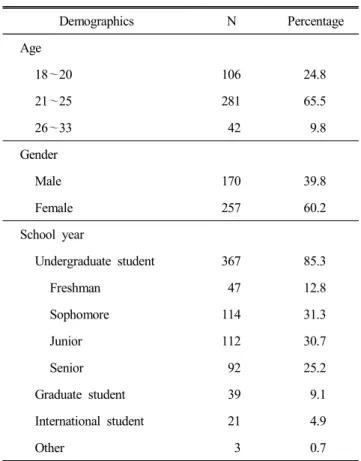
About a quarter of the respondents were in the age of 18~
20 (24.8%). More than half of the customers belonged to the
ages between 21~25 (65.5%). About ten percentages of the respondents were between 26 ~33 (9.8%). The respondents consisted of sixty percent of females and forty percent of males. While about eighty-five percent belonged to undergra- duate programs, the most were in sophomore (31.3%), then junior (30.7%), senior (25.2%), and freshmen (12.8%). Less than ten percent (9.1%) were graduate students and about five percent (4.9%) were designated themselves as international students.
2. Descriptive Statistics of University Food Service Quality Attributes
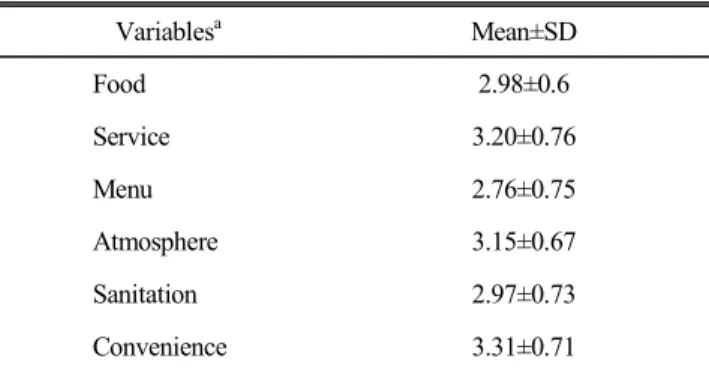
To provide an overview on all the variables under inves- tigation, Table 2 presents the means and standard deviations of quality attributes of university dining services: food quality, service quality, menu, atmosphere, sanitation, and convenience.
Students evaluated convenience (3.31) the highest, followed by service quality (3.20), atmosphere (3.15), food quality (2.98), sanitation (2.97), and menu (2.76). The mean value of each attribute was ranging from 2.76 to 3.31 on the 5-point Likert- type scale.
Table 1. Demographics of respondents (N=430)
Demographics N Percentage
Age
18 ~20 106 24.8
21 ~25 281 65.5
26 ~33 42 9.8
Gender
Male 170 39.8
Female 257 60.2
School year
Undergraduate student 367 85.3
Freshman 47 12.8
Sophomore 114 31.3
Junior 112 30.7
Senior 92 25.2
Graduate student 39 9.1
International student 21 4.9
Other 3 0.7
Table 2. Descriptive statistics of university dining service quality attributes
Variables
aMean±SD
Food 2.98±0.6
Service 3.20±0.76
Menu 2.76±0.75
Atmosphere 3.15±0.67
Sanitation 2.97±0.73
Convenience 3.31±0.71
a
All items were measured on a 5-point-Likert scale from 1:
strongly disagree to 5: strongly agree.
3. Measurement Model
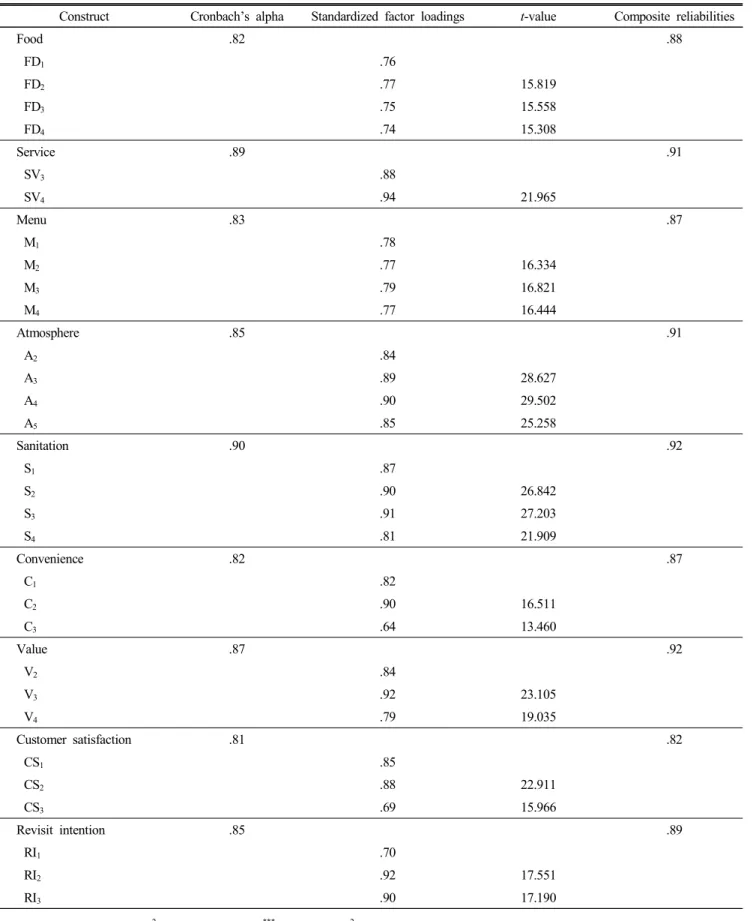
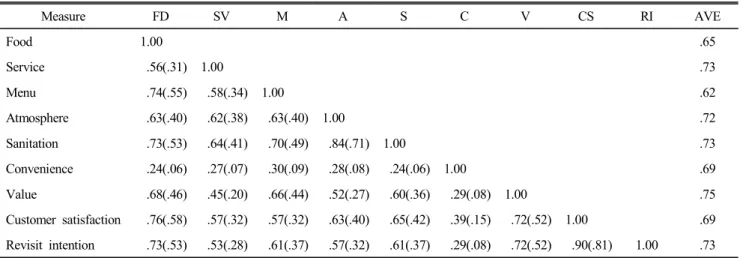
The internal consistencies of the constructs were assessed using Cronbach’s alphas, where 0.8 or above are considered desirable (Hair et al 1998). Cronbach’s alphas of all nine constructs ranged from .81 to .90, including an acceptable level of consistency (Table 3). To measure construct validity for nine measurement scales, convergent validity and dis- criminant validity were conducted. Convergent validity was undertaken in three ways. First, the standardized factor loa- dings ranged from .64 to .94 as shown in Table 3 and were statistically significant (Bagozzi & Yi 1988). Second, com- posite reliabilities, ranging from .82 to .92, exceeded the .80 threshold level of acceptance (Nunnally & Bernstein 1994). In addition, the average variance extracted (AVE) estimates, ranging from .57 to .72, exceeded the recommended .50 thres- hold (Fornell & Lacker 1981) (Table 4). Thus, convergent validity was achieved (Table 3).
Discriminant validity was confirmed by comparing the average variance extracted (AVE) of each construct with the squared variance which it shares with other constructs. All AVE for each construct except between customer satisfaction and revisit intention met Fornell & Larcker’s (1981) thres- holds and were greater than the squared correlation coeffi- cients between constructs (Table 4). Therefore, it was con- cluded that all the measures demonstrated undimensionality and discriminant validity. In the Confirmatory Factor Analysis (CFA) run to evaluate the measurement, the overall model fit was assessed statistically using several goodness-fit-indices.
The CFA indicates a good model fit (χ
2(399)=1095.010, p<
0.001; χ
2/df=2.74; root mean squared error of approxiation [RMSEA]=0.064; confirmatory fit index [CFI]=0.915; Tucker-
Lewis index [TLI]=0.901; incremental fit index [IFI]=0.915) (Schumacker & Lomax 2004) (Table 4).
4. Test of Structural Equation Modeling (SEM) A Structural Equation Modeling (SEM) with a maximum likelihood estimation method tests the proposed model, and a summary of results from the SEM appears in Table 5 and Fig.
2. Findings indicate that the model satisfactorily represents the data (χ
2=990.713; df=381; p=<0.001; RMSEA=0.061; CFI=
0.924; TLI=0.913; IFI=0.925). In addition, the study’s varia- bles well explain the outcome variables. Six university dining service quality attributes (food quality, service quality, menu, atmosphere, sanitation, convenience) account for 54.9% of the total variance in value of university dining establishments, and this value explains 56.9% of the variance in satisfaction, while satisfaction explains 81.6% of the variance in revisit intention.
The hypotheses were tested by examining the significance
of the path coefficients (standardized beta weights). The re-
sults of the standardized parameter estimates and t-values are
presented in Table 5. Fig. 2 presents the estimated model,
illustrating the direction and magnitude of the impact of the
standardized path coefficients. For testing Hypothesis 1, the
finding indicates that food quality significantly and positively
affects value students perceive from university dining es-
tablishments (β=0.731, p<0.001). This finding supports Hypo-
thesis 1. Opposite to Hypothesis 2, service quality did not
have a significant effect on value of university dining establi-
shments (β=0.010, p=0.855). From Hypothesis 3, as pro-
posed, menu has a positive and significant impact on value of
university dining establishments (β=0.320, p<0.001). For Hy-
potheses 4 and 5, atmosphere (β=0.010, p=0.888), and sanita-
tion (β=0.085, p=0.335), respectively, did not affect value,
either. Thus, Hypotheses 2, 4 and 5 lack supports. Hypothesis
6, the relation of convenience to value, was supported with a
positive effect (β=0.103, p<0.01). Thus, student’s evaluation
on convenience positively affected the value they put on uni-
versity dining establishments. Food quality, menu, and conve-
nience have significant influences on value, which are consis-
tent with H1, H3, and H6, respectively. Contrary to expec-
tation, service, atmosphere and sanitation does not have a sig-
nificant impact on value, which rejected H2, H4 and H5. The
findings that menu, atmosphere, and sanitation did not affect
value of university dining establishments may be explained
that college customers do not have high expectations toward
those variables, because student’s evaluations on the three attri-
Table 3. Reliabilities and confirmatory factor analysis properties of constructs
Construct Cronbach’s alpha Standardized factor loadings t-value Composite reliabilities
Food .82 .88
FD
1.76
FD
2.77 15.819
FD
3.75 15.558
FD
4.74 15.308
Service .89 .91
SV
3.88
SV
4.94 21.965
Menu .83 .87
M
1.78
M
2.77 16.334
M
3.79 16.821
M
4.77 16.444
Atmosphere .85 .91
A
2.84
A
3.89 28.627
A
4.90 29.502
A
5.85 25.258
Sanitation .90 .92
S
1.87
S
2.90 26.842
S
3.91 27.203
S
4.81 21.909
Convenience .82 .87
C
1.82
C
2.90 16.511
C
3.64 13.460
Value .87 .92
V
2.84
V
3.92 23.105
V
4.79 19.035
Customer satisfaction .81 .82
CS
1.85
CS
2.88 22.911
CS
3.69 15.966
Revisit intention .85 .89
RI
1.70
RI
2.92 17.551
RI
3.90 17.190
Model measurement fit: χ
2=1,095.010 (df=399
***, p<0.001, χ
2/df=2.74), RMSEA=0.064, CFI=0.915, NFI=0.873, TLI=0.901,
IFI=0.915.
Table 4. Correlations matrix among the latent constructs (squared)
aMeasure FD SV M A S C V CS RI AVE
Food 1.00 .65
Service .56(.31) 1.00 .73
Menu .74(.55) .58(.34) 1.00 .62
Atmosphere .63(.40) .62(.38) .63(.40) 1.00 .72
Sanitation .73(.53) .64(.41) .70(.49) .84(.71) 1.00 .73
Convenience .24(.06) .27(.07) .30(.09) .28(.08) .24(.06) 1.00 .69
Value .68(.46) .45(.20) .66(.44) .52(.27) .60(.36) .29(.08) 1.00 .75
Customer satisfaction .76(.58) .57(.32) .57(.32) .63(.40) .65(.42) .39(.15) .72(.52) 1.00 .69 Revisit intention .73(.53) .53(.28) .61(.37) .57(.32) .61(.37) .29(.08) .72(.52) .90(.81) 1.00 .73
a
Correlation coefficients are estimated from AMOS 7.0. All were significant at .001 level.
Table 5. Summary of structural model
Links Standardized coefficients t-values Results
H1: Food → value .371 4.421
***Supported
H2: Service → value .010 .183 Not supported
H3: Menu → value .320 3.639
***Supported
H4: Atmosphere → value .010 .141 Not supported
H5: Sanitation → value .085 .964 Not Supported
H6: Convenience → value .103 2.338
**Supported
H7: Value → customer satisfaction .754 14.193
***Supported
H8: Customer satisfaction → revisit Intention .905 13.872
***Supported
Goodness-of-fit statistics: χ
2(df=381)=990.713 (χ
2/df : 2.60), RMSEA=0.061, CFI=0.924, TLI=0.913, IFI=0.925.
***
p<0.001,
**p<0.01,
*p<0.05.
Note: coefficients are standardized.
Fig. 2. Structural model results.
butes were similar to those of other significant attributes (food quality, menu, convenience). Hypothesis 7, the test of the effect of value on student’s satisfaction with university dining esta- blishments (β=0.754, p<0.001), also gains support. Hypo- thesis 8 investigated the effect of satisfaction on revisit in- tention. Satisfaction had a significant and positive impact on revisit intention (β=0.905, p<0.001).
5. Role of Value as a Mediator
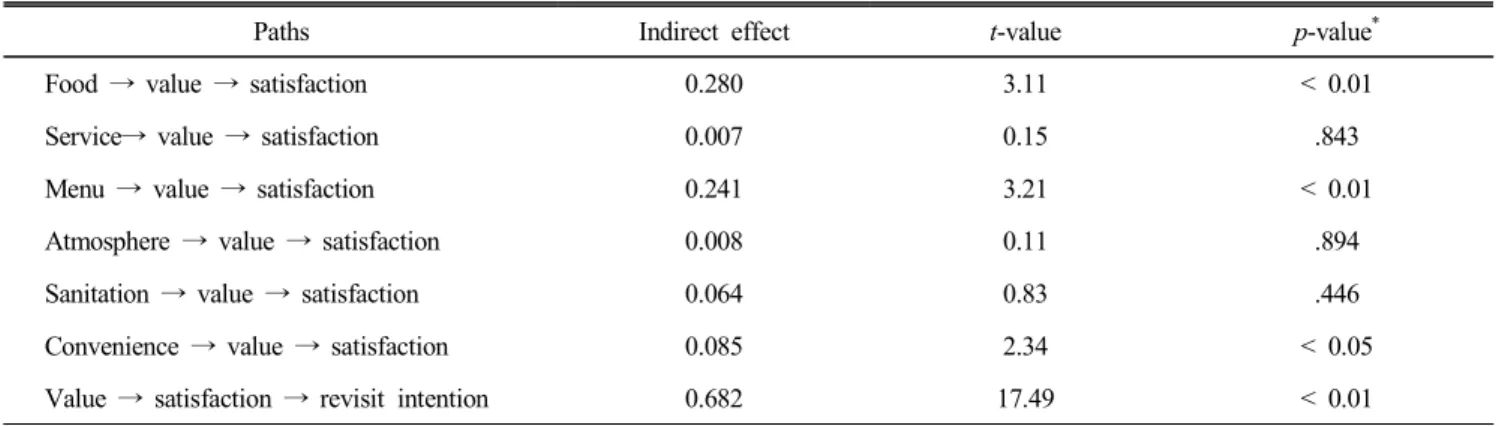
The mediating role of value is tested by examining the in-
direct effects of university dining attributes on customer satis-
faction. Table 6 shows that food, menu, and convenience
significantly affected customer satisfaction through value. The
findings indicated that value as a mediator in the relationship
Table 6. Indirect effects of value and satisfaction with university dining services
Paths Indirect effect t-value p-value
*Food → value → satisfaction 0.280 3.11 < 0.01
Service → value → satisfaction 0.007 0.15 .843
Menu → value → satisfaction 0.241 3.21 < 0.01
Atmosphere → value → satisfaction 0.008 0.11 .894
Sanitation → value → satisfaction 0.064 0.83 .446
Convenience → value → satisfaction 0.085 2.34 < 0.05
Value → satisfaction → revisit intention 0.682 17.49 < 0.01
*
Two tailed significance: bias-corrected percentile method.
between three constructs (food, menu, convenience) and cus- tomer satisfaction. According to Fraizierm et al (2004), a mediator explains why or how its predictor leads to its out- come variables. In this regard, these results implied that the reason for customers’ perceptions on food, menu and con- venience are likely to help customers gain a positive value of the consequences of the customer satisfaction. Thus, it was verified that the impact of university dining service attributes was stronger when value was present compared to when it is not. Conclusively, the role of value as a mediator in the re- lationships between university dining service attributes and satisfaction was confirmed. Likewise, satisfaction was also tested if it acts as mediator between value and revisit inten- tion. As shown in Table 6, value enhances revisit intention through the mediator of satisfaction.
Conclusion and Discussions
College and university food service has received less atten- tion than other food service sectors. The reason may underlie that university food service has been considered as a non- commercial sector for long time. The transition is clear that university food services have adopted commercial food ser- vice operations, including changing its operations from self- operated to contract management company’s operations (Yang et al., 2000). University food services have not been studied enough regarding the concept of value, although it is a con- sensus in the marketing context as to the link between quality and value, while quality being an input to value (Zeithaml VA 1988). Discussion on the link between quality and satisfaction has been a major subject during the last decades (Oliver RL 1998, Cronin et al 2000, Brady et al 2002). In addition, as
a result of the debate on the relative superiority of value as a perceptual construct, many researchers suggested that bu- siness operations may solve problems considering value as the best and most complete antecedent of satisfaction (Oliver RL 1996, Woodruff 1997, McDougall & Levesque, 2000, Day &
Crask, 2000).
This study intends to investigate the relationships among value, satisfaction and revisit intention of university dining attributes. This study also examines whether university dining service attributes dimensions influence value. Further, this study verifies the role of value as a mediator in the formation of customer satisfaction and revisit intention in a university dining context. Some previous studies on university dining services (Kwun DJ 2010) viewed value relating to satis- faction, however, the role of value has not been clearly ana- lyzed. To fulfill the study objectives, data was collected from three universities in Korea.
The findings provided additional information to the pre- vious research on university dining services. Three university dining attributes, such as food, menu and convenience posi- tively affected value of the university dining services. From the magnitudes of the parameter estimates of the variables, food quality was the strongest factor, followed by menu and convenience, on value. To enhance value of university dining services, the results suggest that operators may offer what students feel that they receive good value from the food ser- vices in return for the money, time and efforts they pay for.
As to food quality, students put higher values on tasty, appea- ling, nutritious, and fresh food with appropriate temperature.
Menus they may put higher value are a variety of menu,
healthy, promotional and harmonious menu. Convenience is
also significant in affecting value students assess on the uni-
versity dining services. Students evaluated highly convenient location from classrooms with easy access, while they had dining facilities with long hours assessed highly. The findings show that college students have similar expectations toward university dining services they have on outside commercial restaurants. They are not old-style college food service custo- mers any longer. They do not tolerate monotonous menus or inconvenience from the university food services. Reflecting the outcomes, university food service operators may offer “value- added” food services to their customers. For example, students want to have various menus, including western or exotic menus they experience from commercial restaurants, such as sushi, taco, pizza, pasta, etc. As students may stay late in the evening for classes or library studies, they hope to have food even in the evening or late night. Operators may consider extending food service business hours or offer late-night meal hours. Convenient location is a concern to students, too. As they visit food services mostly between classes, they should go to the food services shortly from classrooms. The location of food service operations should be discussed with university administration and food service operators.
Further SEM, by examining indirect effects, confirmed the positive impact of value on satisfaction. This study verified the mediating role of value on satisfaction in the university dining services. That is, student’s satisfaction is enhanced through the elevation of value of university food services.
This finings emphasizes the importance of value in university dining services. Expectedly, the enhanced satisfaction via value also leads to improvement in revisit intention. In sum- mary, university food service operators should set priorities and pay more attention to the significantly important aspects of the operations to meet customer expectations and improve to return. Through careful and continuous discussions, ad- ministration and food service managers should allocate re- sources properly to improve attributes, value and satisfaction.
Then, they are able to retain or improve revisits of students not to lose them to outside commercial operations. As a re- sult, food service operators may sustain financial stability.
This study offers further implications to the industry. This study provides the importance of value in university dining services. Operators should consider and formulate strategies to add more values on the university food services, and the services should be that students receive more from the food services compared to money, time and efforts they pay for.
More value may come from new products, new units, new services, etc.
While this study is meaning in contributing to the academia and industry, it can offer further research suggestions. Further studies would be directed to expand value research for uni- versity dining services, which can result in market segmen- tation, product differentiation and positioning policies. For instance, male and female students may prefer different menus or services. For the operations located in college of enginee- ring may consider different aspects of food and services, compared to those housed in college of human ecology. The sort of future value research can offer specific services appea- ling to respective segments of customers in universities. For college students, university food service is not only where to have meals between classes, but is an essential piece of their quality of life on campus. Therefore, improving value and satisfaction with dining services need to be realized in an effort to understand the impact they have on overall college experiences and other competitive advantages, such as student recruitment and enrollment, student academic evaluations, and university reputation.
This study evaluated the overall effect of value on uni- versity food services. Value is a multi-faceted concept, such as functional, emotional, and overall values (Lee et al 2007).
Further investigation may suggest the detailed impact of value on university dining services using multi-dimensional items.
This study used a convenience sample with students from three universities in Korea. As students in three universities may not represent the whole university student population, future study may replicate this study by employing a larger sample size. Moreover, the replication of the study would be performed for self-operated and contact company-managed university food services and compare the differences between the two management styles, considering the claim raised by previous study that student satisfaction differed between the two management styles of university food services (Park et al 2000). In addition, future study is suggested to refine this study by incorporating the dimension of customer post-pur- chase behavior. To do so, longitudinal studies are recom- mended by expanding cross-sectional studies.
국문초록
대학교 푸드 서비스는 단체급식이나 그 외 상업급식에 비
해 그 동안 주목을 받지 못하였다. 경영자 및 연구자들은 지
각된 가치는 소비자 행동에 큰 영향을 미치는 것으로 인식하 고 있다. 그러나 대학교 푸드 서비스에서 만족도에 영향을 주는 가치의 매개역할은 아직 확실히 증명되지 않은바 있다.
본 연구에서는 대학교 푸드 서비스의 가치, 만족도와 재방문 의사 속성들 간의 영향관계를 밝혀 고객 지향적인 대학교 푸 드서비스 마케팅의 전략방안을 제시하고자 한다. 따라서 대 학교 푸드 서비스의 서비스 속성이 가치에 영향을 미치는지 여부를 확인하고, 이것이 고객만족과 재방문의사를 형성하 는데 있어서 매개변수로서의 역할을 증명하고자 한다. 본 연 구는 국내 3개 대학의 학생들을 대상으로 진행되었으며 구 조방정식모형(Structural Equation Modeling)이 적용되었다.
연구결과 대학교 푸드 서비스에서 식품, 메뉴, 편리함 등의 속성은 대학교 푸드 서비스의 가치에 긍정적인 영향을 미친 다는 결과를 나타냈으며 가치는 대학교 푸드 서비스의 만족 에 간접영향을 나타내는 것으로 분석되었다. 본 연구는 대학 교 푸드 서비스의 가치를 통해서 만족도에 대한 가치의 매개 역할이 증가함을 알 수 있었다. 또한, 가치를 통해 증가된 만 족도는 재방문의사를 도출해 낸다. 본 연구는 대학교 푸드 서비스 분야에서 고객만족을 형성함에 있어 가치의 매개역 할을 증명함으로써 학문적 시사점을 기여하고 있다. 또한, 레스토랑 경영자나 마케터들에게는 대학교 푸드 서비스에 가치를 고려한 제품과 서비스 제공하는 마케팅 전략수립을 위한 기초자료로 활용될 수 있을 것으로 기대된다. 이러한 대학교 푸드 서비스에 대한 가치연구는 시장세분화, 제품차 별화, 포지셔닝정책 등의 향후 연구를 도출해 내는데 의미 있는 결과를 제시할 것으로 사료된다. 또한 장기적 안목에서 는 학생모집, 학생학업평가 및 대학 명성 등 전체 대학경험 과 그 외 경쟁우위를 선점하기 위해서 대학교 푸드 서비스의 가치와 만족도를 증진시키는 방안이 모색되어야 할 것이다.
Acknowledge
This work was supported by the Kyungwon University research fund of 2011(KWU-R096).
References
Almanza BA, Jaffe W, Lin L (1994) Use of the service attri- bute matrix to measure consumer satisfaction. Hospitality Research J 17: 63-75.
Anderson JC, Gerbing DW (1988) Structural equation mode- ling in practice: A review and recommended two-step approach. Psychological Bulletin 103: 411-423.
Bagozzi RP, Yi Y (1988) On the evaluation of structural equa- tion models. J of the Academy of Marketing Science 16:
77-94.
Brady MK, Cronin JJ, Brand RR (2002). Performance-only measurement of service quality: A replication and exten- sion. J of Business Research 55: 17-31.
Choi S, Lee S (2011) The impact of selection attributes of school cafeteria consumers on satisfaction and behavioral intentions-focused on university cafeteria consumers. The Korean J of Culinary Research 17: 65-75.
Cronin JJ, Brady MK, Hult GTM (2000) Assessing the effects of quality, value and customer satisfaction on consumer behavioral intentions in service environments. J of Retai- ling 76: 193-218.
Day E, Crask MR (2000) Value assessment: The antecedent of customer satisfaction. Journal of Consumer Satisfaction, Dissatisfaction and Complaining Behavior 13: 42-50.
Day GS (1999) Market driven strategy: Processes for creating value (2
nded). The Free Press, New York, p 15.
Fornell C, Larcker DF (1981) Evaluating structural equation models with unobservable variables and measurement error.
J of Marketing Research 28: 39-50.
Frazier PA, Tix AP, Barron, KE (2004) Testing moderation and mediation effects in counseling psychology. J of Coun- seling Psychology 51: 115-34.
Gale BT (1994). Managing customer value: creating quality and service that customers can see. The Free Press, New York, p 54.
Gallarza MG, Saura IG (2006) Value dimensions, perceived value, satisfaction and loyalty: An investigation of univer- sity student’s travel behavior. Tourism Management 27:
437-452.
Gramling L, Byrd R, Epps L, Keith D, Lick R, Tijian, R (2005) Foodservice management and its impact on college opera- tions. Foodservice Research International 16: 15-43.
Grewal D, Monroe KB, Krishnan R (1998) The effects of price- comparison advertising on buyers’ perceptions of acquisi- tion value, transaction value, and behavioral intentions. J of Marketing 62: 46-59.
Hair JF, Anderson RE, Tatham, RL, Black WC (1998) Multi- variate data analysis with readings (Fifth edition). Prentice- Hall, Englewood Cliffs, NJ, p 64.
Heskette JL, Sasser WE, Hart CWL (1990) Service break- throughs: Changing the rules of the game. The Free Press, New York, p 42.
Heskett JL, Sasser WL, Schlesinger LA (1997). The service
profit chain. How leading companies link profit and growth
to loyalty, satisfaction and value. The Free Press, New York, p 23.
Hyun SS (2009) Creating a model of customer equity for chain restaurant brand formation. International J of Hos- pitality Management 28: 529-539.
Hyun SS (2010) Predictors of relationship quality and loyalty in the chain restaurant industry. Cornell Hospitality Quar- terly 51: 251-267.
Hyun SS, Kim W (2011) Dimensions of brand equity in the chain restaurant industry. Cornell Hospitality Quarterly 52:
429-437.
Hyun SS, Kim W, Lee MJ (2011) The impact of advertising on patron’s emotional responses, perceived value, and be- havioral intentions in the chain restaurant industry: The moderating role of advertising-induced arousal. Interna- tional J of Hospitality Management 30: 689-700.
Kim H (2006a) A study on the causal model on students’
perceived quality, affect and satisfaction in college and uni- versity foodservices. Tourism Research 20: 245-262.
Kim, H (2006b) Effect of the consumer’s perception of the university foodservice quality on the consumer attitude. J of Korean Society of Food Science and Nutrition 35: 815-822.
Kim WG, Ng CYN, Kim Y (2009) Influence of institutional DINESERVE on customer satisfaction, return intention, and word-of-mouth. International J of Hospitality Manage- ment 28: 10-17.
Kim H, Kim, M, Kang E (2009) Effects of perceived quality on trust, customer satisfaction and customer loyalty in co- llege and university food services. Tourism Research 33:
73-97.
Kim H, Yoo J, Lee S (2008) The Effects of perceived phy- sical environment on the affect and perceived service qua- lity in college and university foodservices. Tourism Re- search 32: 61-81.
Kivela J, Inbakaran R, Reece J (2000) Consumer research in the restaurant environment, part 3: Analysis, findings, and conclusions. International J of Contemporary Hospitality Management 12: 13-30.
Klassen JK, Trybus E, Kumar A (2005) Planning food services for a campus setting. International J of Hospitality Mana- gement 24: 579-609.
Kwun DJ (2010) Effects of campus foodservice attributes on perceived value, satisfaction, and consumer attitudes: A gen- der-difference approach. International J of Hospitality Ma-
nagement 30: 252-261.
Lam TCY, Heung VCS (1998) University foodservice in Hong Kong: a study of consumer's expectations and satis- faction levels. J of College and University Foodservice 3:
3-12.
Lee SS (2004) College student’s perception and preference of brand name food service in university dining operations.
Unpublished MS Thesis Oklahoma State University, Okla- homa. p 53.
Lee Y, Lee C, Lee, S, Babin BJ (2008) Festivalscapes and patron’s emotions, satisfaction and loyalty. J of Business Research 61: 56-64.
Lee CK, Yoon YS, Lee SK (2007) Investigating the relation- ships among perceived value, satisfaction, and recommen- dations: The case of the Korean DMZ. Tourism Manage- ment 28: 204-214.
McDougall GH, Levesque T (2000) Customer satisfaction with services: Putting perceived value into the equation.
The J of Services Marketing 24: 392-410.
Monroe KB (1979) Pricing Making profitable decisions. Mc Graw-Hill Book Company, New York, p 64.
Nilson TH (1992) Value-added marketing: marketing manage- ment for superior results. McGraw-Hill, Bershire, UK.
Nunnally JC, Bernstein, IH (1994) Psychometric theory (third ed.). McGraw-Hill, New York, p 50.
Oh H (2000) The effects of brand class, brand awareness, and price on customer value and behavioral intentions. J of Hospitality and Tourism Research 24: 136-162.
Oliver RL (1996) Varieties of value in the consumption satis- faction response. Advances in Consumer Research 23: 143- 147.
Ostrom A, Iacobucci D (1995) Consumer trade-offs and the evaluation of services. J of Marketing 59: 17-28.
Park M (2007) Identifying the effect of service quality attri- butes on an overall customer satisfaction by the foodser- vice type and the contract management company scale. J of the Korean Dietetic Association 13: 138-156.
Park J, Song Y, Lee Y, Baek H (2000) Assessment of cus- tomer satisfaction of service quality in university foodser- vices. J of Community Nutrition 5(2 supplement): 324-332.
Pettijohn LS, Pettijohn CE, Luke RH (1997) An evaluation of fast food restaurant satisfaction: determinants, competitive comparisons, and impact on future patronage. J of Restau- rant and Foodservice Marketing 2: 3-20.
Qu H (1997) Determinant factors and choice intention for
Chinese restaurant dining: a multivariate approach. J of Restaurant and Foodservice Marketing 2: 35-49.
Shoemaker S (1998) A strategic approach to segmentation in university food service. J of Restaurant and Foodservice Marketing 3: 3-35.
Soriano DR (2002) Customer’s expectations factors in restau- rants: the situation in Spain. The International J of Quality and Reliability Management 19: 1055-1067.
Tellis GJ, Gaeth GJ (1990) Best value, price-seeking and price aversion: the impact of information and learning on con- sumer choices. J of Marketing 54: 34-45.
Woodruff BR, Gardial FS (1996) Know your customer: new approaches to understanding customer value and satisfac- tion. Malden: Blackwell Business, p 47.
Yang I, Won J, Kang S (2000) Evaluation of customer’s pa- tronage behaviors and satisfaction levels towards service quality dimensions of university residence hall foodservice.
J of the Korean Society of Dietary and Culture 15: 79-94.
Yoon Y, Lee J, Lee C (2010) Measuring festival quality and value affecting visitor’s satisfaction and loyalty using a structural approach. International J of Hospitality Manage- ment 29: 335-342.
Zeithaml VA (1988) Consumer perceptions of price quality and value: a means-end model and synthesis of evidence.
J of Marketing 52: 2-22.
접 수:
최종수정:
채 택:
2011년 12월 28일 2012년 2월 3일 2012년 2월 20일