I. 서 론
크롬(chromium, Cr)과 그 화합물은 야금, 제조, 전 기 도금, 가죽 태닝 및 용접과 같은 수많은 산업 공정에
서 널리 사용되며(Xia et al., 2019). 직업적인 크롬(6 가)에 대한 노출은 크롬생산, 크롬도금과 스프레이도장, 크롬안료의 제조와 크롬합금의 용접, 절단, 그라인딩 과 정에서 발생한다(Roh et al., 2007). 크롬은 1900℃의
https://doi.org/10.15269/JKSOEH.2021.31.3.213
크롬 직업병 유소견자와 요관찰자 추이 및 취급 근로자의 생물학적 노출수준 고찰
박상일ㆍ김남수1ㆍ황보영1ㆍ김화성1ㆍ이성수1ㆍ김용배1*
순천향대학교 대학원 의과학과, 1순천향대학교 의과대학 예방의학교실 및 환경산업의학연구소
Review of the Literature on Level of Biological Exposure and Trends in Possible and Probable Occupational Disease among Chromium Workers
Sang-il ParkㆍNam-Soo Kim1ㆍYoung Hwangbo1ㆍHwa-Sung Kim1ㆍSung-Soo Lee1ㆍYong-Bae Kim1*
Department of Medical Sciences, Graduate School of Soonchunhyang University
1Department of Preventive Medicine & Institute of Occupational and Environmental Medicine, College of Medicine, Soonchunhyang University
ABSTRACT
Objectives: This study identifies the trends in possible and probable occupational disease among chromium workers and reviews the literature on domestic and foreign chromium workers to review the industries, biological exposure levels, and major results.
Methods: The results of the Ministry of Employment and Labor's special health-screening program for hazard agents among workers from 2009 to 2019 were used. Also, the industries, biological exposure levels, and major results on chromium workers were reviewed using PubMed and RISS.
Results: The average annual proportion of both possible and probable occupational disease for chromium workers has recently increased. The average annual proportion of possible and probable occupational disease that can occur was high for both men and women in their 60s or older by age and 10 to 14 years by work duration. By industry, possible occupational disease showed high in manufacturing. In the literature review, many electroplating-related chromium-workers reported high levels of exposure to blood and urine chromium, as did dental technicians; tannery, tile factory or glass mill workers; cement workers; and sodium bichromate workers. Furthermore, a number of main findings in recent studies have reported that chromium exposure is related to genetic toxicity among workers.
Conclusions: In this study, the average annual rate of both possible and probable occupational disease in domestic chromium workers is increasing, and a body of literature shows that chromium exposure is related to genetic toxicity and associated indicators among workers, which requires more systematic study.
Key words: Chromium, worker, occupational disease, exposure level
*Corresponding author: Yong-Bae Kim, Tel: 041-575-2406, E-mail: [email protected]
Department of Preventive Medicine, Soonchunhyang University, 31, Soonchunhyang 6-gil, Dongnam-gu, Cheonan-si, Chungcheongnam-do 31151
Received: July 7, 2021, Revised: August 27, 2021, Accepted: September 11, 2021
Sang-il Park https://orcid.org/0000-0002-6825-3034 Nam-Soo Kim https://orcid.org/0000-0002-2534-012X Young Hwangbo https://orcid.org/0000-0002-8447-8372 Hwa-Sung Kim https://orcid.org/0000-0003-4061-9417 Sung-Soo Lee https://orcid.org/0000-0002-9130-8347 Yong-Bae Kim https://orcid.org/0000-0002-8943-2349 This is an Open-Access article distributed under the terms of the Creative Commons Attribution Non-Commercial License (http://creativecommons.org/licenses/by-nc/3.0) which permits unrestricted non-commercial use, distribution, and reproduction in any medium, provided the original work is properly cited.
녹는점과 2672℃의 끊는 점을 가진 중금속으로 작업장 에서 가장 일반적인 원자가 타입은 크롬(6가)이며, 크롬 (6가)의 용해도는 화학적 형태에 따라 물에 아주 잘 녹 는 것부터 불용성까지 다양하고 가용성 형태는 스텐레 스스틸을 사용하는 MMA(manual metal arc) 용접에 서 가장 일반적으로 사용된다(Roh et al., 2007). 또한 크롬(6가) 이온은 가죽을 무두질할 때 사용해온 이크롬 산 이온(Cr2O72-)으로 대부분 이크롬산칼륨(K2Cr2O7)의 형태로 사용된다.
크롬 및 크롬화합물의 독성은 광범위하게 조사되어 왔는데 용해도와 화합물의 물리적 형태에 따라 나타난 다. 환경에 있는 크롬의 대다수는 크롬(3가)과 크롬(6 가) 상태로 존재하며, 주요 생물학적 차이는 세포막을 교차하는 능력에 있어 크롬(6가)은 크롬(3가)보다 훨씬 쉽게 세포막을 통과 할 수 있다(Nickens et al., 2010).
환경 중 높은 수준의 크롬(6가)에 대한 노출은 상기도 자극, 심한 경우 비중격에 종양(궤양)을 야기할 수 있고 크롬(6가)화합물은 피부, 기도와 신장에 해로운 효과를 야기하며(Roh et al., 2007), 실제로 크롬(6가) 노출이 호흡기 암의 위험을 크게 증가시키는 것으로 나타났다 (Proctor et al., 2014; Urbano et al., 2012). 국내의
“화학물질 및 물리적인자의 노출기준”에 관한 고시에서 는 크롬(6가)화합물(불용성화합물, 수용성)은 “사람에게 서 충분한 발암성 증거가 있는 물질[1A]”로 구분하고 있다. 한편 2019년 특수건강진단 실시결과의 유해인자 별 발생현황에서 크롬 직업병 유소견자 및 요관찰자는 각각 31명, 1324명으로 금속물질 취급근로자 중 가장 많았고, 2016년 이후 매년 크롬 직업병 유소견자 및 요 관찰자는 증가한 결과를 보였다(MoEL, 2016; 2019).
본 연구는 최근 국내에서 크롬 취급근로자의 직업병 유소견자 및 요관찰자 추이를 분석하고, 직업병을 예방관 리하고 관련연구를 진행하는데 참고가 될 수 있도록 국내 외 크롬 취급근로자에 대한 문헌을 검토하여 크롬노출 관 련업종과 최근 취급근로자에 대한 생물학적 노출수준 동 향, 건강영향에 대한 주요 결과를 제시하고자 하였다.
Ⅱ. 연구대상 및 방법
1. 연구대상
연구대상은 2009년부터 2019년까지 우리나라에서 특수건강진단을 실시한 전체근로자를 대상으로 하였다.
주로 유해인자별로 특수건강진단을 실시한 연 근로자수
에 따라 전체근로자, 금속물질 취급근로자(크롬 취급근 로자 포함), 크롬 취급근로자로 구분하고 성별, 연령, 작 업 기간, 사업장 규모, 산업에 따라 구분된 직업병 유소 견자 및 요관찰자 발생 건수 등의 통계자료를 확보하였 다. 전체근로자, 금속물질 취급근로자, 크롬 취급근로자 의 11년간(2009~2019년) 평균 연 근로자수는 각각 3,361,002명, 656,260명, 131,900명이었다. 또한 크 롬 취급근로자의 생물학적 노출수준은 국내외 문헌검색 을 하였으며, 연구대상의 혈중 및 요중크롬, 주요결과에 대해 고찰하였다.
2. 연구방법
1) 유소견자 및 요관찰자 추이
2009년부터 2019년까지 고용노동부의 근로자 건강 진단 실시결과를 이용하였다. 통계자료 중 특수건강진 단을 실시한 연 근로자수에 대해 성별, 연령, 작업 기간, 사업장 규모, 산업별로 구분하고 유해인자별 실시한 연 근로자수에 따라 전체근로자, 금속물질 취급 근로자, 크 롬 취급근로자로 구분하여 평균 연 근로자수를 산출하 였다. 또한 특수건강진단을 실시한 연 근로자수 대비 직 업병 유소견자 및 요관찰자(연 근로자수)의 연평균 비율 (%)을 산정하여 성별, 연령, 작업 기간, 사업장 규모, 산 업별로 차이를 비교하였다. 크롬 취급근로자의 직업병 유소견자 및 요관찰자 추이를 보기 위해 11년간 (2009~2019년) 특건강진단을 실시한 연 근로자수 대 비 직업병 유소견자 및 요관찰자의 연평균 비율(%)을 산정하여 나타냈다. 자료의 통계분석은 SAS(Version 9.4, SAS institute, Cary, NC)를 사용하였으며, 연평 균 비율의 차이는 T-검정과 일원분산분석(사후검정;
Tukey’s studentized range test)을 실시하였다.
2) 문헌검색
문헌검색은 PubMed(http://pubmed.ncbi.nlm.nih.gov) 와 RISS(http://www.riss.kr/index.do)를 활용하였다.
사용한 키워드는 Pubmed인 경우 chromium worker 와 exposure level을 ‘and’로 묶어서 검색하였고 검색 기간은 2010년에서 2021년 6월 15일이며, 텍스트 가 용성은 full text, 종의 분류는 humans로 하였다.
RISS인 경우 위 키워드를 한글로 바꾸어 동일한 방식으 로 검색하였다. Pubmed에서는 총 101개의 논문이 검 색되었고, RISS로 검색 했을 때는 국내학술논문에는 관 련논문이 검색되지 않았다. 이 논문 중에서 제목과 초록
을 검토하여 실제로 본 논문에 적합하다고 저자가 선택 한 논문은 Pubmed 검색논문 41개로, 각 논문의 초록 과 필요할 경우 본문을 인용하였다(Figure 1).
Ⅲ. 결 과
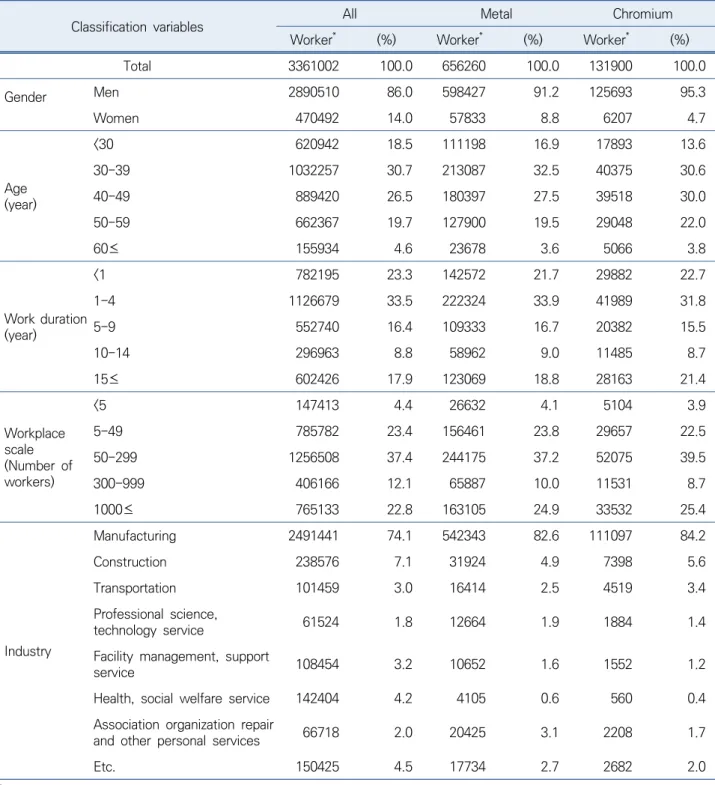
최근 11년간 유해인자별로 특수건강진단을 실시한 연 근로자수에 대해 성별, 연령, 작업 기간, 사업장 규 모, 산업별로 분류하고, 전체, 금속물질 취급 근로자(크 롬 취급근로자 포함), 크롬 취급근로자로 구분하여 연평 균으로 나타낸 분포는 Table 1과 같다. 크롬 취급근로 자는 연평균 131,900명으로 이중 남성이 95.3%, 여성 이 4.7%이며, 연령별로는 30대가 30.6%로 가장 많았 다. 작업기간은 1~4년, 1년 미만이 각각 31.8%, 22.7%
이었으며, 사업장 규모는 50~299명인 경우가 39.5%, 산업별로는 제조업이 84.2%로 가장 많았다.
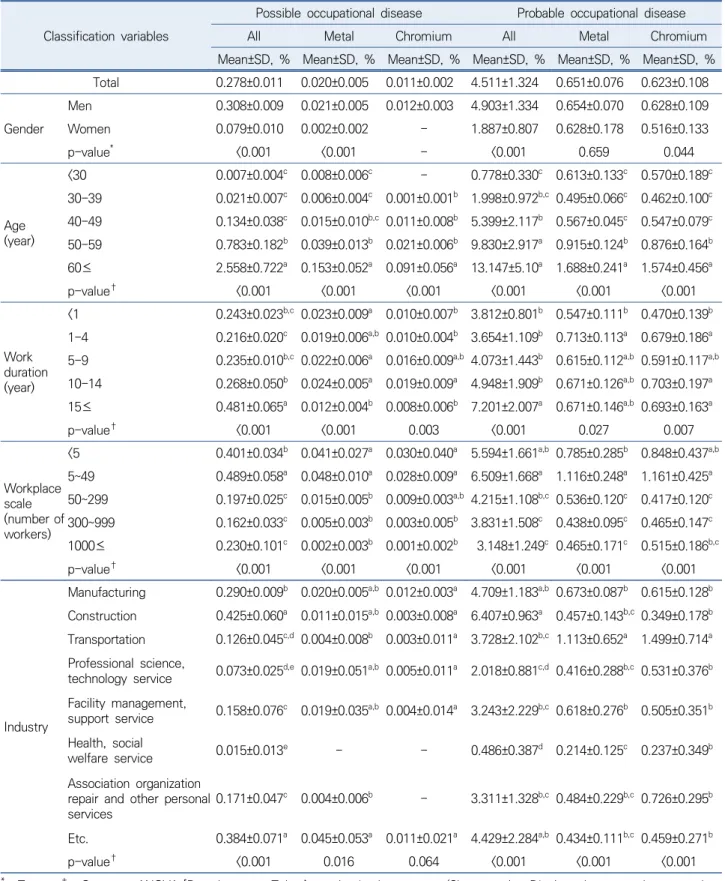
Table 2는 최근 11년간 유해인자별로 특수건강진단 을 실시한 연 근로자수 대비 직업병 유소견자 및 요관 찰자(연 근로자수)의 연평균 비율을 산정하여 성별, 연 령, 작업 기간, 사업장 규모, 산업별로 차이를 비교하였 다. 직업병 유소견자 연평균 비율은 전체근로자, 금속 물질 취급근로자, 크롬 취급근로자 각각 0.278%, 0.020%, 0.011%이며, 직업병 요관찰자 연평균 비율은 전체, 금속물질 취급 근로자, 크롬 취급근로자 각각 4.511%, 0.651%, 0.623%이다. 크롬 취급근로자는 직 업병 유소견자 연평균 비율에서 연령, 작업 기간, 사업
장 규모에 따라 유의한 차이를 보였으며, 직업병 요관 찰자 연평균 비율에서 성별, 연령, 작업 기간, 사업장 규모, 산업별로도 유의한 차이를 보였다. 또한 직업병 유소견자 및 요관찰자 연평균 비율은 남녀 모두 연령 별로 60대 이상, 작업 기간은 10~14년에서 높게 나타 났으며, 사업장 규모는 직업병 유소견자의 경우 5인 미 만, 직업병 요관찰자의 경우 5~49명인 경우에 높게 나 타났다. 산업별로는 직업병 요관찰자의 경우 운수업에 서 높게 나타났으며, 사후검정에서도 다른 업종들과 차 이를 보였다. 한편 전체, 금속물질 취급근로자와 비교 하여 크롬 취급근로자는 사업장 규모나 산업별로 직업 병 유소견자 및 요관찰자의 연평균 비율이 다른 경향 을 보였다.
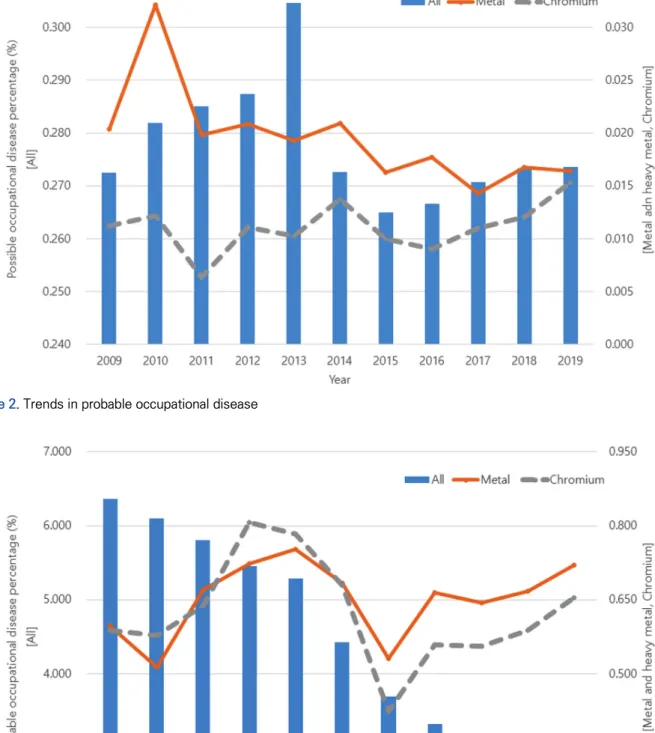
최근 11년간 특수건강진단을 실시한 연 근로자수 대비 직업병 유소견자 및 요관찰자(연 근로자수)의 연도별 비 율을 산정하여 전체 근로자, 금속물질 취급 근로자, 크롬 취급근로자로 구분하였으며, 크롬 직업병 유소견자 및 요 관찰자의 연도별 비율을 각각 Figure 2와 3에 나타냈다.
크롬 직업병 유소견자의 연도별 비율은 최근 증가하는 경 향을 보였으며, 금속물질 취급근로자는 대체로 감소하는 경향을 보였다. 크롬 직업병 요관찰자의 연도별 비율은 최근 증가하는 경향을 보였으며, 금속물질 취급근로자의 연도별 비율도 최근 증가하는 경향을 보였다. 다만 전체 근로자의 직업병 요관찰자의 연도별 비율은 매년 감소하 는 경향을 보였다. 한편 크롬 취급근로자에 대한 문헌검 토 결과에서는 전기도금, 크롬생산, 무두질 공장에서의
- Keyword
‘chromium worker’ and ‘exposure level’
- Result
101 full-text articles found in PubMed (No studies found in RISS)
60 articles excluded for the following reasons:
1) Non-occupational study
2) No Cr blood and urine outcome 3) Duplicated publication
4) Review study, etc.
- 41 articles that fit all criteria in PubMed
Figure 1. Flow chart of the summary of the study selection
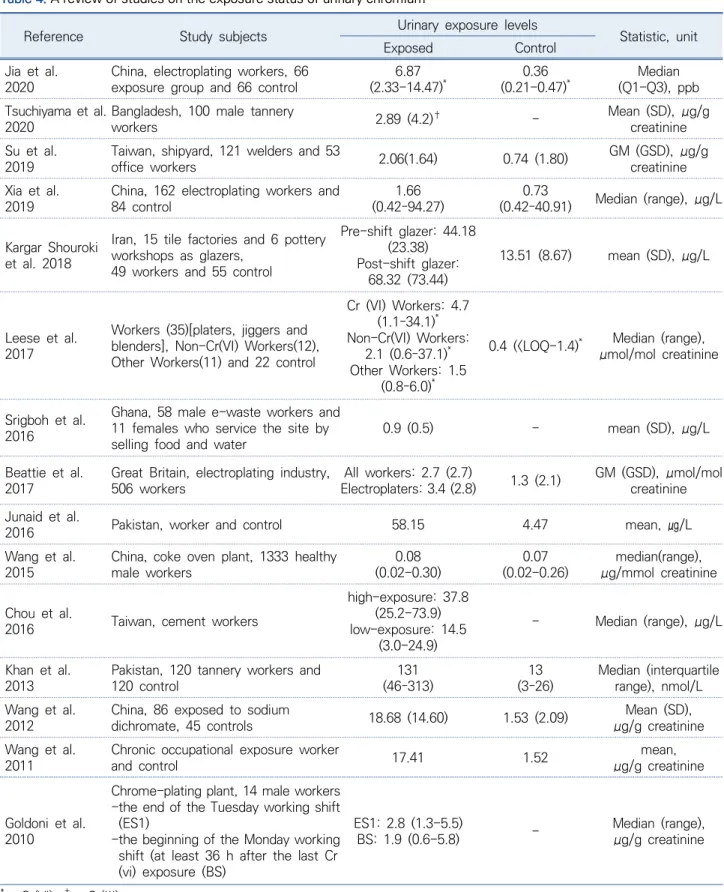
크롬에 대한 직업적 노출 보고가 많았다. 또한 혈중 및 요중 크롬 모두 대조군보다 조사군이 높게 보고되었으며, 혈중 크롬은 치과 기술자와 무두질 작업자에서 높게 나타
났고(Table 3), 요중 크롬은 타일공장이나 유리 세공소 작업자, 시멘트 작업자, 중크롬산나트륨에 노출된 작업자 에서 높게 보고되었다(Table 4).
Classification variables All Metal Chromium
Worker
*(%) Worker
*(%) Worker
*(%)
Total 3361002 100.0 656260 100.0 131900 100.0
Gender
Men 2890510 86.0 598427 91.2 125693 95.3
Women 470492 14.0 57833 8.8 6207 4.7
Age (year)
<30 620942 18.5 111198 16.9 17893 13.6
30-39 1032257 30.7 213087 32.5 40375 30.6
40-49 889420 26.5 180397 27.5 39518 30.0
50-59 662367 19.7 127900 19.5 29048 22.0
60≤ 155934 4.6 23678 3.6 5066 3.8
Work duration (year)
<1 782195 23.3 142572 21.7 29882 22.7
1-4 1126679 33.5 222324 33.9 41989 31.8
5-9 552740 16.4 109333 16.7 20382 15.5
10-14 296963 8.8 58962 9.0 11485 8.7
15≤ 602426 17.9 123069 18.8 28163 21.4
Workplace scale (Number of workers)
<5 147413 4.4 26632 4.1 5104 3.9
5-49 785782 23.4 156461 23.8 29657 22.5
50-299 1256508 37.4 244175 37.2 52075 39.5
300-999 406166 12.1 65887 10.0 11531 8.7
1000≤ 765133 22.8 163105 24.9 33532 25.4
Industry
Manufacturing 2491441 74.1 542343 82.6 111097 84.2
Construction 238576 7.1 31924 4.9 7398 5.6
Transportation 101459 3.0 16414 2.5 4519 3.4
Professional science,
technology service 61524 1.8 12664 1.9 1884 1.4
Facility management, support
service 108454 3.2 10652 1.6 1552 1.2
Health, social welfare service 142404 4.2 4105 0.6 560 0.4
Association organization repair
and other personal services 66718 2.0 20425 3.1 2208 1.7
Etc. 150425 4.5 17734 2.7 2682 2.0
*
: Number of annual workers: Aggregated based on resident registration number, date of initial health-screening, and hazard agents
Table 1. Average number of workers per year of special health-screening program by hazard agents over the last 11 years
Classification variables
Possible occupational disease Probable occupational disease
All Metal Chromium All Metal Chromium
Mean±SD, % Mean±SD, % Mean±SD, % Mean±SD, % Mean±SD, % Mean±SD, % Total 0.278±0.011 0.020±0.005 0.011±0.002 4.511±1.324 0.651±0.076 0.623±0.108 Gender
Men 0.308±0.009 0.021±0.005 0.012±0.003 4.903±1.334 0.654±0.070 0.628±0.109
Women 0.079±0.010 0.002±0.002 - 1.887±0.807 0.628±0.178 0.516±0.133
p-value
*<0.001 <0.001 - <0.001 0.659 0.044
Age (year)
<30 0.007±0.004
c0.008±0.006
c- 0.778±0.330
c0.613±0.133
c0.570±0.189
c30-39 0.021±0.007
c0.006±0.004
c0.001±0.001
b1.998±0.972
b,c0.495±0.066
c0.462±0.100
c40-49 0.134±0.038
c0.015±0.010
b,c0.011±0.008
b5.399±2.117
b0.567±0.045
c0.547±0.079
c50-59 0.783±0.182
b0.039±0.013
b0.021±0.006
b9.830±2.917
a0.915±0.124
b0.876±0.164
b60≤ 2.558±0.722
a0.153±0.052
a0.091±0.056
a13.147±5.10
a1.688±0.241
a1.574±0.456
ap-value
†<0.001 <0.001 <0.001 <0.001 <0.001 <0.001
Work duration (year)
<1 0.243±0.023
b,c0.023±0.009
a0.010±0.007
b3.812±0.801
b0.547±0.111
b0.470±0.139
b1-4 0.216±0.020
c0.019±0.006
a,b0.010±0.004
b3.654±1.109
b0.713±0.113
a0.679±0.186
a5-9 0.235±0.010
b,c0.022±0.006
a0.016±0.009
a,b4.073±1.443
b0.615±0.112
a,b0.591±0.117
a,b10-14 0.268±0.050
b0.024±0.005
a0.019±0.009
a4.948±1.909
b0.671±0.126
a,b0.703±0.197
a15≤ 0.481±0.065
a0.012±0.004
b0.008±0.006
b7.201±2.007
a0.671±0.146
a,b0.693±0.163
ap-value
†<0.001 <0.001 0.003 <0.001 0.027 0.007
Workplace scale (number of workers)
<5 0.401±0.034
b0.041±0.027
a0.030±0.040
a5.594±1.661
a,b0.785±0.285
b0.848±0.437
a,b5~49 0.489±0.058
a0.048±0.010
a0.028±0.009
a6.509±1.668
a1.116±0.248
a1.161±0.425
a50~299 0.197±0.025
c0.015±0.005
b0.009±0.003
a,b4.215±1.108
b,c0.536±0.120
c0.417±0.120
c300~999 0.162±0.033
c0.005±0.003
b0.003±0.005
b3.831±1.508
c0.438±0.095
c0.465±0.147
c1000≤ 0.230±0.101
c0.002±0.003
b0.001±0.002
b3.148±1.249
c0.465±0.171
c0.515±0.186
b,cp-value
†<0.001 <0.001 <0.001 <0.001 <0.001 <0.001
Industry
Manufacturing 0.290±0.009
b0.020±0.005
a,b0.012±0.003
a4.709±1.183
a,b0.673±0.087
b0.615±0.128
bConstruction 0.425±0.060
a0.011±0.015
a,b0.003±0.008
a6.407±0.963
a0.457±0.143
b,c0.349±0.178
bTransportation 0.126±0.045
c,d0.004±0.008
b0.003±0.011
a3.728±2.102
b,c1.113±0.652
a1.499±0.714
aProfessional science,
technology service 0.073±0.025
d,e0.019±0.051
a,b0.005±0.011
a2.018±0.881
c,d0.416±0.288
b,c0.531±0.376
bFacility management,
support service 0.158±0.076
c0.019±0.035
a,b0.004±0.014
a3.243±2.229
b,c0.618±0.276
b0.505±0.351
bHealth, social
welfare service 0.015±0.013
e- - 0.486±0.387
d0.214±0.125
c0.237±0.349
bAssociation organization
repair and other personal
services 0.171±0.047
c0.004±0.006
b- 3.311±1.328
b,c0.484±0.229
b,c0.726±0.295
bEtc. 0.384±0.071
a0.045±0.053
a0.011±0.021
a4.429±2.284
a,b0.434±0.111
b,c0.459±0.271
bp-value
†<0.001 0.016 0.064 <0.001 <0.001 <0.001
*
: T-test,
†: One-way ANOVA [Proc-hoc test; Tukey’s studentized range test (Show results: Displays the same character when the means of two populations are the same and different characteristics when the means of two populations are different)]
Table 2. One-year average proportion (%) of possible occupational disease and probable occupational disease by hazard agent
Figure 2. Trends in probable occupational disease
Figure 3. Trends in probable occupational diseases
Reference Study subjects Blood exposure levels
Statistic, unit
Exposed Control
Hu et al.
2021 China, 455 workers and 545 control 6.42
(6.08-6.79)
*1.29
(1.22-1.36)
*GM (95% CI), ㎍/L Jia et al.
2020 China, 66 electroplating workers and
66 control 7.81
(4.69-16.66)
*2.54
(0.40-4.95)
*Median (Q1-Q3), ppb Berniyanti et al.
2020 Indonesia, 40 dental technicians and
30 control 346.36
(303.78-388.94) 0.06
(0.03-0.08) Mean (95%CI), ㎍/L Bai et al.
2019 China, 171 exposure group and 120
control Female:5.75(2.06)
Male:5.65(2.86) Female:4.50(-)
Male:4.76(1.90) Mean (SD), ㎍/L Xia et al.
2019 China, 162 electroplating workers and
84 control 6.37
(0.04–58.92)
‡3.25
(0.04–25.94)
‡Median (range), μg/L Hu et al.
2017 China, chromate production plant, 25
workers and 16 control 4.837
(0.682–16.414)
*1.160
(0.300–2.392)
*Median (range),
㎍/L Junaid et al.
2016 Pakistan, worker and control 16.30 5.48 Mean, ㎍/L
Yang et al.
2016
China, chrome platers in two
enterprises, 29 electroplating exposed cases and 29 control
14.015
(2.080-41.970) 4.552
(0.240-27.980) median(range), μg/L Li et al.
2016 China, chromium-producing
factories, 262 workers and 115 control (2006, 2008, 2011):
15.6, 7.2, 6.6 (2006, 2008,
2011): 3.3, 1.8, 3.4 Median, μg/L Li et al.
2014 China, chromate production plant, 87
workers and 30 control 14.5 (33)
*4.4 (1.9)
*Mean (SD), μg/L Wang et al.
2014 China, 115 chromate production
workers and 60 control 12.45 (20.23)
§2.81 (0.48)
§Mean(SD), μg/L Ambreen et al.
2014 India, 100 tannery workers and 100
control 167.58 (23.44) 22.09 (3.78) Mean(SD), μg/L
Khan et al.
2013 Pakistan, 120 tannery workers and 120
control 569
(377–726) 318
(245–397)
Median (interquartile range),
nmol/L Halasova et al.
2012 73 welders exposed to chromium and
71 control 0.07 (0.04) 0.03 (0.007) Mean (SD), μmol/L
Zhang et al.
2011 China, 20 electroplating factories, 157
electroplating workers and 93 control 4.41
(0.93-14.98)
§1.54
(0.14-4.58)
§Mean (range), μg/L Wang et al.
2011 Chronic occupational exposure worker
and control 23.49 3.32 Mean, μg/L
Balachandar et al.
2010
India, tannery industries
72 exposed subjects [36 directly exposed (DE) subjects and 36 indirectly exposed (IE) subjects] and 36 control
DE subjects:
4.21 (3.21-10.98) IE subjects:
3.98 (2.98-11.27)
‡(2.68-9.40) 3.01
‡Mean (range), μg/L
Goldoni et al.
2010
Chrome-plating plant, 14 male workers -the end of the Tuesday working shift
(ES1)
-the beginning of the Monday working shift (at least 36 h after the last Cr(vi) exposure (BS)
ES1: 3.4 (1.2-5.8)
§BS: 1.5 (0.1-5.1)
§- Median (range), μg/L
*
: Cr(VI),
†: Cr(III),
‡: peripheral blood Cr,
§: RBC-Cr
Table 3. A review of studies on the exposure status to blood chromium
Reference Study subjects Urinary exposure levels
Statistic, unit
Exposed Control
Jia et al.
2020 China, electroplating workers, 66
exposure group and 66 control 6.87
(2.33-14.47)
*0.36
(0.21-0.47)
*Median (Q1-Q3), ppb Tsuchiyama et al.
2020 Bangladesh, 100 male tannery
workers 2.89 (4.2)
†- Mean (SD), μg/g
creatinine Su et al.
2019 Taiwan, shipyard, 121 welders and 53
office workers 2.06(1.64) 0.74 (1.80) GM (GSD), μg/g
creatinine Xia et al.
2019 China, 162 electroplating workers and
84 control 1.66
(0.42–94.27) 0.73
(0.42–40.91) Median (range), μg/L Kargar Shouroki
et al. 2018
Iran, 15 tile factories and 6 pottery workshops as glazers,
49 workers and 55 control
Pre-shift glazer: 44.18 (23.38) Post-shift glazer:
68.32 (73.44)
13.51 (8.67) mean (SD), μg/L
Leese et al.
2017
Workers (35)[platers, jiggers and blenders], Non-Cr(VI) Workers(12), Other Workers(11) and 22 control
Cr (VI) Workers: 4.7 (1.1–34.1)
*Non-Cr(VI) Workers:
2.1 (0.6–37.1)
*Other Workers: 1.5
(0.8–6.0)
*0.4 (<LOQ-1.4)
*Median (range), μmol/mol creatinine
Srigboh et al.
2016
Ghana, 58 male e-waste workers and 11 females who service the site by
selling food and water 0.9 (0.5) - mean (SD), μg/L
Beattie et al.
2017 Great Britain, electroplating industry,
506 workers All workers: 2.7 (2.7)
Electroplaters: 3.4 (2.8) 1.3 (2.1) GM (GSD), μmol/mol creatinine Junaid et al.
2016 Pakistan, worker and control 58.15 4.47 mean, ㎍/L
Wang et al.
2015 China, coke oven plant, 1333 healthy
male workers 0.08
(0.02-0.30) 0.07
(0.02-0.26) median(range), μg/mmol creatinine Chou et al.
2016 Taiwan, cement workers
high-exposure: 37.8 (25.2-73.9) low-exposure: 14.5
(3.0-24.9)
- Median (range), μg/L Khan et al.
2013 Pakistan, 120 tannery workers and
120 control 131
(46–313) 13
(3–26) Median (interquartile range), nmol/L Wang et al.
2012 China, 86 exposed to sodium
dichromate, 45 controls 18.68 (14.60) 1.53 (2.09) Mean (SD), μg/g creatinine Wang et al.
2011 Chronic occupational exposure worker
and control 17.41 1.52 mean,
μg/g creatinine
Goldoni et al.
2010
Chrome-plating plant, 14 male workers -the end of the Tuesday working shift
(ES1)
-the beginning of the Monday working shift (at least 36 h after the last Cr (vi) exposure (BS)
ES1: 2.8 (1.3-5.5)
BS: 1.9 (0.6-5.8) - Median (range),
μg/g creatinine
*
: Cr(VI),
†: Cr(III)
Table 4. A review of studies on the exposure status of urinary chromium
Ⅳ. 고 찰
특수건강진단은 작업장에서 유해요인에 노출되는 근 로자들의 직업병을 조기진단하고 예방하는 것을 목적으 로 한다(MoEL, 2019). 본 연구의 특수건강진단 결과 (2009~2019년)에서 크롬의 직업병 유소견자 연평균 비율은 0.011% 조사되었는데, Kim & Kim(2020)의 연구결과에서 보고된 납(연), 카드뮴 및 그 화합물의 직 업병 유소견자 연평균 비율(각각 0.094%, 0.085%) 보 다는 낮게 나타났다. 다만, 납과 카드뮴은 직업병 유소 견자 및 요관찰자의 추이는 감소하는 경향을 보였으나 (Kim & Kim, 2020) 크롬의 경우 2016년 이후 매년 증가하는 경향을 보이고 있고, 취급사업장 및 근로자 수 가 유해인자별 분류(금속물질) 중 가장 많다. 최근 환경 부의 ‘화학물질 통계조사 결과보고서’에 의하면 화학물 질의 종류, 유통량 및 제조량이 모두 증가하고 있고, 화 학물질별 배출량⋅위탁처리량에 대한 국내통계보고에 서 연간 크롬 및 그 화합물의 사업장내 배출량은 2009 년 7138.4㎏에서 2018년 20667.8㎏으로 2배 이상 증 가하였으며, 특히 2015년에 일시적인 감소이후 2016~
2017년에 각각 21034.7㎏, 28574.5㎏으로 배출량이 크게 증가하였다(MoE, 2019). 이는 취급근로자의 작업 환경, 보호구착용여부 및 개인위생상태와 같은 개별 작 업장의 특성과 함께 사업장내 크롬의 사용량 증가에 따 른 노출환경의 변화는 직업병 유소견자 및 요관찰자의 증가추이에도 영향을 주었을 것으로 보인다. 한편 크롬 직업병 유소견자 및 요관찰자 연평균 비율은 남녀 모두 연령별로 60대 이상, 작업 기간은 10~14년에서 높게 나타났으며, 사업장 규모는 직업병 유소견자의 경우 5 인 미만인 경우에 높게 나타났다(Table 1). 이는 크롬 취급근로자의 경우 5인 미만 소규모 사업장에서 60대 이상, 만성 노출근로자에서 직업병 유소견자가 높게 나 타나고 있음을 시사한다. 산업별로는 제조업에서 직업 병 유소견자의 연평균비율이 유의하게 높았는데 Jeong
& Ha(2018)는 2017년 작업환경측정결과에서 제조업 중 금속가공제품 제조업(기계 및 가구 제외), 기타기기 제조업(금속제품의 기계 가공), 철도장비제조업에서 크 롬과 그 무기화합물(수용성 6가, 불용성 6가)의 노출기 준 초과사례가 있고 화학물질 및 화학제품제조업, 자동 차 및 트레일러 제조업, 가구제조업, 기타제품제조업에 서는 노출기준 1/2 초과사례가 있음을 보고하였다. 크
롬 직업병 요관찰자의 경우 운수업에서 유의하게 높게 나타났는데 참고로 여객⋅화물자동차 운수업의 작업공 정중 차량정비공정의 세부 작업내용은 엔진, 변속기 등 기관정비, 프레임 등 하체정비, 용접⋅절단, 바디 성형 등 판금⋅도장작업 구분되며, 주로 크롬 노출은 크롬합 금의 용접, 절단, 그라인딩 과정에서 발생한다(Roh et al., 2007). 다만, 운수업은 직업병 요관찰자의 연평균 비율은 높은 반면에 직업병 유소견자의 연평균 비율은 상대적으로 낮게 관찰되고 있어 크롬 노출이 주로 발생 하는 차량정비공정 등에서 근로자들이 직업병 유소견자 수의 증가로 나타나지 않는 것으로 보인다.
크롬 및 그 화합물의 독성은 용해도와 화합물의 물리 적 형태에 따라 다양하게 나타나며, 최근까지 많은 조사 가 이루어져 왔다. 환경 중 높은 수준의 크롬(3가)에 대 한 노출은 상기도 자극, 심한 경우 비 중경의 종양(궤 양)을 야기할 수 있다. 직업적으로 용접 흄에 만성적으 로 노출된 근로자에게서 나타나는 크롬농도의 증가는 폐에 크롬 입자가 축적된다고 보고되었고(Roh et al., 2007), 국내에서 폐암으로 새로 진단되어 입원한 환자 중 일차 병원별 회의를 거쳐 직업병 감시체계 협의회의 작업관련성 평가에서 possible 이상으로 평가된 환례중 노출물질이 크롬인 사례도 다수이며(Kim et al., 2005), 실제로 크롬(6가) 노출이 호흡기 암의 위험을 크게 증가 시키는 것으로 나타났다(Proctor et al., 2014; Urbano et al., 2012).
Li et al.(2016)은 직업종사자의 혈중 크롬 노출수준 을 20 μg/L로 권장하였다. 본 연구의 문헌검토에서 생 물학적 노출지표인 혈중 크롬 권장 기준값을 초과하는 것으로 나타난 업종은 가죽 제조업[무두질 작업자 (167.58μg/L)]과 치과 기술자(346.36μg/L) 등이며, 요 중 크롬은 타일이나 유리 제조업, 시멘트나 중크롬산 취 급 근로자에서 높게 관찰되었다(Chou et al., 2016;
Kargar Shouroki et al., 2018; Wang et al., 2012).
다만, 이러한 결과는 국외 연구사례로 국내문헌은 검색 기간 설정범위 내에서는 일부 검색되었으나 주로 크롬 취급근로자의 작업환경중 공기중 농도에 연구들이며, 생물학적 노출지표(혈중이나 요중 크롬)에 대한 결과는 제시되지 않았다. 한편 2010년 이전 국내 연구에서 Lee & Shin(2001)은 크롬 도금공정 근로자의 전혈 및 요중 크롬농도는 각각 8.38㎍/L, 11.9㎍/L로 보고하였 고, Cha(1988)는 치과기공사 48명을 대상으로 한 연구
에서 전혈 및 요중 크롬농도는 각각 25.1㎍/L, 16.38㎍
/L로 보고한바 있다. 이상의 결과는 같은 업종이라도 연구시기 및 작업환경의 노출특성 등에 따라 취급근로 자의 노출수준에 미치는 영향요인은 다양하게 존재할 수 있어 단순 비교하는데 한계가 있다. 또한 소변중 총 크롬은 TLV-TWA에 의해 기중 호흡기영역에서 크롬 (가용성 6가)의 측정과 업무종료시점에서의 소변중 크 롬의 농도 또는 업무 중 관찰되는 소변중 크롬의 증가 사이에서 나타나는 상관성에 기초하고 있어 폐암, 임상 적인 신장 기능의 변화, 또는 피부나 호흡의 자극과 같 이 잠재적인 건강효과를 예측하지 못한다고 보고된바 있다(Roh et al., 2007).
한편 최근 연구에서 크롬의 노출은 유전적 독성과 관 련이 있고(Bai et al., 2019; Xia et al., 2019), 낮은 수준의 직업적 노출에도 DNA손상을 유발하는 것으로 보고되었다(Zhang et al., 2011). Hu et al.(2018)은 크롬(6가)의 노출이 과메틸화(hypermethylation)에 의 하여 DNA 복구 유전자 발현을 억제할 수 있다고 하였 고, Pan et al.(2018)은 전기도금회사에서 크롬(6가)에 노출된 105명의 남성 근로자를 대상으로 DNA 손상 및 지질과산화의 반응산물인 MDA(malondialdehyde)의 수준을 평가하였는데 크롬(6가) 노출 및 요중 크롬 수준 은 요중 MDA와 높은 상관관계가 있었고, 요중 크롬이 10배 증가하면 요중 MDA가 1.45배 증가하는 것으로 나타나 크롬(6가) 노출 증가가 DNA 손상과 지질의 산 화를 악화시키는 것으로 보고하였다. 국내에서는 크롬 노출에 의한 암 발생의 초기단계 변화인 세포 내 유전 독성 및 산화적 손상을 평가하고 크롬에 노출된 집단에 의 적용성 여부를 판단하기 위해 두 가지 지표 [8-OHdG(8-hydroxydeoxyguanosine) 및 지질과산 화의 반응산물인 MDA]에 대한 동물실험 연구에서 지 질과산화의 반응산물인 MDA 측정이 더 유용성이 있다 고 판단하였고(Maeng et al., 2001), Kim et al.
(2006)은 크롬의 농도증가가 메티오닌의 농도를 증가시 키는 반면, Hcy의 합성과 대사에 관여하는 SAHHase 와 cystathione-β-synthase의 활성도는 유전적으로 밀접한 관련이 있는데 크롬이 Hcy가 Met로 재합성되 는 과정에 영향을 미치고 있다고 판단하였다. 한편 우리 나라 10개 크롬도금공장의 도금작업근로자 51명을 대 상으로 크롬에 의한 유전독성을 평가하고 유전독성지표 와 환경적 폭로량 및 내적 폭로량의 상관성 등을 연구 한 자료에서는 관찰된 염색체이상빈도와 환경 폭로 및
내적 농도인 혈중 크롬농도와의 상관성은 관찰되지 않 았다고 보고하였다(Maeng et al., 1999). 이러한 결과 에도 국내에서 최근 10년 이내의 크롬 노출관련 연구는 제한적으로 확인되고 있고 이전 연구도 동물실험 연구 및 일부 유전독성에 관한 연구로 관련업종 및 취급근로 자에 대한 유전적 독성 및 관련 지표(8-OHdG 및 MDA 등)에 대한 연구가 필요하다고 판단된다.
본 연구에서 활용된 근로자 건강진단 실시결과는 실 시한 근로자수가 중복 집계될 수 있는 등 자료의 제한 점이 있고(Kim & Kim, 2020), 문헌검토 자료는 최근 국내 현황에 대한 자료를 포함하지 못하여 이후 연구에 서 함께 고려되어야 한다. 이러한 자료의 제한점에도 2016년 이후 매년 크롬 직업병 유소견자 및 요관찰자 비율의 증가경향과 최근 연구의 주요결과에서 크롬(6 가)은 유전적 독성과 DNA 복구 시스템을 방해할 수 있 는 것으로 보고되고 있어(Brooks et al., 2008;
Browning et al., 2016; Xia et al., 2019; Zhang et al., 2012), 크롬 취급근로자에 대한 취급업종, 노출수 준 및 주요 연구결과, 직업병 유소견자 및 요관찰자 추 이를 확인하는 것은 직업병 예방 관리와 향후 관련 연 구를 진행하는데 참고가 될 수 있다.
V. 결 론
최근 국내 크롬 취급근로자의 직업병 유소견자 및 요 관찰자 추이를 분석하였으며, 국내외 크롬 취급근로자 에 대한 문헌을 검토하여 관련업종 및 근로자, 최근 생 물학적 노출수준에 대한 동향, 건강영향에 대한 주요 결 과를 확인하였다.
크롬 취급근로자의 직업병 유소견자 및 요관찰자의 연도별 비율은 최근 증가하는 경향을 보였다. 직업병 유 소견자 및 요관찰자 연평균 비율은 남녀 모두 연령별로 60대 이상, 작업 기간은 10~14년에서 높게 나타났으 며, 사업장 규모는 직업병 유소견자의 경우 5인 미만, 직업병 요관찰자의 경우 5~49명인 경우에 높게 나타났 다. 산업별로는 직업병 유소견자 경우 제조업, 직업병 요관찰자의 경우 운수업에서 높게 나타났다.
이러한 결과는 국내에서 2016년 이후 사업장내 크롬 의 배출량 증가와 함께 크롬 직업병유소견자 및 요관찰 자 증가추이 등을 고려할 때 가죽제조업이나 운수업 등 관련업종 및 취급근로자에 대해서는 직업병 예방관리시 우선 대상으로 고려해야 한다. 또한 최근 10년 이내의
국내 크롬 노출관련 연구는 제한적으로 확인되고 있고 유전적 독성 및 관련 지표에 대한 연구도 함께 필요하 다고 판단된다.
감사의 글
본 연구는 순천향대학교 학술연구비 지원으로 수행하 였음.
References
Ambreen K, Khan FH, Bhadauria S, Kumar S. Genotoxicity and oxidative stress in chromium-exposed tannery workers in North India. Toxicol Ind Health 2014;
30(5):405-14
Bai Y, Long C, Hu G, Zhou D, Gao X et al. Association of blood chromium and rare earth elements with the risk of DNA damage in chromate exposed population. Environ Toxicol Pharmacol 2019;72:
103237
Balachandar V, Arun M, Mohana Devi S, Velmurugan P, Manikantan P et al. Evaluation of the genetic alterations in direct and indirect exposures of hexavalent chromium [Cr(VI)] in leather tanning industry workers North Arcot District, South India.
Int Arch Occup Environ Health 2010;83(7):791-801 Beattie H, Keen C, Coldwell M, Tan E, Morton J et al. The
use of bio-monitoring to assess exposure in the electroplating industry. J Expo Sci Environ Epidemiol 2017;27(1):47-55
Berniyanti T, Palupi R, Kriswandini IL, Bramantoro T, Putri IL. Suitability of MDA, 8-OHdG and wild-type p53 as genotoxic biomarkers in metal (Co, Ni and Cr) exposed dental technicians: a cross-sectional study. BMC Oral Health 2020;20(1):65
Brooks B, O'Brien BJ, Ceryak S, Wise Sr JP, Wise SS et al. Excision repair is required for genotoxin-induced mutagenesis in mammalian cells. Carcinogenesis 2008;28:1064-1069
Browning CL, Qin Q, Kelly DF, Prakash R, Vanoli F et al.
Prolonged particulate hexavalent chromium exposure suppresses homologous recombination repair in human lung cells. Toxicol Sci 2016;153(1):
70-78
Cha SS, A study on the heavy metals concentrations in the air of the dental laboratories, in the blood and urine of dental laboratory technicians. Journal of Technologic Dentistry 1988;10(1):11-24
Chou TC, Wang PC, Wu JD, Sheu SC. Chromium-induced skin damage among Taiwanese cement workers.
Toxicol Ind Health. 2016;32(10):1745-51
Goldoni M, Caglieri A, De Palma G, Acampa O, Gergelova P et al. Chromium in exhaled breath condensate (EBC), erythrocytes, plasma and urine in the biomonitoring of chrome-plating workers exposed to soluble Cr(VI). J Environ Monit 2010;12(2):442-7 Halasova E, Matakova T, Musak L, Polakova V, Letkova L
et al. Evaluating chromosomal damage in workers exposed to hexavalent chromium and the modulating role of polymorphisms of DNA repair genes. Int Arch Occup Environ Health 2012;85(5):
473-81
Hu G, Li P, Cui X, Li Y, Zhang J et al. Cr(VI)-induced methylation and down-regulation of DNA repair genes and its association with markers of genetic damage in workers and 16HBE cells. Environ Pollut 2018;238:833-843
Hu G, Long C, Hu L, Xu BP, Chen T et al. Circulating lead modifies hexavalent chromium-induced genetic damage in a chromate-exposed population: An epidemiological study. Science of the Total Environment 2021;752:14182
Hu G, Wang T, Liu J, Chen Z, Zhong L et al. Serum protein expression profiling and bioinformatics analysis in workers occupationally exposed to chromium (VI).
Toxicol Lett 2017;277:76-83
Jia J, Li T, Yao C, Chen J, Feng L, Jiang Z et al. Circulating differential miRNAs profiling and expression in hexavalent chromium exposed electroplating workers. Chemosphere 2020;260:127546
Junaid M, Hashmi MZ, Malik RN. Evaluating levels and health risk of heavy metals in exposed workers from surgical instrument manufacturing industries of Sialkot, Pakistan. Environ Sci Pollut Res Int 2016;
23(18):18010-26
Jeong EG, Ha GC. Development of occupational and industrial health guide and occupational health summary for manufacturing plan. Occupational Safety and Health Research Institute Research.;
2018. p. 190-443
Kargar Shouroki F, Shahtaheri SJ, Golbabaei F, Barkhordari A, Rahimi-Froushani A. Biological Monitoring and Lung Function Assessment among Workers Exposed to Chromium in the Ceramic Industry. J Res Health Sci 2018;18(1):e00408 Khan DA, Mushtaq S, Khan FA, Khan MQ. Toxic effects of
chromium on tannery workers at Sialkot (Pakistan).
Toxicol Ind Health 2013;29(2):209-15
Kim KW, Kim KS, Park IJ, Kang SK, Oh SS et al. Effects of occupational chromium exposure on plasma homocysteine, folate and vitamin B12 concentration.
J Korean Soc Occup Environ Hyg 2006;16(2):2 45-253
Kim NS, Kim YB. Relationship of Follow-up Management, Trend of Possible Occupational Disease and Probable Occupational Disease: Focusing on Lead or Cadmium Workers. J Korean Soc Occup Environ Hyg 2020;30(4):378-386
Kim JI, Kim JH, Kang DM, Kim JW, Kim JE et al.
Epidemiologic characteristics of occupational lung cancer in the Busan area. Korean J Occup Environ Med, 2005;18(1):53-58
Lee JT, Shin YC. Relationship between worker’s exposure to airborne chromium and blood and urine chromium levels in plating process. J Korean Soc Occup Environ Hyg 2001;27(3):1-10
Leese E, Morton J, Gardiner PHE, Carolan VA. The simultaneous detection of trivalent & hexavalent chromium in exhaled breath condensate: A feasibility study comparing workers and controls. Int J Hyg Environ Health 2017;220(2 Pt B):415-423 Li Y, Li P, Yu S, Zhang J, Wang T et al. miR-3940-5p
associated with genetic damage in workers exposed to hexavalent chromium. Toxicol Lett 2014;229(1):
319-26
Li P, Li Y, Zhang J, Yu SF, Wang ZL et al. Establishment of a reference value for chromium in the blood for biological monitoring among occupational chromium workers. Toxicol Ind Health 2016;32(10):1737-44 Maeng SH, Yu IJ, Kim HY, Lee KS, Im CH et al. A study
on genetic and oxidative damage by metallic compounds. Occupational Safety and Health Research Institute Research.; 2001. p. 33-34 Maeng SH, Lee YM, Yu IJ, Im CH, Lee KY et al. A study
on the genotoxicity of industrial chemicals -Chromosomal rearrangements in chromium exposed workers using fluorescence
in situhybridization(FISH). Occupational Safety and Health Research Institute Research.; 1999. p. 33-34 Ministry of Employment and Labor(MoEL). Results of
workers' health examination in 2016.; 2016. p.
41-173
Ministry of Employment and Labor(MoEL). Results of workers' health examination in 2019.; 2019. p.
39-171
Ministry of Employment(MoE). Results report for chemicals statistic survey; 2019 [Accessed 2021 July 27]. Available from: https://kosis.kr/statistics
List/statistics ListIndex.do?menuId=M_01_01&vwcd=
MT_ZTITLE&parmTabId=M_01_01&outLink=Y&ent rType=#content-group
Nickens KP, Patierno SR, Ceryak S. Chromium genotoxicity: a double-edged sword. Chem Biol Interact 2010;188:276-288
Pan CH, Jeng HA, Lai CH. Biomarkers of oxidative stress in electroplating workers exposed to hexavalent chromium. J Expo Sci Environ Epidemiol 2018;28(1):
76-83
Proctor PM, Suh M, Campleman SL, Thompson CM.
Assessment of the mode of action for hexavalent chromium-induced lung cancer following inhalation exposures. Toxicology 2014;325:160-179
Roh JH, Won JU, Choi HC, Cho KH, Kim CN. A study on plans for applying BEI of chemicals in Korea. Ulsan;
Occupational Safety and Health Research Institute Research.; 2007. p. 209-224
Srigboh RK, Basu N, Stephens J, Asampong E, Perkins M et al. Multiple elemental exposures amongst workers at the Agbogbloshie electronic waste (e-waste) site in Ghana. Chemosphere 2016;164:
68-74
Su TY, Pan CH, Hsu YT, Lai CH. Effects of Heavy Metal Exposure on Shipyard Welders: A Cautionary Note for 8-Hydroxy-2'-Deoxyguanosine. Int J Environ Res Public Health 2019;16(23):4813
Tsuchiyama T, Tazaki A, Hossain MM, Yajima I, Ahsan N et al. Increased levels of renal damage biomarkers caused by excess exposure totrivalent chromium in workers in tanneries. Environmental Research 2020;188:109770
Urbano AM, Ferreira LM, Alpoim MC. Molecular and cellular mechanisms of hexavalent chromium- induced lung cancer: an updated perspective. Curr Drug Metabol 2012;13:284-305
Wang TC, Feng WY, Kuang D, Deng QF, Zhang WZ et al.
The effects of heavy metals and their interactions with polycyclic aromatic hydrocarbons on the oxidative stress among coke-oven workers. Environ Res 2015;140:405-13
Wang TC, Jia G, Zhang J, Ma YH, Feng WY et al. Renal impairment caused by chronic occupational chromate exposure. Int Arch Occup Environ Health 2011;84(4):393-401
Wang TC, Jia G, Zhang J, Ma YH, Liu LZ et al. Vitamin B12
and folate deficiency and elevated plasma total
homocysteine in workers with chronic exposure to
chromate. Occup Environ Med 2011;68(12):870-5
Wang TC, Jia G, Song YS, Zhang J, Ma YH et al. Effects
of chronic chromate exposure on human serum prostate specific antigen: a cross sectional study.
Ind Health 2012;50(2):95-102
Wang TC, Song YS, Yu SF, Zhang J, Wang H et al.
Association of folate deficiency and selected tumor marker concentrations in long-term hexavalent chromium exposed population. Int J Hyg Environ Health 2014;217(1):88-94
Xia H, Ying S, Feng L, Wang H, Yao C et al. Decreased 8-oxoguanine DNA glycosylase 1 (hOGG1) expression and DNA oxidation damage induced by Cr (VI). Chem Biol Interact 2019;299:44-51 Yang L, Xia B, Yang X, Ding H, Wu D et al. Mitochondrial
DNA hypomethylation in chrome plating workers.
Toxicol Lett 2016;243:1-6
Zhang XH, Zhang X, Wang XC, Jin LF, Yang ZP et al.
Chronic occupational exposure to hexavalent chromium causes DNA damage in electroplating workers. BMC Public Health 2011;11:224
Zhang XH, Zhang X, Zhang L, Chen Q, Yang Z et al. XRCC1 Arg399Gln was associated with repair capacity for DNA damage induced by occupational chromium exposure. BMC Res. Notes 2012;5:263
<저자정보>
박상일(박사과정), 김남수(연구부교수), 황보영(교수), 김화성(교수), 이성수(교수), 김용배(교수)