Electroexplosive Technology of Nanopowders Production:
Current Status and Future Prospects
Young-Soon Kwon, Jin-Chun Kim, Alexander P. Ilyin
a, Olga B. Nazarenko
a,* , and Dmitry V. Tikhonova
Research Center for Machine Parts and Materials Processing, School of Materials Engineering, University of Ulsan, San-29, Mugeo-2Dong, Nam-Ku, Ulsan 680-749, Korea
a
Tomsk Polytechnic University, Lenin str. 30, 634050, Tomsk, Russia
(Received January 12, 2012; Revised January 26, 2012; Accepted February 5, 2012)
···
Abstract The current situation of the nanopowders production technology based on the process of electrical explo- sion of wires is described. The advantages and disadvantages of the electroexplosive technology are indicated. The results of studies characterizing the effect of the electrical explosion conditions on the nanopowders properties are pre- sented, including latest results: conditions of nanopowders passivation, conditions of nanopowders production having narrow size distribution, the methods of nanopowders diagnostic and standartization. In addition, the application and area of future research on this technology are proposed.
Keywords: Nanopowder, Electrical explosion of wires, Particles characterization
···
1. Introduction
The electrical explosion of wires (EEW) is a process of explosive destruction of a metal wire under the action of great density current (>10
10A/m
2). This process is accompa- nied by scattering products, shock waves and electromag- netic radiation. EEW is characterized by the following peculiarities: time of explosion is 10
−5…10
−8s; tempera- ture at the moment of explosion can reach the value more than 10
4K, pressure ~10
9Pa; velocity of product reces- sion is from 1000 to 5000 m/s. Material of the wire trans- mutes into the nanoscale particles (< 100 nm) in accordance with certain conditions. Extremely nonequi- librium conditions of EEW cause some unusual proper- ties of nanopowders. They are steady against oxidation and sintering at room temperature and characterized with high diffusion activity at the heating.
The EEW technology allows producing nanopowders of metals, alloys, intermetallic compounds, and chemical compounds depending on working ambient in the dis- charge chamber. EEW in inert gases or hydrogen is used
to produce powders of metals, alloys, and intermetallic compounds. EEW in chemically active ambient is used to produce nanopowders of chemical compounds of metals.
The following nanopowders were obtained by EEW: Ag, Al, Cu, Fe, Ni, Ti, W, Mo, Fe-Ni, Pb-Sn, Cu-Zn, Ni-Cr, Al-Cu, Al-B, W-Al, Cu-Ni, Ni-Ti, Al
2O
3, CuO, AlN, W
2C, WC, TiC, etc [1-11].
Technology of nanopowders production based on the phenomenon of EEW has been developed intensively in the last 30 years both in Russia, particularly in Tomsk Polytechnic University, and abroad. The most significant results of our studying the process of EEW as a method for metal and chemical compounds nanopowders produc- tion is presented in this paper.
2. Electrical Explosion of Wires General Aspects 2.1. Advantages of the electroexplosive technology
The method of EEW has a lot of advantages compared to others [1-3]:
●
The important advantage of the electroexplosive tech-
*Corresponding Author : O. B. Nazarenko, TEL: +7-3822-563784, FAX: +7-3822-563650, E-mail: [email protected]
nology is the possibility of the control over the prop- erties of the EEW products, including particles size, phase and chemical composition of nanopowders by means of electrical parameters.
●
This method is characterized with low energy consumption-less than 10…20 kWh/kg, due to direct heating of the wire by electric current without addi- tional heating equipments and due to high heating rate (> 10
7K/s) that provides adiabatic conditions of energy transmission to the wire.
●
The productivity is high enough: the output of nanop- owders on the basis of aluminium wires explosion is 50 g/h, on the basis of tungsten wires explosion − 300 g/h.
●
The electroexplosive technology, unlike other tech- nologies, allows using the same installation to pro- duce nanopowders of metals, alloys, intermetallic compounds, and chemical compounds depending on working ambient in the discharge chamber.
●
The electroexplosive technology is environmentally benign one: the process of nanopowder production is carried out in closed chamber, there is no technologi- cal emission.
2.2. The process of EEW
Electrical explosion of wires is a process of explosive destruction of a metal wire under the action of great cur- rent density (> 10
10A/m
2). This process is accompanied by scattering products, shock waves and electromagnetic radiation. Material of the wire transmutes into the parti- cles of nanosized range in accordance with certain condi- tions. EEW is characterized by the following peculiarities:
time of explosion is 10
−5…10
−8s; temperature at the moment of explosion is more than 10
4K, pressure ~10
9Pa; velocity of product recession is 1…5 km/s.
The process of EEW includes the following stages:
heating of metal in solid state, melting, heating of fluid metal before beginning vaporization, expansion of wire material, scattering of primary products and formation of the final particles.
2.3. Nonequilibrium state of EEW products
The formation of nanosized particles in EEW process occurs in the presence of strongly non equilibrium condi- tions – the large gradients of temperature and speeds of
cooling (> 10
7K/s), intensive heat transfer and mass transfer, ionization, mixture, influence of electric and magnetic fields. The extreme conditions of EEW process provide thermodynamically nonequilibrium structure of metal nanopowders and at the same time it is enough steady structure and presence of the excess stored energy [12, 13].
During the fast explosion a metal wire proceeds to a non-equilibrium state which is characterized by two types of non-equilibrium: the phase and temperature non-equi- librium state. The thermal nonequilibrium is that the result of passing an electric current through a metal wire and its destruction an excitation of the electronic sub- system occurs (to a temperature of 10
6K), but the atomic subsystem is colder (10
4K). The phase nonequilibrium is that the primary products are vapor (clusters), plasma and overheated liquid drops, which cannot coexist under equilibrium conditions (Fig. 1).
3. The Methods for Regulation of EEW-nanopowders Characteristics
Nanoparticles produced by EEW have spherical shape;
at the same time nanopowders are polydisperse systems
[1, 3]. The range of particles size of the electroexplosive
nanopowders is rather wide: from 5·10
−9to 10
−3m. Pow-
der dispersiveness is one of the most important parame-
ters that determines their technical characteristics (packed
density, flow rate, slope angle, reaction capacity and oth-
ers), and their range of use. At the decreasing of metal
Fig. 1. The energy intensity of processes at the action of
concentrated energy flow on aluminum.
particles size less than 100 nm their reactivity increases but the metal content in particles decreases simulta- neously. For instance, the content of metal aluminum in products of electrical explosion of aluminum wires in the medium of hydrogen is 93.4% for nanopowder with aver- age surface particle diameter 290 nm and 86.3% for nan- opowder with average surface particle diameter 120 nm.
Another problem of the nano-state is the nanopowder agglomeration caused the active particle surfaces. Nanop- owders with particle sizes less than 30 nm are unstable toward oxidation, sintering, and agglomeration. In inert media nanopowders of such size sinter at room tempera- ture by a diffusion mechanism, and in chemically reac- tive media they interact with the explosion. Thus, the problem of finding the conditions of producing nanopow- ders that provide high dispersiveness and narrow particle size distribution within 30…60 nm is topical.
3.1. Effect of synthesis conditions on the EEW-nanop- owders characteristics
The dispersiveness and other characteristics of nanopo- wders depend on all conditions of explosion – firstly, on the electrical parameters (energy consumed by wire before explosion, energy of arc stage, the velocity of energy input or power density [1-3]. The nature of wire metal and its geometry (length and diameter of wire), micro- structure and substructure of wire metal, environmental properties – pressure and kind of gas, density (viscosity) also have influence on the dispersiveness and other prop- erties of nanopowders. Besides, the properties of electro- explosive nanopowders are highly dependent on the conditions of passivation [14-16].
It is consider that the specific energy consumption of exploding wire or the ratio e / e
sis the most important parameter determining the degree of nanopowder disper- siveness and the particle size distribution function [1-3].
The specific energy consumption or the reached over- heat e / e
sis a ratio of volume density of energy e to energy of sublimations of wire material e
s; e – is a ratio of the energy consumed by wire before explosion to ini- tial volume of the wire.
The degree of dispersiveness of nanopowder can be evaluated using such characteristics as specific surface area S
spand average surface diameter
s= 6/ ρS
sp.
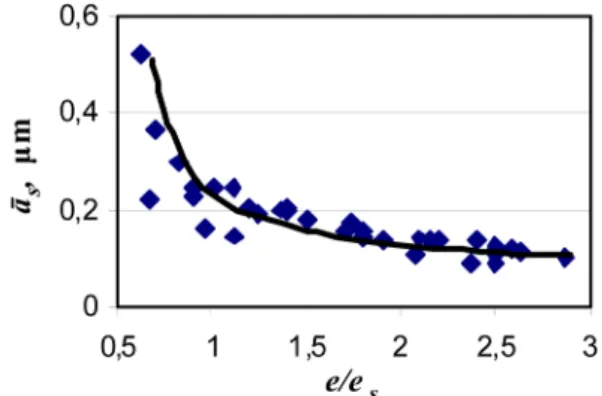
The size of particles produced by EEW decreases with
increasing the the energy input in the wire (Fig. 2), and the particle size distribution becomes narrower. If the value of energy input in the wire increases from 0.8 to (1.6…1.8) e
s, the average surface diameter decreases rap- idly. With further increase in the value of energy the rate of decrease of the diameter slows down, and the process of obtaining nanopowders by means this parameter becomes energetically inefficient.
The arc stage of electric discharge provides additional dispersing effect on the primary products of wires explo- sion [8, 9].
Working gas in discharge chamber at high pressure has a compression effect on explosion product and causes their sintering and coagulation. That is why the particles diameter increases (Fig. 3) if the value of gas pressure increases [2, 3, 9].
The dispersiveness of EEW products increases with the decreasing the wire diameter [2, 3]. However, in this case the product yield significantly decreases. It should be noted that for metal nanoparticles, the particle diameters of 30…10 nm are critical ones, because smaller particles
a
Fig. 2. Dependence of the average surface diameter of aluminum and copper particles on specific energy consumption.
Fig. 3. Dependence of the average surface diameter of particles on the pressure (electric explosion of copper wire in argon,
e / e
s= 1.2).
sinter at room and even lower temperatures.
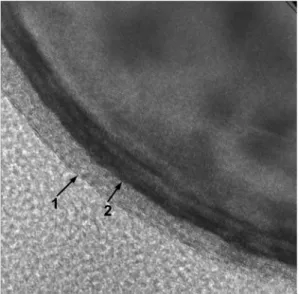
Metal nanopowders produced by EEW in chemically inert gases have the adsorbed layer of working gas on the particles surface (Fig. 4) which does not let the particles contact and keeps them from sintering for a long period of time till the contact with air. Maximal thickness of oxide-hydroxide layer for particles with diameter 30…50 nm is not more than 7…8 nm, and for particles with diameter 100 nm: 3…4 nm. Passivation by slow oxida- tion in air without heating of nanoparticles enables to form the oxide-hydroxide layers. At the increase of nan- opowder dispersiveness the oxides content grows up, due to that the content of unoxidized metals has threshold value depending on diameter: there is an extremely high increase of the oxidation products content at diameter less than 50…60 nm.
The process of passivation may be carried out just directly in the process of explosion; at that the pyro- phoric property of powders reduces as well as the time required for passivation, technological process is simpli- fied. Addition of chemically active gases (O
2or N
2) (5…30 vol.%) to argon during EEW leads to the forma- tion of passivating films on the particles and to the increase in the dispersiveness of obtained powders [7, 14]. In that case the decrease of the particles size hap- pens because of reduction of agglomeration and sinter- ing at the scattering and cooling the EEW products. At the same time it is observed the considerable decrease of aluminum content in nanopowder particles – up to 70…80
wt.%.
The effect of little addition of air (0.5…30 vol.%) in argon using as working medium during electrical explo- sion of copper wires on dispersed, phase and chemical compositions of nanopowders was investigated [7]. Nan- opowders having the highest dispersiveness were pro- duced at the air content 1…2 vol.%: S
sp= 10.5…11 m
2/g that is corresponding to the average particle diameter 60..65 nm. The dependence of the specific surface area of the obtained samples on the air content in the gas mix- ture is shown in Fig. 5.
The refractory compound layers of copper oxide on metal surface of particles prevent the coagulation of par- ticles. An increase of the air content in gases mixture during EEW leads to a reduction in the metal content and to a change of the phase composition.
The output of the Cu-EEW products in the mixture of argon and air depending on the content of air is shown in Fig. 6.
The primary disperse particles formed in the explosion particles react with oxygen in the process of recession Fig. 4. TEM images of aluminum nanoparticle passivated by
air: 1-oxide-hydroxide layer; 2-heavy metal impurities layer.
Fig. 5. Specific surface area of Cu-EEW products in the mixture of argon and air.
Fig. 6. The output of Cu-EEW products in the mixture of
argon and air.
and cooling of primary EEW-products they react with air oxygen and under deficiency in oxygen and higher tem- perature the layer of copper oxide Cu
2O forms (T
melt= 1235ºC) on the particles surface. At the increase of the oxygen content in surrounding gas (in case of air content 5 vol.% and more) Cu
2O oxidizes to CuO in the process of cooling at lower temperature; CuO is less stable than Cu
2O and resolves at temperature more than 1000ºC. The duration of coagulation grows up that results in lower dispersiveness of nanopowders at the increasing of air content in argon more than 10…20 vol.% : S
sp= 8.8 m
2/g.
The interaction of dispersed metal with working ambi- ent during EEW can be used for synthesis of chemical compounds in nanoscale range. The density of reactants is much higher during wire explosions in condensed media compared to explosions in gases. That fact allows the chemical compounds output to be increased and their phase composition to be changed [3, 5, 6, 10].
The effect of the EEW energy parameters, density and dynamic viscosity of surrounding ambient, elemental composition of hydrocarbons (C/H ratio in hydrocarbon molecules) on the phase compositions of nanopowders prepared by electrical explosion of tungsten, titanium and aluminium wires in liquid hydrocarbons was investi- gated [3, 5, 6]. Hexane C
6H
14, decane C
10H
22, benzene C
6H
6, and toluene C
6H
5CH
3were used as working sur- rounding ambient for EEW. Hydrocarbons were taken as reagents because they can give active atoms of carbon during thermodestruction.
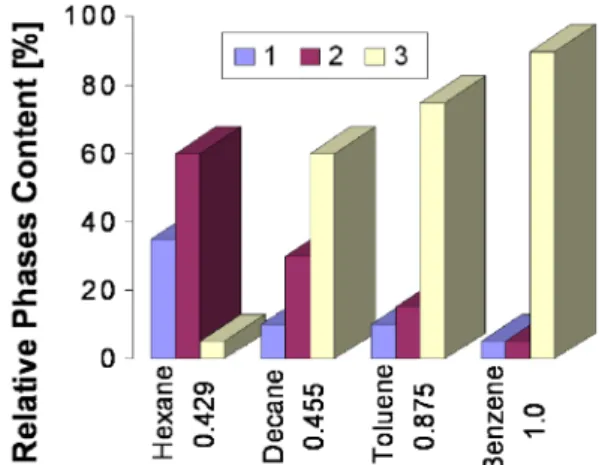
According to the X-ray data, powders prepared by EEW in liquid hydrocarbons contain the carbides phases
and residual metal. Fig. 7 shows the qualitative composi- tion of tungsten EEW products for the indicated liquid hydrocarbon types and the energy input into the wire of
~1.2 e
s. It can be seen from Fig. 7 that the tungsten car- bide WC
1−xoutput increases upon increasing the C/H ratio and the liquid hydrocarbon density, whereas the metallic tungsten content in the products decreases.
The influence of the input energy on the phase and ele- mental composition of EEW products was studied using decane C
10H
22as a working ambient. According to the X-ray data, the main product of the tungsten EEW in decane was carbide WC
1–x. Even for the maximum con- sumed energy ( e / e
s= 1.2), the main phase of tungsten carbide remains the phase WC
1–xdeficient in carbon.
The comparison between the formation of aluminium, tungsten, and titanium carbides produced by EEW showed that the output of the chemical compounds depends on their thermal stability. WC and TiC are more stable com- pounds than Al
4C
3. WC content in the explosion product is higher, TiC as well. The main product of aluminum EEW in decane is metal aluminum even at sufficiently high level of the input energy ( e / e
s= 1.5). The relative content of Al
4C
3does not exceed 40%.
Fig. 8 shows the intensities of 100%-X-ray diffraction patterns of Al
4C
3, WC and TiC produced by EEW in decane.
Low output of aluminum carbide prepared by EEW can be explained by the temperature dependence of ∆G on the formation reaction of Al
4C
3. The temperature at which aluminum carbide remains stable is limited to tem- peratures lower than 3000 K. During aluminum EEW in
Fig. 7. Relative contents of W (1), W
2C (2), and WC
1–xphases (3) in tungsten EEW products having different C/H ratios.
Fig. 8. Dependence of the relative contents of Al
4C
3(1),WC
(2) and TiC (3) phases in the products of EEW in decane on
the energy input in the wire.
decane, the chemical reaction takes place due to diffu- sion of carbon atoms into the aluminum particle at tem- peratures below the boiling point of aluminum (2720 K):
4Al
(liquid)+ 3C
(gas)= Al
4C
3(solid). In the course of this reac- tion, a continuous carbide layer is formed on the metal particle surface, thereby limiting the diffusion of carbon atoms into the metal.
The maximum temperature at which WC and TiC remain stable is much higher than that for the aluminum ones. A decrease in ∆G is observed at ~3000 K. The particle morphology demonstrates the feasibility of forming tung- sten carbides in the liquid phase, because the spherical particles have smooth surfaces. Hence, it follows that tungsten carbides are formed at temperatures exceeding their melting point (for example, T
melt~ 3130 K for W
2C) through the diffusion of carbon atoms into the liquid tung- sten particle: 2W
(liquid)+ C
(gas)= W
2C
(liquid). The fact that the main product of tungsten EEW in liquid hydrocarbons is nonstoichiometric tungsten carbide WC
1−xcan be explained by the high concentration of active carbon atoms in the chemical reaction and by fast cooling of the prepared powders. It is known that WC
1–xremains stable at tem- peratures exceeding 2800 K. Thus, the higher output of tungsten carbide nanopowders is a consequence of their higher thermal stability relative to those of Al
4C
3. The similar explanation can be given for the high output of titanium carbides in EEW.
Powders produced by electrical explosion of alumin- ium wires in water are different crystal modifications of aluminium oxides [2-4]. The content of oxide-hydrox- ides phases is defined by initial conditions of explosion and first of all, by value of the energy, input into wire.
The main product formed by the electrical explosion of aluminium wire in water at specific energy less than sub- limation energy is aluminium hydroxide, and at specific energy more than e
sis low-temperature modification γ - Al
2O
3. A content of residual aluminium decreases with the rise of energy consumed by wire. A drastic decrease of residual aluminium is observed in the range e / e
s~0.9…1.1. Formation of size composition is the result of two mechanisms: dispersion of liquid metal and conden- sation of vapor phase.
Peculiarity of water as an oxidation-reduction environ- ment is the formation of lower oxides at electrical explo- sion of wires made of metals having multiple oxidation
states, such as iron or titanium. Unlike aluminum, which is characterized by the degree of oxidation of only three, the iron can form compounds Fe
+3and Fe
+2, and the tita- nium can form compounds Ti
+4and Ti
+3[3, 10].
3.2. The design of installation for nanopowders pro- duction
The design of a discharge chamber also plays an impor- tant role in the formation of powders in the process of EEW. Improvement of EEW-technology was directed at reliability and productivity growth of equipment, as a result of this an industrial installation UDP-4G has been developed in High Voltage Institute at Tomsk Polytech- nic University and now operates successfully. This instal- lation was designed for producing nanopowders of pure metals and chemical compounds by EEW in gaseous working ambient. UDP-4G became widespread in many countries: South Korea, China, Germany, and United States of America. The installation UDP-4G at Univer- sity of Ulsan (South Korea) is shown in Fig. 9. At the Research Centre Karlsruhe, the production of nanopow- ders generated during EEW was investigated at a capaci- tive facility DEMON-2 [17].
The scheme of installation UDP-4G is shown in Fig. 10.
Carried out investigation showed that state-of-the-art requirements to nanopowder quality specification can not be realized in powder produced at present experimental- industrial installations like UDP-4G. Not enough atten- tion was given to the problem of the powder quality improvement.
After explosion there are multiple reflections of shock waves from the chamber sides in discharge chamber 8 of installation which result in supplementary non-adiabatic
Fig. 9. Installation UDP-4G (University of Ulsan).
compression of the explosion products and their tempera- ture rise. This process results in thermal reflow and addi- tional evaporation of the particles, their sintering and coagulation.
Essential disadvantage of the installation UDP-4G is compression of EEW-product flow in a tube connecting the explosive chamber and the powder collector 12. Parti- cle number density increases during this process, possi- bility of agglomeration increases very much.
The used filter design at the installation UDP-4G causes that the particles of fine fraction are taken away along with gas flow before they have time to settle in powder collector. Another design defect of UDP-4G is unsuccess- ful location of the powder collector, which is dead end for particles on movement of shock wave after electrical explosion; as a result powder is exposed to multiple shock loads and compacts. At production of 100 gram of nanopowder the level of agglomeration is less then at production of 500 gram [18]. Upon an influence shock load the nanopowders sinter and form easily broken structure. Size of the agglomerates can reach 100 ìm and more, but after rubbing of the agglomerated powder through different meshes their sizes correspond to sizes of holes in mesh (Fig. 11).
Mentioned design disadvantages were eliminated at development of the installation UDP-5 [12, 19] on basis of estimation calculation, results of investigation and lit- erature data [20]. Principal scheme of the installation
UDP-5 is shown in Fig. 12.
The discharge chamber opposite inter-electrode gap has perforation. Attached to perforation holes in front of inter-electrode gap the special tubular gas pipes take out the explosion products into the gas separation unit and powder collector. Total flow area of perforation holes ratio to discharge chamber area according to [18] is not less than 0.6. This engineering solution allows avoiding of increasing the temperature of expanding explosion product, their vaporization, melting, and agglomeration under effect of reflected shock waves.
The long tubular pipes for transportation of EEW-prod- ucts are used in UDP-5 in contrast to UDP-4G, in which Fig. 10. Principal scheme of installation UDP-4G: 1-power
supply unit; 2-control panel; 3-high-voltage cable; 4-current shunt; 5-high-voltage input chamber; 6-insulators; 7- discharge switch; 8-discharge chamber; 9-wire mechanism driving; 10- ventilator; 11-filter; 12-collector of nanopowder; 13-forepump;
14-gas-cylinder; 15-exhaust ventilation pipeline; 16-exploding wire; 17-grounded electrode; 18-manometer; 19-motor; 20- forepump control panel; 21-gas fitting.
Fig. 11. Images of agglomerates after rubbing of aluminum powder through mesh (100 µ m): (a) powder produced at TPU, HVRI, lab 14, (b) CETC, Tomsk (optical microscope
“Biolam” x60).
Fig. 12. Principle scheme of the installation UDP-5: 1- discharge
chamber, 2-exploding wire, 3-high-voltage electrode, 4- grounded
electrode, 5-power supply unit, 6-wire mechanism driving, 7
-gas filling system, 8-ventilator, 9-gas pipeline, 10-tubular gas
outlets, 11-unit of gas separation and powder collector, 12-
expansion box, 13-powder collector.
the processes of shock waves suppression and size sepa- ration of particles happen. The tubular gas pipes between the discharge chamber and the unit of gas separation and powder collector provide more uniform distribution of EEW products in surroundings. Particles temperature decreases during their flow through long tubes and prob- ability of particles coagulation becomes lower.
The unit of gas separation and powder collector is made in the form of the expansion boxes successively connected through the branch pipes. Each expansion box is provided with a powder collector with special size ratio [19]. Larger powder fraction separate and settle down in the process of passing through the expenders.
The comparison characteristics of nanopowders pro- duced in the industrial installation UDP-4G and in the model of the installation UDP-5 was made in [18]. Pow- ders were produced by electrical explosion of aluminum wires at following conditions: the wire diameter 0.3 mm, the specific energy consumption e / e
s= 1.6. Size of agglomer- ates decreases from 60…130 µ m to 2.3 µ m, and their content in powder decreases from 60 to 6%.
4. The Application of Nanopowders and Future Research
Our future research will focus on more detailed study- ing the process of EEW, on the further development of technology for production of nanopowders, on the experi- mental studies and selection of the most effective appli- cations of nanopowders.
Actual problem is to find ways to stabilize the nanopar- ticles. The organic compounds decompose before nanopo- wders are beginning to oxidize, so they do not protect them from oxidation. The process of passivation of metal nanop- owders by inorganic films or coatings will be studied.
The particle separation problem is not solved yet, as the problem of nanopowders production with a narrow size distribution. Our attention will be given this matter.
Study of biological effect of nanopowders in order to promote them in the technology and to develop biologi- cally active agents is a very interesting subject.
Search for new applications of powders is also the sub- ject of our research. Already now nanopowders find practical application in the following areas: environmen- tal protection and remediation, catalysis, organic synthe-
sis, ceramics, production of cutting tool, wear-resistant parts and coatings, lubricants and additives.
Promising areas of nanopowders application are the following:
●
Energy supplements in propellants and pyrotechnics, and therefore the problem of increasing the stability of the powders with respect to oxidation appears.
●
Additives in varnishes and paints, including for vehi- cles (to increase impact strength, wear resistance).
●
Hydrogen production in mobile devices.
●