수요자 맞춤형 임대주택단지의 커뮤니티 공간 평가항목에 관한 연구
- 서울시 사례를 중심으로 -
A Study on the Community Space Evaluation Items of Consumer Customized Public Rental Housing in Case of Seoul
오정은* 이재훈**
Oh, Jeong-Eun Lee, Jae-Hoon
Abstract
As increasing demand for the living environment to promote social health, this study focused on consumers customized rental housing community space. Set the community spatial planning objectives and strategies shown in previous studies to the conceptual model for evaluation of community space. Based on the planning methods and standards of consumers custom community facilities, we analyzed the Seoul consumer customized public rental housing nine cases. Because almost located in the small vacant lot, they had limitations as a base for the local community. Nevertheless, through the arrangement of the building, Child care households increase the chance of contact with the neighbors. In elderly households, welfare facilities strengthen the character of as a base for local community. 1-2 person households situated close to the cultural facilities, by installing a hobby room and gym, was judged to be able to promote the community.
Consumer custom rental housing community space evaluation items presented in this study, was set up by analysis of the conceptual model for evaluation of community space and implications of the 9 cases.
Keywords : Community Space, Consumer Customized Public Rental Housing, Evaluation Item 주 요 어 : 커뮤니티 공간, 수요자맞춤형 임대주택, 평가항목
I. 서 론
1. 연구의 배경 및 목적
인구구조와 생활방식이 급격히 변화하면서 소외와 고독 이 커다란 사회적 문제로 대두되었다. 주택에서도 신체적 건강 뿐 아니라 사회적 건강을 도모하는 주거환경에 대한 요구가 커지고 있는바 전통적 의미의 공동체를 대체하는 공동주택 내 커뮤니티 공간의 가능성에 주목하게 되었다.
최근의 공동주택은 커뮤니티 활성화를 위한 다양한 계 획기법을 적용하고 있으며 서울시는 노인인구와 1인 가구 를 대상으로 복지와 연계한 수요자 중심의 임대주택을 공 급하기 시작했다.
가족위주의 4인 가구가 다양한 유형의 1-2인 가구로 전 환되면 단위세대 뿐 아니라 커뮤니티 공간에 요구되는 성
격도 크게 달라질 것이므로, 본 연구에서는 새롭게 등장 하는 수요자 맞춤형 임대주택단지의 커뮤니티 공간 평가 모형을 제시함으로써 사회적 건강까지 아우르는 미래건강 주거 계획의 기초자료를 제공하고자 한다.
2. 연구의 방법과 대상
본 연구의 연구내용 및 방법은 다음과 같다. 첫째는 개 념설정 단계로 선행연구에서 제시된 ‘커뮤니티를 위한 공 용공간의 계획목표와 전략’을 기반으로 커뮤니티 공간평 가를 위한 개념모델을 설정하였다. 둘째, 수요자 맞춤형 임대주택의 도입취지를 이해하고 육아세대와 노인가구, 1- 2 인가구등 수요자의 특성에 부합하는 커뮤니티 공간 계획 방향과 계획지침을 도출하였다. 셋째, 위의 두 가지 기준 을 바탕으로 2012년 이후 공급된 서울시 수요자 맞춤형 임대주택단지 9곳의 공용공간을 분석하였으며 넷째, 사례 에서 드러난 다양한 시사점을 종합하여 수요자 맞춤형 임 대주택단지의 커뮤니티 공간평가항목을 제시하였다.
II. 커뮤니티 공간평가를 위한 개념모델
커뮤니티는 지리적 영역성과 사회적 상호작용 그리고 문화를 서로 공유하고 소속감을 가지는 사람들의 집합체 이다. 우리나라에서 커뮤니티 공간이 부상한 것은 1990년
**정회원(주저자, 교신저자), 단국대학교 건축도시기술연구소 연구 원, 공학박사
**정회원, 단국대학교 건축학과 교수, 공학박사
Corresponding Author: Jeong-Eun Oh, Inst. of Architecture, Architectural & Urban Tech., Dankook Univ., 152, Jukjeon-ro, Suji- gu, Yongin-si, Gyeonggi-do, 16890, Korea
E-mail: [email protected]
본 연구는 2015년도 한국연구재단 연구비 지원으로 수행되었음(과 제번호:NRF-2011-0028471)
대 후반 이후이다. 2000년대, 초고층 주상복합아파트에 공 유공간이 도입되고 질 높은 서비스가 제공되면서 이에 대 한 사회적관심이 높아졌고 커뮤니티 관련 연구가 점차 증 가하였다. 2000년대 이후에는 커뮤니티의 물리적, 심리적 요소에 관한 연구가 급증하여 시설계획 및 공간현황, 이 용실태, 만족도, 요구도 등 사용자 중심 다양한 제안들이 이루어졌다 (Kang & Ham, 2012).
최근, 바람직한 도시문화 형성을 위한 전략으로 ‘커뮤 니티’가 새롭게 주목받고 있어 시대의 흐름에 따라 커뮤 니티 연구의 대상과 내용이 확장되어 왔음을 알 수 있다.
1. 커뮤니티시설의 현황
커뮤니티시설은 공동체를 활성화하는 시설로 단위주호 를 제외한 주민 공통의 편의나 여가생활을 위해 제공되 는 공간이다.『주택건설기준 등에 관한 규정』등에서 각 시설의 세대별 설치시설의 종류 및 규모를 정하고 있는 데 경로당, 보육시설, 도서관 등의 의무설치 면적은 점차 증가하는 추세다<Table 1>.
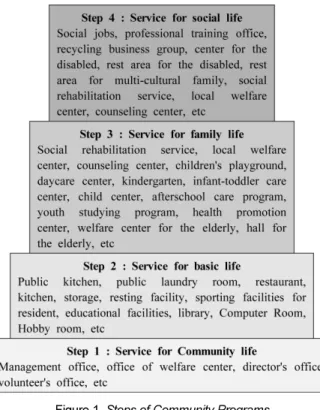
커뮤니티 시설은 내용면에서도 전문화되고 있다. Park, Yim, and Lee(2012) 는 커뮤니티시설을 ‘공동생활서비스’,
‘ 기본생활서비스’와 ‘가족생활서비스’, ‘사회생활서비스’ 시 설로 나누고 단계별로 구분하였다. ‘공동생활서비스’ 시설 은 공동주택의 관리와 운영에 관련된 시설이며 ‘기본생활 서비스’는 단지 내 모든 주민들이 항시적으로 이용하는 일 상생활과 밀접한 기본적인 시설로 다시 편익시설과 취미 시설로 구분된다. 자녀보육시설과 노년생활시설로 나뉘는
‘ 가족생활서비스’시설은 유아, 어린이, 청소년, 노인 등을 대상으로 하는 가족생활의 안정을 위한 시설이며, 경제활 동 지원시설과 사회적 약자 지원시설은, ‘사회생활서비스’
시설로 주거복지 필요지역에 우선 적용되며 복지정책이 강 화됨에 따라 점차 그 비중이 커지고 있다<Figure 1>.
2. 커뮤니티 공간평가를 위한 개념모델 설정
주거환경의 질을 종합적이고 체계적으로 평가하기 위해 서는 설득력 있는 평가항목 설정이 요구된다. 따라서 본 장에서는 선행연구에서 제시된 커뮤니티공간이 궁극적으 로 추구하는 ‘가치’와 그에 따른 ‘계획목표’, ‘계획항목’을
Table 1. Community Facilities Installation StandardsAmenities
Management Office More than 50 households 10 m2+sheets per households over 50 households 500 cm2 (100 m2 below) Greenery rest facilities More than 300 households 500 households in one place, plus one point
per 500 households can
Welfare facilities and Residents communal
facilities
Children’s playground More than 50 households
Less than 100 households: 3 m2 per household More than 100 households: 300 m2+More than 100 households per household every 1 m2
Neighborhood Facilities Every household 6 m2 ratio exceeds ban
(500 m2 less than 500 m2) Kindergarden More than 2000 households『Infant Care Act』
Silver hall More than 100 households 40 m2+More than 150 households per household 0.1 m2 (300 m2 to exceed 300 m2)
Residents communal facilities
Residents sports facilities More than 500 households 300 m2+More than 500 households per 200 households 150 m2
Resident Education Facilities/Reading Room/Youth Facilities/Resident meeting place/Social Welfare Facilities/
Shared kitchens/Shared laundry room/
Hobbies volunteer room
Nursery facility More than 2000 households『Infant Care Act』
Childcare facilities More than 300 households 『Infant Care Act』
Small library More than 300 households 『Library law enforcement decree』
Figure 1. Steps of Community Programs
커뮤니티 공간평가를 위한 개념모델로 설정하고 커뮤니티 공간평가 항목으로써 실효성을 검증하고자 한다.
Rim and Choi(2011) 는 공유공간에서 사회적 교류가 이 루어지기 때문에 공용공간의 질을 높이는 것이 커뮤니티 향상을 위한 기본조건이라 전제하고, 2000년 이후 국내 주거환경의 질적 향상을 도모하기 위해 작성된 16편의 공 공보고서를 분석하여 커뮤니티 공간이 갖추어야 할 근본 적인 가치를 ‘접근성’, ‘기능성’, ‘공공성’, ‘맥락성’, ‘영역 성’으로 구분하였다. 또한 커뮤니티 강화를 위한 공동주 택단지 공용 공간의 계획목표와 전략을 ‘단지 내부’와 ‘단 지와 지역사회 간’ 두 부분으로 나누어 제시하였다.
이는, 기존의 공동주택단지의 주거환경에 대한 문제제 기와 중요쟁점 도출, 해결방안 제시까지 함께 아우른 것 으로 문제의식의 적시성과 연구결과의 공신력을 담보하였 다고 판단하여 본 연구의 커뮤니티 공간 평가를 위한 개 념모델로 설정하였다.
1) 단지 내 커뮤니티 공간평가를 위한 개념모델 Rim and Choi(2011) 는 단지 내 커뮤니티 공간에 요구 되는 가치로 ‘접근성’, ‘기능성’, ‘영역성’ 등 세 가지를 들고 있는데, 이런 속성들이 어떻게 구현되었지 살펴봄으
로써 단지 내 커뮤니티 공간을 평가 해 볼 수 있을 것이다.
공용시설에 접근이 어려우면 이용률이 떨어지고 죽은 공간이 되기 쉽다. 설문조사에서도 커뮤니티 공간에 만족 하는 이유로 ‘집에서 가깝다’와 ‘다양한 장소에서 접근하 기 쉽다’를 들고 있어 ‘접근성’이 이용 빈도에 중요한 요 소임을 보여준다(Lee, Lee, & Yoon, 2010). ‘접근성’은 주 호와 커뮤니티시설의 물리적 일체화 정도, 또 단지 내 보 행로와 커뮤니티시설의 연결정도로 평가할 수 있다.
‘ 기능성’은 설정된 기능이 갖는 역할, 작용, 효과의 정 도를 뜻하며, 입주자 요구를 최대한 충족할 수 있도록 다 목적 기능의 커뮤니티시설이 단지의 구심공간으로 작동할 때 커뮤니티의 ‘기능성’은 확대된다(Shin & Jo, 2012; Lee, Kang, & Park, 2013). 또 공용공간과 개인생활공간이 적 극적으로 연계될 때, 특히 주동 전면이 일상생활을 수용 하는 생활가로로 작동할 때 커뮤니티가 증진되므로 커뮤 니티공간의 ‘기능성’을 평가할 때 이런 측면을 고려하여 야한다<Table 2>.
외부 공간에서는 안부 인사나 어린이 놀이, 대화 등 친 교 활동이 빈번히 관찰된다. 개방적 공간보다는 위요공간 이 거주자 간의 교류를 증대시키는데 더 효율적이다(Kim,
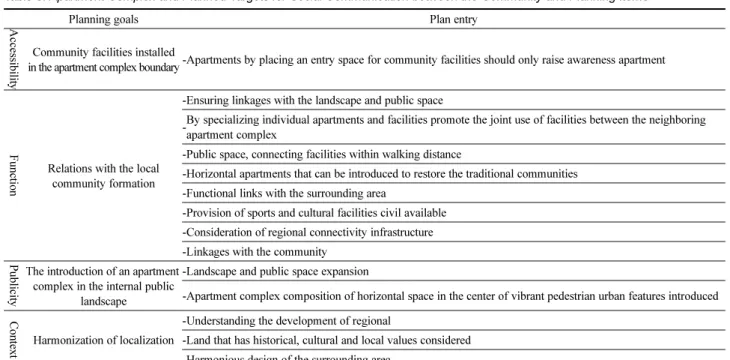
Table 2. Apartment Complex Planning and Planning Goals for Community Enhancement ItemsPlanning goals Plan entry
Accessibility
Installation of the living area adjacent community facilities
-This approach facilitates the configuration of the residents of a community facility space -Community space activities create ideal considering the accessibility of the living area -Community spatialization of potential space
-Apartments ensuring linkage between low-rise apartments as part of a plan Pilotti and playground composition -The composition of the vegetable garden and the garden around the apartment
-Living in an apartment around the spatialize
-Ensuring day-to-day contact area of the front entrance to the apartment space expansion -Apartments close to the entrance and seating area and playground composition linked to infant -Apartments and integrated community facility placement
-Placement of community facilities adjacent to the central square Apartment complex internal
linkages walking routes
-Apartment complex offering a chance due to the increase in daily contact with the walking time to the association of the walking routes
-The composition of the pedestrian network
Function
Installation versatility community facilities
-The composition of the various variable space that can be used in accordance with the Community action plan -Including operational plans and flexible the existing legal provisions Service Facilities
-Including a new facility on an existing legal provisions Service Facilities -Configuration facility to enable various community activity
-Development of a variety of community programs -Everyday events as a multi-purpose hall composition
-Provide incentives for the creation of a new community room apartment complex -Give the villagers autonomous community space renovation possibilities
-Meetinghouse and the introduction of a community center with a multi-purpose space
Integration of walking space and community facilities
-Complex space pedestrian plaza creating a neighborhood community space -Apartment complex space pedestrian life spatialize
-Linked plan the pedestrian-only area and apartment complex in outdoor living facilities
-Integrated pedestrian plaza on the main pedestrian area nuclear copper intersections community composition
Territoriality Through increased community
features to living building layout
-NS type contact opportunities enhanced by the neighboring apartment arrangement between -Grouping of apartments for Community Promotion
-Apartments clustered groupings
Lee, & Sohn, 2014). 외부공간이 소통의 중심이기 위해 서는 먼저, 주요 보행 동선이 모이는 곳에 커뮤니티 중심 공간을 두고 보행 동선과 공용 공간 사이에 위계를 두어 각각 영역의 독립성을 확보하여야 한다. ‘영역성’은 물리 적 공간을 한정함으로써 소유개념을 강화하는 속성이다.
중정영역은 커뮤니티를 증진시키므로 NS 배치나 클러스 터형 배치 등 주동배치유형을 살펴 ‘영역성’을 평가할 수 있다.
2) 지역과 단지의 커뮤니티 평가를 위한 개념모델 전통사회는 지역 공동체적 성격이 강해 커뮤니티가 자 연발생적으로 형성됐지만, 현대는 이를 기대하기 어렵다.
최근에는 재건축 재개발사업에서 커뮤니티 중심의 주거문 화를 형성하여 공동주택단지가 지역과 융합할 수 있도록 하자는 논의가 활발히 진행되고 있어(Cha, Lee, & Kim, 2014) 지역커뮤니티 거점으로써 공동주택 내 커뮤니티시 설의 역할이 주목받고 있다<Table 3>.
단지와 지역 간의 커뮤니티 형성을 위해서는 ‘접근성’,
‘ 기능성’, ‘공공성’, ‘맥락성’이 요구된다(Rim & Choi, 2011). 기존의 커뮤니티 시설은 자기 완결적이고 폐쇄적 이어서 주변지역과 단절된 채 연계되지 못했다(Cha, Lee,
& Kim, 2014). 단지 경계부에 커뮤니티시설을 설치하고 도시의 일부로 단지를 구성하면 지역사회와 단지는 연결 이 긴밀해진다. 따라서 커뮤니티시설의 배치를 살펴봄으 로써 지역사회와의 단지의 ‘접근성’을 평가할 수 있다.
지역사회의 커뮤니티 거점으로서 ‘기능성’은 문화, 복 지, 교육, 체육, 정보, 보육 등 개별단지의 특화된 다양한 시설을 지역사회가 공동 이용함으로써 확대된다. 수영장, 골프장 등 단지차원에서 조성하기 어려운 시설을 지역차 원에서 도입하고 다양한 콘텐츠를 공유함으로써 지역커뮤 니티를 활성화시킬 수 있다.
‘ 공공성’은 단지 내 공공가로를 도입하는 등 가로와 보 도 및 자연경관을 지역사회와 공유함으로써 확대된다. 보 행동선을 지역 기반시설과 연계시켜 사회적 교류를 촉진 하고 단지 내로 공공의 흐름을 유입하면 ‘공공성’을 높일 수 있다.
새로 도입되는 시설이 기존 공간체계를 유지하고 주변 과 조화를 이룰 때 심리적 위화감은 줄어들고 지역의 정 체성은 유지되므로 ‘맥락성’은 지역 커뮤니티를 강화하는 속성 중 하나라 할 수 있으며, 지역특성과 얼마나 조화된 설계인지 평가함으로써 그 성능을 가늠할 수 있다.
III. 수요자 맞춤형 임대주택의 계획지침
1. 맞춤형 주택
1~2 인 가구증가, 인구고령화와 경제수준 향상으로, 에너 지, 건강, 안전, 커뮤니티, 라이프스타일 등을 추구하는 고 품격 주택에 대한 수요가 늘고 있으며 국내 민간건설사 는 경쟁적으로 다양한 주거서비스를 제공하는 수요자 맞 춤형 주택을 개발하고 있다.
맞춤형주택은 ‘설계단계부터 수요자가 참여하여 스스로 만들어 가는 주택공급방식’으로 고객의 개별적 요구, 주 택 트렌드, 분양주택 상품성 등을 포함하는 맞춤개념이며 기존 분양방식과 차별화된 마케팅 전략이다.
최근 도심 자투리땅에 소규모로 공급되는 공공의 맞춤 형 임대주택은 기존 영구임대주택 및 국민임대주택과 달 리 신규 택지 확보의 어려움을 해소하고 도시 내 입지 곤 란한 기존의 대규모 공급방식의 한계를 극복하며, 공공임 대주택에 대한 빈곤 낙인, 빈곤 집중화로 인한 사회의 부 정적 인식을 해소시키는 이점이 있다(Jin, Lee, & Sul, 2009).
Table 3. Apartment Complex and Planned Targets for Social Communication between the Community and Planning Items
Planning goals Plan entry
Accessibility
Community facilities installed
in the apartment complex boundary-Apartments by placing an entry space for community facilities should only raise awareness apartment
Function
Relations with the local community formation
-Ensuring linkages with the landscape and public space
-By specializing individual apartments and facilities promote the joint use of facilities between the neighboring apartment complex
-Public space, connecting facilities within walking distance
-Horizontal apartments that can be introduced to restore the traditional communities -Functional links with the surrounding area
-Provision of sports and cultural facilities civil available -Consideration of regional connectivity infrastructure -Linkages with the community
Publicity
The introduction of an apartment complex in the internal public
landscape
-Landscape and public space expansion
-Apartment complex composition of horizontal space in the center of vibrant pedestrian urban features introduced Context Harmonization of localization
-Understanding the development of regional
-Land that has historical, cultural and local values considered -Harmonious design of the surrounding area
Han, Jung, and Lee (2012) 는 다양한 맞춤형 주택의 등 장에도 불구하고 아직까지는 ‘맞춤형 주택’의 개념이 명 확치 않을 뿐 아니라 적용공간과 디자인요소가 제한되어 수요자요구 실현에 한계가 있으며 대부분 단위평면과 커 뮤니티 시설에 치우쳐 주동이나 외부 공간 등 단지 차원 의 고려가 미흡하다고 지적하면서, 공간 규모나 디자인 요소의 변형이 아니라, 거주자의 라이프스타일에 밀착하 여 생활을 지원할 수 있도록 현재 ‘맞춤형 주택’ 개념을,
‘ 생활맞춤형 주택’으로 확대하여 단위세대, 주동, 단지 등 거주 공간전반에 적용하고, 운영프로그램도 개발하여 공 간의 활용성을 높여야 한다고 주장하였다.
이는 맞춤형 주택의 커뮤니티 공간 평가대상을 커뮤니 티시설에만 국한할 것이 아니라 주동이나 단지 등 일상 생활이 이루어지는 공용 공간 전반으로 넓히고 물리적 공 간계획 뿐 아니라 시설운영체계까지 확대해야 함을 시사 한다.
2. 수요자 맞춤형 커뮤니티공간 계획지침
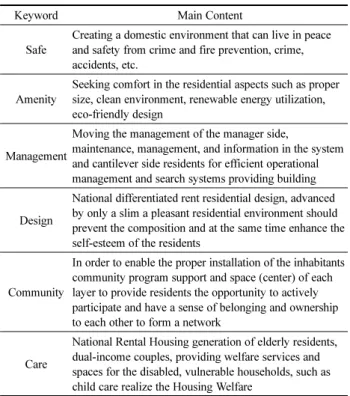
‘ 수요자 맞춤형 임대주택단지’는 거주자 맞춤형 설계와 복지서비스를 제공하며 단위세대에서 주동, 부대시설, 옥 외공간까지 거주자를 고려하는 주거단지로 Jung, Lee, and Han (2012) 은 임대주택 거주자와 관리자 의견조사와 국 내외 사례분석결과를 바탕으로 ‘안전한 주거환경’, ‘쾌적 함 추구’, ‘효율적인 운영관리시스템’, ‘디자인의 차별화’,
‘ 커뮤니티 활성화’, ‘취약계층을 위한 복지서비스 제공’ 등 을 공공임대주택이 지향해야할 가치를 설정하고 그 가치 를 구현하는 계획요소에 따라 생활맞춤형 주거계획 키워 드를 <Table 4>와 같이 제시하였다.
또한 Jung, Lee, and Han (2012)은 거주자의 다양한 요 구에 대응하는 수요자 맞춤형 임대주택을 공급하기 위해
‘ 장애인 고령자 돌봄’, ‘육아지원’, ‘1-2가구를 위한 생활 경제형’ 주거모델을 설정하고 유형별 계획요소와 주거계 획지침을 설정하였는데 그 중 커뮤니티 공간과 연관된 것 은 <Table 5>와 같다.
육아세대는 ‘안전’과 ‘커뮤니티’를 우선 고려해야하며 놀
Table 4. Consumer Customized Housing Planning Keyword
Keyword Main Content
Safe
Creating a domestic environment that can live in peace and safety from crime and fire prevention, crime, accidents, etc.
Amenity
Seeking comfort in the residential aspects such as proper size, clean environment, renewable energy utilization, eco-friendly design
Management
Moving the management of the manager side,
maintenance, management, and information in the system and cantilever side residents for efficient operational management and search systems providing building
Design
National differentiated rent residential design, advanced by only a slim a pleasant residential environment should prevent the composition and at the same time enhance the self-esteem of the residents
Community
In order to enable the proper installation of the inhabitants community program support and space (center) of each layer to provide residents the opportunity to actively participate and have a sense of belonging and ownership to each other to form a network
Care
National Rental Housing generation of elderly residents, dual-income couples, providing welfare services and spaces for the disabled, vulnerable households, such as child care realize the Housing Welfare
Table 5. Community Planning Keyword
Child care generations Safe Safety-zoneSafe Zone (school bus stop) installations for traffic
accident prevention
Guard posts Installing security post near the playground
Design
Storage space
Baby strollers, bicycle storage space, including large objects
Community
Space for mom
Playground, day care, library installation space for mothers to exchange a child using facilities near the front (co-parenting room)
Space for
Children Study room, children's library
Play- ground
Proper size of a playground, a fair arrangement needs review, indoor and outdoor playground, playground equipment considering the different ages, various playgrounds installation
Care
Child care
Kindergarten, Nursery installed, inhabited building on the first floor recommended installation After-school classrooms (classrooms care)
Elderly house-holds Safe
Installation amenities
Assistant chair porch and bathroom, installed auxiliary handle, non-slip tile
Design
Universal Design
Universal design applies only outside the building space
Community
Silver hall
Silver hall requires consideration about when planning a kitchen and dining area, space for a disabled elderly care is necessary, preferably installed on the first floor
Joint garden
Playgrounds, kindergartens, community induction silver hall as closely arranged to increase the utilization
Rest area The outer space of the bench, various seating area provided as cabin
Care
Accessible Services
Services performed for the residents convenience and welfare assistance (wheelchair rental, clean service)
Welfare Center
The elderly, the disabled, including welfare facilities for vulnerable households (health centers, day care service center)
1-2 person house-holds Amenity
Cabinet Design
Secure storage space that can be used for small spaces
Parking lot Pleasant, comfortable and safe parking space
Location
Walking around the apartment complex, cultural/
facilities are located close to shopping and cultural activities
Design
Specialized
plane SOHO type, Stidio type Floor plan available
Community
Sports Gym and sports facilities installed outside space Library Library to enjoy a hobby
Care Accessible
Services Lunch and shopping, such as life support
이터 이용이 많고 어린이집이 부족한 것으로 나타났고 엄 마들의 교류장소에 대한 요구가 높았다. 고령자가구는 ‘커 뮤니티’와 ‘안전’, ‘돌봄’ 관련 계획요소를 우선 고려해야 하고 신체적 정신적 배려가 요구되며 경로당이나 공동텃 밭 등 이웃과 교류할 수 있는 공간계획이 필요한 것으로 나타났다.
1-2 인 가구는 ‘쾌적함’과 ‘커뮤니티’에 대한 요구가 크 고 세대 내부공간을 제외하고 단지 내 이용이 낮고 이웃 과의 교류보다는 주차하기 용이한 환경과 운동이나 독서 등 취미활동을 즐길 수 있는 곳을 선호하므로 이를 우선 적으로 고려할 필요가 있다.
이상의 계획지침은 거주자 및 관리자의 의견조사와 여 러 국내외 사례분석을 바탕으로 한 만큼 거주자의 특성 을 충분히 반영한 것으로 수요자 맞춤형 임대주택단지 커 뮤니티 공간 평가 시 고려해야 할 주요항목으로 판단된다.
IV. 수요자 맞춤형 임대주택단지 커뮤니티 공간분석
1. 서울시 수요자 맞춤형 임대주택 단지
서울시는 자투리 시유지나 유보지에 의료, 일자리, 노후 대책 등 복지서비스가 필요한 사람들을 위한 복지 연계 형 임대주택을 공급하였는데 육아세대, 노인가구, 1-2인 가구를 위한 세 가지 유형으로 구분된다.
거주자의 요구와 개성을 설계에 반영하고 커뮤니티 활 성화를 통해 주거문화의 질을 높일 목적으로 육아세대를 위한 맞춤형주택을 공급하였는데 강서구 가양동에 공동육 아를 위한 협동조합형 임대주택 24가구와 신혼부부를 위 해 양천구 신정동에 다양한 주호와 어린이집으로 구성된 도시마을을 건립하였으며, 구로구 천왕동에 혼자 사는 여 성을 대상으로 보안과 방범을 강화한 도시형 생활주택과 어린이집을 ‘여성 안심주택’으로 공급하였고, 만리 배수지 의 관사와 유휴지에 예술가들의 협동조합형 임대주택을 분양하였다.
독거노인, 거동불편자 등 자활치료자의 생활지원을 위 해 시립병원과 보건소 반경 500 m 이내에 임대주택을 공 급하는 신내동 의료안심주택은 서울의료원 근처 SH공사 의 미 매각 용지를 활용하였다.
1-2 인 가구를 위해서는, 서울시가 토지를 제공하고 지 자체가 건축비를 부담하는 방식으로, 지방출신 학생들을 위한 공공 임대기숙사를 강서구 발산동과 노원구 공릉동 에 공급하였으며, ‘일자리지원형 임대주택’으로 취업이나 창업을 준비하는 ‘사회 초년생’들이 정보를 공유하고 함 께 사업을 전개할 수 있도록 커뮤니티하우스를 문정동과 정릉동에 계획하였다.
2. 사례단지의 커뮤니티 공간분석
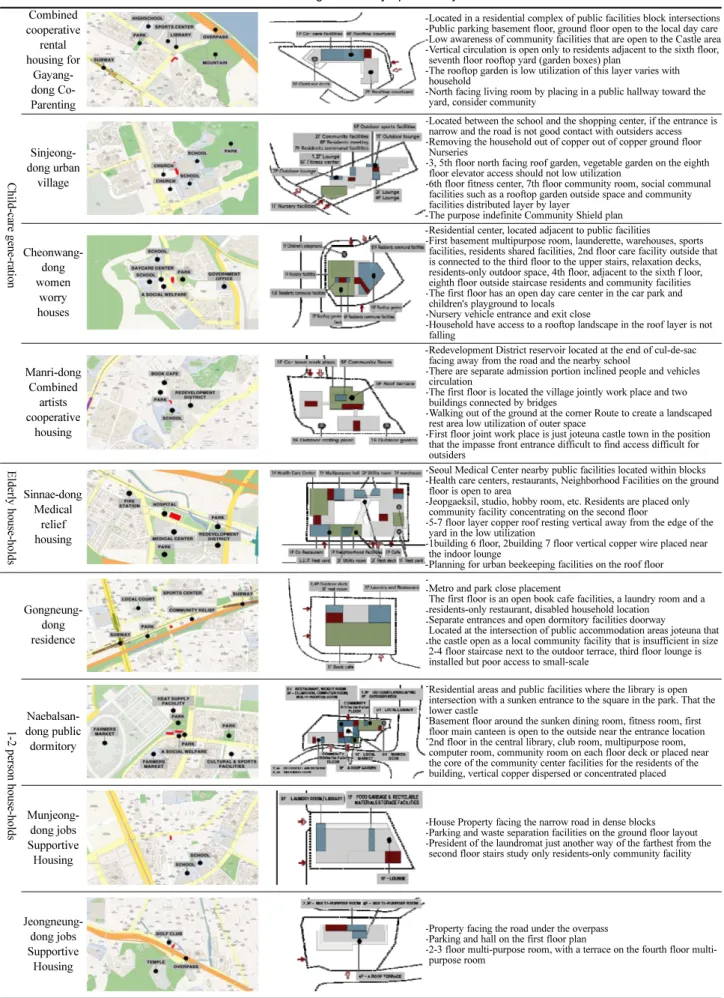
본 장에서는 Rim and Choi (2011)에서 제시한 ‘사회적 소통을 위한 공용공간의 계획목표 및 근본 가치 <Table
2, 3>’ 와 Jung, Lee and Han (2012)의 ‘생활맞춤형 주거 계획지침’ 중 커뮤니티 <Table 5> 관련 항목을 토대로 각 사례의 커뮤니티 공간을 살펴봄으로써 실효성 있는 커뮤 니티 공간 평가항목을 추출하고자 한다.
대부분 단지의 커뮤니티 시설이 거주자들이 접근하기 쉬운 곳, 혹은 출입구 주변에 위치하는 것으로 나타나 ‘생 활공간과 인접한 커뮤니티시설의 설치’라는 목표는 잘 지 켜지고 있었다. 다만, 신정동 도시마을의 옥상 텃밭이나 고층부의 커뮤니티 시설처럼 생활공간과 유리된 경우는 그 활용도가 떨어질 것으로 예상되었다. 또 92가구인 단 지규모에 비해 많은 커뮤니티 공간이 분산 배치되어 관 리가 어렵고 비용상승이 우려되었다. 반면 193실인 내발 산동 기숙사는 수직동선 주변에 커뮤니티실과 옥외시설들 이 분산되어 일상적인 접촉기회가 늘 것으로 판단되었다.
‘ 기능성’면에서 다양한 시설을 도입하고 프로그램에 따 라 변경할 수 있는 가변형 공간을 조성한 바람직한 사례 도 있었으나 신정동 도시마을의 북향 저층 텃밭처럼 위 치가 적절치 않거나 공릉동 공공기숙사의 휴게실같이 실 의 크기가 작고 접근성이 나쁜 경우, 문정동 일자리지원 주택과 같이 운동실, 취미실 등 1-2인 가구의 요구시설을 갖추지 못한 사례도 있었다.
천왕동 여성안심주택과 같이 옥외계단을 2층 옥상마당 으로 연결시키거나 신내동 의료안심주택처럼 중정을 주위 에 커뮤니티시설을 배치하여 보행공간과 커뮤니티 시설의 일체화한 경우, ‘기능성’이 강화될 것이지만 코어에서 멀
Figure 3. Gongneung-dong residence/Munjeong-dong jobsSupportive Housing
Figure 2. Sinjeong-dong Urban Village/Naebalsan-dong Public Dormitory
Table 6. Seoul Consumer Customized Public Rental Housing
Complex scheme
Combined cooperative
rental housing for
Gayang- dong Co- Parenting
Sinjeong- dong urban
village
Cheonwang- dong women worry houses
Manri-dong Combined
artists cooperative
housing
Sinnae-dong Medical
relief housing
Gongneung- dong residence
Naebalsan- dong public
dormitory
Munjeong- dong jobs Supportive Housing
Jeongneung- dong jobs Supportive Housing
Building 1 1 1 1 2 1 2 1 1
Hoseholds 24 92 96 29 222 22 193 31 54
Number of floors
Underground 1floor/ground
5floor
Underground2flo or/ground 8floor
Underground1flo or/ground 9floor
Underground1flo or/ground 5floor
Underground1flo or/ground 7floor
Ground 4floor
Underground1flo or/ground 7floor
Ground 5floor
Underground1flo or/ground 8floor Housing total floor area 1748.59 5778.58 2558.4 1754.07 9399.17 696.79 7142.94 832.03 1402.46
Communitylife service
Administrative offices, welfare offices, gwanjangsil, resources
bongsasil
Manage- ment Office
37.26 Manage-
ment Office
25.02
Manage- ment Office
43.02
Manage- ment Office
44.79
Manage- ment Office
15.91
Basic Life Services
Hobby life
Rest facilities,
sports facilities residents, resident training facility, library, program
room, hobby room
A rooftop
court- yard
205.02 Outdoor
sports facilities
42 Rooftop
Land- scaping
200.41 Rest shelter 91
Rooftop relaxatio n yard
311.04Outdoor
deck 9.07 Rooftop
garden 400 Deck
seating 10 Rooftop terrace 18
Outdoor
Lounge 61.3 Deck
seating 70 Garden 60 Deck
seating 268.28 Lounge 9.07 Sunken 60 Multi- purpose
Room 82.98
Fitness center 36.52
Multi- purpose
Room
69.89 Rooftop
terrace 28 Rest
yard 153 Fitness
Room 130.88
Resident s Meeting
41.99 Exercise Room 28
Commu nity Room
34.59 Multi- purpose
Hall
117.74 Comput
er Room 58.24
Resident s commun
al facilities
11
Multi- purpose
Room
133.42
Multi- purpose
Room
78.02
Reading
room 77.66
Commu nity room
277.02
Club
room 155
Local
library 206.2
Benefits facilities
Public kitchens, common laundry room, dining room, kitchen, warehouse
Laundry
room 13.77
Co- dining
room
90 Restaura
nt 10 Kitchen/
Dining 226 Food, recyclin g
10.31
Laundry
room 17.79 Laundry
room 9.91 Laundry
room 18.64
Family Life service
Children’s playground, day care center, kindergarten, child care
facilities, children's centers, after-school classes, youth study room, wellness room, welfare center, per path
Parenting Co-
facilities 207.03 Children's
playground 31.05 playgroundChildren's 58 Care
center 193.74
Child
care 172.71 Child
care 280
Social Life service
Social employment, vocational training room, recycling corporation, Disabled Care, Disabled shelter,
multicultural family shelter, rehabilitation facilities, community
welfare centers, counseling centers
Co-town work place
147.19 Urban rooftop bee- keeping
103.68 Book Cafe 87.47
Shops/
Local store
50.21
Neigh- borhood Facilities
132.91
Cafe 40.15
Legend Legal basis
Table 7. Seoul Consumer Customized Public Rental Housing Community Space Analysis
Child-care gene-ration
Combined cooperative
rental housing for
Gayang- dong Co- Parenting
- - - - - -
Located in a residential complex of public facilities block intersections Public parking basement floor, ground floor open to the local day care Low awareness of community facilities that are open to the Castle area Vertical circulation is open only to residents adjacent to the sixth floor, seventh floor rooftop yard (garden boxes) plan
The rooftop garden is low utilization of this layer varies with household
North facing living room by placing in a public hallway toward the yard, consider community
Sinjeong- dong urban
village
- - - -
-
Located between the school and the shopping center, if the entrance is narrow and the road is not good contact with outsiders access Removing the household out of copper out of copper ground floor Nurseries
3, 5th floor north facing roof garden, vegetable garden on the eighth floor elevator access should not low utilization
6th floor fitness center, 7th floor community room, social communal facilities such as a rooftop garden outside space and community facilities distributed layer by layer
The purpose indefinite Community Shield plan
Cheonwang- dong women
worry houses
- -
- - -
Residential center, located adjacent to public facilities
First basement multipurpose room, launderette, warehouses, sports facilities, residents shared facilities, 2nd floor care facility outside that is connected to the third floor to the upper stairs, relaxation decks, residents-only outdoor space, 4th floor, adjacent to the sixth f loor, eighth floor outside staircase residents and community facilities The first floor has an open day care center in the car park and children's playground to locals
Nursery vehicle entrance and exit close
Household have access to a rooftop landscape in the roof layer is not falling
Manri-dong Combined
artists cooperative
housing
- - - - -
Redevelopment District reservoir located at the end of cul-de-sac facing away from the road and the nearby school
There are separate admission portion inclined people and vehicles circulation
The first floor is located the village jointly work place and two buildings connected by bridges
Walking out of the ground at the corner Route to create a landscaped rest area low utilization of outer space
First floor joint work place is just joteuna castle town in the position that the impasse front entrance difficult to find access difficult for outsiders
Elderly house-holds
Sinnae-dong Medical
relief housing
- - - - - -
Seoul Medical Center nearby public facilities located within blocks Health care centers, restaurants, Neighborhood Facilities on the ground floor is open to area
Jeopgaeksil, studio, hobby room, etc. Residents are placed only community facility concentrating on the second floor
5-7 floor layer copper roof resting vertical away from the edge of the yard in the low utilization
1building 6 floor, 2building 7 floor vertical copper wire placed near the indoor lounge
Planning for urban beekeeping facilities on the roof floor
1-2 person house-holds
Gongneung- dong residence
- - - - -
Metro and park close placement
The first floor is an open book cafe facilities, a laundry room and a residents-only restaurant, disabled household location
Separate entrances and open dormitory facilities doorway
Located at the intersection of public accommodation areas joteuna that the castle open as a local community facility that is insufficient in size 2-4 floor staircase next to the outdoor terrace, third floor lounge is installed but poor access to small-scale
Naebalsan- dong public
dormitory
-
- -
Residential areas and public facilities where the library is open intersection with a sunken entrance to the square in the park. That the lower castle
Basement floor around the sunken dining room, fitness room, first floor main canteen is open to the outside near the entrance location 2nd floor in the central library, club room, multipurpose room, computer room, community room on each floor deck or placed near the core of the community center facilities for the residents of the building, vertical copper dispersed or concentrated placed
Munjeong- dong jobs Supportive Housing
- - -
House Property facing the narrow road in dense blocks Parking and waste separation facilities on the ground floor layout President of the laundromat just another way of the farthest from the second floor stairs study only residents-only community facility
Jeongneung- dong jobs Supportive Housing
- - -
Property facing the road under the overpass Parking and hall on the first floor plan
2-3 floor multi-purpose room, with a terrace on the fourth floor multi- purpose room
Legend
리 떨어진 건물 모서리의 휴게마당이나 만리동 예술인 협 동주택 외부공간은 활용도가 떨어질 것으로 예상되었다.
북향거실이 됨에도 불구하고 남측으로 공용복도를 두어 공동마당을 형성한 가양동 공동육아를 위한 협동조합형 임대주택과 2층 데크를 중심으로 주호를 배치한 천왕동 여성안심주택은 위요공간을 형성하여 ‘영역성’을 확보한 사례다.
단지와 지역사회간의 ‘접근성’을 증진시키기 위해 대부 분의 단지들이 경계부에 일반시민에 공개되는 커뮤니티시 설의 출입구나 주차장을 설치하였으며 공간이나 층별로 외부개방시설과 단지전용시설을 분리하였다.
신내동 의료안심주택과 내발산동 공공기숙사는 공공시 설 블록과 접해 지역기반시설과 연계를 가지며 단지 내 커뮤니티시설을 일반시민에 제공하여 지역사회와 관계를 형성하는 반면, 주택 밀집지역 내 문정동 일자리지원주택 이나 시 외곽에 입지한 정릉동 일자리지원주택은 보행거 리 내에서 지역기반시설 이용이 어렵고 단지 내 커뮤니 티시설이 빈약하여 지역거점으로 활용도 미흡할 것으로
생각되었다. 공릉동 공공기숙사처럼 22실의 소단지에 지 역 개방시설인 북 카페를 조성한 경우, 주민전용 식당과 중복 운영은 비효율적으로 판단되었다.
공원, 광장 등 공공시설 블록에 접한 신내동 의료안심 주택이나 내발산동 공공기숙사는 단지 내 일반인의 유입 을 돕는 공공가로를 설치하여 도시적 기능을 담당함으로 써 ‘공공성’을 강화하지만, 만리동 예술인 협동조합형 임 대주택은 가로로부터 멀리 떨어져 있어 마을공동작업소 등 단지 내 커뮤니티시설의 일반인 이용이 어렵고 지역 커뮤니티로써의 역할이 제한될 것이다.
새로 조성된 지역의 공공시설 용지에 들어서는 경우 지 역사회와 연계를 고려한 단지계획이 가능하나, 문정동 일 자리지원주택이나 정릉동 일자리지원주택처럼 이미 개발 된 주거지역 내 자투리땅에 소규모 단지로 계획될 경우 1 층 대부분을 주차장이 차지하고 있는 등 지역과 조화된 설계가 어려울 것으로 보인다.
3. 사례분석을 통한 시사점
사례분석 결과, 각 단지에서 나타난 ‘접근성’, ‘기능성’,
‘ 공공성’, ‘맥락성’, ‘영역성’의 구현 여부는 <Figure 9>와 같으며, 수요자 맞춤형인대주택단지의 커뮤니티 공간평가 시 고려해 볼 시사점은 다음과 같다.
1) 입지와 규모
사례들은 이미 개발된 택지개발지구 내 남겨진 자투리 땅에 한 두동으로 지어졌다. 200실 내 외의 두 단지와 100 세대 내외의 두 단지를 제외한 나머지 다섯 곳은 22 세대에서 54실 규모이다. 100세대 이상의 단지들은 대부 분 공원이나 학교 의료시설, 시장, 지하철역 등 공공시설 과 인접하여 지역과 연계성이 좋은 반면, 소규모인 문정 동과 정릉동 일자리지원주택은 주변과 단절되어 문화편익
Figure 5. Housing for Gayang-dong Co-Parenting/Cheonwang-dong Houses
Figure 7. Sinnae-dong Medical relief housing/Manri-dong cooperative housing
Figure 6. Naebalsan-dong Public Dormitory/Jeongneung-dong jobs Supportive Housing
Figure 8. Munjeong-dong Housing/Jeongneung-dong Housing Figure 4. Sinnae-dong Medical Housing/Manri-dong Housing
시설 이용이 어려울 것으로 예상되므로 ‘입지’와 ‘규모’도 커뮤니티 공간의 성능 결정요인으로 작용한다고 볼 수 있 을 것이다.
2) 커뮤니티 시설유형
대부분 단지들이 관리사무소와 같은 ‘공동생활서비스’시 설은 법적요건만 충족시킨 반면, 전 연령층이 항시적으로 이용하는 ‘기본생활서비스’시설은 법적기준 이상으로 갖추 고 있었다. 다만 독서실, 운동시설 등 특화된 ‘취미시설’
보다는 세탁실, 취사장, 식당 등 ‘편익시설’의 설치비율이 높았다. 또한 일자리 지원주택단지 두 곳을 제외하고 육 아보육시설과 건강증진실, 케어센터 등 전문화된 ‘가족생 활서비스’ 시설을 갖추었거나 마을공동작업소, 북 카페, 지역매장, 도시양봉장, 헬스케어센터 등 경제활동이나 사 회적 약자를 지원하는 다양한 ‘사회생활서비스’ 시설을 조 성한 것으로 나타나 주변지역과 시설을 공유함으로써 지 역 커뮤니티 활성화에 기여할 수 있는 잠재력은 클 것으 로 예상되었다.
3) 거주자 유형
거주자유형에 따라 커뮤니티 시설 배치가 다르게 나타 났는데 육아세대를 위한 수요자 맞춤형 주택은 주동배치 를 통해 ‘영역성’이 확보된 커뮤니티 공간을 조성하여 일 생생활에서 접촉의 기회를 늘리고 자연스런 감시를 통해 안전성을 확보하는 경우가 많았다. 또 다목적 룸, 다용도 실 등 용도가 정해지지 않은 실을 계획하여 거주자의 현 실적 필요에 맞게 활용할 수 있도록 운영과 관리의 융통
성을 부여하였다.
노인가구를 위한 수요자 맞춤형 주택은 건강증진실, 복 지센터 등 노년생활지원시설과 도시양봉장, 카페 등 사회 생활서비스 시설을 설치하고 개방적인 단지계획으로 일반 인의 접근을 돕고 주변 공공시설과의 연계를 꾀했다.
1-2 인가구를 위한 수요자 맞춤형주택은 규모에 따라 다 른 양상을 보였는데, 사회복지시설 인근 공원부지 내 입 지한 193실 규모의 내발산동 공공기숙사는 체력 단련실, 컴퓨터실, 동아리방 등 취미실을 중정을 주위로 배치하고 지역매장과 도서관을 개방하는 등 주변과의 연계를 고려 하였으나 20-30실 규모의 공릉동 공공기숙사와 정릉동 일 자리지원주택은 다른 도시형생활주택처럼 외부 휴게공간 과 커뮤니티 시설이 빈약하고 관리시스템이 부재하며 역 세권에서 떨어져 주변과의 연계성도 낮은 것으로 나타났다.
4) 운영체계
96 세대 한 동인 신정동 도시마을은 외부개방 보육시설 과별도로 각 층마다 라운지, 피트니스센터, 실내 어린이놀 이터, 주민공동시설, 옥상텃밭 등을 설치하여 단지규모에 비해 과도하게 여겨졌으며, 22실 규모에 불과한 공릉동 공공기숙사는 1층에 외부 개방 북 카페와 별도로 주민전 용식당을 설치하여 비효율적이라 판단되었다. 사업비와 관 리비를 고려하여 임대주택단지에 적용 가능한 운영체계를 구축할 필요가 있다고 판단되었다.
V. 수요자 맞춤형 임대주택단지의 커뮤니티 공간 평가
선행연구에서 제시된 ‘커뮤니티 공간’의 ‘가치’를 구현 하기 위한 계획항목을 커뮤니티 공간 평가를 위한 개념 모델로 설정하고 ‘수요자 맞춤형 주택’의 커뮤니티공간 계 획지침을 토대로 서울시의 9개 단지를 분석하였으며 그 결과 나타난 시사점을 종합하여 도출한 ‘수요자 맞춤형 임대주택단지 커뮤니티 공간의 평가항목’은 <Table 8>과 같다.
수요자 맞춤형 임대주택단지의 커뮤니티 공간을 평가할 때, ‘지역 공동체 활성화’는 수요자 맞춤형 임대주택단지 의 주요 도입 취지인 만큼 단지 내 커뮤니티 성능 뿐 아 니라 지역사회의 커뮤니티 거점으로서 성능을 살펴 볼 필 요가 있고, 임대주택단지인 점을 감안하여 경제성, 시설구 성의 효율성, 운영관리 체계의 합리성까지 따져보아야 할 것으로 판단되었다.
주민 모두가 상시적으로 이용하는 시설이 단지 내 일 상생활범위 내 위치하면 시설이용율과 만족도가 높아질 것이기 때문에 ‘접근성’은 우선 평가되어야 할 속성이다.
커뮤니티시설과 주요동선의 연계정도, 생활공간과의 거리 등이 평가기준이 될 수 있다.
일반적으로 커뮤니티시설은 다목적 이용이 가능한 가변
공간이 바람직하나 커뮤니티 시설의 ‘기능성’은 공간구성
과 시설운영체계와 밀접한 관계가 있으므로 거주자의 커
Figure 9. Implications of Community Spatial Planning뮤니티 참여 특성을 고려하여 계획 할 필요가 있다. 거주 자의 공동체 의식이 상대적으로 높고 커뮤니티에 자발적 인 참여가 예상되는 협동조합형 임대주택단지는 기능을 한정하는 것보다 융통성 있는 공간을 조성하고 운영과 관 리에도 자율성을 부여하는 것이 바람직한 반면, 공공기숙 사 거주자는 거주기간이 짧고 이웃관계에 소극적이며 커 뮤니티 참여의식이 낮으므로 성격이 분명하고 성능이 뛰 어난 시설을 제공하고 커뮤니티시설의 관리운영에 거주자 의 부담을 최소화하는 것이 오히려 바람직할 수 있다.
또 실의 목적과 기능에 맞는지 살펴보아야 한다. 영구 음영인 곳에 텃밭을 배치한다든지 기능을 수행할 수 없
는 작은 공간을 접근하기 어려운 곳에 배치한다면 커뮤 니티 시설의 기능성은 떨어질 수밖에 없다.
많은 거주자들이 커뮤니티 시설의 경제성을 가장 많이 고려하는 것으로 나타난 바(Lee, Lee, & Yoon, 2010), 유 지관리의 합리성도 평가해야할 항목이다. 임대주택단지라 는 점을 감안할 때 단지규모에 비해 과도한 여러 커뮤니 티 시설을 분산 배치하여 관리비용을 상승시키거나 소규 모 단지에서 유사 기능의 주민전용시설과 시민개방시설을 이중으로 설치하여 관리 부담을 가중시키는 것은 생각해 볼 문제이다.
거주자가 요구하는 시설을 조성하였는지 여부 역시 ‘기 능성’을 평가하는 기준이 된다. 세대 이외에 다른공간의 이용이 적고 인터넷, 홈 오피스 등 서비스와 취미시설 이 용을 중시하는 1-2인 가구는 도서실, 운동시설 등 거주자 가 요구시설을 제공하는 것이 우선이라 생각된다.
대부분의 수요자 맞춤형 임대주택단지이 소규모인 만큼 대표적인 커뮤니티 공간인 외부공간을 집약적으로 이용하 는 것이 커뮤니티성능을 향상에 도움이 된다. 친환경적인 녹지공간계획 여부와 보행공간과의 일체화 정도로 옥외공 간의 질을 평가할 수 있다.
공용공간에 위계를 부여하여 중정영역을 형성하면 이웃 접촉의 기회가 늘고 자연스런 감시가 가능하고 안전성이 확보된다. ‘영역성’은 육아세대에 특히 고려되어야 할 가 치로 주동배치 유형을 살펴보는 것으로 평가할 수 있다.
커뮤니티시설의 종류에 따라 배치 시 고려사항이 달라 지는데 ‘편익시설’과 ‘취미시설’은 단지주민이 상시적으로 이용하는 시설로서 단지 내 생활공간과의 접근성이 중요 하지만 어린이나 노인을 대상으로 하는 ‘가족생활서비스’
시설이나 사회적 약자의 경제활동을 지원하고 주거복지를 실현하는 ‘사회생활서비스’ 시설은, 단지 간 공동이용을 통해 지역 커뮤니티 활성화에 기여할 수 있는 시설들로 단지경계부에 있어 외부인의 접근이 쉽도록 계획되는 것 이 효율적이다.
이처럼 지역에 개방되는 시설을 조성한 경우 가로에서 일반인의 ‘접근’이 쉽도록 진입공간에 커뮤니티시설을 배 치하였는지 또 도시공간의 일부로써 인식될 수 있도록 단 지 내 보행로에 도시적 기능을 부여하였는지를 살펴봄으 로써 주변지역으로부터의 ‘접근성’을 평가할 수 있다.
여러 단지가 커뮤니티시설을 함께 이용하고 지역의 편 익시설을 이용하기 쉬우면 지역 커뮤니티로서의 ‘기능’은 향상된다. 소규모 1-2인가구의 경우 문화 편익시설에 대 한 요구가 크지만 단지 내에 다양한 시설을 조성하기 어 렵기 때문에 주변지역편익시설에 대한 의존도가 커지므로 1-2 인 가구를 위한 소규모 단지는 교통입지가 지역과 단 지간의 커뮤니티 ‘기능성’을 가늠하는 중요한 평가기준이 된다.
최근 주거복지 차원에서 설치가 장려되는 복지시설과 경제활동 지원시설은 단지주민 뿐 아니라 영유아, 어린이, 노인, 사회적 약자 등 특정 계층을 대상으로 하고 있어
Tabel 8. Evaluation items of Community Space in ConsumerCustomized Public Rental Housing Evaluation
attribute
Evaluation items
Evaluation
area Evaluation contents L S F P
Community space of apartment complex Accessibility
Installation of the living area
adjacent community
facilities
○ ○ Composition resting space closed to the entrance
○ ○ Composition community facility easy-to-access Apartment
complex internal linkages walking
routes
○ ○ Community facilities placed near the pedestrian circulation
Function
Installation versatility community
facilities
○ ○Built operating system for residents
○ ○Facility aligned with the function
○ ○Utility of maintaining public space
○ ○ Request facility construction Integration of
walking space and community
facilities
○ ○ Outdoor spaces and pedestrian routes linking
Territoriality
Through increased community features to living
building layout
○ ○
Contact opportunities enhanced through the building layout
○ ○ Courtyard area that can be natural surveillance
Local community Accessibility
Community facilities installed
in the apartment complex boundary
○ ○ Community facilities placed in the doorway
○ ○ Organizing apartment complex as a part of city
Functional
Relations with the local community
formation
○ ○ Functional links with the regional infrastructure
○ ○ ○Public use adjacent between apartment complexes
Publicity
The introduction of an apartment
complex in the internal public
landscape
○ ○ Influx of public flow in apartment comlpex
○ ○ ○
Install of welfare facilities and facilities support economic activity
Con text
Harmonization of
localization ○ ○ ○ ○Planning considering the linkage of local community L: Location, S: Site planning, F: Facilities, P: Program
일반에 개방을 전제로 한다. 따라서 복지시설, 경제활동지 원시설의 설치 여부, 외부에 개방적인 단지계획정도에 따 라 지역사회의 커뮤니티 거점으로서 ‘공공성’을 평가할 수 있다.
대부분의 수요자 맞춤형 임대주택 단지들은 신규 개발 지보다는 기존 도시구조 속에 삽입되는데 주변지역과 조 화된 설계를 통해 기존 도시구조와 긴밀한 연계를 이룸 으로써 지역 공동체를 형성하고 유지하는데 기여하게 된 다. 단지 경계부에 위치하는 커뮤니티시설이 기존 도시구 조와 얼마나 조화를 이루는지 살펴봄으로써 ‘맥락성’을 평 가할 수 있다.
VI. 결 론
서울시 수요자 맞춤형 임대주택단지는, 법적 요건 이상 의 시설을 도입하였으나 대부분 소규모인 만큼 단지 내 부에 다양한 시설 조성이 어렵고 지역커뮤니티로 작동하 기에는 입지 면에서 많은 한계를 가지고 있었다.
사례분석 결과, 수요자의 유형에 따라 커뮤니티 활성화 를 위해 우선 고려해야할 ‘속성’을 파악할 수 있었으며 이는 커뮤니티 공간평가에도 고려되어야 할 것으로 생각 된다.
육아세대를 위한 수요자 맞춤형주택은 ‘영역성’ 확보에 중점을 두고 클러스터를 형성하는 주동배치를 통해 이웃 과의 접촉기회를 늘려 안전하고 융통성 있는 커뮤니티를 조성하며, 노령가구를 위한 수요자 맞춤형주택은 ‘공공성’
에 입각하여 고령자, 장애인 등 취약계층을 위한 복지시 설 위주의 커뮤니티시설을 일반에 개방함으로써 지역 커 뮤니티의 성격을 강화할 필요가 있고, 1-2인 가구를 위한 수요자 맞춤형주택은, 문화 및 편의시설에 근접한 역세권 에 입지하여 지역기반시설이용 편이를 도모하고 거주자가 요구하는 운동 취미시설을 도입하여 ‘기능성’을 높이는 것 이 커뮤니티 공간을 활성화시키는 방안이라 판단되었다.
본 연구에서 제시된 수요자 맞춤형 임대주택단지 커뮤 니티 공간평가모형은, 커뮤니티증진과 수요자맞춤형주택의 도입취지에 맞게, 커뮤니티 공간이 갖추어야 할 ‘접근성’,
‘ 공공성’, ‘맥락성’, ‘영역성’을 구현하기 위한 계획항목을 분석하고 실제 사례에서 나타난 시사점을 종합하여 설정 하였으며, 건강한 주거환경을 평가하는 도구로서 수요자 맞춤형 임대주택단지의 유형에 따라 유연하게 적용할 필 요가 있겠다. 향후 규모와 입지의 한계를 넘어 거주자의 특성에 맞는 커뮤니티공간 계획기법 개발과 프로그램 마
련에 기여할 수 있기를 희망한다.
REFERENCES
1. Cha, S. M., Lee, J. H., & Kim, J. Y. (2014). Characteristics and limits of community facilities in apartment housing complexes. Journal of the Urban Design Institute of Korea, 15(2), 139-154.
2. Han, J. H., Jung, S. Y., & Lee, Y. H. (2012). Current status of consumer customized design applied to domestic apartment houses. Proceedings of Conference of Korea Institute of Ecological Architecture and Environment, Vol.
12, No. 1 (pp. 299-302), Seoul, Korea.
3. Jin, M. Y., Lee, Y. J., & Sul, H. (2009). A review on the improvement of housing tenure stability for multi-family rentalhousing and Chonsei-type rental housing’s tenant.
Daejeon: Korea Land and Housing Corporation.
4. Jung, S. Y., Lee, Y. H., & Han, J. H. (2012). Public rental housing residential life plan tailored Study. Daejeon: Korea Land and Housing Corporation.
5. Kang, S. J., Kim, J. Y., & Ham, S. Y. (2012). A study on the relationship between the changes in multi-housing community research and the key background factors.
Journal of the Korean Housing Association, 22(4), 19-31.
6. Kim, H. Y., Lee, D. W., & Sohn, D. W. (2014).
Characteristics of outdoor space and community activities of apartment housing complex. Journal of the Urban Design Institute of Korea, 15(1), 5-17.
7. Lee, J. Y., Lee, Y. S., & Yoon, H. K. (2010). A study on the preference of layout characteristic for apartment community space. Journal of the Architectural Institute of Korea, 29(3), 113-118.
8. Lee, T. K., Kang, H. K., & Park, S. B. (2013). A study on the residents’ evaluation for the component of high-Rise and high-density apartment community. Journal of the Architectural Institute of Korea, 29(8), 3-11.
9. Park, J. E., Yim, S. J., & Lee, H. W. (2012). A study on the arrangement of community facilities and the types of community programs. Journal of the Architectural Institute of Korea, 28(7), 31-40.
10. Rim, Y. S., & Choi, J. P. (2011). Deduction of the design objectives and strategies of communal spaces in apartment complexes for ‘social interaction and communication’.
Journal of the Korean Housing Association, 22(3), 1-14.
11. Shin, H. K., & Jo, I. S. (2012). The improvement of related legal systems of community facilities for community activation. Journal of the Korean Housing Association, 23(2), 47-57.
Received: April, 24, 2016 Revised: August, 10, 2016 Accepted: August, 18, 2016