• 검색 결과가 없습니다.

Characterization of Composite Membranes Made from Sulfonated Poly(arylene ether sulfone) and Vermiculite with High Cation Exchange Capacity for DMFC Applications

N/A
N/A
Protected

Academic year: 2021

Share "Characterization of Composite Membranes Made from Sulfonated Poly(arylene ether sulfone) and Vermiculite with High Cation Exchange Capacity for DMFC Applications"

Copied!
9
0
0

로드 중.... (전체 텍스트 보기)

전체 글

(1)

높은 이온교환능력을 가지는 버미큘라이트와 술폰화된 폴리아릴렌에테르술폰으로 제조된 복합막의 연료전지 적용을 위한 특성평가

김 득 주·황 해 영*·남 상 용

경상대학교 나노신소재공학과, 공학연구원, 아이큐브 사업단, *애경유화 중앙연구소 (2011년 12월 20일 접수, 2011년 12월 28일 수정, 2011년 12월 28일 채택)

Characterization of Composite Membranes Made from Sulfonated Poly(arylene ether sulfone) and Vermiculite with High Cation Exchange Capacity for DMFC Applications

Deuk Ju Kim, Hae Young Hwang*, and Sang Yong Nam

School of Materials Science and Engineering, Engineering Research Institute, i-Cube Center, Gyeongsang National University, Jinju 660-701, Korea

*Aekyung Petrochemical Co., LTD, Daejeon 305-345, Korea

(Received December 20, 2011, Revised December 28, 2011, Accepted December 28, 2011)

요 약: 본 연구에서는 용액 캐스팅법을 이용하여 각기 다른 함량의 VMT가 첨가된 SPAES/VMT 복합막이 제조되었다.

SPAES 매트릭스 내의 VMT입자 분산은 전자주사현미경으로 관찰된 평균분포에 의해 확인되었다. 1 wt%보다 적은 함량을 포함한 복합막은 고분자 매트릭스 내에 좋은 분산성을 나타내어 막의 상부층과 하부층에 매끈한 표면을 가졌다. 복합막의 함수율은 온도가 증가함에 따라 급격하게 증가되었으며 VMT는 높은 이온교환능력으로 인하여 강한 수분친화도를 가짐으 로 인해 높은 모든 흡착된 수분은 bound water인 것으로 확인하였다. VMT의 함량이 1 wt%보다 적게 첨가된 복합막에서 증가된 이온전도도와 낮아진 메탄올 투과도를 확인할 수 있었다. 모든 복합막 중에서 SPAES/VMT 1.0 wt% 복합막은 선택 도 측면에서 가장 뛰어난 연료전지 성능을 가졌으며 Nafion 112과 비교하여 두배 이상 우수한 값을 나타내었다. 이것은 SPAES/VMT 1.0 wt% 복합막이 직접메탄올 연료전지의 구동을 위한 가장 우수한 조건이 될것이라 사료된다.

Abstract: In this study, polymer composite membranes based on sulfonated poly(arylene ether sulfone) (SPAES) were prepared using a solution casting method with different amount of vermiculite (VMT) content. The dispersion of VMT par- ticles in the SPAES matrix was confirmed by means of a scanning electron microscopy observation. The composite mem- brane containing less than 1 wt% of VMT has a smooth skin on the top and bottom, which means there is a good dispersion of VMT in the matrix. The water uptake of the composite membranes gradually increases as the temperature increases, and the results confirm that all the adsorbed water is bound water because VMT has a strong water affinity on account of its high cation exchange value. A composite membrane with a VMT content of less than 1 wt% increases the proton con- ductivity and reduces the methanol permeability. Of all the composite membranes, the membrane SPAES/VMT 1.0 has the best fuel cell performance in terms of membrane selectivity. The performance value of SPAES/VMT 1.0 is double that of Nafion 112, which suggests that SPAES/VMT1.0 could be an excellent candidate for direct methanol fuel cells.

Keywords: DMFC, vermiculite, proton conductivity, methanol permeability, composite membrane

1. Introduction

1)

Direct methanol fuel cells (DMFCs) are especially

교신저자 (e-mail: [email protected])

attractive for potable power applications due to their

high energy density at low operating temperatures and

use a liquid fuel [1,2]. To be used in DMFC systems,

membranes must have an adequate level of proton con-

(2)

Table 1. The standard CEC values (at pH of 7) [9].

Clay minerals CEC (meq./100 g) Kaolinite 3 ∼ 15 Halloysite 2H2O 5 ∼ 10 Halloysite 4H2O 40 ∼ 50 Montmorillonite- group 70 ∼ 100

Illite 10 ∼ 40 Vermiculite 100 ∼ 150

Chlorite 10 ∼ 40 Glauconite 11∼ 20 + Palygorskite- group 20- 30

Allophane ∼70

ductivity as well as limited methanol transport capa- bilities. Methanol that is transported across the mem- brane must be able to react at the cathode without pro- ducing electricity. This methanol transport causes not only low fuel utilization, but also loss of performance by a mixed potential effect [3]. Nafion membranes, which have good chemical and thermal resistance and high proton conductivity, are commonly used as electrolytes. However, their high methanol crossover is a major drawback in DMFC applications. This limi- tation is associated with the Nafion microstructure: that is, the interconnected ionic domains strongly enhance the high level of proton conductivity but simulta- neously accelerate the diffusion of methanol [1,4].

Some researchers have endeavored to reduce the meth- anol permeability through the polymer electrolyte membrane. To that end, they have used inorganic ma- terials to produce a tortuous pathway for methanol molecules. Organic- inorganic hybrid membranes have the potential to enhance the hydration and water re- tention properties at high temperatures. In addition, layered silicates, such as montmorillonite (MMT), have an attractive hydrophilic property and good level of thermal stability; and the modification of layered sili- cate have also been studied in order to improve their proton conductivity [5- 7]. Lee et al. prepared Nafion/

sulfonated MMT composite membranes for DMFCs.

They found that these composite membranes compared favorably with a pristine Nafion membrane: specifi- cally, the composite membranes displayed a dramatic decrease in the methanol and water permeability and slight decrease in proton conductivity [1]. Galiano et al. used Nafion/sulfonated laponite composite mem- branes for proton exchange membrane fuel cells. They found that the water retention properties were enhanced when the plasma activation modified the hydrophilic layered silicate and the surface. A membrane- electron assembly (MEA) with composite membranes is better than a Nafion membrane at a high operating temper- ature [6]. In our previous work, we incorporated natu- ral and organic modified MMT was incorporated in a poly(styrene- b- ethylene/butylene- b- styrene) copolymer to reduce the methanol permeability. Hydrophilic natural MMT has a high level of proton conductivity and a low level of methanol permeability [7].

Vermiculite (VMT) has a high cation exchange ca- pacity (CEC) due to the substitution of its main cati- ons, namely Si

4+

and Al

3+

. The substitution leads to a net negative surface charge that is compensated by an interlayer of exchangeable hydrated cations (Ca

2+

, Mg

2+

, Cu

2+

, Na

+

, and H

+

) [8]. VMT can be dispersed in water in the same manner as MMT but its platelets have a much higher aspect ratio and CEC. Table 1, which shows the standard CEC values reported by Carroll, indicates that VMT has the highest CEC of the various clay minerals [9].

In this study, the sulfonated poly(arylene ether sul-

fone) (SPAES)/VMT composite membranes were pre-

pared using a solution casting method. The in-

corporation of hydrophilic VMT was expected to im-

prove the water retention ability of polymer composite

membranes. Moreover, its relatively high CEC and as-

pect ratio were expected to provide a tortuous pathway

for methanol molecules without any significant loss of

proton conductivity. The optimum VMT content in the

SPAES matrix was examined with respect to fuel cell

performance and membrane stability.

(3)

2. Experimental

2.1. Materials

The 4,4'- Dichlorodiphenylsulfone (DCDPS) and 4,4'- biphenol (BP) as the aromatic halide and diol, re- spectively, purchased from Tokyo Kasei (Tokyo, Japan) were recrystallized in isopropyl alcohol (IPA) and dried in a vacuum oven for a minimum of 12 h at 120°C.

Fuming sulfuric acid (28% free SO

3

; Aldrich, South Korea) was used to convert the DCDPS to 3,3'- disulfo- nate- 4,4'- dichlorodiphenylsulfone (SDCDPS; yield: 91.4%).

Sodium chloride (NaCl), sodium hydroxide (NaOH), toluene (C

6

H

5

CH

3

), potassium carbonate (K

2

CO

3

), and dimethyl acetamide (DMAc) were obtained from Aldrich (South Korea) and were used as received. N- methylpyrrolidone (NMP; Aldrich, South Korea) was used as a solvent.

VMT, which was obtained from G.biotech Co. Ltd (South Korea), had a large heterogeneous grain size (in the range of 2 mm to 1 cm). An agate ball mill at the Korea research institute of chemical technology was used to grind the VMT to a particle size fraction of less than 100 µm.

2.2. Preparation of SPAES/VMT Composite Membranes

The SPAES was synthesized by using direct copoly- merization of sodium- salted DCDPS, DCDPS, and BP in accordance with previously reported methods [10- 13]. The degree of sulfonation of the prepared SPAES was controlled to 50%, and its inherent viscosity was approximately 1.5 dL/g. VMT particles were dispersed in NMP with a sonicator for 1h. The VMT content in the mixture was varied (0.5, 1, 2, and 4 wt%) on the basis of the SPAES. The SPAES was dissolved in the same solvent to obtain a 5 wt% solution. The dis- persed VMT mixtures were added to a homogenous 5 wt% SPAES solution and stirred for 12 h at room temperature. The solution was cast on a silicon rubber guided glass plate. The level glass plate was stored in- side a fume hood and dried slowly as the temperature was increased to 80°C using an IR ramp. The thick-

ness of all cast membranes was approximately 80 µm.

The membranes were acidified in a 1 M H

2

SO

4

boiling solution for 3 h, and then washed in boiling deionized water for 1 h. The SPAES/VMT composite membranes are referred to as SPAES/VMT#, where # indicates the VMT content.

2.3. Characterization

A cross- section of the membrane was observed by means of a field emission scanning electron micro- scope system (FE- SEM, Philips XL30 S FEG, Nether- lands). The water uptake (%) of the SPAES composite membranes was measured in terms of the weight dif- ference of a dry sample and a hydrated sample at tem- peratures of 25, 40, 60 and 80°C. The water state in- side the hydrated membrane was determined with a differential scanning calorimeter (DSC; DSC Q20, TA Instruments, USA) at a heating rate of 10°C/min. The content of free water (%) was calculated by dividing the endothermic peak, which was derived from the fusion enthalpy of water in the temperature range of - 30 to 30°C by the endothermic heat fusion of pure water, 335 J/g.

The mechanical stability of the membrane was eval- uated by means of a dynamic mechanical analyzer (DMA; DMA Q800, TA Instruments, USA). The mem- branes were cut into 0.5 cm × 3 cm sections and ex- amined at a rate of 1 N/min to 18 N under an iso- thermal condition at 25°C. The proton conductivities of the membranes were tested at various temperatures and humidities using a complex impedance analyzer (SP- 300; BioLogic, France) over a frequency range of 100 mHz to 1 MHz. The composite membrane was fixed in a four- point probe cell, which consisted of four plat- inum wire outer current- carrying electrodes. The con- ductivity was calculated using the following equation:

(1)

where σ is the proton conductivity (in S/cm), L is the

distance between the Pt electrodes (in cm), A is the

(4)

Cross- section Top layer Bottom layer

0 wt%

0.5 wt%

1 wt%

2 wt%

4 wt%

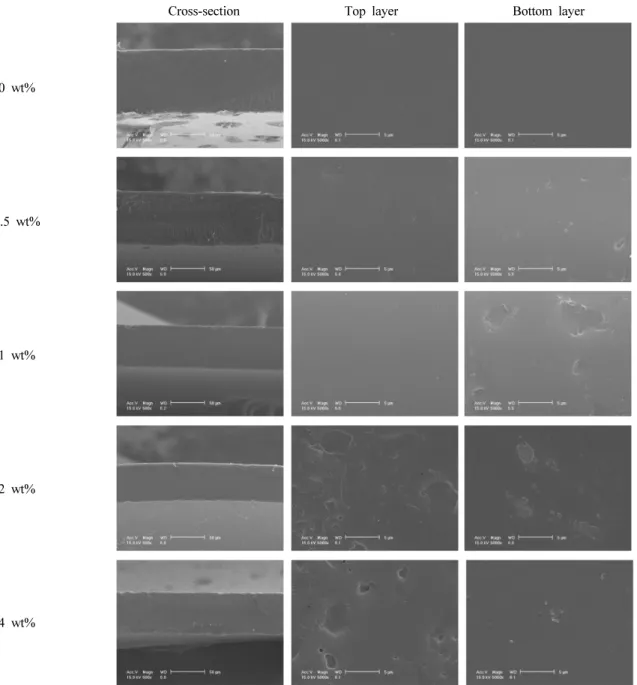
Fig. 1. SEM images of the cross- section (500×), top side and bottom side (5,000×) for the SPAES and SPAES/VMT compo- site membranes with different amount of VMT content.

membrane cross- sectional area (in cm

2

), and R is the membrane resistance (in Ω). The methanol perme- ability was measured at room temperature by means of a two- chamber diffusion cell method. One chamber (80 mL) contained a 10 M (34 wt%) methanol solution and the other chamber (80 mL) was filled with de- ionized water. The methanol concentration was periodi- cally recorded with a GC- M600D gas chromatograph

(Younglin Co. South Korea) equipped with a thermal

conductivity detector (TCD) and a PoraPack Q 80/100

packed column. Using a predetermined standard curve,

a membrane’s methanol permeability was calculated

from the linear interpolation of the permeate- side cell

methanol concentration C

B

, versus time, t. The slope of

the graph can be written as (t)/t- t

0

= α. The methanol

permeability can be calculated as follows:

(5)

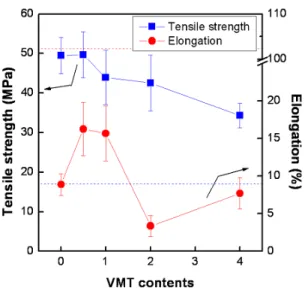
Fig. 2. Mechanical properties of the SPAES and SPAES/

VMT composite membranes with different amount of VMT content.

(2)

where V

B

is the volume of the water compartment, C

B

is the concentration of methanol in the permeate com- partment at time, t, A is the membrane effective area, and L is the membrane thickness.

3. Results and Discussion

3.1. Dispersion of Vermiculite Particles SPAES/VMT composite membranes containing vari- ous amounts of VMT were prepared by a solution casting method. Although the VMT particles are well dispersed and swollen in NMP, the aggregation of VMT in the polymer matrix must be confirmed on ac- count of the possible gravity- induced VMT accumu- lation at the bottom during the fabrication of the membrane. The dispersion of VMT particles in the SPAES matrix was observed with a FE- SEM at 500 × and 5,000 × magnifications of a membrane cross- sec- tion and top and bottom. Fig. 1 shows that the VMT in the SPAES matrix is highly compatible and homo- genous until the addition of 1 wt% of VMT, represent- ing very smooth surface morphologies. When the VMT

content exceeds 2 wt%, partially aggregated VMT and its detachment in the SPAES matrix can be observed at the top and bottom.

3.2. Mechanical Properties

A proton conducting membrane with excellent me- chanical strength is required to operate for a long life- time in DMFCs. The mechanical properties, including the tensile strength and elongation at break, were measured at room temperature with a DMA and the results are presented in Fig. 2. A comparison of a SPAES membrane and Nafion 112 membrane shows a huge difference in the values of the tensile strength and elongation. The SPAES membrane has a high ten- sile strength of approximately 50 MPa and low elonga- tion of less than 10%, whereas the Nafion 112 mem- brane has relatively low tensile strength of 18 MPa and high elongation of more than 100%. These results indicate that the SPAES membrane is brittle and stiff whereas the Nafion 112 is soft and flexible.

The SPAES/VMT0.5 membrane has a maximum ten- sile strength of 50 MPa and an elongation at break value of 17%. The SPAES/VMT1 membrane has a slightly weaker tensile strength in slightly decreased, but an elongation at break value is higher than that of the other composite membranes, possibly due to the dispersion or exfoliation of the VMT layers [5]. However, when the VMT content exceeds 2 wt%, there is a sig- nificant decline in both tensile strength and elongation.

The aggregation of VMT particles in the SPAES ma- trix appears to make the membrane more brittle and fragile. Therefore, SPAES/VMT composite membranes with less than 1 wt% VMT can be excellent candidates for long- term application in DMFC systems.

3.3. Water Uptake and State

Fig. 3 shows the results of the membrane stability in relation to the water uptake at different temperatures of the SPAES and SPAES/VMT composite membranes.

The water uptake of SPAES membrane at room tem-

perature is higher than that of the composite mem-

branes. However, when the temperature of the water is

(6)

Fig. 3. Water uptakes of the SPAES and SPAES/VMT composite membranes containing different amount of VMT content at various temperatures.

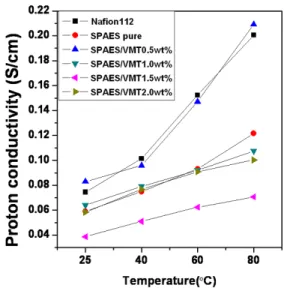
Fig. 4. Proton conductivities of the Nafion 112 (dotted line), SPAES, and SPAES/VMT composites containing dif- ferent amount of VMT content at various temperatures.

increased to 80°C, the composite membranes adsorb a higher amount of water than the SPAES membrane be- cause VMT particles have a high water affinity. As a result, the composite membranes have a higher water uptake at the high temperature of 80°C.

The state of water absorbed in a membrane is an important parameter that affects the proton conductivity and methanol permeability. Our previous studies on fuel cell membranes were focused on the water state of a proton conducting membrane so that we could un- derstand how the water state affects the fuel cell per- formance [7]. However, this study is the first in which the DSC failed to detect the amount of free water (the endothermic peak around 0°C). After several repeti- tions of the experiments, we concluded that all the wa- ter absorbed in VMT composite membranes is bound by the strong interaction of water molecules with the exchange cations and surface layers. The strong water sorption in the SPAES/VMT composite membranes can be explained as follows: all the structural sites in the interlayer spaces are filled with water molecules and with all the possible water- cation, water- surface oxygen atoms, and water- water bonds that can be confirmed for a particular level of hydration [14,15]. The general water adsorption ability of the expended VMT is re-

portedly in the weight range of 200% to 325% and in the volume range of 20 to 50% [16].

3.4. Proton Conductivity

The proton conductivity of the membranes was

measured in terms of the membrane resistance using an

AC impedance. Fig. 4 shows that for all membranes

the proton conductivity increases as the temperature

increases. Of all the SPAES/VMT composite mem-

branes, the SPAES/VMT 0.5 membrane has the highest

proton conductivity at all temperatures. Interestingly,

the proton conductivity soars as the temperature of the

SPAES/VMT 0.5 membrane increases; in this case, the

SPAES/VMT 0.5 membrane has an even higher proton

conductivity (0.21 S/cm) than that of the Nafion 112

(0.20 S/cm). This might be due to the combined effect

of two factors. Firstly, it has the better water retention

at high temperatures, which in turn can be attributed to

the strong hydroscopic property of VMT. And, sec-

ondly, it has strong barrier properties (which prevent

the transport of protons from the anode to the cathode)

because the VMT particles in the SPAES matrix are

well dispersed [16- 18]. However, the proton con-

ductivity of the composite membranes gradually de-

clines when the VMT content exceeds 2 wt%. The re-

(7)

Fig. 5. Methanol permeabilities of the Nafion 112 (dotted line), SPAES, and SPAES/VMT composite membranes with different amount of VMT content.

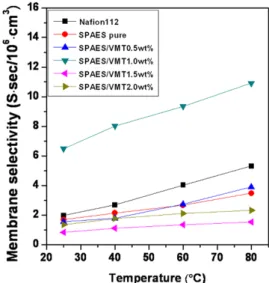
Fig. 6. Membrane selectivities of the Nafion 112 (dotted line), SPAES, and SPAES/VMT composite membranes with different amount of VMT content at various tem- peratures.

sults in Fig. 1 confirm that when the VMT content ex- ceeds 2 wt% aggregation occurs in the SPAES matrix and the transfer of protons in the membrane is re- stricted [19]. In conclusion, when the VMT content is less than 1 wt%, the proton conductivity is improved by the strong hydroscopic property and the good dis- persibility of the VMT particles.

3.5. Methanol Permeability

Fig. 5 shows the methanol permeability of the SPAES membrane and the SPAES/VMT composite membranes with different amount of VMT content. The SPAES/

VMT composite membranes have less methanol perme- ability than the SPAES membrane if the VMT content is less than 1 wt%. This result is related to the fact that the barrier properties of the VMT layers are strengthened by the creation of a tortuous pathway that retards the permeation of methanol molecules through the SPAES matrix. When the membrane has a VMT content of 2%, the methanol permeability dramatically increases most likely on account of the aggregation of VMT particles, which produces a partially defected morphology in the membrane. We concluded therefore that the dispersion of a clay layer can significantly re- duce the methanol permeability because it controls the

distance of the methanol transport pathway through the exfoliated layers. Our results confirm that a VMT par- ticle content of 1 wt% is the most effective proportion in terms of methanol permeability; this proportion yields the lowest methanol permeation of 0.99 × 10

- 8

m

2

/s with well dispersed particles in the membrane.

3.6. Membrane Selectivity

Membrane selectivity is a commonly accepted means of evaluating membrane performance in terms of pro- ton conductivity and methanol permeability [20,21].

For the SPAES membrane and the SPAES/VMT com-

posite membranes, we defined membrane selectivity as

the ratio of proton conductivity to methanol perm-

eability. Fig. 6 shows the membrane selectivity of the

SPAES membrane and SPAES/VMT composite mem-

branes for different amount of VMT content at various

temperatures. The synergistic effect of increasing the

proton conductivity and decreasing the methanol per-

meability improves the overall fuel cell performance of

SPAES/VMT composite membranes with a VMT con-

tent less than 1 wt%. Note that the SPAES/VMT com-

posite membrane with a VMT content of 1 wt% has

the best performance; in fact, its performance is two

(8)

times greater than that of the Nafion 112 membrane.

4. Conclusion

VMT has potential as a barrier material for methanol transport due to its layered silicate structure and high hydroscopic property. SPAES/VMT membranes with different amount of VMT content were prepared via a solution casting method. The dispersion of VMT into SPAES matrix was measured by means of a SEM ob- servation of a cross- section and top and bottom of the composite membranes. Good VMT dispersion was found in composite membranes with a VMT content of less than 1 wt%. Composite membranes with a VMT content in excess of 2 wt% have a partially aggregated portion or depressions on the top and bottom of the membranes. These results correlate well with the me- chanical properties of the composite membranes. The mechanical properties of the membrane with a VMT content of less than 1 wt% appear to be enhanced on account of the better dispersion or exfoliation. In con- trast, the composite membrane with a VMT content of more than 2 wt% has significantly weaker mechanical strength due to partial aggregation. The water uptake of the SPAES membrane and the SPAES/VMT compo- site membranes gradually increases as the temperature increases; and the gradient of increase is sharper in composite membranes with a high VMT content. This outcome may be due to the fact that the high CEC of VMT gives it a strong hydroscopic property. The high- est proton conductivity was obtained with the SPAES/

VMT 0.5 membrane on account of its strong water ad- sorption ability and good dispersion of VMT. The low- est methanol permeability was found in the SPAES/

VMT 1 membrane because the exfoliated or dispersed layers of VMT form a tortuous pathway for methanol molecules. A composite membrane with a VMT con- tent of less than 1 wt% has a high proton conductivity and a low methanol permeability. These factors work together to improve the fuel cell performance. Thus, this type of membrane is highly suitable for DMFC applications.

Acknowledgement

Deuk Ju Kim is grateful to the second stage of the Brain Korea (BK) 21 Project for supporting a fellowship. This work was funded by the Fundamental R&D Program for Core Technology of Materials of the Korean Ministry of Knowledge Economy.

References

1. C. H. Rhee, H. K. Kim, H. Chang, and J. S. Lee,

“Nafion/sulfonated montmorillonite composite: a new concept electrolyte membrane for direct meth- anol fuel cells”, Chem. Mater., 17, 1691 (2005).

2. H. Huh, D. J. Kim, and S. Y. Nam, “Proton con- ductivity and methanol permeability of sulfonated poly(aryl ether sulfone)/modified grapheme hybrid membranes”, Membrane Journal, 21, 3 (2011).

3. B. S. Pivovar, Y. Wang, and E. L. Cussler, “Perva- poration membranes in direct methanol fuel cells”, J. Membr. Sci., 154, 155 (1999).

4. K. S. Yoon, J. H. Choi, J. K. Choi, Y. T. Hong, and H. S. Byun, “Fabrication and Characteristics of Partially Covalent- crosslinked Poly(arylene ether sulfone)s for Use in a Fuel Cell”, Membrane Journal, 18, 4 (2008).

5. M. K. Song, S. B. Park, Y. T. Kim, K. H. Kim, S. K. Min, and H. W. Rhee, “Characterization of polymer- layered silicate nanocomposite membranes for direct methanol fuel cells”, Electrochim. Acta, 50, 639 (2004).

6. P. Bebin, M. Caravanier, and H. Galiano, “Nafion/

clay- SO

3

H membrane for proton exchange mem- brane fuel cell application”, J. Membr. Sci., 278, 35 (2006).

7. H. Y. Hwang, S. J. Kim, D. Y. Oh, Y. T. Hong, and S. Y. Nam, “Proton Conduction and Methanol Transport through Sulfonated Poly(styrene- b- ethyl- ene/butylene- b- styrene)/Clay Nanocomposite”, Macro- mol. Res., 19, 84.

8. K. Zhang, J. Xu, K. Y. Wang, L. Cheng, J. Wang,

(9)

and B. Liu, “Preparation and characterization of chitosan nanocomposites with vermiculite of differ- ent modification", Polym. Degrad. Stab., 94, 2121 (2009).

9. D. Carroll, “Ion exchange in clays and other min- erals”, Geological Society of America Bulletin, 70, 749 (1959).

10. W. L. Harrison, “Synthesis and characterization of sulfonated poly(arylene ether sulfone) copolymers via direct copolymerization: candidates for proton exchange membrane fuel cells”, Hampton University, 2002.

11. Y. T. Hong, C. H. Lee, H. S. Park, K. A. Min, H.

J. Kim, S. Y. Nam, and Y. M. Lee, “Improvement of electrochemical performances of sulfonated poly (arylene ether sulfone) via incorporation of sulfo- nated poly(arylene ether benzimidazole)”, J. Power Sources, 175, 724 (2008).

12. F. Wang, M. Hickner, Y. S. Kim, T. A. Zawo- dzinski, and J. E. McGrath, “Direct polymerization of sulfonated poly (arylene ether sulfone) random (statistical) copolymers: candidates for new proton exchange membranes”, J. Membr. Sci., 197, 231 (2002).

13. J. Y. Park, J. K. Choi, K. J. Choi, T. S. Hwang, H. J. Kim, and Y. T. Hong, “Effects of Mixed Casting Solvents on Morphology and Characteristics of Sulfonated Poly(aryl ether sulfone) Membranes for DMFC Applications”, Membrane Journal, 18, 4 (2008).

14. A. V. Tvardovskii, A. A. Fomkin, Y. I. Tarasevich, I. G. Polyakova, V. V. Serpinskii, and I. M. Guseva,

“Sorption of water vapor on cation- substituted

vermiculite”, Russ. Chem. Bul., 41, 23 (1992).

15. O. Abollino, A. Giacomino, M. Malandrino, and E.

Mentasti, “Interaction of metal ions with montmor- illonite and vermiculite”, Appl. Clay Sci., 38, 227 (2008).

16. Y. S. Choi, T. K. Kim, E. A. Kim, S. H. Joo, C.

Pak, Y. H. Lee, H. Chang, and D. Seung, “Exfo- liated sulfonated poly(arylene ether sulfone) clay nanocomposites”, Advanced Materials, 20, 2341 (2008).

17. V. Neburchilov, J. Martin, H. Wang, and J. Zhang,

“A review of polymer electrolyte membranes for direct methanol fuel cells”, J. Power Sources, 169, 221 (2007).

18. R. Gosalawit, S. Chirachanchai, S. Shishatskiy, and S. P. Nunes, “Sulfonated montmorillonite/sulfo- nated poly(ether ether ketone)(SMMT/SPEEK) nanocomposite membrane for direct methanol fuel cells (DMFCs)”, J. Membr. Sci., 323, 337 (2008).

19. B. Ruffmann, H. Silva, B. Schulte, and S. P. Nunes,

“Organic/inorganic composite membranes for appli- cation in DMFC”, Solid State Ionics, 162, 269 (2003).

20. T. Fu, Z. Cui, S. Zhong, Y. Shi, C. Zhao, G.

Zhang, K. Shao, H. Na, and W. Xing, “Sulfonated poly(ether ether ketone)/clay- SO

3

H hybrid proton exchange membranes for direct methanol fuel cells”, J. Power Sources, 185, 32 (2008).

21. M. M. Hasani- Sadrabadi, S. H. Emami, R. Gha-

ffarian, and H. Moaddel, “Nanocomposite mem-

branes made from sulfonated poly (ether ether ke-

tone) and montmorillonite clay for fuel cell appli-

cations”, Energy Fuels, 22, 2539 (2008).

수치

Table 1. The standard CEC values (at pH of 7) [9].
Fig. 1. SEM images of the cross-        section (500×), top side and bottom side (5,000×) for the SPAES and SPAES/VMT compo- compo-site membranes with different amount of VMT content
Fig. 2.  Mechanical properties of the SPAES and SPAES/
Fig. 3. Water uptakes of the SPAES and SPAES/VMT composite membranes containing different amount of VMT content at various temperatures.
+2

참조

관련 문서

This study reports sensitivity enhancement method of a temperature sensor based on fiber Bragg grating (FBG) in combination with an auxiliary materials with a

The effect of flowable resin composite on microleakage and internal voids in class II composite restorations.. Roberts HW, Charlton DG,

Based on the results of this study, some implications for classes using online reading programs for elementary school students' English reading were

1. Free radical initiator abstract a hydrogen from polymer chains 2. Through chain transfer of propagating chain with polymer chain 3. Polymer mixtures are mechanically

J., “Hydrogen production from partial oxidation of dimethyl ether using corona discharge plasma”, International Journal of Hydrogen Energy , Vol.. Liu C.,

In this study, Sulgidduk was prepared with adding finger root ( Boesenbergia rotunda ) powder containing a large amount of functional substances, and the

Therefore, in order to make advanced composite pallet on digital display production line, this study will analyze stress of the composite pallet according to the

As a result of the study, gas membrane module was selected based on the survey of nitrogen charging capacity and using flow rate in the high-pressure