• 검색 결과가 없습니다.

Landuse and Landcover Change and the Impacts on Soil Carbon Storage on the Bagmati Basin of Nepal

N/A
N/A
Protected

Academic year: 2021

Share "Landuse and Landcover Change and the Impacts on Soil Carbon Storage on the Bagmati Basin of Nepal"

Copied!
7
0
0

로드 중.... (전체 텍스트 보기)

전체 글

(1)

1) Graduate Student, Department of Disaster Prevention and Environmental Engineering, Kyungpook National University 2) Professor, Department of Regional Infrastructure Engineering, Kangwon National University

3) Professor, Department of Biological Environment, Kangwon National University

4) Assistant Professor, Department of Agricultural Civil Engineering, Kyungpook National University

Landuse and Landcover Change and the Impacts on Soil Carbon Storage on the Bagmati Basin of Nepal

Shiksha Bastola

1)

・ Kyuong Jae Lim

2)

・ Jae Eui Yang

3)

・ Yongchul Shin

4)

・ Younghun Jung

Received: October 27

th

, 2019; Revised: November 4

th

, 2019; Accepted: November 12

th

, 2019

ABSTRACT : The upsurge of population, internal migration, economic activities and developmental works has brought significant land use and land cover (LULC) change over the period of 1990 and 2010 in the Bagmati basin of Nepal. Along with alteration on various other ecosystem services like water yield, water quality, soil loss etc. carbon sequestration is also altered. This study thus primary deals with evaluation of LULC change and its impact on the soil carbon storage for the period 1990 to 2010. For the evaluation, InVEST (Integrated Valuation of Ecosystem Services and Tradeoffs) Carbon model is used. Residential and several other infrastructural development activities were prevalent on the study period and as a result in 2010 major soil carbon reserve like forest area is decreased by 7.17% of its original coverage in 1990. This decrement has brought about a subsequent decrement of 1.39 million tons of carbon in the basin. Conversion from barren land, water bodies and built up areas to higher carbon reserve like forest and agriculture land has slightly increased soil carbon storage but still, net reduction is higher. Thus, the spatial output of the model in the form of maps is expected to help in decision making for future land use planning and for restoration policies.

Keywords : Soil carbon, Land use, Carbon storage, Development, Decision-making

ISSN 1598-0820 DOI https://doi.org/10.14481/jkges.2019.20.12.33 Journal of the Korean Geo-Environmental Society

20(12): 33~39. (December 2019) http://www.kges.or.kr

1. Introduction

Among the various ecosystem services provided by the basin, climate change regulation service through carbon storage capacity is the most significant ecosystem service (MEA, 2005). Ecosystem functions to regulate climatic activity by adding or removing greenhouse gases (GHG) such as CO

2

from the atmosphere and terrestrial (Forest, soils, grassland, shrubland, wetland etc) ecosystems stores more carbon than the atmosphere (Sharp et al., 2018). Soil organic carbon releases nutrients required for plant growth, improves biological and physical health of soil and acts as buffer against harmful substances. Thus, increment on soil carbon significantly improves two aspects; mitigation of climate change and overall soil fertility and vice-versa. However, increasing GHG con- centrations in the atmosphere possess a serious threat to the global climate system and in this scenario, soils are an important factor which can affect atmospheric carbon dioxide concentration by causing net emissions or by being a carbon reserve (FAO, 2012). Climate change, land degradation and

biodiversity loss have made soils as one of the most vulnerable resources in the world (FAO, 2017). After the emissions from the fossil fuel combustion, land use and land cover (LULC) change are considered as the second largest anthropogenic source of carbon into the atmosphere (IPCC, 2007).

Soil carbon storage results from interactions of ecological

processes, and the anthropogenic activities affecting these

processes can lead to carbon loss or improved storage. Increased

population, unchecked urbanization, subsequent demands for

infrastructural developments and significant land use and land

cover changes are causing pressure on ecosystems that are

good reserve of carbon. Several studies have been conducted

on the evaluation of global carbon stocks based on biomass

(phytomass) and are quantified with reasonable certainty

compared to soil carbon (Ruesch & Holly, 2008; Saatchi et al.,

2011; Baccini et al., 2012; Harris et al., 2012). As well the

carbon emitted through LULC change is considerably uncertain

and prevalent practices like provision of financial incentives

for REDD+ climate change mitigation policies shows existing

high priority on biomass carbon (Scharlemann et al., 2014).

(2)

Fig. 1. Study area in the map of Nepal

Fig. 2. Land use and land cover for 1990 and 2010 The imbalance between the carbon fluxes into and out of the

soil results in soil carbon change. Land-use change thus may cause quite rapid changes in soil carbon as it alters carbon input to the soil or alters decomposition conditions or sometime both. (Post & Kwon, 2000; Vagen, et al., 2005).

Both developing and developed nations are facing upsurge of LULC change to meet the developmental needs for economic prosperity. These dynamic activities are of great concern as carbon storage capacity provided by the ecosystem might have greatly reduced. Nepal, as a developing nation, also has faced several changes in terms of land use and land cover in the past three decades (i.e Period of 1990-2019) and the Bagmati Basin specially in the upper part of the basin, which incor- porates capital city Kathmandu and two other major urban cities like Lalitpur and Bhaktapur has faced significant alteration on forest, agriculture, and built-up areas. This study thus aims to evaluate the change in soil carbon between the period 1990 and 2010 based on LULC change over the period in the Bagmati basin of Nepal. Few studies have focused on other

ecosystem services like soil loss (Bastola et al., 2018), water yield (Bastola et al., 2019), Land-use and water (Davids et al., 2018) etc. in the basin but there is a clear lack of studies linking LULC change and soil carbon in the basin. The spatial information on where soil carbon is significant and how shifts in land use affects the amount of soil carbon stored can be helpful for decision making for sites for protection, harvest and support decisions influencing these ecosystem services.

2. Methodology

2.1 Study Area

The Bagmati basin lies in central Nepal and the Bagmati

river is the principal river of the basin. The Bagmati river is

a spring and monsoon rain-fed river and has many tributaries

such as Bishnumati, Manohara, Tukucha etc. The basin lies

at latitude 26º42′ to 27º50′ N and longitude 85º22′ to 85º58′E

with the total area of 3,750 km

2

. For the study, based on good

(3)

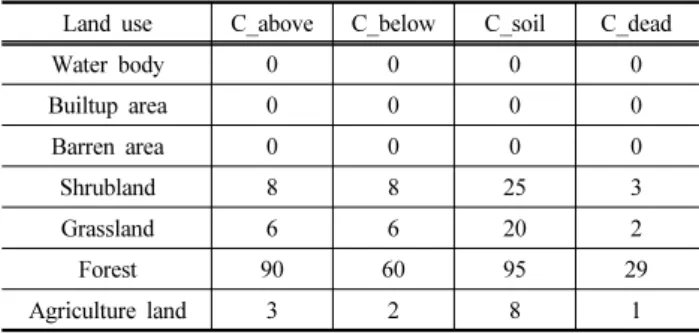
Table 1. Carbon pool data for different land use types (MgC/ha)

Land use C_above C_below C_soil C_dead

Water body 0 0 0 0

Builtup area 0 0 0 0

Barren area 0 0 0 0

Shrubland 8 8 25 3

Grassland 6 6 20 2

Forest 90 60 95 29

Agriculture land 3 2 8 1

Where, C_above refers to aboveground biomass, C_below refers to belowground biomass, C_soil refers to soil organic carbon and C_dead refers to dead organic matter.

data availability, only the area of 2,768.92 km

2

is considered as shown in Fig. 1. Based on morphology and landuse, basin can be divided in three parts as upper, middle and lower basin area. The upper part of the basin is highly populated compared to other parts and covers the whole of Kathmandu valley (Fig. 2). Likewise, middle and lower part of the basin is comparatively flat and as per LULC map, cultivated land is dominant in upper part of basin whereas forest areas are dominant in middle and lower part of the basin. As well, as capital city lies in upperpart of the basin, anthropogenic activities are more dynamic in upper part of the basin.

2.2 Model description and data preparation

In this study, for the mapping of soil carbon, InVEST Carbon Model is used. InVEST (Integrated Valuation of Ecosystem Services and Tradeoffs) is an open source software (NatCap Project, 2018) developed by the natural capital project of Stanford University. The models are spatially explicit and uses maps as an input information and produces maps as an output and are designed to inform decisions about natural resources management. InVEST is a modular tool and has several models like Water yield model, Sediment retention model, Nitrogen model, Carbon Storage and Sequestration model, etc. InVEST models are now widely used in decision making specially in developing nations where adequate data are scarce. The InVEST carbon model was applied on Hawaii for the land use planning along with for adaptation to climate change (Goldstein et al., 2012). Chun (Chun et al., 2019) have used InVEST carbon models to study impacts of LULC change on carbon sequestration in Korea along with economic evaluation. The InVEST Carbon model used in this study maps carbon storage densities to LULC raster by aggregating the amount of carbon stored on four major carbon pools. The carbon pools considered are aboveground biomass, belowground biomass, soil and dead organic matter to produce the total amount of carbon storage.

The carbon storage C

m,i,j

for a given grid cell (i,j) with land-use type m can be calculated as:



  × 















 (1)

Where, A = Actual area of each grid cell (ha) Ca

m,I,j

, Cb

m,I,j

, Cs

m,I,j

, Cd

m,I,j

are the aboveground, below-

ground, soil organic, and dead organic matter carbon density in MgC/ha for grid cell (i,j) with land use type m. The model also produces separate raster with carbon value depending upon LULC raster and carbon pool data. Soil carbon for the study area is computed from carbon raster for soil.

Land use and land cover map of 1990 and 2010 is obtained from the ICIMOD Nepal Geospatial Portal’s regional database system. The map is prepared using public domain Landsat TM data and consists of 7 attributes namely, forest, grassland, shrubland, agriculture, built-up, water body and barren area (Fig. 2). Along with LULC data, the model requires an attribute table (Table 1) which quantitatively describes four carbon pools data for each land use. Published data and the InVEST manual are referred to obtain the carbon pools coefficient values. The output of the model is expressed as million grams per hectare (Mg per ha).

3. Results

Land use and land cover assessment on 1990 and 2010 shows significant conversion on landuse classes like forest, agriculture and built-up areas (Table 1). The highest decrement is on forest area, which is decreased by 13,742 ha making it 7.17% lesser than 1990. Likewise, with increased population and subsequent anthropogenic demands, agriculture area and built up area possess significant increment in 2010 compared to 1990. Agriculture area in 2010 is increased by 5.86%

(3,864.9 ha) and built-up area has highest increment of 69.72%

(7,067.52 ha) in 2010 compared that with 1990 scenario.

Also, barren area is almost doubled in 2010 (4,998.51 ha)

compared with 1990 (2,500.47 ha) and water mass is decreased

(4)

Table 2. Change in land use and land cover

SN LULC class Area_1990 (ha) Area_2010 (ha) Change (ha) % Change

1 Forest 191,538.63 177,796.08 -13,742.55 -7.17

2 Shrubland 553.77 661.14 107.37 +19.39

3 Grassland 3,545.19 5,401.71 1,856.52 +52.37

4 Agriculture 65,926.71 69,791.40 3,864.69 +5.86

5 Barren 2,500.47 4,998.51 2,498.04 +99.90

6 Water 2,690.64 1,039.05 -1,651.59 -61.38

7 Built-up 10,137.69 17,205.21 7,067.52 +69.72

Total 276,893.10 276,893.10

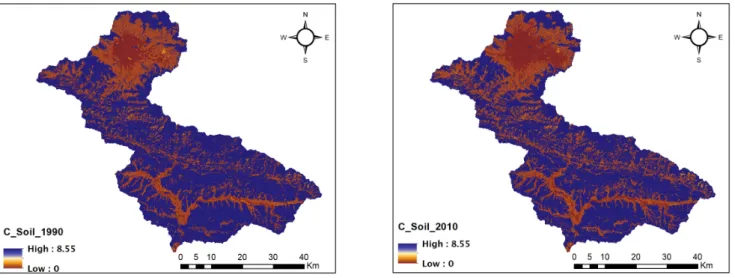
Fig. 3. Soil map for the year 1990 (mg/pixel) Fig. 4. Soil map for the year 2010 (mg/pixel) by 61.38% (1,651.59 ha). Land use class like shrubland and

grassland posses’ slight increments of 107.37 ha and 1856.52 ha respectively.

Evaluation of LULC conversion from one class to another shows a total of 41,871.42 ha of land faced conversion from its original class to another (Table 2). This area accounts for almost 15.12% of the study basin. Period from 1990 to 2010 has observed several developmental works, infrastructural advancements, technology transfer and blooming population growth. To meet this demand, increment on agricultural areas and built up areas are observed to be significant. The con- version pattern shows conversion to agricultural land from other landuse types is highest. Among all land use types, forest conversion to agriculture land is highest (16,961.4 ha) followed by agricultural land conversion to built-up area. This transition has mostly occurred in the upper part of the basin where urban areas consisting three major cities Kathmandu, Bhaktapur and Lalitpur are concentrated. The other notable conversions are from agricultural land to barren land (1,544 ha) and grassland (2,579 ha). The diagonal on the Table 2

shows area of landuse that remained intact in its original form from 1990 to 2010.

Likewise, the analysis of soil carbon based on LULC raster shows with significant LULC conversions in the basin, total amount of soil carbon is reduced by 1.39 million ton of Carbon. The reduced amount of soil carbon (1.39 million ton) caused only by LULC conversion is equivalent to the amount of the carbon emitted by about 275,000 cars a year (USEPA). Fig. 3 and Fig. 4 shows the soil carbon map for the year 1990 and 2010 respectively. Total soil carbon for the year 1990 is 20.73 million tons whereas for the year 2010, total soil carbon is reduced to 19.34 million tons. The net loss on the carbon estimated by the InVEST model comply with the results obtained by Liang (Liang et al., 2017) in the northwestern china. The study has estimated the carbon loss of 3.53 million tons for a period of 10 years (2009-2018) under historical land use demand scenario.

In this study, soil carbon stored in four major land use

types are evaluated and compared for periods of 1990 and

2010. Forest is the highest reserve of soil carbon contributing

(5)

Table 3. Land use and land cover conversion from 1990 to 2010 2010 LULC

1990 LULC

Class Forest Shrubland Grassland Agriculture Barren Water Built-up Total

Forest 171,846.27 311.67 1,460.88 16,961.4 299.34 212.94 446.13 191,538.63

Shrubland 123.21 260.28 72.36 88.56 2.25 1.44 5.67 553.77

Grassland 357.93 18.45 953.37 1,343.25 529.74 19.8 322.65 3,545.19

Agriculture 5,336.01 50.58 2,579.67 49,887.36 1,544.31 187.02 6341.76 65,926.71

Barren 52.11 2.97 73.26 641.34 1,554.03 73.89 102.87 2,500.47

Water 62.46 17.19 258.12 735.48 1,063.71 543.96 9.72 2,690.64

Built-up 18.09 0 4.05 134.01 5.13 0 9,976.41 10,137.69

Change between 1990

and 2010

-13,742.55 107.37 1,856.52 3,864.69 2,498.04 -1,651 7,067.52 -13,742.55

Table 4. Soil carbon based on landuse types (Million t C)

Landuse class Soil carbon 1990 Soil carbon 2010 Change in soil carbon Soil carbon % 1990 Soil carbon % 2010

Agriculture 0.581 0.949 0.368 2.80 4.91

Forest 20.052 18.183 -1.869 96.75 94.01

Shrub 0.015 0.021 0.006 0.07 0.11

Grass 0.078 0.188 0.110 0.38 0.97

Total 20.73 19.34 -1.39

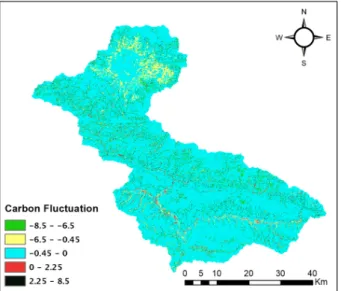
Fig. 5. Carbon fluctuation between period 1990 and 2010 (mg/pixel) 96.75 and 94.01 percentage in 1990 and 2010 respectively and with subsequent decrement (13,742.55 ha) of forest areas, 1.87 million tons of soil carbon is reduced from forest land use. Likewise, increment in agriculture area from other land use like barren, water body and built-up area has increased soil carbon storage by 0.368 million tons. As well, increment on shrubland and grassland has also contributed to small increment of soil carbon storage, however, due to major decrement on forest areas, net soil carbon storage is decreased

on 2010 compared to 1990. Fig. 5 is pictorial representation of soil carbon which shows some areas have gained soil carbon and some areas have lost soil carbon over a period of 20 years. The decrement is higher on upper part of basin where human settlement and other activities are occurring on dynamic rate.

4. Discussions

LULC conversion plays a significant role in the alteration of soil carbon. Results from various studies have shown even the conversion of native vegetation to the cropland causes 25-50% decrement of soil carbon in the top 1 m (Post &

Kwon, 2000; Guo & Gifford, 2002; Murty et al., 2002; Lal,

2004; Aalde et al., 2006). The phenomenon of carbon cycling

and carbon sequestration is most active in topsoil horizons

(FAO, 2017) and top 1m of the world’s soil contains appro-

ximately 1,500 GT C (Johnson & Henderson, 1995) and thus

even small changes into and out of this pool can result to

large change on a global scale. LULC change occur both in

national and regional level and even in countries experiencing

rapid economic growth, development projects are seen con-

centrated in specific regions (Chun et al., 2019). This trend

(6)

is also vivid on developing countries like Nepal. The study area Bagmati basin has faced several developmental works and high rate of internal migration in the period of 1990 to 2010. The upper part of the basin has faced concentrated conversion of forest areas to agriculture and to built-up areas.

The human activities are directly altering topsoil for the purposes like farming, buildings, roads, industries etc. and in absence of proper regulation to check this unsystematic human activity, the capacity of topsoil to store carbon is reducing annually. Also, the unscientific farm management practices and resultant soil degradations and soil erosions are reducing agricultural productions and capacity of soil to reserve the carbon. In this scenario, the maps of soil carbon storage can help in decision making about future land use scenarios and development works, as well helps in restoration policies.

5. Limitations of the Study

The InVEST Carbon Storage and Sequestration model used in this study has its own modelling limitations. It assumes that each LULC is at fixed carbon storage level and the fluctuation on carbon storage is only due to change of LULC from one class to another. It hasn’t well acknowledged the self-capacity of LULC to gain or lose carbon over time.

Likewise, as the model relies on carbon storage estimates for each LULC type, results are reliable to the scale of provided LULC classification and carbon pool value applied. The differences on the soil carbon on the sub classes of LULC types can be obtained if the data for the carbon pools for each finer LULC classes are available.

The InVEST carbon model are well validated on various parts of the world for various approaches of service like for Oasis carbon storage in northwestern China (Liang et al., 2017), for ecosystem services of forests in South Korea (Vicente- Vicente et al., 2019), for LULC changes and carbon costs in South Korea (Chun et al., 2019) etc. and are found to be effective on decision making for sustainable management of land use. Due to field data unavailability and limited scope of the project at this stage, this study lacks field validations and this study is done based on validations on other parts of the world and wide use of InVEST Carbon model on decision

making. This study is expected to be helpful for scenario analysis and can be a step forward for further research.

6. Conclusion

This study investigated how changes in LULC in the Bagmati basin of Nepal has fluctuated the carbon storage on the basin.

The results show with significant alteration of land use class from one to another and especially with reduction on major carbon reserve like forest, total soil carbon storage is reduced by 1.39 million ton in the basin in 2010 compared to 1990.

Forest are equally important for the provision of other eco- system services like water yield, soil retention, etc. and reduction on the forest areas can equally hamper overall provision of interrelated ecosystem services. InVEST carbon model produces maps of soil carbon storage and such maps can support range of decisions by governments, city planners and businesses which aims to identify opportunities to earn credits for reduced carbon emissions.

Further research incorporating various future land use scenarios can bring visualization of best land use policy by indicating temporal and spatial carbon storage/loss. As well, monetary valuation of soil carbon helps for provision of incentives for soil carbon and can enhance preservation and promotion of forest areas and other major ecosystem service providers. Likewise, validation with field estimates of soil carbon on regional scale would improve accuracy of model and enhance accurate economic valuation of soil carbon.

Acknowldegement

This subject is supported by Korea Ministry of Environment as “The SS project; 2019002820002”.

References

1. Aalde, H., Gonzalez, P., Gytarsky, M., Krug, T., Kurz, W. A.,

Lasco, R. D., Martino, D. L., McConkey, B. G., Ogle, S.,

Paustian, K., Raison, J., Ravindranath, R. H., Schoene, D., Smith,

P., Somogyi, Z., Amstel, A. and Verchot, L. (2006), Generic

methodologies applicable to multiple land~use categories. In:

(7)

IPCC Guidelines for National Greenhouse Gas Inventories.

2. Baccini, A., Goetz, S. J., Walker, W. S., Laporte, N. T., Sun, M., Sulla~Menashe, D., Hackler, J. L., Beck, P. S., Dubayah, R., Friedl, M. A., Samanta, S. and Houghton, R. A. (2012), Estimated carbon dioxide emissions from tropical deforestation improved by carbon~density maps, Nature Climate Change, Vol.

2, No. 3, pp. 182~185.

3. Bastola, S., Seong, Y. J., Lee, S. H. and Jung, Y. (2019), Water yield estimation of the Bagmati basin of Nepal using GIS based InVEST model, Journal of Korea Water Resources Association, Vol. 52, No. 9, pp. 637~645.

4. Bastola, S., Seong, Y. J., Lee, S. H., Shin, Y. and Jung, Y.

(2018), Assessment of soil erosion loss by using RUSLE and GIS in the Bagmati basin of Nepal, Journal of Korean Geo- technical Society, Vol. 20, No. 3, pp. 5~14.

5. Chun, J., Kim, C. K., Kang, W., Park, H., Kim, G. and Lee, W. K. (2019), Sustainable management of carbon sequestration service in the areas with high development pressure: Considering land use changes and carbon costs, Sustainability, Vol. 11, No.

8, pp. 5116.

6. Davids, J. C., Rutten, M. M., Shah, RDT., Shah, D. N., Devkota, N., Izebound, P., Pandey, A. and Giesen N, V.D. (2018), Quantifying the connections~linkages between land~use and water in the Kathmandu Valley, Nepal. Environmental Monitoring and Assess- ment, Vol. 190, No. 5, pp. 304.

7. FAO. (2012), Soil carbon monitoring using surveys and modelling General description and application in the United Republic of Tanzania, FAO Forestry Paper, Vol. 168, Rome, Italy.

8. FAO. (2017), Soil Organic Carbon: the hidden potential. Food and Agriculture Organization of the United Nations Rome, Italy.

9. Goldstein, J. H., Caldarone, G., Duarte, T. K., Ennaanay, D., Hannahs, N., Mendoza, G., Polasky, S., Wolny, S. and Daily, G. C. (2012), Integrating ecosystem service tradeoffs into land- use decisions. Proceedings of National Academy of Sciences, USA, Vol. 109, No. 19, pp. 7565~7570.

10. Guo, L. B. and Gifford, R.M. (2002), Soil carbon stocks and land use change: a meta~analysis, Global Change Biology, Vol.

8, No. 4, pp. 345~360.

11. Harris, N. L., Brown, S., Hagen, S. C., Saatchi, S. S., Petrova, S., Salas, W., Hansen, M. C., Potapov, P. V. and Lotsch, A.

(2012), Baseline map of carbon emissions from deforestation in tropical regions, Science, Vol. 336, No. 6088, pp. 1573~1576.

12. IPCC Climate Change 2007. (2007), Synthesis Report, Contri- bution of Working Groups I, II and III to the Fourth Assessment Report of the Intergovernmental Panel on Climate Change, IPCC, Geneva, Switzerland.

13. Johnson, D. W. and Henderson, P. (1995), Effects of forest management and elevated carbon dioxide on soil carbon storage.

In: Soil Management and the Greenhouse Effect, Lewis Publishers, London, pp. 137~145.

14. Lal, R. (2004), Soil carbon sequestration impacts on global climate

change and food security, Science, Vol. 304, pp. 1623~1627.

15. Liang, Y., Liu, L. and Huang, J. (2017), Integrating the SD- CLUE-S and InVEST models into assessment of oasis carbon storage in northwestern China, PLoS ONE, Vol. 12, No. 2.

16. MEA. (2005), Millennium Ecosystem Assessment. Ecosystems and Human Well~Being: Synthesis; Island Press: Washington, DC, USA, pp. 1~137.

17. Murty, D., Kirschbaum, M. U. F., McMurtrie, R. E. and McGilvray, H. (2002), Does conversion of forest to agricultural land change soil carbon and nitrogen? A review of the literature, Global Change Biology, Vol. 8, No. 2, pp. 105~123

18. Post, W.M. and Kwon, K. C. (2000), Soil carbon sequestration and land~use change: processes and potential, Global Change Biology, Vol. 6, No. 3, pp. 317~327.

19. Ruesch, A. and Holly, K. G. (2008), New IPCC Tier~1 Global Biomass Carbon Map for the Year 2000. Available online from the Carbon Dioxide Information Analysis Center [http://cdiac.

ess~dive.lbl.gov], Oak Ridge National Laboratory, Oak Ridge, Tennessee. USA.

20. Saatchi, S. S., Harris, N. L., Brown, S., Lefsky, M., Mitchard, E.

T., Salas, W., Zutta, B. R., Buermann, W., Lewis, S. L., Hagen, S., Petrova, S., White, L., Silman, M. and Morel, A. (2011), Benchmark map of forest carbon stocks in tropical regions across three continents. Proceedings of National Academy of Sciences USA, Vol. 108, No. 24, pp. 9899~9904.

21. Scharlemann, J. PW., Tanner, E. VJ., Hiederer, R. and Kapos, V. (2014), Global soil carbon: understanding and managing the largest terrestrial carbon pool, Carbon Management, Vol. 5, No.

1, pp. 81~91.

22. Sharp, R., Tallis, H. T., Ricketts, T., Guerry, A. D., Wood, S.

A., Chaplin~Kramer, R., Nelson, E., Ennaanay, D., Wolny, S., Olwero, N., Vigerstol, K., Pennington, D., Mendoza, G., Aukema, J., Foster, J., Forrest, J., Cameron, D., Arkema, K., Lonsdorf, E., Kennedy, C., Verutes, G., Kim, C. K., Guannel, G., Papenfus, M., Toft, J., Marsik, M., Bernhardt, J., Griffin, R., Glowinski, K., Chaumont, N., Perelman, A., Lacayo, M. Mandle, L., Hamel, P., Vogl, A. L., Rogers, L., Bierbower, W., Denu, D. and Douglass, J. (2018), InVEST 3.6.0 User’s Guide. The Natural Capital Project, Stanford, CA, USA.

23. United States Environmental Protection Agency (USEPA), Green Vehicle Guide, accessed from https://www.epa.gov/greenvehicles/

greenhouse-gas-emissions-typical-passenger-vehicle, accessed on November 11, 2019.

24. Vagen, T. G., Lal, R. and Singh, B. R. (2005), Soil carbon sequestration in sub-Saharan Africa: a review, Land Degradation

& Development, Vol. 16, No. 1, pp. 53~71.

25. Vicente-Vicente, J. L., Fuss, S., Song, C., Lee, J., Kim, M.,

Lee, W.-K. and Son, Y. (2019), A Holistic View of Soils in

Delivering Ecosystem Services in Forests: A Case Study in

South Korea., Forests, Vol. 10, No. 6, pp. 487.

수치

Fig. 2. Land use and land cover for 1990 and 2010The imbalance between the carbon fluxes into and out of the
Table 1. Carbon pool data for different land use types (MgC/ha)
Fig. 3. Soil map for the year 1990 (mg/pixel) Fig. 4. Soil map for the year 2010 (mg/pixel)by 61.38% (1,651.59 ha)
Table 3. Land use and land cover conversion from 1990 to 2010 2010 LULC

참조

관련 문서