• 검색 결과가 없습니다.

Korean New Records of Five Bdelloids including Four Rare Species

N/A
N/A
Protected

Academic year: 2021

Share "Korean New Records of Five Bdelloids including Four Rare Species"

Copied!
7
0
0

로드 중.... (전체 텍스트 보기)

전체 글

(1)

Korean J. Environ. Biol. 33(3) : 283~289 (2015) http://dx.doi.org/10.11626/KJEB.2015.33.3.283

INTRODUCTION

In the genera Macrotrachela Milne, 1886 and Habrotro- cha Bryce, 1910, about 106 and 128 taxa, respectively, have been known to the world (Segers 2007, updated in 2012).

In Korea, 17 Macrotrachela and 18 Habrotrocha taxa have been reported until recently (Song 2015; Song and Min 2015).

The result of the present study added three Macrotrachela and two Habrotrocha species to the Korean record, which led to 20 taxa in Macrotrachela and 20 in Habrotrocha.

These Korean new records included four rare species with very limited distributions such as M. magna, M. oblita, M. inermis and H. schultei. Most remarkably, M. magna and H. schultei are recorded outside their type localities for the first time after 60 and 49 years after their descriptions, res­

pectively. M. oblita has been reported only from five Euro­

pean countries, and M. inermis has been known from three

European countries and Eastern Turkey before the present study. While H. eremita is a presumably cosmopolitan spe­

cies because of its wide distribution, it is new to Asian fauna.

Here diagnostic characteristics, illustrations and discus­

sions on the taxonomy and distribution of each Korean new record are provided.

MATERIALS AND METHODS

For the present taxonomic study on Korean rotifers, spe­

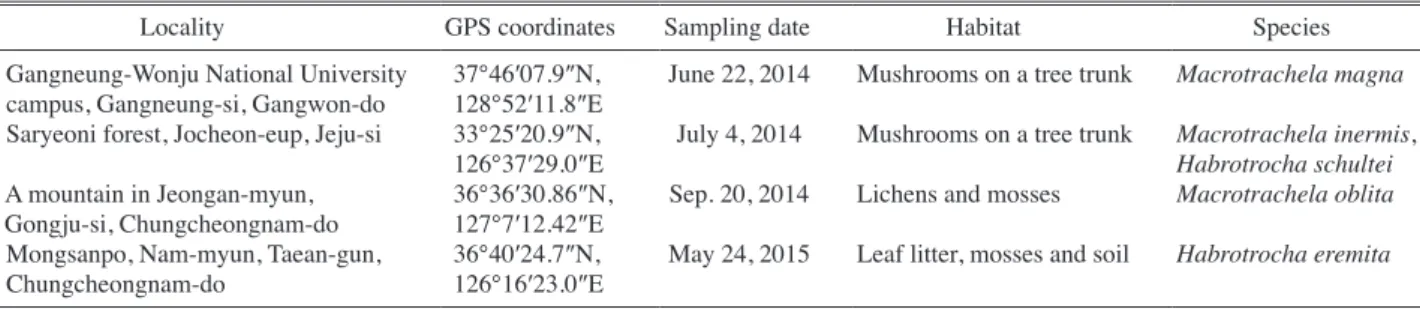
cimens collected from various terrestrial habitats such as mosses, lichens, mushrooms on tree trunks, leaf litter and soil were investigated. Samples were collected from four locations in Korea from July 4, 2014 to May 24, 2015. The detailed habitat information and sampling date of each loca­

lity are listed in Table 1. The bdelloids were extracted, ex­

amined and identified according to a previously described method (Song 2014). The photography and motion records of living specimens were performed using an Infinity 2 dig­

ital camera (Lumenera Corporation, ON, Canada). The pho­

* Corresponding author: Min Ok Song, Tel. 033­640­2310,

Fax. 033­640­2867, E­mail. [email protected], [email protected]
ⓒ 2015. Korean Society of Environmental Biology.

Korean New Records of Five Bdelloids including Four Rare Species

Min Ok Song*

Department of Biology, Gangneung-Wonju National University, Gangwon-do 201-702, Korea Abstract - The bdelloids collected from various terrestrial habitats such as mosses, lichens, mushrooms on tree trunks, leaf litter and soil at four different locations in Korea were investigated. Five bdelloids new to Korea were identified: Macrotrachella inermis Donner, 1965, Macrotrachela magna Schulte, 1954, Macrotrachela oblita Donner, 1949, Habrotrocha eremita (Bryce, 1894) and Habrotrocha schultei Donner, 1965. All these rotifers except M. inermis are new to Asia as well. Remarkably, these five Korean new records included four rare species with poorly known distributions. M. magna and H. schultei are recorded outside their type localities for the first time. M. oblita has been reported only from five European countries, and M. inermis has been known from three European countries and Eastern Turkey before the present study. The taxonomy and distribution of each rare bdelloid are discussed here.

Key words: bdelloids, new records, taxonomy, Korea, distribution

(2)

tographs and computer­grabbed images of motion records were used for illustrations. Measurements were made by using Photoshop CS3. The specimens were killed with head, foot, and toes extended, by using the boiling water fixation method (Pennak 1978) instead of narcotization. The method of Stemberger (1979) was used for the preparation of per­

manent mounts.

The classification scheme is based on Melone and Ricci (1995).

RESULTS AND DISCUSSION Phylum Rotifera Cuvier, 1817 윤형동물문 Class Eurotatoria De Ridder, 1957 진윤충강 Subclass Bdelloidea Hudson, 1884 질형아강 Order Philodinida Melone & Ricci, 1995 선윤충목 Family Philodinidae Bryce, 1910 선윤충과 Genus Macrotrachela Milne, 1886 큰관윤충속 1. Macrotrachela inermis Donner, 1965 (Fig. 1)

연약큰관윤충 ( 신칭 )

Synonyms: Macrotrachela inermis Donner, 1965, pp. 139­

140, Fig. 103; Donner, 1970, p. 242, Abb. 21d, g, h.

Material examined: 2 specimens, Saryeoni forest, Jocheon­

eup, Jeju­si, July 4, 2014.

Diagnosis: Upper lip arched and with rounded triangle­

shaped median lobe; upper lip slightly lower than trochal discs. Corona much narrower than cingulum pad. Pharyn­

geal tube slightly longer than trophi length. Teeth 4/4. Spurs conical with pointed ends; interspace narrower than spur base width.

Measurements: Total body length (in feeding) 203~210 μm. Total body length (in creeping) 270 μm. Greatest trunk

width (in feeding) 58 ~59 μm. Greatest trunk width (in creeping) 44 μm. Corona width 22 μm. Cingulum width 23~25 μm. Cingulum pad width 28~29 μm. Trophi length 11~12 μm. Spur length 6 μm.

Remarks: This species is distinguished from its congeners by wide rostrum, short rostral lamella, 4/4 teeth and coro­

na as wide as or narrower than cingulum pad. The general morphology of the Korean specimens conforms to the ori­

ginal description well except that the upper lips of some Austrian specimens were much lower than trochal discs and with a slight median notch (Fig. 103d­e in Donner 1965).

While the Austrian and Turkish specimens were collected from mosses (Donner 1970; Kaya 2013), the Korean speci­

mens were isolated from mushrooms on a tree trunk. Kaya (2013) reported this species from the eastern part of Turkey (Erzurum), which was the first Asian record of it.

Habitat: The specimens were isolated from mushrooms on a tree trunk at Saryeoni forest.

World Distribution: Austria, Italy, Turkey, Belarus, Korea.

Deposition: NIBR (KOSPGR0000270525, KOSPIV 0000206148, KOSPIV0000206149).

Identifier: Min Ok Song.

2. Macrotrachela magna Schulte, 1954 (Fig. 2) 거대큰관윤충 ( 신칭 )

Synonyms: Macrotrachela magna Schulte, 1954, pp. 603­

604, Abb. 29a­d; Donner, 1965, p. 140, Fig. 94j.

Material examined: 3 specimens, Gangneung­Wonju Na­

tional University campus, June 22, 2014.

Diagnosis: Upper lip bilobed medially and with slightly bilobed depression between 2 lobes. Corona wider than cin­

gulum. Body reddish and granulated. Spurs conical, point­

ed, not granulated and with narrow interspace. First foot pseudosegment with one hump dorsally. Teeth 2+1/1+2.

Table 1. List of sampling localities

Locality GPS coordinates Sampling date Habitat Species 1. Gangneung­Wonju National University

campus, Gangneung­si, Gangwon­do 37°46′07.9″N,

128°52′11.8″E June 22, 2014 Mushrooms on a tree trunk Macrotrachela magna 2. Saryeoni forest, Jocheon­eup, Jeju­si 33°25′20.9″N,

126°37′29.0″E July 4, 2014 Mushrooms on a tree trunk Macrotrachela inermis, Habrotrocha schultei 3. A mountain in Jeongan­myun,

Gongju­si, Chungcheongnam­do 36°36′30.86″N,

127°7′12.42″E Sep. 20, 2014 Lichens and mosses Macrotrachela oblita 4. Mongsanpo, Nam­myun, Taean­gun,

Chungcheongnam­do 36°40′24.7″N,

126°16′23.0″E May 24, 2015 Leaf litter, mosses and soil Habrotrocha eremita

(3)

Three toes very short.

Measurements: Total body length (in feeding) 380 μm.

Greatest trunk width (in creeping) 74 μm. Greatest trunk width (in feeding) 102~116 μm. Corona width 83 μm. Cin­

gulum width 70~71 μm. Cingulum pad width 65~68 μm.

Trophi length 29~30 μm. Spur length 14 μm.

Remarks: This species is rather bigger than other Macro- trachela species and its total body length is up to 500 μm (Donner 1965). The general morphology of the Korean specimens is in good agreement with the original descrip­

tion. The present study is the first record after the original description of this species from Germany by Schulte (1954).

Habitat: The specimens were isolated from mushrooms on a tree trunk at Gangneung­Wonju National University campus.

World Distribution: Germany and Korea.

Deposition: NIBR (KOSPGR0000270524, KOSPIV 0000206146, KOSPIV0000206147).

Identifier: Min Ok Song.

3. Macrotrachela oblita Donner, 1949 (Fig. 3) 삼엽무늬큰관윤충 ( 신칭 )

Synonyms: Macrotrachela oblita Donner, 1949, pp. 148­

149, Abb. 26a­g; Donner, 1965, pp. 164­166, Figs. 121a­

e.

Material examined: 5 specimens, Jeongan­myeon, Gong­

ju­si, Chungcheongnam­do, Sep. 20, 2014.

Diagnosis: Corona wider than cingulum and higer than upper lip. Upper lip arched and trilobed medially; upper lip with trilobed and crusted area dorsally. Sulcus with 2 small projections medially. Teeth 2/2. Spurs conical, narrow, with straight margins and with pointed ends; interspace wider than spur base width.

Measurements: Total body length (in creeping) 385 μm.

Greatest trunk width (in feeding) 89~90 μm. Greatest trunk width (in creeping) 70 μm. Corona width 75 μm. Cingulum width 61~63 μm. Cingulum pad width 55 μm. Smallest neck width 34 μm. Trophi length 22 μm. Spur length 10~13 μm.

Remarks: This species is characterized by two small pro­

cesses on sulcus and thick patched area on upper lip, which is granulated and trilobed anteriorly. The morphology of the Korean specimens conforms well with that of the original description except that the spurs are narrower and the inter­

space is a little bit wider than those of the type specimens.

This species has been reported only four European coun­

tries after its description from Austria by Donner (1949).

The present report is the first one outside Europe.

Habitat: The specimens were isolated from lichens and mosses collected from a mountain at Jeongan­myeon, Gong­

Fig. 1. Macrotrachela inermis Donner, 1965: A, creeping, dorsal view; B, feeding, dorsal view; C, head and neck (in feed­

ing), dorsal view; D, foot and spurs (in creeping), ventral view (scale bars: A, B=50 μm; C=25 μm; D=10 μm).

A B

C D

(4)

ju­si.

World Distribution: Austria, Belgium, Czech Republic, Hungary, Belarus and Korea.

Deposition: NIBR (KOSPGR0000276141, KOSPIV 0000219237, KOSPIV0000219238).

Identifier: Min Ok Song.

Family Habrotrochidae Bryce, 1910 협관윤충과

Genus Habrotrocha Hudson and Gosse, 1886 협관윤충속 4. Habrotrocha eremita (Bryce, 1894) (Fig. 4)

은둔협관윤충 ( 신칭 )

Synonyms: Callidina eremita Bryce, 1894, pp. 452­454, pl.

23, fig. 3.

Habrotrocha eremita: Donner, 1949, p. 140, fig. 17; Don­

ner, 1950, p. 292, fig. 2; Donner, 1962, p. 316, figs. 12b, c.

Material examined: 1 specimen, Mongsanpo, Nam­myun, Taean­gun, Chungcheongnam­do, May 24, 2015.

Diagnosis: Nest composed of gelatinous material and deb­

ris. Corona much wider than cingulum pad. Sulcus V­shaped and slightly narrower than pedicel width; one small and tri­

angular projection in the middle of sulcus. Pedicel long and divergent. Upper lip much lower than sulcus base; arched, rimmed and with auricel­like swollen lateral margin. Head and neck cylindrical. Trunk round.

Measurements: Total body length (in creeping) 180 μm.

Corona width 38 μm. Cingulum width 34 μm. Cingulum pad Fig. 2. Macrotrachela magna Schulte, 1954: A, feeding, dorsal view; B, head and neck (in feeding), dorsal view; C, foot and spurs (in creep­

ing), ventral view; D, spurs and toes, ventral view (scale bars: A, B=50 μm; C, D=20 μm).

A B

C

D

(5)

Fig. 3. Macrotrachela oblita Donner, 1949: A, feeding, dorsal view; B, head and neck (in feeding), dorsal view; C, rump, foot and spurs, ven­

tral view; D, foot, spurs and toes, ventral view (scale bars: A=50 μm; B=25 μm; C=10 μm; D=20 μm).

A B

C D

Fig. 4. Habrotrocha eremita (Bryce, 1894): A, feeding, ventral view; B, C, feeding, dorsal view (scale bars: A­C=25 μm).

A B

C

(6)

width 28 μm. Dorsal antenna length 12 μm. Trophi length 20 μm. Smallest neck width 25 μm.

Remarks: This species closely resembles H. solitaria Don­

ner, 1949 and H. visa Donner, 1954. Donner (1962) placed these three species in a “solitaria-visa-eremita” group, and examined the variations in body size, trophi length, feeding head length, dental formula, corona width, cingulum pad width, sulcus width, upper lip morphology, presence or ab­

sence of a projection on the sulcus, and egg size. One of the most distinguishable characteristic may be the ratio of the corona width to the cingulum pad width, which is 0.75~0.93 for H. solitaria, 0.92~1.11 for H. visa, and about 1.38 for H.

eremita (Song and Min 2015). The ratio of the corona width

to the cingulum pad width is 1.36 for the Korean specimen.

Even though this species has a very wide distribution as shown below, the present study is the first Asian record of it.

Habitat: The specimen was isolated from leaf litter, mosses and soil collected from Mongsanpo beach area.

World distribution: Europe, Africa, North and South Ame­

rica, New Zealand and Korea.

Deposition: NIBR (KOSPIV0000228917).

Identifier: Min Ok Song.

5. Habrotrocha schultei Donner, 1965 (Fig. 5) 슐트협관윤충 ( 신칭 )

Synonyms: Habrotrocha spec. A, Schulte, 1954, p. 599, Fig. 5. Habrotrocha schultei Donner, 1965: A, creeping, ventral view; B, creeping, dorsal view; C, feeding, dorsal view; D, foot and spurs,

ventral view (scale bars: A­C=50 μm; D=10 μm).

A B C

D

(7)

Abb. 17a­d.

Habrotrocha schultei Donner, 1965, p. 79, Fig. 58h­k.

Material examined: 2 specimens, Saryeoni Forest, Jo­

cheon­eup, Jeju­si (mushrooms on tree trunk), July 4, 2014.

Diagnosis: Upper lip wavy and rounded triangle­shaped;

upper lip much lower than trochal discs. Corona much nar­

rower than cingulum pad; corona width about 3/5 of cin­

gulum width. Sulcus very narrow. Pharyngeal tube as long as trophi. Teeth 5/5. Spurs conical with pointed ends; inter­

space much narrower than spur base width.

Measurements: Total body length (in feeding) 164 μm.

Greatest trunk width (in feeding) 57~58 μm. Corona width 16 μm. Cingulum width 25 μm. Cingulum pad width 24 μm. Smallest neck width 22 μm. Trophi length 12 μm. Spur length 4 μm.

Remarks: This species is easily recognized by its very nar­

row sulcus, rounded triangle­shaped upper lip, plump trunk during feeding and very narrow corona, which is only about 3/5 of cingulum width.

This is very rare species and the present study is the first report of it after the original description. Schulte (1954) described the present species as Habrotrocha spec. A from pinewoods at Erlangen, Germany. Donner (1965) made a new specific epithet “schultei” for this species.

Habitat: The specimens were isolated from mushrooms on a tree trunk at Saryeoni forest.

World Distribution: Germany and Korea.

Deposition: NIBR (KOSPGR0000270526, KOSPIV000 0206151).

Identifier: Min Ok Song.

ACKNOWLEDGEMENT

This work was supported by a grant from the National Institute of Biological Resources (NIBR), funded by the Ministry of Environment (MOE) of the Republic of Korea (NIBR No. 2014­02­001; NIBR201501201).

REFERENCES

Bryce D. 1894. Further notes on macrotrachelous Callidinae. J.

Quekett Microsc. Club ser. 2:436­455.

Donner J. 1949. Rotatorien der Humusböden. Österr. Zool.

Zeitscr. Wien II:117­151.

Donner J. 1950. Rotatorien der Humusböden. Hüllen und Ge­

häuse bei bdelloiden Rädertieren, besonders bei Bodenbe­

wohnern. Österr. Zool. Zeitscr., Wien 2:287­335.

Donner J. 1962. Neue und wenig bekannte Bdelloidea (Rotato­

ria) des Bodens. Acta Zool. Academ. Scient. Hungaricae 8:

303­333.

Donner J. 1965. Ordnung Bdelloidea (Rotatoria, Rädertiere).

Bestimmungsbücher zur Bodenfauna Europas. Akademie­

Verl., Berlin. 297 pp.

Donner J. 1970. Die Rädertierbestände submerser Moose der Salzach und anderer Wasser­Biotope des Flußgebietes.

Arch. Hydrobiol. Suppl. 36:109­254.

Kaya M. 2013. Terrestrial bdelloid rotifers from Erzurum (east­

ern part of Turkey). Turk. J. Zool. 37:413­418.

Melone G and C Ricci. 1995. Rotatory apparatus in Bdelloids.

Hydrobiologia 313/314:91­98.

Pennak RW. 1978. Freshwater Invertebrates of the United States. 2nd ed. John Wiley and Sons Inc., New York. 803 pp.

Schulte H. 1954. Beiträge zur Ökologie und Systematik der Bodenrotatorien. Zool. Jahrb. (Syst.) 82:551­617.

Segers H. 2007. Annotated checklist of the rotifers (Phylum Rotifera), with notes on nomenclature, taxonomy and dis­

tribution. Zootaxa 1564:1­104.

Song MO. 2014. Eight new records of monogonont and bdel­

loid rotifers from Korea. J. Species Res. 3:53­62.

Song MO. 2015. New Records of One Monogonont and 5 Bdelloid Rotifers from Korea. Korean J. Environ. Biol. 33:

140­147.

Song MO and G­S Min. 2015. A new species and ten new re­

cords of bdelloid rotifers from Korea. Zootaxa 3964:211­

Stemberger RS. 1979. A Guide to Rotifers of the Laurentian 227.

Great Lakes. US Environmental Protection Agency, Cin­

cinnati, Ohio. 185 pp.

Received: 27 August 2015

Revised: 14 September 2015

Revision accepted: 15 September 2015

수치

Table 1. List of sampling localities
Fig. 1.    Macrotrachela inermis Donner, 1965: A, creeping, dorsal  view; B, feeding, dorsal view; C, head and neck (in feed­
Fig. 3.    Macrotrachela oblita Donner, 1949: A, feeding, dorsal view; B, head and neck (in feeding), dorsal view; C, rump, foot and spurs, ven­

참조

관련 문서