서 론
해양 오염물질의 약 80% 이상은 하천을 통하여 연안 해역으로 유입됨으로서 인간 활동에 의하여 발생되는
오염물질의 대부분은 해양오염의 원인 물질이라고 할 수 있다. 이런 원인물질 중에서 해양으로 유입된 중금속 은 퇴적물과의 결합에 의해 축적률이 높아 다른 오염물 질보다도 상대적으로 긴 반감기를 가질 뿐만 아니라 미 량일지라도 농축 및 축적이 가능하여 해양생물의 생리 적 장애를 유발하며 (DeForest et al. 2007; Atici et al.
2008), 먹이연쇄 과정을 통해 최상위 포식자인 인체에까 Korean J. Environ. Biol. 31(2) : 69~77 (2013) http://dx.doi.org/10.11626/KJEB.2013.31.2.069
─
─ 69 ──
말똥성게
(Hemicentrotus pulcherrimus)의 수정 및 배아 발생률에 대한 비소와 크롬의 독성영향
황운기∙류향미∙유 준∙강한승*
국립수산과학원 서해수산연구소 해양생태위해평가센터
Toxic Effects of Arsenic and Chromium on the Fertilization and Embryo Development Rates in the Sea Urchin
(Hemicentrotus pulcherrimus)
Un-Ki Hwang, Hyang-Mi Ryu, Jun Yu and Han-Seung Kang*
National Fisheries Research & Development Institute, West Sea Fisheries Research Institute, Marine Ecological Risk Assessment Center, Eulwang-dong, Jung-gu, Incheon 400-420, Korea
Abstract -- Toxic effects of arsenic (As) and chromium (Cr) has been investigated using the sea urchin (Hemicentrotus pulcherrimus) germ cell and pluteus-larvae. The gametotoxic and embry- otoxic effects of As and Cr on H. plucherrimus were each investigated at 6.25, 12.5, 25, 50, 100.
Spawning was induced by 0.5 M KCl solution and the normal fertilization and embryogenesis rates were performed for 10 min and 64 hrs after fertilization, respectively. The normal fertiliza- tion and embryogenesis rates in the control condition (not including As and Cr) were greater than 94% and 93%, respectively. The fertilization rate was not significantly changed compared with control but embryogenesis rate was significantly decreased with concentration-dependent manner.
As and Cr reduced normal embryogenesis rates and a significant reduction occurred at concen- tration greater than 6.25 ppb (P⁄⁄0.01) and 25 ppb (P⁄⁄0.05), respectively. The lowest-observed- effect-concentration (LOEC) of normal embryogenesis rate in As and Cr were each 6.25 and 25 ppb, respectively. From these results, normal embryogenesis rate of H. pulcherrimus have toxic effect at greater than the 6.25 ppb concentration of As and 25 ppb concentration of Cr in marine ecosystems. These results suggest that the normal embryogenesis rates of H. pulcherrimus are very useful test method for the toxicity assessment of heavy metal as As and Cr in marine ecosystems.
Key words : H. pulcherrimus, fertilization, embryogenesis, As, Cr, toxicity
* Corresponding author: Han-Seung Kang, Tel. 032-745-0684, Fax. 032-745-0686, E-mail. [email protected]
<Review paper>
지 영향을 미칠 수 있어 인류의 보건과도 직결되는 심 각한 문제라고 할 수 있다 (Martin and Whitfield 1983;
Phillips and Segar 1986; Yap et al. 2004; Reiley 2007).
중금속 중에서 비소 (Arsenic, As)는 인체 대사에 불필 요한 유해금속물질 (toxic and non-essential metal)로 잘 알려져 있다. 화산활동 등과 같은 자연활동에 의해 지표 면에서 흔히 발견되고 광업 및 제련과정에서 광석에 들 어있던 비소의 노출 및 비소 성분이 포함된 제초제, 살 충제 등의 사용으로 인해 많은 양의 비소가 환경내로 유입되고 있다 (Irving et al. 2008). 환경내로 유입된 As는 흡입이나 피부 흡수를 통한 노출도 가능하지만 그 양은 미비한 것으로 알려져 있으며 (Bae et al. 2006), 대부분 물과 식품을 통하여 인체에 흡입되는 것으로 알려져 있 다 (Gebel 1999). As는 아시아 (Bhattacharyya et al. 2003;
Xia and Liu 2004) 및 유럽 일부지역 (Lewis et al. 1999;
Lamm et al. 2004; Caceres et al. 2005)에서 이용되는 음 용수에서 검출되어 전 세계적인 문제로 대두되었다. 크 롬 (Chromium, Cr)은 화학적 안전성과 내열성, 내부식성, 전기저항성이 강하기 때문에 각종 금속의 도금 및 합금 에 널리 사용되며 중독되면 구토와 복통 등이 생기고 심하면 무뇨증과 요독증으로 사망하게 된다 (Suh et al.
1999). Cr은 자연 상태에서 3가 및 6가 상태로 존재하 며, 일반적으로 6가 Cr이 3가 Cr보다 독성이 강하며 발 암물질로 알려져 있다(Sivakumar and Subbhuraam 2005).
우리나라의 경우 중금속이 해양생물에 미치는 영향에 관한 연구는 부착성 이매패류 (Lee and Lee 1984; Choi et al. 1992)를 중심으로 이루어져 왔으나, 대부분은 이화학 적 연구가 중심이 되어 생물에 미치는 독성 영향에 대 한 연구보다는 생물 체내에 존재하는 중금속 함량을 파 악하는 연구가 수행되어져 왔다. 하지만, 최근에는 자연 생태계에 존재하는 단독 또는 혼합 이물질에 대한 생물 영향을 밝혀서 해양생태계의 위해성을 판단하고자 하는 연구가 활발하게 진행되고 있다 (Han et al. 2008; Hwang et al. 2009, 2011, 2012). 이러한 연구는 USEPA (U. S. En- vironmental Protection Agency) 및 ASTM (American So- ciety for Testing and Materials) 등에서도 표준 지침서를 제시하였으며, 오염물질에 대해 민감하게 반응하는 초기 생활사를 이용한 시험법이 널리 활용되고 있다 (Martin et al. 1981; Beiras and Albentosa 2004; Geffard et al. 2004).
해양오염물질이 생물체에 미치는 영향은 오래전부터 무척추동물을 대상으로 진행되어 왔으며 (Okubo and Okubo 1962; Kobayashi 1971; Lonning and Hagstrom 1975), 무척추동물 중에서 성게는 유용 수산 생물로서 배아 단 계와 같은 초기 생활사를 활용하기 때문에 민감성이 뛰
어날 뿐만 아니라 짧은 시간에 평가할 수 있다는 장점으 로 인해 독성평가 생물로 오래전부터 널리 사용되어 왔 다 (Kobayashi 1977, 1981; Greenwood 1983; Dinnel et al.
1989).
이런 장점으로 인해 본 연구에서는 유용 수산생물로 서 조간대 암반 지역에 서식하는 말똥성게 (Hemicentro- tus pulcherrimus)의 초기생활사를 이용하여, As와 Cr의 독성 영향을 평가함과 동시에 시험방법으로 유용하게 활 용할 수 있는지에 대한 타당성을 평가하고자 하였다. 또 한, 본 연구결과를 바탕으로 해양 생태계 내에서 이들 중 금속의 독성 영향에 대한 H. pulcherrimus의 정상 배아 발생률에 대한 반수영향농도 (50% Effective Concentra- tion, EC50), 반수영향농도에 대한 95% 신뢰구간(95% Con- fidence limit, 95% CI), 무영향농도 (No Observed Effective Concentration, NOEC), 최소영향농도 (Lowest Observed Effective Concentration, LOEC)를 제시하고자 하였다.
재료 및 방법
1. 실험동물
실험에 사용된 H. pulcherrimus는 2012년 3월 전라북 도 부안군 변산면 격포리 인근 해역의 조간대 암반지역 에서 채집하여 국립수산과학원 서해수산연구소 해양생 물배양실에서 1~2주간 순치 후 실험에 이용하였다. 해 양생물배양실의 수조환경은 자연채광 상태의 유수식으 로 9±1�C의 수온을 유지하였다.
2. 방정 및 방란 유도
H. pulcherrimus는 암, 수 각각 6개체로 크기는 직경 3.5 cm 이상을 사용하였으며, 표면의 원생동물 및 이물질 을 제거하기 위하여 멸균된 해수를 이용하여 표면을 세 척한 후, 실험에 이용하였다. 배양액으로 사용된 해수는 membrane filter (pore size 0.45μm)로 여과된 자연해수를 사용하였다. 0.5 M KCl 용액 1 mL을 체강내로 주입시킨 후, 여과 및 멸균한 자연해수가 담긴 100 mL 용량의 비 이커에 넣고 생식공이 충분히 잠기게 하였다 (Xu et al.
2012). 30분 동안 방정, 방란을 유도시켜 얻은 배우자를 정자용액은 1회, 난자용액은 3회 세정하여 실험에 사용 하였다.
3. 중금속 노출
실험에 사용한 중금속 As (Arsenic standard solution,
CAS No. 7440-38-2), Cr (Chromium standard solution, CAS No. 7440-47-3)은 JUNSEI (Tokyo, Japan) 제품을 사 용하였다. 실험동물의 수정 및 배아 발생률에 미치는 As 와 Cr의 영향을 살펴보기 위하여 멸균된 해수를 이용하 여 1 ppm 농도로 조성한 stock solution을 준비한 후, 희 석하여 사용하였다. As 및 Cr 노출에 의한 H. pulcherri- mus의 수정률 및 배아 발생률을 조사하기 위한 실험농 도는 0, 6.25, 12.5, 25, 50, 100 ppb의 7개 농도구로 설정 하였다.
4. 배양조건
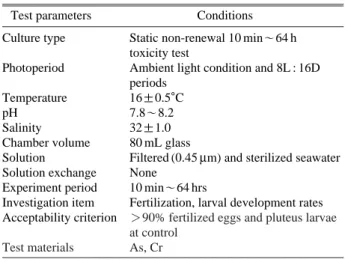
실험에 사용된 중금속 농도를 조성한 멸균 해수 배양 액의 pH는 7.8~8.2, 배양온도는 16±0.5�C를 유지하였 다. 인공수정 (arificial insemination)시 적정한 정자 접종 을 위하여 정자는 2,000~2,500배 희석하였으며, 멸균 해수 배양액 1 mL에 수정란 1,500~2,000개를 준비해 Table 1의 조건으로 배양하였다(Pagano et al. 1985a, b).
5. 수정 및 배아 발생 관찰
방정 유도를 통해서 얻은 정자는 각각의 As 및 Cr 실 험 농도에 30분간 노출 시킨 후, 방란 유도를 통해 얻은 정상 난자와 인공수정을 시켰다. 수정 10분 경과 후 수 정막의 형성 유∙무로 수정률을 관찰하였다 (Fig. 1). 발 생률은 pluteus 유생기인 수정 후 64시간째 정상 및 비 정상 발생으로 나누어 관찰하였다 (Pagono et al. 1985a, b) (Fig. 2).
실험은 농도별로 3회 반복 실시하였으며 100개 이상의
배아를 3회 반복 계수하여 고정된 배아 수에 대한 정상 적인 배아 수의 백분율을 산출하였다. 이들 결과를 이용 하여 수정 및 배아 발생률에 대한 반수영향농도 (50%
Effective Concentration, EC50)와 95% 신뢰구간 (95% Con- fidence Limit, 95% Cl)을 probit 통계법을 이용하여 분석 하였다. 또한, 무영향농도 (No Observed Effective Con- centration, NOEC), 최소영향농도 (Lowest Observed Effec- tive Concentration, LOEC)는 Dunnett’s를 이용하여 분석 하였다.
6. 통계학적 분석
대조군과 실험군의 유의성 검정은 Student’s t-test로 비교하였으며, p가 0.05 이하인 것만 유의한 것으로 하 였다.
결 과
1. As와 Cr 노출에 따른 수정률의 변동
H. pulcherrimus의 정자를 중금속인 As와 Cr의 동일농 도 (0, 6.25, 12.5, 25, 50, 100 ppb)에 30분간 노출시킨 후, Table 1. Experimental culture conditions using the normal fertili-
zation and embryogenesis rates in the sea urchin, H. pul- cherrimus
Test parameters Conditions
Culture type Static non-renewal 10 min~64 h toxicity test
Photoperiod Ambient light condition and 8L : 16D periods
Temperature 16±0.5�C
pH 7.8~8.2
Salinity 32±1.0
Chamber volume 80 mL glass
Solution Filtered (0.45μm) and sterilized seawater Solution exchange None
Experiment period 10 min~64 hrs
Investigation item Fertilization, larval development rates Acceptability criterion ¤90% fertilized eggs and pluteus larvae
at control Test materials As, Cr
Fig. 1. Diagnostic features of normal (A) and abnormal (B) fertil- ized eggs in the sea urchin, H. pulcherrimus.
Fig. 2. Diagnostic features of normal (A) and abnormal (B) pluteus larvae in the sea urchin, H. pulcherrimus.
(A) (B)
(A) (B)
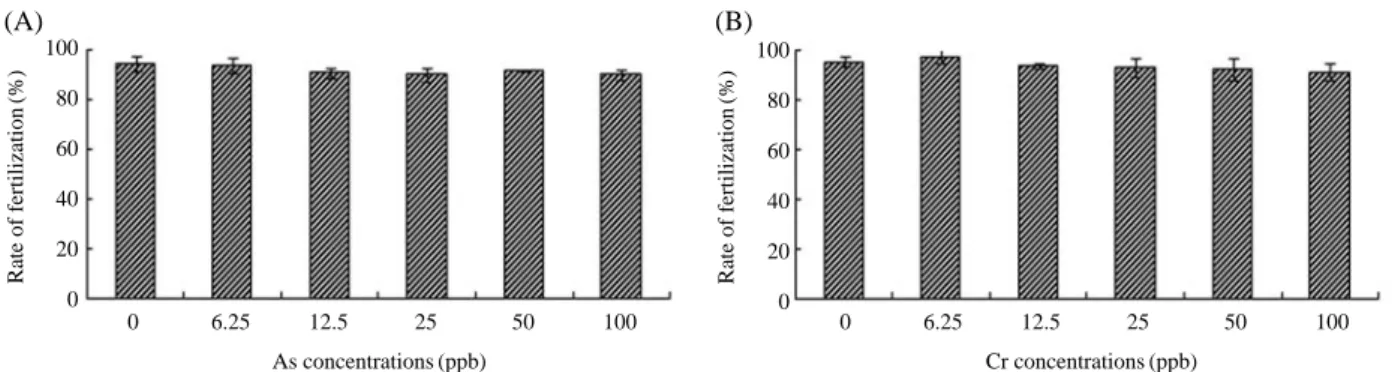
난자와 10분간 수정시켜 현미경으로 정상 수정률을 관 찰하여 백분율 (%)로 나타내었다 (Fig. 3). As를 첨가하지 않은 대조구의 수정률은 94.33±3.05%를 나타냈으며, 실험구 중에 가장 고농도인 100 ppb에서는 89.33±
3.21%로 유의적인 차이가 나타나지 않았다. Cr의 경우 는 대조구에서 95.66±2.30%로 나타났으며, 가장 고농 도인 100 ppb에서는 91.66±3.51%로 이들 금속 첨가로 수정률은 유의적인 차이가 나타나지 않았다(Fig. 3).
2. As와 Cr 노출에 따른 배아 발생률의 변동
H. pulcherrimus의 배아 발생률에 미치는 As와 Cr의 영향을 나타냈다 (Fig. 4). 수정 후 64시간 후, pluteus 유 생기의 정상 배아 발생률은 As의 경우 대조구에서 93.66
±0.57%를 Cr에서는 95.33±2.30%를 나타냈으나, 중금 속 농도가 증가할수록 급격히 감소하는 경향을 나타내 었다. As를 첨가한 실험구에서 최소 농도인 6.25 ppb에서 67.66±7.63%로 유의적으로 감소하였으며 (P⁄0.01), As 농도가 증가할수록 정상 배아 발생률은 급격히 감소해 50 ppb에서는 1.33±1.15% (P⁄0.01)를 나타냈으며 최고
농도인 100 ppb에서는 정상 배아 발생률을 관찰할 수 없 었다 (Fig. 4). Cr의 경우도 중금속 농도가 증가할수록 정 상 배아 발생률이 감소하는 경향을 나타내고 있으나, As 보다는 농도의존성이 다소 덜 한 것으로 관찰되었다. Cr 을 첨가한 실험군의 경우는 25 ppb 이상의 농도에서 유 의적으로 감소하였으며(P⁄0.05), 최고 농도인 100 ppb에 서 정상 배아 발생률이 23.33±4.16%로 급격히 감소하 였다(P⁄0.01) (Fig. 4).
3. 배아 발생률을 이용한 독성 평가
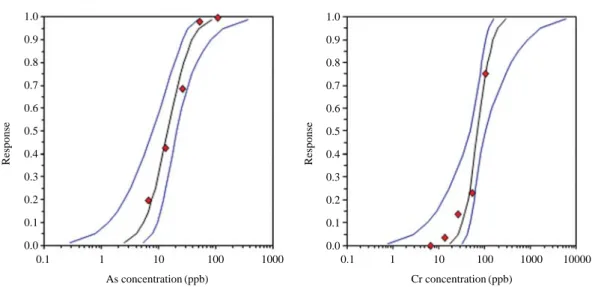
정상 배아 발생률은 As와 Cr 농도가 증가할수록 감소 하는 농도 의존성을 나타냈으며, 농도반응 관계식은 표 준 독성반응으로 잘 알려진 Sigmoid 형태를 나타냈다 (Fig. 5).
H. pulcherrimus의 정상 배아 발생률에 대한 As의 영 향을 독성치로 나타냈을 때, EC50은 14.38 ppb를 나타냈 고, EC50에 대한 95% CI는 7.82~20.71 ppb를 나타냈다.
정상 배아 발생률에 대한 NOEC와 LOEC는 각각 ⁄6.25, 6.25 ppb로 나타났다. 정상 배아 발생률에 대한 Cr의 반 Fig. 3. Changes of normal fertilization rates in the sea urchin H. pulcherrimus eggs exposed to As (A) and Cr (B). Vertical bars represent the
SE of the mean for three times.
Fig. 4. Changes of normal embryogenesis rates in the sea urchin, H. pulcherrimus eggs exposed to As (A) and Cr (B). Vertical bars represent the SE of the mean for three times. *P⁄0.05 and **P⁄0.01 for control (not including As and Cr).
100 80 60 40 20 0
0 6.25 12.5 25 50 100
As concentrations (ppb)
0 6.25 12.5 25 50 100
Cr concentrations (ppb)
Rate of fertilization(%) Rate of fertilization(%)
100 80 60 40 20 0
(A) (B)
100 80 60 40 20 0
100 80 60 40 20
Rate of embryogenesis(%) Rate of embryogenesis(%) 0
0 6.25 12.5 25 50 100
As concentrations (ppb)
0 6.25 12.5 25 50 100
Cr concentrations (ppb)
(A) (B)
**
**
**
**
**
**
*
수영향농도 EC50은 71.49 ppb를 나타냈고, 95% CI는 47.84~104.15 ppb를 나타냈으며, NOEC와 LOEC는 각각 12.5, 25 ppb를 나타냈다(Table 2).
고 찰
해양으로 유입되는 오염물질로부터 해양생태계를 안 전하게 감시할 수 있는 평가방법의 중요성이 인식되고 있으나 (Bidwell et al. 1998), 대부분 연안 해역에서 이루 어지는 환경조사는 특정 유해물질을 이화학적으로 정량 하여 기준치와 비교하는 전통적인 조사방법 위주로 실시 되고 있다. 이런 전통적인 조사는 해양에 존재하는 유해 물질에 대한 개별 정보를 제공한다는 점에서는 매우 유 용하나, 유해물질에 대한 분석 능력이 제한되어 있어 미 지의 오염물질에 대한 영향을 판단할 수 없을 뿐만 아 니라 유해물질 상호작용에 의해 발생되는 독성의 상승 (synergism), 부가 (addition) 및 길항 (antagonism) 작용에
대해서는 전혀 알 수 없다는 단점을 지니고 있다 (Ahlf et al. 2002; Chu and Chow 2002). 이러한 이화학적 분석방 법의 한계성을 극복하기 위하여 단일 유해물질의 양을 관찰하기 보다는 생물의 생리 및 행동학적 반응을 이용 한 통합적인 독성을 평가하는 해양생태독성 연구가 활 발하게 진행되고 있다 (Beiras et al. 2003; Han et al. 2008;
Hwang et al. 2012).
해양에 유입되는 독성물질에 대한 생물반응을 살펴보 기 위해서는 시험생물의 선정 및 독성물질에 대한 노출 시기 등과 같은 시험방법의 차이로 인해 생물 체내에 미 치는 영향은 다양하게 나타날 수 있는 문제점이 있다. 이 러한 문제점을 해결하기 위해서는 시험방법의 표준화 및 유용 시험생물 종을 선정하는 연구는 매우 중요하다. 본 시험에 사용한 시험생물 종인 말똥성게는 채집이 용이 할 뿐만 아니라 생식세포인 정자와 난자를 쉽게 얻을 수 있으며 실험실에서 배아발생 과정을 관찰하기 용이한 장 점으로 인해 생태독성 연구에 활발하게 이용될 수 있을 것으로 판단되어, 본 연구에서는 우리나라 조간대 암반 지역에 서식하며 실험실에서 인공배란 및 수정을 쉽게 유도할 수 있으며 실내배양이 용이한 H. pulcherrimus를 시험종으로 이용하였다.
본 연구 결과 As (0. 6.25, 12.5, 25, 50, 100 ppb)와 Cr (0.
6.25, 12.5, 25, 50, 100 ppb) 노출에 의한 H. pulcherrimus 의 수정률은 대조구와 비교해 유의적인 차이를 나타내지 않았다 (Fig. 3). 정상적인 배아 발생률의 경우 As는 대조 군에서 93.67±0.57%를 보였으나, 농도가 증가할수록 급 격히 감속해 최고농도구인 100 ppb에서는 정상 pluteus 유생을 관찰할 수가 없었다 (Fig. 4). Cr의 경우도 농도가 Fig. 5. Concentrations-response by As and Cr treatment using the normal embryogenesis of sea urchin, H. pulcherrimus.
Table 2. Toxicological estimation using the form of a fertilization membrane and normal pluteus in the sea urchin, H. pulch- errimus exposed to As, Cr
Items Toxicity (End-points) As (ppb) Cr (ppb)
EC50 Normal pluteus 14.38 71.49
95% Cl Normal pluteus 7.82-20.71 47.84-104.15
NOEC Normal pluteus ⁄6.25 12.5
LOEC Normal pluteus 6.25 25
EC50: 50% Effective concentration, 95% Cl: 95% Confidence limit, NOEC: No observed effective concentration,
LOEC: Lowest observed effective concentration.
1.0 0.9 0.8 0.7 0.6 0.5 0.4 0.3 0.2 0.1 0.0
1.0 0.9 0.8 0.7 0.6 0.5 0.4 0.3 0.2 0.1 0.0
0.1 1 10 100 1000
As concentration (ppb)
0.1 1 10 100 1000 10000
Cr concentration (ppb)
Response Response
증가할수록 배아발생률은 감소하는 경향을 나타내었으 며 100 ppb 농도에서는 정상 발생률이 23.33±4.16으로 유의적으로 감소하였다 (Fig. 4). 이상의 결과로 보아 As 와 Cr은 성게의 정상적인 배아 발생과정을 저해 시키는 것을 알 수 있다. 중금속 농도가 증가할수록 배아 발생률 이 농도 의존적으로 감소하는 것은 다른 중금속 연구결 과와 유사하게 나타났다(Gopalakrishnan et al. 2007, 2008;
Hwang et al. 2011, 2012). 본 연구결과에서 As와 Cr은 수 정률에는 영향을 미치지 않은 것으로 나타났으나, Hwang et al. (2012)의 연구결과에서는 중금속인 Zn의 경우는 31 ppb에서 H. pulcherrimus의 수정률을 유의적으로 감소 시켰다고 보고하였다. 또한, Fathallah et al. (2010)이 유럽 산 조개류의 일종인 Ruditapes decusatus를 이용한 연구 결과에서 본 실험과 동일하게 30분간 정자를 Cu, Hg, Zn 에 노출시킨 후 난자와 수정시켰을 경우 Cu는 영향이 없 었으나 Hg과 Zn은 256 및 512 ppt에서 유의적으로 감소 하는 것으로 보고하였다. 그러나 Warnau et al. (1996) 등 의 연구에 의하면 성게의 일종인 Paracentrotus lividus의 정자에 Hg, Cu, Cd 및 Ag을 노출시켰을 때 수정률의 감 소를 보고하였다. 해초류인 Phallusia mammillata의 경우 Hg이 수정률에 영향을 미치지 않았다 (Franchet et al.
1997). 이러한 결과들로부터 중금속은 종류에 따라서 수 컷 생식 세포인 정자의 활성에 영향을 미쳐 수정률 감소 를 유발하는 것으로 사료된다. 그러나 생물종에 따라 중 금속이 정자의 수정 능력에 미치는 영향이 다르게 나타 나는 결과도 나타나므로 수정률을 이용한 중금속의 생태 위해성의 평가는 충분치 못하다고 생각되며 또한 중금 속 종류에 따라 다른 적용이 필요하다고 판단된다.
본 연구결과에서 중금속 노출에 의해 배아 발생률이 수정률보다 저해현상이 민감하게 나타나는 것은 배아가 pluteus 유생시기에 도달 시까지 As와 Cr에 더 오랫동안 노출됨으로 인해 발달 저해가 증가되었을 것으로 사료된 다 (Hwang et al. 2008). 또한, 이들 중금속에 의해 pluteus 유생 이전 시기부터 영향을 받았다 할지라도 형태적으 로 분화정도가 진전된 pluteus 유생시기의 배아가 독성 에 대해 증폭되어 표현되기 때문에 pluteus 형성 시기가 수정률에 비해 더욱 민감하게 나타나는 것으로 판단된 다(Wui et al. 1992).
오염물질에 대한 상대적 독성을 평가하기 위하여 사용 되는 반수영향농도를 이용하여 중금속이 H. pulcherrimus 배아 발생률에 미치는 영향을 살펴보면 As의 EC50은 14.38 ppb, Cr은 71.49 ppb로 나타났다. 우리나라 남, 서해 주요 12지역 (인천, 평택, 목포, 해창만, 광양, 통영, 행암만, 감만, 부산남항, 부산북항, 온산, 장생포)항구의 표면 퇴적
물에서의 As 및 Cr의 오염정도를 조사한 결과 As는 3.9
~60.1 ppm의 농도로 조사되었으며 조사 지역 중에서 장생포 지역이 가장 높은 농도로 나타났다. Cr의 경우는 11~401 ppm으로 부산남항이 가장 높은 농도로 나타났 다(Choi et al. 2012). 이러한 결과로 보아 우리나라 남, 서 해 지역의 As 및 Cr의 오염은 매우 높은 것으로 생각되 며 본 연구결과에서 제시한 EC50값은 오염정도를 평가 하기 위한 중요한 지침으로 활용할 수 있으리라 생각된 다. Hwang et al. (2009, 2011, 2012)은 H. pulcherrimus 배 아 발생률에 미치는 영향을 이용한 실험에서 Cd의 EC50
은 244.04 ppb, Cu는 10.32 ppb, Co는 71.84 ppb, Pb은 45.13 ppb, Zn은 19.82 ppb로 보고하였다. 이들 연구결과 를 이용하여 중금속에 대한 H. pulcherrimus 배아 발생률 에 미치는 독성 영향은 Cu¤As¤Zn¤Pb¤Cr¤Co¤Cd 순으로 나타낼 수 있다. Kobayashi (1994)는 성게 (Diade- ma setosum)의 초기 발생에 미치는 영향에서 중금속 중 에서 Hg이 가장 큰 독성 영향을 보였으며 Cu¤Zn¤Ni
¤Cd 순으로 영향을 미치는 것으로 보고하였다. 불가사 리의 초기 발생에 미치는 중금속 영향을 조사한 Yu (1998)의 결과에서 아므로 불가사리 (Asterias amurensis) 는 Hg¤Cu¤Zn¤Cd¤Ni 순으로 영향을 미치며, 별 불 가사리 (Asterias pectinifera)는 Cu¤Hg¤Zn¤Cr¤Ni 순 으로 독성이 큰 것으로 보고하였다. 넙치 (Paralichthys olivaceus)의 수정란 부화율을 이용한 Hwang et al. (2012) 의 연구에서는 Cr¤As¤Pb 독성의 영향이 큰 것으로 보 고하였다. 이들 연구결과로 생물종에 따라 중금속 독성 에 대한 민감도와 중금속에 대한 상대적 독성 영향은 차 이가 있는 것으로 판단되며, 시험 생물종에 따른 노출시 기와 같은 시험방법도 고려해야 할 것이다. Cu와 Zn은 생물 체내에 있어 생명 유지를 위한 필수 미량금속원소 로 잘 알려져 있어 독성이 낮게 나타날 것으로 판단했 으나, 상대적으로 독성이 큰 것으로 나타나, 향후 독성영 향 기작에 관해 좀 더 구체적인 연구가 필요할 것으로 사료된다.
본 연구결과를 활용하여 Dunnett’s test를 실시한 통계 분석에 의한 LOEC에 의하면 해양생태계 내에서 As 및 Cr의 농도는 6.25 ppb 및 25 ppb를 초과할 경우, H. pul- cherrimus의 정상 배아 발생률은 독성 영향을 받을 것 으로 판단된다. 본 연구는 사육 및 관리가 편리한 동, 식 물 플랑크톤을 대상으로 이루어지던 생태독성 시험연구 에서 유용수산생물자원인 H. pulcherrimus를 이용한 것 으로, 향후 해양유입 유해물질에 대한 수산생물 위해성 평가 시에 유용하게 활용될 것으로 판단된다.
적 요
말똥성게 (Hemicentrotus pulcherrimus)의 생식세포 및 pluteus 유생을 이용하여 중금속인 Arsenic (As)와 Chro- mium (Cr)이 정상 수정률 및 배아 발생률에 미치는 독 성 영향을 조사하였다. H. pulcherrimus의 수정률 및 배 아 발생률에 미치는 As와 Cr의 독성은 6.25, 12.5, 25, 50, 100 ppb의 농도에서 조사하였다. 0.5 M KCl 용액을 이용 하여 방란 및 방정을 유도하였고, 정상 수정률 및 배아 발생률은 수정 후 각각 10분 및 64시간째 관찰하였다.
As와 Cr을 첨가하지 않은 대조구에서 정상 수정률과 배 아 발생률은 각각 94%와 93% 이상을 나타냈다. 이들 중 금속 첨가에 의해 수정률은 아무런 변화가 나타나지 않 았지만 배아 발생률은 농도 의존적 감소하는 것으로 나 타났으며, As의 첨가에 의해 배아 발생률은 6.25 ppb에서 유의적으로 감소하였으며 (P⁄0.01), Cr의 경우는 25 ppb 에서 유의적인 감소를 나타냈다 (P⁄0.05). H. pulcherri- mus의 정상 배아 발생률에 대한 LOEC는 As의 경우는 6.25 ppb를 Cr은 25 ppb를 나타냈다. 이들 연구결과로 해 양생태계 내에서 As가 6.25 ppb, Cr이 25 ppb를 초과하는 농도일 때는 H. pulcherrimus와 같은 무척추동물의 정상 부화율은 급격히 감소할 것으로 판단된다. 본 연구결과 를 바탕으로, H. pulcherrimus의 정상 배아 발생률을 이용 한 생물학적 평가방법은 중금속과 같은 유해물질에 대한 해양생태계의 영향을 판단하기 위한 시험방법으로 유용 하게 이용될 수 있을 것으로 판단된다.
사 사
본 논문은 2012년도 국립수산과학원 경상과제 연구비 지원으로 국립수산과학원 서해수산연구소 해양생태 위 해평가센터에서 수행한 연구입니다.
참 고 문 헌
Ahlf W, H Holler, H Neumann-Hense and M Ricking. 2002. A guidance for the assessment and evaluation of sediment qual- ity: A german approach based on ecotoxicological and che- mical measurements. J. Soils Sediment 2:37-42.
Atici T, S Ahiska, A Altindag and D Aydin. 2008. Ecological effect of some heavy metals (Cd, Pb, Hg, Cr) pollution of phytoplanktonic algae and zooplanktonic organisms in Sari-
yar Dam Reservoir in turkey. Afr. J. Biotechnol. 7:1972- 1977.
Bae ON, MY Lee, SM Chung, JH Ha and JH Chung. 2006.
Potential risk to human health by arsenic and its metabolite.
J. Environ. Toxicol. 21:1-11.
Beiras R, N femández, J Bellas, V Besada, A González-Quijano and T Nunes. 2003. Inttegrative assessment of marine pol- lution in Galician estuaries using sediment chemistry, mus- sel bioaccumulation, and embryo-larval toxicity bioassays.
Chemosphere 52:1209-1224.
Beiras R and M Albentosa. 2004. Inhibition of embryo devel- opment of the commercial bivalves Ruditapes decussatus and Mytilus galloprovincialis by trace metals; Implication for the implementation of seawateer quality criteria.
Aquaculture 230:205-213.
Bhattacharyya R, D Chatterjee, B Nath, J Jana, G Jacks and M Vahter. 2003. High arsenic groundwater: mobilization, me- tabolism and mitigation-an overview in the Bengal Delta Plain. Mol. Cell Biochem. 253:347-355.
Bidwell JR, KW Wheeler and TR Burridge. 1998. Toxicant effects on the zoospore stage of the marine macroalga Eck- lonia radiata (Phaeophyta: Laminariales). Mar. Ecol. Prog.
Ser. 163:259-265.
Caceres DD, P Pino, N Montesinos, E Atalah, H Amigo and D Loomis. 2005. Exposure to inorganic arsenic in drinking water and total urinary arsenic concentration in a Chilean population. Environ. Res. 98:151-159.
Choi HG, JS Park and PY Lee. 1992. Study on the heavy metal concentration in mussel and oyster from the Korean coastal water. Bull. Korean Fish. Soc. 25:485-494.
Choi KY, SH Kim, GH Hong and HT Chon. 2012. Distributions of heavy metals in the sediments of South Korean harbors.
Environ. Geochem. Health 34:71-82.
Chu KW and KL Chow. 2002. Synergistic toxicity of multiple heavy metal is revealed by a biological assay using a nema- tode and its transgenic derivative. Aquat. Toxicol. 61:53-64.
DeForest DK, KV Brix and WJ Adams. 2007. Assessing metal bioaccumulation in aquatic environments: the inverse rela- tionship between bioaccumulation factors, trophic transfer factors and exposure concentration. Aquat. Toxicol. 84:236- 246.
Dinnel PA, JM Link, QJ Stober, MW Letourneau and WE Ro- berts. 1989. Comparative sensitivity of sea urchin sperm bioassay to metals and pessticides. Com. Toxi. 18:748-755.
Fathallah S, MN Medhioub, A Medhioub and M Kraiem. 2010.
Toxicity of Hg, Cu and Zn on early developmental stages of the European clam (Ruditapes decussatus) with potential application in marine water quality assessment. Environ.
Monit. Assess. 171:661-669.
Franchet C, M Goudeau and H Goudeau. 1997. Mercuric ions impair the fertilisation potential, the resumption of meiosis, the formation of male pronucleus, and increase polyspermy, in the egg of the ascidian Phallusia mammillata. J. Exp. Zool.
278:255-272.
Gebel TW. 1999. Arsenic and drinking water contamination.
Science 283:1458-1459.
Geffard OE, H His, JF Budzinski, A Chiffoleau, Coynel and H Etcheber. 2004. Effects of storage method and duration on the toxicity of marine sediments to embryos of Crassostrea gigas oysters. Environ. Pollut. 129:457-465.
Gopalakrishnan S, H Thilagam and PV Raja. 2007. Toxicity of heavy metals on embryogenesis and larvae of marine seden- tary polychaete Hydroides elegans. Arch. Environ. Contam.
Toxicol. 52:171-178.
Gopalakrishnan S, H Thilagam and PV Raja. 2008. Comparison of heavy metal toxicity in life stafes (spermiotoxicity, egg toxicity, embryotoxicity and larval toxicity) of Hydroides elegans. Chemosphere 71:515-528.
Greewood PJ. 1983. The influence of an oil dispersant chem- serve OSE-DH on the viability of sea urchin gametes. Com- bined effects of tmperature, concentration and exposure time on fertilization. Aqua. Toxicol. 4:15-29.
Han TJ, YS Han, GS Park and SM Lee. 2008. Development marine ecotoxicological standard methods for Ulva sporula- tion test. Kor. J. Soc. Ocean. 13:121-128.
Hwang UK, CW Lee, SM Lee, KH An and SY Park. 2008.
Effects of salinity and standard toxic metal (Cu, Cd) on fer- tilization and embryo development in the sea urchin (Stron- gylocentrotus nudus). J. Environ. Sci. 17:775-781.
Hwang UK, CW Rhee, KS Kim, KH An and SY Park. 2009.
Effects of salinity and standard toxic metal (Cu, Cd) on fer- tilization and embryo development rates in the sea urchin (Hemicentrotus pulcherrimus). J. Environ. Toxicol. 24:9-16.
Hwang UK, HM Ryu, YH Choi, SM Lee and HS Kang. 2011.
Effect of cobalt (II) on the fertilization and embryo devel- opment of the sea urchin (Hemicentrotus pulcherrimus). J.
Fac. Agr. Kyushu Univ. 29:251-257.
Hwang UK, S Heo, JS Park and HS Kang. 2012. Effects of lead and zinc on the fertilization and embryo development of the sea urchin (Hemicentrotus pulcherrimus). Korean J. Environ.
Biol. 30:128-135.
Irving EC, RB Lowell, JM Culp, K Liber, Q Xie and R Kerrich.
2008. Effects of arsenic speciation and low dissolved oxy- gen condition on the toxicity of arsenic to a lotic mayfly.
Environ. Toxicol. Chem. 27:583-590.
Kobayashi N. 1971. Fertilized sea urchin egg as an indicatory material for marine pollution bioassay preliminary experi- ment. Publ. Seto. Mar. Biol. Lab. 19:379-406.
Kobayashi N. 1977. Preliminary experiments with sea urchin pluteus and metamorphosis in marine pollution bioassay.
Publ. Seto. Mar. Biol. Lab. 24:9-21.
Kobayashi N. 1981. Comparative toxicity of carious chemicals, oil extracts and oil dispersant extracts to canadian and japanese sea urchin egg. Publ. Seto. Mar. Biol. Lab. 26:123- 133.
Kobayashi N. 1994. Application of eggs of the sea urchin (Dia- dema Setosum) in marine pollution bioassays. Phuket Mar.
Biol. Cent. Res. Bull. 59:91-94.
Lamm Sh, A Engel, MB Kruse, M Feinleib, DM Byrd, S Lai and R Wilson. 2004. Arsenic in drinking water and bladder cancer mortality in the United States: an analysis based on 133 U.S. counties and 30 years of observation. J. Occup.
Environ. Med. 46:298-306.
Lee SH and KW Lee. 1984. Heavy metals in mussels in the Korean coastal waters. J. Oceanol. Soc. Korea 19:111-117.
Lewis DR, JW Southwick, R Ouellet-Hellstrom, J Rench and RL Calderon. 1999. Drinking water arsenic in Utah: A co- hort mortality study. Environ. Health Prespect. 1017:359- 365.
Lonning S and BH Hagstrom. 1975. The effects of oil disper- sants on the cell in the fertilization and development. Norw.
J. Zool. 23:131-134.
Martin JM and M Whitfield. 1983. The significance of river imput of chemical elements to the ocean. In Trace Metals in sea Water. Plenum Press. New York. pp.265-296.
Martin M, KE Osborn, P Bilig and N Glicksten. 1981. Toxicit- ies of ten metals to Crassostrea gigas and Mytilus edulis embryos and Cancer magister larvae. Mar. Pollut. Bull. 12:
305-308.
Okubo K and T Okubo. 1962. Study on the bioassay method for the evalution of water pollution-II, Useof the fertilized eggs of sea urchins and bibalves. Bull. Toka. regional Fish Res. Lab. 32:13-140.
Pagono G, M Cipollaro, G Corsale, A Esposite, E Ragucciand and GG Giordano. 1985a. Ph-induced changes in mitotic and develomental patterns in sea urchin embryogenesis, I.
Exposure of embryos. Terato. Carcino. Mutage. 5:101-112.
Pagono G, M Cipollaro, G Corsale, A Esposite, E Ragucciand and GG Giordano. 1985b. Ph-induced changes in mitotic and develoment patterns in sea urchin embryogenesis, II.
Exposure of sperm. Terato. Carcino. Mutage. 5:113-121.
Phillips DJH and DA Segar. 1986. Use of bioindicators in moni- toring conservative contaminants. Mar. Pollut. Bull. 17:10- 15.
Reiley MC. 2007. Science, policy and trends of metals risk assessment at EPA: howunderstanding metals bioavailabil- ity has chang metals risk assesment at USEPA. Aquat. Toxi-
col. 84:292-298.
Sivakumar S and CV Subbhuraam. 2005. Toxicity of chromium (III) and chromium (VI) to the earthworm Eisenia fetida.
Ecotoxicol. Environ. Saf. 105:51-58.
Suh KH, KH Ahn, HS Lee, HG Lee, JK Cho and YK Hong.
1999. Biosorption of Pb abd Cr by using Sargassum saga- mianum. J. Korean Fish Soc. 32:399-403.
Warnau M, M Iacarino, A de Biase, A Temara, M Jangoux, P Dubois and G Pagano. 1996. Spermiotoxicity and embryo- toxicity of heavy metals in the echinoid Paracentrotus livi- dus. Environ. Toxicol. Chem. 15:1931-1936.
Wui IS, JB Lee and SH Yoo. 1992. Bioassay on marine sedi- ment pollution by using sea urchin embryo culture in the south-west inland sea of Korea. Korean J. Environ. Biol.
10:92-99.
Xia Y and J Liu. 2004. An overview on chronic arsenism via
dringking water in PR China. Toxicology 198:25-29.
Xu L, H Tian, W Wang and S Ru. 2012. Effects of monocroto- phos pesticide on serotonin metabolism during early devel- opment in the sea urchin, Hemicentrotus pulcherrimus. En- viron. Toxicol. Pharmacol. 34:537-547.
Yap CK, A Ismail and SG Tan. 2004. Heavy metal (Cd, Cu, Pb and Zn) concentraions in the green-lipped mussel Perna viridis collected from some wild and aquacultural sites in the west coast of Peninsular Malaysia. Food Chem. 84:569- 575.
Yu CM. 1998. A study on the effect of heavy metals on embryos formation of sea urchins. Kor. J. Env. Hlth. Soc. 24:6-10.
Received: 18 February 2013 Revised: 3 April 2013 Revision accepted: 4 April 2013