Ortho-phenylphenol을 주성분을 하는 훈증소독제의 Trichophyton mentagrophytes , Candida albicans 그리고
Aspergillus niger 에 대한 살진균 효과
박은기·이수응*·조기융**·김용팔***·유창열****·김석*****·이후장*****† 고신대학교 의과대학 인문사회의학교실, *(재)춘천바이오산업진흥원,
**공군교육사령부 정보통신학교 기상교육대, ***엘캄코 바이오(주),
****경남도립남해대학 인터넷정보학과, *****경상대학교 수의과대학·생명과학연구원
Fungicidal Efficacy of a Fumigation Disinfectant with Ortho-phenylphenol as an Active Ingredient against Trichophyton mentagrophytes,
Candida albicans and Aspergillus niger
Eun-Kee Park, Soo-Ung Lee*, Ki-Yung Cho**, Yongpal Kim***, Chang-Yeol Yoo****
Suk Kim, and Hu-Jang Lee*****†
Department of Medical Humanities and Social Medicine, College of Medicine, Kosin University, Busan, Korea
*Chuncheon Bioindustry Foundation, Chuncheon, Korea
**Meteorology education platoon, Information & Communication School, ROKAF Education & Training Command, Chinju, Korea
***Elkahmco Bio Co., Ltd., Seoul, Korea
****Department of Computer Information, Gyeongnam Provincial Namhae College, Namhae, Korea
*****Research Institute of Life Sciences and College of Veterinary Medicine, Gyeongsang National University, Chinju, Korea
ABSTRACT
Objectives: This study evaluated the fungicidal efficacy of a fumigant containing 20% ortho-phenylphenol against Trichophytone mentagrophytes (T. mentagrophytes), Candida albicans (C. albicans) and Aspergillus niger (A. niger).
Methods: Five replicates of each carrier were contaminated by depositing 0.05 mL of each fungal suspension.
After drying, two carriers without exposure to the fumigant and three carriers with exposure to the fumigant were left in a sealed room (25 m
3) at 21 ±0.5
oC and 60 ±10% relative humidity for 15 hours. Immediately after removal from the test room, each carrier was transferred into recovery diluent and suspended, diluted and inoculated.
After incubation, the numbers of each colony were counted, and the parameter values (N, T, d) were calculated.
Results: The working culture suspension number (N value) of T. mentagrophytes, C. albicans and A. niger were 1.0 ×10
8, 1.2 ×10
8and 5.7 ×10
7CFU/mL, respectively. All the colony numbers on the carriers exposed to the fumigant (n1, n2, n3) were higher than 0.5N1 (the number of fungal test suspensions by pour plate method), 0.5N2 (the number of fungal test suspensions by filter membrane method) and 0.5N1, respectively. In addition, all mean numbers of test strains recovered on the control-carriers (T value) were over 10
6CFU/mL. For the fungicidal effect of the fumigant, all numbers of fungal reductions after exposure of the fumigant (d value) were 4 logCFU/mL.
†
Corresponding author: College of Veterinary Medicine, Gyeongsang National University, Chinju, 660-701, Korea, Tel:
+82-55-772-2352, Fax: +82-55-772-2308, E-mail: [email protected]
Received: 3 April 2014, Revised: 2 June 2014, Accepted: 12 June 2014
Conclusions: The present study showed that fumigant containing 20% ortho-phenylphenol has effective fungicidal activity against T. mentagrophytes, C. albicans and A. niger.
Keywords: Aspergillus niger, Candida albicans, Fumigation disinfectant, Ortho-phenylphenol, Trichophyton mentagrophytes
I. 서 론
곰팡이는 사람, 동물 그리고 식물에 유익한 작용 을 하지만, 동시에 유해한 작용도 한다. 몇몇 곰팡 이성 질병들은 사람에게 매우 위험하지만, 페니실린 과 같은 곰팡이 유래 항생제는 사람의 건강에 매우 유용하게 사용되고 있다.1,2) 실제적으로, 곰팡이류는 유기물질을 분해하여 필수 영양분으로 만들어, 자연 환경으로 되돌려 보내는 역할을 수행함으로써, 지구 상에 존재하는 생명체에게 있어서는 필수불가결한 존재이다.3)
곰팡이류는 알레르기성 비염과 천식, 그리고 외인 성 알레르기성 폐포염을 일으키는 알레르기 유발 항 원의 원인으로 잘 알려져 있다.4-6) 실내 환경에서 존 재하는 모든 곰팡이류는 알레르기 유발 항원을 생성 하며,5)발암성 물질인 아플라톡신과 같은 독성 대사 산물을 만들어 내기도 한다.7) 또한, 곰팡이류는 알 코올류, 알데히드류, 그리고 케톤류를 포함한 다양한 휘발성 물질들을 생산하는데, 이러한 물질들은 곰팡 이 냄새의 원인이 되며, 눈, 코, 목의 자극과 두통을 유발하기도 한다.4,8) 실내 환경에서 발견되는 몇몇 곰팡이류들은 면역저하 환자들에서 기회감염을 일으 키기도 하는 것으로 알려져 있다.9)
Trichophyton mentagrophytes
(
T. mentagrophytes)는 동물친화성 곰팡이로 통상적으로 토끼나 기니픽과 같 은 설치류에서 발견되는 것으로 보고되어 있다.10) T.mentagrophytes는 기니픽에서 발생하는 피부진균증 의 가장 일반적인 원인균으로 알려져 있으나,11,12)대 부분의 경우, 기니픽은 피부진균의 무증상 보균원으 로서 사람에게 피부진균증을 전파하기도 하는 것으 로 알려져 있다.13)
Candida albicans
(
C. albicans)는 많은 포유동물의 위장관과 구강의 점막 표면에서 증식하는 미생물총 의 일 부분을 구성하고 있다.14) 개의 표재성 진균 피 부 감염증은 칸디다증의 일종이며, 인수공통전염병 으로 알려져 있다.15) C. albicans는 동물의 소화기관의 점막표면과 점막피부 연결부위에 주로 기생하지 만, 숙주의 건강상태가 나빠지는 특별한 조건하에서 는 신장, 간, 폐, 뇌척수막 혹은 심장과 같은 내부 장기에 심각한 감염을 일으키는 것으로 보고되어 있
다.16,17) C. albicans는 선행요인이 없는 건강한 사람
과 동물에서는 거의 감염을 일으키지 않지만, 면역 저하 환자들에서는 점막, 피부, 혹은 전신 칸디다증 을 일으킬 수 있는 것으로 알려져 있다.18)
아스페루길루스증은 조류에서 일반적으로 흔한 곰 팡이성 감염으로, 조류의 호흡기를 통해 많은 양의 Aspergillus 곰팡이가 흡입될 경우에 일반적으로 발 생하는 것으로 알려져 있다.19) Aspergillus 속은 200 종 이상이며, 약 20여종만이 사람에서 기회감염을 일으키는 것으로 보고되어 있다.20) Aspergillus niger
(
A.niger)는 Aspergillus 속 곰팡이 중에서 가장 일반적 으로 분리되는 균으로, 특정 과일과 채소에서 검은 곰팡이병이라고 불리는 질병을 일으키는 것으로 알 려져 있다.21,22) Aspergillus 포자는 공기, 물, 토양, 썩 은 채소, 동물사료, 동물체내, 그리고 실내대기환경 등에서 자주 발견된다.23)
병원성 미생물의 제어를 위해, 진균제의 사용이 식 품공장, 가축농장, 병원 그리고 가정 등에서 증가함 에 따라, 진균제-저항성 진균의 출현이 항생제 내성 병원균에서의 기전과 동일하게 증가하고 있다.24)하 지만, 소독제들은 병원균의 대사기전에 광범위하게 작용하는 성분들로 혼합되어 있어서, 병원체의 내성 형성을 어렵게 만들고 있다.25)
전 세계적으로, 포스포린 가스, 이산화염소 그리고 ortho-phenyl phenol
(
OPP)을 포함하는 훈증소독제들 이 식품의 보존과, 환경으로부터 병원균의 제어를 위 해 광범위하게 사용되고 있다.26-28) 특히, OPP는 가 정, 식품공장 그리고 병원 등에서 기구 혹은 표면제 의 소독을 위해 사용되고 있다.26)현재까지, OPP를 주성분으로 하는 훈증소독제의 T. mentagrophytes, C. albicans 그리고 A. niger에 대한 살진균 효과에 대한 연구는 거의 진행된 바가
없는 실정이다. 따라서 본 연구에서는, Association Francaise de Normalisation
(
AFNOR)의 French Standard(
NF T 72-281)29)와 Park 등30)의 연구방법에 따라. OPP 를 주성분으로 하는 훈증소독제의 T. mentagrophytes, C. albicans 그리고 A. niger에 대한 살진균 효과를 확인하기 위하여 수행되었다.II. 재료 및 방법 1. 실험물질
본 시험에 사용된 실험물질은 ㈜엘캄코바이오
(
서 울)에서 공급받은 OPP를 주성분으로 하는 훈증소독 제, Fumagari OPP®(
1 캔(
20 g), OPP 4 g)를 사용하 였다. 물질은 흰색의 분말로서 사용기간 동안 실온 에 보관하여 실험에 사용하였다.2. 균주배양 및 현탁액 준비
T. mentagrophytes
(
KACC 45553), C. albicans(
KACC 30004) 그리고 A. niger(
KACC 43547)는 농 업유전자원정보센터(
수원)에서 분양받아 실험에 사 용하였다.T. mentagrophytes와 A. niger는 Sabouraud dextrose agar
(
BD, Franklin Lakes, NJ, USA)에 심 어 30±1oC에서 각각 10일과 72시간 동안 계대배 양하였다. C. albicans는 Malt extract agar(
MEA)(
BD, Franklin Lakes, NJ, USA)에 심어 30±1oC에 서 48시간 동안 계대배양하였다. 계대배양 후, T.mentagrophytes 배지표면에 배양된 균사체를 모아 서 25 mL의 0.85% NaCl 용액에 넣어 분해시켜 부 유시켰다. 부유액을 여과시킨 후, 여과액을 혈구계 산판에 놓고 농도를 측정한 다음, 희석액
(
증류수 1 L 중, 1.0 g tryptone, 8.5 g sodium chloride)을 사용하여 포자수를 1.25-1.55×10⁸ colony forming unit(
CFU)/mL 농도로 조정한 후, 환원유를 가하여 20배로 희석하여 포자수가 5×10⁶CFU/mL 이상인 것을 시험에 공시하였다. 또한, 배양된 C. albicans 균주 소량을 10 mL의 희석액이 들어 있는 100 mL 플라스크에 넣고 교반시킨 다음, 부유액을 혈구계 산판에 놓고 포자의 농도를 측정한 다음, 희석액을 사용하여 포자수가 108 CFU/mL 이상이 되도록 조 정한 후, 환원유를 가하여 20배로 희석하여, 포자 수가 5×10⁶ CFU/mL 이상인 것을 시험에 공시하였다. A. niger의 경우, 배양된 균주 소량을 10×mL 의 0.05% polysorbate 80% 수용액에 넣고 분생포 자를 제거한 다음, 분생포자를 제거한 배양액을 글 라스 필터를 이용하여 걸려주었다. 걸러준 배양액의 현탁액을 혈구계산판에 놓고 포자의 농도를 측정한 다음, 희석액을 사용하여 포자수를 5×10⁷ CFU/mL 이상이 되도록 조정한 후, 환원유를 가하여 20배로 희석하여, 2.5×10⁶ CFU/mL 이상인 것을 시험에 공 시하였다.
3. 환원유 혼합 현탁액의 포자계산
조정된 곰팡이 현탁액을 희석액을 이용하여 106과 107배로 희석한 다음, 각각의 희석액 1 mL를 취하 여 페트리접시에 넣고, 45oC MEA 배지 15-20 mL 을 가하였다. 106과 107배로 희석한 현탁액 1 mL를 취하여 분리 막 여과장치에 넣고 여과한 후, 세척액 으로 씻어준 다음, 여과막을 MEA 배지 위에 올려 놓았다. 각각의 배지를 30oC에서 48시간 동안 배양 한 다음, 포자수 계산이 불가능한 배지는 폐기하고, 다시 24시간 동안 더 배양한 후, 포자수를 계산하였 다. 평판배지법31)과 여과법32)으로 배양된 집락수를 각각 N1과 N2로 하였다.
4. 포자의 담체 도포 및 소독제 적용
각각의 균주 현탁액 0.05 mL을 각각 5개의 담체
(
지름 3 cm, 높이 1.2 mm) 에 도포하고, 도포된 담 체들을 멸균 페트리접시에 담아, 37oC 배양기에서 건조시키며, 45분을 초과하지 않도록 하였다. 21±0.5oC, 습도 60±10% 조건에서, 건조된 담체 2개는 페트리 접시에 담아 훈증소독제에 노출이 없는 상태 에서 15시간 동안 놓아두고, 나머지 3개의 건조된 담체는 밀폐된 방
(
25m3)에서 훈증소독제와 담체를 담은 페트리 접시의 거리를 2.2 m로 하고, 바닥으로 부터 1.2 m 높이에 페트리 접시를 수직으로 세워 훈 증소독제와 반대 방향이 되도록 한 다음, 훈증소독 제에 불을 붙여 15시간 동안 놓아두었다.5. 소독제 잔류효과
Fig. 1은 훈증소독제 잔류에 의한 균주 증식 억제 효과를 확인하기 위한 실험을 수행하는 과정을 Park 등30)의 연구로부터 인용하여 나타낸 것이다.
훈증소독제를 15시간 접촉 시킨 직후, 각각의 담
체를 100 mL 회복액(증류수 1 L 중, 이 들어있는 삼 각플라스크에 넣고, 수초 동안 흔들어 준 다음, 1 mL 을 취하여 페트리접시에 넣고, 희석한 포자 희석액
(
106과 107배) 1 mL도 섞이지 않게 넣은 다음, 배양 배지를 넣고 잘 혼합한 후, 30oC에서 각각의 포자 희석액을 일정기간 동안(
T. mentagrophytes 10일, C.albicans 48시간, A. niger 72시간) 배양한 다음, 자 란 집락수
(
n1)를 계산하였다. 담체를 넣은 회복액 98 mL를 막 여과하고, 50 mL 희석액으로 3번 세정 한 후, 희석액에 4번 침지시킨 여과막을 배지에 넣 고, 희석한 시험 포자 현탁액(106과 107배) 1 mL을 가하여, 혼합한 다음, 배양한 후, 형성된 집락수를 계산하여 평균값(
n2)을 기록하였다. 희석한 시험 포 자 현탁액(
106과 107 배) 1 mL과, 회복액에서 잔류 물이 제거된 담체를 넣은 회복액 1 mL을 페트리접 시에 넣고, 배지를 가하여 혼합·배양한 후, 집락수 를 계산하였다(n3). 이렇게 얻은 n1, n2, n3을 각각 N1, N2, N1과 비교하였다.6. 훈증소독제 적용
각각의 포자 현탁액을 도포건조시킨 각각의 담체를 훈증소독제에 15시간 동안 노출시킨 직후, 각각의 담 체를 100 mL 회복액이 있는 삼각플라스크에 넣고, 수 초 동안 흔들어 준 다음, 유리봉을 이용하여, 담체에 부착된 잔류물을 제거하고, 1분 동안 초음파 진동기 를 이용하여 남은 잔류물을 제거하였다. 이어서, 담체 잔류물이 들어 있는 회복액으로부터 1 mL을 취하여 9 mL 새로운 회복액에 넣고, 연속적으로 두 번 더 희 석시켜 103 배로 희석하였다. 담체 잔류물이 들어 있 는 회복액과, 102와 103 배 희석액을 각각 1 mL을 취 하여 배양배지가 들어 있는 평판배지에 접종하여, 30oC에서 각각의 포자 현탁액을 일정기간 동안
(
T.mentagrophytes 10일, C. albicans 48시간, A. niger 72 시간) 배양한 다음, 각각의 포자수를 계산하였다. 담 체로부터 부착된 잔류물을 제거한 회복액 현탁액 87 mL을 분리 막 여과장치에 넣고 여과한 후, 여과막 을 영양배지 위에 올려놓고 30oC에서 각각의 균주를
Fig. 1. Schematic diagram of the preliminary screening test for an inhibitory effect of fumigant residues.
일정기간 동안
(
T. mentagrophytes 10일, C. albicans 48시간, A. niger 72시간)배양한 다음, 각각의 포자수 의 평균값을 n'1로 하였다. 잔류물을 제거한 담체를 넣은 회복액 현탁액을 배지에 넣고 배양하여, 자란 포 자수의 평균을 n'2로 하였다.7. 실험 결과의 계산
14이하 165 이상인 배지의 집락수는 세지 않았으 며, 실험균주 현탁액 중 집락수
(
N), 대조 담체의 회 복 집락수(
T), 그리고 훈증소독제 노출 담체의 집락 수 감소 log값(
d)의 계산은 아래 각각의 식에 의해 산출하였다.(
106 배로 희석하여 얻은 값: x, y; 107 배로 희석 하여 얻은 값: z, w)(
102 배 회복액에서 얻은 값: x, y; 103 배 회복액 에서 얻은 값: z, w)(
n'1: 담체 부착물 함유 회복액 여과막에서 자란 균 주 집락수의 평균,n'2: 담체 부착물 함유 회복액을 심은 배지에서 자 란 균주 집락수의 평균)
8. 훈증소독제 살균효과 판정
AFNOR29)의 기준에 따라, T. mentagrophytes, C.
albicans 그리고 A. niger에 대한 훈증소독제의 효과 는 ‘실험결과의 계산’에 의해 얻은 d값이 4 이상인 경우로 하였다.
III. 결과 및 고찰 1. 소독제 잔류효과
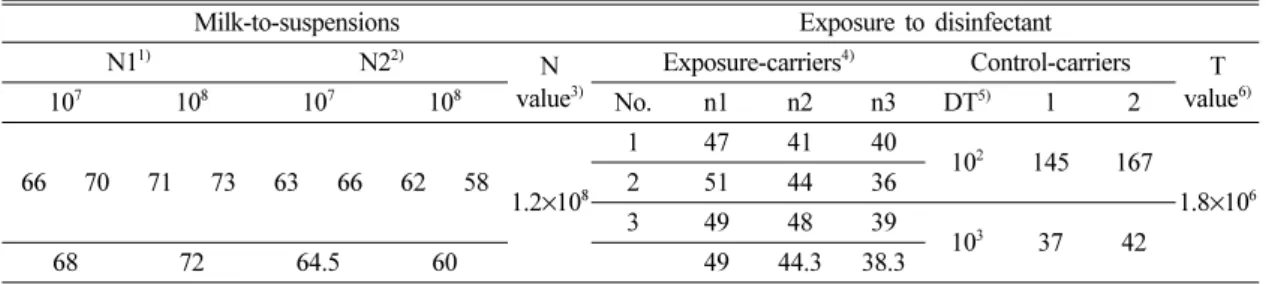
Table 1-3은 각각 환원유 혼합 T. mentagrophytes, C. albicans 그리고 A. niger 현탁액의 균수와, T.
mentagrophytes, C. albicans 그리고 A. niger를 도포 건조시킨 담체에 소독제를 노출시킨 후, 산출한 균 수를 나타낸 것이다.
AFNOR29)에 따르면, T. mentagrophytes와 C.
albicans의 N값은 108CFU/mL 이상이어야 하며, A.
niger의 N값은 5×10⁷CFU/mL 이상 이어야 하며, 소
N CFU m L ( ⁄ ) x + y + z + w --- 2.2 × 10
6=
T CFU carrier ( ⁄ ) x + y + z + w
--- 2.2 × 10
2× 100
=
d = log T – log ( n'1 + n'2 ) = log [ T ⁄ ( n'1 + n'2 ) ]
Table 1. Viable counts(CFU/mL) of T. mentagrophytes in milk-to-suspensions and in the carriers exposed to disinfectant
Milk-to-suspensions Exposure to disinfectant
N1
1)N2
2)N value
3)Exposure-carriers
4)Control-carriers
T value
6)10
610
710
610
7No. n1 n2 n3 DT
5)1 2
59 68 53 62 52 57 48 53
1.0 ×10
81 35 36 30
10
299 106
1.2 ×10
62 39 35 31
3 37 37 32
10
326 30
63.5 57.5 54.5 50.5 37 36 31
1)
N1, the number of fungal test suspentions by pour plate method.
2)
N2, the number of fungal suspentions by filter membrane method.
3)
N, the number of colony in working culture suspension.
( x, y: 10
7dilution colony; z, w: 10
8dilution colony)
4)
n1, n2, n3, the colony numbers on the carriers exposed the fumigant.
5)
DT, dilution time.
6)
T, the mean number of colony recovered on the control-carriers.
( x, y: 10
2dilution colony; z, w: 10
3dilution colony) N ( x + y + z + w )
--- 2.2 × 10
6=
T ( x + y + z + w )
--- 2.2 × 10
2× 100
=
독제에 노출되지 않은 대조군-담체로부터 배양된 균 수로부터 산출된 모든 균주의 T값은 106 CFU/mL 이상이어야 한다고 규정하고 있다. Table 1-3에서, T.
mentagrophytes, C. albicans 그리고 A. niger로부터 구한 N값은 각각 1.0×10⁸, 1.2×10⁸ 그리고 5.7×10⁷ CFU/mL이었으며, T. mentagrophytes, C. albicans 그
Table 2. Viable counts(CFU/mL) of C. albicans in milk-to-suspensions and in the carriers exposed to disinfectant
Milk-to-suspensions Exposure to disinfectant
N1
1)N2
2)N
value
3)Exposure-carriers
4)Control-carriers T value
6)10
710
810
710
8No. n1 n2 n3 DT
5)1 2
66 70 71 73 63 66 62 58
1.2 ×10
81 47 41 40
10
2145 167
1.8 ×10
62 51 44 36
3 49 48 39
10
337 42
68 72 64.5 60 49 44.3 38.3
1)
N1, the number of fungal test suspentions by pour plate method.
2)
N2, the number of fungal suspentions by filter membrane method.
3)
N, the number of colony in working culture suspension.
( x, y: 10
7dilution colony; z, w: 10
8dilution colony)
4)
n1, n2, n3, the colony numbers on the carriers exposed the fumigant.
5)
DT, dilution time.
6)
T, the mean number of colony recovered on the control-carriers.
(x, y: 10
2dilution colony; z, w: 10
3dilution colony)
Table 3. Viable counts(CFU/mL) of A. niger in milk-to-suspensions and in the carriers exposed to disinfectant
Milk-to-suspensions Exposure to disinfectant
N1
1)N2
2)N
value
3)Exposure-carriers
4)Control-carriers T value
6)10
710
810
710
8No. n1 n2 n3 DT
5)1 2
33 36 29 31 32 34 26 30
5.7 ×10
71 21 17 15 10
2156 192
2.1 ×10
62 20 17 19
3 22 20 17
10
349 65
34.5 30 33 28 21 18 17
1)
N1, the number of fungal test suspentions by pour plate method.
2)
N2, the number of fungal suspentions by filter membrane method.
3)
N, the number of colony in working culture suspension.
( x, y: 10
7dilution colony; z, w: 10
8dilution colony)
4)
n1, n2, n3, the colony numbers on the carriers exposed the fumigant.
5)
DT, dilution time.
6)
T, the mean number of colony recovered on the control-carriers.
(x, y: 10
2dilution colony; z, w: 10
3dilution colony) N ( x + y + z + w )
--- 2.2 × 10
6=
T ( x + y + z + w )
--- 2.2 × 10
2× 100
=
N ( x + y + z + w ) --- 2.2 × 10
6=
T ( x + y + z + w )
--- 2.2 × 10
2× 100
=
리고 A. niger로부터 구한 T값은 각각 1.2×10⁶, 1.8×10⁶ 그리고 2.1×10⁶ CFU/mL이었다. 따라서 T.
mentagrophytes, C. albicans 그리고 A. niger로부터 구한 N값과 T값은 모두 AFNOR29)에서 규정한 기 준을 충족하고 있어서, 본 연구가 유효하게 진행되 었음을 알 수 있다.
AFNOR29)에 따르면, 소독제 노출 담체로부터 증 식한 균수 n1, n2, n3값이 각각 0.5N1, 0.5N2, 0.5N1 값 보다 모두 커야 훈증소독제 실험을 수행할 수 있 는 조건을 만족하는 것으로 규정하고 있다. Table 1- 3에서, T. mentagrophytes, C. albicans 그리고 A.
niger로부터 구한 각각의 n1, n2, n3값이 각각 0.5N1, 0.5N2, 0.5N1값 보다 모두 큰 값을 내타내어, AFNOR29)기준을 만족하여, 훈증소독제의 살곰팡이 효과실험을 수행할 수 있는 전제조건을 충족하였다.
만일, n1, n2, n3값이 각각 0.5N1, 0.5N2, 0.5N1값 과 같거나 작으면, 배지나 여과막에 균의 증식을 충 분히 억제 할 수 있는 많은 양의 소독제가 잔류하 고 있다는 것을 의미하므로, 배지의 조성을 조정하 거나, 담체 회복액에 중화제를 첨가하거나, 여과막의 세정 횟수를 증가시켜 실험을 다시 수행하여 조건을 만족시켜야 하는 것으로 AFNOR29)에명시하고 있다.
2. 훈증소독제의 살균효과
Table 4-6은 훈증소독제를 노출시킨 담체로부터 회 복된 균수와 훈증소독제의 살균효과를 나타낸 것이다.
Table 4-6에서 T. mentagrophytes, C. albicans 그 리고 A. niger 도포 담체에 소독제를 노출시킨 후, 적정배지에 배양을 통해 확인된 각각 균수의 logCFU/
mL 감소값, 즉, d 값은 각각 4.99, 4.88, 4.81로 나 타나, OPP를 주성분으로 하는 훈증소독제, Fumagari OPP®는 T. mentagrophytes, C. albicans, A. niger 순 으로 높은 살진균 효과를 나타내었다.
AFNOR29)의 기준에 따르면, 훈증소독제가 살진균 효과를 갖기 위해서는 d 값이 4 이상이어야 한다고 규정하고 있다. 본 연구에서, 훈증소독제를 적용한 후, T. mentagrophytes, C. albicans 그리고 A. niger 의 d 값은 모두 4 이상을 나타내어, 훈증소독제, Fumagari OPP®는 T. mentagrophytes, C. albicans 그 리고 A. niger에 대해 효과적인 살진균력을 갖는 것 으로 확인되었다.
Meszaros 등33)은 각종 재질의 담체에 105 CFU/mL
Table 4. Viable counts(CFU/mL) of T. mentagrophytes in the carriers exposed to disinfectant and fungicidal effect of the fumigant
Dilution time
Colony number in
carriers
1)n'1
2)n'2
3)d value (log)
4)C1 C2 C3
10
20 0 0 5 0
4.99
7 0
10
30 0 0
2 0
1)
C1, C2, C3, test-carriers.
2)
n'1, the mean number of fungi in recovery solution.
3)
n'2, the mean number of fungi on carriers plated in agar.
4)
d, the reduction of fungal number.
( T, the mean number of colony recovered on the carriers) Table 5. Viable counts(CFU/mL) of C. albicans in the carriers exposed to disinfectant and fungicidal effect of the fumigant
Dilution time
Colony number in
carriers
1)n'1
2)n'2
3)d value (log)
4)C1 C2 C3
10
20 0 0 8 0
4.88
10 0
10
30 0 0
6 0
1)
C1, C2, C3, test-carriers.
2)
n'1, the mean number of fungi in recovery solution.
3)
n'2, the mean number of fungi on carriers plated in agar.
4)
d, the reduction of fungal number.
( T, the mean number of colony recovered on the carriers) Table 6. Viable counts(CFU/mL) of A. niger in the carriers exposed to disinfectant and fungicidal effect of the fumigant
Dilution time
Colony number in
carriers
1)n'1
2)n'2
3)d value (log)
4)C1 C2 C3
10
20 0 0 10 0
4.81
9 0
10
30 0 0
13 0
1)
C1, C2, C3, test-carriers.
2)
n'1, the mean number of fungi in recovery solution.
3)
n'2, the mean number of fungi on carriers plated in agar.
4)
d, the reduction of fungal number.
( T, the mean number of colony recovered on the carriers) d = log T – log ( n'1 + n'2 ) = log [ T ⁄ ( n'1 + n'2 ) ]
d = log T – log ( n'1 + n'2 ) = log [ T ⁄ ( n'1 + n'2 ) ]
d = log T – log ( n'1 + n'2 ) = log [ T ⁄ ( n'1 + n'2 ) ]
로 희석한 T. mentagrophytes와 A. niger 희석액 10 µL를 도포하고 실온에서 건조시킨 후, 과산화수 소 증기를 35% 농도로 60분간 분무한 다음, 담체를 회복액에 넣고 부착된 균주를 제거하여, 평판배지에 배양하여 회복된 균수를 측정하였다. 그 결과, 스테 인리스 재질의 실험 담체에서의 T. mentagrophytes 와 A. niger는 검출되지 않았다고 보고하였다. Arita 등34)의 연구에 따르면, C. albicans를 표면에 부착·
배양한 아크릴 소재의 의치를 4 mg/L 농도의 오존 수에 1분 동안 담가 놓아둔 결과, C. albicans의 균 수
(
1.6×10⁵CFU/mL)가 오존수를 처리하지 않은 경 우(
3.0×10⁵CFU/mL)와 비교하여 약 45% 정도 감소 하였다고 보고하였다.본 연구에서 사용한 Fumagari OPP®의 T.
mentagrophytes와 A. niger에 대한 살진균 효과는 Meszaros 등33)의 연구결과 보다는 낮게 나타났는데, 이는 적용 균량이 본 연구보다 낮았으며, 고농도의 과산화수소
(
35%)를 직접적으로 적용했던 것에 기인 한 것으로 사료된다. 또한, 본 연구의 C. albicans에 대한 살진균효과는 Arita 등34)의 연구결과보다는 높 게 나타났는데, 이는 오존수를 처리한 시간보다 본 연구에서 훈증소독제를 적용한 시간이 길었던 점에 기인하는 것으로 사료된다.이상의 연구 결과로부터, OPP를 주성분으로 하는 훈증 소독제, Fumagari OPP®은 비다공성의 표면에 부착되어 있는 T. mentagrophytes, C. albicans 그리 고 A. niger에 적용할 경우, 4.0 logCFU 이상의 감 소결과를 나타내어, T. mentagrophytes, C. albicans 그리고 A. niger의 살진균을 목적으로 사용할 수 있 는 효과적인 훈증소독제로 사료된다.
본 연구를 통해, OPP를 주성분으로 하는 훈증 소 독제의 T. mentagrophytes, C. albicans 그리고 A.
niger에 대한 살진균 효과를 처음으로 실험실 수준 에서 규명하였으며, 향후, T. mentagrophytes, C.
albicans 그리고 A. niger에 오염된 식품저장소나 환 경 중에서 OPP를 주성분으로 하는 훈증 소독제의 적응시험을 통해 그 효과를 규명할 필요가 있을 것 으로 사료된다.
IV. 결 론
본 연구는 T. mentagrophytes, C. albicans 그리고
A. niger을 대상으로 ortho-phenylphenol 20%를 함 유한 훈증소독제, Fumagari OPP®의 살진균 효과를 평가하기 위해 수행되었다. 예비 시험에서, T.
mentagrophytes, C. albicans 그리고 A. niger의 현탁 액 균수는 각각 1.0×10⁸, 1.2×10⁸ 그리고 5.7×10⁷이 었으며, 모든 훈증소독제에 노출시킨 담체의 균수는 모두 평판배지법과 여과법으로 배양한 시험균주 현 탁액의 균수의 50%보다 많았다. 또한, 대조 담체로 부터 회복된 T. mentagrophytes, C. albicans 그리고 A. niger 균수는 각각 1.2×10⁶, 1.8×10⁶ 그리고 2.1×10⁶ CFU/mL이었다. 훈증소독제의 살균효과 시험에서는, 훈증소독제를 처리한 담체의 T. mentagrophytes, C.
albicans 그리고 A. niger의 감소 균수는 각각 4.99, 4.88 그리고 4.81 logCFU/mL로 나타났다. 이상의 결 과로부터, 훈증소독제, Fumagari OPP®는 T.
mentagrophytes, C. albicans 그리고 A. niger에 대해 효과적인 살진균 효과를 갖는 것으로 확인되었다.
감사의 글
본 연구는
(
주)엘캄코바이오(
서울)의 지원으로 수행 되어 작성된 것으로, 이에 감사드립니다.References