Print ISSN: 2288-4637 / Online ISSN 2288-4645 doi:10.13106/jafeb.2021.vol8.no4.1057
Impact of Servant Leadership on Public Service Motivation of Civil Servants: Empirical Evidence from Vietnam
Toan Khanh Pham TRAN
1, Truc Trung TRUONG
2Received: December 15, 2020 Revised: March 06, 2021 Accepted: March 15, 2021
Abstract
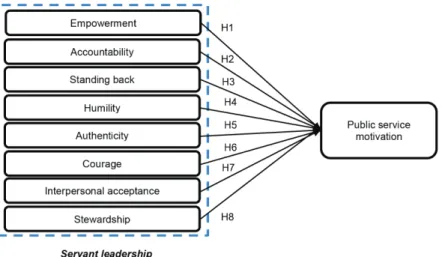
Servant leadership has been noticeable in the last decade in the leadership literature on account its focus on serving others first. The target of servant leadership is not the organization, but rather the followers and their development and also the ability to motivate others to become servant leaders. Serving leadership has been recognized as a leadership philosophy that addresses ethical concerns, which is linked to ethical leadership. This study aims to investigate the relationship between dimensions of servant leadership and public service motivation of civil servants. Data were collected from civil servants working in public organizations at district level in Ho Chi Minh City of Vietnam through survey forms. The research hypotheses are tested by factor analysis and regression. The results report that 7 dimensions of servant leadership positively affect public service motivation in the following ascending order: Empowerment, standing back, forgiveness, humility, integrity, accountability, and courage. On the other hand stewardship has an insignificant impact on the role of leading and supervising. Our study contributes to the existing literature on servant leadership as well as public service motivation by throwing light onto a so-far neglected transitional country like Vietnam. Thereby, this study proposes a number of implications for the leaders to improve leadership style to enhance public service motivation of civil servants.
Keywords: Servant Leadership, Public Service Motivation, Civil Servant, Vietnam JEL Classification Code: M10, M12, M53, M54
less emphasis on material rewards than those in the private sector (Anderfuhren-Biget et al., 2010). In recent years, the public sector in Western countries has emphasized the concept of public service motivation (Chen et al., 2014; Kim & Park, 2017). The public service motivation has a core content which is the feelings/motivations to perform meaningful works for the community and society (Taylor, 2008); it transcends the personal interests and aims at public benefit and values (Kim, 2017). Many factors are affecting the motivation of public service, in which, the managers with their leadership style play an important role in stimulating and motivating the subordinates, which later has a great influence on the performance of public organization (Olesia et al., 2014). In the public sector, effective leadership is the foundation for an organizations’ ability to adapt rapidly to the ever-changing conditions in the business environment and to enhance public service quality (Parris & Peachey, 2013). Moreover, leaders can stimulate employees’ motivation by providing the required resources and by designing working conditions that boost objective fulfillment and job autonomy (Aboramadan, 2020).
Servant leadership has attracted much attention in the last decade because of its focus on serving others first
1
First Author and Corresponding Author. Ph.D. Student, Graduate School, Ho Chi Minh City Open University, Vietnam [Postal Address:
97 Vo Van Tan Street, District 3, Ho Chi Minh City, 700000, Vietnam]
Email: [email protected]; [email protected]
2
Ph.D. Student, Graduate School, Ho Chi Minh City Open University, Vietnam. Email: [email protected]
© Copyright: The Author(s)
This is an Open Access article distributed under the terms of the Creative Commons Attribution Non-Commercial License (https://creativecommons.org/licenses/by-nc/4.0/) which permits unrestricted non-commercial use, distribution, and reproduction in any medium, provided the original work is properly cited.