우리나라 일부 농업 종사자의 개인보호구 착용, 작업위생행위에 따른 소변 중 MDA, 8-OHdG 농도 변화
Changes in Urinary MDA and 8-OHdG Concentrations due to Wearing Personal Protective Equipment and Performing Protective Behaviors
among Agricultural Workers in Korea
Jiyun Lee*, Kyunghee Ji*†, Bokyung Kim*, Seokhwan Park**, and Pan-Gyi Kim*
*Department of Environmental Health, Graduate School at Yongin University, Yongin, 17092, Republic of Korea
**Department of Environmental Engineering, College of BIT Convergence, Seowon University, Cheongju, 28674, Republic of Korea
ABSTRACT
Objectives: Oxidative stress and DNA damage have been proposed as mechanisms linking pesticide exposure to health effects such as cancer and neurological diseases. We investigated whether protective measures could significantly reduce the levels of biomarkers for oxidative stress and DNA damage in agricultural workers.
Methods: In the present study, the levels of malondialdehyde (MDA) and 8-hydroxy-2’-deoxyguanosine (8- OHdG), biomarkers related to oxidative stress and DNA damage, respectively, were analyzed in urine samples collected from agricultural workers in two provinces of Korea (n=60). The influence of wearing personal protective equipment (PPE) and performing protective behaviors on the levels of these two biomarkers was also evaluated.
Results: The median urinary levels of MDA and 8-OHdG were 10.45 nmol/mg creatinine and 14.42 ng/mg creatinine in subjects living in region A, while they were 6.25 nmol/mg creatinine and 24.77 ng/mg creatinine in subjects living in region B, respectively. The levels of MDA and 8-OHdG were higher in male farmers. Farmers wearing greater numbers of PPE and performing more protective behaviors had significantly lower levels of MDA. Greater numbers of protective behaviors was significantly associated with lower levels of 8-OHdG.
Conclusion: The results of the present study indicate that pesticide exposure could induce oxidative stress and DNA damage in agricultural workers, and that protective measures are important for mitigating pesticide exposure.
Keywords: Malondialdehyde, 8-hydroxy-2′-deoxyguanosine, personal protective equipment, pesticide, pro- tective behavior
I. Introduction
Pesticides increase the yield and quality of agricultural products by protecting crop against pests.1) However, these chemicals are biologically active and can adversely affect the health when
humans are exposed for extended periods.2) The potential health effects of pesticide exposure in agricultural workers are of interest as these workers are exposed to extensive amounts of pesticides with high frequency.3) In agricultural workers, pesticide toxicity is generally associated with the class of the
†
Corresponding author: Department of Occupational and Environmental Health, Yongin University, Yongin, 17092, Republic of Korea, Tel: +82-31-8020-2747, Fax: +82-31-8020-2886, E-mail: [email protected]
Received: 3 November 2017, Revised: 5 December 2017, Accepted: 13 December 2017
원 저 Original articlespesticide compound. Routine exposure to pesticides can result in long-term health effects, including cancer and adverse effects on reproduction.4) Previous study showed that long-term pesticide exposure is significantly related to cancer incidence, such as leukemia, lung, pancreatic, colon, rectal, bladder, prostate, and skin cancer.5)
Measuring pesticide metabolites in urine samples collected before and after pesticide exposure has been frequently used to evaluate pesticide exposure.6) However, this method does not represent the impact on health. Oxidative stress biomarkers have been used to link pesticide exposure with the risk of chronic diseases such as cancer, inflammatory disease, and neurodegenerative diseases.7-9) Two such oxidative stress biomarkers, malondialdehyde (MDA) and 8-hydroxy-2’- deoxyguanosine (8-OHdG) have been commonly measured in human biological samples. MDA is the end products of lipid peroxidation10) and 8-OHdG is one of the predominant forms of free radical- induced oxidative lesions, and has therefore been widely used as a biomarker for oxidative stress and carcinogenesis.11) For example, increased levels of lipid peroxides in the serum and urine7,9) as well as DNA damage8,9,12,13) have been detected following pesticide exposure. However, studies on the level of oxidative stress in agricultural workers in Korea are lacking.
The use of protective behaviors may reduce exposure to agricultural pesticides and potentially minimizes adverse health outcomes.14) The United States Environmental Protection Agency (US EPA) has established agricultural worker protection standard (WPS) to inform workers and handlers about pesticide safety, to provide protections from potential exposure to pesticides, and to mitigate exposures that do occur.15) The protective behaviors include washing hands before eating or using the restroom; wearing protective clothing to minimize skin contact with pesticide residue at work;
showering and changing clothes immediately after
work; and washing work clothes separately from other laundry.16) Unlike the US, where the proportion of agricultural workers exposed to pesticides is low by introducing aviation control systems on large scale farms, there are many self- employed farmers who spray pesticides directly in Korea.17) The Rural Development Administration is conducting safety education for farmers, and the Korea Occupational Safety and Health Agency (KOSHA) provide tips on safe pesticide use and first aid treatment for pesticide poisoning accidents.
However, they are not offer differentiated protection method according to crop and pesticide application, and the specification of personal protective equipment are not standardized.17) Studies on Korean farmers have shown that the actual personal protective equipment (PPE) wearing rate is poor because it is too hot and uncomfortable.17) Furthermore, there is a lack of awareness on the toxicity of pesticides and the necessity of wearing protective clothing.18,19)
In the present study, we determined the levels of MDA and 8-OHdG in urine samples collected from agricultural workers in Korea and evaluated the contribution of protective measures on such exposure. Although the study population may not be representative of all agricultural workers in Korea owing to regional specificity, the results of this study will be useful in developing management plans for pesticides in the agricultural worker population.
II. Materials and Methods
1. Study population and description of the study area
A study population was recruited from Gyeonggi (site A) and Jincheon (site B) provinces in the Korean peninsula between July and August 2014.
Cultivation in enclosed space production facilities (e.g., greenhouses) and rice farming are the representative agricultures in Korea, and therefore
two regions were chosen based on these considerations. Site A is close to the city, and approximately 80-90% grow cucumbers and tomatoes in greenhouses. Site B is a rural area and serves as a cropland for rice. A total of 78 subjects were recruited; however, 18 individuals were excluded from the analysis because of missing relevant information (n=60, 30 males and 30 females) (Table 1). Written statements of informed consent were obtained from all subjects before they participated in the study.
2. Questionnaire survey and urine sampling An extensive questionnaire was developed to gather information on demographic characteristics of
the participants (sex, age, years of farming, history of smoking, and alcohol consumption) and the details of pesticide use (wearing PPE, and protective behaviors following pesticide use). The wearing PPE and protective behaviors were investigated for 7 items (chemical-resistant hats, protective eyewear, respirator, long-sleeved shirts, long-pants, chemical- resistant gloves, and chemical-resistant footwear) and 5 items (compliance with safe use standards of pesticides, changing clothes after spraying pesticides, showering immediately after spraying pesticides, spraying pesticides with back wind, and having frequent breaks), respectively, based on the WPS. Details of the PPE characteristics20) are shown in Table 2. One-on-one interviews by a trained
Table 1. Demographic characteristics and the details of protective measures of study population
Variables Site A number (%) Site B number (%)
Male Female Male Female
All samples 15 (100%) 15 (100%) 15 (100%) 15 (100%)
Age
≤ 49 years 3 (20.0%) 3 (20.0%) 0 (0.0%) 1 (6.6%)
50 ~ 59 years 7 (46.7%) 8 (53.4%) 3 (20.0%) 2 (13.3%)
60 ~ 69 years 2 (13.3%) 2 (13.3%) 2 (13.3%) 5 (33.4%)
≥ 70 years 3 (20.0%) 2 (13.3%) 10 (66.7%) 7 (46.7%)
Years of farming
≤ 10 2 (13.3%) 1 (6.6%) 1 (6.6%) 4 (26.7%)
11 ~ 20 2 (13.3%) 7 (46.7%) 4 (26.7%) 1 (6.6%)
≥ 21 11 (73.4%) 7 (46.7%) 10 (66.7%) 10 (66.7%)
History of smoking
Non-smoker 3 (20.0%) 13 (86.7%) 2 (13.3%) 14(93.4%)
Past or present smoker 12 (80.0%) 2 (13.3%) 13 (86.7%) 1 (6.6%) Alcohol
consumption
Non-drinker 5 (33.3%) 13 (86.7%) 7 (46.7%) 7 (46.7%)
Past or present drinker 10 (66.7%) 2 (13.3%) 8 (53.3%) 8 (53.3%)
Wearing personal protective equipment
Chemical-resistant hats 8 (53.4%) 10 (66.7%) 12 (80.0%) 12 (80.0%)
Protective eyewear 2 (13.3%) 0 (0.0%) 1 (6.6%) 6 (40.0%)
Respirator 3 (20.0%) 2 (13.3%) 1 (6.6%) 7 (46.7%)
Long-sleeved shirts 5 (33.4%) 6 (40.0%) 9 (60.0%) 10 (66.7%)
Long-pants 3 (20.0%) 7 (46.7%) 3 (20.0%) 10 (66.7%)
Chemical-resistant gloves 3 (20.0%) 2 (13.3%) 5 (33.3%) 9 (60.0%) Chemical-resistant footwear 10 (66.7%) 12 (80.0%) 14 (93.4%) 14 (93.4%)
Protective behavior
Compliance with safe use standards of pesticides 10 (66.7%) 7 (46.7%) 13 (86.7%) 10 (66.7%)
Changing clothes after spraying pesticides 9 (60.0%) 9 (60.0%) 14 (93.4%) 12 (80.0%)
Showering immediately after spraying pesticides 10 (66.7%) 9 (60.0%) 14 (93.4%) 12 (80.0%)
Spraying pesticides in back wind 10 (66.7%) 8 (53.3%) 13 (86.7%) 12 (80.0%)
Having frequent breaks 12 (80.0%) 9 (60.0%) 10 (66.7%) 13 (86.7%)
interviewer were conducted at the time of urine sampling. The type of crop treated, the commercial names of the pesticides they had used, and the frequency of pesticides application were also recorded. Participants were instructed on the proper self-collection of the first-void urine (i.e., filling the first 20 mL in a marked cup), and sent to be laboratory within 4 hours. Urine samples were stored at -80°C prior to analysis.
3. Analysis of urinary MDA and 8-OHdG concentrations
Urinary levels of MDA were measured using OxiSelectTM thiobarbituric acid reactive substances (TBARS) assay kit (STA-330; Cell Biolabs Inc., San Diego, CA, USA) following the manufacturer’s instructions. Briefly, aliquots of urine samples (100 µL) or standards were added to the TBA reagent and heated in a water bath at 95°C for 60 min.
Samples were cooled in ice water and centrifuged at 3,000 rpm for 15 min. Absorbance was measured at 532 nm using a spectrophotometric plate reader (TECAN infinite® M 200, TECAN Group ltd.,
Männedorf, Switzerland).
Urinary concentrations of 8-OHdG were measured using OxiSelectTM oxidative DNA damage ELISA kit (STA-320; Cell Biolabs Inc., San Diego, CA, USA) following the manufacturer’s instructions.
Briefly, urine samples (50 µL) or standards were added to the wells of the 8-OHdG conjugate-coated plate and incubated at 25°C for 10 min. Anti-8- OHdG antibody, secondary antibody-enzyme conjugate, and substrate solution were added to each well and incubated at room temperature. Finally, a stop solution was added into each well, and absorbance was measured at 450 nm using a spectrophotometric plate reader (TECAN infinite® M 200). The urinary concentrations of MDA and 8-OHdG were adjusted for creatinine levels in the urine.
4. Statistical analysis
Statistical analyses were performed using SAS, version 9.3 (SAS Institute Inc., Cary, NC, USA).
The concentrations of MDA and 8-OHdG were found to be skewed and were log-transformed before the analysis. Independent t-test and Dunnett’s
Table 2. Description of personal protective equipment for agricultural working condition
Terminology Description
Chemical-resistant hats - Chemical resistant hat with a wide brim
Protective eyewear
- Goggles - Face shield
- Safety glasses with front, brow, and temple protection - Full-face respirator
Respirator
- Self-contained breathing apparatus - Full-facepiece air-purifying respirator - Half-mask air-purifying respirator - Filtering facepiece
Long-sleeved shirts - Loose-fitting, one- or two-piece chemical-resistant garment that covers, at a minimum, the entire body except head, hands, and feet
Long-pants
Chemical-resistant gloves
- Protective gloves specified on the pesticide product labeling
(gloves made of leather, cotton, or other absorbent materials may not be worn while performing handler activities unless gloves made of these materials are listed as acceptable for such use on the pesticide product labeling)
Chemical-resistant footwear
- Chemical resistant shoes - Chemical resistant boots
- Chemical resistant shoe coverings worn over shoes or boots
analysis of variance (ANOVA) were used to evaluate the influence of variables (site, sex, age, years of farming, history of smoking, alcohol consumption, wearing PPE, and protective behavior) on urinary concentrations of MDA and 8-OHdG.
For this analysis, the number of PPE adopted by a farmer is simply categorized into 3 groups without considering their efficiency of protection of exposure to pesticide as follows; less than 2, 2~3, and more than 4. The protective behavior was also categorized by 2 or less, 3~4, and 5.
The relationship between protective measures (number of wearing PPE and performing protective behavior) and urinary concentrations of oxidative stress biomarkers was evaluated using regression analysis. Two variables (number of wearing PPE and performing protective behavior) that were found significant determinant of urinary MDA and 8- OHdG concentrations based on simple regression analysis (p<0.05) were included in the multiple regression analysis. We adjusted models for sex, age, site, history of smoking, and alcohol consumption to consider the possibility for differences in MDA and 8-OHdG concentrations by these variables. In the regression analysis, original values of the number of wearing PPE (1 to 7 items) and performing protective behavior (1 to 5 items) were included in the model. P values less than 0.05 were considered significant.
III. Results
The demographic and lifestyle information (i.e., age, history of smoking, and alcohol consumption), and pesticide characteristics obtained from the questionnaire (i.e., years of farming, wearing PPE and protective behaviors) was summarized in Table 1. Site A was composed of the subjects under the age of 59 (70%), while site B mainly had subjects over 60 years of age (80%). Most of the participants answered that they have been engaged in agriculture for more than 21 years (64%). The
average number of pesticide application days per year was 26 days in site A and 18 days in site B.
The most frequently used PPE were chemical- resistant footwear (83%), chemical-resistant hats (70%), and long-sleeved shirts (50%). Fewer participants reported regular use of long-pants (38%), chemical-resistant gloves (32%), respirator (22%), and protective eyewear (15%). Regarding protective behaviors, the majority mentioned that they normally showered immediately after direct contact with a pesticide (75%), changed their clothes after spraying pesticides (73%), took frequent breaks (73%), and sprayed pesticides with back wind (72%).
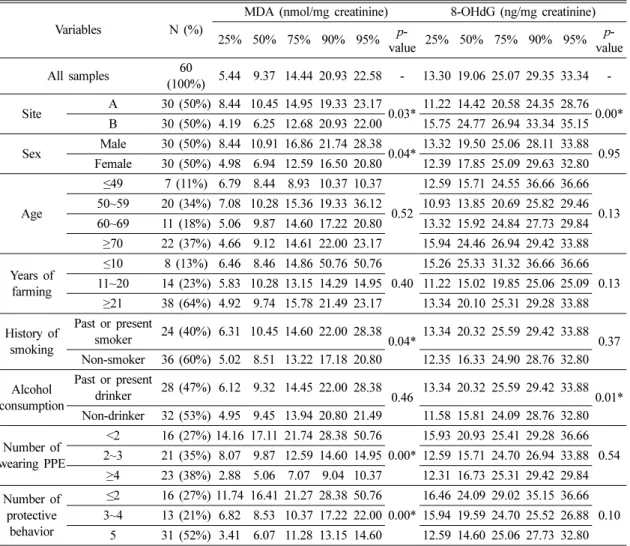
The urinary MDA and 8-OHdG concentrations of the study participants are summarized in Table 3.
The creatinine-adjusted median urinary levels were 9.37 nmol/mg creatinine for MDA and 19.06 ng/
mg creatinine for 8-OHdG. Significant differences in urinary MDA levels were found among distinct groups based on the sites, sexes, history of smoking, number of PPE worn, and number of protective behavior performed. In addition, significant differences in urinary 8-OHdG levels were observed among different sites and alcohol consumption. Urinary levels of MDA were higher in male farmers living in site A, while those of 8- OHdG were higher in male farmers living in site B.
The creatinine-adjusted concentrations of MDA and 8-OHdG in participants by the number of PPE worn and the number of protective behaviors performed are shown in Fig. 1. Participants wearing less number of PPE and performing less number of protective behaviors tended to have greater concentrations of MDA. The wearing of PPE and protective behavior were found to be significant determinants of MDA and 8-OHdG in urine after the adjustment for age, sex, site, history of smoking, and alcohol consumption in multiple regression analysis (Table 4).
IV. Discussion
In general, compared to Korea’s general population, pesticide sprayers had higher levels of MDA and 8-OHdG. Although our study does not have a control group, the median concentrations of MDA (13.19 µmol/L in males and 7.52 µmol/L in females) and 8-OHdG (22.58 ng/mL) obtained in the present study were higher than those reported in the general population of Korea (8.14 µmol/L in males and 5.52 µmol/L in females for MDA21) and 4.46 ng/mL for 8-OHdG22)). Previous studies have
also shown that the levels of MDA23-24) and 8-
OHdG8,9,13,25) in the urine or plasma samples
collected from pesticide sprayers are greater than those of the control participants. A pilot study of pesticide applicators and farm workers working in fruit orchards (e.g., apples and pears) in Oregon showed that serum MDA and urinary 8-OHdG levels were higher than those in the controls.10) These data suggest that agricultural workers are frequently exposed to higher concentrations of chemicals that induce oxidative stress and DNA damage.
Table 3. Urinary malondialdehyde (MDA) and 8-hydroxy-2'-deoxyguanosine (8-OHdG) in the participating adult population
Variables N (%)
MDA (nmol/mg creatinine) 8-OHdG (ng/mg creatinine) 25% 50% 75% 90% 95% p-
value 25% 50% 75% 90% 95% p- value
All samples 60
(100%) 5.44 9.37 14.44 20.93 22.58 - 13.30 19.06 25.07 29.35 33.34 - Site A 30 (50%) 8.44 10.45 14.95 19.33 23.17
0.03* 11.22 14.42 20.58 24.35 28.76 0.00*
B 30 (50%) 4.19 6.25 12.68 20.93 22.00 15.75 24.77 26.94 33.34 35.15 Sex Male 30 (50%) 8.44 10.91 16.86 21.74 28.38
0.04* 13.32 19.50 25.06 28.11 33.88 Female 30 (50%) 4.98 6.94 12.59 16.50 20.80 12.39 17.85 25.09 29.63 32.80 0.95
Age
≤49 7 (11%) 6.79 8.44 8.93 10.37 10.37 0.52
12.59 15.71 24.55 36.66 36.66 50~59 20 (34%) 7.08 10.28 15.36 19.33 36.12 10.93 13.85 20.69 25.82 29.46 0.13 60~69 11 (18%) 5.06 9.87 14.60 17.22 20.80 13.32 15.92 24.84 27.73 29.84
≥70 22 (37%) 4.66 9.12 14.61 22.00 23.17 15.94 24.46 26.94 29.42 33.88 Years of
farming
≤10 8 (13%) 6.46 8.46 14.86 50.76 50.76 0.40
15.26 25.33 31.32 36.66 36.66 0.13 11~20 14 (23%) 5.83 10.28 13.15 14.29 14.95 11.22 15.02 19.85 25.06 25.09
≥21 38 (64%) 4.92 9.74 15.78 21.49 23.17 13.34 20.10 25.31 29.28 33.88 History of
smoking
Past or present
smoker 24 (40%) 6.31 10.45 14.60 22.00 28.38
0.04* 13.34 20.32 25.59 29.42 33.88 0.37 Non-smoker 36 (60%) 5.02 8.51 13.22 17.18 20.80 12.35 16.33 24.90 28.76 32.80 Alcohol
consumption
Past or present
drinker 28 (47%) 6.12 9.32 14.45 22.00 28.38
0.46 13.34 20.32 25.59 29.42 33.88 0.01*
Non-drinker 32 (53%) 4.95 9.45 13.94 20.80 21.49 11.58 15.81 24.09 28.76 32.80 Number of
wearing PPE
<2 16 (27%) 14.16 17.11 21.74 28.38 50.76 0.00*
15.93 20.93 25.41 29.28 36.66 0.54 2~3 21 (35%) 8.07 9.87 12.59 14.60 14.95 12.59 15.71 24.70 26.94 33.88
≥4 23 (38%) 2.88 5.06 7.07 9.04 10.37 12.31 16.73 25.31 29.42 29.84 Number of
protective behavior
≤2 16 (27%) 11.74 16.41 21.27 28.38 50.76 0.00*
16.46 24.09 29.02 35.15 36.66 0.10 3~4 13 (21%) 6.82 8.53 10.37 17.22 22.00 15.94 19.59 24.70 25.52 26.88
5 31 (52%) 3.41 6.07 11.28 13.15 14.60 12.59 14.60 25.06 27.73 32.80
Asterisk (*) indicates significant difference between groups ( p < 0.05) using independent t-test or ANOVA. -: Not available.
We compared the levels of oxidative stress biomarkers in two different agricultural sites. We found that MDA concentrations were higher in site A, while 8-OHdG concentrations were higher in site B. Since the period of pesticide use varies depending on the cultivated crops and harvesting times, the levels of effective biomarkers can vary.
The subjects living in site A mainly produce cucumber and tomatoes, and have been used chlorothalonil fungicide (trade name, Dakonil) and emamectin benzoate insecticide (trade name, APEM). The study participants living in site B cultivated rice and used carbofuran (product name, Furadan) and validamycin-a (product name,
Barimoon). It has been reported that lipid peroxidation (TBARS) was increased in a concentration- and time-dependent manner in rat hepatocytes exposed to chlorothalonil.26-27) In addition, MDA was significantly increased in male rats exposed to 2.5 mg emamectin benzoate/kg body weight for 28 days.28) These results support those of our study that showed significantly greater MDA concentrations in the urine collected from participants in site A.
The MDA and 8-OHdG levels in the agricultural population of the US,9,10,13) Greece,8) Egypt,29) and Korea30-31) from the literature are summarized in Table 5. The urinary concentrations of 8-OHdG
Fig. 1. Urinary malondialdehyde (MDA) and 8-hydroxy-2’-deoxyguanosine (8-OHdG) concentrations in participants by
number of wearing personal protective equipment (a) and protective behavior (b). Box indicates interquartile range
showing the 25
thand 75
thpercentile values. The black line in the box denotes median value, and black circle denotes
5
thand 95
thpercentiles. Asterisk indicates significant difference between groups (p<0.05). PPE: personal protective
equipment, PB: protective behavior.
(median: 19.06 ng/mg creatinine) in the Korean population were higher than those in the US population (median: 3.42 ng/mL).13) These observations may suggest that the Korean agricultural population
is exposed to higher concentrations of pesticides than the US agricultural population. The greater use of pesticides by Korean farmers could partly explain this result: the use of pesticides per unit area in
Table 4. Relationships between oxidative biomarker and protective measures based on multiple regression analyses
Oxidative biomarkers Variables β 95% confidence interval p
MDA (nmol/mg creatinine)
Wearing PPE -4.06 (-0.66, -0.22) 0.0002
Protective behavior -2.41 (-0.45, -0.04) 0.0196
8-OHdG (ng/mg creatinine)
Wearing PPE -0.19 (-0.15, 0.12) 0.8523
Protective behavior -3.05 (-0.32, -0.06) 0.0036
Adjusted for sex, age, site, history of smoking, and alcohol consumption. PPE: personal protective equipment.
Table 5. Concentrations of malondialdehyde (MDA) and 8-hydroxy-2'-deoxyguanosine (8-OHdG) in agricultural farmers in worldwide
Country Biomarker
(sample) Characteristics N Sampling
year Age (years) Arithmetic
mean (unit) Median (unit) Reference
USA MDA
(serum)
Farm workers 10 2000 35.9 ± 9.7 - 1.4 (μmol/L)
[9, 10]
Applicators 12 44.0 ± 6.9 - 6.7 (μmol/L)
Control 9 31.4 ± 11.2 - 0.29 (μmol/L)
Egypt MDA
(serum)
Knapsack motor sprayer 80 2007
20~60 9.50 (mmol/dL) -
[28]
Conventional motor sprayer 70 20~60 12.6 (mmol/dL) -
Control 60 23~55 5.36 (mmol/dL) -
Korea
MDA
(urine) Pesticide exposed farmer 84 2011 adult 0.13 (μmol/g
creatinine) - [30]
MDA
(urine) Farmers 60 2014 62.1 ± 11.3
11.6 (μmol/L) 10.8 (μmol/g
creatinine)
10.7 (μmol/L) 9.3 (μmol/g creatinine)
This study
USA
8-OHdG (urine)
Farm workers 63
2003 57.0 ± 2.9 3.42 (ng/mL) -
Control 48 46.0 ± 1.6 3.00 (ng/mL) - [13]
8-OHdG (urine)
Farm workers 10 2000
35.9 ± 9.7 - 190 (nmol/L)
[9, 10]
Applicators 12 44.0 ± 6.9 - 85 (nmol/L)
Control 9 31.4 ± 11.2 - 23 (nmol/L)
Greece
8-OHdG (whole blood)
Sprayers 80
2010
adult - 17.31 (pg/mL)
Rural and urban residents 206 - - 13.24 (pg/mL) [8]
Korea
8-OHdG
(urine) Pesticide exposed farmer 84 2011 adult 0.93 (ng/mg
creatinine) - [30]
8-OHdG (urine)
Farm workers
(sunblock users) 48 2015
66.8 ± 10.9 7.76 (ng/g creatinine) - Farm workers [31]
(non-sunblock users) 38 68.3 ± 11.3 7.93 (ng/g creatinine) - 8-OHdG
(urine) Farmers 60 2014 62.1 ± 11.3
19.8 (ng/mL) 19.4 (ng/mg
creatinine)
22.5 (ng/mL) 19.0 (ng/mg creatinine)
This study
MDA: malondialdehyde, 8-OHdG: 8-hydroxy-2’-deoxyguanosine, –: Not available.
Korea (11.3 kg/ha in 2014) is more than that in the US.32) The observation that males showed significantly greater concentrations of MDA and 8- OHdG compared to females is comparable to the results of other study,8) who showed that the median 8-OHdG concentrations in males (15.39 pg/mL) were significantly greater than those in females (10.24 pg/mL). Although apparent reasons for sex- dependent differences are not known, the greater use of pesticides by males could partly explain these observations.
Since pesticides can be exposed mainly through the dermal route, it is important to wear PPE when spraying pesticides and to perform protective behavior. In the present study, participants wearing a greater number of PPE and performing more protective behaviors had significantly less levels of MDA and 8-OHdG. Participants mostly wore chemical-resistant footwear and hats; however, the wearing rates of chemical-resistant gloves, respirator, and protective eyewear were the lowest.
Consistent with our results, among protective clothing use, the wearing rate of protective hats and footwear was the highest in Gyeongju farmers.33) In the case of Carolina farmers in the US, the majority of participants wore hats (93%) and water-resistant outerwear (68%).16) It has been also reported that farmers in Chungnam area in Korea,34) as well as in Greece,8) frequently wore protection footwear, hats, and gloves. These wearing rates were lower than or similar to those of our study participants.
Although the reduction of pesticide exposure should not rely solely on PPE use, safety training on PPE helps to encourage farmworkers to use PPE. In addition, 68% of the farmworkers did not wear gloves while working in the fields; therefore, it is necessary to solve this problem in Korean farmers.
V. Conclusion
In summary, it is important to reduce pesticide exposure and induction of oxidative stress by using
appropriate protective measures, since pesticides are mostly absorbed through dermal contact. The results of this study showing that wearing more numbers of PPE and performing protective behaviors could significantly reduce the accumulation levels of MDA and 8-OHdG. However, there are some limitations that must be considered for interpreting the results of this study. First, the research subjects are limited to small sample size of farm workers in rural areas; therefore, it is difficult to generalize them as whole farmers. In addition, it was difficult to control the effective ingredients of pesticides, because we recruited subjects as voluntary participants. The lack of control groups that are not exposed to pesticides, absence of pesticide exposure assessment, one-time urine sampling, and self-report of behavior are also limitations. Given the importance of wearing PPE and performing protective behavior in pesticide users, further studies are needed to investigate the influence of protective measures to pesticide exposure with an appropriate control group and a larger study population.
Acknowledgement
This study was supported by a Grant (14161MFDS016) from the Ministry of Food and Drug Safety in 2014.